Communication 130
What is “Communication”? Communication means different things to different people.  In the business world, communication is synonymous with information. One communicates just as one would plan, control, or manage. Communication scholars might define communication as “the process in which people interactively create, sustain and maintain meaning.”
So What is Communication, Then?!?! Communication reflects the world and simultaneously helps to create it. So it could be said it is  how  we plan, control, manage, persuade, lead, love, etc. Communication examines the various ways human interaction is developed, experienced and understood.
What is a Theory? According to Miller (2002) “theory provides an abstract understanding of the communication process.” For example a theory of customer service might explain why you received bad service at the local department store, and explain why you had a great experience at another store last week. Theories provide a lens in which to view the world.
Communication Theories… “ focus attention on particular concepts, clarify our observations, predict communication behavior, and generate personal and social change (Littlejohn, 1999) Agenda Setting  (The media do not tell us how to think, but what to think about) is one example of a theory used to predict  and  explain behavior.
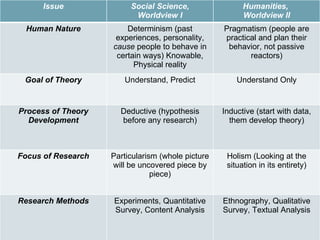
Issue Social Science, Worldview I Humanities,  Worldview II Human Nature Determinism (past experiences, personality,  cause  people to behave in certain ways) Knowable, Physical reality Pragmatism (people are practical and plan their behavior, not passive reactors) Goal of Theory Understand, Predict Understand Only Process of Theory Development Deductive (hypothesis before any research) Inductive (start with data, them develop theory) Focus of Research Particularism (whole picture will be uncovered piece by piece) Holism (Looking at the situation in its entirety) Research Methods Experiments, Quantitative Survey, Content Analysis Ethnography, Qualitative Survey, Textual Analysis
Types of Communication Research Survey Research- Most common, market research, organizational audits. Unlike experiments, surveys do not claim that one thing causes another; it is the only way to find out how someone thinks, feels, or intends to behave.  Two Types Interviews –  (Oral)  Completed face to face or over the phone. Focus Group are another example Questionnaires-  (Written)  Questions less complex that interviews. Used when privacy is a factor.
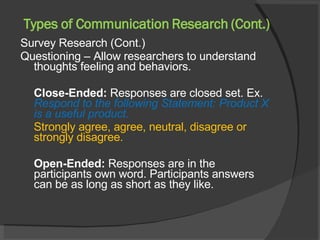
Types of Communication Research (Cont.) Survey Research (Cont.) Questioning – Allow researchers to understand thoughts feeling and behaviors. Close-Ended:  Responses are closed set. Ex.  Respond to the following Statement: Product X is a useful product.   Strongly agree, agree, neutral, disagree or strongly disagree. Open-Ended:  Responses are in the participants own word. Participants answers can be as long as short as they like.
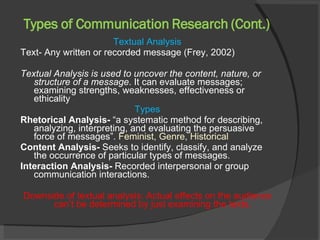
Types of Communication Research (Cont.) Textual Analysis Text- Any written or recorded message (Frey, 2002) Textual Analysis is used to uncover the content, nature, or structure of a message . It can evaluate messages; examining strengths, weaknesses, effectiveness or ethicality  Types Rhetorical Analysis-  “a systematic method for describing, analyzing, interpreting, and evaluating the persuasive force of messages”.  Feminist, Genre, Historical Content Analysis-  Seeks to identify, classify, and analyze the occurrence of particular types of messages. Interaction Analysis-  Recorded interpersonal or group communication interactions.  Downside of textual analysis: Actual effects on the audience can’t be determined by just examining the texts.
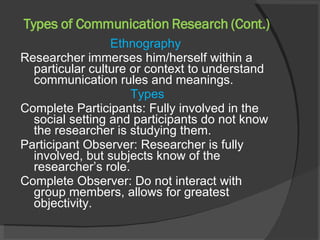
Types of Communication Research (Cont.) Ethnography  Researcher immerses him/herself within a particular culture or context to understand communication rules and meanings.  Types Complete Participants: Fully involved in the social setting and participants do not know the researcher is studying them. Participant Observer: Researcher is fully involved, but subjects know of the researcher’s role. Complete Observer: Do not interact with group members, allows for greatest objectivity.
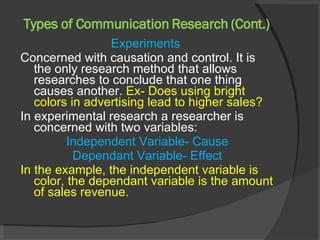
Types of Communication Research (Cont.) Experiments  Concerned with causation and control. It is the only research method that allows researches to conclude that one thing causes another.  Ex- Does using bright colors in advertising lead to higher sales? In experimental research a researcher is concerned with two variables: Independent Variable- Cause Dependant Variable- Effect In the example, the independent variable is color, the dependant variable is the amount of sales revenue.

An Intro To Communication Theory

  • 1.
  • 2.
    What is “Communication”?Communication means different things to different people. In the business world, communication is synonymous with information. One communicates just as one would plan, control, or manage. Communication scholars might define communication as “the process in which people interactively create, sustain and maintain meaning.”
  • 3.
    So What isCommunication, Then?!?! Communication reflects the world and simultaneously helps to create it. So it could be said it is how we plan, control, manage, persuade, lead, love, etc. Communication examines the various ways human interaction is developed, experienced and understood.
  • 4.
    What is aTheory? According to Miller (2002) “theory provides an abstract understanding of the communication process.” For example a theory of customer service might explain why you received bad service at the local department store, and explain why you had a great experience at another store last week. Theories provide a lens in which to view the world.
  • 5.
    Communication Theories… “focus attention on particular concepts, clarify our observations, predict communication behavior, and generate personal and social change (Littlejohn, 1999) Agenda Setting (The media do not tell us how to think, but what to think about) is one example of a theory used to predict and explain behavior.
  • 6.
    Issue Social Science,Worldview I Humanities, Worldview II Human Nature Determinism (past experiences, personality, cause people to behave in certain ways) Knowable, Physical reality Pragmatism (people are practical and plan their behavior, not passive reactors) Goal of Theory Understand, Predict Understand Only Process of Theory Development Deductive (hypothesis before any research) Inductive (start with data, them develop theory) Focus of Research Particularism (whole picture will be uncovered piece by piece) Holism (Looking at the situation in its entirety) Research Methods Experiments, Quantitative Survey, Content Analysis Ethnography, Qualitative Survey, Textual Analysis
  • 7.
    Types of CommunicationResearch Survey Research- Most common, market research, organizational audits. Unlike experiments, surveys do not claim that one thing causes another; it is the only way to find out how someone thinks, feels, or intends to behave. Two Types Interviews – (Oral) Completed face to face or over the phone. Focus Group are another example Questionnaires- (Written) Questions less complex that interviews. Used when privacy is a factor.
  • 8.
    Types of CommunicationResearch (Cont.) Survey Research (Cont.) Questioning – Allow researchers to understand thoughts feeling and behaviors. Close-Ended: Responses are closed set. Ex. Respond to the following Statement: Product X is a useful product. Strongly agree, agree, neutral, disagree or strongly disagree. Open-Ended: Responses are in the participants own word. Participants answers can be as long as short as they like.
  • 9.
    Types of CommunicationResearch (Cont.) Survey Research (Cont.) Questioning – Allow researchers to understand thoughts feeling and behaviors. Close-Ended: Responses are closed set. Ex. Respond to the following Statement: Product X is a useful product. Strongly agree, agree, neutral, disagree or strongly disagree. Open-Ended: Responses are in the participants own word. Participants answers can be as long as short as they like.
  • 10.
    Types of CommunicationResearch (Cont.) Textual Analysis Text- Any written or recorded message (Frey, 2002) Textual Analysis is used to uncover the content, nature, or structure of a message . It can evaluate messages; examining strengths, weaknesses, effectiveness or ethicality Types Rhetorical Analysis- “a systematic method for describing, analyzing, interpreting, and evaluating the persuasive force of messages”. Feminist, Genre, Historical Content Analysis- Seeks to identify, classify, and analyze the occurrence of particular types of messages. Interaction Analysis- Recorded interpersonal or group communication interactions. Downside of textual analysis: Actual effects on the audience can’t be determined by just examining the texts.
  • 11.
    Types of CommunicationResearch (Cont.) Ethnography Researcher immerses him/herself within a particular culture or context to understand communication rules and meanings. Types Complete Participants: Fully involved in the social setting and participants do not know the researcher is studying them. Participant Observer: Researcher is fully involved, but subjects know of the researcher’s role. Complete Observer: Do not interact with group members, allows for greatest objectivity.
  • 12.
    Types of CommunicationResearch (Cont.) Experiments Concerned with causation and control. It is the only research method that allows researches to conclude that one thing causes another. Ex- Does using bright colors in advertising lead to higher sales? In experimental research a researcher is concerned with two variables: Independent Variable- Cause Dependant Variable- Effect In the example, the independent variable is color, the dependant variable is the amount of sales revenue.