BIRTH OF PHILOSOPHY
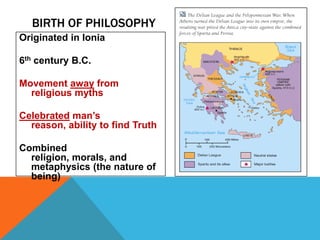
Originated in Ionia
6th century B.C.

Movement away from
religious myths
Celebrated man’s
reason, ability to find Truth
Combined
religion, morals, and
metaphysics (the nature of
being)
MAN BEGAN ASKING IMPORTANT QUESTIONS.
Do gods cause everything?
Are the gods real? What is real?
Can man affect change?
How to live well =
 Right opinions about God, world, man, virtue
OVERVIEW OF THE COSMOLOGISTS
Questioned nature of the cosmos (universe)
“Single, eternal, imperishable substance = basis for reality”
Wanted to understand the “One”
 Everything emerges from the “One”
THALES: THE FIRST PHILOSOPHER
Contemporary of Solon
“Water = basic element for
everything in nature”
Omitted gods from origin of nature

Believed earth floated on water
First to predict eclipse of the sun
ANAXIMANDER
Rejected Thales belief
about water
“Indefinite substance
(Boundless) = source of
all”
“Boundless” contains
powers of heat and cold
 Heat and cold produced nucleus
(seed of world)
 Influenced ideas about evolution
ANAXIMENES
“Air is primary
substance”

Believed world was
orderly
“Rainbow = sun’s rays
falling on dense air”
OVERVIEW OF RELIGIOUS MYSTICS
Soul more important than body
Immortality
Transmigration of the soul (reincarnation)
 Ate no meat
 Influenced Plato
PYTHAGORAS: COINED THE TERM
“PHILOSOPHY”
Taught transmigration of souls
(reincarnation)

“Order in universe based on numbers”
Mathematical, geometrical, astronomical
science
Knew that earth is a sphere
Developed Pythagorean theorem
HERACLITUS

“You can never step
into same stream
twice”
“Material world is in
state of flux”
 Matter itself is constantly
changing

“Fire (constantly
changing) = source of
all things”
PARMENIDES
Disagreed with Heraclitus
“Change is an illusion of the
senses”
“Reality is fixed, unchanging”
Founder of formal logic
Believed in one True Being:
transcendent, permanent, perf
ect
EMPEDOCLES
Identified four basic elements:
Fire, Water, Earth, Air
“Reality is permanent but
mobile”
Four elements move by two
opposing forces
 Love and Strife
 Like magnet’s attraction or repulsion
DEMOCRITUS
Called the “laughing
philosopher”
World made of atoms:
 Innumerable
tiny, solid, indivisible, unchangeab
le particles
 Atoms move, create
shapes/colors
 Senses perceive shapes/colors
ANAXAGORAS
Friend of Pericles
“World made of tiny
fundamental particles:
seeds”
“Seeds unite on rational basis
by nous, or mind”
Made distinction between
matter and mind
HIPPOCRATES: FATHER OF MEDICINE
Started a school
Observed ill
patients, classified
symptoms
Predicted future
course of an illness
Rejected supernatural
explanations and
cures
SOPHISTS
Paid, traveling teachers of rhetoric, dialectic, argumentation
 Taught students how to win arguments
 Some claimed to teach wisdom
Socrates believed sophistry was wrong
 “Distracts people from pursuit of Truth”
CRITIAS
Sophist
“Law is contrary to nature”
“Law man-made, so weak controls
strong”
Extremist
“Gods invented, keep people from
acting independently” (There
are no gods.)
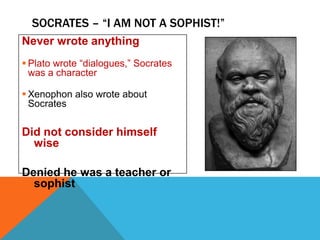
SOCRATES – “I AM NOT A SOPHIST!”
Never wrote anything
 Plato wrote “dialogues,” Socrates
was a character
 Xenophon also wrote about
Socrates

Did not consider himself
wise
Denied he was a teacher or
sophist
THE BAREFOOT PHILOSOPHER
Socrates walked around Athens, barefooted
Odd looking: Bulging eyes, large nose
 Successfully argued that he was superior looking
Taught by asking questions
 Socratic Method
THE SOCRATIC METHOD OF TEACHING
Leading questions get people to think (“Aha!”)
Believed people do wrong because of ignorance
 Don’t know what is virtuous
 Educate in virtue, right living will follow
BOTH student AND teacher learns
TRIAL AND EXECUTION
Angry Athenians accused him of:
 Corrupting youth + bringing new gods into city
Stood trial
Choice: exile or execution
Chose death: drank poison (hemlock)
THE CYNICS
Extremists
Based philosophy on Socratic teaching
Disdained worldly pleasure and wealth
Withdrew from political life
ANTISTHENES

Founded the Cynics
Follower of Socrates
DIOGENES: THE MOST FAMOUS CYNIC
Wore rags, lived in a tub
Performed shameful acts
in public
Made living by begging
Defined happiness:
 Satisfy natural needs in
simple, direct, public way
DIOGENES’ VIEW OF RELIGION
Ridiculed all
religious
observances
Plato said
Diogenes was
Socrates gone
mad.
CYNICS’ BELIEF ABOUT VIRTUE
“Virtue = wisdom and happiness”

“Virtue comes from proper style of life”
 Can’t be taught, does not come from philosophy
 (Socrates said the opposite)
CYNICS’ VIEW OF THE POLIS
Abandoned concept of polis altogether

Diogenes said he was kosmopolites
 “Citizen of the world”
PLATO
Socrates’ most important
student
Became greater than
Socrates
First systematic
philosopher
Applied philosophy to
political events, ideas
PLATO’S DIALOGUES
Wrote 26 philosophical
discussions
 Almost all were dialogues
 “Conversations” between
Socrates and various
people
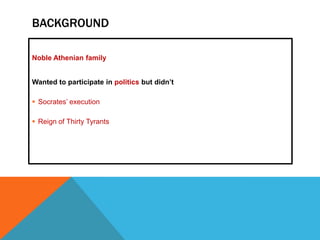
BACKGROUND
Noble Athenian family
Wanted to participate in politics but didn’t
 Socrates’ execution
 Reign of Thirty Tyrants
PLATO’S SCHOOL: THE ACADEMY

Influential school
Purpose: train
statesmen, citizens
Closed by Justinian in
6th century A.D.
POLITICAL BELIEFS
“Truth can be discovered by REASON”
Disliked democracy because power given to “amateurs”
 Philosopher = “lover of wisdom”

should lead polis

“We should question, challenge authority”
COMMITMENT TO THE POLIS
“Polis is based on virtues: order, harmony, justice”
Goal of the polis: Produce good people
“Man was meant to live in community”
“Community helps man become good”
KNOWLEDGE AND TRAINING
“Knowledge” (episteme)
 True, unchanging wisdom
 Only for a few philosophers
Philosophers need training (helps philosopher see “reality”)
PLATO’S PHILOSOPHER-KING
Only philosophers
qualified to rule

Prefer “life of
contemplation”
Will accept
responsibility from
sense of duty
JUSTICE & HOLINESS
Tried to define justice
and holiness
These are inherent in
the Good
Discovery possible
only through
philosophy
PRESERVING THE POLIS
“Preserve polis through moral + political reform”
Alleviate causes of strife:
 Private property, family
 Anything that comes between citizen and polis
THE GOOD
Man must have
knowledge of the
Good
Understand
philosophical
principles first
Right action follows
BACKGROUND
Plato’s student
Son of court doctor in
Macedon
Studied at the Academy

Joined Platonic colony in
Asia Minor
Taught Alexander the Great
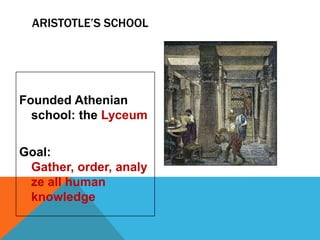
ARISTOTLE’S SCHOOL

Founded Athenian
school: the Lyceum
Goal:
Gather, order, analy
ze all human
knowledge
ARISTOTLE’S WRITINGS
Wrote dialogues on
Platonic
philosophy; none
survive
158 collections of
information
 Served as basis for
scientific works
 Only the Constitution of
the Athenians remains
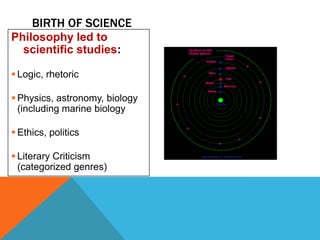
BIRTH OF SCIENCE
Philosophy led to
scientific studies:
 Logic, rhetoric
 Physics, astronomy, biology
(including marine biology
 Ethics, politics
 Literary Criticism
(categorized genres)
ARISTOTLE’S SCIENTIFIC METHOD
Observe evidence
 Physical evidence OR opinion

Apply reason; discover
patterns/inconsistenci
es
 Compare + contrast

Explain with
metaphysical
principles
THE GOOD LIFE
Emphasized balanced life
 Moderation in all things
Goal: “The Good Life”
 Contemplative but enough wealth to live comfortably
BELIEFS ABOUT THE POLIS
Sophists: “Polis is a
man-made
convention”
Aristotle said no:
 Polis is natural, necessary
 Polis will change over time
 Polis will improve
ARISTOTLE’S CORE BELIEFS
Everything evolves to final, perfected form
Institutions serve human needs, helps continue species
Marriage + household necessary to polis
Purpose of polis: moral (not military, economic)
ARISTOTLE’S MIDDLE CLASS
“Power should rest
with middle class”
 Most numerous and
stable
 Not arrogant from wealth
or malicious from poverty

Mixed Constitution
best
 Democracy AND oligarchy
ARISTOTLE’S LAST DAYS
Alexander died; Athenians rebelled from Macedonian rule
Aristotle fled
 Died in Calcis (in Euboea) the next year
ISOCRATES

Contemporary of Plato
and Aristotle
Headed important
rhetorical/
philosophical school
in Athens
POLITICAL BELIEFS
Supported Philip of Macedon
 Sought unity and leadership
Urged imperial conquest
 Plato said, “No – problem is moral”
 Aristotle said, “Apply virtue, moderation; empower middle class”
SKEPTICS
Founder: Pyrrho
Pointed out philosophical
fallacies in rival
schools

“Nothing can be known;
accept conventional
morality”
CYNICS
Denounced morality and status quo

Advocated crude, “natural” life
Shocked and outraged public
DIOGENES: THE MOST FAMOUS CYNIC

Diogenes reportedly walked
around the streets of
Athens, in broad
daylight, carrying a
lantern.

When asked why he was
doing this, Diogenes said
that he was searching for
an honest man.
DIOGENES AND ALEXANDER THE GREAT
Alexander once had an
opportunity to meet
Diogenes, who was reclining
in the sunshine.
Thrilled to meet the famous
philosopher, Alexander asked
if there was any favor he might
do for him.
"Yes,” Diogenes replied. “Stand
out of my sunlight."
ACCOUNTS OF DIOGENES’ DEATH
Numerous reports:
 held his breath till he
died
 became ill from eating
raw octopus
 suffered an infected
dog bite
LAST WORDS….
Someone once asked Diogenes how he wished to be buried. He said he wanted
to be thrown outside the city wall so wild animals could feast on his body.
“Wouldn’t you mind that?” the man asked.
"Not at all,” Diogenes said, “as long as you provide me with a stick to chase the
creatures away!"
“But how could you use the stick? Wouldn’t you lack awareness?” the man
asked.
“If I lack awareness,” the philosopher replied, “then why should I care what
happens to me when I am dead?"
EPICUREANS
Founded by Epicurus
“Happiness achieved through
reason”
“Nothing after death, so no
need to fear death”
“Gods exist but uninterested in
human affairs”
EPICUREANS
Wanted to liberate people from:
 Reliance on the gods
 Belief in supernatural
 Fear of death
EPICUREANS

Emphasis on pleasure, good life (hedonism)
Pleasure = “absence of pain, trouble or responsibility”
Withdrew from society
Avoided business and public life
Advocated “restrained selfishness”
STOICS
Founder: Zeno

Established a school
Combined
philosophies of
Socrates, Cynics, Ea
stern thought
THE STOIC’S GOAL IN LIFE
“Live in harmony with yourself and with nature.”

“God and nature are the same.”
Logos = guiding principle in life, divine reason
“Everyone has spark of divinity”
“After death, spark returns to eternal, divine spirit”
STOIC IDEAS ABOUT VIRTUE
“Pursue virtue; differentiate between good, evil, indifferent”
Good: prudence, justice, courage, temperance
Evil: folly, injustice, cowardice
Indifferent: life, beauty, health, strength, pleasure, wealth
“Misery results from passion; passion = soul’s disease”

Philosophers power point

  • 2.
    BIRTH OF PHILOSOPHY Originatedin Ionia 6th century B.C. Movement away from religious myths Celebrated man’s reason, ability to find Truth Combined religion, morals, and metaphysics (the nature of being)
  • 3.
    MAN BEGAN ASKINGIMPORTANT QUESTIONS. Do gods cause everything? Are the gods real? What is real? Can man affect change? How to live well =  Right opinions about God, world, man, virtue
  • 5.
    OVERVIEW OF THECOSMOLOGISTS Questioned nature of the cosmos (universe) “Single, eternal, imperishable substance = basis for reality” Wanted to understand the “One”  Everything emerges from the “One”
  • 6.
    THALES: THE FIRSTPHILOSOPHER Contemporary of Solon “Water = basic element for everything in nature” Omitted gods from origin of nature Believed earth floated on water First to predict eclipse of the sun
  • 7.
    ANAXIMANDER Rejected Thales belief aboutwater “Indefinite substance (Boundless) = source of all” “Boundless” contains powers of heat and cold  Heat and cold produced nucleus (seed of world)  Influenced ideas about evolution
  • 8.
    ANAXIMENES “Air is primary substance” Believedworld was orderly “Rainbow = sun’s rays falling on dense air”
  • 10.
    OVERVIEW OF RELIGIOUSMYSTICS Soul more important than body Immortality Transmigration of the soul (reincarnation)  Ate no meat  Influenced Plato
  • 11.
    PYTHAGORAS: COINED THETERM “PHILOSOPHY” Taught transmigration of souls (reincarnation) “Order in universe based on numbers” Mathematical, geometrical, astronomical science Knew that earth is a sphere Developed Pythagorean theorem
  • 12.
    HERACLITUS “You can neverstep into same stream twice” “Material world is in state of flux”  Matter itself is constantly changing “Fire (constantly changing) = source of all things”
  • 13.
    PARMENIDES Disagreed with Heraclitus “Changeis an illusion of the senses” “Reality is fixed, unchanging” Founder of formal logic Believed in one True Being: transcendent, permanent, perf ect
  • 14.
    EMPEDOCLES Identified four basicelements: Fire, Water, Earth, Air “Reality is permanent but mobile” Four elements move by two opposing forces  Love and Strife  Like magnet’s attraction or repulsion
  • 15.
    DEMOCRITUS Called the “laughing philosopher” Worldmade of atoms:  Innumerable tiny, solid, indivisible, unchangeab le particles  Atoms move, create shapes/colors  Senses perceive shapes/colors
  • 16.
    ANAXAGORAS Friend of Pericles “Worldmade of tiny fundamental particles: seeds” “Seeds unite on rational basis by nous, or mind” Made distinction between matter and mind
  • 18.
    HIPPOCRATES: FATHER OFMEDICINE Started a school Observed ill patients, classified symptoms Predicted future course of an illness Rejected supernatural explanations and cures
  • 20.
    SOPHISTS Paid, traveling teachersof rhetoric, dialectic, argumentation  Taught students how to win arguments  Some claimed to teach wisdom Socrates believed sophistry was wrong  “Distracts people from pursuit of Truth”
  • 21.
    CRITIAS Sophist “Law is contraryto nature” “Law man-made, so weak controls strong” Extremist “Gods invented, keep people from acting independently” (There are no gods.)
  • 22.
    SOCRATES – “IAM NOT A SOPHIST!” Never wrote anything  Plato wrote “dialogues,” Socrates was a character  Xenophon also wrote about Socrates Did not consider himself wise Denied he was a teacher or sophist
  • 23.
    THE BAREFOOT PHILOSOPHER Socrateswalked around Athens, barefooted Odd looking: Bulging eyes, large nose  Successfully argued that he was superior looking Taught by asking questions  Socratic Method
  • 24.
    THE SOCRATIC METHODOF TEACHING Leading questions get people to think (“Aha!”) Believed people do wrong because of ignorance  Don’t know what is virtuous  Educate in virtue, right living will follow BOTH student AND teacher learns
  • 25.
    TRIAL AND EXECUTION AngryAthenians accused him of:  Corrupting youth + bringing new gods into city Stood trial Choice: exile or execution Chose death: drank poison (hemlock)
  • 27.
    THE CYNICS Extremists Based philosophyon Socratic teaching Disdained worldly pleasure and wealth Withdrew from political life
  • 28.
  • 29.
    DIOGENES: THE MOSTFAMOUS CYNIC Wore rags, lived in a tub Performed shameful acts in public Made living by begging Defined happiness:  Satisfy natural needs in simple, direct, public way
  • 30.
    DIOGENES’ VIEW OFRELIGION Ridiculed all religious observances Plato said Diogenes was Socrates gone mad.
  • 31.
    CYNICS’ BELIEF ABOUTVIRTUE “Virtue = wisdom and happiness” “Virtue comes from proper style of life”  Can’t be taught, does not come from philosophy  (Socrates said the opposite)
  • 32.
    CYNICS’ VIEW OFTHE POLIS Abandoned concept of polis altogether Diogenes said he was kosmopolites  “Citizen of the world”
  • 34.
    PLATO Socrates’ most important student Becamegreater than Socrates First systematic philosopher Applied philosophy to political events, ideas
  • 35.
    PLATO’S DIALOGUES Wrote 26philosophical discussions  Almost all were dialogues  “Conversations” between Socrates and various people
  • 36.
    BACKGROUND Noble Athenian family Wantedto participate in politics but didn’t  Socrates’ execution  Reign of Thirty Tyrants
  • 37.
    PLATO’S SCHOOL: THEACADEMY Influential school Purpose: train statesmen, citizens Closed by Justinian in 6th century A.D.
  • 38.
    POLITICAL BELIEFS “Truth canbe discovered by REASON” Disliked democracy because power given to “amateurs”  Philosopher = “lover of wisdom” should lead polis “We should question, challenge authority”
  • 39.
    COMMITMENT TO THEPOLIS “Polis is based on virtues: order, harmony, justice” Goal of the polis: Produce good people “Man was meant to live in community” “Community helps man become good”
  • 40.
    KNOWLEDGE AND TRAINING “Knowledge”(episteme)  True, unchanging wisdom  Only for a few philosophers Philosophers need training (helps philosopher see “reality”)
  • 41.
    PLATO’S PHILOSOPHER-KING Only philosophers qualifiedto rule Prefer “life of contemplation” Will accept responsibility from sense of duty
  • 42.
    JUSTICE & HOLINESS Triedto define justice and holiness These are inherent in the Good Discovery possible only through philosophy
  • 43.
    PRESERVING THE POLIS “Preservepolis through moral + political reform” Alleviate causes of strife:  Private property, family  Anything that comes between citizen and polis
  • 44.
    THE GOOD Man musthave knowledge of the Good Understand philosophical principles first Right action follows
  • 46.
    BACKGROUND Plato’s student Son ofcourt doctor in Macedon Studied at the Academy Joined Platonic colony in Asia Minor Taught Alexander the Great
  • 47.
    ARISTOTLE’S SCHOOL Founded Athenian school:the Lyceum Goal: Gather, order, analy ze all human knowledge
  • 48.
    ARISTOTLE’S WRITINGS Wrote dialogueson Platonic philosophy; none survive 158 collections of information  Served as basis for scientific works  Only the Constitution of the Athenians remains
  • 49.
    BIRTH OF SCIENCE Philosophyled to scientific studies:  Logic, rhetoric  Physics, astronomy, biology (including marine biology  Ethics, politics  Literary Criticism (categorized genres)
  • 50.
    ARISTOTLE’S SCIENTIFIC METHOD Observeevidence  Physical evidence OR opinion Apply reason; discover patterns/inconsistenci es  Compare + contrast Explain with metaphysical principles
  • 51.
    THE GOOD LIFE Emphasizedbalanced life  Moderation in all things Goal: “The Good Life”  Contemplative but enough wealth to live comfortably
  • 52.
    BELIEFS ABOUT THEPOLIS Sophists: “Polis is a man-made convention” Aristotle said no:  Polis is natural, necessary  Polis will change over time  Polis will improve
  • 53.
    ARISTOTLE’S CORE BELIEFS Everythingevolves to final, perfected form Institutions serve human needs, helps continue species Marriage + household necessary to polis Purpose of polis: moral (not military, economic)
  • 54.
    ARISTOTLE’S MIDDLE CLASS “Powershould rest with middle class”  Most numerous and stable  Not arrogant from wealth or malicious from poverty Mixed Constitution best  Democracy AND oligarchy
  • 55.
    ARISTOTLE’S LAST DAYS Alexanderdied; Athenians rebelled from Macedonian rule Aristotle fled  Died in Calcis (in Euboea) the next year
  • 56.
    ISOCRATES Contemporary of Plato andAristotle Headed important rhetorical/ philosophical school in Athens
  • 57.
    POLITICAL BELIEFS Supported Philipof Macedon  Sought unity and leadership Urged imperial conquest  Plato said, “No – problem is moral”  Aristotle said, “Apply virtue, moderation; empower middle class”
  • 60.
    SKEPTICS Founder: Pyrrho Pointed outphilosophical fallacies in rival schools “Nothing can be known; accept conventional morality”
  • 62.
    CYNICS Denounced morality andstatus quo Advocated crude, “natural” life Shocked and outraged public
  • 63.
    DIOGENES: THE MOSTFAMOUS CYNIC Diogenes reportedly walked around the streets of Athens, in broad daylight, carrying a lantern. When asked why he was doing this, Diogenes said that he was searching for an honest man.
  • 64.
    DIOGENES AND ALEXANDERTHE GREAT Alexander once had an opportunity to meet Diogenes, who was reclining in the sunshine. Thrilled to meet the famous philosopher, Alexander asked if there was any favor he might do for him. "Yes,” Diogenes replied. “Stand out of my sunlight."
  • 65.
    ACCOUNTS OF DIOGENES’DEATH Numerous reports:  held his breath till he died  became ill from eating raw octopus  suffered an infected dog bite
  • 66.
    LAST WORDS…. Someone onceasked Diogenes how he wished to be buried. He said he wanted to be thrown outside the city wall so wild animals could feast on his body. “Wouldn’t you mind that?” the man asked. "Not at all,” Diogenes said, “as long as you provide me with a stick to chase the creatures away!" “But how could you use the stick? Wouldn’t you lack awareness?” the man asked. “If I lack awareness,” the philosopher replied, “then why should I care what happens to me when I am dead?"
  • 68.
    EPICUREANS Founded by Epicurus “Happinessachieved through reason” “Nothing after death, so no need to fear death” “Gods exist but uninterested in human affairs”
  • 69.
    EPICUREANS Wanted to liberatepeople from:  Reliance on the gods  Belief in supernatural  Fear of death
  • 70.
    EPICUREANS Emphasis on pleasure,good life (hedonism) Pleasure = “absence of pain, trouble or responsibility” Withdrew from society Avoided business and public life Advocated “restrained selfishness”
  • 72.
    STOICS Founder: Zeno Established aschool Combined philosophies of Socrates, Cynics, Ea stern thought
  • 73.
    THE STOIC’S GOALIN LIFE “Live in harmony with yourself and with nature.” “God and nature are the same.” Logos = guiding principle in life, divine reason “Everyone has spark of divinity” “After death, spark returns to eternal, divine spirit”
  • 74.
    STOIC IDEAS ABOUTVIRTUE “Pursue virtue; differentiate between good, evil, indifferent” Good: prudence, justice, courage, temperance Evil: folly, injustice, cowardice Indifferent: life, beauty, health, strength, pleasure, wealth “Misery results from passion; passion = soul’s disease”