Dhvani Theory in
Indian Aesthetics
Personal information
Name - Hina Parmar
Roll no - 10
Sem - 2(M.A.)
Enrollment no - 4069206420220021
Batch - 2022-24
Email- hinaparmar612@gmail.com
Subject – Dhvani Theory in Indian Aesthetics
Paper code - 22402
Paper no - 109
Paper - Literary Theory & Criticism and
Indian Aesthetics
Submitted to - Department of English,
M.K.B.U
Table of contents
•Introduction
•Meaning of Dhvani
•"Dhvani"theory of
Anandavardhana
•Dhvani theory in indian poetics
•Sabda and Artha
•Response upon Dhvani theory
from chatGPT
•Conclusion
•Citation
Indian Aesthetics
Introduction
India before the coming of muslims, is full of surprises and none is more
surprising than that authorities do not agree as to the role, or even the
existence of art in india.
In Troy Organ' s article 'Indian Aesthetics : it's Technique and
assumptions' Heinrich Zimmer begins his book "The art of the Indian
Asia" with this confident statement : " Indian art, beside documentary the
history of a majestic civilization, opens a comparatively simple delightful
way into the timeless domain of the Hindu spirit, for it readers in eloquent
visual forms the whole message that india holds in keep for mankind.“
(Organ)
Meaning of "Dhvani"
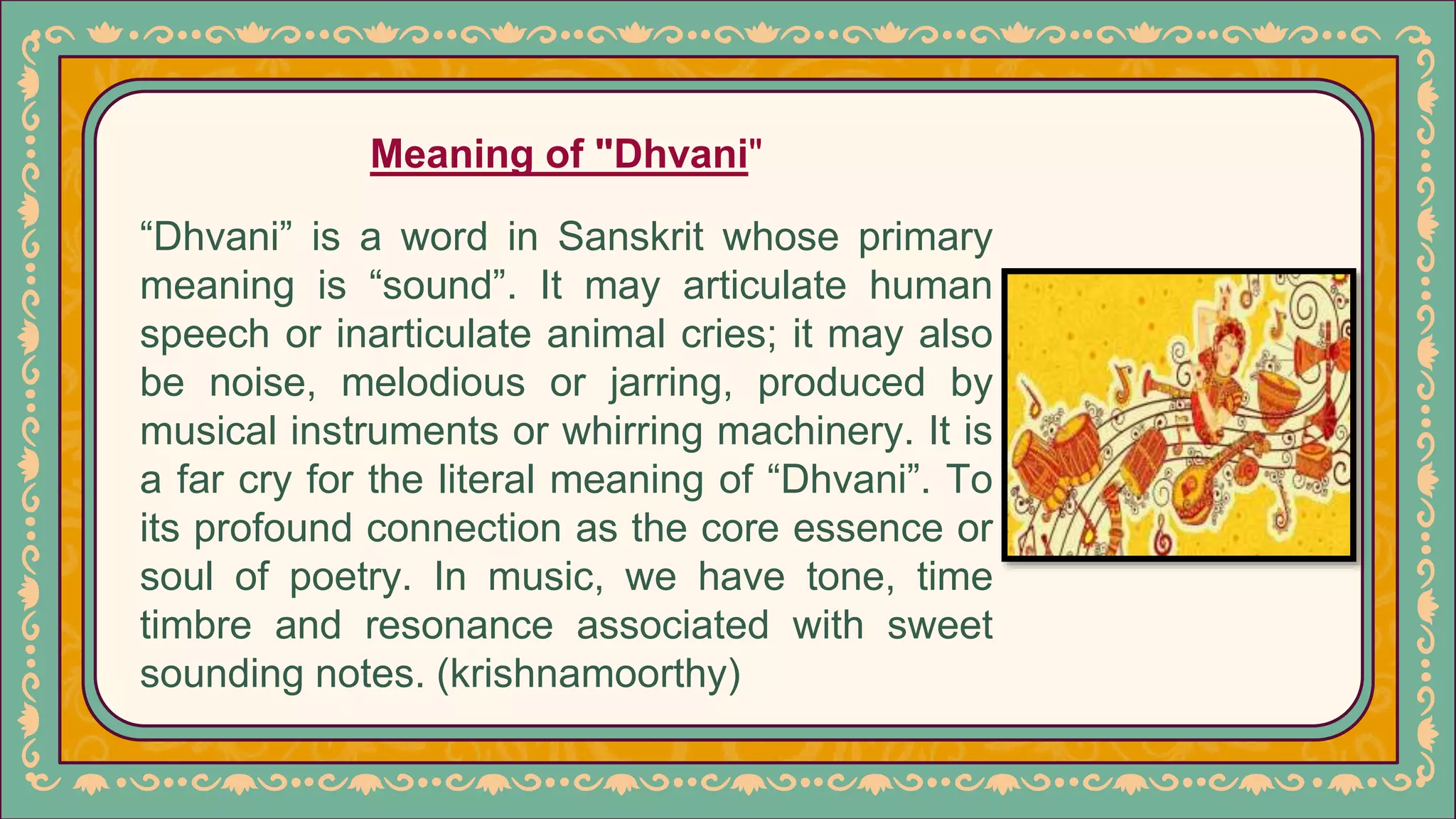
“Dhvani” is a word in Sanskrit whose primary
meaning is “sound”. It may articulate human
speech or inarticulate animal cries; it may also
be noise, melodious or jarring, produced by
musical instruments or whirring machinery. It is
a far cry for the literal meaning of “Dhvani”. To
its profound connection as the core essence or
soul of poetry. In music, we have tone, time
timbre and resonance associated with sweet
sounding notes. (krishnamoorthy)
Anandvardhan
Ānandavardhana belongs to the ninth century, before that
there were many Alankārikas who focused on sabda and
artha, and lingered around the word and its meaning.
Because a poetry is defined as: “Sabda-
Artha sahitau Kavyam” (Bhamaha), poem is the
combination of sabda and artha. Earlier poetics; like
Bhamaha, Dandin and Vāmana, all these people
concentrated on the sabda and artha, which is the body of
the poem and that is causing beauty to the poem. He
developed a new theory and pointed out that words of great
poets continue to resonate in our hearts and give numerous
meanings as one reflects on it.
(Singh)
Dhvani Theory in Indian Aesthetics
Dhvani is a suggested sense; the most significant part of the
poetry. To know what is this dhvani? One should understand
the function of the word and go through Dhvanyāloka.
Grammarians and Alankarikas, they mentioned there are
three such functions of the word. Abhidha,
Laksana,Vyanjana.
1. The first one is Abhidhā, there is a function of the word
which signifies or denotes, it is a primary sense like this
is Mukesh, this is red color, it's a direct meaning etc.
2. The second one is Laksanā, the function of the Laksanā
is to indicate, and when the primary sense is obstructed
the word conveys a sense other than the primary sense;
but related to it. (Singh)
3. Third is Vyanjanā, the meaning of the word is not limited to its primary sense but much
more than that it has the power to reach beyond the obvious.
•Abhidhā is a function which gives a direct meaning, the word is called vācaka and the
meaning is vācyārtha.
•Laksanā is the function, it gives the secondary sense, lakchaka is the word and
lakchyārtha is the meaning.
•vyanjanā is a suggestion and vyanjaka is a word and vyangārtha is the meaning.
There was much debate under suggestive meaning, though not explicit, far more beautiful
and sensitive becomes the object of awareness is regarded as the essence of poetry.
The dhvani theory of Ānandavardhana focused on the potential of suggestive sense in
poetry. Sabda with its vācyārtha forms the body of kāvya, but the essence of rasa can be
perceived only through suggestion (vyanjanā). (Singh)
Sabda and Artha
Sabda and artha, the word and the meaning; they are the body of the
kāvya, like how the human beings have the body and the inner soul is
there. That inner soul, he considered it as Dhvani. Dhvanyāloka is divided
into four chapters they are called udyota (flash), and that way the whole
text is written in three parts –
1. Karika
2. Vrtti
3. Examples
In the first chapter of Dhvanyāloka, he establishes dhvani by refuting all
the objections by answering all the questions and doubts of the anti dhvani
scholars. The second chapter deals with the varieties of dhvani from the
standpoint of this suggested – vyangya. The third chapter deals with the
varieties of Dhvani from the standpoint of the suggestion – vyanjaka.
Fourth chapter deals with the endlessness of the creative imagination of
the poet and main Rasa in Rāmāyana and Mahābhārata. (singh)
Dhvani Theory in Aesthetics(response taken from chatGPT)
Elaborate Dhvani theory in indian aesthetics briefly.
The Dhvani theory is a central concept in Indian Aesthetics, particularly in the field of
literary criticism. The theory is based on the idea that the primary function of poetry
and other forms of literature is to evoke emotions and feelings in the reader or
listener.
According to the Dhvani theory, there are two types of meaning in literature: the
explicit or surface meaning (vachya) and the suggested or implied meaning
(dhvani). While the surface meaning is conveyed through the words and sentences
of the text, the suggested meaning is not directly expressed but is instead evoked
through suggestion or implication.
The Dhvani theory distinguishes three types of suggested meaning:
1.Vyangya or Allusive Suggestion: This is a suggestion that refers to something
else, such as a cultural or mythological reference, which the reader or listener is
expected to understand and interpret.
1.Vastu or Objective Suggestion: This refers to the emotions and
feelings that are evoked in the reader or listener by the words and imagery
of the text.
2.Alankara or Ornamentation: This refers to the literary devices used in
the text, such as metaphors, similes, and other figures of speech, which
contribute to the suggested meaning of the text.
The Dhvani theory suggests that the suggested meaning is the most
important aspect of literature, as it has the power to evoke emotions and
feelings in the reader or listener. It is through the suggested meaning that
the literary work achieves its aesthetic value, and the reader or listener
experiences the rasa or aesthetic pleasure.
Overall, the Dhvani theory emphasizes the importance of the suggested
meaning in literature and the power of suggestion to evoke emotions and
feelings in the reader or listener.
Conclusion
It is true that poets focus their attention first and
foremost in the explicit sense. However, this fact does not
imply that Dhvani is unimportant or undervalued. A man
eager to view things (at night) is seen looking for a torch
first as a means of achieving his goal. The torch isn't an
end in itself; it's only a tool for achieving another goal.
Poets, likewise, are interested in the explicit sense as a
means of communicating their other ideas in a suggestive
manner. The suggested concepts are the goals that the
poets use to drive their selection of other objects.
Citation
KRISe, vol. 28, no. 4 (108), 1985, pp. 113–22. JSTOR,
http://www.jstor.org/stable/24158033. AccHNAMOORTHY, K. “‘Dhvani’ or
Suggestion: A Study in Perspective.” Indian Literaturessed 13 Mar. 2023.
Organ, Troy. “Indian Aesthetics: Its Techniques and Assumptions.” Journal of
Aesthetic Education, vol. 9, no. 1, 1975, pp. 11–27. JSTOR,
https://doi.org/10.2307/3331761. Accessed 13 Mar. 2023.
Singh, Ajay. “International Journal of English Literature and Social Sciences.”
Dhvani Theory in Indian Aesthetics , vol. 7, no. 3, May 2022,
doi:10.22161/ijels.
Thank You

Dhvani Theory in Indian Aeshetics

  • 1.
  • 2.
    Personal information Name -Hina Parmar Roll no - 10 Sem - 2(M.A.) Enrollment no - 4069206420220021 Batch - 2022-24 Email- hinaparmar612@gmail.com Subject – Dhvani Theory in Indian Aesthetics Paper code - 22402 Paper no - 109 Paper - Literary Theory & Criticism and Indian Aesthetics Submitted to - Department of English, M.K.B.U
  • 3.
    Table of contents •Introduction •Meaningof Dhvani •"Dhvani"theory of Anandavardhana •Dhvani theory in indian poetics •Sabda and Artha •Response upon Dhvani theory from chatGPT •Conclusion •Citation
  • 4.
    Indian Aesthetics Introduction India beforethe coming of muslims, is full of surprises and none is more surprising than that authorities do not agree as to the role, or even the existence of art in india. In Troy Organ' s article 'Indian Aesthetics : it's Technique and assumptions' Heinrich Zimmer begins his book "The art of the Indian Asia" with this confident statement : " Indian art, beside documentary the history of a majestic civilization, opens a comparatively simple delightful way into the timeless domain of the Hindu spirit, for it readers in eloquent visual forms the whole message that india holds in keep for mankind.“ (Organ)
  • 5.
    Meaning of "Dhvani" “Dhvani”is a word in Sanskrit whose primary meaning is “sound”. It may articulate human speech or inarticulate animal cries; it may also be noise, melodious or jarring, produced by musical instruments or whirring machinery. It is a far cry for the literal meaning of “Dhvani”. To its profound connection as the core essence or soul of poetry. In music, we have tone, time timbre and resonance associated with sweet sounding notes. (krishnamoorthy)
  • 6.
    Anandvardhan Ānandavardhana belongs tothe ninth century, before that there were many Alankārikas who focused on sabda and artha, and lingered around the word and its meaning. Because a poetry is defined as: “Sabda- Artha sahitau Kavyam” (Bhamaha), poem is the combination of sabda and artha. Earlier poetics; like Bhamaha, Dandin and Vāmana, all these people concentrated on the sabda and artha, which is the body of the poem and that is causing beauty to the poem. He developed a new theory and pointed out that words of great poets continue to resonate in our hearts and give numerous meanings as one reflects on it. (Singh)
  • 7.
    Dhvani Theory inIndian Aesthetics Dhvani is a suggested sense; the most significant part of the poetry. To know what is this dhvani? One should understand the function of the word and go through Dhvanyāloka. Grammarians and Alankarikas, they mentioned there are three such functions of the word. Abhidha, Laksana,Vyanjana. 1. The first one is Abhidhā, there is a function of the word which signifies or denotes, it is a primary sense like this is Mukesh, this is red color, it's a direct meaning etc. 2. The second one is Laksanā, the function of the Laksanā is to indicate, and when the primary sense is obstructed the word conveys a sense other than the primary sense; but related to it. (Singh)
  • 8.
    3. Third isVyanjanā, the meaning of the word is not limited to its primary sense but much more than that it has the power to reach beyond the obvious. •Abhidhā is a function which gives a direct meaning, the word is called vācaka and the meaning is vācyārtha. •Laksanā is the function, it gives the secondary sense, lakchaka is the word and lakchyārtha is the meaning. •vyanjanā is a suggestion and vyanjaka is a word and vyangārtha is the meaning. There was much debate under suggestive meaning, though not explicit, far more beautiful and sensitive becomes the object of awareness is regarded as the essence of poetry. The dhvani theory of Ānandavardhana focused on the potential of suggestive sense in poetry. Sabda with its vācyārtha forms the body of kāvya, but the essence of rasa can be perceived only through suggestion (vyanjanā). (Singh)
  • 9.
    Sabda and Artha Sabdaand artha, the word and the meaning; they are the body of the kāvya, like how the human beings have the body and the inner soul is there. That inner soul, he considered it as Dhvani. Dhvanyāloka is divided into four chapters they are called udyota (flash), and that way the whole text is written in three parts – 1. Karika 2. Vrtti 3. Examples In the first chapter of Dhvanyāloka, he establishes dhvani by refuting all the objections by answering all the questions and doubts of the anti dhvani scholars. The second chapter deals with the varieties of dhvani from the standpoint of this suggested – vyangya. The third chapter deals with the varieties of Dhvani from the standpoint of the suggestion – vyanjaka. Fourth chapter deals with the endlessness of the creative imagination of the poet and main Rasa in Rāmāyana and Mahābhārata. (singh)
  • 10.
    Dhvani Theory inAesthetics(response taken from chatGPT) Elaborate Dhvani theory in indian aesthetics briefly. The Dhvani theory is a central concept in Indian Aesthetics, particularly in the field of literary criticism. The theory is based on the idea that the primary function of poetry and other forms of literature is to evoke emotions and feelings in the reader or listener. According to the Dhvani theory, there are two types of meaning in literature: the explicit or surface meaning (vachya) and the suggested or implied meaning (dhvani). While the surface meaning is conveyed through the words and sentences of the text, the suggested meaning is not directly expressed but is instead evoked through suggestion or implication. The Dhvani theory distinguishes three types of suggested meaning: 1.Vyangya or Allusive Suggestion: This is a suggestion that refers to something else, such as a cultural or mythological reference, which the reader or listener is expected to understand and interpret.
  • 11.
    1.Vastu or ObjectiveSuggestion: This refers to the emotions and feelings that are evoked in the reader or listener by the words and imagery of the text. 2.Alankara or Ornamentation: This refers to the literary devices used in the text, such as metaphors, similes, and other figures of speech, which contribute to the suggested meaning of the text. The Dhvani theory suggests that the suggested meaning is the most important aspect of literature, as it has the power to evoke emotions and feelings in the reader or listener. It is through the suggested meaning that the literary work achieves its aesthetic value, and the reader or listener experiences the rasa or aesthetic pleasure. Overall, the Dhvani theory emphasizes the importance of the suggested meaning in literature and the power of suggestion to evoke emotions and feelings in the reader or listener.
  • 12.
    Conclusion It is truethat poets focus their attention first and foremost in the explicit sense. However, this fact does not imply that Dhvani is unimportant or undervalued. A man eager to view things (at night) is seen looking for a torch first as a means of achieving his goal. The torch isn't an end in itself; it's only a tool for achieving another goal. Poets, likewise, are interested in the explicit sense as a means of communicating their other ideas in a suggestive manner. The suggested concepts are the goals that the poets use to drive their selection of other objects.
  • 13.
    Citation KRISe, vol. 28,no. 4 (108), 1985, pp. 113–22. JSTOR, http://www.jstor.org/stable/24158033. AccHNAMOORTHY, K. “‘Dhvani’ or Suggestion: A Study in Perspective.” Indian Literaturessed 13 Mar. 2023. Organ, Troy. “Indian Aesthetics: Its Techniques and Assumptions.” Journal of Aesthetic Education, vol. 9, no. 1, 1975, pp. 11–27. JSTOR, https://doi.org/10.2307/3331761. Accessed 13 Mar. 2023. Singh, Ajay. “International Journal of English Literature and Social Sciences.” Dhvani Theory in Indian Aesthetics , vol. 7, no. 3, May 2022, doi:10.22161/ijels.
  • 14.