 The Socratic or Classical period of the Ancient era of
philosophy denotes the Greek contemporaries and
near contemporaries of the influential philosopher
Socrates.
 It includes the following major philosophers:
 Socrates (464 - 399 B.C.) Greek
 Plato (c. 428 - 348 B.C.) Greek
 Aristotle (384 - 322 B.C.) Greek
 Epicurus (341 - 270 B.C.) was a Greek
 Born around 470 B. C. - Socrates was
executed in 399 B. C.
 Lived in Athens at the height of its
civilisation.
 Excellent soldier – he had great
physical power and could endure a
lot.
 He was interested in the
development of a person’s moral
character.
 He lived a virtuous life.
 He attempted to improve the
Athenians sense of justice
 He claimed he was the wiser one
since he was the only person aware of
his own ignorance
 Put on trial and found guilty ◦ heresy
◦ corrupting the minds of the youth
The soul is hugely important in his philosophy
 Had to be nurtured and protected.
 Gaining wisdom would save the soul.
 This would lead the person to living a virtuous life
‘Knowing what is good is the same as doing what is
good.’ ~ Socrates.
 Believed people would not willingly do wrong.
 No-one wants to be a bad person.
 Later philosophers would disagreed with him.
 They said that a person might know what is right but
may not be strong enough or disciplined enough to do.
SOCRATES (470/469 – 399 BC)
 DIALECTIC: A method of seeking truth through a
series of questions and answers.
 The Socratic method is a “dialectic” method teaching.
 To solve a problem, it is broken down into a series of
questions, the answers to which gradually distil the
answer a person would seek.
Socrates Ethics primary concern in philosophy
was, “How should we live?” 3 Questions
 What is good?
 What is right?
 What is justice?
 Socrates' ethics assumes that
Education is the key to living an
ethical life.
 No one desires evil.
 No one errs or does wrong willingly
or knowingly.
 Virtue—all virtue—is knowledge.
 Virtue = positive moral behaviour.
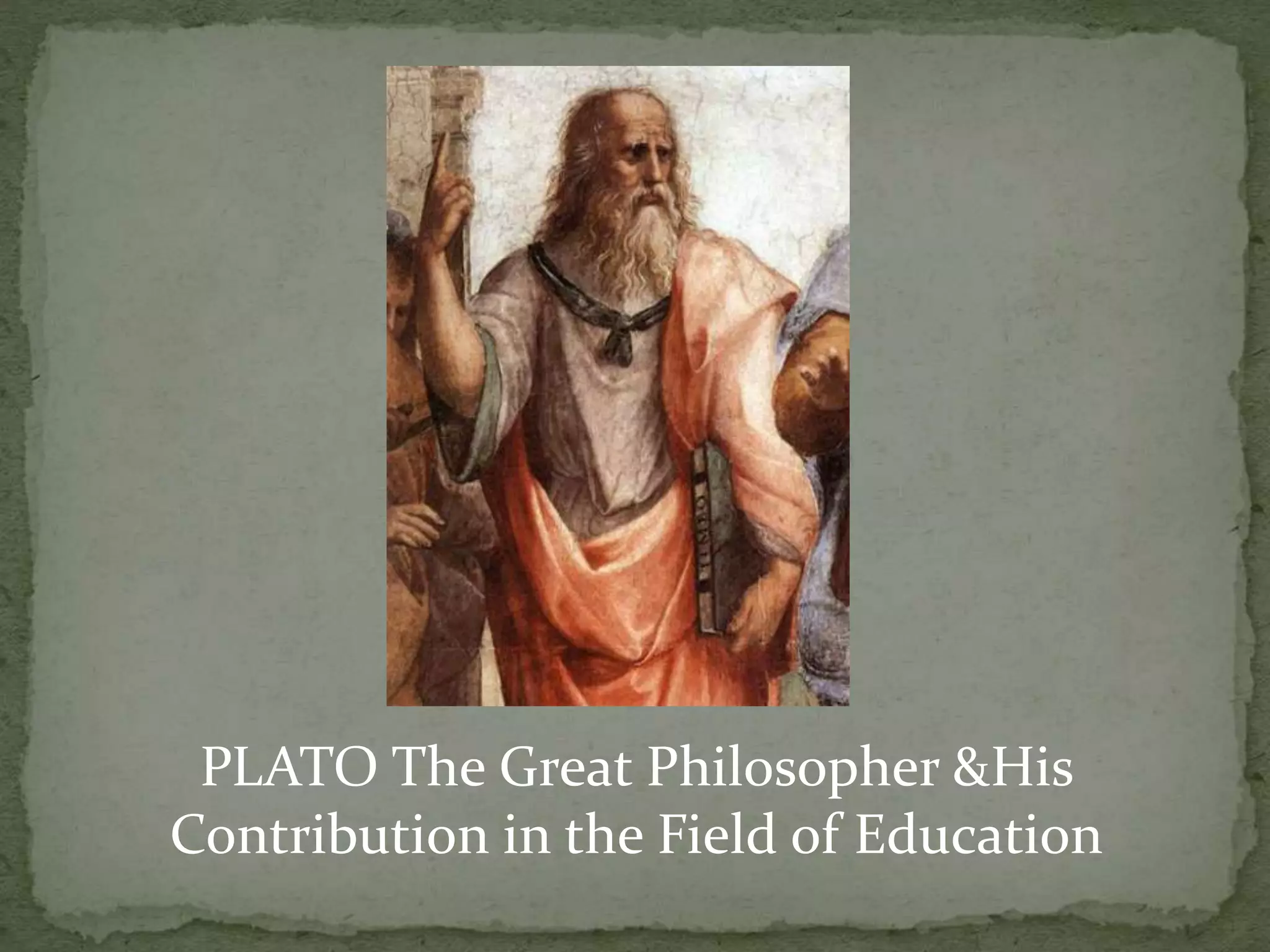
PLATO The Great Philosopher &His
Contribution in the Field of Education
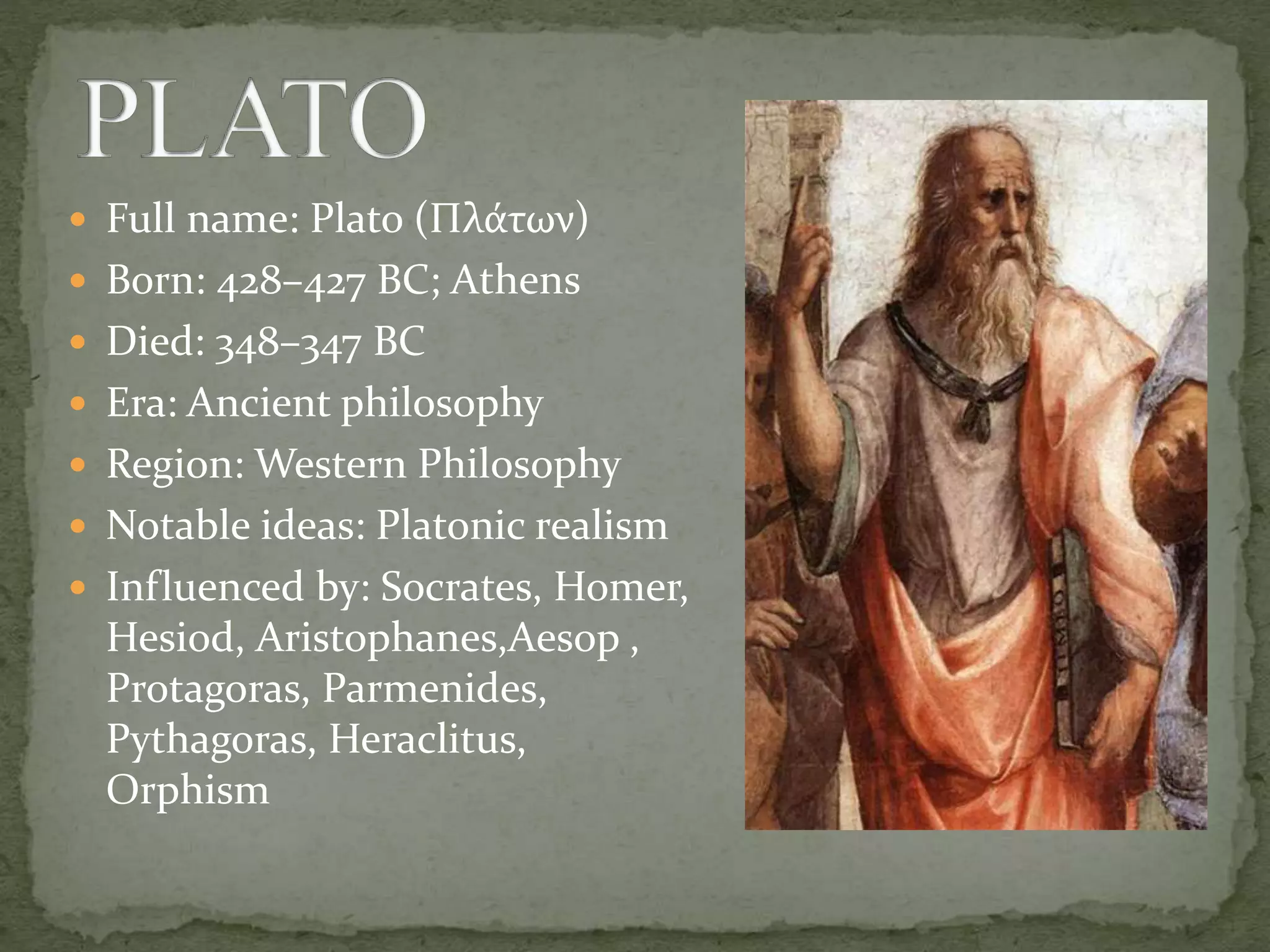
 Full name: Plato (Πλάτων)
 Born: 428–427 BC; Athens
 Died: 348–347 BC
 Era: Ancient philosophy
 Region: Western Philosophy
 Notable ideas: Platonic realism
 Influenced by: Socrates, Homer,
Hesiod, Aristophanes,Aesop ,
Protagoras, Parmenides,
Pythagoras, Heraclitus,
Orphism
 Plato is perhaps the first philosopher whose complete
works are still available to us.
 He wrote no systematic treatises giving his views, but
rather he wrote a number (about 35, although
the authenticity of at least some of these remains in
doubt) of superb dialogues, written in the form
of conversations, a form which permitted him to
develop the Socratic method of question and answer.
 Ethics (with discussion of the nature of virtue)
 Metaphysics (where topics include immortality, man, mind, and Realism)
 Political Philosophy (where topics such as censorship and the ideal state are
discussed)
 Philosophy of Religion (considering topics such
as Atheism, Dualism and Pantheism)
 Epistemology (where he looked at ideas such as a priori
knowledge and Rationalism)
 The Philosophy of Mathematics and the theory of art (especially dance,
music, poetry, architecture and drama).
In his dialogues, Plato discussed every kind of philosophical
idea, including :
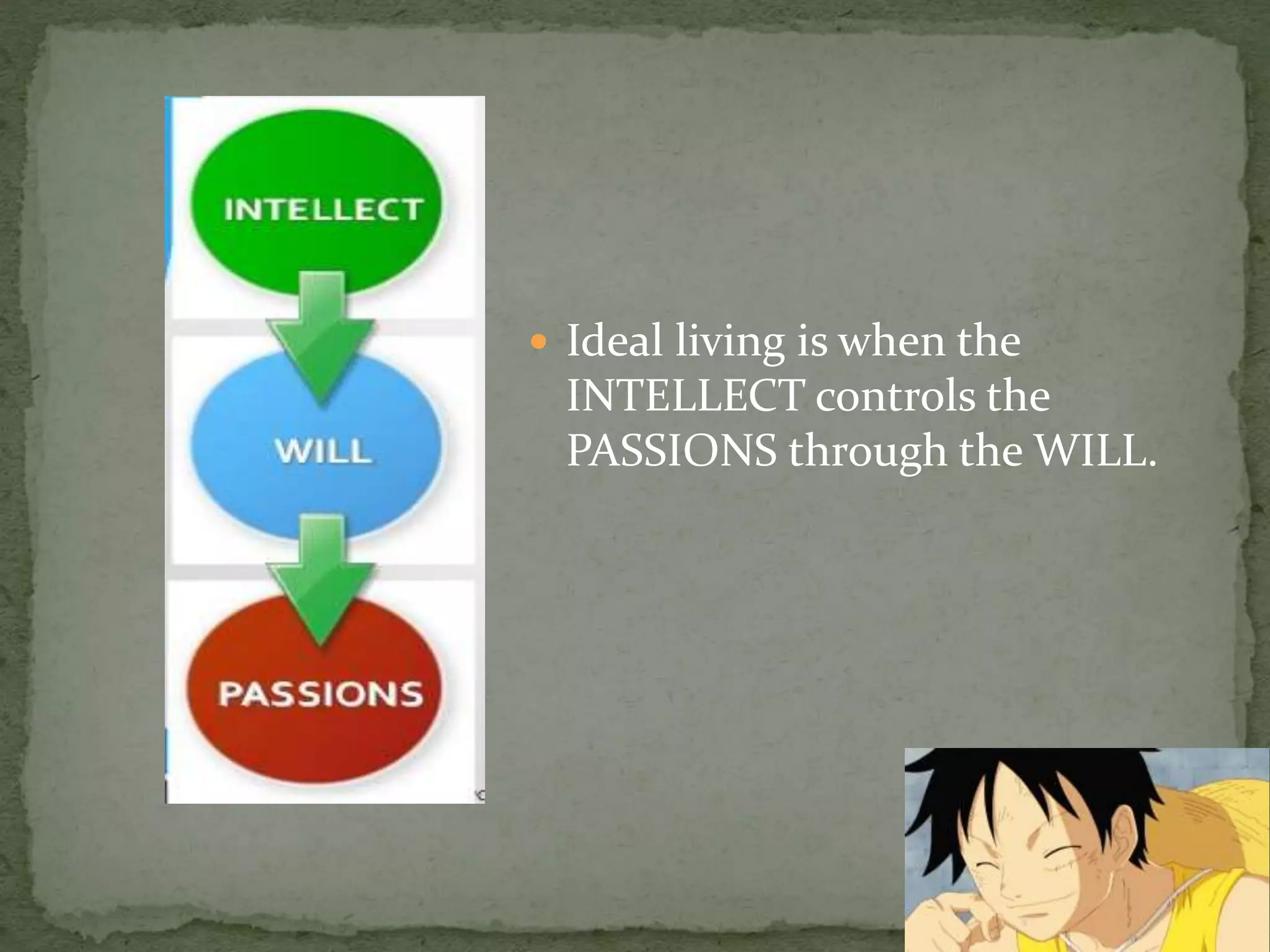
Plato Ethics Humans are made of 3 conflicting
elements:
• PASSION
• INTELLECT
• WILL
 Most people live life allowing the PASSIONS,
INTELLECT and WILL to be in conflict with one
another.
Plato Ethics: Passions Intellect Will
 Ideal living is when the
INTELLECT controls the
PASSIONS through the WILL.
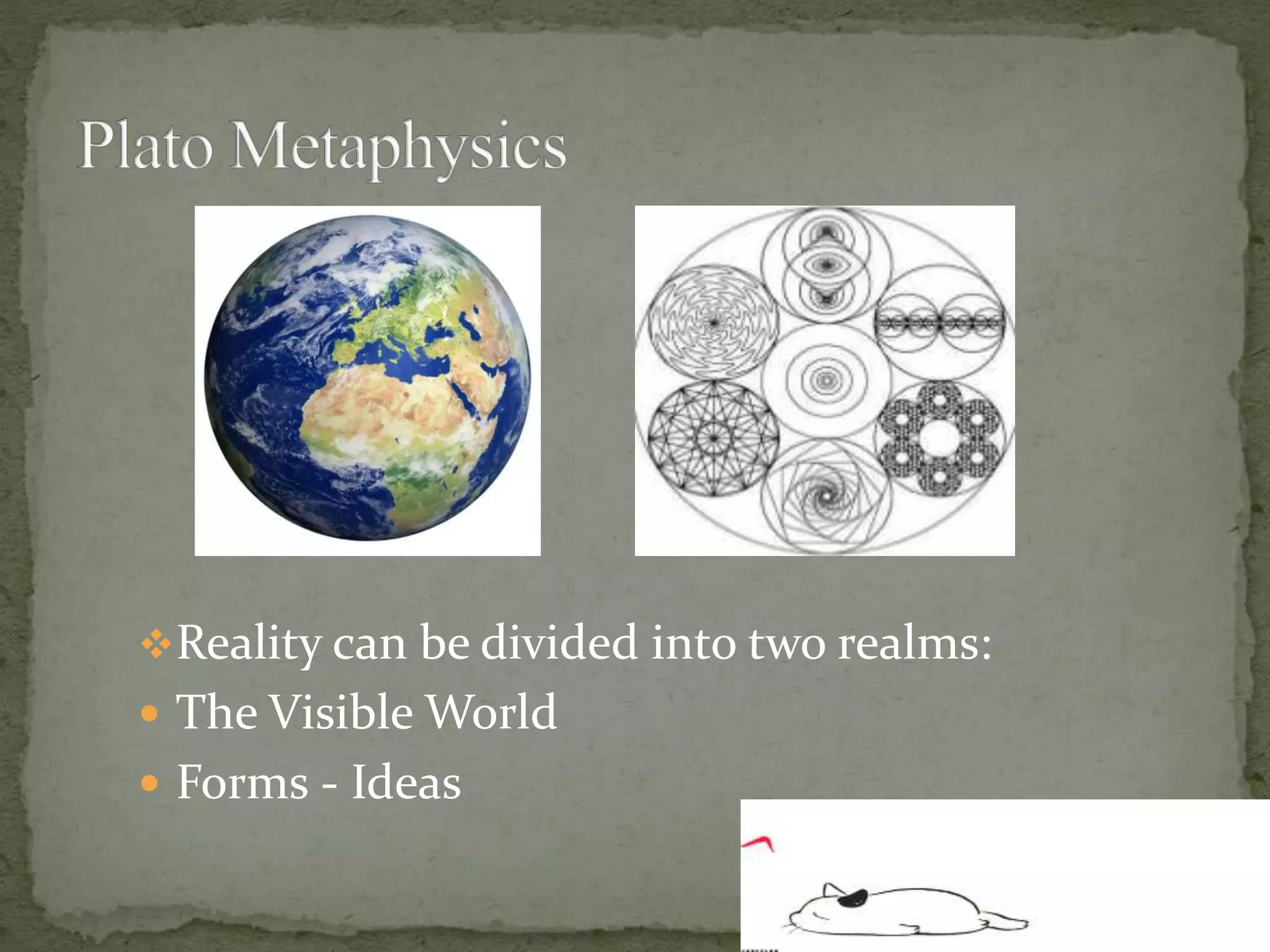
Reality can be divided into two realms:
 The Visible World
 Forms - Ideas
The Visible World
 Lower - Imperfect
 World experienced by our
senses
 Physical
 Bound by Space and Time
 Always changing
 Always “becoming”
Realm of Forms-Ideas
 Higher - Perfect
 ULTIMATE REALITY
 Not accessible to our senses
 Non-Physical
 Not Bound by Space and Time
 Never Changing Always “is”
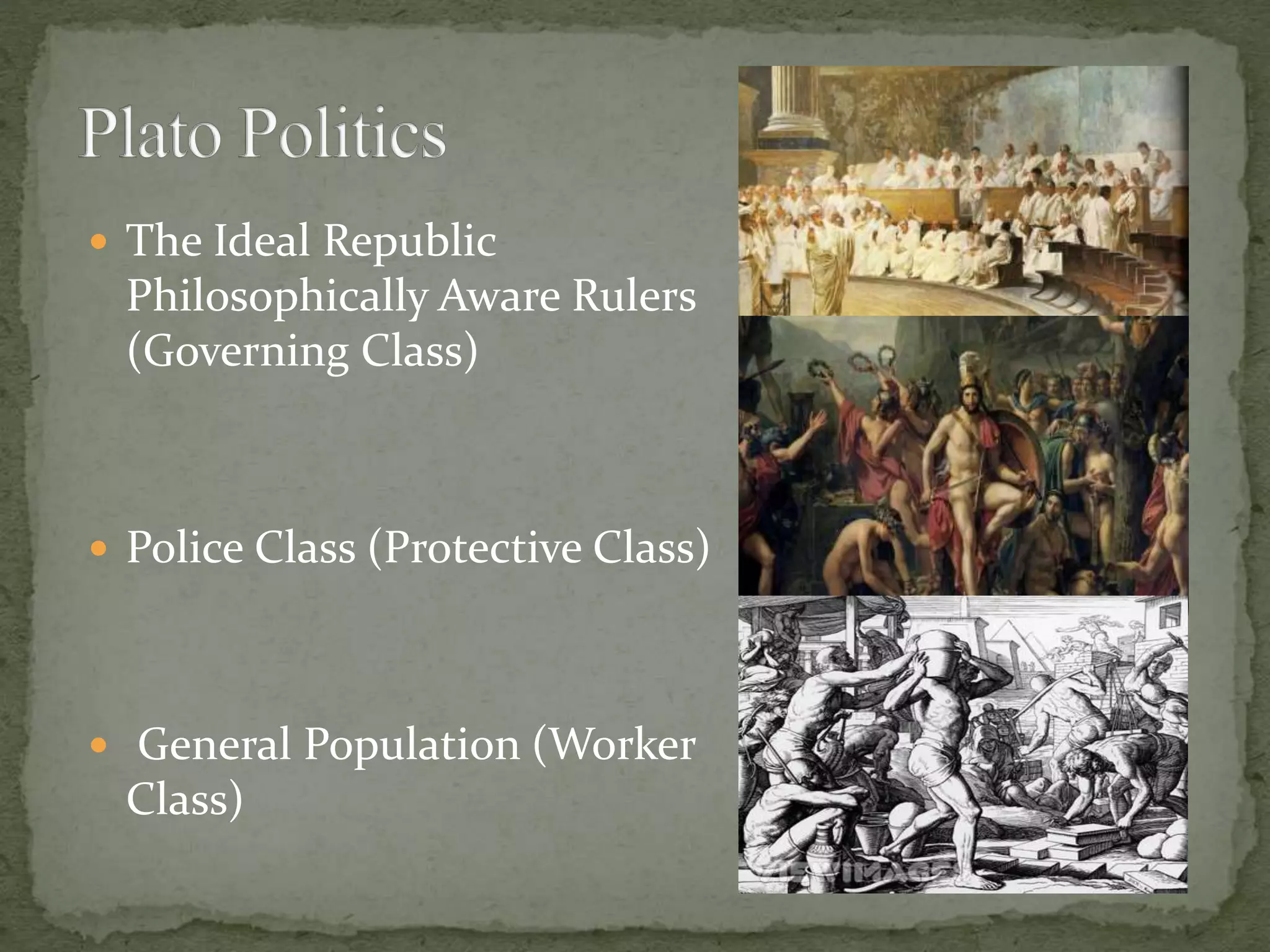
 The Ideal Republic
Philosophically Aware Rulers
(Governing Class)
 Police Class (Protective Class)
 General Population (Worker
Class)
 NAME: Aristotle
 OCCUPATION: philosopher
 BIRTH DATE: c. 384 BCE
DEATH DATE: c. 322 BCE
 EDUCATION: Plato's
Academy, Lyceum
 PLACE OF BIRTH: Stagira,
Chalcidice, Greece
 PLACE OF DEATH: Chalcis,
Euboea, Greece
 He was a Greek philosopher and polymath. Also a
student of Plato and teacher of Alexander the Great.
 His writings cover many subjects, including physics,
metaphysics, poetry, theatre, music, logic, rhetoric,
linguistics, politics, government, ethics, biology, and
zoology.
 Aristotle's writings were the first to create a
comprehensive system of Western philosophy,
encompassing ethics, aesthetics, logic, science,
politics, and metaphysics.
Logic 3 Areas of Learning
1. Theoretical
2. Practical
3. Productive
 Logic is a Tool underlying all learning
Virtuous Life
 Know what is Right
 Do what is Right
 Practical Wisdom - Make Right Decisions based
on Good Reasons
 Contemplation of the Best things NOT just
Good things – Good is the enemy of the Best
 Motivation for Doing Anything is Flourishing
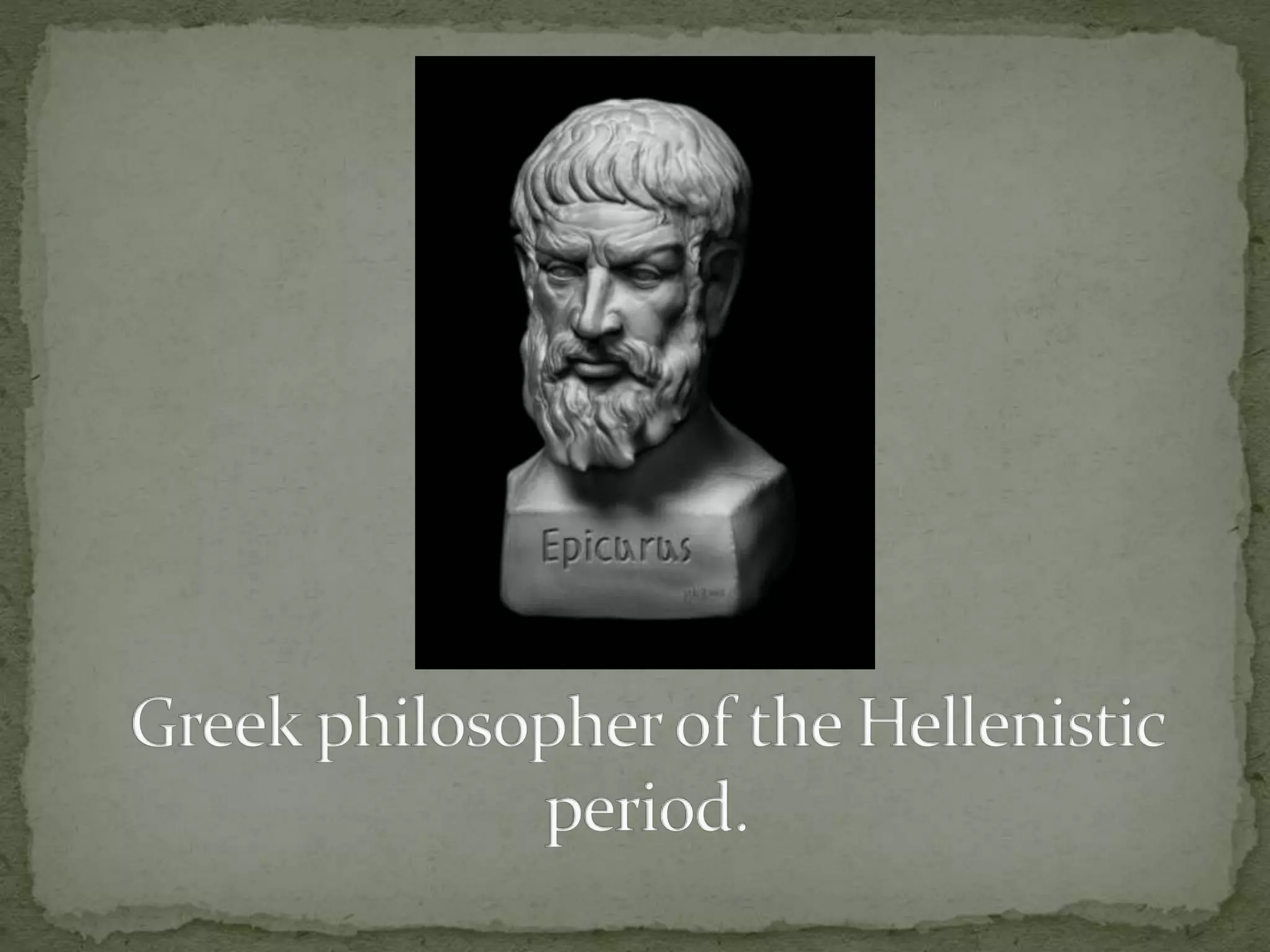
 Epicurus, Born 341 B.C, Samos,
Greece—died 270,
 Athens, Greek philosopher, author
of an ethical philosophy of simple
pleasure, friendship, and
retirement.
 He founded schools of philosophy
that survived directly from the 4th
century B.C. until the 4th century
A.D.
 He was also one of the first Greeks to break from the
god-fearing and god-worshipping tradition of the
time, and he caused something of a stir by claiming
that the gods do not concern themselves at all with
human.
 He strongly believed that death was not to be feared,
because all sensation and consciousness ends with
death, and so in death there is neither pleasure nor
pain.
 Epicurus is a key figure in the development of science
and the scientific method because of his insistence
believing nothing except that which can be tested
through direct observation and logical deduction.
Many of his ideas about nature and physics presaged
important scientific concepts of our time.
Epicurus is an empiricist
 The ultimate source
information for knowledge
comes from experience
 Either from sensation of
things outside of us or
experience of our own
thoughts and feelings
Reality is made up only of material bodies and void
 sense data shows us material bodies, and void must
exist for bodies to move or to be cut
 senses indicate nothing else.
Universe is eternal—you can’t get something
emerging from nothing
So some material must be eternal, but large bodies are
not
There must be smallest parts of matter (called
“atoms”) that are not further indivisible (or else could
dissolve into nothing), & they exist eternally.
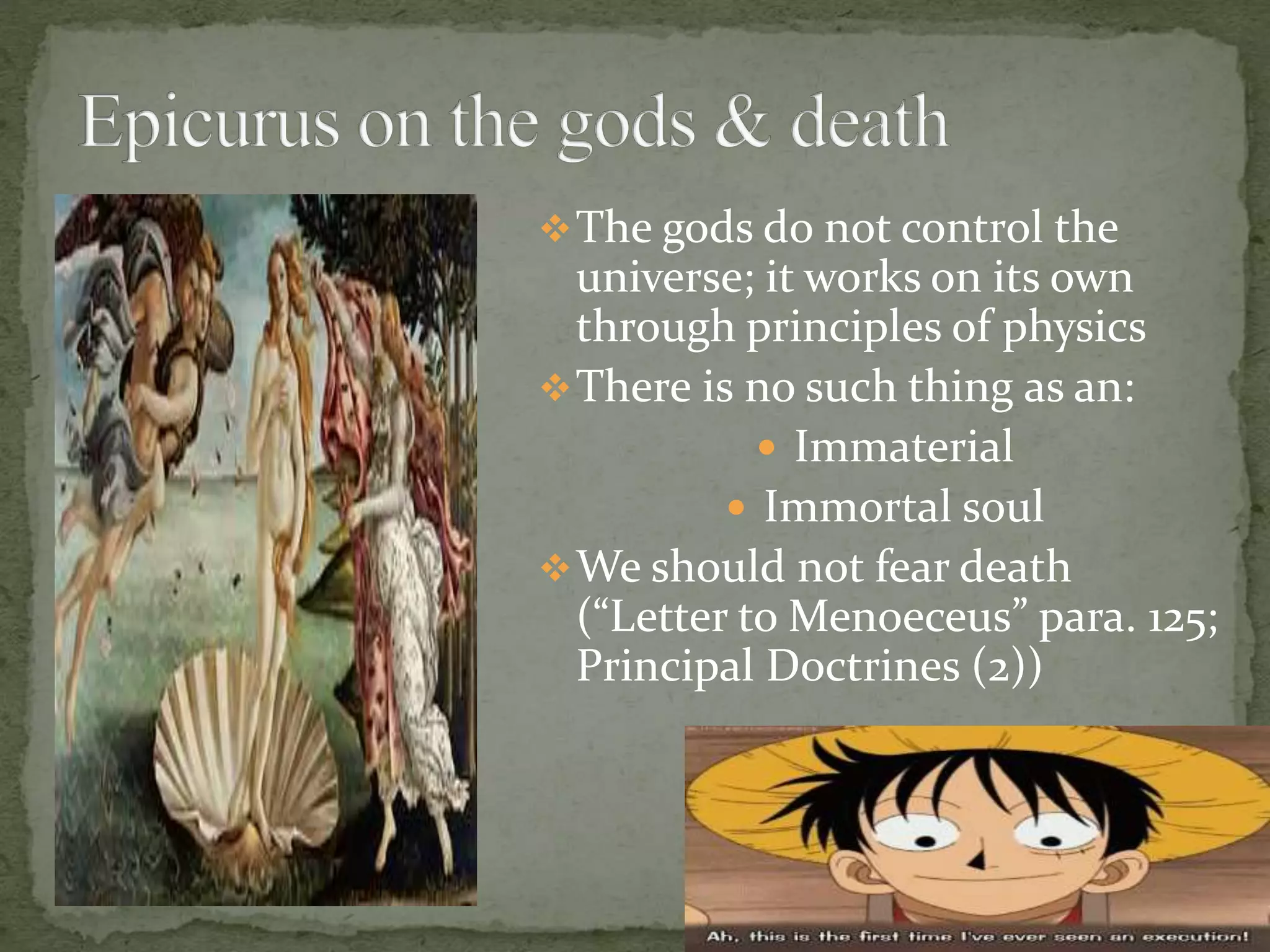
The gods do not control the
universe; it works on its own
through principles of physics
There is no such thing as an:
 Immaterial
 Immortal soul
We should not fear death
(“Letter to Menoeceus” para. 125;
Principal Doctrines (2))
THE VIRTUE OF PLEASURE
 One reason is our tendency to reject pleasure as a
moral good.
 We usually think of charity, compassion, humility,
wisdom, honor, justice, and other virtues as morally
good, while pleasure is, at best, morally neutral, but for
Epicurus, behavior in pursuit of pleasure assured an
upright life.
HEDONISM AND ATARAXIA
 Hedonism (a life devoted to pleasure) is what many of
us think of when we hear Epicurus' name, but ataraxia,
the experience of optimal, enduring pleasure, is what
we should associate with the atomist philosopher.
H.e.b report for philosophy

H.e.b report for philosophy

  • 2.
     The Socraticor Classical period of the Ancient era of philosophy denotes the Greek contemporaries and near contemporaries of the influential philosopher Socrates.  It includes the following major philosophers:  Socrates (464 - 399 B.C.) Greek  Plato (c. 428 - 348 B.C.) Greek  Aristotle (384 - 322 B.C.) Greek  Epicurus (341 - 270 B.C.) was a Greek
  • 4.
     Born around470 B. C. - Socrates was executed in 399 B. C.  Lived in Athens at the height of its civilisation.  Excellent soldier – he had great physical power and could endure a lot.  He was interested in the development of a person’s moral character.  He lived a virtuous life.  He attempted to improve the Athenians sense of justice  He claimed he was the wiser one since he was the only person aware of his own ignorance  Put on trial and found guilty ◦ heresy ◦ corrupting the minds of the youth
  • 5.
    The soul ishugely important in his philosophy  Had to be nurtured and protected.  Gaining wisdom would save the soul.  This would lead the person to living a virtuous life ‘Knowing what is good is the same as doing what is good.’ ~ Socrates.  Believed people would not willingly do wrong.  No-one wants to be a bad person.  Later philosophers would disagreed with him.  They said that a person might know what is right but may not be strong enough or disciplined enough to do.
  • 6.
    SOCRATES (470/469 –399 BC)  DIALECTIC: A method of seeking truth through a series of questions and answers.  The Socratic method is a “dialectic” method teaching.  To solve a problem, it is broken down into a series of questions, the answers to which gradually distil the answer a person would seek.
  • 7.
    Socrates Ethics primaryconcern in philosophy was, “How should we live?” 3 Questions  What is good?  What is right?  What is justice?
  • 8.
     Socrates' ethicsassumes that Education is the key to living an ethical life.  No one desires evil.  No one errs or does wrong willingly or knowingly.  Virtue—all virtue—is knowledge.  Virtue = positive moral behaviour.
  • 10.
    PLATO The GreatPhilosopher &His Contribution in the Field of Education
  • 11.
     Full name:Plato (Πλάτων)  Born: 428–427 BC; Athens  Died: 348–347 BC  Era: Ancient philosophy  Region: Western Philosophy  Notable ideas: Platonic realism  Influenced by: Socrates, Homer, Hesiod, Aristophanes,Aesop , Protagoras, Parmenides, Pythagoras, Heraclitus, Orphism
  • 12.
     Plato isperhaps the first philosopher whose complete works are still available to us.  He wrote no systematic treatises giving his views, but rather he wrote a number (about 35, although the authenticity of at least some of these remains in doubt) of superb dialogues, written in the form of conversations, a form which permitted him to develop the Socratic method of question and answer.
  • 13.
     Ethics (withdiscussion of the nature of virtue)  Metaphysics (where topics include immortality, man, mind, and Realism)  Political Philosophy (where topics such as censorship and the ideal state are discussed)  Philosophy of Religion (considering topics such as Atheism, Dualism and Pantheism)  Epistemology (where he looked at ideas such as a priori knowledge and Rationalism)  The Philosophy of Mathematics and the theory of art (especially dance, music, poetry, architecture and drama). In his dialogues, Plato discussed every kind of philosophical idea, including :
  • 14.
    Plato Ethics Humansare made of 3 conflicting elements: • PASSION • INTELLECT • WILL  Most people live life allowing the PASSIONS, INTELLECT and WILL to be in conflict with one another. Plato Ethics: Passions Intellect Will
  • 15.
     Ideal livingis when the INTELLECT controls the PASSIONS through the WILL.
  • 16.
    Reality can bedivided into two realms:  The Visible World  Forms - Ideas
  • 17.
    The Visible World Lower - Imperfect  World experienced by our senses  Physical  Bound by Space and Time  Always changing  Always “becoming”
  • 18.
    Realm of Forms-Ideas Higher - Perfect  ULTIMATE REALITY  Not accessible to our senses  Non-Physical  Not Bound by Space and Time  Never Changing Always “is”
  • 19.
     The IdealRepublic Philosophically Aware Rulers (Governing Class)  Police Class (Protective Class)  General Population (Worker Class)
  • 22.
     NAME: Aristotle OCCUPATION: philosopher  BIRTH DATE: c. 384 BCE DEATH DATE: c. 322 BCE  EDUCATION: Plato's Academy, Lyceum  PLACE OF BIRTH: Stagira, Chalcidice, Greece  PLACE OF DEATH: Chalcis, Euboea, Greece
  • 23.
     He wasa Greek philosopher and polymath. Also a student of Plato and teacher of Alexander the Great.  His writings cover many subjects, including physics, metaphysics, poetry, theatre, music, logic, rhetoric, linguistics, politics, government, ethics, biology, and zoology.  Aristotle's writings were the first to create a comprehensive system of Western philosophy, encompassing ethics, aesthetics, logic, science, politics, and metaphysics.
  • 24.
    Logic 3 Areasof Learning 1. Theoretical 2. Practical 3. Productive  Logic is a Tool underlying all learning
  • 25.
    Virtuous Life  Knowwhat is Right  Do what is Right  Practical Wisdom - Make Right Decisions based on Good Reasons  Contemplation of the Best things NOT just Good things – Good is the enemy of the Best  Motivation for Doing Anything is Flourishing
  • 28.
     Epicurus, Born341 B.C, Samos, Greece—died 270,  Athens, Greek philosopher, author of an ethical philosophy of simple pleasure, friendship, and retirement.  He founded schools of philosophy that survived directly from the 4th century B.C. until the 4th century A.D.
  • 29.
     He wasalso one of the first Greeks to break from the god-fearing and god-worshipping tradition of the time, and he caused something of a stir by claiming that the gods do not concern themselves at all with human.  He strongly believed that death was not to be feared, because all sensation and consciousness ends with death, and so in death there is neither pleasure nor pain.
  • 30.
     Epicurus isa key figure in the development of science and the scientific method because of his insistence believing nothing except that which can be tested through direct observation and logical deduction. Many of his ideas about nature and physics presaged important scientific concepts of our time.
  • 31.
    Epicurus is anempiricist  The ultimate source information for knowledge comes from experience  Either from sensation of things outside of us or experience of our own thoughts and feelings
  • 32.
    Reality is madeup only of material bodies and void  sense data shows us material bodies, and void must exist for bodies to move or to be cut  senses indicate nothing else. Universe is eternal—you can’t get something emerging from nothing So some material must be eternal, but large bodies are not There must be smallest parts of matter (called “atoms”) that are not further indivisible (or else could dissolve into nothing), & they exist eternally.
  • 33.
    The gods donot control the universe; it works on its own through principles of physics There is no such thing as an:  Immaterial  Immortal soul We should not fear death (“Letter to Menoeceus” para. 125; Principal Doctrines (2))
  • 34.
    THE VIRTUE OFPLEASURE  One reason is our tendency to reject pleasure as a moral good.  We usually think of charity, compassion, humility, wisdom, honor, justice, and other virtues as morally good, while pleasure is, at best, morally neutral, but for Epicurus, behavior in pursuit of pleasure assured an upright life.
  • 35.
    HEDONISM AND ATARAXIA Hedonism (a life devoted to pleasure) is what many of us think of when we hear Epicurus' name, but ataraxia, the experience of optimal, enduring pleasure, is what we should associate with the atomist philosopher.