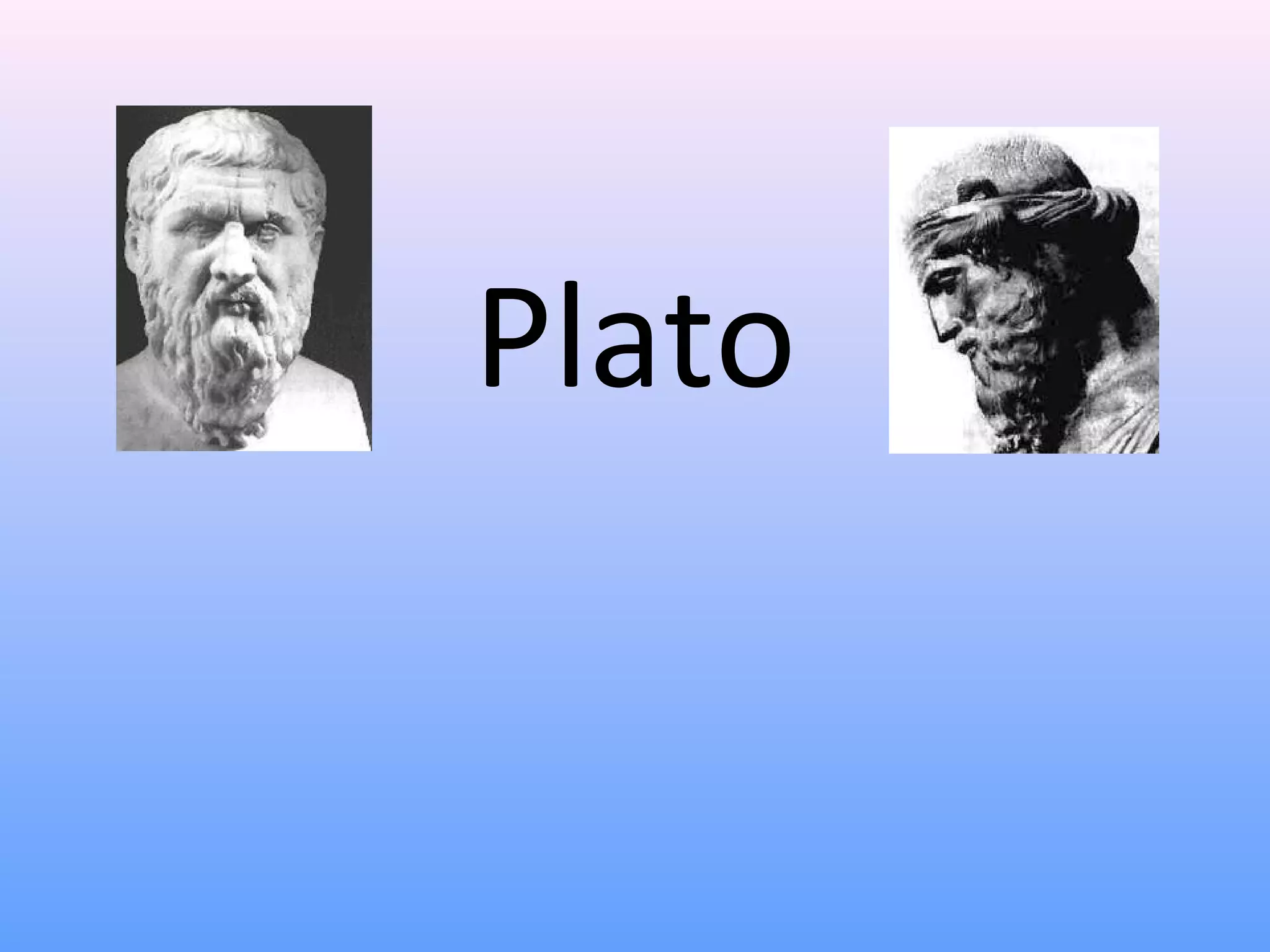
Plato
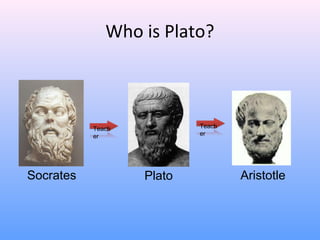
Who is Plato?
Teach
er
Teach
er
Socrates Plato Aristotle
Plato’s Biography
•Born around the year 428 B.C. in Athens
•His father died when he was young
•Plato’s birth name was Aristocles (not to be
confused with Aristotle) and he gained the
nickname “Platon” because of his broad build
•When he was young, his basis of study was
music and poetry
•Plato was in the military service from 409 B.C.
to 404 B.C. and then joined a group called the
Thirty Tyrants, but ended up leaving it because
of the violence
• Socrates was Plato’s disciple and Plato started to adopt
his philosophy & style of debate.
• After Socrates’ death in 399 B.C., Plato left Athens with
some friends and traveled for the next 12 years while
studying geometry, geology, astronomy, and religion.
• Plato’s studies were directed toward the question of
virtue & the formation of noble character
Plato Back In ATHENS
• When Plato returned to Athens
in 387 B.C., he started a school
of learning called the
Academy, which was
eventually described as the 1st
European University
• At the Academy, he taught his
subjects astronomy, biology,
mathematics, political theory,
and philosophy.
Plato’s Works
• He had 36 dialogues (books) and 13 letters- “The
Republic”
• Give readers a sense of philosophy as a living and
unfinished subject, to which they will need to
contribute to finish
• Modern scholars doubt the authenticity
• After writing, his works were “lost” until the
Renaissance
• They have been steadily studied since
• Big influence in math and science
– Difference between arithmetic and logistic
• “He believed that ideas were far more real
than the natural world. He advised that
astronomers not waste their time observing
the stars and planets. It was better he
believed, just to think about them”- Carl
Sagan
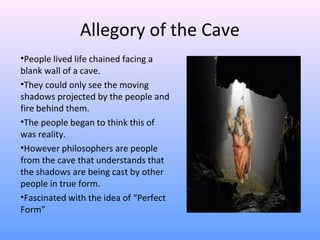
Allegory of the Cave
•People lived life chained facing a
blank wall of a cave.
•They could only see the moving
shadows projected by the people and
fire behind them.
•The people began to think this of
was reality.
•However philosophers are people
from the cave that understands that
the shadows are being cast by other
people in true form.
•Fascinated with the idea of “Perfect
Form”
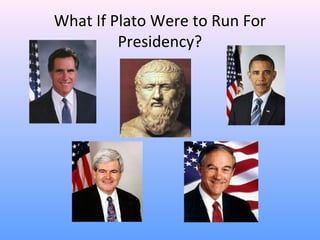
What If Plato Were to Run For
Presidency?
Plato & Politics
• The Republic
– Virtues of Justice
– Courage
– Wisdom and Moderation (Individual and Society)
• 3 Part Society
– Workers (producing)
• The “appetite” of the soul
– Warriors (protecting)
• The “spirit” of the soul
– Rulers (governing)
• The “reason” of the soul
Plato & Politics Cont.
Courage is not merely military courage but
primarily civic courage: the ability to preserve
the right, law-inspired belief, and stand in
defense of such values as friendship and
freedom on which a good society is founded.
Plato & Politics Cont.
Plato’s Government Would Have:
• Multiparty System
• Periodic Elections
• Professional Civil Service (Union)
Plato believed that that there could be a body of
knowledge whose attainment would make it
possible to completely heal political problems.
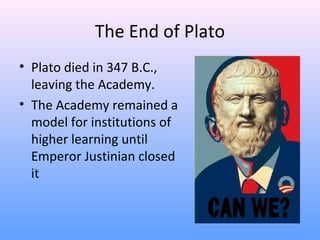
The End of Plato
• Plato died in 347 B.C.,
leaving the Academy.
• The Academy remained a
model for institutions of
higher learning until
Emperor Justinian closed
it
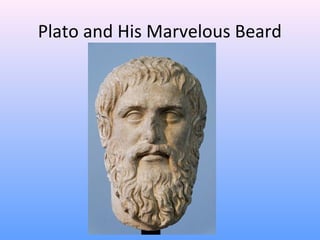
Plato and His Marvelous Beard

Plato

  • 1.
  • 2.
  • 3.
    Plato’s Biography •Born aroundthe year 428 B.C. in Athens •His father died when he was young •Plato’s birth name was Aristocles (not to be confused with Aristotle) and he gained the nickname “Platon” because of his broad build •When he was young, his basis of study was music and poetry •Plato was in the military service from 409 B.C. to 404 B.C. and then joined a group called the Thirty Tyrants, but ended up leaving it because of the violence
  • 4.
    • Socrates wasPlato’s disciple and Plato started to adopt his philosophy & style of debate. • After Socrates’ death in 399 B.C., Plato left Athens with some friends and traveled for the next 12 years while studying geometry, geology, astronomy, and religion. • Plato’s studies were directed toward the question of virtue & the formation of noble character
  • 5.
    Plato Back InATHENS • When Plato returned to Athens in 387 B.C., he started a school of learning called the Academy, which was eventually described as the 1st European University • At the Academy, he taught his subjects astronomy, biology, mathematics, political theory, and philosophy.
  • 6.
    Plato’s Works • Hehad 36 dialogues (books) and 13 letters- “The Republic” • Give readers a sense of philosophy as a living and unfinished subject, to which they will need to contribute to finish • Modern scholars doubt the authenticity • After writing, his works were “lost” until the Renaissance • They have been steadily studied since • Big influence in math and science – Difference between arithmetic and logistic
  • 7.
    • “He believedthat ideas were far more real than the natural world. He advised that astronomers not waste their time observing the stars and planets. It was better he believed, just to think about them”- Carl Sagan
  • 8.
    Allegory of theCave •People lived life chained facing a blank wall of a cave. •They could only see the moving shadows projected by the people and fire behind them. •The people began to think this of was reality. •However philosophers are people from the cave that understands that the shadows are being cast by other people in true form. •Fascinated with the idea of “Perfect Form”
  • 9.
    What If PlatoWere to Run For Presidency?
  • 10.
    Plato & Politics •The Republic – Virtues of Justice – Courage – Wisdom and Moderation (Individual and Society) • 3 Part Society – Workers (producing) • The “appetite” of the soul – Warriors (protecting) • The “spirit” of the soul – Rulers (governing) • The “reason” of the soul
  • 11.
    Plato & PoliticsCont. Courage is not merely military courage but primarily civic courage: the ability to preserve the right, law-inspired belief, and stand in defense of such values as friendship and freedom on which a good society is founded.
  • 12.
    Plato & PoliticsCont. Plato’s Government Would Have: • Multiparty System • Periodic Elections • Professional Civil Service (Union) Plato believed that that there could be a body of knowledge whose attainment would make it possible to completely heal political problems.
  • 13.
    The End ofPlato • Plato died in 347 B.C., leaving the Academy. • The Academy remained a model for institutions of higher learning until Emperor Justinian closed it
  • 14.
    Plato and HisMarvelous Beard