Classical Encryption
Techniques
Introduction to Network Security
Classical encryption techniques
• Encryption :-
– Encryption is something like making a secret letter by
changing, swapping or replacing characters in
previously defend order. The format of the message is
not changed.
• Encoding :-
– In coding the format of data is changed. For example
we record a voice sample, the recorder will encode
the analog voice signals into digital signals & store.
2
Basic terminology
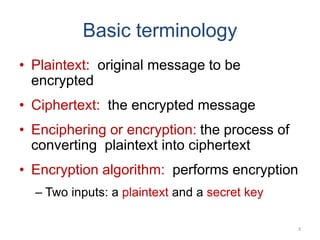
• Plaintext: original message to be
encrypted
• Ciphertext: the encrypted message
• Enciphering or encryption: the process of
converting plaintext into ciphertext
• Encryption algorithm: performs encryption
– Two inputs: a plaintext and a secret key
3
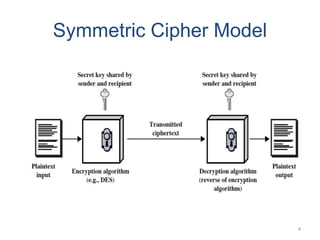
Symmetric Cipher Model
4
• Deciphering or decryption: recovering
plaintext from ciphertext
• Decryption algorithm: performs decryption
– Two inputs: ciphertext and secret key
• Secret key: same key used for encryption
and decryption
– Also referred to as a symmetric key
5
• Cipher or cryptographic system : a scheme
for encryption and decryption
• Cryptography: science of studying ciphers
• Cryptanalysis: science of studying attacks
against cryptographic systems
• Cryptology: cryptography + cryptanalysis
6
Ciphers
• Symmetric cipher: same key used for
encryption and decryption
– Block cipher: encrypts a block of plaintext at a
time (typically 64 or 128 bits)
– Stream cipher: encrypts data one bit or one byte
at a time
• Asymmetric cipher: different keys used for
encryption and decryption
7
Symmetric Encryption
• or conventional / secret-key / single-key
• sender and recipient share a common key
• all classical encryption algorithms are
symmetric
8
Symmetric Encryption
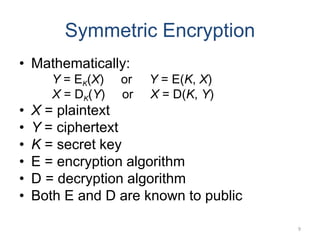
• Mathematically:
Y = EK(X) or Y = E(K, X)
X = DK(Y) or X = D(K, Y)
• X = plaintext
• Y = ciphertext
• K = secret key
• E = encryption algorithm
• D = decryption algorithm
• Both E and D are known to public
9
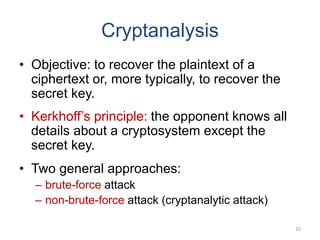
Cryptanalysis
• Objective: to recover the plaintext of a
ciphertext or, more typically, to recover the
secret key.
• Kerkhoff’s principle: the opponent knows all
details about a cryptosystem except the
secret key.
• Two general approaches:
– brute-force attack
– non-brute-force attack (cryptanalytic attack)
10
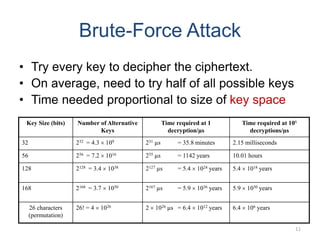
Brute-Force Attack
• Try every key to decipher the ciphertext.
• On average, need to try half of all possible keys
• Time needed proportional to size of key space
Key Size (bits) Number of Alternative
Keys
Time required at 1
decryption/µs
Time required at 106
decryptions/µs
32 232 = 4.3  109 231 µs = 35.8 minutes 2.15 milliseconds
56 256 = 7.2  1016 255 µs = 1142 years 10.01 hours
128 2128 = 3.4  1038 2127 µs = 5.4  1024 years 5.4  1018 years
168 2168 = 3.7  1050 2167 µs = 5.9  1036 years 5.9  1030 years
26 characters
(permutation)
26! = 4  1026 2  1026 µs = 6.4  1012 years 6.4  106 years
11
12
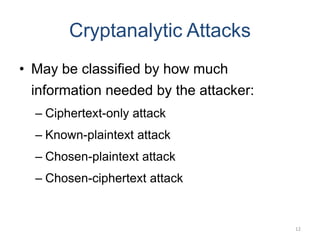
Cryptanalytic Attacks
• May be classified by how much
information needed by the attacker:
– Ciphertext-only attack
– Known-plaintext attack
– Chosen-plaintext attack
– Chosen-ciphertext attack
Classical Ciphers
• Plaintext is viewed as a sequence of
elements (e.g., bits or characters)
• Substitution cipher: replacing each
element of the plaintext with another
element.
• Transposition (or permutation) cipher:
rearranging the order of the elements of
the plaintext.
13
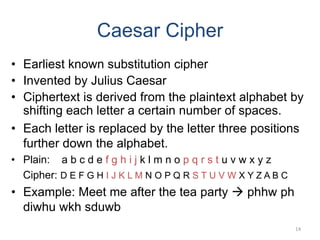
Caesar Cipher
• Earliest known substitution cipher
• Invented by Julius Caesar
• Ciphertext is derived from the plaintext alphabet by
shifting each letter a certain number of spaces.
• Each letter is replaced by the letter three positions
further down the alphabet.
• Plain: a b c d e f g h i j k l m n o p q r s t u v w x y z
Cipher: D E F G H I J K L M N O P Q R S T U V W X Y Z A B C
• Example: Meet me after the tea party  phhw ph
diwhu wkh sduwb
14
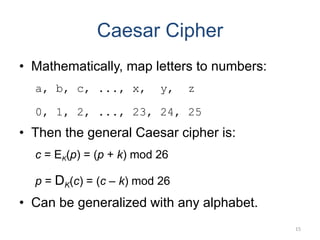
Caesar Cipher
• Mathematically, map letters to numbers:
a, b, c, ..., x, y, z
0, 1, 2, ..., 23, 24, 25
• Then the general Caesar cipher is:
c = EK(p) = (p + k) mod 26
p = DK(c) = (c – k) mod 26
• Can be generalized with any alphabet.
15
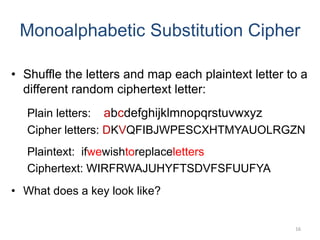
Monoalphabetic Substitution Cipher
• Shuffle the letters and map each plaintext letter to a
different random ciphertext letter:
Plain letters: abcdefghijklmnopqrstuvwxyz
Cipher letters: DKVQFIBJWPESCXHTMYAUOLRGZN
Plaintext: ifwewishtoreplaceletters
Ciphertext: WIRFRWAJUHYFTSDVFSFUUFYA
• What does a key look like?
16
Playfair Cipher
•
• One approach to improving security is to encrypt multiple letters at a
time.
• The Playfair Cipher is the best known such cipher.
• Invented by Charles Wheatstone in 1854, but named after his friend
Baron Playfair.
• Simplest substitution cipher with two letters combination.
• Encryption algo takes 5x5 matrix of letters.
• Generate the key table. (drop any duplicate letter).
• Key alphabets are filled in matrix from left to right & top to bottom.
• Rest of the letters are filled in matrix in remaining spaces.
• Letters I & j takes the same place.
17
Playfair Cipher
• Rules:
– If pair letters are same, add an X (uncommon
letter) after the first letter.
• Balloon will be (ba lx lo on).
– If the letter appear in same row / column of the
table, replace them with the letter to immediate
right respectively.
– If the letters are not on same row or column ,
replace with letter in the corners of rectangle.
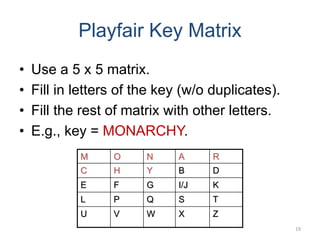
Playfair Key Matrix
• Use a 5 x 5 matrix.
• Fill in letters of the key (w/o duplicates).
• Fill the rest of matrix with other letters.
• E.g., key = MONARCHY.
M O N A R
C H Y B D
E F G I/J K
L P Q S T
U V W X Z
19
Encrypting and Decrypting
Plaintext is encrypted two letters at a time.
1. If a pair is a repeated letter, insert filler like 'X’.
2. If both letters fall in the same row, replace
each with the letter to its right (circularly).
3. If both letters fall in the same column, replace
each with the the letter below it (circularly).
4. Otherwise, each letter is replaced by the letter
in the same row but in the column of the other
letter of the pair.
20
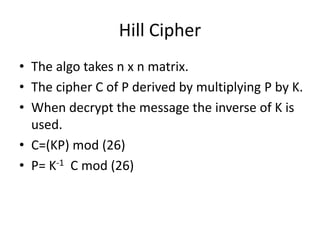
Hill Cipher
• The algo takes n x n matrix.
• The cipher C of P derived by multiplying P by K.
• When decrypt the message the inverse of K is
used.
• C=(KP) mod (26)
• P= K-1 C mod (26)
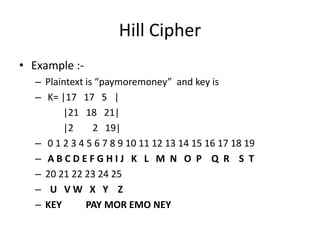
Hill Cipher
• Example :-
– Plaintext is “paymoremoney” and key is
– K= |17 17 5 |
|21 18 21|
|2 2 19|
– 0 1 2 3 4 5 6 7 8 9 10 11 12 13 14 15 16 17 18 19
– A B C D E F G H I J K L M N O P Q R S T
– 20 21 22 23 24 25
– U V W X Y Z
– KEY PAY MOR EMO NEY
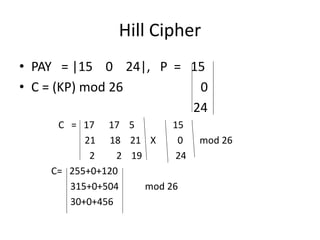
Hill Cipher
• PAY = |15 0 24|, P = 15
• C = (KP) mod 26 0
24
C = 17 17 5 15
21 18 21 X 0 mod 26
2 2 19 24
C= 255+0+120
315+0+504 mod 26
30+0+456
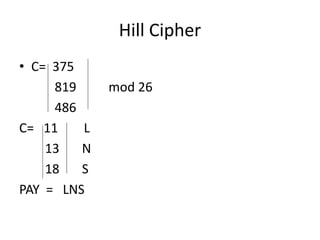
Hill Cipher
• C= 375
819 mod 26
486
C= 11 L
13 N
18 S
PAY = LNS
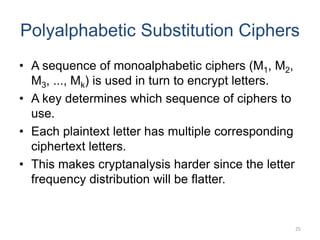
Polyalphabetic Substitution Ciphers
• A sequence of monoalphabetic ciphers (M1, M2,
M3, ..., Mk) is used in turn to encrypt letters.
• A key determines which sequence of ciphers to
use.
• Each plaintext letter has multiple corresponding
ciphertext letters.
• This makes cryptanalysis harder since the letter
frequency distribution will be flatter.
25
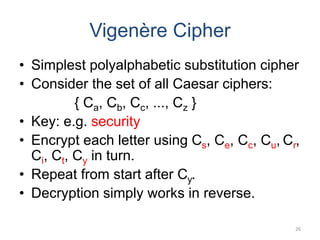
Vigenère Cipher
• Simplest polyalphabetic substitution cipher
• Consider the set of all Caesar ciphers:
{ Ca, Cb, Cc, ..., Cz }
• Key: e.g. security
• Encrypt each letter using Cs, Ce, Cc, Cu, Cr,
Ci, Ct, Cy in turn.
• Repeat from start after Cy.
• Decryption simply works in reverse.
26
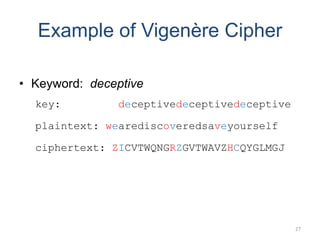
Example of Vigenère Cipher
• Keyword: deceptive
key: deceptivedeceptivedeceptive
plaintext: wearediscoveredsaveyourself
ciphertext: ZICVTWQNGRZGVTWAVZHCQYGLMGJ
27
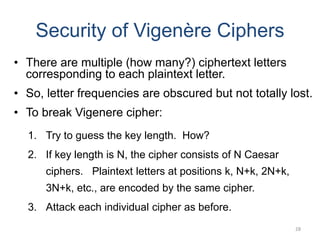
Security of Vigenère Ciphers
• There are multiple (how many?) ciphertext letters
corresponding to each plaintext letter.
• So, letter frequencies are obscured but not totally lost.
• To break Vigenere cipher:
1. Try to guess the key length. How?
2. If key length is N, the cipher consists of N Caesar
ciphers. Plaintext letters at positions k, N+k, 2N+k,
3N+k, etc., are encoded by the same cipher.
3. Attack each individual cipher as before.
28
Transposition Ciphers
• Also called permutation ciphers.
• Shuffle the plaintext, without altering the
actual letters used.
• Example: Row Transposition Ciphers
29
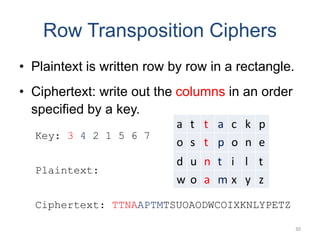
Row Transposition Ciphers
• Plaintext is written row by row in a rectangle.
• Ciphertext: write out the columns in an order
specified by a key.
Key: 3 4 2 1 5 6 7
Plaintext:
Ciphertext: TTNAAPTMTSUOAODWCOIXKNLYPETZ
a t t a c k p
o s t p o n e
d u n t i l t
w o a m x y z
30
Product Ciphers
• Uses a sequence of substitutions and
transpositions
– Harder to break than just substitutions or
transpositions
• This is a bridge from classical to modern ciphers.
31
Unconditional & Computational
Security
• A cipher is unconditionally secure if it is
secure no matter how much resources
(time, space) the attacker has.
• A cipher is computationally secure if the
best algorithm for breaking it will require
so much resources (e.g., 1000 years) that
practically the cryptosystem is secure.
• All the ciphers we have examined are not
unconditionally secure.
32
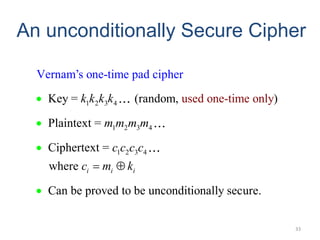
An unconditionally Secure Cipher
33
1 2 3 4
1 2 3 4
1 2 3 4
Key = (random, )
Plaintext =
Cipherte
Vernam’s one-time pad cip
used one-time only
xt =
where
Can be proved to be unconditionally sec
her
ur .
e
i i i
k k k k
m m m m
c c c c
c m k
 




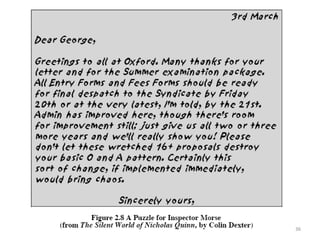
Steganography
• Hide a message in another message.
• E.g., hide your plaintext in a graphic image
– Each pixel has 3 bytes specifying the RGB color
– The least significant bits of pixels can be
changed w/o greatly affecting the image quality
– So can hide messages in these LSBs
• Advantage: hiding existence of messages
• Drawback: high overhead
34
35
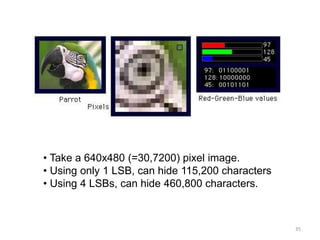
• Take a 640x480 (=30,7200) pixel image.
• Using only 1 LSB, can hide 115,200 characters
• Using 4 LSBs, can hide 460,800 characters.
36
Summary
• Have considered:
– classical cipher techniques and terminology
– monoalphabetic substitution ciphers
– cryptanalysis using letter frequencies
– Playfair cipher
– polyalphabetic ciphers
– transposition ciphers
– product ciphers and rotor machines
– stenography
37

EncryptionTechChap2.ppt

  • 1.
  • 2.
    Classical encryption techniques •Encryption :- – Encryption is something like making a secret letter by changing, swapping or replacing characters in previously defend order. The format of the message is not changed. • Encoding :- – In coding the format of data is changed. For example we record a voice sample, the recorder will encode the analog voice signals into digital signals & store. 2
  • 3.
    Basic terminology • Plaintext:original message to be encrypted • Ciphertext: the encrypted message • Enciphering or encryption: the process of converting plaintext into ciphertext • Encryption algorithm: performs encryption – Two inputs: a plaintext and a secret key 3
  • 4.
  • 5.
    • Deciphering ordecryption: recovering plaintext from ciphertext • Decryption algorithm: performs decryption – Two inputs: ciphertext and secret key • Secret key: same key used for encryption and decryption – Also referred to as a symmetric key 5
  • 6.
    • Cipher orcryptographic system : a scheme for encryption and decryption • Cryptography: science of studying ciphers • Cryptanalysis: science of studying attacks against cryptographic systems • Cryptology: cryptography + cryptanalysis 6
  • 7.
    Ciphers • Symmetric cipher:same key used for encryption and decryption – Block cipher: encrypts a block of plaintext at a time (typically 64 or 128 bits) – Stream cipher: encrypts data one bit or one byte at a time • Asymmetric cipher: different keys used for encryption and decryption 7
  • 8.
    Symmetric Encryption • orconventional / secret-key / single-key • sender and recipient share a common key • all classical encryption algorithms are symmetric 8
  • 9.
    Symmetric Encryption • Mathematically: Y= EK(X) or Y = E(K, X) X = DK(Y) or X = D(K, Y) • X = plaintext • Y = ciphertext • K = secret key • E = encryption algorithm • D = decryption algorithm • Both E and D are known to public 9
  • 10.
    Cryptanalysis • Objective: torecover the plaintext of a ciphertext or, more typically, to recover the secret key. • Kerkhoff’s principle: the opponent knows all details about a cryptosystem except the secret key. • Two general approaches: – brute-force attack – non-brute-force attack (cryptanalytic attack) 10
  • 11.
    Brute-Force Attack • Tryevery key to decipher the ciphertext. • On average, need to try half of all possible keys • Time needed proportional to size of key space Key Size (bits) Number of Alternative Keys Time required at 1 decryption/µs Time required at 106 decryptions/µs 32 232 = 4.3  109 231 µs = 35.8 minutes 2.15 milliseconds 56 256 = 7.2  1016 255 µs = 1142 years 10.01 hours 128 2128 = 3.4  1038 2127 µs = 5.4  1024 years 5.4  1018 years 168 2168 = 3.7  1050 2167 µs = 5.9  1036 years 5.9  1030 years 26 characters (permutation) 26! = 4  1026 2  1026 µs = 6.4  1012 years 6.4  106 years 11
  • 12.
    12 Cryptanalytic Attacks • Maybe classified by how much information needed by the attacker: – Ciphertext-only attack – Known-plaintext attack – Chosen-plaintext attack – Chosen-ciphertext attack
  • 13.
    Classical Ciphers • Plaintextis viewed as a sequence of elements (e.g., bits or characters) • Substitution cipher: replacing each element of the plaintext with another element. • Transposition (or permutation) cipher: rearranging the order of the elements of the plaintext. 13
  • 14.
    Caesar Cipher • Earliestknown substitution cipher • Invented by Julius Caesar • Ciphertext is derived from the plaintext alphabet by shifting each letter a certain number of spaces. • Each letter is replaced by the letter three positions further down the alphabet. • Plain: a b c d e f g h i j k l m n o p q r s t u v w x y z Cipher: D E F G H I J K L M N O P Q R S T U V W X Y Z A B C • Example: Meet me after the tea party  phhw ph diwhu wkh sduwb 14
  • 15.
    Caesar Cipher • Mathematically,map letters to numbers: a, b, c, ..., x, y, z 0, 1, 2, ..., 23, 24, 25 • Then the general Caesar cipher is: c = EK(p) = (p + k) mod 26 p = DK(c) = (c – k) mod 26 • Can be generalized with any alphabet. 15
  • 16.
    Monoalphabetic Substitution Cipher •Shuffle the letters and map each plaintext letter to a different random ciphertext letter: Plain letters: abcdefghijklmnopqrstuvwxyz Cipher letters: DKVQFIBJWPESCXHTMYAUOLRGZN Plaintext: ifwewishtoreplaceletters Ciphertext: WIRFRWAJUHYFTSDVFSFUUFYA • What does a key look like? 16
  • 17.
    Playfair Cipher • • Oneapproach to improving security is to encrypt multiple letters at a time. • The Playfair Cipher is the best known such cipher. • Invented by Charles Wheatstone in 1854, but named after his friend Baron Playfair. • Simplest substitution cipher with two letters combination. • Encryption algo takes 5x5 matrix of letters. • Generate the key table. (drop any duplicate letter). • Key alphabets are filled in matrix from left to right & top to bottom. • Rest of the letters are filled in matrix in remaining spaces. • Letters I & j takes the same place. 17
  • 18.
    Playfair Cipher • Rules: –If pair letters are same, add an X (uncommon letter) after the first letter. • Balloon will be (ba lx lo on). – If the letter appear in same row / column of the table, replace them with the letter to immediate right respectively. – If the letters are not on same row or column , replace with letter in the corners of rectangle.
  • 19.
    Playfair Key Matrix •Use a 5 x 5 matrix. • Fill in letters of the key (w/o duplicates). • Fill the rest of matrix with other letters. • E.g., key = MONARCHY. M O N A R C H Y B D E F G I/J K L P Q S T U V W X Z 19
  • 20.
    Encrypting and Decrypting Plaintextis encrypted two letters at a time. 1. If a pair is a repeated letter, insert filler like 'X’. 2. If both letters fall in the same row, replace each with the letter to its right (circularly). 3. If both letters fall in the same column, replace each with the the letter below it (circularly). 4. Otherwise, each letter is replaced by the letter in the same row but in the column of the other letter of the pair. 20
  • 21.
    Hill Cipher • Thealgo takes n x n matrix. • The cipher C of P derived by multiplying P by K. • When decrypt the message the inverse of K is used. • C=(KP) mod (26) • P= K-1 C mod (26)
  • 22.
    Hill Cipher • Example:- – Plaintext is “paymoremoney” and key is – K= |17 17 5 | |21 18 21| |2 2 19| – 0 1 2 3 4 5 6 7 8 9 10 11 12 13 14 15 16 17 18 19 – A B C D E F G H I J K L M N O P Q R S T – 20 21 22 23 24 25 – U V W X Y Z – KEY PAY MOR EMO NEY
  • 23.
    Hill Cipher • PAY= |15 0 24|, P = 15 • C = (KP) mod 26 0 24 C = 17 17 5 15 21 18 21 X 0 mod 26 2 2 19 24 C= 255+0+120 315+0+504 mod 26 30+0+456
  • 24.
    Hill Cipher • C=375 819 mod 26 486 C= 11 L 13 N 18 S PAY = LNS
  • 25.
    Polyalphabetic Substitution Ciphers •A sequence of monoalphabetic ciphers (M1, M2, M3, ..., Mk) is used in turn to encrypt letters. • A key determines which sequence of ciphers to use. • Each plaintext letter has multiple corresponding ciphertext letters. • This makes cryptanalysis harder since the letter frequency distribution will be flatter. 25
  • 26.
    Vigenère Cipher • Simplestpolyalphabetic substitution cipher • Consider the set of all Caesar ciphers: { Ca, Cb, Cc, ..., Cz } • Key: e.g. security • Encrypt each letter using Cs, Ce, Cc, Cu, Cr, Ci, Ct, Cy in turn. • Repeat from start after Cy. • Decryption simply works in reverse. 26
  • 27.
    Example of VigenèreCipher • Keyword: deceptive key: deceptivedeceptivedeceptive plaintext: wearediscoveredsaveyourself ciphertext: ZICVTWQNGRZGVTWAVZHCQYGLMGJ 27
  • 28.
    Security of VigenèreCiphers • There are multiple (how many?) ciphertext letters corresponding to each plaintext letter. • So, letter frequencies are obscured but not totally lost. • To break Vigenere cipher: 1. Try to guess the key length. How? 2. If key length is N, the cipher consists of N Caesar ciphers. Plaintext letters at positions k, N+k, 2N+k, 3N+k, etc., are encoded by the same cipher. 3. Attack each individual cipher as before. 28
  • 29.
    Transposition Ciphers • Alsocalled permutation ciphers. • Shuffle the plaintext, without altering the actual letters used. • Example: Row Transposition Ciphers 29
  • 30.
    Row Transposition Ciphers •Plaintext is written row by row in a rectangle. • Ciphertext: write out the columns in an order specified by a key. Key: 3 4 2 1 5 6 7 Plaintext: Ciphertext: TTNAAPTMTSUOAODWCOIXKNLYPETZ a t t a c k p o s t p o n e d u n t i l t w o a m x y z 30
  • 31.
    Product Ciphers • Usesa sequence of substitutions and transpositions – Harder to break than just substitutions or transpositions • This is a bridge from classical to modern ciphers. 31
  • 32.
    Unconditional & Computational Security •A cipher is unconditionally secure if it is secure no matter how much resources (time, space) the attacker has. • A cipher is computationally secure if the best algorithm for breaking it will require so much resources (e.g., 1000 years) that practically the cryptosystem is secure. • All the ciphers we have examined are not unconditionally secure. 32
  • 33.
    An unconditionally SecureCipher 33 1 2 3 4 1 2 3 4 1 2 3 4 Key = (random, ) Plaintext = Cipherte Vernam’s one-time pad cip used one-time only xt = where Can be proved to be unconditionally sec her ur . e i i i k k k k m m m m c c c c c m k      
  • 34.
    Steganography • Hide amessage in another message. • E.g., hide your plaintext in a graphic image – Each pixel has 3 bytes specifying the RGB color – The least significant bits of pixels can be changed w/o greatly affecting the image quality – So can hide messages in these LSBs • Advantage: hiding existence of messages • Drawback: high overhead 34
  • 35.
    35 • Take a640x480 (=30,7200) pixel image. • Using only 1 LSB, can hide 115,200 characters • Using 4 LSBs, can hide 460,800 characters.
  • 36.
  • 37.
    Summary • Have considered: –classical cipher techniques and terminology – monoalphabetic substitution ciphers – cryptanalysis using letter frequencies – Playfair cipher – polyalphabetic ciphers – transposition ciphers – product ciphers and rotor machines – stenography 37