



Business models,
Revenue models,
Value chain
Business models
What Is an e-Business Model?
• The e-Business model, like any business
model, describes
– how a company functions;
– how it provides a product or service,
– how it generates revenue, and
– how it will create and adapt to new markets and
technologies.
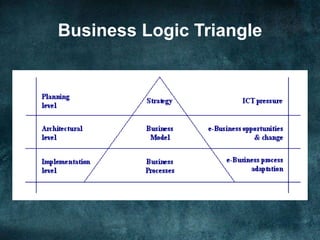
Business Logic Triangle
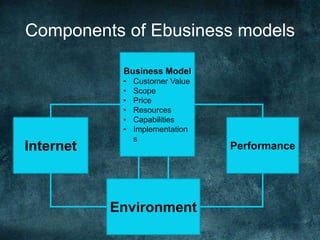
Components of Ebusiness models
Business Model
• Customer Value
• Scope
• Price
• Resources
• Capabilities
• Implementation
s
Internet Performance
Environment
Storefront Model
• The storefront combines transaction processing,
security, online payment and information storage
to enable merchants to sell their products on the
Web.
• This is a basic form of e-commerce where the
buyer and the seller interact directly.
• To conduct storefront e-commerce, merchants
need to organize an online catalogue of products,
take orders through their Web sites, accept
payments in a secure environment, send
merchandise to customers and manage customer
data
Storefront Model
• Some of the most successful e-businesses
are using the storefront model.
• Many of the leading storefront model
companies are B2C companies
• Companies use a shopping cart and
supporting technologies to offer their products
and services to customers
Shopping Cart Technology
• This order processing technology allows customers
to accumulate items they wish to buy as they
continue to shop.
• Supporting the shopping cart is a product catalogue,
which is hosted on the merchant server in the form
of a database
• Databases also store customer information, such as
names, addresses, credit-card information and past
purchases
Auction Model
• Auction sites act as forums through which Internet
users can log-on and assume the role of either
bidder or seller.
• As a seller, you are able to post an item you wish to
sell, the minimum price you require to sell your item
and a deadline to close the auction.
• Some sites allow you to add features, such as a
photograph or a description of the item’s condition.
Auction Model
• As a bidder, you may search the site for availability
of the item you are seeking, view the current bidding
activity and place a bid (bids are usually in
designated increments).
• Some sites allow you to submit a maximum bidding
price and will continue bidding for you.
Portal Model
• Portal sites give visitors the chance to find almost
everything they are looking for in one place.
• They often offer news, sports and weather, as well
as the ability to search the Web.
• Search engines are horizontal portals, or portals that
aggregate information on a broad range of topics.
• Other portals are more specific, offering a great deal
of information pertaining to a single area of interest
these are called vertical portals.
Dynamic Pricing Model
• The web has changed the way business is done and
the way products are priced.
• In the past, bargain hunters had to search out deals
by visiting numerous local retailers and wholesalers.
Today it just few click away.
Name Your Price Model
• The name your price model empowers customers by
allowing them to choose their price for products and
services.
• Many of the businesses that offer this services have
formed partnerships with leaders of industries such
as travel, lending and retail.
• These industry leaders receive the customer’s
desired price from the intermediary and decide
whether or not to sell the product or service.
• If the customer price is not reasonable then that
customer can ask for another price.
Comparison Pricing Model
• It allows the customer to poll a variety of merchants
and find a desired product or service at the lowest
price.
• These sites gets their revenue from the partnerships
with particular merchants.
• www.Bottomdollar.com
Demand Sensitive Pricing Model
• The more people who buy a product in a single
purchase, the lower the cost-per-person becomes.
• Selling products individually can be expensive
because the vendor must price a product so that it
covers selling and overhead cost while still
generating a profit.
• When customers buy in bulk, the cost is shared and
the profit margin is increased.
• www.mer-cata.com
• www.mobshop.com
Bartering Model
• Offering one item in exchange for another.
– www.ubarter.com
• The seller makes an initial offer with the intention of
bartering to reach a final agreement with the buyer.
– www.isolve.com
Rebate Model
• EDLP
• eBates is a shopping site where customers receive
a rebate on every purchase.
• eBates have formed partnership with wholesalers
and retailers who will offer discount.
Offering Free Products and Service
• They offer their products for free on the web.
• Many of these sites also form partnership with
companies to exchange products and services for
advertisement space and vice versa.
• www.hsx.com
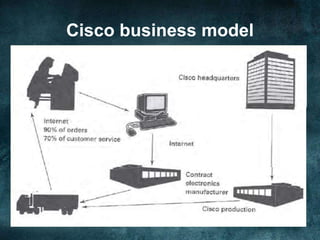
Cisco business model
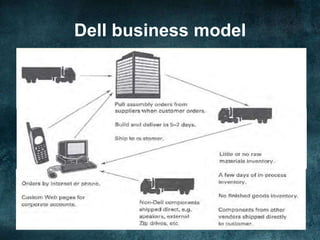
Dell business model
Revenue models
Revenue Models
• In business, revenue typically consists of the total
amount of money received by the company for
goods sold or services provided during a certain
time period.
• Therefore, revenue models are a part of the
business model.
Revenue Models
• Many online companies generate revenues
from multiple income streams such as
– advertising,
– subscription,
– affiliate marketing etc.
– Online models not only sell goods or services
• also contacts (e.g. banner)
• information (e.g. user-data)
Revenue Models
• The type of revenue model you choose will
depend on the type of product or service you
intend to sell.
Two types of products you can sell
• products you make, which you should
sell at a higher price than they cost to
make
• products you buy, which you should sell
at a higher price than you paid for them
Advertising Revenue Model
• Fees are generated from advertisers in exchange for
advertisements, which is ultimately the classic
principal among the revenue models besides sales
Affiliate Revenue Model
• In exchange for bringing business to your
affiliates, you receive a commission, or a
percentage of the sales they make on that
business.
Licensing Revenue Model
• Assume you have created a product.
Companies would pay you a licensing fee for
the right to market, copy, or use the product.
• Licensing is the granting of permission to use
intellectual property, such as music, photos,
software programs, and inventions
Subscription Revenue Model
• Users are charged a periodic (daily, monthly or
annual) fee to subscribe to a service.
• Many sites combine free content with premium
membership
Transaction Fee Revenue Model
• A company receives commissions based on volume
for enabling or executing transactions
• The revenue is generated through transaction fees
by the customer paying a fee for a transaction to the
operator of a platform.
• The company is a market place operator providing
the customer with a platform to place his
transactions.
• During this process the customer may be presented
as a buyer as well as a seller.
Sales Revenue Model
• Wholesalers and retailers of goods and services sell
their products online.
• The main benefits for the customer are the
convenience, time savings, fast information etc.
• The prices are often more competitive.
• In terms of online sales there are different models
such as market places as common entry points for
various products from multiple vendors
Industry Value
Chains
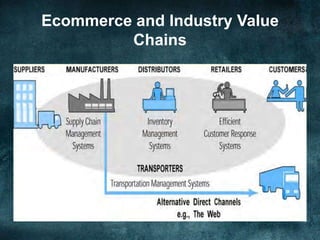
Industry Value Chains
• Set of activities performed by suppliers,
manufacturers, transporters, distributors, and
retailers that transform raw inputs into final products
and services
• Internet reduces cost of information and other
transactional costs
• Leads to greater operational efficiencies, lowering
cost, prices, adding value for customers
Ecommerce and Industry Value
Chains
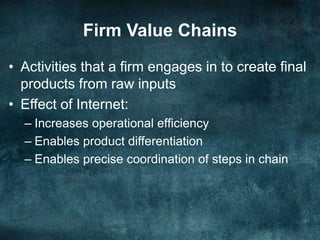
Firm Value Chains
• Activities that a firm engages in to create final
products from raw inputs
• Effect of Internet:
– Increases operational efficiency
– Enables product differentiation
– Enables precise coordination of steps in chain
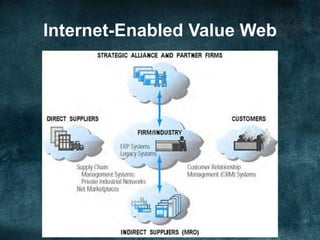
Internet-Enabled Value Web
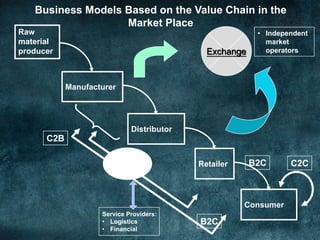
Raw
material
producer
Manufacturer
Distributor
Retailer
Consumer
Exchange
C2B
B2C
B2C C2CNew
Middleman
• Independent
market
operators
Service Providers:
• Logistics
• Financial
Business Models Based on the Value Chain in the
Market Place
Class 5

Class 5

  • 1.
  • 2.
  • 3.
    What Is ane-Business Model? • The e-Business model, like any business model, describes – how a company functions; – how it provides a product or service, – how it generates revenue, and – how it will create and adapt to new markets and technologies.
  • 4.
  • 5.
    Components of Ebusinessmodels Business Model • Customer Value • Scope • Price • Resources • Capabilities • Implementation s Internet Performance Environment
  • 6.
    Storefront Model • Thestorefront combines transaction processing, security, online payment and information storage to enable merchants to sell their products on the Web. • This is a basic form of e-commerce where the buyer and the seller interact directly. • To conduct storefront e-commerce, merchants need to organize an online catalogue of products, take orders through their Web sites, accept payments in a secure environment, send merchandise to customers and manage customer data
  • 7.
    Storefront Model • Someof the most successful e-businesses are using the storefront model. • Many of the leading storefront model companies are B2C companies • Companies use a shopping cart and supporting technologies to offer their products and services to customers
  • 8.
    Shopping Cart Technology •This order processing technology allows customers to accumulate items they wish to buy as they continue to shop. • Supporting the shopping cart is a product catalogue, which is hosted on the merchant server in the form of a database • Databases also store customer information, such as names, addresses, credit-card information and past purchases
  • 9.
    Auction Model • Auctionsites act as forums through which Internet users can log-on and assume the role of either bidder or seller. • As a seller, you are able to post an item you wish to sell, the minimum price you require to sell your item and a deadline to close the auction. • Some sites allow you to add features, such as a photograph or a description of the item’s condition.
  • 10.
    Auction Model • Asa bidder, you may search the site for availability of the item you are seeking, view the current bidding activity and place a bid (bids are usually in designated increments). • Some sites allow you to submit a maximum bidding price and will continue bidding for you.
  • 11.
    Portal Model • Portalsites give visitors the chance to find almost everything they are looking for in one place. • They often offer news, sports and weather, as well as the ability to search the Web. • Search engines are horizontal portals, or portals that aggregate information on a broad range of topics. • Other portals are more specific, offering a great deal of information pertaining to a single area of interest these are called vertical portals.
  • 12.
    Dynamic Pricing Model •The web has changed the way business is done and the way products are priced. • In the past, bargain hunters had to search out deals by visiting numerous local retailers and wholesalers. Today it just few click away.
  • 13.
    Name Your PriceModel • The name your price model empowers customers by allowing them to choose their price for products and services. • Many of the businesses that offer this services have formed partnerships with leaders of industries such as travel, lending and retail. • These industry leaders receive the customer’s desired price from the intermediary and decide whether or not to sell the product or service. • If the customer price is not reasonable then that customer can ask for another price.
  • 14.
    Comparison Pricing Model •It allows the customer to poll a variety of merchants and find a desired product or service at the lowest price. • These sites gets their revenue from the partnerships with particular merchants. • www.Bottomdollar.com
  • 15.
    Demand Sensitive PricingModel • The more people who buy a product in a single purchase, the lower the cost-per-person becomes. • Selling products individually can be expensive because the vendor must price a product so that it covers selling and overhead cost while still generating a profit. • When customers buy in bulk, the cost is shared and the profit margin is increased. • www.mer-cata.com • www.mobshop.com
  • 16.
    Bartering Model • Offeringone item in exchange for another. – www.ubarter.com • The seller makes an initial offer with the intention of bartering to reach a final agreement with the buyer. – www.isolve.com
  • 17.
    Rebate Model • EDLP •eBates is a shopping site where customers receive a rebate on every purchase. • eBates have formed partnership with wholesalers and retailers who will offer discount.
  • 18.
    Offering Free Productsand Service • They offer their products for free on the web. • Many of these sites also form partnership with companies to exchange products and services for advertisement space and vice versa. • www.hsx.com
  • 19.
  • 20.
  • 21.
  • 22.
    Revenue Models • Inbusiness, revenue typically consists of the total amount of money received by the company for goods sold or services provided during a certain time period. • Therefore, revenue models are a part of the business model.
  • 23.
    Revenue Models • Manyonline companies generate revenues from multiple income streams such as – advertising, – subscription, – affiliate marketing etc. – Online models not only sell goods or services • also contacts (e.g. banner) • information (e.g. user-data)
  • 24.
    Revenue Models • Thetype of revenue model you choose will depend on the type of product or service you intend to sell.
  • 25.
    Two types ofproducts you can sell • products you make, which you should sell at a higher price than they cost to make • products you buy, which you should sell at a higher price than you paid for them
  • 26.
    Advertising Revenue Model •Fees are generated from advertisers in exchange for advertisements, which is ultimately the classic principal among the revenue models besides sales
  • 27.
    Affiliate Revenue Model •In exchange for bringing business to your affiliates, you receive a commission, or a percentage of the sales they make on that business.
  • 28.
    Licensing Revenue Model •Assume you have created a product. Companies would pay you a licensing fee for the right to market, copy, or use the product. • Licensing is the granting of permission to use intellectual property, such as music, photos, software programs, and inventions
  • 29.
    Subscription Revenue Model •Users are charged a periodic (daily, monthly or annual) fee to subscribe to a service. • Many sites combine free content with premium membership
  • 30.
    Transaction Fee RevenueModel • A company receives commissions based on volume for enabling or executing transactions • The revenue is generated through transaction fees by the customer paying a fee for a transaction to the operator of a platform. • The company is a market place operator providing the customer with a platform to place his transactions. • During this process the customer may be presented as a buyer as well as a seller.
  • 31.
    Sales Revenue Model •Wholesalers and retailers of goods and services sell their products online. • The main benefits for the customer are the convenience, time savings, fast information etc. • The prices are often more competitive. • In terms of online sales there are different models such as market places as common entry points for various products from multiple vendors
  • 32.
  • 33.
    Industry Value Chains •Set of activities performed by suppliers, manufacturers, transporters, distributors, and retailers that transform raw inputs into final products and services • Internet reduces cost of information and other transactional costs • Leads to greater operational efficiencies, lowering cost, prices, adding value for customers
  • 34.
  • 35.
    Firm Value Chains •Activities that a firm engages in to create final products from raw inputs • Effect of Internet: – Increases operational efficiency – Enables product differentiation – Enables precise coordination of steps in chain
  • 36.
  • 37.
    Raw material producer Manufacturer Distributor Retailer Consumer Exchange C2B B2C B2C C2CNew Middleman • Independent market operators ServiceProviders: • Logistics • Financial Business Models Based on the Value Chain in the Market Place