Social Commerce,
Location based commerce
Social commerce (SC)
• The delivery of e-commerce activities and transactions through social
networks and/or via Web 2.0 software
Wednesday, 16 March 2016 2
Wednesday, 16 March 2016 3
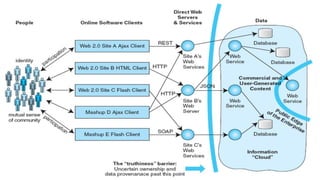
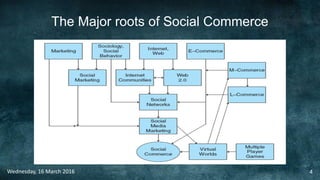
The Major roots of Social Commerce
Wednesday, 16 March 2016 4
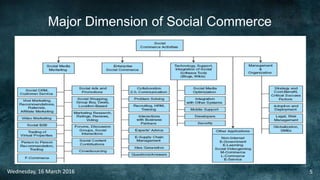
Major Dimension of Social Commerce
Wednesday, 16 March 2016 5
Wednesday, 16 March 2016 6
Wednesday, 16 March 2016 7
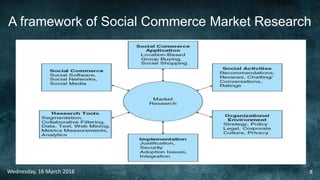
A framework of Social Commerce Market Research
Wednesday, 16 March 2016 8
Social Capital
• A sociological concept that refers to connections within and between
social networks—the core idea is that social networks have value; just
as physical capital or human capital can increase productivity (both
individual and collective), so do social contacts affect the productivity of
individuals and groups
Wednesday, 16 March 2016 9
Social media marketing (SMM)
• A term that describes use of social media platforms such as networks,
online communities, blogs, wikis, or any other online collaborative
media for marketing, market research, sales, CRM, and customer
service; it may incorporate ideas and concepts from social capital, Web
2.0, social media, and social marketing
Wednesday, 16 March 2016 10
Social graph
• A term coined by Mark Zuckerberg of Facebook, which originally
referred to the social network of relationships between users of the
social networking service provided by Facebook—the idea was for
Facebook to benefit from the social graph by taking advantage of the
relationships between individuals that Facebook provides, to offer a
richer online experience—this definition was expanded to refer to a
social graph of all Internet users
Wednesday, 16 March 2016 11
Social shopping
• A method of e-commerce where shoppers’ friends become involved in
the shopping experience; social shopping attempts to use technology
to mimic the social interactions found in physical malls and stores
Wednesday, 16 March 2016 12
Social Advertising
• Social ads and Social apps
• Viral marketing
• Location-based advertisement and social networks
• Using YouTube and other social presentation sites for advertising
• Using Twitter as an advertising and marketing tool
Wednesday, 16 March 2016 13
THE MAJOR MODELS OF SOCIAL SHOPPING
• Social recommendations, ratings and reviews, comparisons, and
conversations
• Group buying and shopping together
• Deal purchases (flash sales), such as daily deals
• Shopping communities and clubs
• Peer-to-peer models (e.g., money lending)
• Location-based shopping
• F-commerce; shopping at Facebook
• Shopping with Twitter
• Other innovative models
Wednesday, 16 March 2016 14
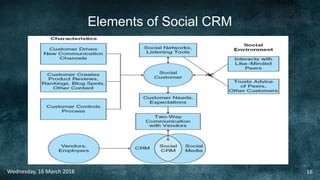
Social CRM (SCRM)
• A customer engagement strategy in support of companies’ defined
goals and objectives toward optimizing the customer experience:
success requires a focus on people, processes, and technology
associated with customer touchpoints and interactions
Wednesday, 16 March 2016 15
Elements of Social CRM
Wednesday, 16 March 2016 16
Crowdsourcing
• The act of outsourcing tasks, traditionally performed by an employee or
contractor, to an undefined, large group of people or community (a
“crowd”), through an open call
• THE PROCESS OF CROWDSOURCING
– Identify the issue (problem) you want to investigate or solve
– Identify the target crowd
– Broadcast to the unknown crowd
– Engage the crowd in an innovative and creative process
– User-generated content is submitted
– Evaluate the submitted material
Wednesday, 16 March 2016 17
Collective intelligence (CI)
• The capacity of human communities to evolve toward higher order
complexity and harmony, through such innovation mechanisms as
variation-feedback-selection, differentiation-integration-transformation,
and competition-cooperation-coopetition
Wednesday, 16 March 2016 18
The Seven Dimensions of Virtual Worlds
1. Social space
2. Entertainment space
3. Transaction space
4. Experimental/demonstration space
5. Collaboration space
6. Smart agents space
7. Fantasy space
Wednesday, 16 March 2016 19
Location-based advertisement and social networks
• Geosocial networking
– A type of social networking in which geographic services and capabilities such
as geocoding and geotagging are used to enable additional social dynamics
• Geolocation
– The identification of the real-world geographic location of an Internet-connected
computer, mobile device, website visitor, or other
Wednesday, 16 March 2016 20
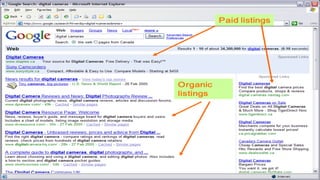
Search engine marketing
• 2 major methods of achieving this positioning within search engine
marketing
– Search engine optimization (SEO) - built into the design of web pages (organic
positioning)
– Search engine advertising and paid placement
Wednesday, 16 March 2016 21
Wednesday, 16 March 2016 22
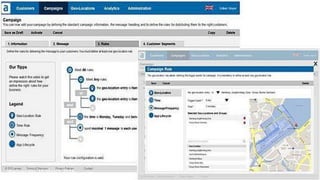
Location-based commerce
• Location-based Commerce (L-Commerce) refers to the localization of
products and services through mobile commerce and context aware
computing technologies.
• L-commerce revolves around 5 key service areas:
– Location: determining the basic position of a person or a thing
– Navigation: plotting a route from one location to another
– Tracking: monitoring the movement of a person or a thing
– Mapping: creating maps of specific geographical locations
– Timing: determining the precise time at a specific location
Wednesday, 16 March 2016 23
Technologies
• Providing location-based services involves several technologies.
– Position Determining Equipment (PDE) - identifies location of mobile device.
– Mobile Positioning Center (MPC) - a server that manages the location info from
PDE.
– Geographic Information System (GIS) - geographic contents consists of streets,
road maps, addresses, and points of interest.
– Location-specific content - used in conjunction with geographic content to
provide the location of particular services.
Wednesday, 16 March 2016 24
Wednesday, 16 March 2016 25
Location-based service
• Location-based services (LBS) are a general class of computer
program-level services that use location data to control features.
• As such LBS is an information service and has a number of uses in
social networking today as an entertainment service, which is
accessible with mobile devices through the mobile network and which
uses information on the geographical position of the mobile device.
• This has become more and more important with the expansion of the
smartphone and tablet markets as well.
Wednesday, 16 March 2016 26
LBS applications
• Recommending social events in a city
• Requesting the nearest business or service, such as an ATM, restaurant or a retail store
• Turn by turn navigation to any address
• Assistive Healthcare Systems
• Locating people on a map displayed on the mobile phone
• Receiving alerts, such as notification of a sale on gas or warning of a traffic jam
• Location-based mobile advertising
• Asset recovery combined with active RF to find, for example, stolen assets in containers where GPS
would not work
• Contextualizing learning and research
• Games where your location is part of the game play, for example your movements during your day
make your avatar move in the game or your position unlocks content.
• Real-time Q&A revolving around restaurants, services, and other venues
Wednesday, 16 March 2016 27
Geosocial networking
• Geosocial networking is a type of social networking in which
geographic services and capabilities such as geocoding and
geotagging are used to enable additional social dynamics.
• User-submitted location data or geolocation techniques can allow
social networks to connect and coordinate users with local people or
events that match their interests.
• Geolocation on web-based social network services can be IP-based or
use hotspot trilateration.
Wednesday, 16 March 2016 28
Location-based game
• A location-based game (or location-enabled game) is a type of
pervasive game in which the gameplay evolves and progresses via a
player's location.
• Thus, location-based games must provide some mechanism to allow
the player to report their location, frequently this is through some kind
of localization technology, for example by using satellite positioning
through GPS.
Wednesday, 16 March 2016 29
Locative media
• Locative media or Location-based media are media of communication
functionally bound to a location.
• The physical implementation of locative media, however, is not bound
to the same location to which the content refers.
Wednesday, 16 March 2016 30
Geomarketing
• Geomarketing is the integration of geographical intelligence into
various aspects of marketing, including sales and distribution.
Geomarketing research is the use of geographic parameters in
marketing research methodology, including from sampling, data
collection, analysis, and presentation.
• Geomarketing Services related to routing, territorial planning, and site
selection where the location is the key factor for such disciplines.
Wednesday, 16 March 2016 31
Case Study: ASOS
Wednesday, 16 March 2016 32
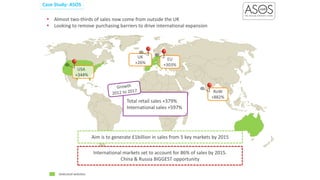
Case Study: ASOS
Aim is to generate £1billion in sales from 5 key markets by 2015
International markets set to account for 86% of sales by 2015.
China & Russia BIGGEST opportunity
 Almost two-thirds of sales now come from outside the UK
 Looking to remove purchasing barriers to drive international expansion
USA
+344%
UK
+26%
EU
+303%
RoW
+882%
Total retail sales +379%
International sales +597%
Dedicated websites
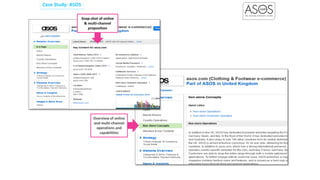
Case Study: ASOS
Overview of online
and multi-channel
operations and
capabilities
Snap-shot of online
& multi-channel
proposition
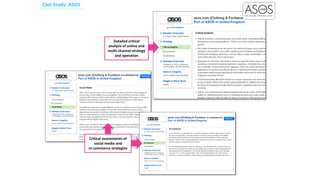
Cast Study: ASOS
Detailed critical
analysis of online and
multi-channel strategy
and operation
Critical assessments of
social media and
m-commerce strategies
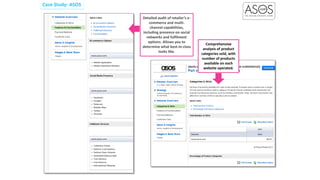
Case Study: ASOS
Comprehensive
analysis of product
categories sold, with
number of products
available on each
website operated.
Detailed audit of retailer’s e-
commerce and multi-
channel capabilities,
including presence on social
networks and fulfilment
options. Allows you to
determine what best-in-class
looks like.
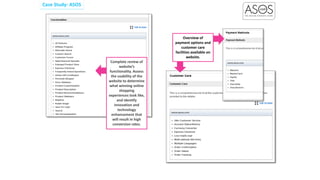
Case Study: ASOS
Overview of
payment options and
customer care
facilities available on
website.
Complete review of
website’s
functionality. Assess
the usability of the
website to determine
what winning online
shopping
experiences look like,
and identify
innovation and
technology
enhancement that
will result in high
conversion rates.
Case Study: China
Wednesday, 16 March 2016 38
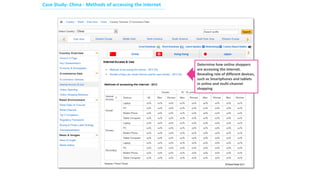
Case Study: China - Methods of accessing the internet
Determine how online shoppers
are accessing the internet.
Revealing role of different devices,
such as Smartphones and tablets
in online and multi-channel
shopping
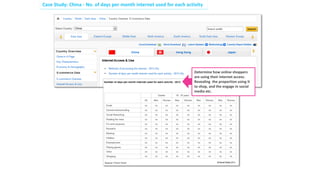
Case Study: China - No. of days per month internet used for each activity
Determine how online shoppers
are using their internet access.
Revealing the proportion using it
to shop, and the engage in social
media etc.
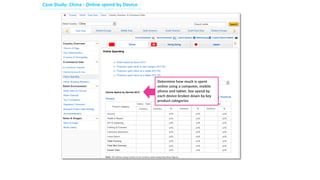
Case Study: China - Online spend by Device
Determine how much is spent
online using a computer, mobile
phone and tablet. See spend by
each device broken down by key
product categories
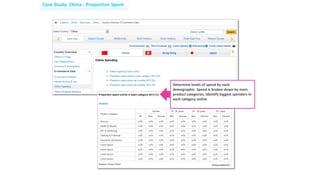
Case Study: China - Proportion Spent
Determine levels of spend by each
demographic. Spend is broken down by main
product categories. Identify biggest spenders in
each category online
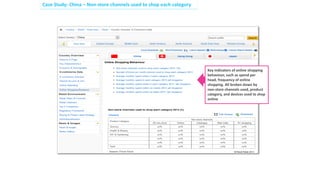
Case Study: China – Non-store channels used to shop each category
Key indicators of online shopping
behaviour, such as spend per
head, frequency of online
shopping. All broken down by
non-store channels used, product
category, and devices used to shop
online
Wednesday, 16 March 2016 44

Class 19

  • 1.
  • 2.
    Social commerce (SC) •The delivery of e-commerce activities and transactions through social networks and/or via Web 2.0 software Wednesday, 16 March 2016 2
  • 3.
  • 4.
    The Major rootsof Social Commerce Wednesday, 16 March 2016 4
  • 5.
    Major Dimension ofSocial Commerce Wednesday, 16 March 2016 5
  • 6.
  • 7.
  • 8.
    A framework ofSocial Commerce Market Research Wednesday, 16 March 2016 8
  • 9.
    Social Capital • Asociological concept that refers to connections within and between social networks—the core idea is that social networks have value; just as physical capital or human capital can increase productivity (both individual and collective), so do social contacts affect the productivity of individuals and groups Wednesday, 16 March 2016 9
  • 10.
    Social media marketing(SMM) • A term that describes use of social media platforms such as networks, online communities, blogs, wikis, or any other online collaborative media for marketing, market research, sales, CRM, and customer service; it may incorporate ideas and concepts from social capital, Web 2.0, social media, and social marketing Wednesday, 16 March 2016 10
  • 11.
    Social graph • Aterm coined by Mark Zuckerberg of Facebook, which originally referred to the social network of relationships between users of the social networking service provided by Facebook—the idea was for Facebook to benefit from the social graph by taking advantage of the relationships between individuals that Facebook provides, to offer a richer online experience—this definition was expanded to refer to a social graph of all Internet users Wednesday, 16 March 2016 11
  • 12.
    Social shopping • Amethod of e-commerce where shoppers’ friends become involved in the shopping experience; social shopping attempts to use technology to mimic the social interactions found in physical malls and stores Wednesday, 16 March 2016 12
  • 13.
    Social Advertising • Socialads and Social apps • Viral marketing • Location-based advertisement and social networks • Using YouTube and other social presentation sites for advertising • Using Twitter as an advertising and marketing tool Wednesday, 16 March 2016 13
  • 14.
    THE MAJOR MODELSOF SOCIAL SHOPPING • Social recommendations, ratings and reviews, comparisons, and conversations • Group buying and shopping together • Deal purchases (flash sales), such as daily deals • Shopping communities and clubs • Peer-to-peer models (e.g., money lending) • Location-based shopping • F-commerce; shopping at Facebook • Shopping with Twitter • Other innovative models Wednesday, 16 March 2016 14
  • 15.
    Social CRM (SCRM) •A customer engagement strategy in support of companies’ defined goals and objectives toward optimizing the customer experience: success requires a focus on people, processes, and technology associated with customer touchpoints and interactions Wednesday, 16 March 2016 15
  • 16.
    Elements of SocialCRM Wednesday, 16 March 2016 16
  • 17.
    Crowdsourcing • The actof outsourcing tasks, traditionally performed by an employee or contractor, to an undefined, large group of people or community (a “crowd”), through an open call • THE PROCESS OF CROWDSOURCING – Identify the issue (problem) you want to investigate or solve – Identify the target crowd – Broadcast to the unknown crowd – Engage the crowd in an innovative and creative process – User-generated content is submitted – Evaluate the submitted material Wednesday, 16 March 2016 17
  • 18.
    Collective intelligence (CI) •The capacity of human communities to evolve toward higher order complexity and harmony, through such innovation mechanisms as variation-feedback-selection, differentiation-integration-transformation, and competition-cooperation-coopetition Wednesday, 16 March 2016 18
  • 19.
    The Seven Dimensionsof Virtual Worlds 1. Social space 2. Entertainment space 3. Transaction space 4. Experimental/demonstration space 5. Collaboration space 6. Smart agents space 7. Fantasy space Wednesday, 16 March 2016 19
  • 20.
    Location-based advertisement andsocial networks • Geosocial networking – A type of social networking in which geographic services and capabilities such as geocoding and geotagging are used to enable additional social dynamics • Geolocation – The identification of the real-world geographic location of an Internet-connected computer, mobile device, website visitor, or other Wednesday, 16 March 2016 20
  • 21.
    Search engine marketing •2 major methods of achieving this positioning within search engine marketing – Search engine optimization (SEO) - built into the design of web pages (organic positioning) – Search engine advertising and paid placement Wednesday, 16 March 2016 21
  • 22.
  • 23.
    Location-based commerce • Location-basedCommerce (L-Commerce) refers to the localization of products and services through mobile commerce and context aware computing technologies. • L-commerce revolves around 5 key service areas: – Location: determining the basic position of a person or a thing – Navigation: plotting a route from one location to another – Tracking: monitoring the movement of a person or a thing – Mapping: creating maps of specific geographical locations – Timing: determining the precise time at a specific location Wednesday, 16 March 2016 23
  • 24.
    Technologies • Providing location-basedservices involves several technologies. – Position Determining Equipment (PDE) - identifies location of mobile device. – Mobile Positioning Center (MPC) - a server that manages the location info from PDE. – Geographic Information System (GIS) - geographic contents consists of streets, road maps, addresses, and points of interest. – Location-specific content - used in conjunction with geographic content to provide the location of particular services. Wednesday, 16 March 2016 24
  • 25.
  • 26.
    Location-based service • Location-basedservices (LBS) are a general class of computer program-level services that use location data to control features. • As such LBS is an information service and has a number of uses in social networking today as an entertainment service, which is accessible with mobile devices through the mobile network and which uses information on the geographical position of the mobile device. • This has become more and more important with the expansion of the smartphone and tablet markets as well. Wednesday, 16 March 2016 26
  • 27.
    LBS applications • Recommendingsocial events in a city • Requesting the nearest business or service, such as an ATM, restaurant or a retail store • Turn by turn navigation to any address • Assistive Healthcare Systems • Locating people on a map displayed on the mobile phone • Receiving alerts, such as notification of a sale on gas or warning of a traffic jam • Location-based mobile advertising • Asset recovery combined with active RF to find, for example, stolen assets in containers where GPS would not work • Contextualizing learning and research • Games where your location is part of the game play, for example your movements during your day make your avatar move in the game or your position unlocks content. • Real-time Q&A revolving around restaurants, services, and other venues Wednesday, 16 March 2016 27
  • 28.
    Geosocial networking • Geosocialnetworking is a type of social networking in which geographic services and capabilities such as geocoding and geotagging are used to enable additional social dynamics. • User-submitted location data or geolocation techniques can allow social networks to connect and coordinate users with local people or events that match their interests. • Geolocation on web-based social network services can be IP-based or use hotspot trilateration. Wednesday, 16 March 2016 28
  • 29.
    Location-based game • Alocation-based game (or location-enabled game) is a type of pervasive game in which the gameplay evolves and progresses via a player's location. • Thus, location-based games must provide some mechanism to allow the player to report their location, frequently this is through some kind of localization technology, for example by using satellite positioning through GPS. Wednesday, 16 March 2016 29
  • 30.
    Locative media • Locativemedia or Location-based media are media of communication functionally bound to a location. • The physical implementation of locative media, however, is not bound to the same location to which the content refers. Wednesday, 16 March 2016 30
  • 31.
    Geomarketing • Geomarketing isthe integration of geographical intelligence into various aspects of marketing, including sales and distribution. Geomarketing research is the use of geographic parameters in marketing research methodology, including from sampling, data collection, analysis, and presentation. • Geomarketing Services related to routing, territorial planning, and site selection where the location is the key factor for such disciplines. Wednesday, 16 March 2016 31
  • 32.
  • 33.
    Case Study: ASOS Aimis to generate £1billion in sales from 5 key markets by 2015 International markets set to account for 86% of sales by 2015. China & Russia BIGGEST opportunity  Almost two-thirds of sales now come from outside the UK  Looking to remove purchasing barriers to drive international expansion USA +344% UK +26% EU +303% RoW +882% Total retail sales +379% International sales +597% Dedicated websites
  • 34.
    Case Study: ASOS Overviewof online and multi-channel operations and capabilities Snap-shot of online & multi-channel proposition
  • 35.
    Cast Study: ASOS Detailedcritical analysis of online and multi-channel strategy and operation Critical assessments of social media and m-commerce strategies
  • 36.
    Case Study: ASOS Comprehensive analysisof product categories sold, with number of products available on each website operated. Detailed audit of retailer’s e- commerce and multi- channel capabilities, including presence on social networks and fulfilment options. Allows you to determine what best-in-class looks like.
  • 37.
    Case Study: ASOS Overviewof payment options and customer care facilities available on website. Complete review of website’s functionality. Assess the usability of the website to determine what winning online shopping experiences look like, and identify innovation and technology enhancement that will result in high conversion rates.
  • 38.
  • 39.
    Case Study: China- Methods of accessing the internet Determine how online shoppers are accessing the internet. Revealing role of different devices, such as Smartphones and tablets in online and multi-channel shopping
  • 40.
    Case Study: China- No. of days per month internet used for each activity Determine how online shoppers are using their internet access. Revealing the proportion using it to shop, and the engage in social media etc.
  • 41.
    Case Study: China- Online spend by Device Determine how much is spent online using a computer, mobile phone and tablet. See spend by each device broken down by key product categories
  • 42.
    Case Study: China- Proportion Spent Determine levels of spend by each demographic. Spend is broken down by main product categories. Identify biggest spenders in each category online
  • 43.
    Case Study: China– Non-store channels used to shop each category Key indicators of online shopping behaviour, such as spend per head, frequency of online shopping. All broken down by non-store channels used, product category, and devices used to shop online
  • 44.