
Chapter 2
e-Business Models
E-Commerce Programming
Mutah University
Faculty of IT, Department of Software Engineering
Dr. Ra’Fat A. AL-msie’deen
Part 2
Constructing an e-Business
This material is based on chapter 1 of “e-Business & e-Commerce
for Managers” by Harvey M. Deitel, Paul Deitel, Kate Steinbuhler.
Chapter 2, e-Business Models
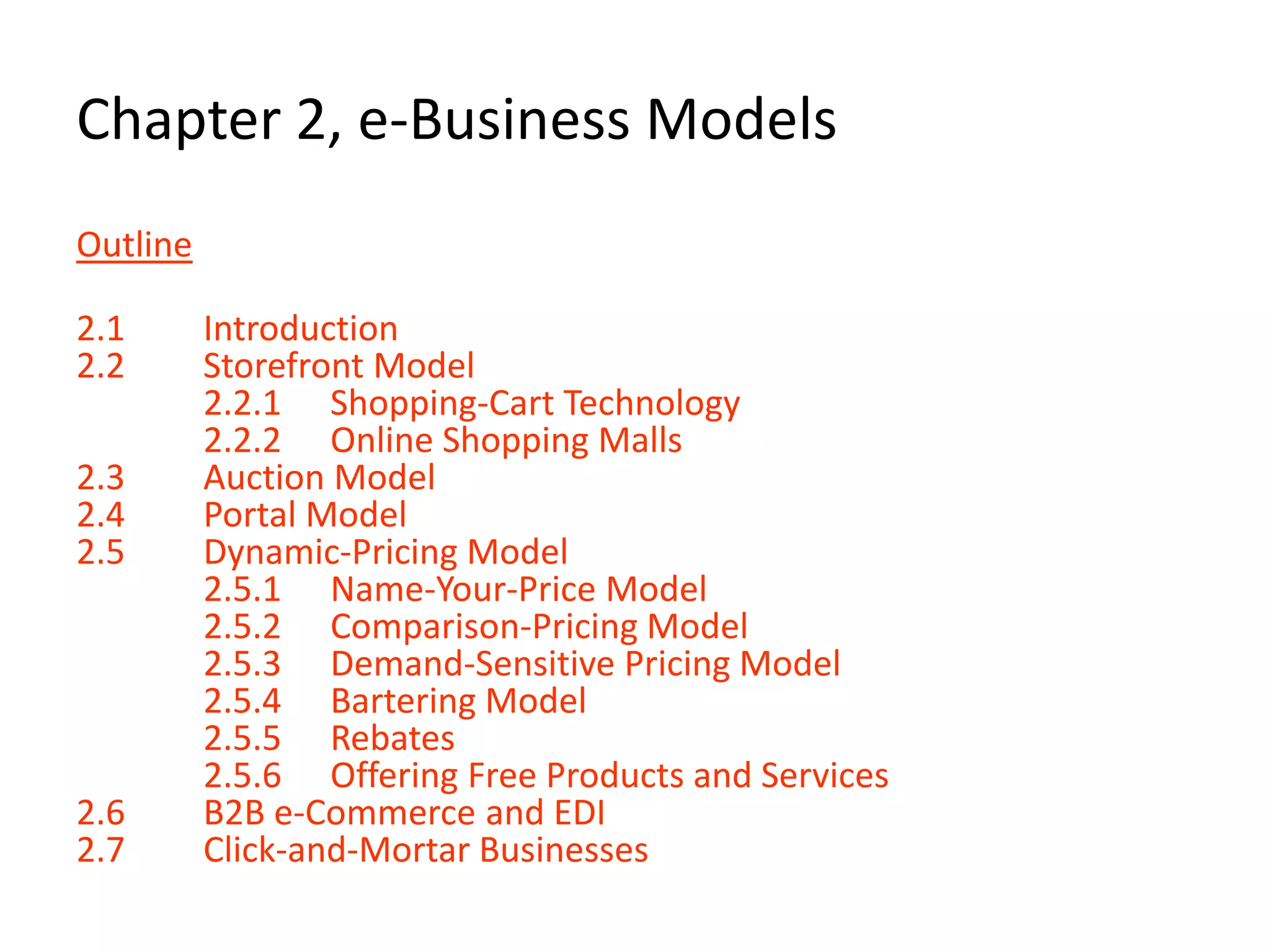
Outline
2.1 Introduction
2.2 Storefront Model
2.2.1 Shopping-Cart Technology
2.2.2 Online Shopping Malls
2.3 Auction Model
2.4 Portal Model
2.5 Dynamic-Pricing Model
2.5.1 Name-Your-Price Model
2.5.2 Comparison-Pricing Model
2.5.3 Demand-Sensitive Pricing Model
2.5.4 Bartering Model
2.5.5 Rebates
2.5.6 Offering Free Products and Services
2.6 B2B e-Commerce and EDI
2.7 Click-and-Mortar Businesses
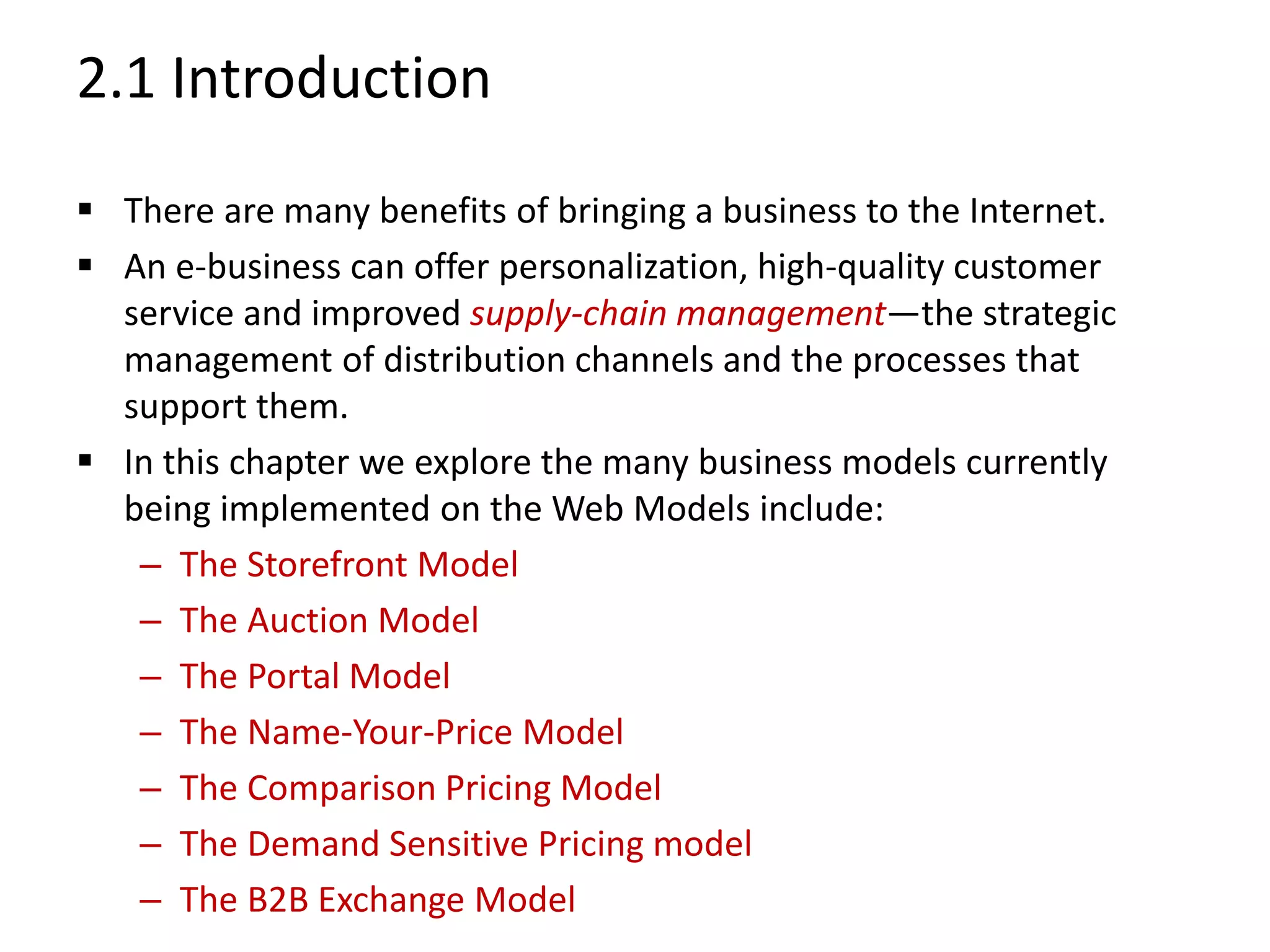
2.1 Introduction
 There are many benefits of bringing a business to the Internet.
 An e-business can offer personalization, high-quality customer
service and improved supply-chain management—the strategic
management of distribution channels and the processes that
support them.
 In this chapter we explore the many business models currently
being implemented on the Web Models include:
– The Storefront Model
– The Auction Model
– The Portal Model
– The Name-Your-Price Model
– The Comparison Pricing Model
– The Demand Sensitive Pricing model
– The B2B Exchange Model
2.1 Introduction
 e-Business
– A company that has an online presence.
 E-commerce businesses allow customers to sell, trade and
barter over the Web.
 A company’s policy, operations, technology and ideology
define its business model.
2.2 Storefront Model
 Storefront model enables merchants to sell products on the
Web
– Transaction processing, security, online payment,
information storage
 E-commerce allows companies to conduct business 24-by-7,
all day everyday, worldwide
 An e-commerce storefront should include:
– Online catalog of products
– Order processing
– Secure payment
– Timely order fulfillment
2.2.1 Shopping Cart Technology
 Shopping Cart
– An order-processing technology allowing customers to
accumulate lists of items they wish to buy as they continue
to shop
 Shopping cart is supported by
– Product catalog
– Merchant server
– Database technology
 Combine a number of purchasing methods to give customers
a wide array of options
2.2.2 Online Shopping Malls
 Wide selection of products and services
 Offers greater convenience than shopping at multiple online
shops
 Consumers can make multiple purchases in one transaction
2.3 Auction Model
 Online auction sites
– Act as forums through which Internet users can log-on and
assume the role of either bidder or seller
– Collect a commission on every successful auction
– Sellers post items they wish to sell and wait for buyers to
bid
 Reserve price
– The minimum price a seller will accept in a given auction
 Reverse auctions
– Allow the buyer to set a price as sellers compete to match
or even beat it
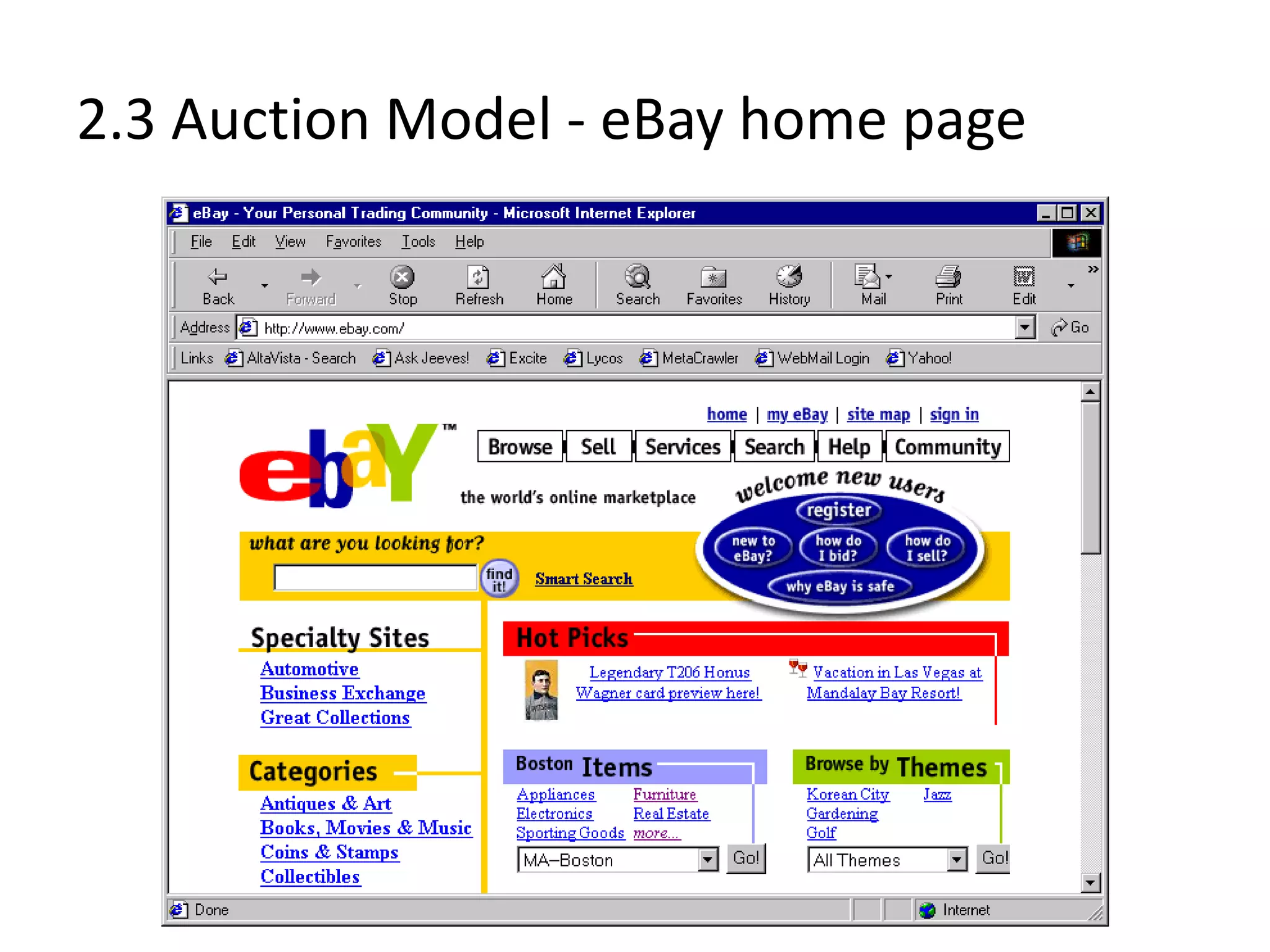
2.3 Auction Model - eBay home page
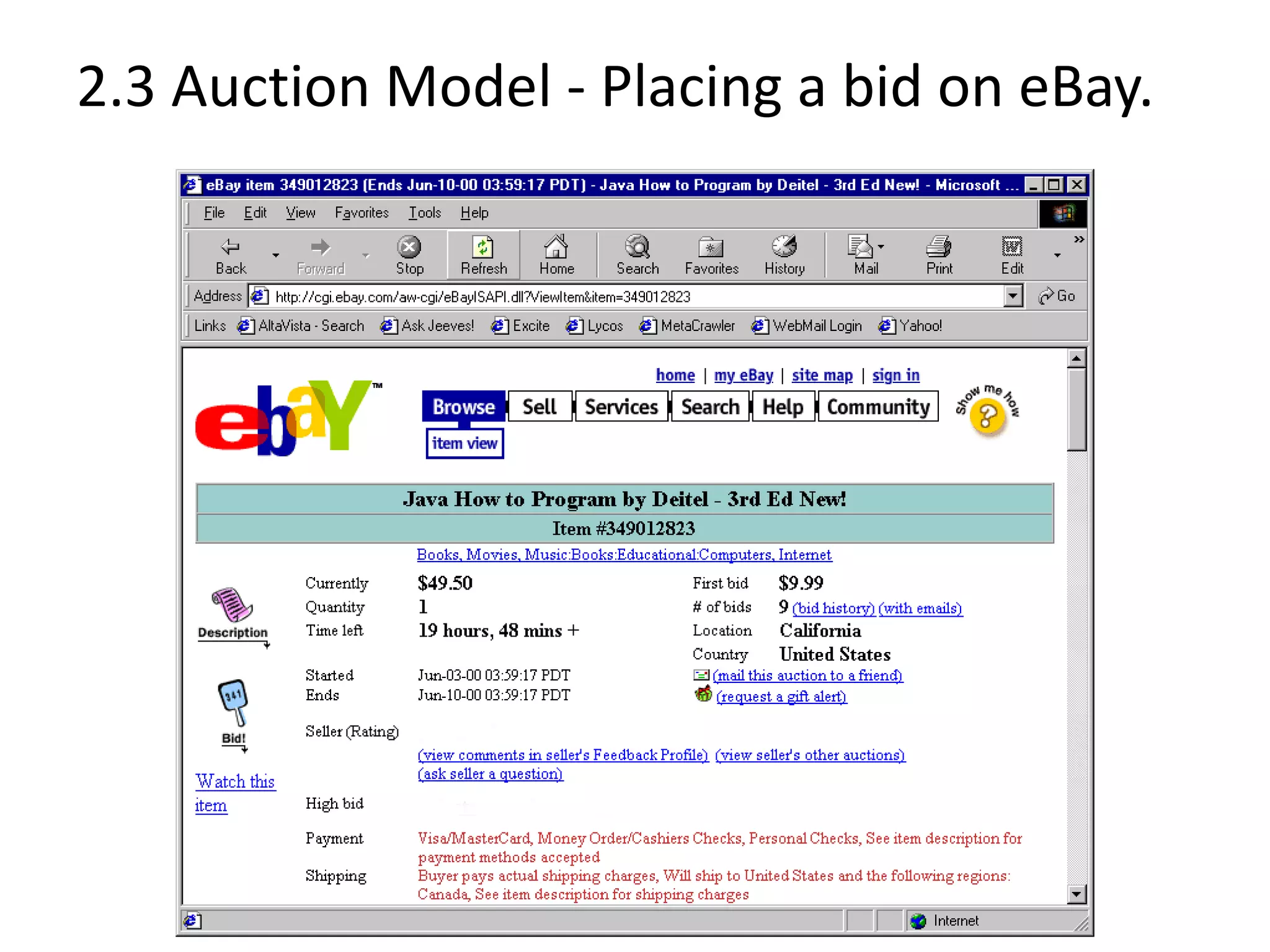
2.3 Auction Model - Placing a bid on eBay.
2.4 Portal Model
 Portal sites
– Give visitors the chance to find almost everything they are
looking for in one place
– They often offer news, sports and weather information, as well
as the ability to search the Web.
– When most people hear the word "portal," they think of search
engines.
 Horizontal portals
– Portals that aggregate information on a broad range of topics
– Yahoo!, Google
 Vertical portals
– Portals that offer more specific information within a single area
of interest
– WebMD
• People can learn about and discuss medical issues at a
variety of Web sites (WebMD).
2.5 Dynamic Pricing Models
 This section describes in depth the many ways in which
creative pricing is being used to generate business.
 Many of these methods would not be possible without the
Internet.
 Some companies enable customers to name the prices they
are willing to pay for travel, homes, automobiles and
consumer goods.
 The Web has changed the way products are priced and
purchased.
2.5.1 Name-Your-Price Model
 Name-your-price for products and services.
 The name-your-price business model empowers customers by
allowing them to state the price they are willing to pay for
products and services.
 If the customer’s price is not accepted, the customer may
offer another price. If it is accepted, the customer is obligated
to make the purchase.
2.5.2 Comparison-Pricing Model
 Web sites using shopping bot technology to find the lowest
price for a given item.
 The comparison-pricing model allows customers to poll a
variety of merchants and find a desired product or service at
the lowest price
 These sites often generate revenue from partnerships with
particular merchants.
 You need to be careful when using these services, though,
because you may not necessarily be getting the best price
available on the entire Web.
2.5.3 Demand-Sensitive Pricing Model
 The Web has enabled customers to demand better, faster
service at cheaper prices.
 It also empowers buyers to shop in large groups to obtain
group discounts.
 Group buying reduces price as volume of sales increase.
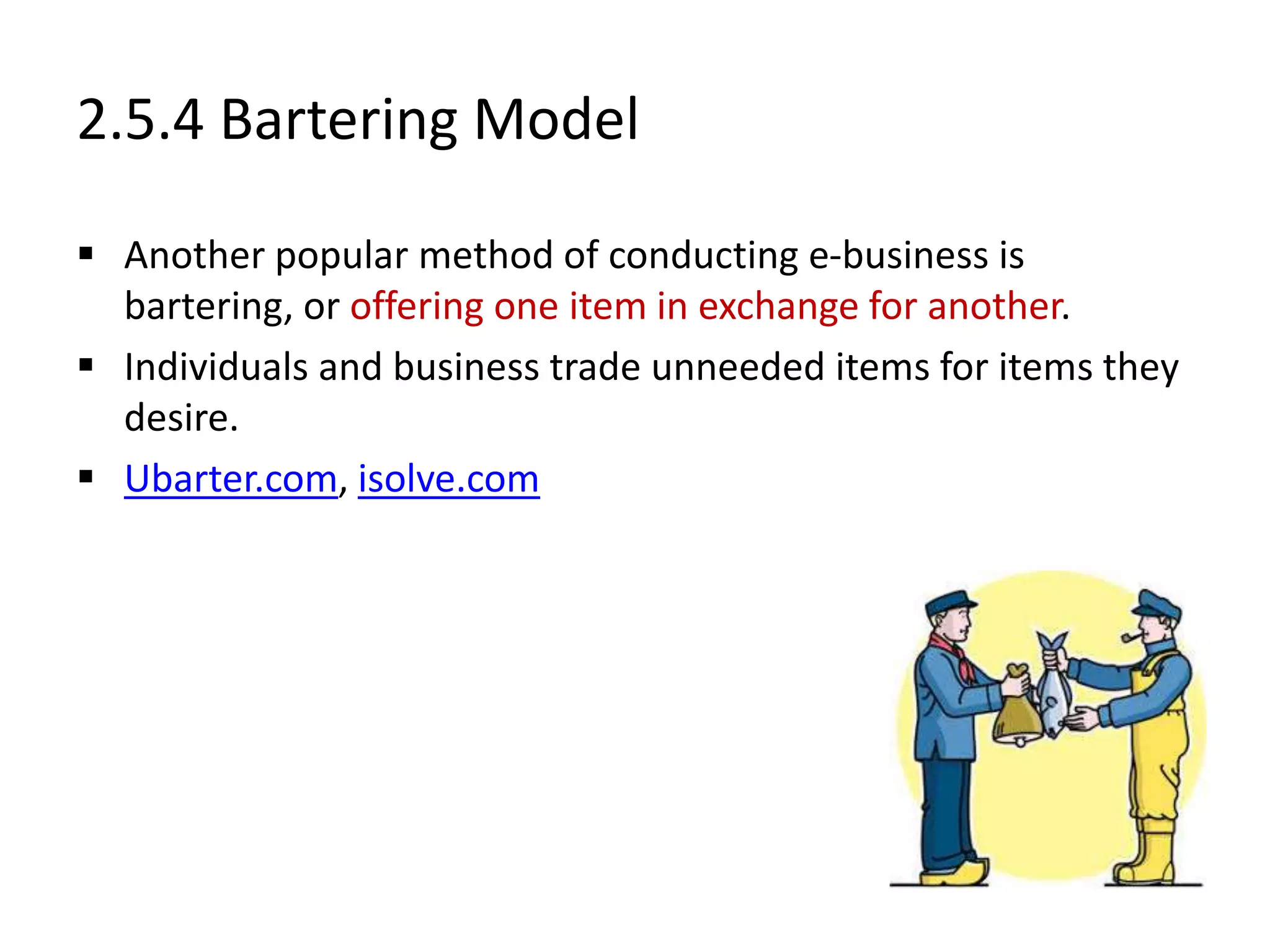
2.5.4 Bartering Model
 Another popular method of conducting e-business is
bartering, or offering one item in exchange for another.
 Individuals and business trade unneeded items for items they
desire.
 Ubarter.com, isolve.com
2.5.5 Rebate Model
 Sites offer rebates on product at leading online retailers in
return for commission or advertising revenues.
 eBates
2.5.6 Offering Free Products and Services
 Many entrepreneurs are forming their business models
around advertising-driven revenue streams.
 Television networks, radio stations, magazines and print
media use advertising to fund their operations and make a
profit.
 Many of the sites also form partnerships with companies to
exchange products and services for advertising space and vice
versa.
 The sites offer their products for free on the Web.
 Free products and services generate high traffic.
 Freemerchant, Start Sampling, FreeSamples.com
2.6 B2B E-Commerce and EDI
 B2B e-business
– B2B, the acronym for "business-to-business,“.
– The electronic business relationship between two or more companies.
– Online or offline.
– Electronic Data Interchange (EDI) systems help businesses manage
their supply chains.
– A company’s supply chain refers to the relationship between original
equipment manufacturers, secondary manufacturers, distributors,
shipping companies, retailers and consumers.
 Traditional EDI uses a value-added network or VAN
– A closed network that includes all members of a production process.
 XML (eXtensible Markup Language)
– A development technology similar to HTML (Hypertext Markup
Language).
– Improves the compatibility between disparate systems, creating new
market opportunities.
2.6 B2B E-Commerce and EDI ... (Cont.)
 B2B e-commerce and the use of exchange sites allow
businesses to reach their markets faster and more efficiently.
 Lead time
– The time it takes to receive a product from a supplier after
an order has been placed.
 Long lead times increase inventory costs, increase worker
stress levels and strain relationships between the
manufacturer and the supplier.
2.6 B2B E-Commerce and EDI ... (Cont.)
 JIT (just-in-time) inventory management
– Supplies arrive at the exact time they are needed, thereby
limiting any unnecessary inventory expense.
 Enterprise Application Integration (EAI)
– The process of integrating traditional EDI systems with the
Web.
 Business-to-business integrators (B2Bi)
– Companies that use XML and similar technologies to help
other companies integrate their current systems with the
Web.
– www.excara.com, Webmethods.com, commerceone.com,
tibco.com, Freemarkets.com, mercator.com
2.7 Click-and-Mortar Businesses
 Brick-and-mortar
– Companies that operate solely offline with traditional
business practices
 Click-and-mortar
– Companies operating with both an online and offline
presence.
 Click and mortar companies have brand recognition, and an
established customer base.
– Barnesandnoble.com
– Bestbuy.com
2.7 Click-and-Mortar Businesses ... (Cont.)
 Key benefits to automotive industry
– Combined supplier base
– Connects automobile manufacturers, dealers and
consumers in a single marketplace
– Decreases lead time and production costs
 Key benefits to electronics industry
– Provides access to thousands of components from
hundreds of electronic suppliers
– Provides ability to search by part number, product type or
manufacturer
– Increases competitive pricing
2.7 Click-and-Mortar Businesses ... (Cont.)
 Key benefits to energy industry
– Provides real time pricing data on energy commodities
– Provides access to hundreds of energy commodities
– Allows regional energy providers to gain access to a
worldwide market
 Key benefits to food industry
– Reduced lead time preserves perishables
– Provides access to real time pricing data
– Online auction technology allows for alternative pricing
2.7 Click-and-Mortar Businesses ... (Cont.)
 Benefits to chemical industry
– Access to millions of chemical products from thousands of
suppliers
– Integrated supply chains provide faster, more reliable
transactions
 Benefits to construction industry
– Contracting and subcontracting are made simpler by
online bidding
– Construction companies can find raw materials from
suppliers worldwide
Thank you for your attention
Chapter 2
e-Business Models
E-Commerce Programming
Mutah University
Faculty of IT, Department of Software Engineering
Dr. Ra’Fat A. AL-msie’deen
Part 2
Constructing an e-Business

E-Commerce Programming - "Chapter 2: e-Business Models"

  • 1.
    Chapter 2 e-Business Models E-CommerceProgramming Mutah University Faculty of IT, Department of Software Engineering Dr. Ra’Fat A. AL-msie’deen Part 2 Constructing an e-Business
  • 2.
    This material isbased on chapter 1 of “e-Business & e-Commerce for Managers” by Harvey M. Deitel, Paul Deitel, Kate Steinbuhler.
  • 3.
    Chapter 2, e-BusinessModels Outline 2.1 Introduction 2.2 Storefront Model 2.2.1 Shopping-Cart Technology 2.2.2 Online Shopping Malls 2.3 Auction Model 2.4 Portal Model 2.5 Dynamic-Pricing Model 2.5.1 Name-Your-Price Model 2.5.2 Comparison-Pricing Model 2.5.3 Demand-Sensitive Pricing Model 2.5.4 Bartering Model 2.5.5 Rebates 2.5.6 Offering Free Products and Services 2.6 B2B e-Commerce and EDI 2.7 Click-and-Mortar Businesses
  • 4.
    2.1 Introduction  Thereare many benefits of bringing a business to the Internet.  An e-business can offer personalization, high-quality customer service and improved supply-chain management—the strategic management of distribution channels and the processes that support them.  In this chapter we explore the many business models currently being implemented on the Web Models include: – The Storefront Model – The Auction Model – The Portal Model – The Name-Your-Price Model – The Comparison Pricing Model – The Demand Sensitive Pricing model – The B2B Exchange Model
  • 5.
    2.1 Introduction  e-Business –A company that has an online presence.  E-commerce businesses allow customers to sell, trade and barter over the Web.  A company’s policy, operations, technology and ideology define its business model.
  • 6.
    2.2 Storefront Model Storefront model enables merchants to sell products on the Web – Transaction processing, security, online payment, information storage  E-commerce allows companies to conduct business 24-by-7, all day everyday, worldwide  An e-commerce storefront should include: – Online catalog of products – Order processing – Secure payment – Timely order fulfillment
  • 7.
    2.2.1 Shopping CartTechnology  Shopping Cart – An order-processing technology allowing customers to accumulate lists of items they wish to buy as they continue to shop  Shopping cart is supported by – Product catalog – Merchant server – Database technology  Combine a number of purchasing methods to give customers a wide array of options
  • 8.
    2.2.2 Online ShoppingMalls  Wide selection of products and services  Offers greater convenience than shopping at multiple online shops  Consumers can make multiple purchases in one transaction
  • 9.
    2.3 Auction Model Online auction sites – Act as forums through which Internet users can log-on and assume the role of either bidder or seller – Collect a commission on every successful auction – Sellers post items they wish to sell and wait for buyers to bid  Reserve price – The minimum price a seller will accept in a given auction  Reverse auctions – Allow the buyer to set a price as sellers compete to match or even beat it
  • 10.
    2.3 Auction Model- eBay home page
  • 11.
    2.3 Auction Model- Placing a bid on eBay.
  • 12.
    2.4 Portal Model Portal sites – Give visitors the chance to find almost everything they are looking for in one place – They often offer news, sports and weather information, as well as the ability to search the Web. – When most people hear the word "portal," they think of search engines.  Horizontal portals – Portals that aggregate information on a broad range of topics – Yahoo!, Google  Vertical portals – Portals that offer more specific information within a single area of interest – WebMD • People can learn about and discuss medical issues at a variety of Web sites (WebMD).
  • 13.
    2.5 Dynamic PricingModels  This section describes in depth the many ways in which creative pricing is being used to generate business.  Many of these methods would not be possible without the Internet.  Some companies enable customers to name the prices they are willing to pay for travel, homes, automobiles and consumer goods.  The Web has changed the way products are priced and purchased.
  • 14.
    2.5.1 Name-Your-Price Model Name-your-price for products and services.  The name-your-price business model empowers customers by allowing them to state the price they are willing to pay for products and services.  If the customer’s price is not accepted, the customer may offer another price. If it is accepted, the customer is obligated to make the purchase.
  • 15.
    2.5.2 Comparison-Pricing Model Web sites using shopping bot technology to find the lowest price for a given item.  The comparison-pricing model allows customers to poll a variety of merchants and find a desired product or service at the lowest price  These sites often generate revenue from partnerships with particular merchants.  You need to be careful when using these services, though, because you may not necessarily be getting the best price available on the entire Web.
  • 16.
    2.5.3 Demand-Sensitive PricingModel  The Web has enabled customers to demand better, faster service at cheaper prices.  It also empowers buyers to shop in large groups to obtain group discounts.  Group buying reduces price as volume of sales increase.
  • 17.
    2.5.4 Bartering Model Another popular method of conducting e-business is bartering, or offering one item in exchange for another.  Individuals and business trade unneeded items for items they desire.  Ubarter.com, isolve.com
  • 18.
    2.5.5 Rebate Model Sites offer rebates on product at leading online retailers in return for commission or advertising revenues.  eBates
  • 19.
    2.5.6 Offering FreeProducts and Services  Many entrepreneurs are forming their business models around advertising-driven revenue streams.  Television networks, radio stations, magazines and print media use advertising to fund their operations and make a profit.  Many of the sites also form partnerships with companies to exchange products and services for advertising space and vice versa.  The sites offer their products for free on the Web.  Free products and services generate high traffic.  Freemerchant, Start Sampling, FreeSamples.com
  • 20.
    2.6 B2B E-Commerceand EDI  B2B e-business – B2B, the acronym for "business-to-business,“. – The electronic business relationship between two or more companies. – Online or offline. – Electronic Data Interchange (EDI) systems help businesses manage their supply chains. – A company’s supply chain refers to the relationship between original equipment manufacturers, secondary manufacturers, distributors, shipping companies, retailers and consumers.  Traditional EDI uses a value-added network or VAN – A closed network that includes all members of a production process.  XML (eXtensible Markup Language) – A development technology similar to HTML (Hypertext Markup Language). – Improves the compatibility between disparate systems, creating new market opportunities.
  • 21.
    2.6 B2B E-Commerceand EDI ... (Cont.)  B2B e-commerce and the use of exchange sites allow businesses to reach their markets faster and more efficiently.  Lead time – The time it takes to receive a product from a supplier after an order has been placed.  Long lead times increase inventory costs, increase worker stress levels and strain relationships between the manufacturer and the supplier.
  • 22.
    2.6 B2B E-Commerceand EDI ... (Cont.)  JIT (just-in-time) inventory management – Supplies arrive at the exact time they are needed, thereby limiting any unnecessary inventory expense.  Enterprise Application Integration (EAI) – The process of integrating traditional EDI systems with the Web.  Business-to-business integrators (B2Bi) – Companies that use XML and similar technologies to help other companies integrate their current systems with the Web. – www.excara.com, Webmethods.com, commerceone.com, tibco.com, Freemarkets.com, mercator.com
  • 23.
    2.7 Click-and-Mortar Businesses Brick-and-mortar – Companies that operate solely offline with traditional business practices  Click-and-mortar – Companies operating with both an online and offline presence.  Click and mortar companies have brand recognition, and an established customer base. – Barnesandnoble.com – Bestbuy.com
  • 24.
    2.7 Click-and-Mortar Businesses... (Cont.)  Key benefits to automotive industry – Combined supplier base – Connects automobile manufacturers, dealers and consumers in a single marketplace – Decreases lead time and production costs  Key benefits to electronics industry – Provides access to thousands of components from hundreds of electronic suppliers – Provides ability to search by part number, product type or manufacturer – Increases competitive pricing
  • 25.
    2.7 Click-and-Mortar Businesses... (Cont.)  Key benefits to energy industry – Provides real time pricing data on energy commodities – Provides access to hundreds of energy commodities – Allows regional energy providers to gain access to a worldwide market  Key benefits to food industry – Reduced lead time preserves perishables – Provides access to real time pricing data – Online auction technology allows for alternative pricing
  • 26.
    2.7 Click-and-Mortar Businesses... (Cont.)  Benefits to chemical industry – Access to millions of chemical products from thousands of suppliers – Integrated supply chains provide faster, more reliable transactions  Benefits to construction industry – Contracting and subcontracting are made simpler by online bidding – Construction companies can find raw materials from suppliers worldwide
  • 27.
    Thank you foryour attention
  • 28.
    Chapter 2 e-Business Models E-CommerceProgramming Mutah University Faculty of IT, Department of Software Engineering Dr. Ra’Fat A. AL-msie’deen Part 2 Constructing an e-Business