6 Consumer Purchasing
Strategies
Practical Purchasing Strategies
• Timing purchases
– Price variations by time of year (seasons)
• Store selection
– Location, price, selection, services
• Brand Comparison
– Private-label or store brands (sold by one
chain) vs. national brands
• Label Information
– Open dating (shelf life of products)
6-1
Practical Purchasing
Strategies
Price comparison
– Unit pricing = standard of measurement
– Coupons and rebates
– More store convenience higher prices
– Ready-to-use products higher prices
– Large is not always best buy (check unit price, usage)
– “Sale” prices not always a savings (anchoring)
– Online sources can save time
6-2
Practical Purchasing
Strategies
Warranties
• Written guarantee from manufacturer or
distributor specifying conditions under which a
product can be returned, replaced, or repaired.
• Express Warranty (usually written); 2 Forms
– Full Warranty (covers entire product; fix or repair for a time)
– Limited Warranty (covers only certain parts of a product)
• Implied warranty (covers a product’s intended use)
– Warranty of title (says seller has the right to sell a product)
– Warranty of merchantability (product is fit for its use)
6-3
Warranties
• Used Car Warranties
– FTC requires a “buyers’ guide sticker”
• Tells if car has warranty and, if so, what it covers
– Warranty of merchantability (item fit for intended use)
• New Car Warranties
– Basic parts against defects
– Power train coverage (engine, transmission)
– Corrosion warranty (covers holes due to rust)
• Service Contracts
– “Extended warranty”
6-4
Research-Based Buying
Major Purchase Decision-making
Process
• Phase 1: Pre-shopping Activities
– Problem identification: prioritize needs and wants
– Information gathering: information is power! WHERE to go?
– Follow the RULE OF THREE (all major products and services)
• Phase 2: Evaluating Alternatives
– Price analysis (range of prices and differences in cost)
– Comparison shopping (especially complex and expensive items)
• Phase 3: Determining Purchase Price and Selection
– Negotiation (cars: start with dealer invoice, NOT sticker price)
– Payment alternatives (cash, loan, lease)
– Acquisition and installation
• Phase 4: Post-purchase Activities
– Maintenance and operation
– After-sale service alternatives
– Resolution of purchase concerns 6-5
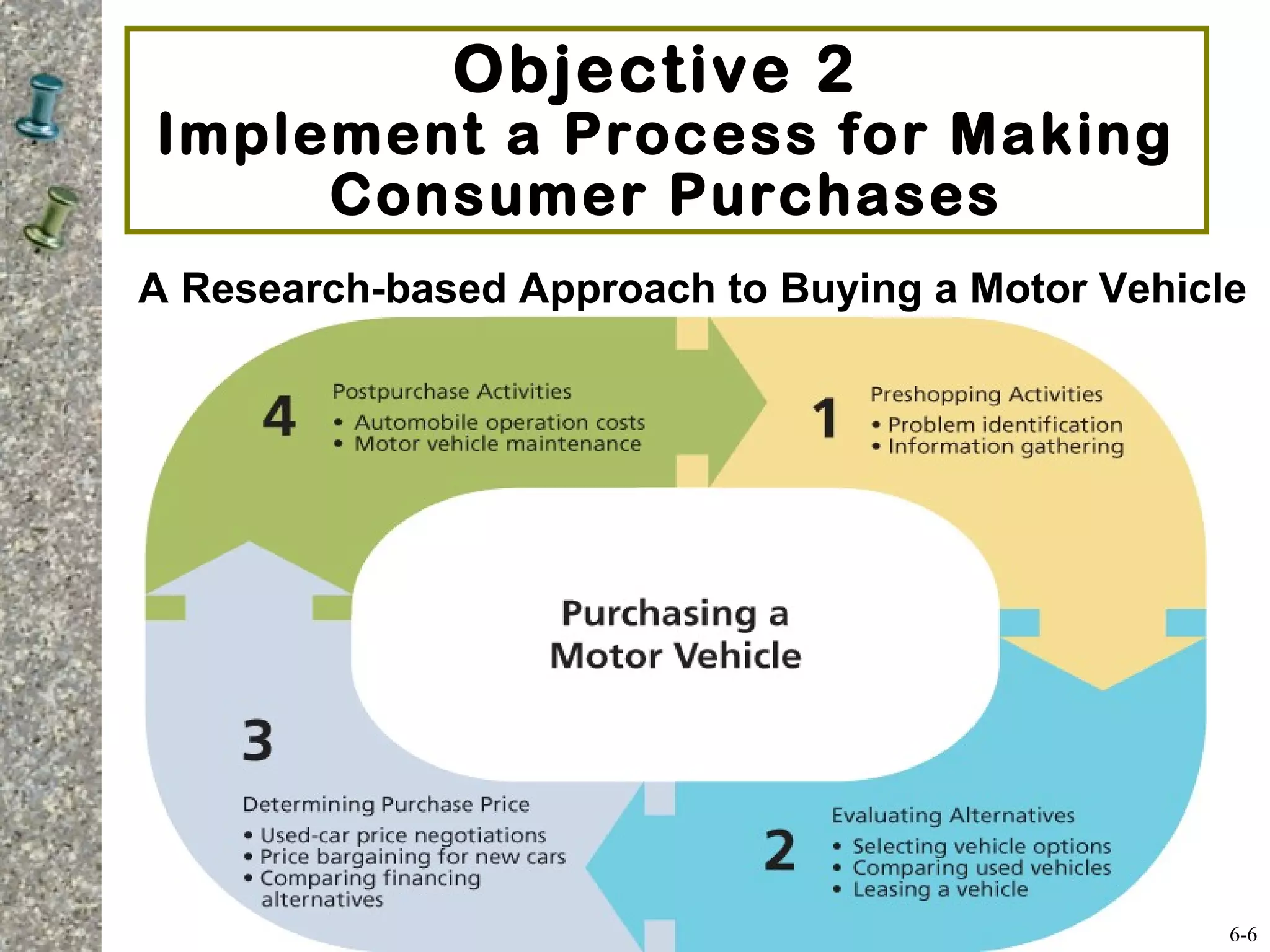
Objective 2
Implement a Process for Making
Consumer Purchases
A Research-based Approach to Buying a Motor Vehicle
6-6
Buying a Motor Vehicle
Phase 1 – Pre-shopping Activities
• Problem Identification
– Focus on real needs (e.g., reliable transportation)
• Information Gathering
– Personal contacts
– Business organizations
– Media information
– Independent testing organizations
– Government agencies
– Online sources
6-7
• Purchase Alternatives (e.g., new vs. used, makes/models, delaying)
• Selecting Vehicle Options
– Performance Options (mechanical devices, engine size,
transmission, power steering, cruise control, and
antilock brakes)
– Comfort and Convenience Options (power seats, air
conditioning, power locks)
– Aesthetic Features (metallic paint, special trim, leather
interior, sunroof)
• Comparing used vehicles
• Leasing a motor vehicle
Buying a Motor Vehicle
Phase 2 - Evaluating Alternatives
6-8
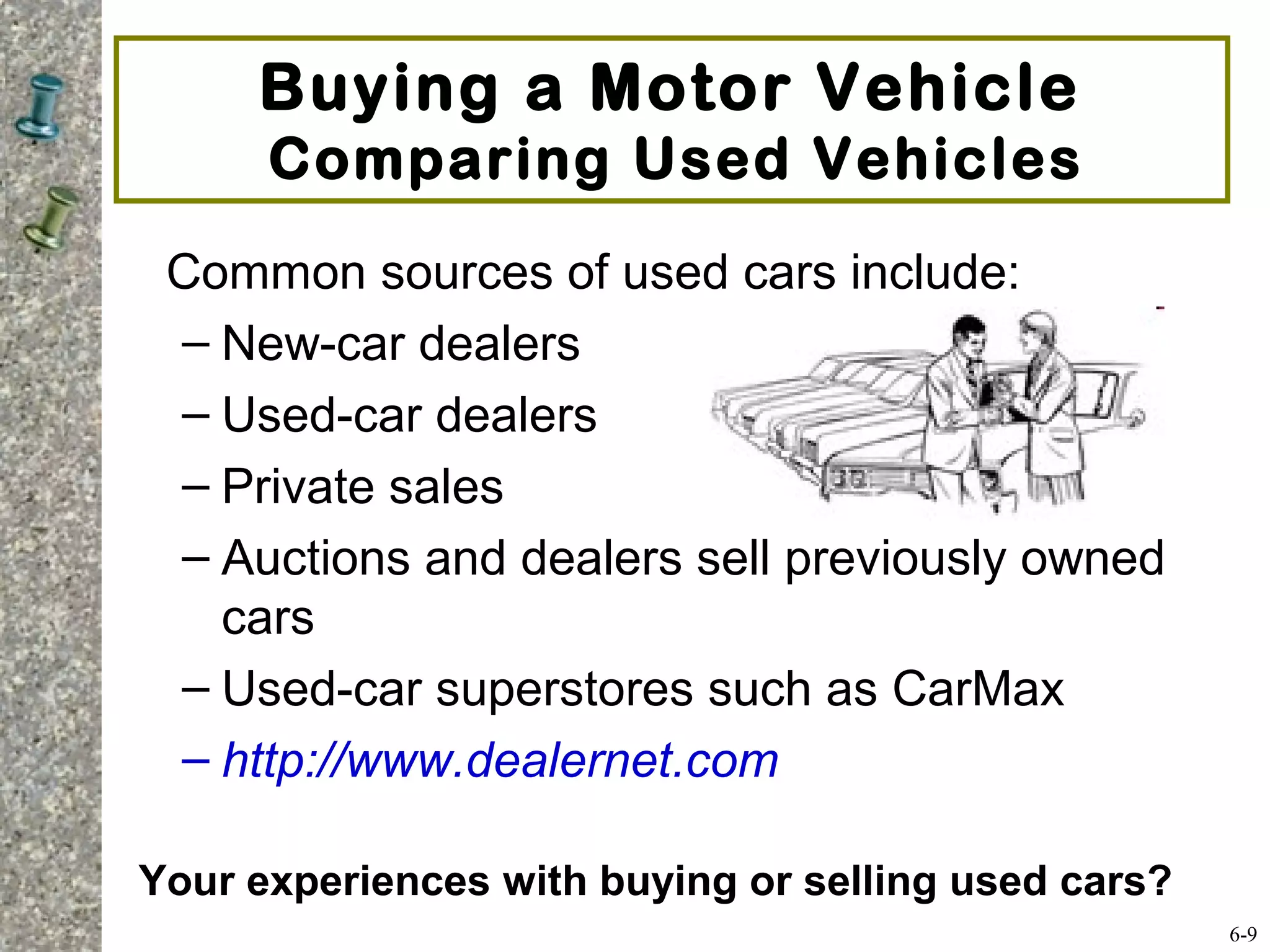
Common sources of used cars include:
– New-car dealers
– Used-car dealers
– Private sales
– Auctions and dealers sell previously owned
cars
– Used-car superstores such as CarMax
– http://www.dealernet.com
Buying a Motor Vehicle
Comparing Used Vehicles
6-9
Your experiences with buying or selling used cars?
Advantages
– Small cash outflow (security deposit vs. downpaymt on loans)
– Lower monthly payments than buying (renting a car)
– Lease provides detailed records - helps if you use your
car for business purposes
– Able to obtain a more expensive car more often
Disadvantages
– No ownership interest
– Must meet requirements to qualify (similar to credit)
– May have additional costs for extra mileage, “wear and
tear”, turning car in early, moving, or certain repairs
Buying a Motor Vehicle
Leasing a Motor Vehicle
6-10
• Capitalized Cost = price of the vehicle
– Average buyer pays 92% of list
– Average leaser pays 96% of list
• Money Factor = interest rate paid on cap. cost
• Payment Schedule
– Monthly payment amount
– number of payments
• Residual Value = expected value of the vehicle at the
end of the lease
– Closed-End Lease (“Walk-away” Lease)- no charge if end-of-
lease value is lower than projected residual value
– Open-End Lease- lease holder pays difference between
projected residual value and actual market value at end of lease
Buying a Motor Vehicle
Financial Aspects of Leasing
6-11
Buying a Motor Vehicle
Phase 3 - Determining Purchase
Price
Negotiation may lower price or add features
– Have all the necessary information
– Deal with a person who has the authority to give
you a lower price or additional features
Used-Car Price Negotiation
– Edmund’s Used Car Prices - http://
www.edmunds.com
– Kelly Blue Book - http://www.kbb.com
The more new cars sold, the more used cars
there are for sale, keeping the prices down
6-12
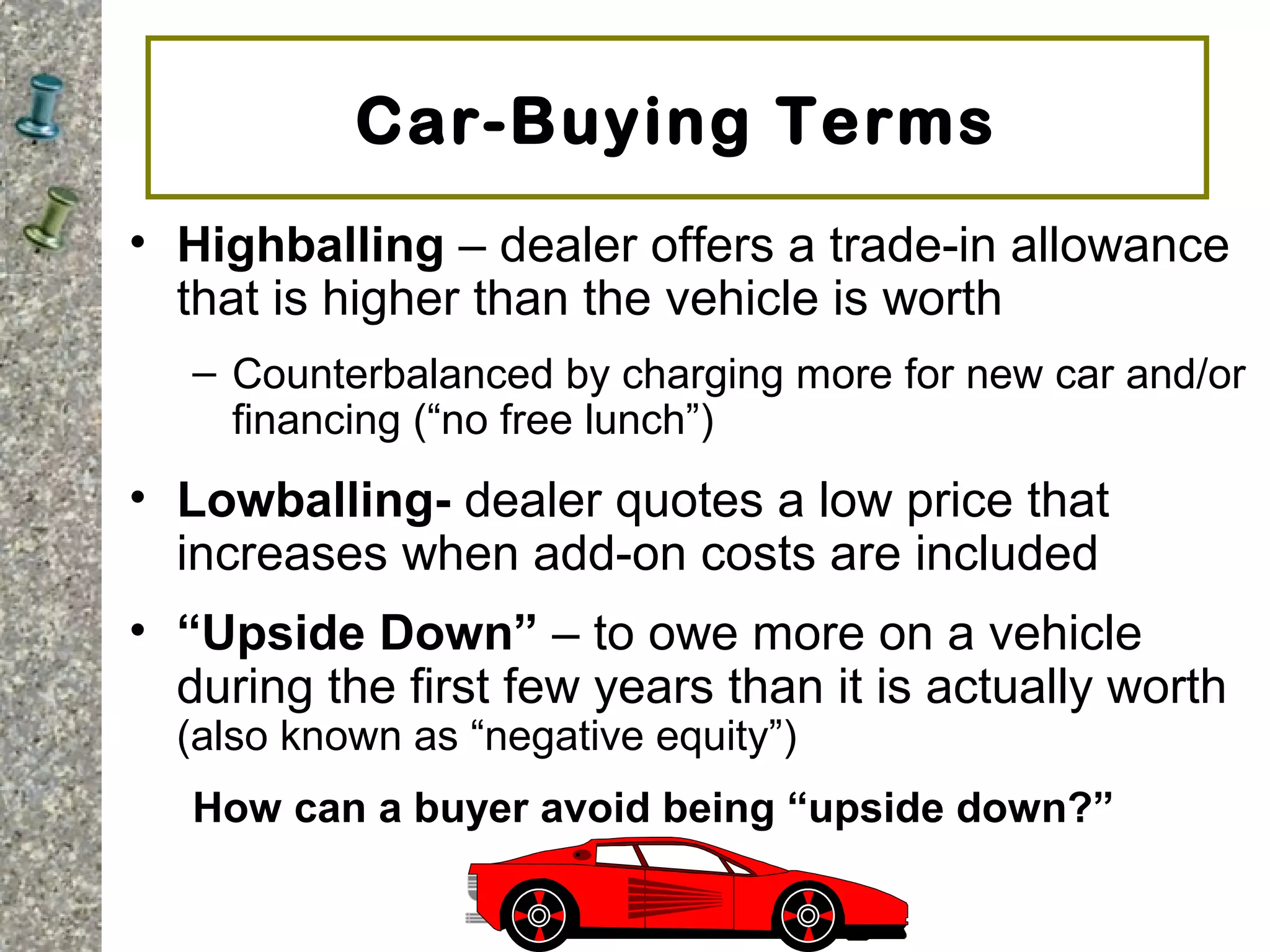
Car-Buying Terms
• Highballing – dealer offers a trade-in allowance
that is higher than the vehicle is worth
– Counterbalanced by charging more for new car and/or
financing (“no free lunch”)
• Lowballing- dealer quotes a low price that
increases when add-on costs are included
• “Upside Down” – to owe more on a vehicle
during the first few years than it is actually worth
(also known as “negative equity”)
How can a buyer avoid being “upside down?”
Buying a Motor Vehicle
Price Bargaining for New Cars
• Sticker Price = suggested retail price
– Includes base price + accessories
• Invoice Price = dealers cost
– Consumer Reports: http://www.consumerreports.org
– Edmund’s New Car Prices: http://www.edmunds.com
• Negotiate a cost somewhere in range in
between
• Until price of the new car is settled:
– Don’t mention any trade-in
– Don’t mention dealer financing
6-14
Buying a Motor Vehicle
Price Bargaining for New Cars
• Price bargaining - compare dealers
– Set-price dealers (“no-haggling” prices)
– Car buying services = auto broker
• Car prices $50 - $200 over dealer’s cost
• Fee-based; arranges purchase with dealer
• Sales agreement = specific details
• Consumer protection for new-car buyers
– Warranties
– State lemon laws
6-15
Sales Techniques to Avoid
• Lowballing and Highballing
• “How much can you afford per month?”
• Offers to “hold” a car with a deposit: Never
leave a deposit unless ready to buy
• “Your price is only $100 above our cost”
– Usually added hidden costs or dealer incentives
• Sales agreements with preprinted amounts
– Cross out inappropriate numbers
Buying a Motor Vehicle
Price Bargaining for New Cars
6-16
Buying a Motor Vehicle
Comparing Financial
Alternatives
• Financing Sources
– Banks, credit unions, other financial institutions,
finance companies, or dealer financing
– Get preapproved for a certain amount: will let you
know how much you can borrow, at what interest
rate, and for how long
• Check the APR and any Rebates
– Use online calculators to determine whether to take
low interest rate OR rebate (usually can’t get both)
– http://www.bankrate.com/calculators/auto/low-
interest-rebate-calculator.aspx
6-17
Researching Rebates
• Rebate – Nothing more than a refund of
part of the purchase price.
– Factory-Direct Rebates – Come directly from
the manufacturer to the buyer rather than to
the dealer as part of a dealer incentive
package.
• Buyer should use rebate money for
downpayment on car- NOT spending
money!
– Benefits of doing this?
Buying a Motor Vehicle
Phase 4: Post-Purchase
Activities
• Maintenance and ownership costs are associated with
some purchases
• Correct use yields improved performance and fewer
repairs
• Investigate, evaluate, and negotiate a variety of
servicing options
• Complain if not satisfied with a purchase
6-19
You can expect to spend over $200,000 on car expenses
over your lifetime!
Buying a Motor Vehicle
Phase 4: Post-Purchase Activities
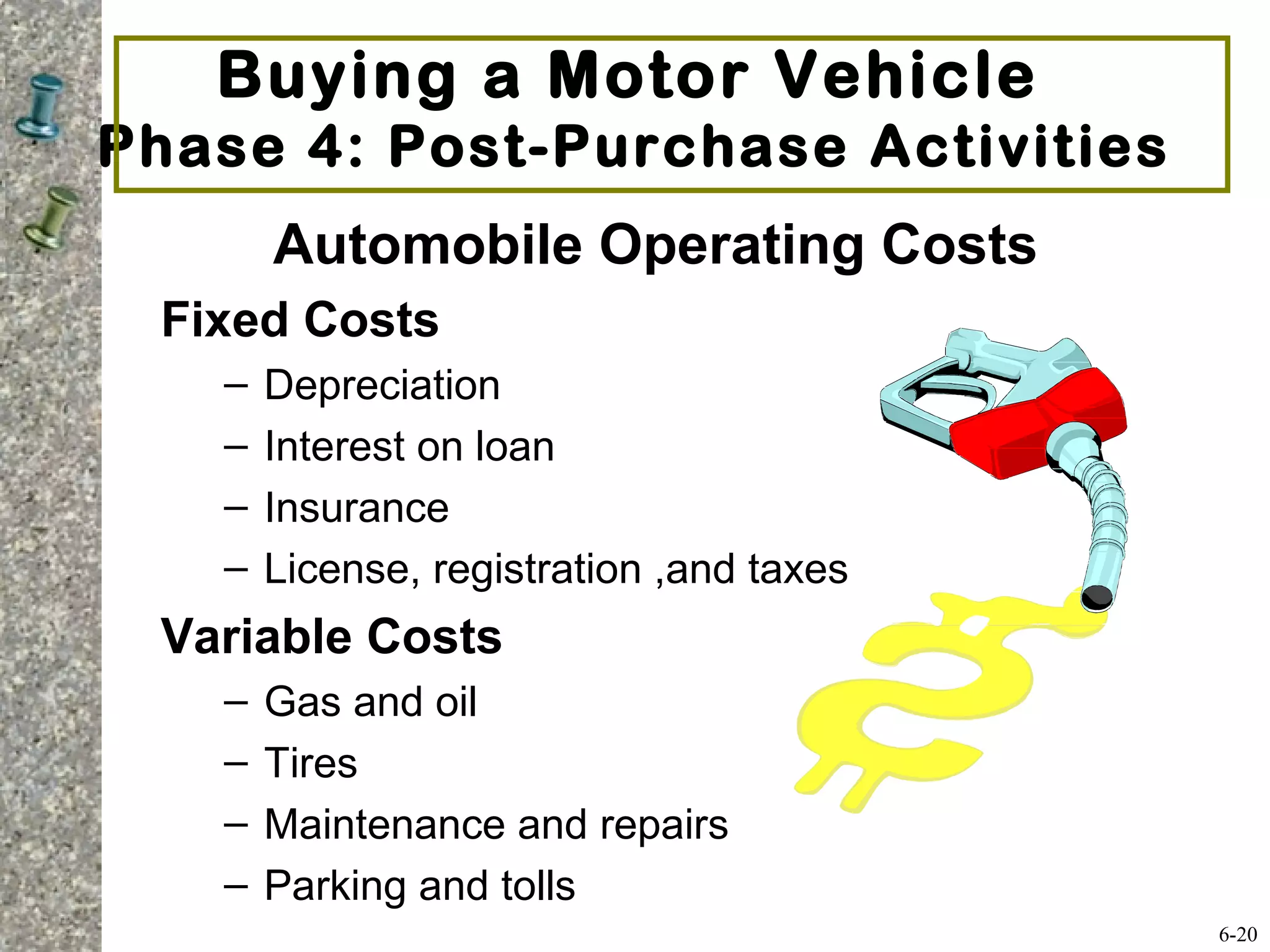
Automobile Operating Costs
Fixed Costs
– Depreciation
– Interest on loan
– Insurance
– License, registration ,and taxes
Variable Costs
– Gas and oil
– Tires
– Maintenance and repairs
– Parking and tolls
6-20
Buying a Motor Vehicle
Phase 4 - Post-purchase
Activities
Vehicle Servicing Options
– Car dealers
– Service stations
– Independent auto repair shops
– Mass merchandise retailers like Sears
and Wal-Mart
– Specialty shops such as oil/lube, muffler,
transmission, and tire shops
Be alert for signs of fraud
6-21
Objective 3
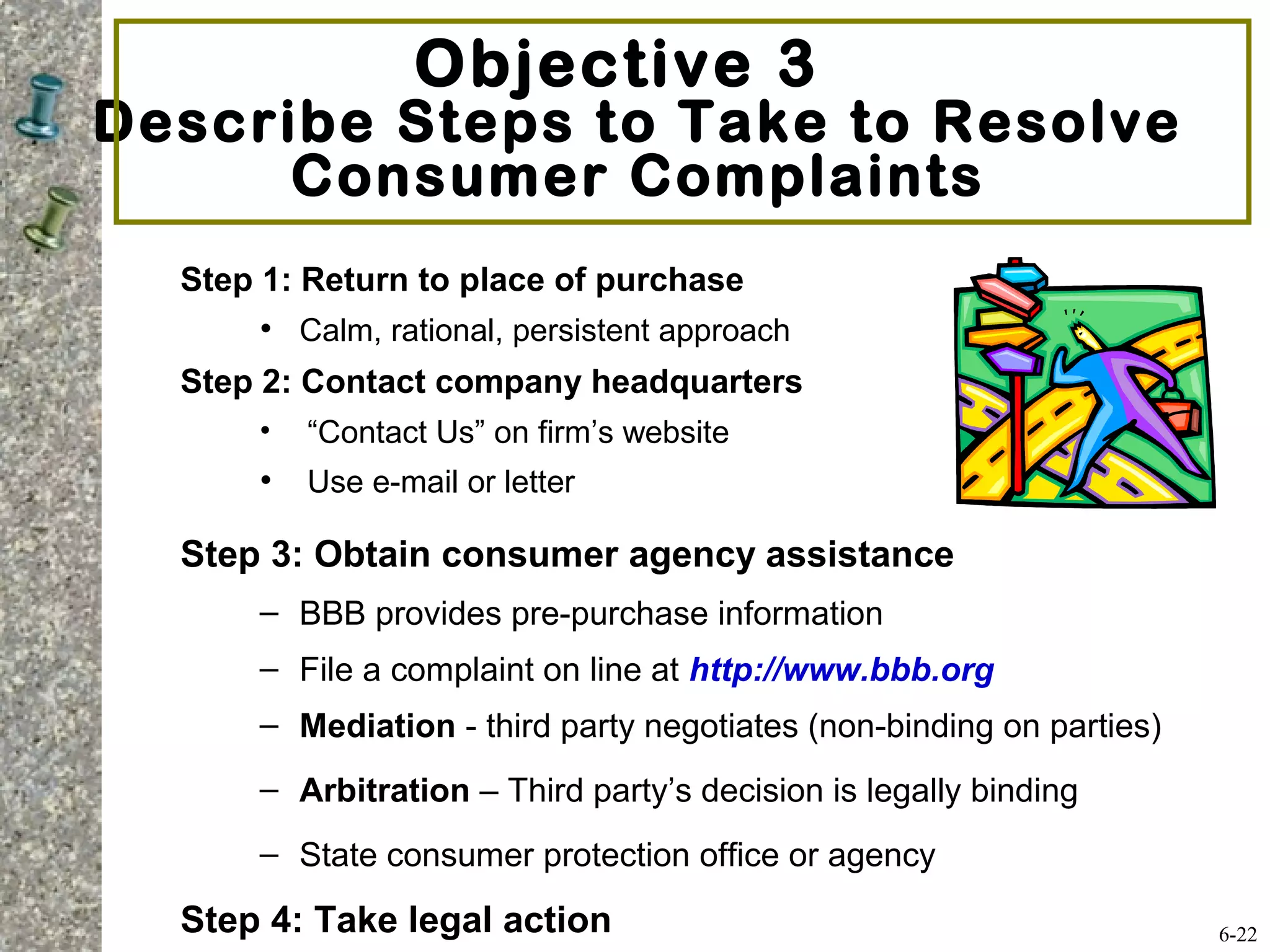
Describe Steps to Take to Resolve
Consumer Complaints
Step 1: Return to place of purchase
• Calm, rational, persistent approach
Step 2: Contact company headquarters
• “Contact Us” on firm’s website
• Use e-mail or letter
Step 3: Obtain consumer agency assistance
– BBB provides pre-purchase information
– File a complaint on line at http://www.bbb.org
– Mediation - third party negotiates (non-binding on parties)
– Arbitration – Third party’s decision is legally binding
– State consumer protection office or agency
Step 4: Take legal action 6-22
Objective 4
Evaluate Legal Alternatives
Available to Consumers
Legal Options for Consumers
–Small claims court
–Class action suits
–Using a lawyer
–Other legal alternatives
• Legal aid society (public agency)
• Prepaid legal services 6-23
Wrap Up
• Chapter Quiz
• Concept Check 6-1- How Does Service
Contract Differ from Warranty?
• Concept Check 6-2- When Might
Leasing be Appropriate?
• Concept Check 6-3-How Does
Arbitration Differ From Mediation?

Chapter 6

  • 1.
    6 Consumer Purchasing Strategies PracticalPurchasing Strategies • Timing purchases – Price variations by time of year (seasons) • Store selection – Location, price, selection, services • Brand Comparison – Private-label or store brands (sold by one chain) vs. national brands • Label Information – Open dating (shelf life of products) 6-1
  • 2.
    Practical Purchasing Strategies Price comparison –Unit pricing = standard of measurement – Coupons and rebates – More store convenience higher prices – Ready-to-use products higher prices – Large is not always best buy (check unit price, usage) – “Sale” prices not always a savings (anchoring) – Online sources can save time 6-2
  • 3.
    Practical Purchasing Strategies Warranties • Writtenguarantee from manufacturer or distributor specifying conditions under which a product can be returned, replaced, or repaired. • Express Warranty (usually written); 2 Forms – Full Warranty (covers entire product; fix or repair for a time) – Limited Warranty (covers only certain parts of a product) • Implied warranty (covers a product’s intended use) – Warranty of title (says seller has the right to sell a product) – Warranty of merchantability (product is fit for its use) 6-3
  • 4.
    Warranties • Used CarWarranties – FTC requires a “buyers’ guide sticker” • Tells if car has warranty and, if so, what it covers – Warranty of merchantability (item fit for intended use) • New Car Warranties – Basic parts against defects – Power train coverage (engine, transmission) – Corrosion warranty (covers holes due to rust) • Service Contracts – “Extended warranty” 6-4
  • 5.
    Research-Based Buying Major PurchaseDecision-making Process • Phase 1: Pre-shopping Activities – Problem identification: prioritize needs and wants – Information gathering: information is power! WHERE to go? – Follow the RULE OF THREE (all major products and services) • Phase 2: Evaluating Alternatives – Price analysis (range of prices and differences in cost) – Comparison shopping (especially complex and expensive items) • Phase 3: Determining Purchase Price and Selection – Negotiation (cars: start with dealer invoice, NOT sticker price) – Payment alternatives (cash, loan, lease) – Acquisition and installation • Phase 4: Post-purchase Activities – Maintenance and operation – After-sale service alternatives – Resolution of purchase concerns 6-5
  • 6.
    Objective 2 Implement aProcess for Making Consumer Purchases A Research-based Approach to Buying a Motor Vehicle 6-6
  • 7.
    Buying a MotorVehicle Phase 1 – Pre-shopping Activities • Problem Identification – Focus on real needs (e.g., reliable transportation) • Information Gathering – Personal contacts – Business organizations – Media information – Independent testing organizations – Government agencies – Online sources 6-7
  • 8.
    • Purchase Alternatives(e.g., new vs. used, makes/models, delaying) • Selecting Vehicle Options – Performance Options (mechanical devices, engine size, transmission, power steering, cruise control, and antilock brakes) – Comfort and Convenience Options (power seats, air conditioning, power locks) – Aesthetic Features (metallic paint, special trim, leather interior, sunroof) • Comparing used vehicles • Leasing a motor vehicle Buying a Motor Vehicle Phase 2 - Evaluating Alternatives 6-8
  • 9.
    Common sources ofused cars include: – New-car dealers – Used-car dealers – Private sales – Auctions and dealers sell previously owned cars – Used-car superstores such as CarMax – http://www.dealernet.com Buying a Motor Vehicle Comparing Used Vehicles 6-9 Your experiences with buying or selling used cars?
  • 10.
    Advantages – Small cashoutflow (security deposit vs. downpaymt on loans) – Lower monthly payments than buying (renting a car) – Lease provides detailed records - helps if you use your car for business purposes – Able to obtain a more expensive car more often Disadvantages – No ownership interest – Must meet requirements to qualify (similar to credit) – May have additional costs for extra mileage, “wear and tear”, turning car in early, moving, or certain repairs Buying a Motor Vehicle Leasing a Motor Vehicle 6-10
  • 11.
    • Capitalized Cost= price of the vehicle – Average buyer pays 92% of list – Average leaser pays 96% of list • Money Factor = interest rate paid on cap. cost • Payment Schedule – Monthly payment amount – number of payments • Residual Value = expected value of the vehicle at the end of the lease – Closed-End Lease (“Walk-away” Lease)- no charge if end-of- lease value is lower than projected residual value – Open-End Lease- lease holder pays difference between projected residual value and actual market value at end of lease Buying a Motor Vehicle Financial Aspects of Leasing 6-11
  • 12.
    Buying a MotorVehicle Phase 3 - Determining Purchase Price Negotiation may lower price or add features – Have all the necessary information – Deal with a person who has the authority to give you a lower price or additional features Used-Car Price Negotiation – Edmund’s Used Car Prices - http:// www.edmunds.com – Kelly Blue Book - http://www.kbb.com The more new cars sold, the more used cars there are for sale, keeping the prices down 6-12
  • 13.
    Car-Buying Terms • Highballing– dealer offers a trade-in allowance that is higher than the vehicle is worth – Counterbalanced by charging more for new car and/or financing (“no free lunch”) • Lowballing- dealer quotes a low price that increases when add-on costs are included • “Upside Down” – to owe more on a vehicle during the first few years than it is actually worth (also known as “negative equity”) How can a buyer avoid being “upside down?”
  • 14.
    Buying a MotorVehicle Price Bargaining for New Cars • Sticker Price = suggested retail price – Includes base price + accessories • Invoice Price = dealers cost – Consumer Reports: http://www.consumerreports.org – Edmund’s New Car Prices: http://www.edmunds.com • Negotiate a cost somewhere in range in between • Until price of the new car is settled: – Don’t mention any trade-in – Don’t mention dealer financing 6-14
  • 15.
    Buying a MotorVehicle Price Bargaining for New Cars • Price bargaining - compare dealers – Set-price dealers (“no-haggling” prices) – Car buying services = auto broker • Car prices $50 - $200 over dealer’s cost • Fee-based; arranges purchase with dealer • Sales agreement = specific details • Consumer protection for new-car buyers – Warranties – State lemon laws 6-15
  • 16.
    Sales Techniques toAvoid • Lowballing and Highballing • “How much can you afford per month?” • Offers to “hold” a car with a deposit: Never leave a deposit unless ready to buy • “Your price is only $100 above our cost” – Usually added hidden costs or dealer incentives • Sales agreements with preprinted amounts – Cross out inappropriate numbers Buying a Motor Vehicle Price Bargaining for New Cars 6-16
  • 17.
    Buying a MotorVehicle Comparing Financial Alternatives • Financing Sources – Banks, credit unions, other financial institutions, finance companies, or dealer financing – Get preapproved for a certain amount: will let you know how much you can borrow, at what interest rate, and for how long • Check the APR and any Rebates – Use online calculators to determine whether to take low interest rate OR rebate (usually can’t get both) – http://www.bankrate.com/calculators/auto/low- interest-rebate-calculator.aspx 6-17
  • 18.
    Researching Rebates • Rebate– Nothing more than a refund of part of the purchase price. – Factory-Direct Rebates – Come directly from the manufacturer to the buyer rather than to the dealer as part of a dealer incentive package. • Buyer should use rebate money for downpayment on car- NOT spending money! – Benefits of doing this?
  • 19.
    Buying a MotorVehicle Phase 4: Post-Purchase Activities • Maintenance and ownership costs are associated with some purchases • Correct use yields improved performance and fewer repairs • Investigate, evaluate, and negotiate a variety of servicing options • Complain if not satisfied with a purchase 6-19 You can expect to spend over $200,000 on car expenses over your lifetime!
  • 20.
    Buying a MotorVehicle Phase 4: Post-Purchase Activities Automobile Operating Costs Fixed Costs – Depreciation – Interest on loan – Insurance – License, registration ,and taxes Variable Costs – Gas and oil – Tires – Maintenance and repairs – Parking and tolls 6-20
  • 21.
    Buying a MotorVehicle Phase 4 - Post-purchase Activities Vehicle Servicing Options – Car dealers – Service stations – Independent auto repair shops – Mass merchandise retailers like Sears and Wal-Mart – Specialty shops such as oil/lube, muffler, transmission, and tire shops Be alert for signs of fraud 6-21
  • 22.
    Objective 3 Describe Stepsto Take to Resolve Consumer Complaints Step 1: Return to place of purchase • Calm, rational, persistent approach Step 2: Contact company headquarters • “Contact Us” on firm’s website • Use e-mail or letter Step 3: Obtain consumer agency assistance – BBB provides pre-purchase information – File a complaint on line at http://www.bbb.org – Mediation - third party negotiates (non-binding on parties) – Arbitration – Third party’s decision is legally binding – State consumer protection office or agency Step 4: Take legal action 6-22
  • 23.
    Objective 4 Evaluate LegalAlternatives Available to Consumers Legal Options for Consumers –Small claims court –Class action suits –Using a lawyer –Other legal alternatives • Legal aid society (public agency) • Prepaid legal services 6-23
  • 24.
    Wrap Up • ChapterQuiz • Concept Check 6-1- How Does Service Contract Differ from Warranty? • Concept Check 6-2- When Might Leasing be Appropriate? • Concept Check 6-3-How Does Arbitration Differ From Mediation?