 
 Dictionary.com says:
o Freedom from risk or danger; safety.
o Freedom from doubt, anxiety, or fear; confidence.
o Something that gives or assures safety, as:
• A group or department of private guards: Call building
security if a visitor acts suspicious.
• Measures adopted by a government to prevent espionage,
sabotage, or attack.
• Measures adopted, as by a business or homeowner, to
prevent a crime such as burglary or assault: Security was lax
at the firm's smaller plant.
 …etc.
Network security consists of the provisions and
policies adopted by a network administrator to
prevent and monitor unauthorized access,
misuse, modification, or denial of a computer
network and network-accessible resources.
Network security involves the authorization of
access to data in a network, which is controlled
by the network administrator.
 Confidentiality: only sender, intended receiver
should “understand” message contents
o sender encrypts message
o receiver decrypts message
 Authentication: sender, receiver want to confirm
identity of each other
 Message integrity: sender, receiver want to
ensure message not altered (in transit, or
afterwards) without detection
 Access and availability: services must be
accessible and available to users
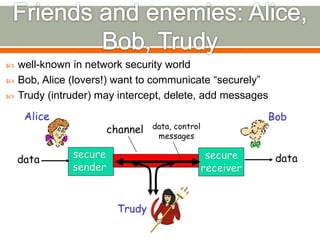
 well-known in network security world
 Bob, Alice (lovers!) want to communicate “securely”
 Trudy (intruder) may intercept, delete, add messages
… well, real-life Bobs and Alices!
web browser/server for electronic transactions
(e.g., on-line purchases)
on-line banking client/server
DNS servers
routers exchanging routing table updates
other examples?
They can do a lot of things
 eavesdrop: intercept messages
 actively insert messages into connection
 impersonation: can fake (spoof) source address
in packet (or any field in packet)
 hijacking: “take over” ongoing connection by
removing sender or receiver, inserting himself in
place
 denial of service: prevent service from being
used by others (e.g., by overloading resources)
Confidentiality
o Information about system or its users cannot be
learned by an attacker
Integrity
o The system continues to operate properly, only
reaching states that would occur if there were no
attacker
Availability
o Actions by an attacker do not prevent users from
having access to use of the system
Data
o Information we keep on computers (product
design, financial records, personnel data)
o Lost time, lost sales, lost confidence
Resources
o Unauthorized use of computer time & space
Reputation
o Misrepresentation, forgery, negative publicity
Financial institutions and banks
Internet service providers
Pharmaceutical companies
Government and defence agencies
Contractors to various government agencies
Multinational corporations
ANYONE ON THE NETWORK
Definition - hardware &/or software
components that restrict access between a
restricted network & the Internet or between
networks
Logically - a separator, restricted, analyser
Rarely a single object
o Restricts people to entering at a controlled point
o Prevents attackers from getting close to other
defences (host controls)
o Restricts people to leaving at a controlled point
Focus security decisions - single point to
leverage control
Enforce security policy - minimize exceptions
Log Internet activity - analysis
Limit exposure - separate sensitive areas of
one network from another or outside world
Can’t protect against
o malicious insiders
o connections that don’t go through it
o new threats
o viruses
o scans for source & destination addresses & port
numbers, not details of data
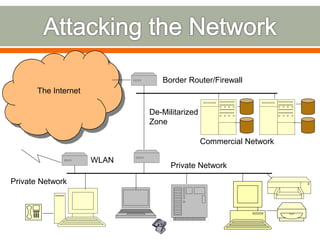
The Internet
De-Militarized
Zone
Private Network
Border Router/Firewall
Commercial Network
Private Network
WLAN
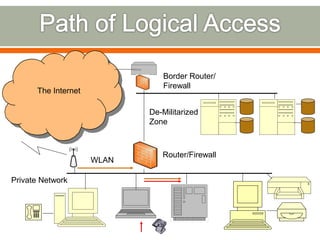
The Internet
De-Militarized
Zone
Private Network
Border Router/
Firewall
Router/Firewall
WLAN
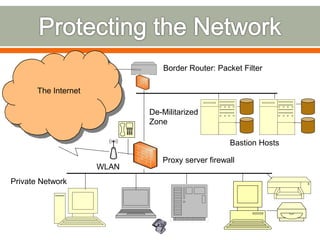
The Internet
De-Militarized
Zone
Private Network
Border Router: Packet Filter
Bastion Hosts
Proxy server firewall
WLAN
Authentication (entity, data origin)
Access control (prevent unauthorized access)
Confidentiality (disclosure, encryption)
Data integrity (value of data item)
Non-repudiation (falsely denying a transaction)
Used to monitor for “suspicious activity” on a
network
Can protect against known software exploits,
like buffer overflows
We can run a dictionary attack on the
passwords
o The passwords in /etc/passwd are encrypted with
the crypt(3) function (one-way hash)
o Can take a dictionary of words, crypt() them all,
and compare with the hashed passwords
This is why your passwords should be
meaningless random junk!
o For example, “sdfo839f” is a good password
Purpose: Make a network service unusable,
usually by overloading the server or network
Many different kinds of DoS attacks
o SYN flooding
o SMURF
o Distributed attacks
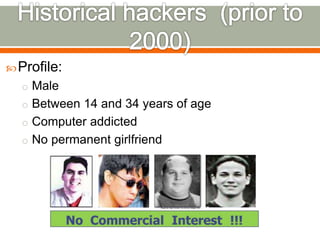
Profile:
o Male
o Between 14 and 34 years of age
o Computer addicted
o No permanent girlfriend
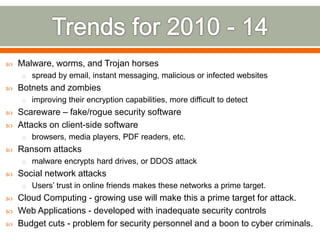
 Malware, worms, and Trojan horses
o spread by email, instant messaging, malicious or infected websites
 Botnets and zombies
o improving their encryption capabilities, more difficult to detect
 Scareware – fake/rogue security software
 Attacks on client-side software
o browsers, media players, PDF readers, etc.
 Ransom attacks
o malware encrypts hard drives, or DDOS attack
 Social network attacks
o Users’ trust in online friends makes these networks a prime target.
 Cloud Computing - growing use will make this a prime target for attack.
 Web Applications - developed with inadequate security controls
 Budget cuts - problem for security personnel and a boon to cyber criminals.
 
Class 16
Class 16
Class 16
Class 16
Class 16
Class 16
Class 16
Class 16

Class 16

  • 2.
  • 3.
     Dictionary.com says: oFreedom from risk or danger; safety. o Freedom from doubt, anxiety, or fear; confidence. o Something that gives or assures safety, as: • A group or department of private guards: Call building security if a visitor acts suspicious. • Measures adopted by a government to prevent espionage, sabotage, or attack. • Measures adopted, as by a business or homeowner, to prevent a crime such as burglary or assault: Security was lax at the firm's smaller plant.  …etc.
  • 4.
    Network security consistsof the provisions and policies adopted by a network administrator to prevent and monitor unauthorized access, misuse, modification, or denial of a computer network and network-accessible resources. Network security involves the authorization of access to data in a network, which is controlled by the network administrator.
  • 5.
     Confidentiality: onlysender, intended receiver should “understand” message contents o sender encrypts message o receiver decrypts message  Authentication: sender, receiver want to confirm identity of each other  Message integrity: sender, receiver want to ensure message not altered (in transit, or afterwards) without detection  Access and availability: services must be accessible and available to users
  • 6.
     well-known innetwork security world  Bob, Alice (lovers!) want to communicate “securely”  Trudy (intruder) may intercept, delete, add messages
  • 7.
    … well, real-lifeBobs and Alices! web browser/server for electronic transactions (e.g., on-line purchases) on-line banking client/server DNS servers routers exchanging routing table updates other examples?
  • 8.
    They can doa lot of things  eavesdrop: intercept messages  actively insert messages into connection  impersonation: can fake (spoof) source address in packet (or any field in packet)  hijacking: “take over” ongoing connection by removing sender or receiver, inserting himself in place  denial of service: prevent service from being used by others (e.g., by overloading resources)
  • 9.
    Confidentiality o Information aboutsystem or its users cannot be learned by an attacker Integrity o The system continues to operate properly, only reaching states that would occur if there were no attacker Availability o Actions by an attacker do not prevent users from having access to use of the system
  • 10.
    Data o Information wekeep on computers (product design, financial records, personnel data) o Lost time, lost sales, lost confidence Resources o Unauthorized use of computer time & space Reputation o Misrepresentation, forgery, negative publicity
  • 11.
    Financial institutions andbanks Internet service providers Pharmaceutical companies Government and defence agencies Contractors to various government agencies Multinational corporations ANYONE ON THE NETWORK
  • 12.
    Definition - hardware&/or software components that restrict access between a restricted network & the Internet or between networks Logically - a separator, restricted, analyser Rarely a single object o Restricts people to entering at a controlled point o Prevents attackers from getting close to other defences (host controls) o Restricts people to leaving at a controlled point
  • 13.
    Focus security decisions- single point to leverage control Enforce security policy - minimize exceptions Log Internet activity - analysis Limit exposure - separate sensitive areas of one network from another or outside world
  • 14.
    Can’t protect against omalicious insiders o connections that don’t go through it o new threats o viruses o scans for source & destination addresses & port numbers, not details of data
  • 15.
    The Internet De-Militarized Zone Private Network BorderRouter/Firewall Commercial Network Private Network WLAN
  • 16.
    The Internet De-Militarized Zone Private Network BorderRouter/ Firewall Router/Firewall WLAN
  • 17.
    The Internet De-Militarized Zone Private Network BorderRouter: Packet Filter Bastion Hosts Proxy server firewall WLAN
  • 18.
    Authentication (entity, dataorigin) Access control (prevent unauthorized access) Confidentiality (disclosure, encryption) Data integrity (value of data item) Non-repudiation (falsely denying a transaction)
  • 19.
    Used to monitorfor “suspicious activity” on a network Can protect against known software exploits, like buffer overflows
  • 20.
    We can runa dictionary attack on the passwords o The passwords in /etc/passwd are encrypted with the crypt(3) function (one-way hash) o Can take a dictionary of words, crypt() them all, and compare with the hashed passwords This is why your passwords should be meaningless random junk! o For example, “sdfo839f” is a good password
  • 21.
    Purpose: Make anetwork service unusable, usually by overloading the server or network Many different kinds of DoS attacks o SYN flooding o SMURF o Distributed attacks
  • 22.
    Profile: o Male o Between14 and 34 years of age o Computer addicted o No permanent girlfriend
  • 23.
     Malware, worms,and Trojan horses o spread by email, instant messaging, malicious or infected websites  Botnets and zombies o improving their encryption capabilities, more difficult to detect  Scareware – fake/rogue security software  Attacks on client-side software o browsers, media players, PDF readers, etc.  Ransom attacks o malware encrypts hard drives, or DDOS attack  Social network attacks o Users’ trust in online friends makes these networks a prime target.  Cloud Computing - growing use will make this a prime target for attack.  Web Applications - developed with inadequate security controls  Budget cuts - problem for security personnel and a boon to cyber criminals.
  • 24.