eAuction :
The Efficient Negotiation Tool
- Busting a few myths
Your Partner in the Journey
 Ajay Garg : Experienced Strategic Sourcing and SCM SME
https://www.linkedin.com/in/ajay-garg-5a84964/
SCM => Supply Chain Management
SME => Subject Matter Expert
eAuction is the most efficient, transparent and simpler way to negotiate;
It has gained Popularity, Precedence and Momentum in last decade…
More
People
Know it
More
People
Prefer &
Follow it
More
people
Use it
Myths and Realities
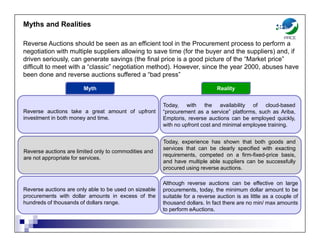
Reverse Auctions should be seen as an efficient tool in the Procurement process to perform a
negotiation with multiple suppliers allowing to save time (for the buyer and the suppliers) and, if
driven seriously, can generate savings (the final price is a good picture of the “Market price”
difficult to meet with a “classic” negotiation method). However, since the year 2000, abuses have
been done and reverse auctions suffered a “bad press”
Reverse auctions take a great amount of upfront
investment in both money and time.
Today, with the availability of cloud-based
“procurement as a service” platforms, such as Ariba,
Emptoris, reverse auctions can be employed quickly,
with no upfront cost and minimal employee training.
Myth Reality
Reverse auctions are limited only to commodities and
are not appropriate for services.
Today, experience has shown that both goods and
services that can be clearly specified with exacting
requirements, competed on a firm-fixed-price basis,
and have multiple able suppliers can be successfully
procured using reverse auctions.
Reverse auctions are only able to be used on sizeable
procurements with dollar amounts in excess of the
hundreds of thousands of dollars range.
Although reverse auctions can be effective on large
procurements, today, the minimum dollar amount to be
suitable for a reverse auction is as little as a couple of
thousand dollars. In fact there are no min/ max amounts
to perform eAuctions.
Myth Reality
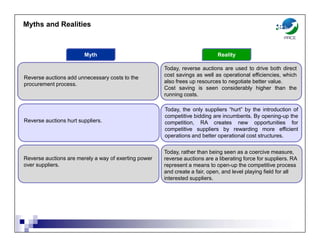
Reverse auctions add unnecessary costs to the
procurement process.
Today, reverse auctions are used to drive both direct
cost savings as well as operational efficiencies, which
also frees up resources to negotiate better value.
Cost saving is seen considerably higher than the
running costs.
Reverse auctions hurt suppliers.
Today, the only suppliers “hurt” by the introduction of
competitive bidding are incumbents. By opening-up the
competition, RA creates new opportunities for
competitive suppliers by rewarding more efficient
operations and better operational cost structures.
Myths and Realities
Reverse auctions are merely a way of exerting power
over suppliers.
Today, rather than being seen as a coercive measure,
reverse auctions are a liberating force for suppliers. RA
represent a means to open-up the competitive process
and create a fair, open, and level playing field for all
interested suppliers.
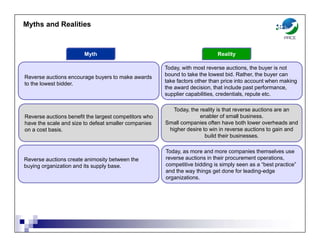
Reverse auctions benefit the largest competitors who
have the scale and size to defeat smaller companies
on a cost basis.
Today, the reality is that reverse auctions are an
enabler of small business.
Small companies often have both lower overheads and
higher desire to win in reverse auctions to gain and
build their businesses.
Myths and Realities
Myth Reality
Reverse auctions encourage buyers to make awards
to the lowest bidder.
Today, with most reverse auctions, the buyer is not
bound to take the lowest bid. Rather, the buyer can
take factors other than price into account when making
the award decision, that include past performance,
supplier capabilities, credentials, repute etc.
Reverse auctions create animosity between the
buying organization and its supply base.
Today, as more and more companies themselves use
reverse auctions in their procurement operations,
competitive bidding is simply seen as a “best practice”
and the way things get done for leading-edge
organizations.
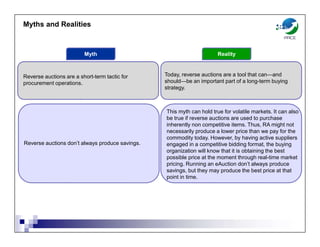
Reverse auctions are a short-term tactic for
procurement operations.
Today, reverse auctions are a tool that can—and
should—be an important part of a long-term buying
strategy.
Myths and Realities
Reverse auctions don’t always produce savings.
This myth can hold true for volatile markets. It can also
be true if reverse auctions are used to purchase
inherently non competitive items. Thus, RA might not
necessarily produce a lower price than we pay for the
commodity today. However, by having active suppliers
engaged in a competitive bidding format, the buying
organization will know that it is obtaining the best
possible price at the moment through real-time market
pricing. Running an eAuction don’t always produce
savings, but they may produce the best price at that
point in time.
Myth Reality
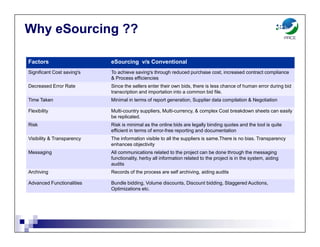
Why eSourcing ??
Factors eSourcing v/s Conventional
Significant Cost saving's To achieve saving's through reduced purchase cost, increased contract compliance
& Process efficiencies
Decreased Error Rate Since the sellers enter their own bids, there is less chance of human error during bid
transcription and importation into a common bid file.
Time Taken Minimal in terms of report generation, Supplier data compilation & Negotiation
Flexibility Multi-country suppliers, Multi-currency, & complex Cost breakdown sheets can easily
be replicated.
Risk Risk is minimal as the online bids are legally binding quotes and the tool is quite
efficient in terms of error-free reporting and documentation
Visibility & Transparency The information visible to all the suppliers is same.There is no bias. Transparency
enhances objectivity
Messaging All communications related to the project can be done through the messaging
functionality, herby all information related to the project is in the system, aiding
audits
Archiving Records of the process are self archiving, aiding audits
Advanced Functionalities Bundle bidding, Volume discounts, Discount bidding, Staggered Auctions,
Optimizations etc.
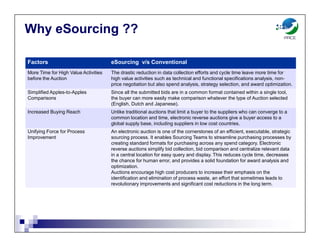
Factors eSourcing v/s Conventional
More Time for High Value Activities
before the Auction
The drastic reduction in data collection efforts and cycle time leave more time for
high value activities such as technical and functional specifications analysis, non-
price negotiation but also spend analysis, strategy selection, and award optimization.
Simplified Apples-to-Apples
Comparisons
Since all the submitted bids are in a common format contained within a single tool,
the buyer can more easily make comparison whatever the type of Auction selected
(English, Dutch and Japanese).
Increased Buying Reach Unlike traditional auctions that limit a buyer to the suppliers who can converge to a
common location and time, electronic reverse auctions give a buyer access to a
global supply base, including suppliers in low cost countries.
Unifying Force for Process
Improvement
An electronic auction is one of the cornerstones of an efficient, executable, strategic
sourcing process. It enables Sourcing Teams to streamline purchasing processes by
creating standard formats for purchasing across any spend category. Electronic
reverse auctions simplify bid collection, bid comparison and centralize relevant data
in a central location for easy query and display. This reduces cycle time, decreases
the chance for human error, and provides a solid foundation for award analysis and
optimization.
Auctions encourage high cost producers to increase their emphasis on the
identification and elimination of process waste, an effort that sometimes leads to
revolutionary improvements and significant cost reductions in the long term.
Why eSourcing ??
NOT just Business
as Usual
Science & Art
of
Achieving
Best in Class…
… through Answers to most of the Pain Points through
Customized & Effective Interventions…
YOUR VISION
IS MY MISSION
THANK YOU !

E auctions myths & realities

  • 1.
    eAuction : The EfficientNegotiation Tool - Busting a few myths Your Partner in the Journey  Ajay Garg : Experienced Strategic Sourcing and SCM SME https://www.linkedin.com/in/ajay-garg-5a84964/ SCM => Supply Chain Management SME => Subject Matter Expert
  • 2.
    eAuction is themost efficient, transparent and simpler way to negotiate; It has gained Popularity, Precedence and Momentum in last decade… More People Know it More People Prefer & Follow it More people Use it
  • 3.
    Myths and Realities ReverseAuctions should be seen as an efficient tool in the Procurement process to perform a negotiation with multiple suppliers allowing to save time (for the buyer and the suppliers) and, if driven seriously, can generate savings (the final price is a good picture of the “Market price” difficult to meet with a “classic” negotiation method). However, since the year 2000, abuses have been done and reverse auctions suffered a “bad press” Reverse auctions take a great amount of upfront investment in both money and time. Today, with the availability of cloud-based “procurement as a service” platforms, such as Ariba, Emptoris, reverse auctions can be employed quickly, with no upfront cost and minimal employee training. Myth Reality Reverse auctions are limited only to commodities and are not appropriate for services. Today, experience has shown that both goods and services that can be clearly specified with exacting requirements, competed on a firm-fixed-price basis, and have multiple able suppliers can be successfully procured using reverse auctions. Reverse auctions are only able to be used on sizeable procurements with dollar amounts in excess of the hundreds of thousands of dollars range. Although reverse auctions can be effective on large procurements, today, the minimum dollar amount to be suitable for a reverse auction is as little as a couple of thousand dollars. In fact there are no min/ max amounts to perform eAuctions.
  • 4.
    Myth Reality Reverse auctionsadd unnecessary costs to the procurement process. Today, reverse auctions are used to drive both direct cost savings as well as operational efficiencies, which also frees up resources to negotiate better value. Cost saving is seen considerably higher than the running costs. Reverse auctions hurt suppliers. Today, the only suppliers “hurt” by the introduction of competitive bidding are incumbents. By opening-up the competition, RA creates new opportunities for competitive suppliers by rewarding more efficient operations and better operational cost structures. Myths and Realities Reverse auctions are merely a way of exerting power over suppliers. Today, rather than being seen as a coercive measure, reverse auctions are a liberating force for suppliers. RA represent a means to open-up the competitive process and create a fair, open, and level playing field for all interested suppliers.
  • 5.
    Reverse auctions benefitthe largest competitors who have the scale and size to defeat smaller companies on a cost basis. Today, the reality is that reverse auctions are an enabler of small business. Small companies often have both lower overheads and higher desire to win in reverse auctions to gain and build their businesses. Myths and Realities Myth Reality Reverse auctions encourage buyers to make awards to the lowest bidder. Today, with most reverse auctions, the buyer is not bound to take the lowest bid. Rather, the buyer can take factors other than price into account when making the award decision, that include past performance, supplier capabilities, credentials, repute etc. Reverse auctions create animosity between the buying organization and its supply base. Today, as more and more companies themselves use reverse auctions in their procurement operations, competitive bidding is simply seen as a “best practice” and the way things get done for leading-edge organizations.
  • 6.
    Reverse auctions area short-term tactic for procurement operations. Today, reverse auctions are a tool that can—and should—be an important part of a long-term buying strategy. Myths and Realities Reverse auctions don’t always produce savings. This myth can hold true for volatile markets. It can also be true if reverse auctions are used to purchase inherently non competitive items. Thus, RA might not necessarily produce a lower price than we pay for the commodity today. However, by having active suppliers engaged in a competitive bidding format, the buying organization will know that it is obtaining the best possible price at the moment through real-time market pricing. Running an eAuction don’t always produce savings, but they may produce the best price at that point in time. Myth Reality
  • 7.
    Why eSourcing ?? FactorseSourcing v/s Conventional Significant Cost saving's To achieve saving's through reduced purchase cost, increased contract compliance & Process efficiencies Decreased Error Rate Since the sellers enter their own bids, there is less chance of human error during bid transcription and importation into a common bid file. Time Taken Minimal in terms of report generation, Supplier data compilation & Negotiation Flexibility Multi-country suppliers, Multi-currency, & complex Cost breakdown sheets can easily be replicated. Risk Risk is minimal as the online bids are legally binding quotes and the tool is quite efficient in terms of error-free reporting and documentation Visibility & Transparency The information visible to all the suppliers is same.There is no bias. Transparency enhances objectivity Messaging All communications related to the project can be done through the messaging functionality, herby all information related to the project is in the system, aiding audits Archiving Records of the process are self archiving, aiding audits Advanced Functionalities Bundle bidding, Volume discounts, Discount bidding, Staggered Auctions, Optimizations etc.
  • 8.
    Factors eSourcing v/sConventional More Time for High Value Activities before the Auction The drastic reduction in data collection efforts and cycle time leave more time for high value activities such as technical and functional specifications analysis, non- price negotiation but also spend analysis, strategy selection, and award optimization. Simplified Apples-to-Apples Comparisons Since all the submitted bids are in a common format contained within a single tool, the buyer can more easily make comparison whatever the type of Auction selected (English, Dutch and Japanese). Increased Buying Reach Unlike traditional auctions that limit a buyer to the suppliers who can converge to a common location and time, electronic reverse auctions give a buyer access to a global supply base, including suppliers in low cost countries. Unifying Force for Process Improvement An electronic auction is one of the cornerstones of an efficient, executable, strategic sourcing process. It enables Sourcing Teams to streamline purchasing processes by creating standard formats for purchasing across any spend category. Electronic reverse auctions simplify bid collection, bid comparison and centralize relevant data in a central location for easy query and display. This reduces cycle time, decreases the chance for human error, and provides a solid foundation for award analysis and optimization. Auctions encourage high cost producers to increase their emphasis on the identification and elimination of process waste, an effort that sometimes leads to revolutionary improvements and significant cost reductions in the long term. Why eSourcing ??
  • 9.
    NOT just Business asUsual Science & Art of Achieving Best in Class… … through Answers to most of the Pain Points through Customized & Effective Interventions…
  • 10.
    YOUR VISION IS MYMISSION THANK YOU !