• The goal of your business is to make money
• In the early stages, money does not flow in buckets
• You need money to survive
• Your revenue (or savings) at some point needs to
exceed your costs
• You want to maximize your ROI as much as possible
• You need to understand your market, your pricing
options and your potential revenues
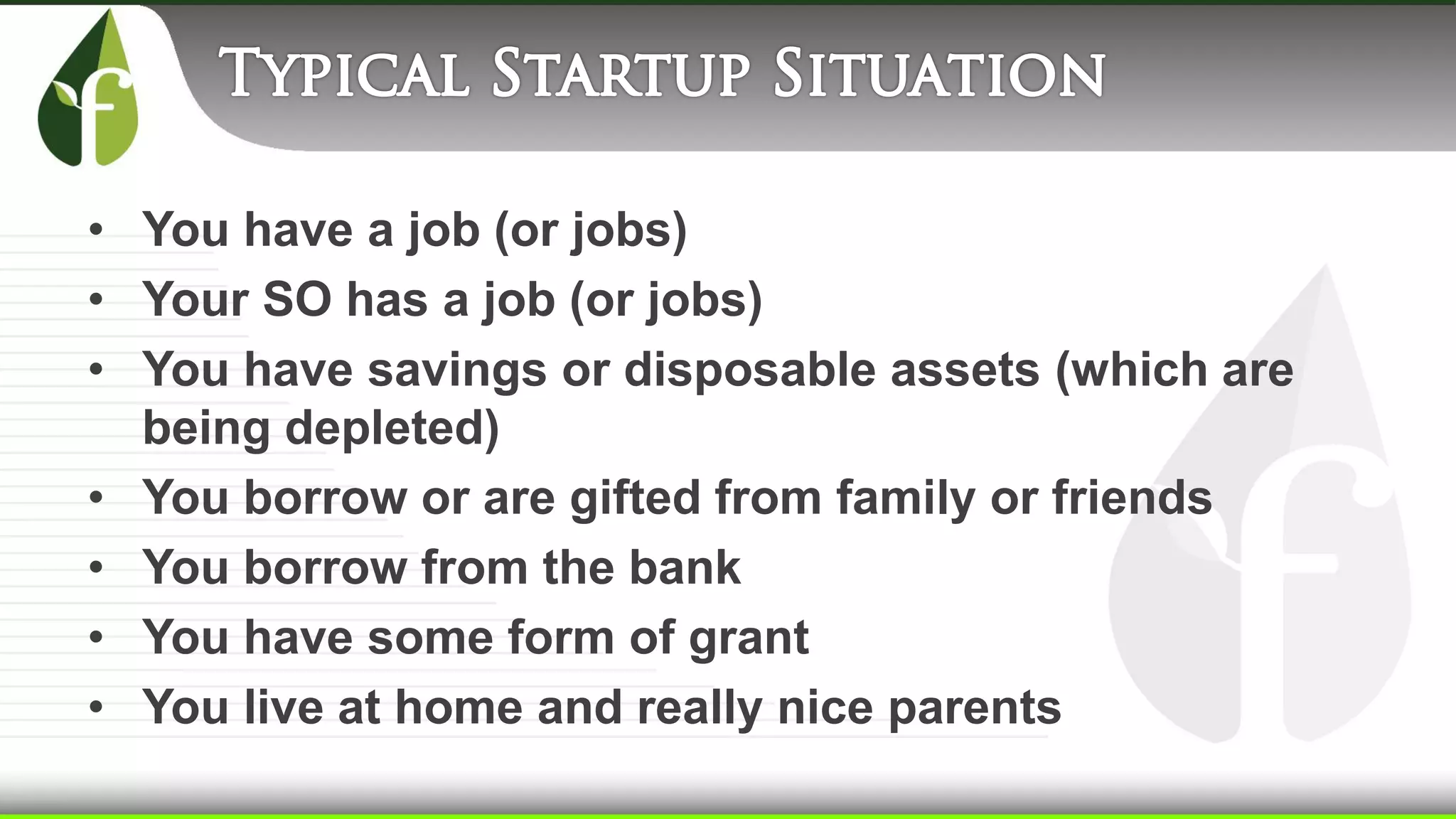
• You have a job (or jobs)
• Your SO has a job (or jobs)
• You have savings or disposable assets (which are
being depleted)
• You borrow or are gifted from family or friends
• You borrow from the bank
• You have some form of grant
• You live at home and really nice parents
• Burn rate is the rate at which cash is decreasing.
Especially in early stage startups, it’s important to know
and monitor burn rate as companies fail when they are
running out of cash and don’t have enough time left to
raise funds or reduce expenses.
• Monthly cash burn = cash balance at the beginning of
the year minus cash balance end of the year / 12
• Product: Anything relating to the product as well as what the customer
perceives as the product
• Price: Cost to the user and determining a pricing strategy
• Promotion: Tools and channels used to reach customers and prospects
(advertising, sales promotions, public relations, etc.)
• Place: The channel of physical distribution (the product’s actual movement
through a means of distribution) and sales (how the product is sold, whether
through website, wholesalers, retailers, direct mail, etc.)
• Target Marketing involves breaking a market into groups (segments)
whose needs and desires most closely match your product or service
offerings and then focusing marketing and sales efforts on one or more of
these segment.
• Geographic – Country, region, postal code, city, compound
• Demographic – Age, gender, religion, race
• Psychographic/Behavioral – class, personality, lifestyle
Total available
market (TAM)
Serviceable
Available Market
(SAM)
Serviceable
Obtainable (SOM)
Penetrated Market
(PM)
Target Market
Your customers
TAM in your geographic reach
Potential scale of the market 228 Million Coffee Drinkers
47 Million Brew at Home
16 Million are aged 25-35
8 Million are drink our coffee
Consumer Markets Business Markets
Many customers, geographically dispersed Fewer customers, concentrated in
locations
Smaller amounts of money Larger budgets
Simple decision making Complex decision making
Influenced heavily by advertising More focus on personal selling
Subjective buying criteria More objective formal criteria
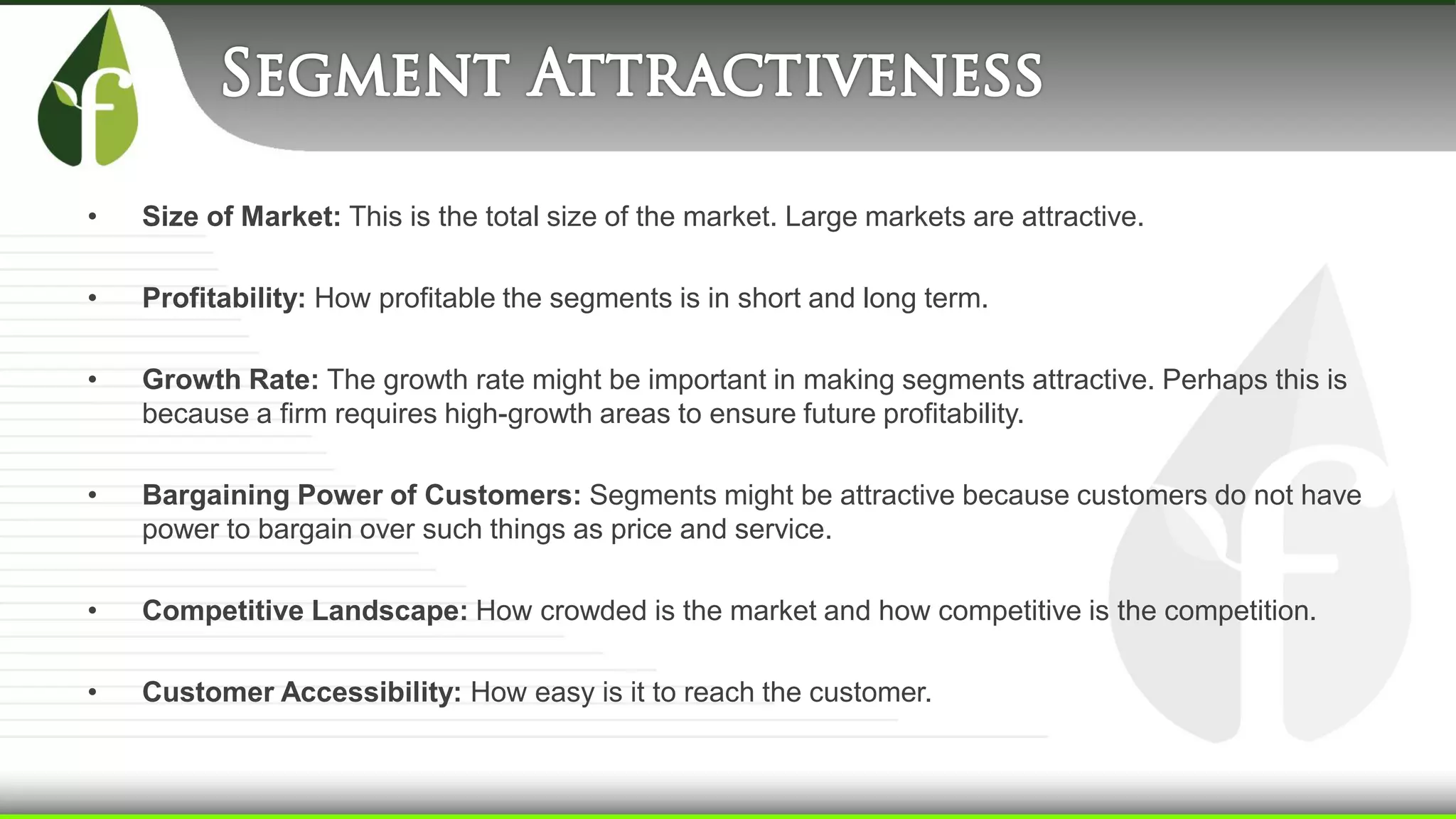
• Size of Market: This is the total size of the market. Large markets are attractive.
• Profitability: How profitable the segments is in short and long term.
• Growth Rate: The growth rate might be important in making segments attractive. Perhaps this is
because a firm requires high-growth areas to ensure future profitability.
• Bargaining Power of Customers: Segments might be attractive because customers do not have
power to bargain over such things as price and service.
• Competitive Landscape: How crowded is the market and how competitive is the competition.
• Customer Accessibility: How easy is it to reach the customer.
Stage Key considerations Metric
Awareness Are people aware of the problem
you solve? Has anyone heard of
you?
Search results, Web traffic, social
media mentions
Consideration When they have the pain do they
think of you? Do they understand
your solution?
Requests for information, number
of demons
Trial Do people sign up? Do they begin
to use your solution?
Sign ups, pilots
Adoption Do people use full workflows? Are
they getting value?
Engagement metrics, % people
using full workflow, economics
Recommendation Do your current users bring in
new users?
Viral co-efficient K, Net promoter
score
• Sell expertise (services)
• Sell a physical product
• Sell a virtual product
• Sell a custom product
• Sell labour (yours or someone else’s)
• Ad-Based Revenue Model - Ad-based revenue models entail creating ads for a specific
website, service, app, or other product, and placing them on strategic, high-traffic channels.
• Affiliate Revenue Model - Promoting links to relevant products and collecting commission
on the sales of those products
• Transactional Revenue Model - This method is one of the most direct ways of generating
revenue, as it entails a company providing a service or product and customers paying them
for it.
• Subscription Revenue Model - The subscription revenue model entails offering your
customers a product or service that customers can pay for over a longer period of time,
usually month to month, or even year to year.
• Web Sales - this is an offshoot of the transactional revenue model, in which a customer
pays directly for a product or service, except that customers must first come to your
company via a web search or outbound marketing, and conduct transactions solely over
the internet.
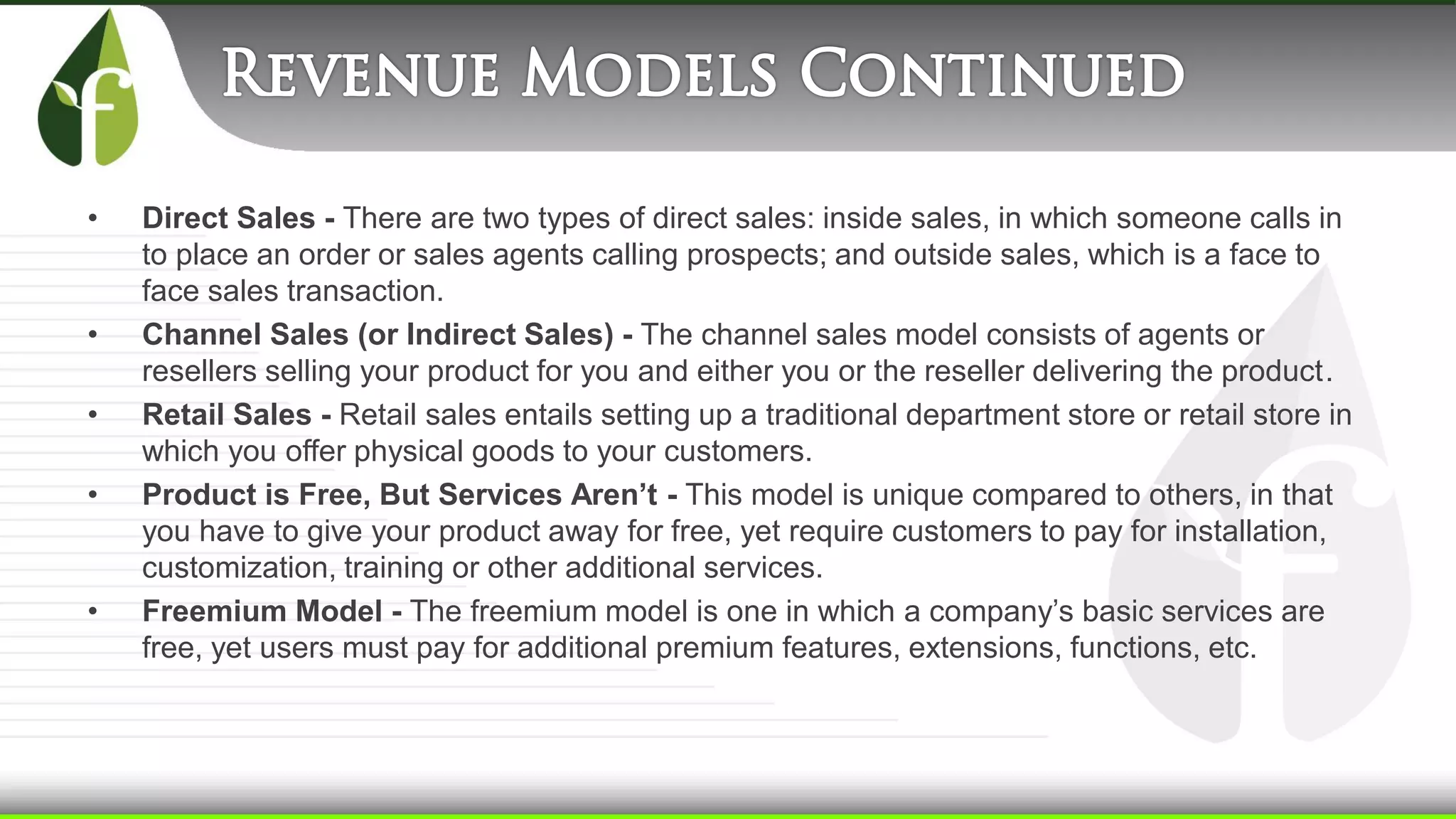
• Direct Sales - There are two types of direct sales: inside sales, in which someone calls in
to place an order or sales agents calling prospects; and outside sales, which is a face to
face sales transaction.
• Channel Sales (or Indirect Sales) - The channel sales model consists of agents or
resellers selling your product for you and either you or the reseller delivering the product.
• Retail Sales - Retail sales entails setting up a traditional department store or retail store in
which you offer physical goods to your customers.
• Product is Free, But Services Aren’t - This model is unique compared to others, in that
you have to give your product away for free, yet require customers to pay for installation,
customization, training or other additional services.
• Freemium Model - The freemium model is one in which a company’s basic services are
free, yet users must pay for additional premium features, extensions, functions, etc.
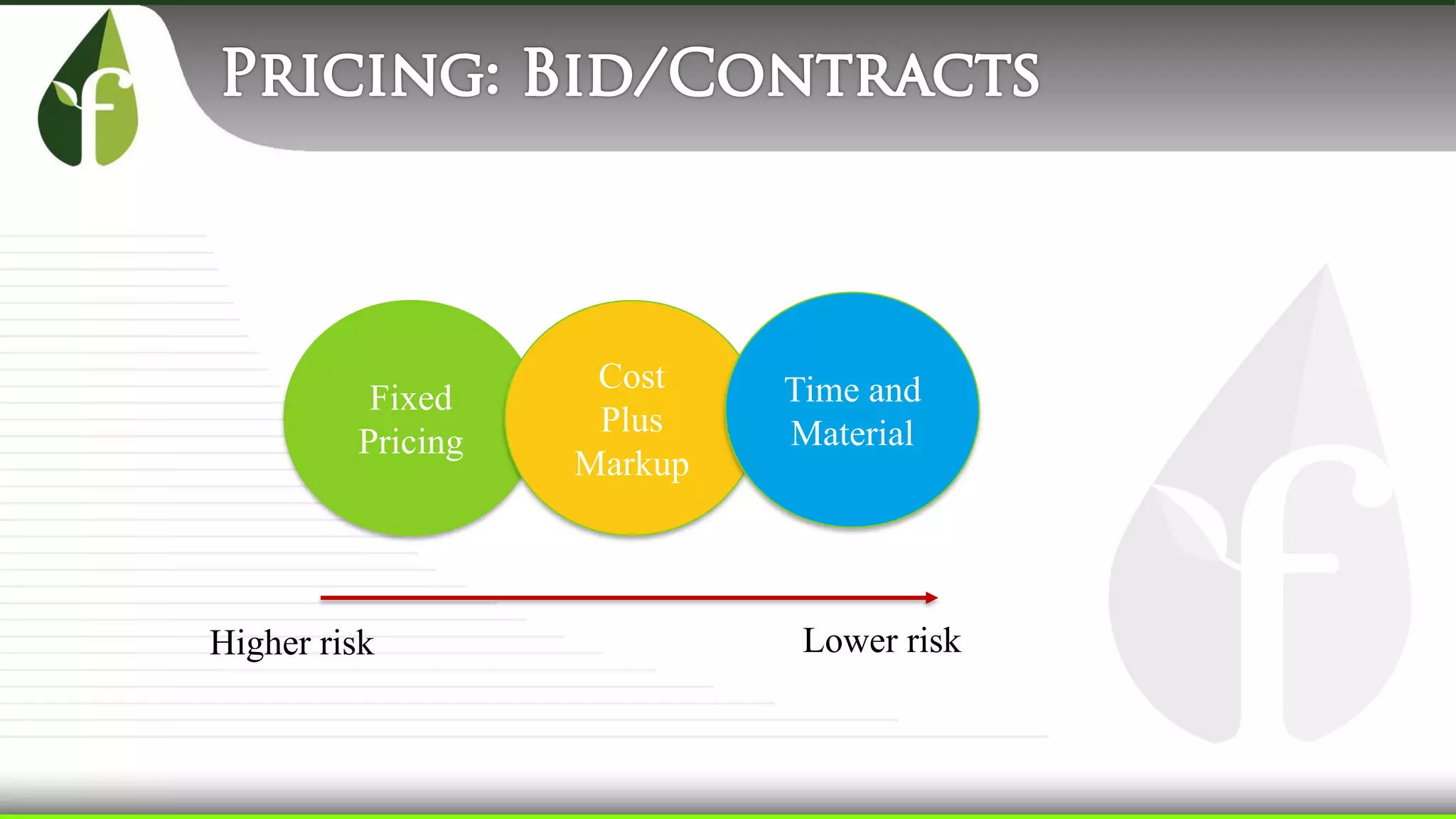
Fixed
Pricing
Cost
Plus
Markup
Time and
Material
Higher risk Lower risk
Money for goods
Metric Type Examples
Number of users Seats, active users, environments,
connections
Level of Usage Data volume, storage, sockets opened,
duration
Transaction Volume Conversions, Click Throush, Sales
Business value Increase in profit, energy saved, change in
conversion rates, savings
Innovation in pricing can be valuable and a differentiator
DifferentiationPrice
Image
Support Quality
Design
Convenience
• Skim – Price as high as you can to increase profit and
reinvest in innovation
• Market Following – Price relative to a market leader or
standard price
• Penetration – Price as low as you can to win market
share
Penetration Market Skimming
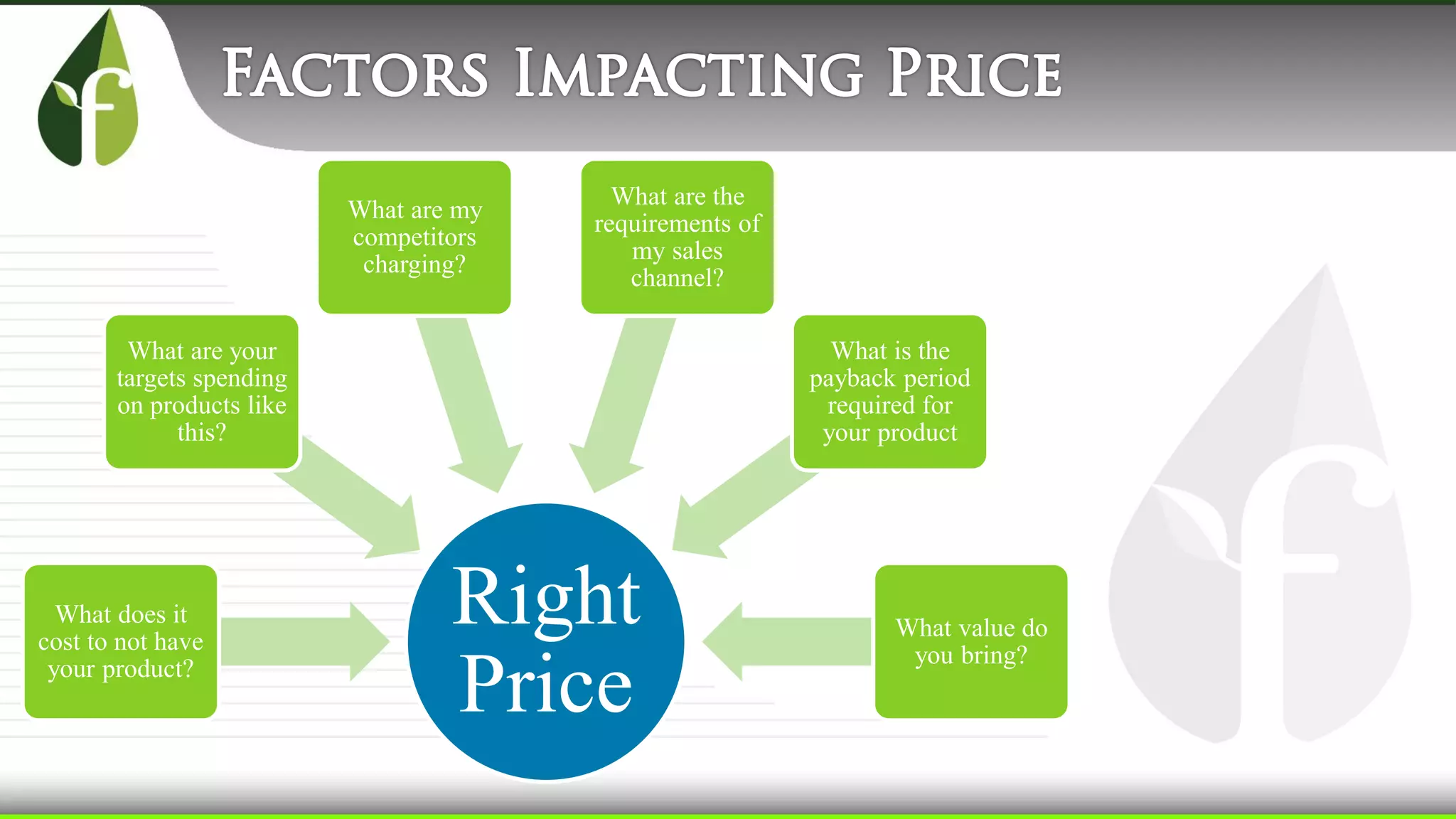
Right
Price
What does it
cost to not have
your product?
What are your
targets spending
on products like
this?
What are my
competitors
charging?
What are the
requirements of
my sales
channel?
What is the
payback period
required for
your product
What value do
you bring?
• Don’t limit payment types
• Reward loyalty
• Make it easy to buy
• Offer discounts
– Quantity Discount: When two or more of the same product are purchased at the same time
– Tie-In Discount (“Bundling”): When two or more different products are purchased at the same time
– Seasonal Discount: When products are bought within a specific time-frame
– Conditional Discount: When the products purchased are used or reconditioned
– Stripped Discount: When the products purchased are “stripped” of one or more features
• Request and/or reward referrals
• Don’t complicate pricing
• Make the value proposition clear
• Answer questions quickly
• Time limit offers / early bird offers
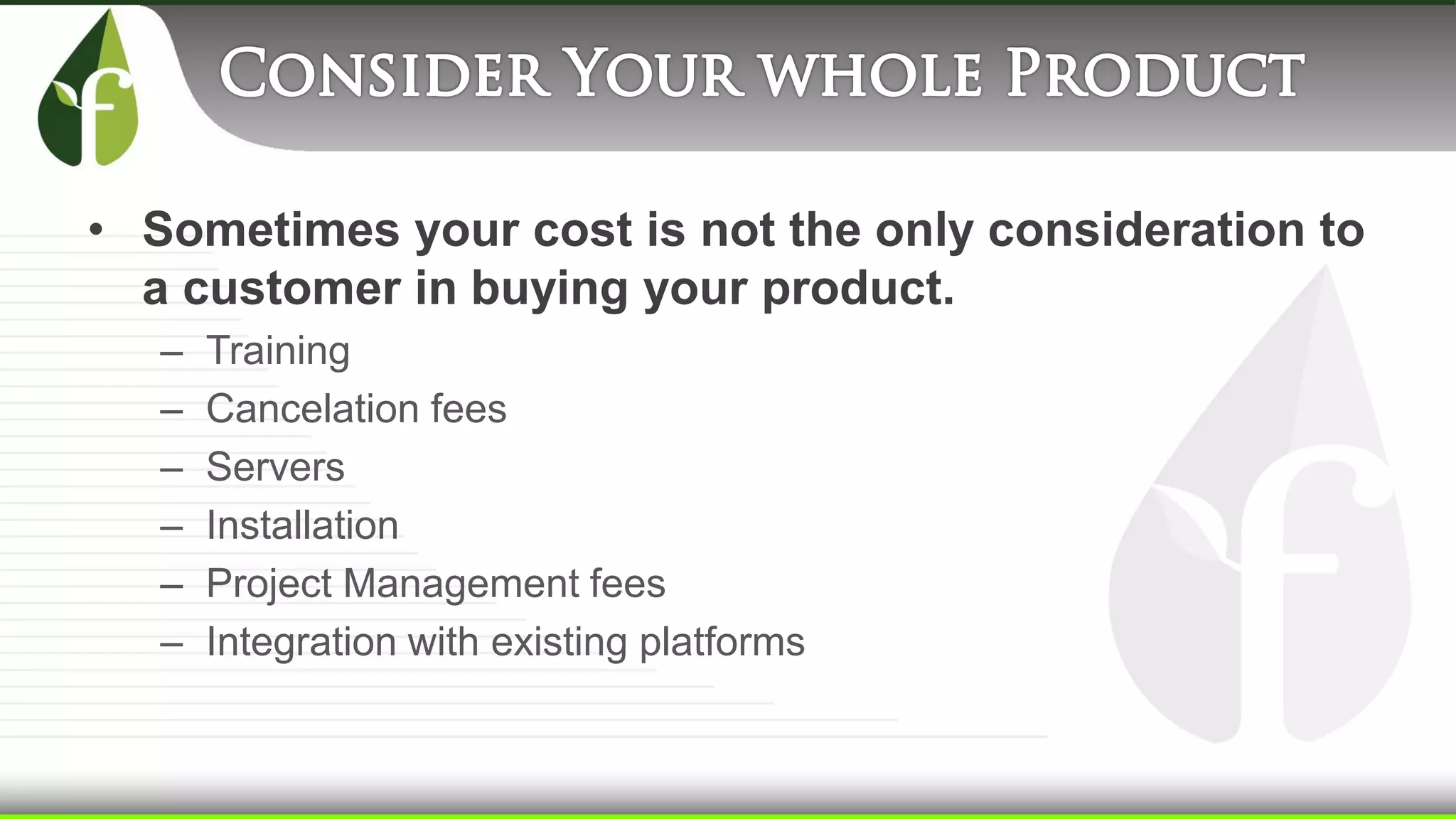
• Sometimes your cost is not the only consideration to
a customer in buying your product.
– Training
– Cancelation fees
– Servers
– Installation
– Project Management fees
– Integration with existing platforms
• Key test groups
– Pre-test
– Friendlies
– Customer Targets
– Larger Audiences
– You can do A/B testing
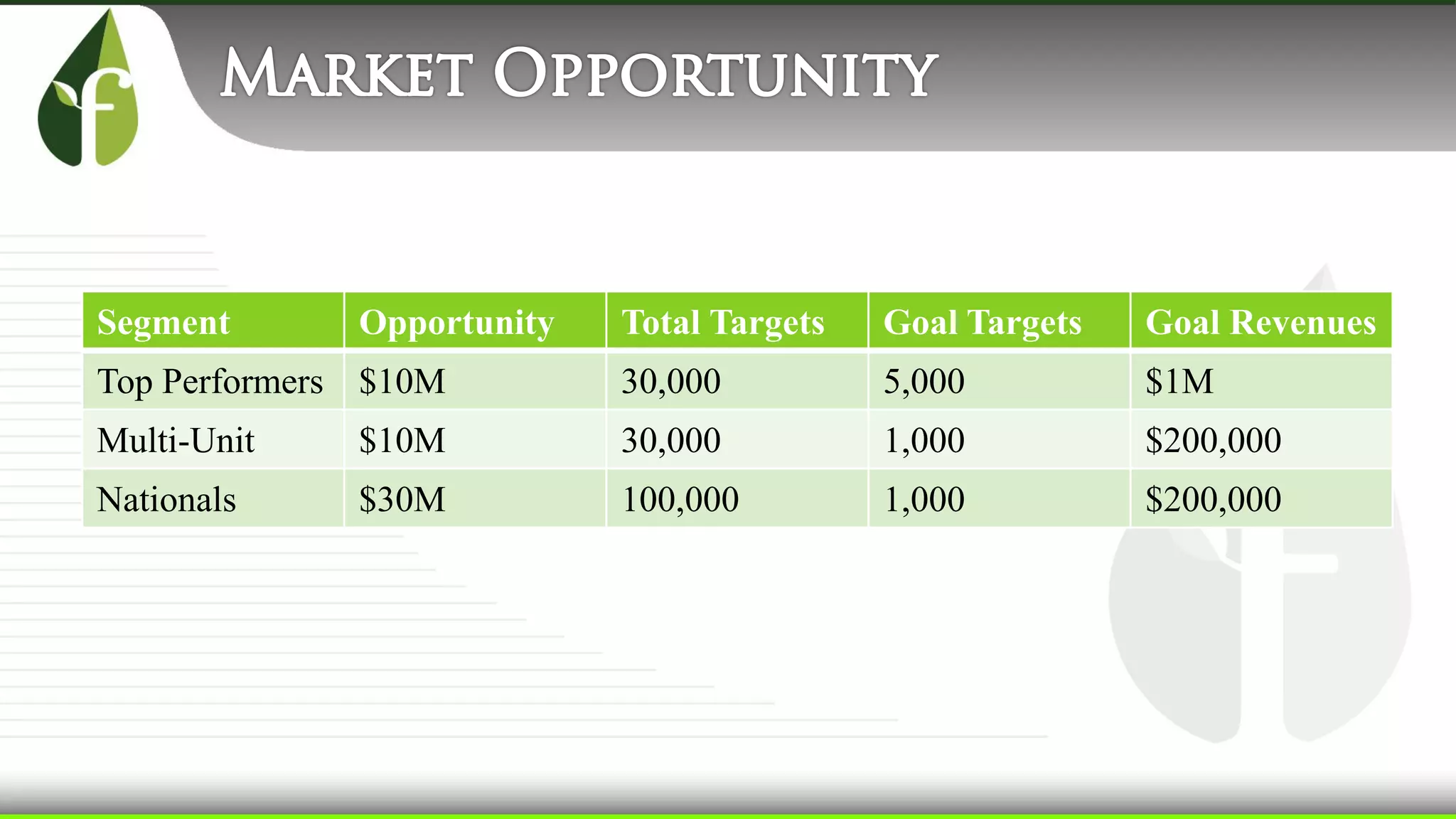
Segment Opportunity Total Targets Goal Targets Goal Revenues
Top Performers $10M 30,000 5,000 $1M
Multi-Unit $10M 30,000 1,000 $200,000
Nationals $30M 100,000 1,000 $200,000
• The exercise of predicting sales, revenues, costs,
growth, the break even point and other variables
over a particular period of time in order to determine
the feasibility of your business or particular revenue
model or initiative.
• Unit economics is defined as the “direct revenues and
costs associated with a particular business model, and
are specifically expressed on a per unit basis”.
• Revenue - the amount of money that a company actually receives during a specific
period, including discounts and deductions for returned merchandise.
• Customer Acquisition Cost - the cost associated in convincing a customer to buy a
product/service.
• Operational Costs - the expenses which are related to the operation of a business,
or to the operation of a device, component, piece of equipment or facility.
• Growth Costs – Costs associated with business and product development
• Lifetime value - is the projected revenue that a customer will generate during
their lifetime.
Revenue – Costs = Profit
Fixed Costs
Fixed costs are costs that must be paid whether or not
any units are produced.
Variable Costs
Unit variable costs are costs that vary directly with the
number of products produced.
• Business premises lease (or mortgage)
• Startup loan payments
• Taxes
• Insurance
• Vehicle leases
• Equipment (machinery, tools, computers, etc.)
• Payroll (if employees are on salary)
• Some utilities
• Accounting fees
• Hosting Fees
• Wages for commission-based employees
• Utilities costs that increase with activity
• Raw materials
• Shipping costs
• Advertising (can be fixed or variable)
• Equipment repair
• Sales costs (such as credit card processing fees, etc.)
• Be realistic on revenue expectations
Potential
Maximum
Revenue
Customer Constraints
Competitive Constraints
Company Constraints
Product Adoption Constraints
Realistic
Revenue
Forecast
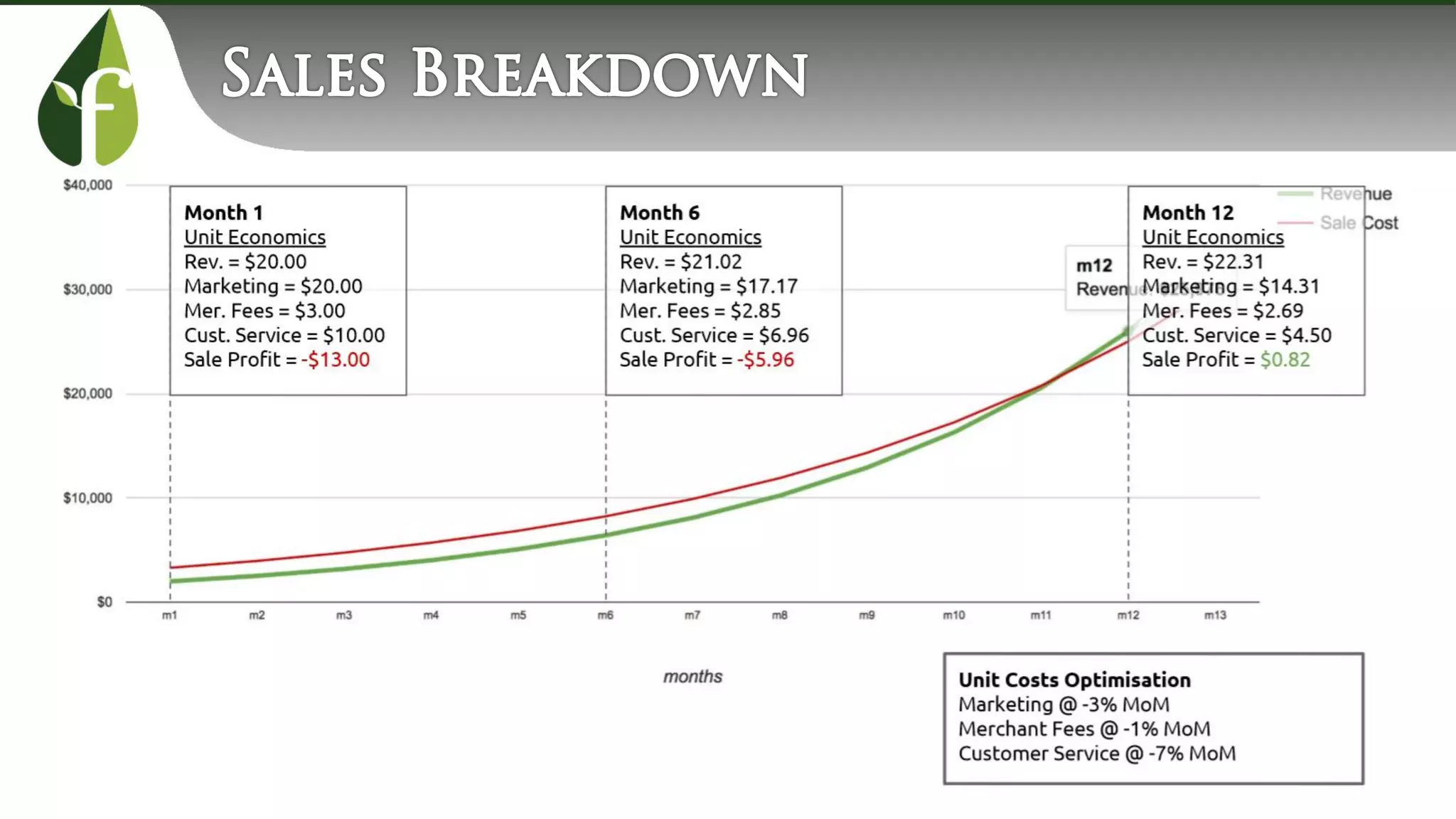
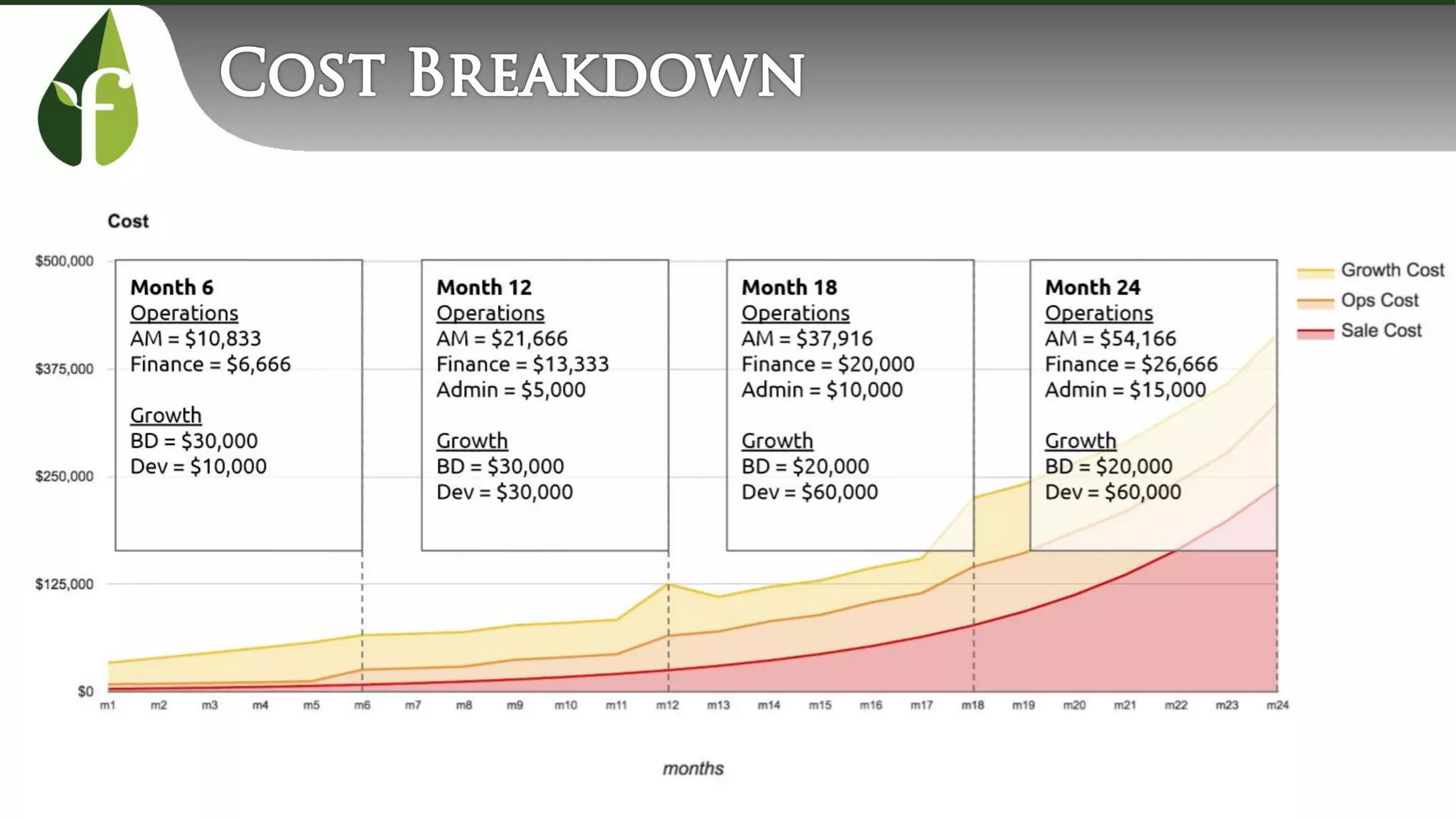
Month 24: $125 per cart
Month 1: $100 per cart
Profit: $9,704
-1.5 Million over 2 years
• Do not understand cost to serve
• Do not understand how customers get value
• Think all customers get value the same way
• Default to cost plus pricing
• Default to market following pricing
• Ignoring real competitive alternatives
• Fail to set reference prices (no pricing architecture)
• No, erratic or mixed pricing strategy
• Not realistic in adoption expectations
Founder mentor presentation   waleed e - revenue

Founder mentor presentation waleed e - revenue

  • 2.
    • The goalof your business is to make money • In the early stages, money does not flow in buckets • You need money to survive • Your revenue (or savings) at some point needs to exceed your costs • You want to maximize your ROI as much as possible • You need to understand your market, your pricing options and your potential revenues
  • 3.
    • You havea job (or jobs) • Your SO has a job (or jobs) • You have savings or disposable assets (which are being depleted) • You borrow or are gifted from family or friends • You borrow from the bank • You have some form of grant • You live at home and really nice parents
  • 4.
    • Burn rateis the rate at which cash is decreasing. Especially in early stage startups, it’s important to know and monitor burn rate as companies fail when they are running out of cash and don’t have enough time left to raise funds or reduce expenses. • Monthly cash burn = cash balance at the beginning of the year minus cash balance end of the year / 12
  • 5.
    • Product: Anythingrelating to the product as well as what the customer perceives as the product • Price: Cost to the user and determining a pricing strategy • Promotion: Tools and channels used to reach customers and prospects (advertising, sales promotions, public relations, etc.) • Place: The channel of physical distribution (the product’s actual movement through a means of distribution) and sales (how the product is sold, whether through website, wholesalers, retailers, direct mail, etc.)
  • 6.
    • Target Marketinginvolves breaking a market into groups (segments) whose needs and desires most closely match your product or service offerings and then focusing marketing and sales efforts on one or more of these segment. • Geographic – Country, region, postal code, city, compound • Demographic – Age, gender, religion, race • Psychographic/Behavioral – class, personality, lifestyle
  • 7.
    Total available market (TAM) Serviceable AvailableMarket (SAM) Serviceable Obtainable (SOM) Penetrated Market (PM) Target Market Your customers TAM in your geographic reach Potential scale of the market 228 Million Coffee Drinkers 47 Million Brew at Home 16 Million are aged 25-35 8 Million are drink our coffee
  • 8.
    Consumer Markets BusinessMarkets Many customers, geographically dispersed Fewer customers, concentrated in locations Smaller amounts of money Larger budgets Simple decision making Complex decision making Influenced heavily by advertising More focus on personal selling Subjective buying criteria More objective formal criteria
  • 9.
    • Size ofMarket: This is the total size of the market. Large markets are attractive. • Profitability: How profitable the segments is in short and long term. • Growth Rate: The growth rate might be important in making segments attractive. Perhaps this is because a firm requires high-growth areas to ensure future profitability. • Bargaining Power of Customers: Segments might be attractive because customers do not have power to bargain over such things as price and service. • Competitive Landscape: How crowded is the market and how competitive is the competition. • Customer Accessibility: How easy is it to reach the customer.
  • 10.
    Stage Key considerationsMetric Awareness Are people aware of the problem you solve? Has anyone heard of you? Search results, Web traffic, social media mentions Consideration When they have the pain do they think of you? Do they understand your solution? Requests for information, number of demons Trial Do people sign up? Do they begin to use your solution? Sign ups, pilots Adoption Do people use full workflows? Are they getting value? Engagement metrics, % people using full workflow, economics Recommendation Do your current users bring in new users? Viral co-efficient K, Net promoter score
  • 11.
    • Sell expertise(services) • Sell a physical product • Sell a virtual product • Sell a custom product • Sell labour (yours or someone else’s)
  • 12.
    • Ad-Based RevenueModel - Ad-based revenue models entail creating ads for a specific website, service, app, or other product, and placing them on strategic, high-traffic channels. • Affiliate Revenue Model - Promoting links to relevant products and collecting commission on the sales of those products • Transactional Revenue Model - This method is one of the most direct ways of generating revenue, as it entails a company providing a service or product and customers paying them for it. • Subscription Revenue Model - The subscription revenue model entails offering your customers a product or service that customers can pay for over a longer period of time, usually month to month, or even year to year. • Web Sales - this is an offshoot of the transactional revenue model, in which a customer pays directly for a product or service, except that customers must first come to your company via a web search or outbound marketing, and conduct transactions solely over the internet.
  • 13.
    • Direct Sales- There are two types of direct sales: inside sales, in which someone calls in to place an order or sales agents calling prospects; and outside sales, which is a face to face sales transaction. • Channel Sales (or Indirect Sales) - The channel sales model consists of agents or resellers selling your product for you and either you or the reseller delivering the product. • Retail Sales - Retail sales entails setting up a traditional department store or retail store in which you offer physical goods to your customers. • Product is Free, But Services Aren’t - This model is unique compared to others, in that you have to give your product away for free, yet require customers to pay for installation, customization, training or other additional services. • Freemium Model - The freemium model is one in which a company’s basic services are free, yet users must pay for additional premium features, extensions, functions, etc.
  • 14.
  • 17.
  • 18.
    Metric Type Examples Numberof users Seats, active users, environments, connections Level of Usage Data volume, storage, sockets opened, duration Transaction Volume Conversions, Click Throush, Sales Business value Increase in profit, energy saved, change in conversion rates, savings Innovation in pricing can be valuable and a differentiator
  • 19.
  • 20.
    • Skim –Price as high as you can to increase profit and reinvest in innovation • Market Following – Price relative to a market leader or standard price • Penetration – Price as low as you can to win market share
  • 21.
  • 22.
    Right Price What does it costto not have your product? What are your targets spending on products like this? What are my competitors charging? What are the requirements of my sales channel? What is the payback period required for your product What value do you bring?
  • 23.
    • Don’t limitpayment types • Reward loyalty • Make it easy to buy • Offer discounts – Quantity Discount: When two or more of the same product are purchased at the same time – Tie-In Discount (“Bundling”): When two or more different products are purchased at the same time – Seasonal Discount: When products are bought within a specific time-frame – Conditional Discount: When the products purchased are used or reconditioned – Stripped Discount: When the products purchased are “stripped” of one or more features • Request and/or reward referrals • Don’t complicate pricing • Make the value proposition clear • Answer questions quickly • Time limit offers / early bird offers
  • 24.
    • Sometimes yourcost is not the only consideration to a customer in buying your product. – Training – Cancelation fees – Servers – Installation – Project Management fees – Integration with existing platforms
  • 25.
    • Key testgroups – Pre-test – Friendlies – Customer Targets – Larger Audiences – You can do A/B testing
  • 26.
    Segment Opportunity TotalTargets Goal Targets Goal Revenues Top Performers $10M 30,000 5,000 $1M Multi-Unit $10M 30,000 1,000 $200,000 Nationals $30M 100,000 1,000 $200,000
  • 27.
    • The exerciseof predicting sales, revenues, costs, growth, the break even point and other variables over a particular period of time in order to determine the feasibility of your business or particular revenue model or initiative.
  • 28.
    • Unit economicsis defined as the “direct revenues and costs associated with a particular business model, and are specifically expressed on a per unit basis”.
  • 29.
    • Revenue -the amount of money that a company actually receives during a specific period, including discounts and deductions for returned merchandise. • Customer Acquisition Cost - the cost associated in convincing a customer to buy a product/service. • Operational Costs - the expenses which are related to the operation of a business, or to the operation of a device, component, piece of equipment or facility. • Growth Costs – Costs associated with business and product development • Lifetime value - is the projected revenue that a customer will generate during their lifetime. Revenue – Costs = Profit
  • 30.
    Fixed Costs Fixed costsare costs that must be paid whether or not any units are produced. Variable Costs Unit variable costs are costs that vary directly with the number of products produced. • Business premises lease (or mortgage) • Startup loan payments • Taxes • Insurance • Vehicle leases • Equipment (machinery, tools, computers, etc.) • Payroll (if employees are on salary) • Some utilities • Accounting fees • Hosting Fees • Wages for commission-based employees • Utilities costs that increase with activity • Raw materials • Shipping costs • Advertising (can be fixed or variable) • Equipment repair • Sales costs (such as credit card processing fees, etc.)
  • 31.
    • Be realisticon revenue expectations Potential Maximum Revenue Customer Constraints Competitive Constraints Company Constraints Product Adoption Constraints Realistic Revenue Forecast
  • 33.
    Month 24: $125per cart Month 1: $100 per cart
  • 36.
  • 37.
    • Do notunderstand cost to serve • Do not understand how customers get value • Think all customers get value the same way • Default to cost plus pricing • Default to market following pricing • Ignoring real competitive alternatives • Fail to set reference prices (no pricing architecture) • No, erratic or mixed pricing strategy • Not realistic in adoption expectations