Uniform & Non-Uniform Circular Motion
I P S I T A M A N D A L
References
An Introduction To Mechanics
by Daniel Kleppner & Robert Kolenkow,
Chapter 1 (sections 1.8, 1.12, 1.13, 1.14)
Fundamentals of Physics
by Jearl Walker, David Halliday, & Robert Resnick,
Chapter 4 (section 4-5)
Introduction to Classical Mechanics
by David Morin, Chapter 3 (section 3.5)
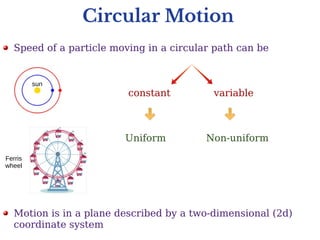
Circular Motion
Speed of a particle moving in a circular path can be
constant variable
Uniform Non-uniform
Motion is in a plane described by a two-dimensional (2d)
coordinate system
sun
Ferris
wheel
Polar Coordinates ...
Recall ( flipped class lecture at home ):
Directions of unit vectors vary with position
We derived
1
.
ˆ
i
ˆ
j
θ
θ̂
ˆ
r
Derivatives of Unit Vectors
Exercise / Tutorial:
Geometric Derivation
Velocity
Position:
Velocity:
Components of Velocity
Radial Velocity Tangential Velocity
(constant radius)
Change in Velocity
Velocity is a vector ⤇ has (1) magnitude (speed), (2) direction
A change in velocity results in acceleration ⤇ a net force acts on the
body
The change may involve magnitude and / or direction ⤇ a body in
circular motion ( ) is accelerating
= change in velocity
Clicker Question
According to Newton’s laws, in an inertial frame, what is the net force
acting on a body in a circular motion ?
A: Zero
B: Non-zero
C: Can be zero or non-zero depending on whether speed is constant or
changing
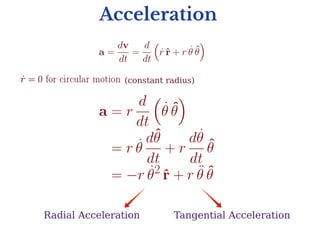
Acceleration
Radial Acceleration Tangential Acceleration
(constant radius)
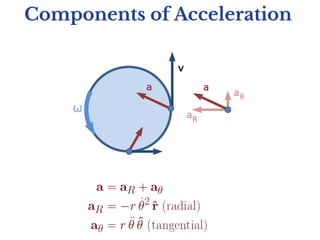
Components of Acceleration
Constant
Angular Speed
Uniform Circular Motion
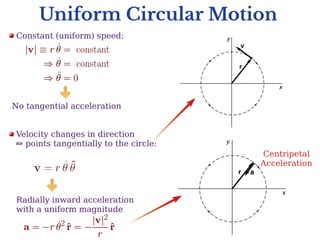
Constant (uniform) speed:
No tangential acceleration
Velocity changes in direction
⤇ points tangentially to the circle:
Radially inward acceleration
with a uniform magnitude
Centripetal
Acceleration
Centripetal acceleration arises from a centripetal force:
Centripetal force accelerates a body by changing the direction of
its velocity without changing its speed
Centripetal Force
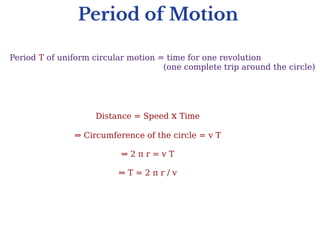
Period T of uniform circular motion = time for one revolution
(one complete trip around the circle)
Period of Motion
Distance = Speed x Time
⇒ Circumference of the circle = v T
⇒ 2 π r = v T
⇒ T = 2 π r / v
Examples
Swinging a ball on the end of a string ⤇ tension provides the
centripetal force
Satellite in a circular orbit around Earth
⤇ gravity provides the centripetal force
Examples ...
Car moving in a horizontal circle on a level surface ⤇ friction provides
the centripetal force
Death spiral in figure skating ⤇ the man is the center of rotation (one
toe dug into the ice in a pivot position), exerting centripetal force to
keep his partner moving in a circle
Problem 1
A bob of mass m hangs from a string of length L. Conditions have been
set up so that the mass swings around in a horizontal circle, with the
string making an angle of ϕ with the vertical. What is the angular
speed ω of the bob?
R = L sin ϕ
ϕ
L
R
m
Weight = m g
Tension = T
ϕ
Problem 1 ...
ϕ
T
T cos ϕ
T sin ϕ
a = v2 / R
m g
Bob
0 = T cos ϕ - m g ( y-direction )
- m a = - T sin ϕ ( r-direction )
gives
a / g = tan ϕ
⇒ v2 = R g tan ϕ
⇒ R2 ω2 = R g tan ϕ
⇒ ω2 = g tan ϕ / ( L sin ϕ)
Problem 2
A car of mass m moves at a constant speed v around a banked circular
track of radius R . If the friction is negligible (slippery conditions like ice
on a highway or oil on a racetrack), what bank angle φ prevents sliding?
φ
v
φ
φ
Weight = m g
Normal reaction = N
φ
N
N cos φ
N sin φ
a = v2 / R
m g
0 = N cos φ - m g ( y-direction )
- m a = - N sin φ ( r-direction )
gives
tan φ = v2 / ( g R )
Variable
Angular Speed
Non-Uniform Circular Motion
Speed varies:
Velocity changes in direction + magnitude ⤇ points tangentially to the
circle
Both radial & tangential components of acceleration are nonzero
Tangential component of a = rate of change of speed
Tangential component of a is in the same (opposite) direction as the
velocity if the particle is speeding up (slowing down)
Exercise / Tutorial: Prove that
Examples
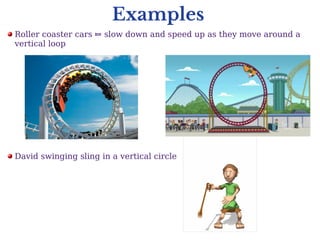
Roller coaster cars ⤇ slow down and speed up as they move around a
vertical loop
David swinging sling in a vertical circle
Problem 3
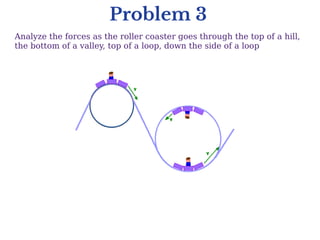
Analyze the forces as the roller coaster goes through the top of a hill,
the bottom of a valley, top of a loop, down the side of a loop
Problem 3: Solution
(1) Top of the hill
Centripetal force is supplied by gravity
& possibly even the safety harness
Normal reaction = N ≥ 0
Weight = m g
Fnet = N – m g (in vertically upward direction)
⇒ - centripetal force = N – m g
⇒ - m v1
2 / R1 = N – m g
How fast can the coaster can go until the rider just (barely) loses contact with
the seat ?
N = 0
⇒ m v1
2 / R1 = m g
⇒ v1
2 = g R1
At higher speeds, N = m ( g - v1
2 / R1 ) says that the normal force will be negative!
This just means that for v1
2 / R1 > g the rider will fly off the coaster ( N=0 ) unless
a safety harness supplies an extra downward force ( Fsafety ) pulling the rider
downward, providing the remaining centripetal force : m v1
2 / R1 = m g + Fsafety
velocity v1
N
mg
R1
Problem 3: Solution ...
(2) Bottom of the valley
Normal reaction = N
Weight = m g
Fnet = N – m g (in vertically upward direction)
⇒ centripetal force = N – m g
⇒ m v2
2 / R2 = N – m g
velocity v2
N
R2
mg
Problem 3: Solution ...
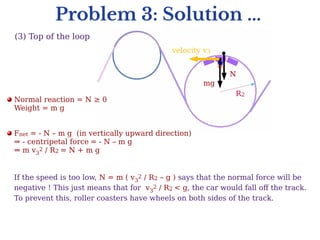
(3) Top of the loop
Normal reaction = N ≥ 0
Weight = m g
Fnet = - N – m g (in vertically upward direction)
⇒ - centripetal force = - N – m g
⇒ m v3
2 / R2 = N + m g
If the speed is too low, N = m ( v3
2 / R2 – g ) says that the normal force will be
negative ! This just means that for v3
2 / R2 < g, the car would fall off the track.
To prevent this, roller coasters have wheels on both sides of the track.
velocity v3
N
R2
mg
Problem 3: Solution ...
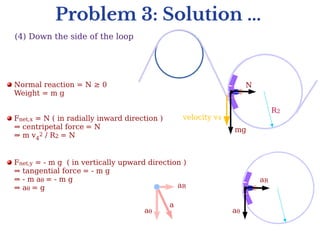
(4) Down the side of the loop
Normal reaction = N ≥ 0
Weight = m g
Fnet,x = N ( in radially inward direction )
⇒ centripetal force = N
⇒ m v4
2 / R2 = N
Fnet,y = - m g ( in vertically upward direction )
⇒ tangential force = - m g
⇒ - m aθ = - m g
⇒ aθ = g
N
R2
velocity v4
mg
aθ
aR
aθ
aR
a
Points to Remember
An object moving in a circle:
Always has a tangentially directed velocity
Always has a radially inward component of acceleration
Always has a net force acting on it
Has a tangential component of acceleration if its speed changes with
time
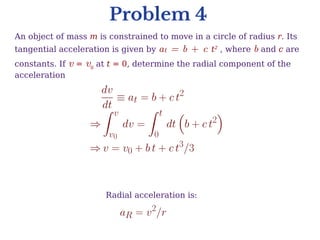
Problem 4
An object of mass m is constrained to move in a circle of radius r. Its
tangential acceleration is given by at = b + c t2
, where b and c are
constants. If v = v0
at t = 0, determine the radial component of the
acceleration
Radial acceleration is:

circular.pdf

  • 1.
    Uniform & Non-UniformCircular Motion Uniform & Non-Uniform Circular Motion I P S I T A M A N D A L
  • 2.
    References An Introduction ToMechanics by Daniel Kleppner & Robert Kolenkow, Chapter 1 (sections 1.8, 1.12, 1.13, 1.14) Fundamentals of Physics by Jearl Walker, David Halliday, & Robert Resnick, Chapter 4 (section 4-5) Introduction to Classical Mechanics by David Morin, Chapter 3 (section 3.5)
  • 3.
    Circular Motion Speed ofa particle moving in a circular path can be constant variable Uniform Non-uniform Motion is in a plane described by a two-dimensional (2d) coordinate system sun Ferris wheel
  • 4.
    Polar Coordinates ... Recall( flipped class lecture at home ): Directions of unit vectors vary with position We derived 1 . ˆ i ˆ j θ θ̂ ˆ r
  • 5.
    Derivatives of UnitVectors Exercise / Tutorial: Geometric Derivation
  • 6.
  • 7.
    Components of Velocity RadialVelocity Tangential Velocity (constant radius)
  • 8.
    Change in Velocity Velocityis a vector ⤇ has (1) magnitude (speed), (2) direction A change in velocity results in acceleration ⤇ a net force acts on the body The change may involve magnitude and / or direction ⤇ a body in circular motion ( ) is accelerating = change in velocity
  • 9.
    Clicker Question According toNewton’s laws, in an inertial frame, what is the net force acting on a body in a circular motion ? A: Zero B: Non-zero C: Can be zero or non-zero depending on whether speed is constant or changing
  • 10.
    Acceleration Radial Acceleration TangentialAcceleration (constant radius)
  • 11.
  • 12.
  • 13.
    Uniform Circular Motion Constant(uniform) speed: No tangential acceleration Velocity changes in direction ⤇ points tangentially to the circle: Radially inward acceleration with a uniform magnitude Centripetal Acceleration
  • 14.
    Centripetal acceleration arisesfrom a centripetal force: Centripetal force accelerates a body by changing the direction of its velocity without changing its speed Centripetal Force
  • 15.
    Period T ofuniform circular motion = time for one revolution (one complete trip around the circle) Period of Motion Distance = Speed x Time ⇒ Circumference of the circle = v T ⇒ 2 π r = v T ⇒ T = 2 π r / v
  • 16.
    Examples Swinging a ballon the end of a string ⤇ tension provides the centripetal force Satellite in a circular orbit around Earth ⤇ gravity provides the centripetal force
  • 17.
    Examples ... Car movingin a horizontal circle on a level surface ⤇ friction provides the centripetal force Death spiral in figure skating ⤇ the man is the center of rotation (one toe dug into the ice in a pivot position), exerting centripetal force to keep his partner moving in a circle
  • 18.
    Problem 1 A bobof mass m hangs from a string of length L. Conditions have been set up so that the mass swings around in a horizontal circle, with the string making an angle of ϕ with the vertical. What is the angular speed ω of the bob? R = L sin ϕ ϕ L R m Weight = m g Tension = T ϕ
  • 19.
    Problem 1 ... ϕ T Tcos ϕ T sin ϕ a = v2 / R m g Bob 0 = T cos ϕ - m g ( y-direction ) - m a = - T sin ϕ ( r-direction ) gives a / g = tan ϕ ⇒ v2 = R g tan ϕ ⇒ R2 ω2 = R g tan ϕ ⇒ ω2 = g tan ϕ / ( L sin ϕ)
  • 20.
    Problem 2 A carof mass m moves at a constant speed v around a banked circular track of radius R . If the friction is negligible (slippery conditions like ice on a highway or oil on a racetrack), what bank angle φ prevents sliding? φ v φ φ Weight = m g Normal reaction = N φ N N cos φ N sin φ a = v2 / R m g 0 = N cos φ - m g ( y-direction ) - m a = - N sin φ ( r-direction ) gives tan φ = v2 / ( g R )
  • 21.
  • 22.
    Non-Uniform Circular Motion Speedvaries: Velocity changes in direction + magnitude ⤇ points tangentially to the circle Both radial & tangential components of acceleration are nonzero Tangential component of a = rate of change of speed Tangential component of a is in the same (opposite) direction as the velocity if the particle is speeding up (slowing down) Exercise / Tutorial: Prove that
  • 23.
    Examples Roller coaster cars⤇ slow down and speed up as they move around a vertical loop David swinging sling in a vertical circle
  • 24.
    Problem 3 Analyze theforces as the roller coaster goes through the top of a hill, the bottom of a valley, top of a loop, down the side of a loop
  • 25.
    Problem 3: Solution (1)Top of the hill Centripetal force is supplied by gravity & possibly even the safety harness Normal reaction = N ≥ 0 Weight = m g Fnet = N – m g (in vertically upward direction) ⇒ - centripetal force = N – m g ⇒ - m v1 2 / R1 = N – m g How fast can the coaster can go until the rider just (barely) loses contact with the seat ? N = 0 ⇒ m v1 2 / R1 = m g ⇒ v1 2 = g R1 At higher speeds, N = m ( g - v1 2 / R1 ) says that the normal force will be negative! This just means that for v1 2 / R1 > g the rider will fly off the coaster ( N=0 ) unless a safety harness supplies an extra downward force ( Fsafety ) pulling the rider downward, providing the remaining centripetal force : m v1 2 / R1 = m g + Fsafety velocity v1 N mg R1
  • 26.
    Problem 3: Solution... (2) Bottom of the valley Normal reaction = N Weight = m g Fnet = N – m g (in vertically upward direction) ⇒ centripetal force = N – m g ⇒ m v2 2 / R2 = N – m g velocity v2 N R2 mg
  • 27.
    Problem 3: Solution... (3) Top of the loop Normal reaction = N ≥ 0 Weight = m g Fnet = - N – m g (in vertically upward direction) ⇒ - centripetal force = - N – m g ⇒ m v3 2 / R2 = N + m g If the speed is too low, N = m ( v3 2 / R2 – g ) says that the normal force will be negative ! This just means that for v3 2 / R2 < g, the car would fall off the track. To prevent this, roller coasters have wheels on both sides of the track. velocity v3 N R2 mg
  • 28.
    Problem 3: Solution... (4) Down the side of the loop Normal reaction = N ≥ 0 Weight = m g Fnet,x = N ( in radially inward direction ) ⇒ centripetal force = N ⇒ m v4 2 / R2 = N Fnet,y = - m g ( in vertically upward direction ) ⇒ tangential force = - m g ⇒ - m aθ = - m g ⇒ aθ = g N R2 velocity v4 mg aθ aR aθ aR a
  • 29.
    Points to Remember Anobject moving in a circle: Always has a tangentially directed velocity Always has a radially inward component of acceleration Always has a net force acting on it Has a tangential component of acceleration if its speed changes with time
  • 30.
    Problem 4 An objectof mass m is constrained to move in a circle of radius r. Its tangential acceleration is given by at = b + c t2 , where b and c are constants. If v = v0 at t = 0, determine the radial component of the acceleration Radial acceleration is: