CIFAR-10
Object Recognition in Images
Team Name: PatternfinderS Team # 24
Priyanshu Agrawal(201305511)
Satya Madala(201305508)
Background
 Image Classification
 Applications
Automatic image annotation
Reverse image search
 Kinds of datasets
Digital Images
Few thousands to millions of images.
 Machine Learning problems in this domain
Image search engine
Face detection
Problem
 Task is to classify images into following ten labels.
 The data labels are Cat, Dog, Airplane, Automobile,
Bird, Deer, Frog, Horse, Ship, Truck.
 Challenges
Large Data set
Small Image size (32x32)
Dataset
Data consists of 60,000 32x32 color images in 10
classes, with 6000 images per class.
There are 50,000 training images and 10,000 test images
The classes are completely mutually exclusive.
With the above mentioned samples, we will build a model
to identify whether the given image is Cat or a Dog etc.
Data Insights
 The objects within classes in this dataset are extremely
varied. For example the "bird" class contains many different
types of bird (both big birds and small).
 Not only are there many types of bird, but the occur at many
possible magnifications, all possible angles and all possible
poses.
 Sometimes only parts of the bird are shown.
 The poses problem is even worse for the dog/cat category,
because these animals occur at many different types of
poses, and sometimes only the head is shown or left part of
the body, etc.
Method 1
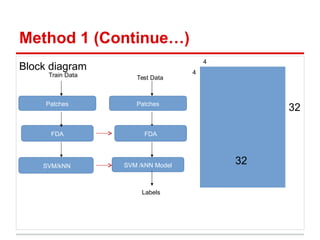
 Divide every 32*32 px image into 64 patches of 4*4 px
 Feature length would be 3*16*64 = 3072.
 Followed by Fisher on all images and extract their top 9
Dimensions
 Values obtained above will represent final feature
vector for images.
 Classification using SVM/kNN.
Method 1 (Continue…)
Block diagram 4
4
32
32
FDA
Patches
SVM/kNN
Patches
FDA
SVM /kNN Model
Labels
Train Data Test Data
Method 1 Drawbacks
 This method based on just intensity.
 Same object captured in different light.
 Image taken from different angles.
Method 2
Aim : Preserve the Shape of Image
Step 1 : Image is filtered using Laplace of Gaussian
filter(LoG).
log_image = edge(gray_image,'log', [], 2);
Method 2 (Continue…)
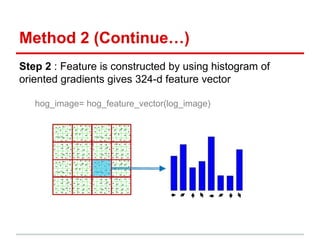
Step 2 : Feature is constructed by using histogram of
oriented gradients gives 324-d feature vector
hog_image= hog_feature_vector(log_image)
Method 2 (Continue…)
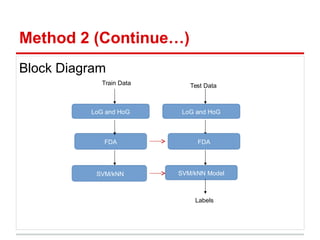
Block Diagram
FDA
LoG and HoG
SVM/kNN
LoG and HoG
FDA
SVM/kNN Model
Labels
Train Data Test Data
Experiments
 Divide given 50K data to train data and test data. Apply
Feature engineering and classification.
 40,000(80%) images as train data, 10,000(20%) images
as validation data.
 Result Evaluation : Percentage of labels that are
predicted correctly
 Number of Fisher dimensions (D = 7, 9, 13)
SVM kernel (linear, rbf)
kNN( k= 13, 17, 21)
Results
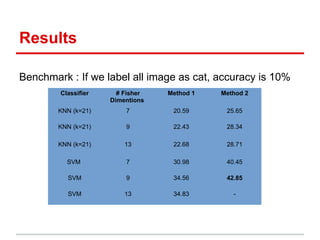
Benchmark : If we label all image as cat, accuracy is 10%
Classifier # Fisher
Dimentions
Method 1 Method 2
KNN (k=21) 7 20.59 25.65
KNN (k=21) 9 22.43 28.34
KNN (k=21) 13 22.68 28.71
SVM 7 30.98 40.45
SVM 9 34.56 42.85
SVM 13 34.83 -
Thank You

CIFAR-10

  • 1.
    CIFAR-10 Object Recognition inImages Team Name: PatternfinderS Team # 24 Priyanshu Agrawal(201305511) Satya Madala(201305508)
  • 2.
    Background  Image Classification Applications Automatic image annotation Reverse image search  Kinds of datasets Digital Images Few thousands to millions of images.  Machine Learning problems in this domain Image search engine Face detection
  • 3.
    Problem  Task isto classify images into following ten labels.  The data labels are Cat, Dog, Airplane, Automobile, Bird, Deer, Frog, Horse, Ship, Truck.  Challenges Large Data set Small Image size (32x32)
  • 4.
    Dataset Data consists of60,000 32x32 color images in 10 classes, with 6000 images per class. There are 50,000 training images and 10,000 test images The classes are completely mutually exclusive. With the above mentioned samples, we will build a model to identify whether the given image is Cat or a Dog etc.
  • 5.
    Data Insights  Theobjects within classes in this dataset are extremely varied. For example the "bird" class contains many different types of bird (both big birds and small).  Not only are there many types of bird, but the occur at many possible magnifications, all possible angles and all possible poses.  Sometimes only parts of the bird are shown.  The poses problem is even worse for the dog/cat category, because these animals occur at many different types of poses, and sometimes only the head is shown or left part of the body, etc.
  • 6.
    Method 1  Divideevery 32*32 px image into 64 patches of 4*4 px  Feature length would be 3*16*64 = 3072.  Followed by Fisher on all images and extract their top 9 Dimensions  Values obtained above will represent final feature vector for images.  Classification using SVM/kNN.
  • 7.
    Method 1 (Continue…) Blockdiagram 4 4 32 32 FDA Patches SVM/kNN Patches FDA SVM /kNN Model Labels Train Data Test Data
  • 8.
    Method 1 Drawbacks This method based on just intensity.  Same object captured in different light.  Image taken from different angles.
  • 9.
    Method 2 Aim :Preserve the Shape of Image Step 1 : Image is filtered using Laplace of Gaussian filter(LoG). log_image = edge(gray_image,'log', [], 2);
  • 10.
    Method 2 (Continue…) Step2 : Feature is constructed by using histogram of oriented gradients gives 324-d feature vector hog_image= hog_feature_vector(log_image)
  • 11.
    Method 2 (Continue…) BlockDiagram FDA LoG and HoG SVM/kNN LoG and HoG FDA SVM/kNN Model Labels Train Data Test Data
  • 12.
    Experiments  Divide given50K data to train data and test data. Apply Feature engineering and classification.  40,000(80%) images as train data, 10,000(20%) images as validation data.  Result Evaluation : Percentage of labels that are predicted correctly  Number of Fisher dimensions (D = 7, 9, 13) SVM kernel (linear, rbf) kNN( k= 13, 17, 21)
  • 13.
    Results Benchmark : Ifwe label all image as cat, accuracy is 10% Classifier # Fisher Dimentions Method 1 Method 2 KNN (k=21) 7 20.59 25.65 KNN (k=21) 9 22.43 28.34 KNN (k=21) 13 22.68 28.71 SVM 7 30.98 40.45 SVM 9 34.56 42.85 SVM 13 34.83 -
  • 14.