Convolutional Neural
Network
Lecturer:Shi Changtai
Neural Network and BP Algorithm
01
Convolutional Neural Network
02
Some Practical Tricks
03
Apply CNN in News Classification
04
Experiment Result
05
Homework
06
CONTENTS
Neural Network and BP Algorithm
01
Neural Network and BP Algorithm01
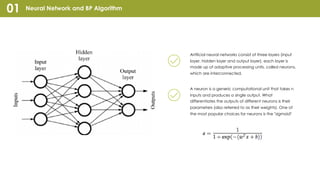
Artificial neural networks consist of three layers (input
layer, hidden layer and output layer), each layer is
made up of adaptive processing units, called neurons,
which are interconnected.
A neuron is a generic computational unit that takes n
inputs and produces a single output. What
differentiates the outputs of different neurons is their
parameters (also referred to as their weights). One of
the most popular choices for neurons is the "sigmoid"
Neural Network and BP Algorithm01
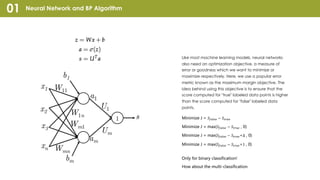
Like most machine learning models, neural networks
also need an optimization objective, a measure of
error or goodness which we want to minimize or
maximize respectively. Here, we use a popular error
metric known as the maximum margin objective. The
idea behind using this objective is to ensure that the
score computed for "true" labeled data points is higher
than the score computed for "false" labeled data
points.
Only for binary classification!
How about the multi-classification
Minimize J = 𝑆"#$%& − 𝑆()*&
Minimize J = max(𝑆"#$%& − 𝑆()*& , 0)
Minimize J = max(𝑆"#$%& − 𝑆()*&+∆ , 0)
Minimize J = max(𝑆"#$%& − 𝑆()*&+1 , 0)
Neural Network and BP Algorithm01
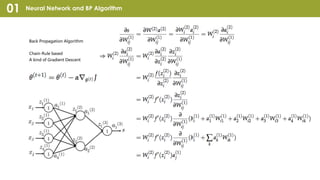
Back Propagation Algorithm
Chain-Rule based
A kind of Gradient Descent
Neural Network and BP Algorithm01
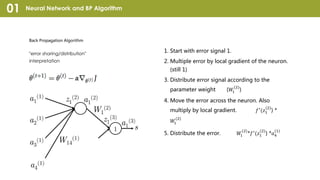
Back Propagation Algorithm
"error sharing/distribution"
interpretation
1. Start with error signal 1.
2. Multiple error by local gradient of the neuron.
(still 1)
3. Distribute error signal according to the
parameter weight (𝑊.
(0)
)
4. Move the error across the neuron. Also
multiply by local gradient. 𝑓3(𝑧.
(0)
) *
𝑊.
(0)
5. Distribute the error. 𝑊.
(0)
*𝑓3(𝑧.
(0)
) *𝑎6
(.)
Convolutional Neural Network
02
Convolutional Neural Network02
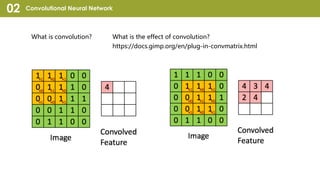
What is convolution? What is the effect of convolution?
https://docs.gimp.org/en/plug-in-convmatrix.html
Convolutional Neural Network02
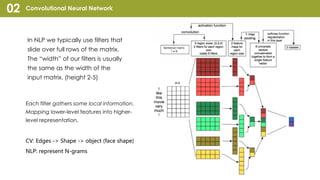
In NLP we typically use filters that
slide over full rows of the matrix.
The “width” of our filters is usually
the same as the width of the
input matrix. (height 2-5)
Each filter gathers some local information.
Mapping lower-level features into higher-
level representation.
CV: Edges -> Shape -> object (face shape)
NLP: represent N-grams
Convolutional Neural Network02
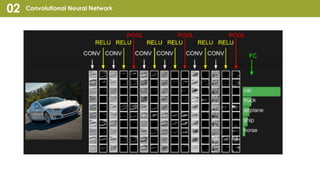
Convolution neural network?
Convolution layer + Pooling layer
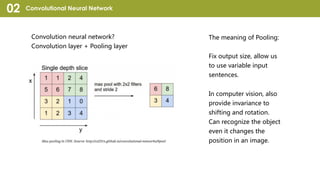
The meaning of Pooling:
Fix output size, allow us
to use variable input
sentences.
In computer vision, also
provide invariance to
shifting and rotation.
Can recognize the object
even it changes the
position in an image.
Some Practical Tricks
03
Some Practical Tricks03
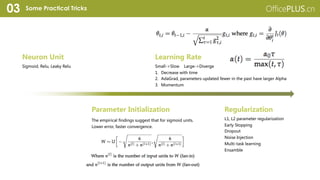
Sigmoid, Relu, Leaky Relu
Neuron Unit
The empirical findings suggest that for sigmoid units.
Lower error, faster convergence.
Parameter Initialization
Small->Slow Large->Diverge
1. Decrease with time
2. AdaGrad, parameters updated fewer in the past have larger Alpha
3. Momentum
Learning Rate
L1, L2 parameter regularization
Early Stopping
Dropout
Noise Injection
Multi-task learning
Ensamble
Regularization
(Regularization and Bayesian
Uncertainty)
Apply CNN in News Classification
04
Apply CNN in News Classification04
Data Format
<doc>
<url>Page_URL</url>
<docno>Page_ID</docno>
<contenttitle>Title</contenttitle>
<content>Content</content>
</doc>
Parameter Setting
embedding_size: 200
keep_prob: 0.7
batch_size: 500
evaluate_step: 100
filter_size: 2,3,4
train_dev_split_ratio: 0.99
topic_num: 12
epoch_size: 10
filter_num: 3
shuffle_input: False
Health: 10,000 items
Auto: 10,000 items
Business: 10,000 items
Experiment Result
05
Experiment Result05
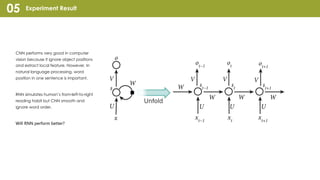
CNN performs very good in computer
vision because it ignore object positions
and extract local feature. However, In
natural language processing, word
position in one sentence is important.
RNN simulates human’s from-left-to-right
reading habit but CNN smooth and
ignore word order.
Will RNN perform better?
Experiment Result05
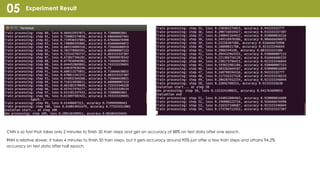
CNN is so fast that takes only 2 minutes to finish 50 train steps and get an accuracy of 88% on test data after one epoch.
RNN is relative slower, it takes 4 minutes to finish 50 train steps, but it gets accuracy around 90% just after a few train steps and attains 94.2%
accuracy on test data after half epoch.
Homework
06
Homework06
As mentioned in lecture,
How to derive least squares error and cross entropy
using maximum likelihood method?
(Just use simple formulas and descriptions)
Reference
[1] Yoon Kim. ”Convolutional Neural Networks for
Sentence Classification” EMNLP 2014.
LINK: http://aclweb.org/anthology/D/D14/D14-
1181.pdf
[2] Peng Wang, Jiaming Xu. ”Semantic Clustering and
Convolutional Neural Network for Short Text
Categorization” 2015.
LINK: http://www.aclweb.org/anthology/P15-2058
Question
Time

Convolutional neural network

  • 1.
  • 2.
    Neural Network andBP Algorithm 01 Convolutional Neural Network 02 Some Practical Tricks 03 Apply CNN in News Classification 04 Experiment Result 05 Homework 06 CONTENTS
  • 3.
    Neural Network andBP Algorithm 01
  • 4.
    Neural Network andBP Algorithm01 Artificial neural networks consist of three layers (input layer, hidden layer and output layer), each layer is made up of adaptive processing units, called neurons, which are interconnected. A neuron is a generic computational unit that takes n inputs and produces a single output. What differentiates the outputs of different neurons is their parameters (also referred to as their weights). One of the most popular choices for neurons is the "sigmoid"
  • 5.
    Neural Network andBP Algorithm01 Like most machine learning models, neural networks also need an optimization objective, a measure of error or goodness which we want to minimize or maximize respectively. Here, we use a popular error metric known as the maximum margin objective. The idea behind using this objective is to ensure that the score computed for "true" labeled data points is higher than the score computed for "false" labeled data points. Only for binary classification! How about the multi-classification Minimize J = 𝑆"#$%& − 𝑆()*& Minimize J = max(𝑆"#$%& − 𝑆()*& , 0) Minimize J = max(𝑆"#$%& − 𝑆()*&+∆ , 0) Minimize J = max(𝑆"#$%& − 𝑆()*&+1 , 0)
  • 6.
    Neural Network andBP Algorithm01 Back Propagation Algorithm Chain-Rule based A kind of Gradient Descent
  • 7.
    Neural Network andBP Algorithm01 Back Propagation Algorithm "error sharing/distribution" interpretation 1. Start with error signal 1. 2. Multiple error by local gradient of the neuron. (still 1) 3. Distribute error signal according to the parameter weight (𝑊. (0) ) 4. Move the error across the neuron. Also multiply by local gradient. 𝑓3(𝑧. (0) ) * 𝑊. (0) 5. Distribute the error. 𝑊. (0) *𝑓3(𝑧. (0) ) *𝑎6 (.)
  • 8.
  • 9.
    Convolutional Neural Network02 Whatis convolution? What is the effect of convolution? https://docs.gimp.org/en/plug-in-convmatrix.html
  • 10.
  • 11.
    Convolutional Neural Network02 InNLP we typically use filters that slide over full rows of the matrix. The “width” of our filters is usually the same as the width of the input matrix. (height 2-5) Each filter gathers some local information. Mapping lower-level features into higher- level representation. CV: Edges -> Shape -> object (face shape) NLP: represent N-grams
  • 12.
    Convolutional Neural Network02 Convolutionneural network? Convolution layer + Pooling layer The meaning of Pooling: Fix output size, allow us to use variable input sentences. In computer vision, also provide invariance to shifting and rotation. Can recognize the object even it changes the position in an image.
  • 13.
  • 14.
    Some Practical Tricks03 Sigmoid,Relu, Leaky Relu Neuron Unit The empirical findings suggest that for sigmoid units. Lower error, faster convergence. Parameter Initialization Small->Slow Large->Diverge 1. Decrease with time 2. AdaGrad, parameters updated fewer in the past have larger Alpha 3. Momentum Learning Rate L1, L2 parameter regularization Early Stopping Dropout Noise Injection Multi-task learning Ensamble Regularization (Regularization and Bayesian Uncertainty)
  • 15.
    Apply CNN inNews Classification 04
  • 16.
    Apply CNN inNews Classification04 Data Format <doc> <url>Page_URL</url> <docno>Page_ID</docno> <contenttitle>Title</contenttitle> <content>Content</content> </doc> Parameter Setting embedding_size: 200 keep_prob: 0.7 batch_size: 500 evaluate_step: 100 filter_size: 2,3,4 train_dev_split_ratio: 0.99 topic_num: 12 epoch_size: 10 filter_num: 3 shuffle_input: False Health: 10,000 items Auto: 10,000 items Business: 10,000 items
  • 17.
  • 18.
    Experiment Result05 CNN performsvery good in computer vision because it ignore object positions and extract local feature. However, In natural language processing, word position in one sentence is important. RNN simulates human’s from-left-to-right reading habit but CNN smooth and ignore word order. Will RNN perform better?
  • 19.
    Experiment Result05 CNN isso fast that takes only 2 minutes to finish 50 train steps and get an accuracy of 88% on test data after one epoch. RNN is relative slower, it takes 4 minutes to finish 50 train steps, but it gets accuracy around 90% just after a few train steps and attains 94.2% accuracy on test data after half epoch.
  • 20.
  • 21.
    Homework06 As mentioned inlecture, How to derive least squares error and cross entropy using maximum likelihood method? (Just use simple formulas and descriptions)
  • 22.
    Reference [1] Yoon Kim.”Convolutional Neural Networks for Sentence Classification” EMNLP 2014. LINK: http://aclweb.org/anthology/D/D14/D14- 1181.pdf [2] Peng Wang, Jiaming Xu. ”Semantic Clustering and Convolutional Neural Network for Short Text Categorization” 2015. LINK: http://www.aclweb.org/anthology/P15-2058 Question Time