
Neural Network as a function
Taisuke Oe
Neural Network as a Function.
1.Who I am.
2.Deep Learning Overview
3.Neural Network as a function
4.Layered Structure as a function composition
5.Neuron as a node in graph
6.Training is a process to optimize states in each
layer
7.Matrix as a calculation unit in parallel in GPU
Who am I?
Taisuke Oe / @OE_uia
● Co-chair of ScalaMatsuri
CFP is open by 15th
Oct.
Travel support for highly voted speakers
Your sponsorship is very welcome :)
● Working in Android Dev in Scala
● Deeplearning4j/nd4s author
● Deeplearning4j/nd4j contributor
http://scalamatsuri.org/index_en.html
Deep Learning Overview
● Purpose:
Recognition, classification or prediction
● Architecture:
Train Neural Network parameters with
optimizing parameters in each layer.
● Data type:
Unstructured data, such as images, audio,
video, text, sensory data, web-logs
● Use case:
Recommendation engine, voice search, caption
generation, video object tracking, anormal
detection, self-organized photo album.
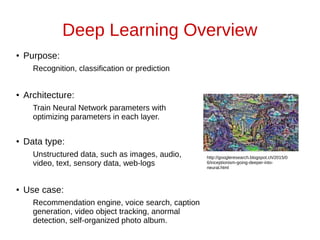
http://googleresearch.blogspot.ch/2015/0
6/inceptionism-going-deeper-into-
neural.html
Deep Learning Overview
● Advantages v.s. other ML algos:
– Expressive and accurate (e.g. ImageNet Large Scale
Visual Recognition Competition)
– Speed
● Disadvantages
– Difficulty to guess the reason of results.
Why?
Neural Network is a function
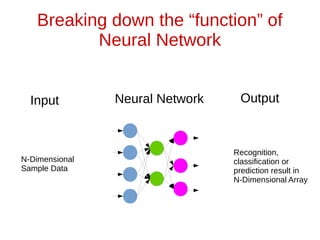
Breaking down the “function” of
Neural Network
OutputInput Neural Network
N-Dimensional
Sample Data
Recognition,
classification or
prediction result in
N-Dimensional Array
Simplest case:
Classification of Iris
Neural Network
Features
[5.1 1.5 1.8 3.2]
Probability of each class
[0.9 0.02 0.08]
ResultSample
Neural Network is like a
Function1[INDArray, INDArray]
Neural Network
Features
[5.1 1.5 1.8 3.2]
Probability of each class
[0.9 0.02 0.08]
ResultSample
W:INDArray => INDArray
W
Dealing with multiple samples
Neural Network
Features
[
5.1 1.5 1.8 3.2
4.5 1.2 3.0 1.2
⋮ ⋮
3.1 2.2 1.0 1.2
]
Probability of each class
[
0.9 0.02 0.08
0.8 0.1 0.1
⋮ ⋮
0.85 0.08 0.07
]
ResultsIndependent
Samples
Generalized Neural Network
Function
ResultsNeural Network
[
X11 X12 ⋯ X1 p
X21 X2 p
⋮ ⋮
Xn 1 Xn2 ⋯ Xnp
] [
Y11 Y12 ⋯ Y1 m
Y21 Y2 m
⋮ ⋮
Yn1 Yn2 ⋯ Ynm
]
NN Function deals with multiple
samples as it is (thx to Linear Algebra!)
ResultIndependent
Samples
Neural Network
[
X11 X12 ⋯ X1 p
X21 X2 p
⋮ ⋮
Xn 1 Xn2 ⋯ Xnp
] [
Y11 Y12 ⋯ Y1 m
Y21 Y2 m
⋮ ⋮
Yn1 Yn2 ⋯ Ynm
]
W:INDArray => INDArray
W
Layered Structure
as a function composition
Neural Network is a layered
structure
[
X11 X12 ⋯ X1 p
X21 X2 p
⋮ ⋮
Xn 1 Xn2 ⋯ Xnp
] [
Y11 Y12 ⋯ Y1 m
Y21 Y2 m
⋮ ⋮
Yn1 Yn2 ⋯ Ynm
]
L1 L2 L3
Each Layer is also a function which
maps samples to output
[
X11 X12 ⋯ X1 p
X21 X2 p
⋮ ⋮
Xn 1 Xn2 ⋯ Xnp
]
L1
[
Z11 Z12 ⋯ Z1 q
Z21 Z2 p
⋮ ⋮
Zn1 Zn2 ⋯ Znp
]
Output
of Layer1
L1 :INDArray => INDArray
NN Function is composed of
Layer functions.
W=L1andThenL2andThenL3
W ,L1 ,L2 ,L3 :INDArray => INDArray
[
X11 X12 ⋯ X1 p
X21 X2 p
⋮ ⋮
Xn 1 Xn2 ⋯ Xnp
] [
Y11 Y12 ⋯ Y1 m
Y21 Y2 m
⋮ ⋮
Yn1 Yn2 ⋯ Ynm
]
Neuron as a node in graph
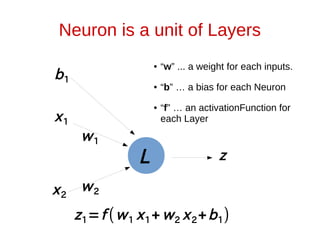
Neuron is a unit of Layers
x1
x2
z1=f (w1 x1+ w2 x2+b1)
w1
w2
● “w” ... a weight for each inputs.
● “b” … a bias for each Neuron
● “f” … an activationFunction for
each Layer
b1
L z
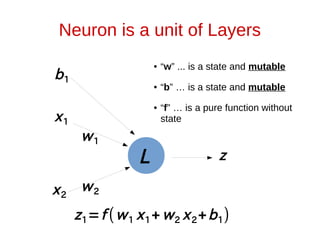
Neuron is a unit of Layers
x1
x2
z1=f (w1 x1+ w2 x2+b1)
w1
w2
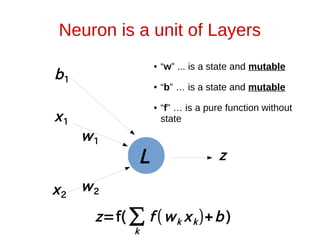
● “w” ... is a state and mutable
● “b” … is a state and mutable
● “f” … is a pure function without
state
b1
L z
Neuron is a unit of Layers
L
x1
z
x2
z=f( ∑
k
f (wk xk )+b )
w1
w2
● “w” ... is a state and mutable
● “b” … is a state and mutable
● “f” … is a pure function without
state
b1
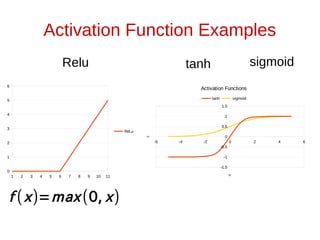
Activation Function Examples
Relu
f (x)=max (0, x)
tanh sigmoid
-6 -4 -2 0 2 4 6
-1.5
-1
-0.5
0
0.5
1
1.5
Activation Functions
tanh sigmoid
u
z
1 2 3 4 5 6 7 8 9 10 11
0
1
2
3
4
5
6
ReLu
How does L1 function look like?
L1 (X)=( X・
[
W11 W12 ⋯ W1q
W21 W2q
⋮ ⋮
Wp1 Wp2 ⋯ Wpq
]+
[
b11 b12 ⋯ b1q
b21 b2q
⋮ ⋮
bn 1 bn 2 ⋯ bnq
]) map f
Weight Matrix Bias Matrix
L1 :INDArray => INDArray
L1
(
[
X11 X12 ⋯ X1p
X21 X2p
⋮ ⋮
Xn1 Xn 2 ⋯ Xnp
]・
[
W11 W12 ⋯ W1 q
W21 W2 q
⋮ ⋮
Wp1 Wp2 ⋯ Wpq
]+
[
b11 b12 ⋯ b1 q
b21 b2 q
⋮ ⋮
bn 1 bn 2 ⋯ bnq
]) map f
Input
Feature Matrix Weight Matrix Bias Matrix
=
[
Z11 Z12 ⋯ Z1 q
Z21 Z2 p
⋮ ⋮
Zn 1 Zn 2 ⋯ Znp
]
Output of Layer1
How does L1 function look like?
Training is a process to optimize
states in each layer
Training of Neural Network
● Optimizing Weight Matrices and Bias Matrices in each layer.
● Optimizing = Minimizing Error, in this context.
● How are Neural Network errors are defined?
Weight Matrix Bias Matrix
L (X)=( X・
[
W11 W12 ⋯ W1q
W21 W2q
⋮ ⋮
Wp1 Wp2 ⋯ Wpq
]+
[
b11 b12 ⋯ b1q
b21 b2q
⋮ ⋮
bn 1 bn 2 ⋯ bnq
]) map f
Error definition
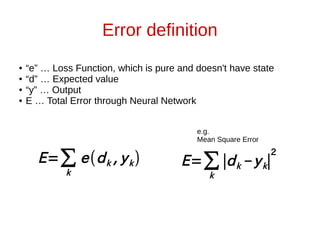
● “e” … Loss Function, which is pure and doesn't have state
● “d” … Expected value
● “y” … Output
● E … Total Error through Neural Network
E=∑
k
e(dk , yk ) E=∑
k
|dk – yk|
2
e.g.
Mean Square Error
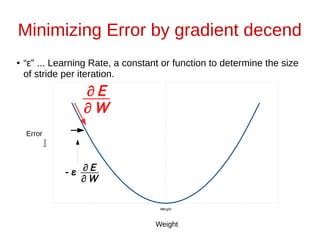
Minimizing Error by gradient decend
Weight
Error
∂ E
∂ W
Weight
Error
● “ε” ... Learning Rate, a constant or function to determine the size
of stride per iteration.
-ε ∂ E
∂ W
Minimize Error by gradient decend
● “ε” ... Learning Rate, a constant or function to determine the size
of stride per iteration.
[
W11 W12 ⋯ W1q
W21 W2q
⋮ ⋮
Wp1 Wp2 ⋯ Wpq
] -= ε
[
∂E
∂ W11
∂E
∂ W12
⋯ ∂ E
∂ W1q
∂E
∂ W21
∂ E
∂ W2q
⋮ ⋮
∂E
∂ Wp1
∂E
∂ Wp2
⋯ ∂ E
∂ Wpq
]
[
b11 b12 ⋯ b1q
b21 b2q
⋮ ⋮
bp1 Wp2 ⋯ bpq
] -= ε
[
∂ E
∂ b11
∂ E
∂ b12
⋯ ∂ E
∂ b1q
∂ E
∂ b21
∂ E
∂ b2q
⋮ ⋮
∂ E
∂bp1
∂ E
∂bp2
⋯ ∂ E
∂ bpq
]
Matrix as a calculation unit
in parallel in GPU
Matrix Calculation in Parallel
● Matrix calculation can be run in parallel, such as multiplication,
adding,or subtraction.
● GPGPU works well matrix calculation in parallel, with around
2000 CUDA cores per NVIDIA GPU and around 160GB / s
bandwidth.
[
W11 W12 ⋯ W1 q
W21 W2 q
⋮ ⋮
Wp1 Wp 2 ⋯ Wpq
] -= ε
[
∂ E
∂ W11
∂ E
∂ W12
⋯
∂ E
∂ W1 q
∂ E
∂ W21
∂ E
∂ W2 q
⋮ ⋮
∂ E
∂ Wp 1
∂ E
∂ Wp 2
⋯ ∂ E
∂ Wpq
]
(
[
X11 X12 ⋯ X1p
X21 X2p
⋮ ⋮
Xn1 Xn2 ⋯ Xnp
]・
[
W11 W12 ⋯ W1q
W21 W2q
⋮ ⋮
Wp 1 Wp2 ⋯ Wpq
]+
[
b11 b12 ⋯ b1q
b21 b2q
⋮ ⋮
bn1 bn2 ⋯ bnq
]) map f
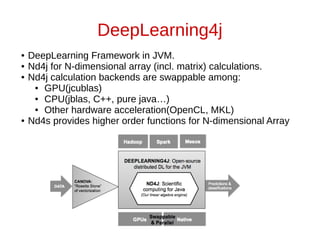
DeepLearning4j
● DeepLearning Framework in JVM.
● Nd4j for N-dimensional array (incl. matrix) calculations.
● Nd4j calculation backends are swappable among:
● GPU(jcublas)
● CPU(jblas, C++, pure java…)
● Other hardware acceleration(OpenCL, MKL)
● Nd4s provides higher order functions for N-dimensional Array

Neural Network as a function

  • 1.
    Neural Network asa function Taisuke Oe
  • 2.
    Neural Network asa Function. 1.Who I am. 2.Deep Learning Overview 3.Neural Network as a function 4.Layered Structure as a function composition 5.Neuron as a node in graph 6.Training is a process to optimize states in each layer 7.Matrix as a calculation unit in parallel in GPU
  • 3.
    Who am I? TaisukeOe / @OE_uia ● Co-chair of ScalaMatsuri CFP is open by 15th Oct. Travel support for highly voted speakers Your sponsorship is very welcome :) ● Working in Android Dev in Scala ● Deeplearning4j/nd4s author ● Deeplearning4j/nd4j contributor http://scalamatsuri.org/index_en.html
  • 4.
    Deep Learning Overview ●Purpose: Recognition, classification or prediction ● Architecture: Train Neural Network parameters with optimizing parameters in each layer. ● Data type: Unstructured data, such as images, audio, video, text, sensory data, web-logs ● Use case: Recommendation engine, voice search, caption generation, video object tracking, anormal detection, self-organized photo album. http://googleresearch.blogspot.ch/2015/0 6/inceptionism-going-deeper-into- neural.html
  • 5.
    Deep Learning Overview ●Advantages v.s. other ML algos: – Expressive and accurate (e.g. ImageNet Large Scale Visual Recognition Competition) – Speed ● Disadvantages – Difficulty to guess the reason of results. Why?
  • 6.
  • 7.
    Breaking down the“function” of Neural Network OutputInput Neural Network N-Dimensional Sample Data Recognition, classification or prediction result in N-Dimensional Array
  • 8.
    Simplest case: Classification ofIris Neural Network Features [5.1 1.5 1.8 3.2] Probability of each class [0.9 0.02 0.08] ResultSample
  • 9.
    Neural Network islike a Function1[INDArray, INDArray] Neural Network Features [5.1 1.5 1.8 3.2] Probability of each class [0.9 0.02 0.08] ResultSample W:INDArray => INDArray W
  • 10.
    Dealing with multiplesamples Neural Network Features [ 5.1 1.5 1.8 3.2 4.5 1.2 3.0 1.2 ⋮ ⋮ 3.1 2.2 1.0 1.2 ] Probability of each class [ 0.9 0.02 0.08 0.8 0.1 0.1 ⋮ ⋮ 0.85 0.08 0.07 ] ResultsIndependent Samples
  • 11.
    Generalized Neural Network Function ResultsNeuralNetwork [ X11 X12 ⋯ X1 p X21 X2 p ⋮ ⋮ Xn 1 Xn2 ⋯ Xnp ] [ Y11 Y12 ⋯ Y1 m Y21 Y2 m ⋮ ⋮ Yn1 Yn2 ⋯ Ynm ]
  • 12.
    NN Function dealswith multiple samples as it is (thx to Linear Algebra!) ResultIndependent Samples Neural Network [ X11 X12 ⋯ X1 p X21 X2 p ⋮ ⋮ Xn 1 Xn2 ⋯ Xnp ] [ Y11 Y12 ⋯ Y1 m Y21 Y2 m ⋮ ⋮ Yn1 Yn2 ⋯ Ynm ] W:INDArray => INDArray W
  • 13.
    Layered Structure as afunction composition
  • 14.
    Neural Network isa layered structure [ X11 X12 ⋯ X1 p X21 X2 p ⋮ ⋮ Xn 1 Xn2 ⋯ Xnp ] [ Y11 Y12 ⋯ Y1 m Y21 Y2 m ⋮ ⋮ Yn1 Yn2 ⋯ Ynm ] L1 L2 L3
  • 15.
    Each Layer isalso a function which maps samples to output [ X11 X12 ⋯ X1 p X21 X2 p ⋮ ⋮ Xn 1 Xn2 ⋯ Xnp ] L1 [ Z11 Z12 ⋯ Z1 q Z21 Z2 p ⋮ ⋮ Zn1 Zn2 ⋯ Znp ] Output of Layer1 L1 :INDArray => INDArray
  • 16.
    NN Function iscomposed of Layer functions. W=L1andThenL2andThenL3 W ,L1 ,L2 ,L3 :INDArray => INDArray [ X11 X12 ⋯ X1 p X21 X2 p ⋮ ⋮ Xn 1 Xn2 ⋯ Xnp ] [ Y11 Y12 ⋯ Y1 m Y21 Y2 m ⋮ ⋮ Yn1 Yn2 ⋯ Ynm ]
  • 17.
    Neuron as anode in graph
  • 18.
    Neuron is aunit of Layers x1 x2 z1=f (w1 x1+ w2 x2+b1) w1 w2 ● “w” ... a weight for each inputs. ● “b” … a bias for each Neuron ● “f” … an activationFunction for each Layer b1 L z
  • 19.
    Neuron is aunit of Layers x1 x2 z1=f (w1 x1+ w2 x2+b1) w1 w2 ● “w” ... is a state and mutable ● “b” … is a state and mutable ● “f” … is a pure function without state b1 L z
  • 20.
    Neuron is aunit of Layers L x1 z x2 z=f( ∑ k f (wk xk )+b ) w1 w2 ● “w” ... is a state and mutable ● “b” … is a state and mutable ● “f” … is a pure function without state b1
  • 21.
    Activation Function Examples Relu f(x)=max (0, x) tanh sigmoid -6 -4 -2 0 2 4 6 -1.5 -1 -0.5 0 0.5 1 1.5 Activation Functions tanh sigmoid u z 1 2 3 4 5 6 7 8 9 10 11 0 1 2 3 4 5 6 ReLu
  • 22.
    How does L1function look like? L1 (X)=( X・ [ W11 W12 ⋯ W1q W21 W2q ⋮ ⋮ Wp1 Wp2 ⋯ Wpq ]+ [ b11 b12 ⋯ b1q b21 b2q ⋮ ⋮ bn 1 bn 2 ⋯ bnq ]) map f Weight Matrix Bias Matrix L1 :INDArray => INDArray
  • 23.
    L1 ( [ X11 X12 ⋯X1p X21 X2p ⋮ ⋮ Xn1 Xn 2 ⋯ Xnp ]・ [ W11 W12 ⋯ W1 q W21 W2 q ⋮ ⋮ Wp1 Wp2 ⋯ Wpq ]+ [ b11 b12 ⋯ b1 q b21 b2 q ⋮ ⋮ bn 1 bn 2 ⋯ bnq ]) map f Input Feature Matrix Weight Matrix Bias Matrix = [ Z11 Z12 ⋯ Z1 q Z21 Z2 p ⋮ ⋮ Zn 1 Zn 2 ⋯ Znp ] Output of Layer1 How does L1 function look like?
  • 24.
    Training is aprocess to optimize states in each layer
  • 25.
    Training of NeuralNetwork ● Optimizing Weight Matrices and Bias Matrices in each layer. ● Optimizing = Minimizing Error, in this context. ● How are Neural Network errors are defined? Weight Matrix Bias Matrix L (X)=( X・ [ W11 W12 ⋯ W1q W21 W2q ⋮ ⋮ Wp1 Wp2 ⋯ Wpq ]+ [ b11 b12 ⋯ b1q b21 b2q ⋮ ⋮ bn 1 bn 2 ⋯ bnq ]) map f
  • 26.
    Error definition ● “e”… Loss Function, which is pure and doesn't have state ● “d” … Expected value ● “y” … Output ● E … Total Error through Neural Network E=∑ k e(dk , yk ) E=∑ k |dk – yk| 2 e.g. Mean Square Error
  • 27.
    Minimizing Error bygradient decend Weight Error ∂ E ∂ W Weight Error ● “ε” ... Learning Rate, a constant or function to determine the size of stride per iteration. -ε ∂ E ∂ W
  • 28.
    Minimize Error bygradient decend ● “ε” ... Learning Rate, a constant or function to determine the size of stride per iteration. [ W11 W12 ⋯ W1q W21 W2q ⋮ ⋮ Wp1 Wp2 ⋯ Wpq ] -= ε [ ∂E ∂ W11 ∂E ∂ W12 ⋯ ∂ E ∂ W1q ∂E ∂ W21 ∂ E ∂ W2q ⋮ ⋮ ∂E ∂ Wp1 ∂E ∂ Wp2 ⋯ ∂ E ∂ Wpq ] [ b11 b12 ⋯ b1q b21 b2q ⋮ ⋮ bp1 Wp2 ⋯ bpq ] -= ε [ ∂ E ∂ b11 ∂ E ∂ b12 ⋯ ∂ E ∂ b1q ∂ E ∂ b21 ∂ E ∂ b2q ⋮ ⋮ ∂ E ∂bp1 ∂ E ∂bp2 ⋯ ∂ E ∂ bpq ]
  • 29.
    Matrix as acalculation unit in parallel in GPU
  • 30.
    Matrix Calculation inParallel ● Matrix calculation can be run in parallel, such as multiplication, adding,or subtraction. ● GPGPU works well matrix calculation in parallel, with around 2000 CUDA cores per NVIDIA GPU and around 160GB / s bandwidth. [ W11 W12 ⋯ W1 q W21 W2 q ⋮ ⋮ Wp1 Wp 2 ⋯ Wpq ] -= ε [ ∂ E ∂ W11 ∂ E ∂ W12 ⋯ ∂ E ∂ W1 q ∂ E ∂ W21 ∂ E ∂ W2 q ⋮ ⋮ ∂ E ∂ Wp 1 ∂ E ∂ Wp 2 ⋯ ∂ E ∂ Wpq ] ( [ X11 X12 ⋯ X1p X21 X2p ⋮ ⋮ Xn1 Xn2 ⋯ Xnp ]・ [ W11 W12 ⋯ W1q W21 W2q ⋮ ⋮ Wp 1 Wp2 ⋯ Wpq ]+ [ b11 b12 ⋯ b1q b21 b2q ⋮ ⋮ bn1 bn2 ⋯ bnq ]) map f
  • 31.
    DeepLearning4j ● DeepLearning Frameworkin JVM. ● Nd4j for N-dimensional array (incl. matrix) calculations. ● Nd4j calculation backends are swappable among: ● GPU(jcublas) ● CPU(jblas, C++, pure java…) ● Other hardware acceleration(OpenCL, MKL) ● Nd4s provides higher order functions for N-dimensional Array