Chrysanthemum
or
Mums/ Crysanths
Taxanomy
✖ Scientific name: Dendranthema grandiflora
✖Local name: Chrysanthemum
✖Hindi name: Guldaudi
✖Family: Asteracea
History and Origin
Chrysanthemums were first cultivated in China as a
flowering herb as far back as the 15th century BC.
Types of Chrysanthemum
1. IRREGULAR INCURVE :-
These are the giant blooms of the Chrysanthemum genus.
The florets (petals) loosely incurve and make fully closed centers.
The lower florets present an irregular appearance and may give a skirted effect.
Flower size: 6-8 inches.
Flower characteristics:
✖ Grown as a disbud
✖ Plant moderately short.
2. REFLEX :-
The florets in this class curve downward and overlap, similar to bird plumage.
The tops of these blooms are full, but somewhat flattened.
Doreen statham (1995)
Flower size: 4-6 inches.
Flower characteristics:
✖ Grown as a disbud
✖ Plant medium height.
3. REGULAR INCURVE :-
A true globular bloom equal in breadth and depth.
The florets smoothly incurve and form a ball.
Flower size: 4-6 inches.
Flower characteristics:
✖ Grown as a disbud, plant
✖ Moderately short.
4. DECORATIVE :-
A flattened bloom with short petals. As in classes 1-3 the center disk is not visible.
The upper florets tend to incurve, but the lower petals generally reflex.
Flower size: 5 inches or greater
Flower characteristics:
✖ Grown as a pot mum or disbud,
✖ Plant height short.
5. INTERMEDIATE INCURVE :-
This bloom class is smaller than the irregular incurve, with shorter florets, only partially
incurving with full centers, but giving a more open appearance.
Many of the popular commercial incurving types are in this intermediate class.
Flower size: 6 inches or greater.
Flower characteristics:
✖ Grown as a disbud
✖ Plant medium height.
5. INTERMEDIATE INCURVE :-
This bloom class is smaller than the irregular incurve, with shorter florets, only partially
incurving with full centers, but giving a more open appearance.
Many of the popular commercial incurving types are in this intermediate class.
Flower size: 6 inches or greater.
Flower characteristics:
✖ Grown as a disbud
✖ Plant medium height.
5. .Pompon :-
A small globular bloom, somewhat flat when young but fully round when mature.
Size ranges from small button types to large disbudded blooms almost 4
Inches in diameter.
The florets incurve or reflex in a regular manner and fully conceal the center.
Flower size: 1-4 inches.
Flower characteristics :
✖ Grown as a spray
✖ Plant height tall.
6. SPOON :-
Essentially the same as the semi-double, except the ray florets are like spoons at the tips.
The center disk is round and visible.
Flower size: 4 inches or greater.
Flower characteristics:
✖ Grown as a disbud or spray
✖ Plant height tall.
7. BRUSH OR THISTLE :-
Fine tubular florets which grow parallel to the stem and resemble an artist’s paint brushes
or in the thistle form
The florets are flattened, twisted and dropping.
Flower size: less than 2 inches.
Flower characteristics:
✖ Grown as a spray
✖ Plant medium height.
Climate and Soil
Soil :-
The ideal soil for chrysanthemum growing is a well drained, sandy
loam of good texture and aeration.
Good amount of organic matter and pH of 6.5 is essential.
It is a shallow fibrous rooted plant and is very sensible to water
logged conditions.
Soil should be levelled properly.
Cocopeat should be added to improve structure & water holding
capacity.
If growing 1st time, soil should be disinfected using Formaldehyde.
Climate Requirement
Chrysanthemum requires long days for good vegetative
growth and short days for flowering.
The most important environmental factors influencing the
growth and flowering of these plants are light and temperature.
The rate of vegetative growth and flowering are also affected
by temperature.
The optimum temperature of 15.6 0C is required.
The relative humidity of 70 to 90% is suitable for the plants.
Light -
Shading in the summer is usually needed not only to
reduce the light intensity but to also control heat.
Long day plant.
Supplemental light is useful during low-light
Periods.
Propagation Technique
Propagation
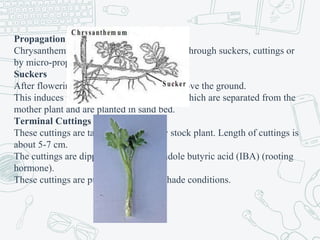
Chrysanthemum is propagated vegetatively through suckers, cuttings or
by micro-propagation.
Suckers
After flowering, the stem is cut back just above the ground.
This induces the formation of side suckers which are separated from the
mother plant and are planted in sand bed.
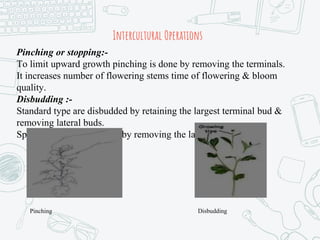
Terminal Cuttings
These cuttings are taken from a healthy stock plant. Length of cuttings is
about 5-7 cm.
The cuttings are dipped in 2500 ppm indole butyric acid (IBA) (rooting
hormone).
These cuttings are put in sand beds in shade conditions.
Time of Planting
Time of planting
Terminal cuttings of stock plants are taken in june and
they are transplanted after rooting at the end of july.
These plants are ready for pinching during end of
august or beginning of september.
Spacing
30 x 30 cm (plant to plant and row to row)
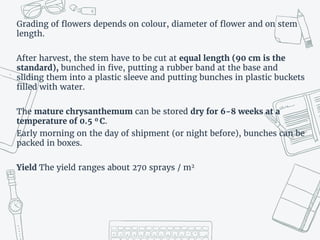
Pinching or stopping:-
To limit upward growth pinching is done by removing the terminals.
It increases number of flowering stems time of flowering & bloom
quality.
Disbudding :-
Standard type are disbudded by retaining the largest terminal bud &
removing lateral buds.
Spray types are disbudded by removing the large apical bud.
Pinching Disbudding
Intercultural Operations
Particular attention also being paid to pest and disease control,
especially mildew which can be largely prevented by adequate
ventilation.
Irrigation About 8 – 9 lit of water/sq.mt is required/day.
Manure and Fertilizer
Recommended dose of FYM:
25t at 125:120:25 kg NPk/ha
Basal application: half of N + entire P and K
Top dressing: half of N applied 30 days after planting
Fertilizer Requirement (kg/acre):
 Spray GA3 at 50 ppm at 30, 45 and 60 days after planting to increase
flower yield
Harvest
Flowers are cut soon after the disappearance of green colour in the
centre of the flowers and the center petals are fully expanded.
Pompons are cut when they are fully developed.
Cutting the stem while the flowers are slightly on the “green” side is
preferred because it offers a better quality product for the customer.
Harvested flowers are to be kept immediately in a bucket containing
water and preservatives to avoid desiccation.
Grading of flowers depends on colour, diameter of flower and on stem
length.
After harvest, the stem have to be cut at equal length (90 cm is the
standard), bunched in five, putting a rubber band at the base and
sliding them into a plastic sleeve and putting bunches in plastic buckets
filled with water.
The mature chrysanthemum can be stored dry for 6-8 weeks at a
temperature of 0.5 0 C.
Early morning on the day of shipment (or night before), bunches can be
packed in boxes.
Yield The yield ranges about 270 sprays / m2
Thanks!
Any questions?

Chrysanthemum

  • 1.
  • 2.
    Taxanomy ✖ Scientific name:Dendranthema grandiflora ✖Local name: Chrysanthemum ✖Hindi name: Guldaudi ✖Family: Asteracea
  • 3.
    History and Origin Chrysanthemumswere first cultivated in China as a flowering herb as far back as the 15th century BC.
  • 4.
    Types of Chrysanthemum 1.IRREGULAR INCURVE :- These are the giant blooms of the Chrysanthemum genus. The florets (petals) loosely incurve and make fully closed centers. The lower florets present an irregular appearance and may give a skirted effect. Flower size: 6-8 inches. Flower characteristics: ✖ Grown as a disbud ✖ Plant moderately short.
  • 5.
    2. REFLEX :- Theflorets in this class curve downward and overlap, similar to bird plumage. The tops of these blooms are full, but somewhat flattened. Doreen statham (1995) Flower size: 4-6 inches. Flower characteristics: ✖ Grown as a disbud ✖ Plant medium height.
  • 6.
    3. REGULAR INCURVE:- A true globular bloom equal in breadth and depth. The florets smoothly incurve and form a ball. Flower size: 4-6 inches. Flower characteristics: ✖ Grown as a disbud, plant ✖ Moderately short.
  • 7.
    4. DECORATIVE :- Aflattened bloom with short petals. As in classes 1-3 the center disk is not visible. The upper florets tend to incurve, but the lower petals generally reflex. Flower size: 5 inches or greater Flower characteristics: ✖ Grown as a pot mum or disbud, ✖ Plant height short.
  • 8.
    5. INTERMEDIATE INCURVE:- This bloom class is smaller than the irregular incurve, with shorter florets, only partially incurving with full centers, but giving a more open appearance. Many of the popular commercial incurving types are in this intermediate class. Flower size: 6 inches or greater. Flower characteristics: ✖ Grown as a disbud ✖ Plant medium height.
  • 9.
    5. INTERMEDIATE INCURVE:- This bloom class is smaller than the irregular incurve, with shorter florets, only partially incurving with full centers, but giving a more open appearance. Many of the popular commercial incurving types are in this intermediate class. Flower size: 6 inches or greater. Flower characteristics: ✖ Grown as a disbud ✖ Plant medium height.
  • 10.
    5. .Pompon :- Asmall globular bloom, somewhat flat when young but fully round when mature. Size ranges from small button types to large disbudded blooms almost 4 Inches in diameter. The florets incurve or reflex in a regular manner and fully conceal the center. Flower size: 1-4 inches. Flower characteristics : ✖ Grown as a spray ✖ Plant height tall.
  • 11.
    6. SPOON :- Essentiallythe same as the semi-double, except the ray florets are like spoons at the tips. The center disk is round and visible. Flower size: 4 inches or greater. Flower characteristics: ✖ Grown as a disbud or spray ✖ Plant height tall.
  • 12.
    7. BRUSH ORTHISTLE :- Fine tubular florets which grow parallel to the stem and resemble an artist’s paint brushes or in the thistle form The florets are flattened, twisted and dropping. Flower size: less than 2 inches. Flower characteristics: ✖ Grown as a spray ✖ Plant medium height.
  • 13.
  • 14.
    Soil :- The idealsoil for chrysanthemum growing is a well drained, sandy loam of good texture and aeration. Good amount of organic matter and pH of 6.5 is essential. It is a shallow fibrous rooted plant and is very sensible to water logged conditions. Soil should be levelled properly. Cocopeat should be added to improve structure & water holding capacity. If growing 1st time, soil should be disinfected using Formaldehyde.
  • 15.
    Climate Requirement Chrysanthemum requireslong days for good vegetative growth and short days for flowering. The most important environmental factors influencing the growth and flowering of these plants are light and temperature. The rate of vegetative growth and flowering are also affected by temperature. The optimum temperature of 15.6 0C is required. The relative humidity of 70 to 90% is suitable for the plants.
  • 16.
    Light - Shading inthe summer is usually needed not only to reduce the light intensity but to also control heat. Long day plant. Supplemental light is useful during low-light Periods.
  • 17.
  • 18.
    Propagation Chrysanthemum is propagatedvegetatively through suckers, cuttings or by micro-propagation. Suckers After flowering, the stem is cut back just above the ground. This induces the formation of side suckers which are separated from the mother plant and are planted in sand bed. Terminal Cuttings These cuttings are taken from a healthy stock plant. Length of cuttings is about 5-7 cm. The cuttings are dipped in 2500 ppm indole butyric acid (IBA) (rooting hormone). These cuttings are put in sand beds in shade conditions.
  • 19.
    Time of Planting Timeof planting Terminal cuttings of stock plants are taken in june and they are transplanted after rooting at the end of july. These plants are ready for pinching during end of august or beginning of september. Spacing 30 x 30 cm (plant to plant and row to row)
  • 20.
    Pinching or stopping:- Tolimit upward growth pinching is done by removing the terminals. It increases number of flowering stems time of flowering & bloom quality. Disbudding :- Standard type are disbudded by retaining the largest terminal bud & removing lateral buds. Spray types are disbudded by removing the large apical bud. Pinching Disbudding Intercultural Operations
  • 21.
    Particular attention alsobeing paid to pest and disease control, especially mildew which can be largely prevented by adequate ventilation. Irrigation About 8 – 9 lit of water/sq.mt is required/day.
  • 22.
  • 23.
    Recommended dose ofFYM: 25t at 125:120:25 kg NPk/ha Basal application: half of N + entire P and K Top dressing: half of N applied 30 days after planting Fertilizer Requirement (kg/acre):  Spray GA3 at 50 ppm at 30, 45 and 60 days after planting to increase flower yield
  • 24.
  • 25.
    Flowers are cutsoon after the disappearance of green colour in the centre of the flowers and the center petals are fully expanded. Pompons are cut when they are fully developed. Cutting the stem while the flowers are slightly on the “green” side is preferred because it offers a better quality product for the customer. Harvested flowers are to be kept immediately in a bucket containing water and preservatives to avoid desiccation.
  • 26.
    Grading of flowersdepends on colour, diameter of flower and on stem length. After harvest, the stem have to be cut at equal length (90 cm is the standard), bunched in five, putting a rubber band at the base and sliding them into a plastic sleeve and putting bunches in plastic buckets filled with water. The mature chrysanthemum can be stored dry for 6-8 weeks at a temperature of 0.5 0 C. Early morning on the day of shipment (or night before), bunches can be packed in boxes. Yield The yield ranges about 270 sprays / m2
  • 27.