1
Presenter:
Minraj Ghimire
BSc. Horticulture 3rd
semester
Exam Roll No.: 03
A presentation on:
Chrysanthemum Production Technology
Assigned by :
Asst. Prof. Mr. Bikash Khanal
Department of Horticulture
TU, IAAS
MRMC, ILAM
Chrysanthemum indicum (Asteraceae)
.
2
Both annual & perennial;
 Herbaceous and sometimes partly woody
Classification
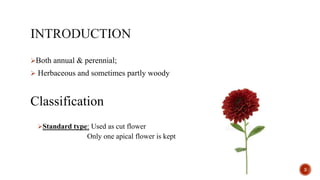
Standard type: Used as cut flower
Only one apical flower is kept
3
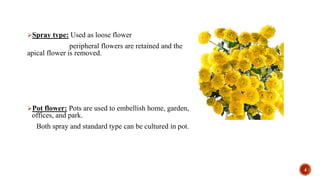
Spray type: Used as loose flower
peripheral flowers are retained and the
apical flower is removed.
Pot flower: Pots are used to embellish home, garden,
offices, and park.
Both spray and standard type can be cultured in pot.
4
 Achievement
 Copper Bowl
 Escapade
 Helen Castel
 Mandalay
 Matador
 Miss Atlanta
 Orange Bowl
5
 Good textured well drained sandy loam
 The optimal pH range is 6.5 – 7.5.
Climate
 Day temperature of 22℃ and night temperature of 16℃ is suitable for quality
flower production.
 Higher temperature causes delay flowering and the flower color fade away
 Use of CO2 (600-900 ppm) improves the color, size and yield of flower.
6
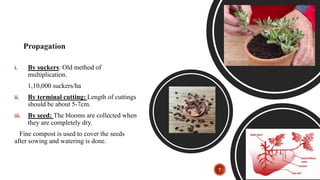
i. By suckers: Old method of
multiplication.
1,10,000 suckers/ha
ii. By terminal cutting: Length of cuttings
should be about 5-7cm.
iii. By seed: The blooms are collected when
they are completely dry.
Fine compost is used to cover the seeds
after sowing and watering is done.
7
 The plants need adequate water during vegetative growth when new leaves are being formed.
 After formation of flower bud less water needed as no further leaves are formed.
 However, water stagnation causes root rot, so drainage should be maintained.
 chrysanthemum requires humidity between 70-90%.
Planting distance
 Maintained according to varieties.
 Usually, 15×15 or 10×15cm₂
8
 FYM requires about 18-20 MT/ha
 Usually 20:20:10 gm per m² N:P:K is applied for better yield.
 Micro nutrients like foliar spray of ZnSO4 at 0.25% and MgSO4 at 0.5% can be applied.
9
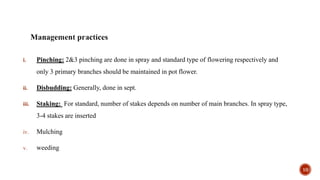
i. Pinching: 2&3 pinching are done in spray and standard type of flowering respectively and
only 3 primary branches should be maintained in pot flower.
ii. Disbudding: Generally, done in sept.
iii. Staking: For standard, number of stakes depends on number of main branches. In spray type,
3-4 stakes are inserted
iv. Mulching
v. weeding
10
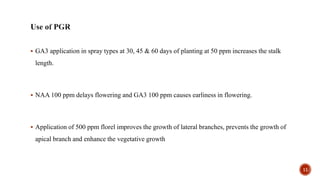
 GA3 application in spray types at 30, 45 & 60 days of planting at 50 ppm increases the stalk
length.
 NAA 100 ppm delays flowering and GA3 100 ppm causes earliness in flowering.
 Application of 500 ppm florel improves the growth of lateral branches, prevents the growth of
apical branch and enhance the vegetative growth
11
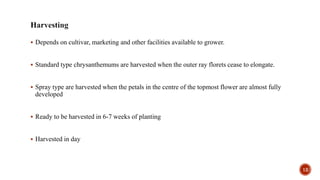
 Depends on cultivar, marketing and other facilities available to grower.
 Standard type chrysanthemums are harvested when the outer ray florets cease to elongate.
 Spray type are harvested when the petals in the centre of the topmost flower are almost fully
developed
 Ready to be harvested in 6-7 weeks of planting
 Harvested in day
12
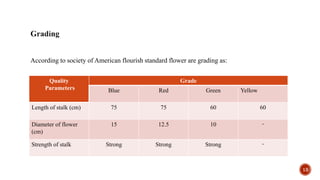
According to society of American flourish standard flower are grading as:
13
Quality
Parameters
Grade
Blue Red Green Yellow
Length of stalk (cm) 75 75 60 60
Diameter of flower
(cm)
15 12.5 10 -
Strength of stalk Strong Strong Strong -
 Chrysanthemum cut flowers can be wrapped in plastics and stored dry for 6-8 weeks at a
temperature of -0.5℃.
 Temperature of truck shipment should be 2-4℃.
Packaging
 Most of the standard chrysanthemum are placed in sleeves and packed in display boxes.
 For bulk packing of sprays, 10, 15 or 20 stems are placed in sleeves according to the grades
14
 Dipping of stem for a very short period (5 sec.) in 1200-4800 ppm AgNO3 or soaking the
stems in 1000 ppm for 10 min.
 Addition of 2% sucrose to silver nitrate was found beneficial, which increase vase life for 12-
20 days.
Disorders
Blindness: Low night temperature and short day induces blindness.
Petals do not develop properly due to this.
15
 Powdery mildew
 Leaf spot
 Gray mold
 Rust
Pests
 Aphids
 Hairy caterpillar
 Termites
 Thrips 16

Crysanthemum production technology slides

  • 1.
    1 Presenter: Minraj Ghimire BSc. Horticulture3rd semester Exam Roll No.: 03 A presentation on: Chrysanthemum Production Technology Assigned by : Asst. Prof. Mr. Bikash Khanal Department of Horticulture TU, IAAS MRMC, ILAM
  • 2.
  • 3.
    Both annual &perennial;  Herbaceous and sometimes partly woody Classification Standard type: Used as cut flower Only one apical flower is kept 3
  • 4.
    Spray type: Usedas loose flower peripheral flowers are retained and the apical flower is removed. Pot flower: Pots are used to embellish home, garden, offices, and park. Both spray and standard type can be cultured in pot. 4
  • 5.
     Achievement  CopperBowl  Escapade  Helen Castel  Mandalay  Matador  Miss Atlanta  Orange Bowl 5
  • 6.
     Good texturedwell drained sandy loam  The optimal pH range is 6.5 – 7.5. Climate  Day temperature of 22℃ and night temperature of 16℃ is suitable for quality flower production.  Higher temperature causes delay flowering and the flower color fade away  Use of CO2 (600-900 ppm) improves the color, size and yield of flower. 6
  • 7.
    i. By suckers:Old method of multiplication. 1,10,000 suckers/ha ii. By terminal cutting: Length of cuttings should be about 5-7cm. iii. By seed: The blooms are collected when they are completely dry. Fine compost is used to cover the seeds after sowing and watering is done. 7
  • 8.
     The plantsneed adequate water during vegetative growth when new leaves are being formed.  After formation of flower bud less water needed as no further leaves are formed.  However, water stagnation causes root rot, so drainage should be maintained.  chrysanthemum requires humidity between 70-90%. Planting distance  Maintained according to varieties.  Usually, 15×15 or 10×15cm₂ 8
  • 9.
     FYM requiresabout 18-20 MT/ha  Usually 20:20:10 gm per m² N:P:K is applied for better yield.  Micro nutrients like foliar spray of ZnSO4 at 0.25% and MgSO4 at 0.5% can be applied. 9
  • 10.
    i. Pinching: 2&3pinching are done in spray and standard type of flowering respectively and only 3 primary branches should be maintained in pot flower. ii. Disbudding: Generally, done in sept. iii. Staking: For standard, number of stakes depends on number of main branches. In spray type, 3-4 stakes are inserted iv. Mulching v. weeding 10
  • 11.
     GA3 applicationin spray types at 30, 45 & 60 days of planting at 50 ppm increases the stalk length.  NAA 100 ppm delays flowering and GA3 100 ppm causes earliness in flowering.  Application of 500 ppm florel improves the growth of lateral branches, prevents the growth of apical branch and enhance the vegetative growth 11
  • 12.
     Depends oncultivar, marketing and other facilities available to grower.  Standard type chrysanthemums are harvested when the outer ray florets cease to elongate.  Spray type are harvested when the petals in the centre of the topmost flower are almost fully developed  Ready to be harvested in 6-7 weeks of planting  Harvested in day 12
  • 13.
    According to societyof American flourish standard flower are grading as: 13 Quality Parameters Grade Blue Red Green Yellow Length of stalk (cm) 75 75 60 60 Diameter of flower (cm) 15 12.5 10 - Strength of stalk Strong Strong Strong -
  • 14.
     Chrysanthemum cutflowers can be wrapped in plastics and stored dry for 6-8 weeks at a temperature of -0.5℃.  Temperature of truck shipment should be 2-4℃. Packaging  Most of the standard chrysanthemum are placed in sleeves and packed in display boxes.  For bulk packing of sprays, 10, 15 or 20 stems are placed in sleeves according to the grades 14
  • 15.
     Dipping ofstem for a very short period (5 sec.) in 1200-4800 ppm AgNO3 or soaking the stems in 1000 ppm for 10 min.  Addition of 2% sucrose to silver nitrate was found beneficial, which increase vase life for 12- 20 days. Disorders Blindness: Low night temperature and short day induces blindness. Petals do not develop properly due to this. 15
  • 16.
     Powdery mildew Leaf spot  Gray mold  Rust Pests  Aphids  Hairy caterpillar  Termites  Thrips 16