

Protected cultivation- EC-24
(2+1)
PRESENTED BY:
RAKESH KUMAR PATTNAIK
Asst. Prof. Horticulture
MITS INSTITUTE OF PROFESSIONAL STUDIES
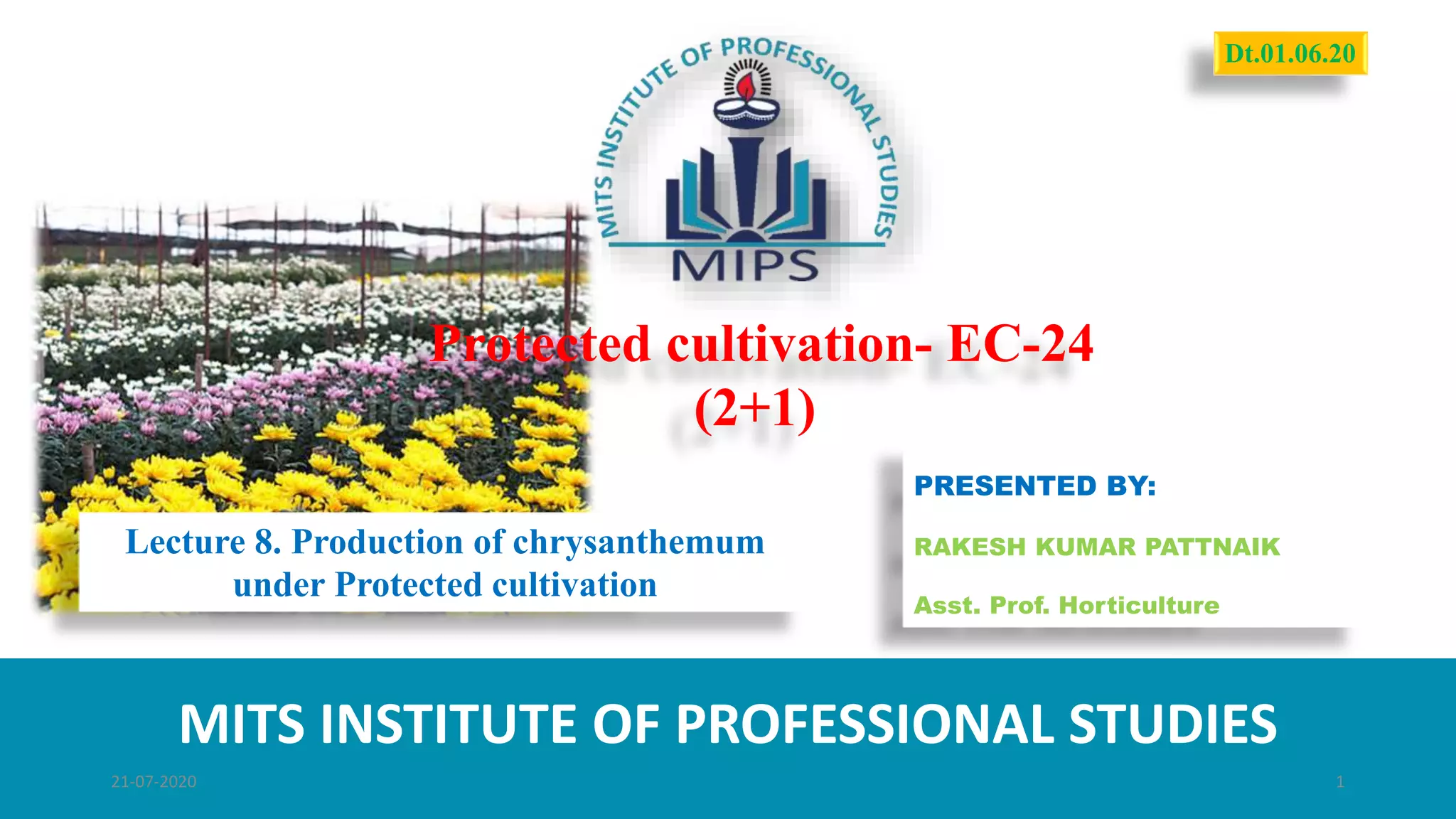
Lecture 8. Production of chrysanthemum
under Protected cultivation
Dt.01.06.20
21-07-2020 1
MITS INSTITUTE OF PROFESSIONAL STUDIES
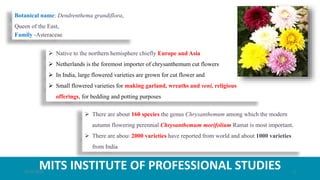
Botanical name: Dendrenthema grandiflora,
Queen of the East,
Family -Asteraceae
 Native to the northern hemisphere chiefly Europe and Asia
 Netherlands is the foremost importer of chrysanthemum cut flowers
 In India, large flowered varieties are grown for cut flower and
 Small flowered varieties for making garland, wreaths and veni, religious
offerings, for bedding and potting purposes
 There are about 160 species the genus Chrysanthemum among which the modern
autumn flowering perennial Chrysanthemum morifolium Ramat is most important.
 There are about 2000 varieties have reported from world and about 1000 varieties
from India
21-07-2020 2
MITS INSTITUTE OF PROFESSIONAL STUDIES
Casa Granda, Snowdon White, Vesuvio, Melody Lane, Dancer, Kikubiori,
Super Giant, Christmas Carol, Gloria Red, Silvia Green, Dream Castle,
Taiching Queen, Helmy Pot, Sancho, Green Goddess, Golden. Splender
and Bronze Turner.
Important varieties:
21-07-2020 3
Uses:
 As a back ground in borders by planting erect and tall varieties.
 Dwarf and compact varieties are suitable for front row planting of borders and as
pot culture.
 As a cut flower and loose flower for making garland and hair adornment.
 Extra-large bloom varieties used for exhibition
MITS INSTITUTE OF PROFESSIONAL STUDIES
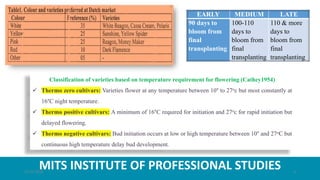
Classification of varieties based on temperature requirement for flowering (Cathey1954)
 Thermo zero cultivars: Varieties flower at any temperature between 10° to 27oc but most constantly at
16°C night temperature.
 Thermo positive cultivars: A minimum of 16°C required for initiation and 27oc for rapid initiation but
delayed flowering.
 Thermo negative cultivars: Bud initiation occurs at low or high temperature between 10° and 27oC but
continuous high temperature delay bud development.
EARLY MEDIUM LATE
90 days to
bloom from
final
transplanting
100-110
days to
bloom from
final
transplanting
110 & more
days to
bloom from
final
transplanting
21-07-2020 4
MITS INSTITUTE OF PROFESSIONAL STUDIES
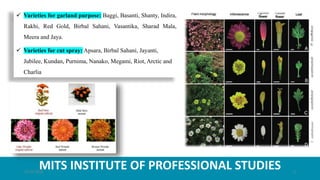
 Varieties for garland purpose: Baggi, Basanti, Shanty, Indira,
Rakhi, Red Gold, Birbal Sahani, Vasantika, Sharad Mala,
Meera and Jaya.
 Varieties for cut spray: Apsara, Birbal Sahani, Jayanti,
Jubilee, Kundan, Purnima, Nanako, Megami, Riot, Arctic and
Charlia
21-07-2020 5
MITS INSTITUTE OF PROFESSIONAL STUDIES
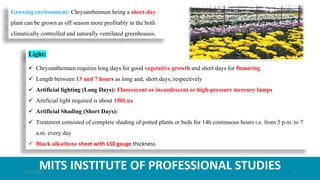
Growing environment: Chrysanthemum being a short-day
plant can be grown as off season more profitably in the both
climatically controlled and naturally ventilated greenhouses.
Light:
 Chrysanthemum requires long days for good vegetative growth and short days for flowering
 Length between 13 and 7 hours as long and, short days, respectively
 Artificial lighting (Long Days): Fluorescent or incandescent or high-pressure mercury lamps
 Artificial light required is about 150Lux
 Artificial Shading (Short Days):
 Treatment consisted of complete shading of potted plants or beds for 14h continuous hours i.e. from 5 p.m. to 7
a.m. every day
 Black alkathene sheet with 150 gauge thickness
21-07-2020 6
MITS INSTITUTE OF PROFESSIONAL STUDIES
Temperature:
 Low night temperature results in more vegetative growth, taller plants, delay in flowering, longer
pedicels, sturdier plants and more intense flower colours.
 Night temperature not lower than 18°c.
 Normal greenhouse crop and getting good flowering stems the optimum temperature should be
16-18°C during the night and 24-28oC during the day.
CO2: Enrichment of CO2 levels in air to 600-900ppm is
recommended in closed environment.
21-07-2020 7
MITS INSTITUTE OF PROFESSIONAL STUDIES
Relative Humidity:
 Desirable to maintain a relative humidity of 60-70% during
crop growth and flower bud development.
 The optimum relative humidity is raised by spraying
water and lowered by providing ventilation and heating.
Propagation:
Chrysanthemum is propagated by
vegetative means either by suckers, cuttings or
by micro propagation.
Terminal cuttings:
 The cuttings are taken from a healthy stock plant, 5-7cm long cutting are made removing lower leaves
and half of the open leaves.
 The cuttings are dipped in the IBA (2500ppm) or in Seradex/Keradex (rooting hormone) then planted
in sand bed.
 These cutting are kept in semi-shade conditions and water immediately and thereafter regularly
21-07-2020 8
MITS INSTITUTE OF PROFESSIONAL STUDIES
Growing medium:
The ideal soil for growing is a well drained sandy loam, good amount of
organic matter, pH 6.5, EC between 1 to 1.5 with low levels of NaCl and
Sulphates
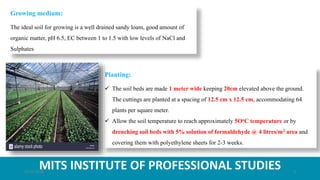
Planting:
 The soil beds are made 1 meter wide keeping 20cm elevated above the ground.
The cuttings are planted at a spacing of 12.5 cm x 12.5 cm, accommodating 64
plants per square meter.
 Allow the soil temperature to reach approximately 5OoC temperature or by
drenching soil beds with 5% solution of formaldehyde @ 4 litres/m2 area and
covering them with polyethylene sheets for 2-3 weeks.
21-07-2020 9
MITS INSTITUTE OF PROFESSIONAL STUDIES
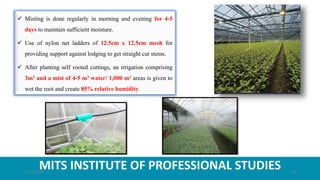
 Misting is done regularly in morning and evening for 4-5
days to maintain sufficient moisture.
 Use of nylon net ladders of 12.5cm x 12.5cm mesh for
providing support against lodging to get straight cut stems.
 After planting self rooted cuttings, an irrigation comprising
3m3 and a mist of 4-5 m3 water/ 1,000 m2 areas is given to
wet the root and create 85% relative humidity.
21-07-2020 10
MITS INSTITUTE OF PROFESSIONAL STUDIES
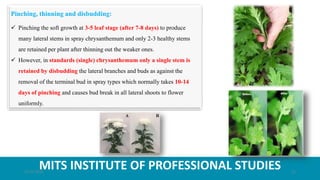
Pinching, thinning and disbudding:
 Pinching the soft growth at 3-5 leaf stage (after 7-8 days) to produce
many lateral stems in spray chrysanthemum and only 2-3 healthy stems
are retained per plant after thinning out the weaker ones.
 However, in standards (single) chrysanthemum only a single stem is
retained by disbudding the lateral branches and buds as against the
removal of the terminal bud in spray types which normally takes 10-14
days of pinching and causes bud break in all lateral shoots to flower
uniformly.
21-07-2020 11
MITS INSTITUTE OF PROFESSIONAL STUDIES
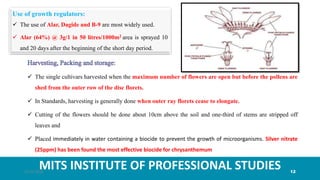
Use of growth regulators:
 The use of Alar, Dagide and B-9 are most widely used.
 Alar (64%) @ 3g/1 in 50 litres/1000m2 area is sprayed 10
and 20 days after the beginning of the short day period.
 The single cultivars harvested when the maximum number of flowers are open but before the pollens are
shed from the outer row of the disc florets.
 In Standards, harvesting is generally done when outer ray florets cease to elongate.
 Cutting of the flowers should be done about 10cm above the soil and one-third of stems are stripped off
leaves and
 Placed immediately in water containing a biocide to prevent the growth of microorganisms. Silver nitrate
(25ppm) has been found the most effective biocide for chrysanthemum
21-07-2020 12
MITS INSTITUTE OF PROFESSIONAL STUDIES
 The 10 or 5 cut stems of standard and spray, respectively packed in one bunch.
 In the packing house, flowers are sorted into different grades as heavy stems 70-80cm and
lighter stems of 60cm and kept in buckets containing the solution 2% sodium
hypochlorite at 2°C in cold storage.
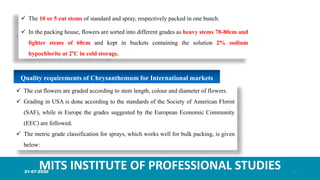
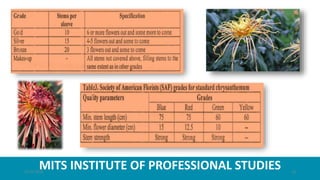
Quality requirements of Chrysanthemum for International markets
 The cut flowers are graded according to stem length, colour and diameter of flowers.
 Grading in USA is done according to the standards of the Society of American Florist
(SAF), while in Europe the grades suggested by the European Economic Community
(EEC) are followed.
 The metric grade classification for sprays, which works well for bulk packing, is given
below:
21-07-2020 13
MITS INSTITUTE OF PROFESSIONAL STUDIES21-07-2020 14
MITS INSTITUTE OF PROFESSIONAL STUDIES
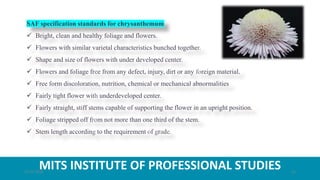
SAF specification standards for chrysanthemum
 Bright, clean and healthy foliage and flowers.
 Flowers with similar varietal characteristics bunched together.
 Shape and size of flowers with under developed center.
 Flowers and foliage free from any defect, injury, dirt or any foreign material.
 Free form discoloration, nutrition, chemical or mechanical abnormalities
 Fairly tight flower with underdeveloped center.
 Fairly straight, stiff stems capable of supporting the flower in an upright position.
 Foliage stripped off from not more than one third of the stem.
 Stem length according to the requirement of grade.
21-07-2020 15
MITS INSTITUTE OF PROFESSIONAL STUDIES21-07-2020 16

Chrysanthemum under green house

  • 1.
    Protected cultivation- EC-24 (2+1) PRESENTEDBY: RAKESH KUMAR PATTNAIK Asst. Prof. Horticulture MITS INSTITUTE OF PROFESSIONAL STUDIES Lecture 8. Production of chrysanthemum under Protected cultivation Dt.01.06.20 21-07-2020 1
  • 2.
    MITS INSTITUTE OFPROFESSIONAL STUDIES Botanical name: Dendrenthema grandiflora, Queen of the East, Family -Asteraceae  Native to the northern hemisphere chiefly Europe and Asia  Netherlands is the foremost importer of chrysanthemum cut flowers  In India, large flowered varieties are grown for cut flower and  Small flowered varieties for making garland, wreaths and veni, religious offerings, for bedding and potting purposes  There are about 160 species the genus Chrysanthemum among which the modern autumn flowering perennial Chrysanthemum morifolium Ramat is most important.  There are about 2000 varieties have reported from world and about 1000 varieties from India 21-07-2020 2
  • 3.
    MITS INSTITUTE OFPROFESSIONAL STUDIES Casa Granda, Snowdon White, Vesuvio, Melody Lane, Dancer, Kikubiori, Super Giant, Christmas Carol, Gloria Red, Silvia Green, Dream Castle, Taiching Queen, Helmy Pot, Sancho, Green Goddess, Golden. Splender and Bronze Turner. Important varieties: 21-07-2020 3 Uses:  As a back ground in borders by planting erect and tall varieties.  Dwarf and compact varieties are suitable for front row planting of borders and as pot culture.  As a cut flower and loose flower for making garland and hair adornment.  Extra-large bloom varieties used for exhibition
  • 4.
    MITS INSTITUTE OFPROFESSIONAL STUDIES Classification of varieties based on temperature requirement for flowering (Cathey1954)  Thermo zero cultivars: Varieties flower at any temperature between 10° to 27oc but most constantly at 16°C night temperature.  Thermo positive cultivars: A minimum of 16°C required for initiation and 27oc for rapid initiation but delayed flowering.  Thermo negative cultivars: Bud initiation occurs at low or high temperature between 10° and 27oC but continuous high temperature delay bud development. EARLY MEDIUM LATE 90 days to bloom from final transplanting 100-110 days to bloom from final transplanting 110 & more days to bloom from final transplanting 21-07-2020 4
  • 5.
    MITS INSTITUTE OFPROFESSIONAL STUDIES  Varieties for garland purpose: Baggi, Basanti, Shanty, Indira, Rakhi, Red Gold, Birbal Sahani, Vasantika, Sharad Mala, Meera and Jaya.  Varieties for cut spray: Apsara, Birbal Sahani, Jayanti, Jubilee, Kundan, Purnima, Nanako, Megami, Riot, Arctic and Charlia 21-07-2020 5
  • 6.
    MITS INSTITUTE OFPROFESSIONAL STUDIES Growing environment: Chrysanthemum being a short-day plant can be grown as off season more profitably in the both climatically controlled and naturally ventilated greenhouses. Light:  Chrysanthemum requires long days for good vegetative growth and short days for flowering  Length between 13 and 7 hours as long and, short days, respectively  Artificial lighting (Long Days): Fluorescent or incandescent or high-pressure mercury lamps  Artificial light required is about 150Lux  Artificial Shading (Short Days):  Treatment consisted of complete shading of potted plants or beds for 14h continuous hours i.e. from 5 p.m. to 7 a.m. every day  Black alkathene sheet with 150 gauge thickness 21-07-2020 6
  • 7.
    MITS INSTITUTE OFPROFESSIONAL STUDIES Temperature:  Low night temperature results in more vegetative growth, taller plants, delay in flowering, longer pedicels, sturdier plants and more intense flower colours.  Night temperature not lower than 18°c.  Normal greenhouse crop and getting good flowering stems the optimum temperature should be 16-18°C during the night and 24-28oC during the day. CO2: Enrichment of CO2 levels in air to 600-900ppm is recommended in closed environment. 21-07-2020 7
  • 8.
    MITS INSTITUTE OFPROFESSIONAL STUDIES Relative Humidity:  Desirable to maintain a relative humidity of 60-70% during crop growth and flower bud development.  The optimum relative humidity is raised by spraying water and lowered by providing ventilation and heating. Propagation: Chrysanthemum is propagated by vegetative means either by suckers, cuttings or by micro propagation. Terminal cuttings:  The cuttings are taken from a healthy stock plant, 5-7cm long cutting are made removing lower leaves and half of the open leaves.  The cuttings are dipped in the IBA (2500ppm) or in Seradex/Keradex (rooting hormone) then planted in sand bed.  These cutting are kept in semi-shade conditions and water immediately and thereafter regularly 21-07-2020 8
  • 9.
    MITS INSTITUTE OFPROFESSIONAL STUDIES Growing medium: The ideal soil for growing is a well drained sandy loam, good amount of organic matter, pH 6.5, EC between 1 to 1.5 with low levels of NaCl and Sulphates Planting:  The soil beds are made 1 meter wide keeping 20cm elevated above the ground. The cuttings are planted at a spacing of 12.5 cm x 12.5 cm, accommodating 64 plants per square meter.  Allow the soil temperature to reach approximately 5OoC temperature or by drenching soil beds with 5% solution of formaldehyde @ 4 litres/m2 area and covering them with polyethylene sheets for 2-3 weeks. 21-07-2020 9
  • 10.
    MITS INSTITUTE OFPROFESSIONAL STUDIES  Misting is done regularly in morning and evening for 4-5 days to maintain sufficient moisture.  Use of nylon net ladders of 12.5cm x 12.5cm mesh for providing support against lodging to get straight cut stems.  After planting self rooted cuttings, an irrigation comprising 3m3 and a mist of 4-5 m3 water/ 1,000 m2 areas is given to wet the root and create 85% relative humidity. 21-07-2020 10
  • 11.
    MITS INSTITUTE OFPROFESSIONAL STUDIES Pinching, thinning and disbudding:  Pinching the soft growth at 3-5 leaf stage (after 7-8 days) to produce many lateral stems in spray chrysanthemum and only 2-3 healthy stems are retained per plant after thinning out the weaker ones.  However, in standards (single) chrysanthemum only a single stem is retained by disbudding the lateral branches and buds as against the removal of the terminal bud in spray types which normally takes 10-14 days of pinching and causes bud break in all lateral shoots to flower uniformly. 21-07-2020 11
  • 12.
    MITS INSTITUTE OFPROFESSIONAL STUDIES Use of growth regulators:  The use of Alar, Dagide and B-9 are most widely used.  Alar (64%) @ 3g/1 in 50 litres/1000m2 area is sprayed 10 and 20 days after the beginning of the short day period.  The single cultivars harvested when the maximum number of flowers are open but before the pollens are shed from the outer row of the disc florets.  In Standards, harvesting is generally done when outer ray florets cease to elongate.  Cutting of the flowers should be done about 10cm above the soil and one-third of stems are stripped off leaves and  Placed immediately in water containing a biocide to prevent the growth of microorganisms. Silver nitrate (25ppm) has been found the most effective biocide for chrysanthemum 21-07-2020 12
  • 13.
    MITS INSTITUTE OFPROFESSIONAL STUDIES  The 10 or 5 cut stems of standard and spray, respectively packed in one bunch.  In the packing house, flowers are sorted into different grades as heavy stems 70-80cm and lighter stems of 60cm and kept in buckets containing the solution 2% sodium hypochlorite at 2°C in cold storage. Quality requirements of Chrysanthemum for International markets  The cut flowers are graded according to stem length, colour and diameter of flowers.  Grading in USA is done according to the standards of the Society of American Florist (SAF), while in Europe the grades suggested by the European Economic Community (EEC) are followed.  The metric grade classification for sprays, which works well for bulk packing, is given below: 21-07-2020 13
  • 14.
    MITS INSTITUTE OFPROFESSIONAL STUDIES21-07-2020 14
  • 15.
    MITS INSTITUTE OFPROFESSIONAL STUDIES SAF specification standards for chrysanthemum  Bright, clean and healthy foliage and flowers.  Flowers with similar varietal characteristics bunched together.  Shape and size of flowers with under developed center.  Flowers and foliage free from any defect, injury, dirt or any foreign material.  Free form discoloration, nutrition, chemical or mechanical abnormalities  Fairly tight flower with underdeveloped center.  Fairly straight, stiff stems capable of supporting the flower in an upright position.  Foliage stripped off from not more than one third of the stem.  Stem length according to the requirement of grade. 21-07-2020 15
  • 16.
    MITS INSTITUTE OFPROFESSIONAL STUDIES21-07-2020 16