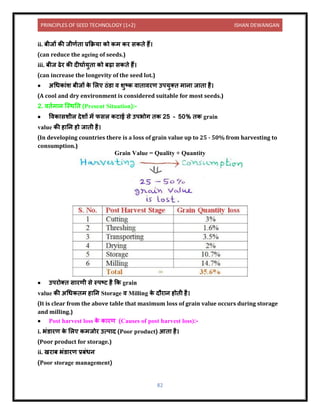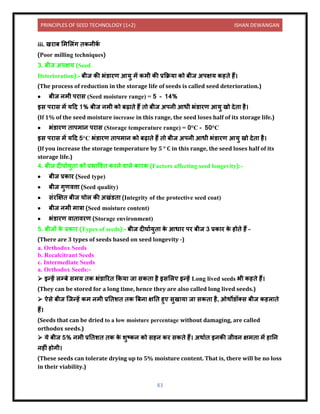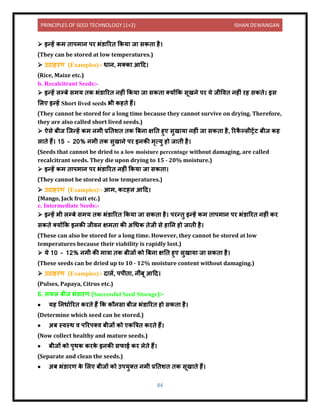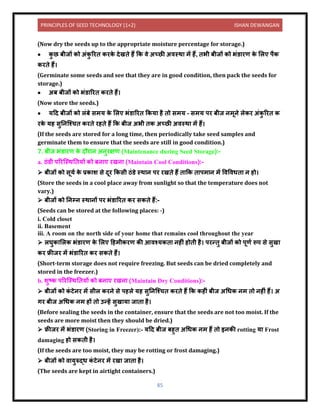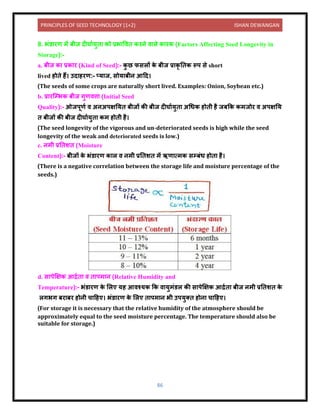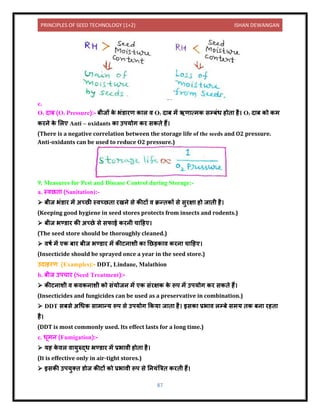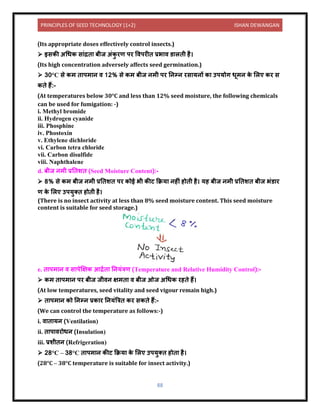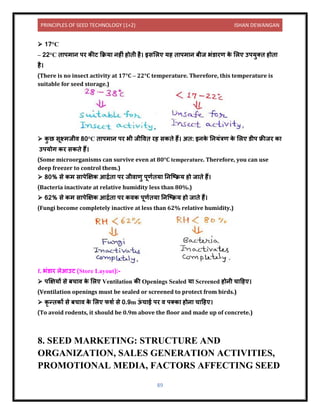
PRINCIPLES OF SEED TECHNOLOGY (1+2) ISHAN DEWANGAN
1
Seed and seed technology: introduction, definition and importance
DEFINITION:
Seed :- seed is a propagating material.
or
Seed is a miniature plant.
or
A seed is an embryonic plant enclosed in a protective outer covering . The formation
of the
seed is part of the process of reproduction in seed plants, the spermatophytes,
including the
gymnosperm and angiosperm plants.
Seed technology :- Seed technology is the science dealing with the methods of
improving
physical and genetical characteristics of seed. It involves such activities as variety
development, evolution and release of varieties, seed production, seed processing,
seed
certification and storage & distributions of seed.
Importance :-
★Higher At. production.
★Good quality seed.
★Timely supply of seed.
★Reasonable price of seeds.
PRINCIPLES OF SEED TECHNOLOGY (1+2) ISHAN DEWANGAN
2
Deterioration causes of crop varieties and their control; Maintenance of genetic
purity during seed production
Deterioration :- The action or process of becoming impaired or inferior in quality, functioning
or condition.
Variety :- It is a group of plant having clear distinguished characters which when reproduced
either sexually or asexually retains these characters.
Causes :-
1. Developmental variations.
2. Mechanical mixtures.
3. Mutations.
4. Natural crossing.
5. Minor genetic variations.
6. Selected influence of pest and diseases.
7. The techniques of the plant breeder.
1. Developmental variations :- • the crop is grown in different /difficult climate conditions.
•For several consecutive generation the development variations May arise as differential growth
response.
Control:- To avoid or minimize such development variation the variety should always be grown
in adoptable areas.
2. Mechanical mixtures :-
• Contamination through field - self sown seed or volunteer plants
• Seed drill - if same seed drill is used for sowing 2 or 3 varieties
• Carrying 2 different varieties adjacent to each other.
• Growing 2 different varieties adjacent to each other.
• Threshing floor
• Combine or threshers
PRINCIPLES OF SEED TECHNOLOGY (1+2) ISHAN DEWANGAN
3
• Bags or seed bins
• During seed processing
3. Mutations. :-
It is not of much importance as the occurrence of spontaneous mutations is very low i.e., 10-7.
Control:- If any visible mutations are observed they should be removed by rouging.
4. Natural crossing. :-
• It is an important source of contamination in sexually propagated crops due to introgression of
genes from unrelated stocks/genotypes.
• The extent of contamination depends upon the natural cross fertilization.
• Natural crossing is main source of contamination in cross-fertilized or often cross-fertilized
crops.
The extent of genetic contamination depends on breeding system of the species, isolation
distance, varietal mass and pollinating agent.
Control :- To overcome the problem of natural crossing isolation distance has to be
maintained.
5. Minor genetic variations :-
• Some minor genetic changes may occur during production cycles due to difference in
environment.
• Due to these changes in the yields may be affected.
Control :- To avoid such minor genetic variations periodic testing of the varieties must be
done from breeder's seed and nucleus seed in self-pollinated crops
• Minor genetic variation is a common feature in often cross- pollinated species: therefore
care should be taken during maintenance of nucleus and breeder seed.
6. Selected influence of pest and diseases :-
If the seed is used for sowing the seed crop is not treated with suitable chemical, it may carry
PRINCIPLES OF SEED TECHNOLOGY (1+2) ISHAN DEWANGAN
4
seed borne diseases and insects pests Which may attack the seed crop. So, scientific seed
seed production measures are adopted.
7.The techniques of the plant breeder Instability may occur in a variety due to genetic
irregularities if it is not properly assessed at the time of release.
• Premature release of a variety, which has been breed for particular disease, leads to the
production of resistant and susceptible plants which may be an important cause of deterioration.
Control :- When songlike and Kalyan Sona wheat varieties were released in India for commercial
cultivation the genetic variability in both the varieties was still in flowing stage and several
secondary selections were made by the breeders.
1. Control of seed source
2. Selection of the field.
3. Isolation from the contamination.
4. Plant protection.
5. Harvesting and threshing,
6. Providing isolation to prevent cross fertilization or mechanical mixtures
7. Rouging of seed fields prior to planting
8. Periodic testing of varieties for. genetic purity
9. Grow in adapted areas only to avoid genetic shifts in the variety
10. Certification of seed crops to maintain genetic purity and quality
11. Adopting generation system.
foundation and certified seed production in vegetables
Potato (Solanum tuberosum)
1. Source of seed
2. Selection of the field
3. Isolation :- 5 meters and 50 meters for hybrid seed production
PRINCIPLES OF SEED TECHNOLOGY (1+2) ISHAN DEWANGAN
5
4. Preparation of the field
5. Sowing :- 15 sep.to 31 October and 25-30 quintals seed required. 60cm space
between rows and 15-20 cm in plants. 10 cm deep sowing.
6. Fertilizers:- 100-125:80-100:80-100 kg/hac N:P:K
7. Irrigation :- 5-10 irrigation are required
8. Haulm cutting :- when the crop is well tuberized, hum cutting is done. Irrigation is
withheld 10-15 days before the haulm cutting
9. Plant protection :- weeding by Siezine… Early blight, and late blight are main
disease of potato use metasystox….for control of insect use heptcholer and thimet.
10. Roguing
11. Digging :- In the last week of January, digging is done. The tubers are washed with
Bleaching powder, dried in shade for a week, diseased and injured tubers are
removed and the tubers are graded.
Tomato ( Lycopersicon asculation)
1. Source of seed
2. Selection of the field
3. Isolation :- 50 and 25 meters for foundation and certified seed.
4. Preparation of the field :-
5. Sowing :- in September and first week of December and transplanting in October and
end of January to mid-February. 600-700 gm. seed required. 45-60 cm. space in rows
and 45 cm in plants to plants
6. Fertilizers :- 100:60:60 kg N:P:K
7. Irrigation :- at weekly intervals required.
8. Plant protection :- weeding by hoeing… blight and damping off is control by Zineb
and mineb… fruit borer are control by sevin.
PRINCIPLES OF SEED TECHNOLOGY (1+2) ISHAN DEWANGAN
6
9. Roguing
10. Harvesting :- When the fruits are fully ripened, the pickings are done. The fruits are
crushed and left for fermentation for a day and immersed in water the next day. The
seeds sink to the bottom and the un-decomposed pulp floats to the top. The seeds
are collected and dried by spreading in trays to 8 % moisture content and stored.
Sometimes, and acid HCL is also used to separate seeds form crushed fruits.
Chilies ( Capsicum annum)
1. Source of seed
2. Selection of the field
3. Isolation :- 400 meters for foundation and 200 for certified seed
4. Sowing :- 700 gm seed required and 60 cm spacing into plants and 45 cm into
plants.
5. Fertilizers :- 80:40:40 kg. N:P:K
6. Irrigation :- when required
7. Plant protection :- weeding by hoeing …. die back, and bacterial fruit spot are
control by Agrosan G.N.
8. Roguing
9. Harvesting :- The fruits are picked when they are fully ripe and become red. These
are dried in open air and sunshine and the seeds are collected. The seeds are further
dried to 8 % moisture level and stored.
Foundation and certified seed production of important
cereals & fodder crops
Production of foundation seed :- the seed is produced from the breeder’s seed under the
supervision of the seed certification agency and every precaution is taken to maintain its
PRINCIPLES OF SEED TECHNOLOGY (1+2) ISHAN DEWANGAN
7
genetic purity and quality. It is protected from out crossing and mechanical admixture by
keeping proper isolation during raising of a seed crop and during handling of the seeds and
by roguing of seed fields.
Production of Certified seed :- The seed produced from the foundation seed of an
improved variety under the supervision of a seed certification agency, so that its quality is
maintained according to the certification standards and is sold to the farmers for raising their
crops, is known as certified seed.
General principles & methods of seed production :- focus on these points
1. Control of seed source
2. Selection of the field
3. Isolation from contamination
4. Farm operations :- preparation of the field, sowing, manures and fertilizers, irrigation
and drainage, Plant protection.
5. Roguing
6. Harvesting and threshing
7. Seed processing
8. Seed treatment
9. Seed storage
10. Seed testing
11. Bagging.
Seed production in ‘wheat’ (Triticum aestivum) :-
1. Source of seed :- For production of foundation seed, breeder’s or foundation seed
and for certified seed production, foundation seed is obtained from a source
recognized by a certification agency. The class and purity of the seed is verified by
PRINCIPLES OF SEED TECHNOLOGY (1+2) ISHAN DEWANGAN
8
the labels attached with the seed bag before sowing and these labels are retained
after sowing.
2. Selection of the field :- Field for seed production of wheat should be such, in which
sowing of wheat was not done in the previous year. If the same variety was grown
and the genetic purity of the seed fulfilled the certification standards, such field can
be selected. The soil of the field should be fertile loam and there should be proper
arrangement of drainage in the field.
3. Isolation :- Wheat is a self-pollinated crop. So, isolation of 3 meters of the seed field
from other fields, is sufficient. But, for prevention from loose smut of wheat, an
isolation distance of 150 meters is recommended.
4. Sowing :- Time of sowing is first fortnight of November. The spacing between rows
should be 20 cm., depth of sowing is kept 4-5 cm. At the time of pre-sowing
ploughing, B.H.C. 10% dust is mixed in the soil @ of 25 kg./hac. to prevent termite
attack on the seed crop. If the seed has not been treated, then it should be treated
with Vitavex 0.25 %.
5. Fertilizers :- N.= 120 kg., P.= 60 kg., K.= 40 kg… Foliar spray of urea 2.5 % at the
time of seed setting helps in proper development of grains.
6. Irrigation :- Six irrigations are required , at every critical stage.
7. Plant protection :- (a) weed control :- To control broad leaved weeds in the seed
crop, 0.5 kg. 2,4-D in 750 lit. of water /hac. should be sprayed after 30-35 days of
sowing. For control of phalaris minor,Isoproturon (7 5 W.P.) 1 Kg. spray after one
month of sowing. (b). Disease control :- use Dithane Z-78 or Mineb
fungicides should be sprayed 3-4 for rusts control. ©.Insect control
:- 1,25 liters. Thiodan or 750ml.Ecakex 25% E.C. or 500 ml.
8. Roguning :- All the off-type plants and plants infected with loose smut should be
PRINCIPLES OF SEED TECHNOLOGY (1+2) ISHAN DEWANGAN
9
removed at the time of flowering. Such plant should be completely eradicated and
loose smutted plants are kept in envelopes or bags and carried away from the field.
The remaining plants must be removed at the time of maturity.
9. Harvesting :- at 15 % moisture.
10. Threshing :- thresher should be well cleaned before threshing.
11. Processing :- After harvesting and threshing, the seed should be well dried and
cleaned. The seed bags should also be cleaned and treated by dipping in 3 % of
D.D.T. solution and then dried properly.
12. Storage :- The seed should be stored at low temp. The store should be moisture
proof and well cleaned. The bags should be stacked on wooden pallets. The stacks
should be separated. The store should be visited on 15 days intervals, if
insects-pests are observed, the store should be fumigated.
Rice ( Oryza sativa)
1. Source of seed :-
2. Selection of field :-
3. Isolation :- 3 meters
4. Sowing :- A. direct sowing in this method two type of sowing basis of water amount
Un-puddled and puddling method B. transplanting method
5. Fertilizers :- 120:60:50 kg/hac NPK.and 15 kg zinc
6. Irrigation :- 2.5-5.0 cm standing water requirement.
7. Plant protection :- Stam F-34 and propanil for weed control Khaira,blast,brown spot
and bacterial leaf blight are main disease of rice use suitable chemical for controlling
disease. Gundhi bug, stemborer, Plant hopper are main pest of rice use satiable
chemical
8. Roguing :-
PRINCIPLES OF SEED TECHNOLOGY (1+2) ISHAN DEWANGAN
10
9. Harvesting, threshing etc.:- When last inspection of the field is over the grains turn
yellow and hardened and moisture content is below 25 %. the crop should be
harvest.
Maize ( Zea mays ) :-
1. Source of seed.
2. Selection of the field.
3. Isolation :- 400 meters for foundation seed and 200 meter for certified seeds.
4. Sowing :- in second week of June and spacing is 75cm. rows and 20 cm. in plants or
3-5 cm. depth.16-18 kg/hac seed required.
5. Fertilizers :- 120:65:40 kg/hac NPK. and 25 kg of zn
6. Irrigation :- Shallow irrigations, as and when required, particularly at flowering stage,
should be given.
7. Plant protection :- Tafazine and simazine for weeding……. Kernel rot and seedling
blight, downy mildew, stalk rot, leaf blight are main disease of maize use suitable
chemicals… Stemborer are main insect of maize use thiodan and BHC.
8. Roguing.
9. Harvesting :- at 15% moisture
PRINCIPLES OF SEED TECHNOLOGY (1+2) ISHAN DEWANGAN
11
Sorghum/Jowar ( Sorghum bicolor)
1. Source of seed.
2. Selection of seed.
3. Isolation :- 200 metres
4. Sowing :- 12-15 kg. Seed at 45cm. spacing in rows and 7.5 spacing in plant at 3-4 cm
depth in moth of last week of june.
5. Fertilizers :- 100:60:60 kg/hac. NPK.
6. Irrigation :- The crop should be irrigated as and when needed. The rain water
should not be allowed to stagnate in the field.
7. Plant protection :- Atragine for weeding….For leaf spot disease use Ziram…. Shoot
fly control by Thimet.
8. Roguing.
9. Harvesting, threshing, etc. :- when the grains become whitish yellow or reddish and
hardened and moisture level is below 15%, the harvesting can be started.
Bajra ( Pennisetum americanum)
1. Source of seed.
2. Selection of the field.
3. Isolation :- 1000meters.
4. Sowing :- 3-5 kg. seed/hac. 50cm spacing in rows and 20cm. in plants or 2.5 cm
depth in mid-July
5. Fertilizers :- 100:50:50 kg/hac.
6. Irrigation :-
7. Plant protection :- Atrazine for weeding … Green ear, smut, ergot are disease of
bajra use suitable chemicals … stem borer control by BHC.
8. Roguing.
PRINCIPLES OF SEED TECHNOLOGY (1+2) ISHAN DEWANGAN
12
9. Harvesting, threshing, etc. :- The seed crop is harvested at proper maturity.
infected ear are removed and after threshing and drying, the seeds are stored.
Berseem and Lucerne
1. Source of seed
2. Selection of the field
3. Isolation :- 400 meters of foundation seed and 100 meters for certified seed.
4. Preparation of the seed
5. Sowing : - in October November 30kg seed at 5cm.depth are required.
6. Fertilizers :- 25:50 kg NP.
7. Irrigation :- at 15=20 days intervals.
8. Plant protection :- weeding by hand pulling … semi-looper, thrips, aphids and
caterpillar are major insect
9. Roguing
10. Harvesting :- Cutting for fodder are stopped by the end of February and the crop is
allowed to produce seed. The seed crop is harvested when two third of the pods turn
brown or black. The harvested crop is left in the field for 3-4 days for drying. After
threshing and cleaning, the seeds are further dried to 7% moisture level and stored.
Oats (Avena sativa)
1. Source of seed
2. Selection of the field
3. Isolation :- 3 meters for general crop and 150 meters for control of loose smut.
4. Preparation of the field
5. Sowing :- in mid october to mid November, 20-25 cm spacing at rows and plant to
plant spacing is 5 cm. depth is 5-6 cm., 80-100 kg./hac. seed required.
6. Fertilizers :- 80:30 N:P
PRINCIPLES OF SEED TECHNOLOGY (1+2) ISHAN DEWANGAN
13
7. Irrigation :- First irrigation is given 20-25 DAS, and subsequent irrigation are given at
3 weeks intervals. Usually, the field is irrigated after each cutting.
8. Plant protection :- weeding should be done during 3 weeks after after sowing for
control of weed…. for control of loose smut of oats, treated seed should be sown with
Agrosan G.N.and 20 kg B.H.C. use for insect control
9. Roguing
10. Harvesting, threshing, etc. :- After the second cutting, the crop is allowed to grow for
seed production. The seed crop is harvested at proper maturity on availability of
certification report. Threshing is done at 14 % moisture content and the seeds are
further dried to 10 % moisture level for safe storage.
PRINCIPLES OF SEED TECHNOLOGY (1+2) ISHAN DEWANGAN
14
Foundation & certified seed production of Pulses
Gram ( Cicer arietinum)
1. Source of seed
2. Selection of the field
3. Isolation :- for foundation 10 meters and certified 5 meters.
4. Preparation of the field
5. Sowing :- at last week of October of first fortnight of November in rows 45-60 cm.
apart and 60-75 kg/hac. is required.
6. Fertilizers :- 20:50:30 N:P:K
7. Irrigation :- if there is no rains, 1-2 irrigation may be given.
8. Plant protection :- weeding by hoeing,, Wilt blight and stem rot is main disease… for
control of gram pod borer use 10 kg Aldrin
9. Roguing
10. Harvesting, threshing, etc. :- After the final inspection of the crop, when the pods
become yellowish and the grains are hardened, the crop can be harvested. After
harvesting, the crop is left in the field for drying for a week. After threshing, the seeds
are dried to required moisture content, filled in the bags and stored.
Pigeon Pea ( Cajanus cajan)
1. Source of seed
2. Selection of the field
3. Isolation :- 5-30 % cross pollination occurs. So, 200 meters for foundation seed and
100 meters for certified seed.
4. Preparation of the field
5. Sowing :- in last week of June or first week of July. 60-75 cm. spacing in lines and
25-30 cm. in plants. 12-15 kg. seed required/ hac.
PRINCIPLES OF SEED TECHNOLOGY (1+2) ISHAN DEWANGAN
15
6. Fertilizers :- 25:50:40 N:P:K
7. Irrigation :- The seed crop is irrigated as and when required. If there is no rains of
the time of flowering, irrigation is required
8. Plant protection :- weeding by Lasso .. Wilt, leaf spot and mosaic, are the main
disease of pigeon pea. The infected plants are eradicated… pod borer and leaf roller,
control by Monocrotophos should be sprayed.
9. Roguing
10. Harvesting, threshing, etc. :- The crop is harvested at maturity. The harvested crop
is left in the field to dry for about a week. After threshing and cleaning, the seed
should be dried to 8-10 % moisture level before storage.
Black gram and green gram
1. Source of seed
2. Selection of the field
3. Isolation :- for foundation seed 10 meters and 5 meters for certification seed.
4. Preparation of the field
5. Sowing :- in July, in rows, 30-45 cm apart, keeping 10 cm plant to plant distance for
which 12-15 kg. seed/hac. required
6. Fertilizers :- 20:50:100 kg. N:P:K
7. Irrigation :- 3-4 irrigation.
8. Plant protection :- weeding by Treflan … Yellow mosaic are control by Metasystem
and hairy catter piller control by Thiodan.
9. Roguing
10. Harvesting, threshing, etc. :- harvesting done when most of the pods turn black,
whereas in case of green gram several pickings are made. After threshing, the seeds
are dried to 8-9 % moisture level and store.
PRINCIPLES OF SEED TECHNOLOGY (1+2) ISHAN DEWANGAN
16
foundation and certified seed production of Oils
Mustard ( Brassica campestris)
1. Source of seed
2. Selection of the field
3. Isolation :- 100 meters for foundation seed and 50 meters for certified seed
production.
4. Preparation of the field
5. Sowing :- in mid-October to mid-November. 25-30 cm spacing in rows and 3 cm.
depth and 5-8 kg. Seed are required
6. Fertilizers :- 75:40:40 kg N:P:K
7. Irrigation :- first at 4-6 leaf stage, second flowering stage.
8. Plant protection :- weeding by hoeing .,, blight control by Dithane M-45 and
mustard saw fly by Endosulphan
9. Roguing
10. Harvesting, threshing, etc. harvested at plants turn yellow due to the problem of
shattering. After drying 2-3 days in sunshine threshing can be done. The seed store
at 8-9 % moisture.
Groundnut ( Arachis hypogea)
1. Source of seed
2. Selection of the field
3. Isolation :- 3 meters
4. Preparation of the field
5. Sowing :- in 15 June to 15 July and spacing in rows is 45cm and 10 cm in plant to
plant and 5 cm depth or seed requirement is 80-100 kg/hac.
6. Fertilizers :- 20:60:40 kg/hac N:P:K
PRINCIPLES OF SEED TECHNOLOGY (1+2) ISHAN DEWANGAN
17
7. Irrigation :- 2-3 irrigation
8. Plant protection :- Weeding by Lasso….Tikka, root rot and rosette is main disease
of GN. and hairy caterpillar control by Thiodan
9. Roguing
10. Harvesting, threshing, etc. :- harvesting at when 80-90 % pods are ripened. On
maturity of the crop, the leaves become yellow and the shells turn golden yellow and
hard.
Soyabean ( Glycine max)
1. Source of seed
2. Selection of the field
3. Isolation :- 3 meters
4. Preparation of the field
5. Sowing :- before monsoon sowing, row to row spacing is 60 cm and 5 cm in plant to
plant at 3-4 cm depth is required or 65-75 kg. seed is required.
6. Fertilizers :- 25:100:50 kg./hac N:P:K
7. Irrigation :- 1-2 irrigation are required
8. Plant protection :- weeding by Lasso and hoeing … mosaic, rust are controlled by
Malathion and Dithane...and hairy caterpillar are controlled by Thiodan
9. Roguing
10. Harvesting, threshing, etc.:- when all the leaves of crop plants fall down or turn
yellow, the crop is harvested. The harvested crop is dried in small heaps for 2-3 days
before threshing.
PRINCIPLES OF SEED TECHNOLOGY (1+2) ISHAN DEWANGAN
18
Sesame ( Sesamum indicum)
1. Source of seed
2. Selection of the field
3. Isolation :- 100 meters for foundation seed and 50 meters for certified seed
production
4. Preparation of the field
5. Sowing :- in June and July 30-45cm spacing in rows and 15-20 cm in plants or 3-4 kg
seed required
6. Fertilizers :- 30:20:30 kg N:P:K
7. Irrigation :- when required
8. Plant protection :- weeding by hoeing… Rosette or Phyllody and leaf spot is main
diseases of sesamum. .leaf roller, gall fly are controlled by Parathion.
9. Roguing
10. Harvesting, threshing, etc..:- when the plants turn yellow, but the capsules are still
green, the crop is harvested.
PRINCIPLES OF SEED TECHNOLOGY (1+2) ISHAN DEWANGAN
19
3. SEED CERTIFICATION, PHASES, PROCEDURE,
FIELD INSEPECTION, SEED ACT AND SEED
ENFORCEMENT
SEED CERTIFICATION
• Definition: Seed certification is a legally sanctioned system
for quality control of seed multiplication and production.
– Seed certification consist of field inspection for
checking field standards and seed testing for checking
seed standards in certification agencies and seed
testing laboratory
• Purpose of seed certification
The purpose of
seed certification is to maintain and make available to the
public, through certification, high quality seeds and propagating
materials of notified kind and varieties so grown and distributed
as to ensure genetic identity and genetic purity.
• Eligibility requirements for certification:
• Any variety to become eligible for seed certification
should meet the following requirement:-
• General requirements
• Field standards
PRINCIPLES OF SEED TECHNOLOGY (1+2) ISHAN DEWANGAN
20
• Specific requirements
• Seed Standards
• General requirements :Should be a notified variety under
Section-5 of the Indian Seed Act, 1966, Should be in the
production chain and its pedigree should be traceable.
• Field standards
Field standards include the selection of site, isolation
requirements, spacing, planting ratio, border rows etc.
• Specific Requirements Presence of off-types in any seed
crop, disease affected plants, objectionable weed plants
etc., should be within the maximum permissible levels for
certification.
• Seed Standards
Seed standards include the germination, moisture, purity
etc.
Seed Certification Agencies
• Seeds Act, 1966 provides for the establishment of Seed
Certification Agencies in each State.
• Seed Certification Agency should function on the
following broad principles:
Seed Certification agency should be an autonomous body.
PRINCIPLES OF SEED TECHNOLOGY (1+2) ISHAN DEWANGAN
21
Seed Certification Agency should not involve itself in the
production and marketing of seeds.
The Seed Certification Standards and procedures adapted
by seed certification agency should be uniform, throughout
the country.
Seed Certification Agency should have close linkage with
the technical and other related institutions.
Its long-term objective should be to operate on no-profit
no-loss basis.
Adequate staff trained in seed certification should be
maintained by the Certification Agency.
It should serve the interests of seed producers and
farmers/users.
Seed Certification Phases
• Seed Certification is carried out in five phases listed as
under:
i. Verification of seed source
ii. Field Inspection of the seed crop in the field to verify
the prescribed field standards
iii. Supervision at harvesting and after harvesting .
iv. Seed sampling and testing in seed testing laboratory
v. Grant of certificate, issue of certification tags,labelling,
sealing etc.
PRINCIPLES OF SEED TECHNOLOGY (1+2) ISHAN DEWANGAN
22
SEED CERTIFICATION PROCEDURE
1. Application for Seed certification :
Any person/agency submit application to SSCA
2. Verification of application form :
SCA verify that variety should be eligible and seed source is
authentic.
3. Certification Fees :
Application fees : 25/-
Inspection Fees : 275/-
Seed testing fees : 50/- per sample
4. Inspection of seed crop : Seed inspector makes inspection
at appropriate stage of crop growth. He ensure minimum
standards for isolation, planting ratio, preceding crop
requirement, rouging etc.No. of inspection vary from crop
to crop
Crop stages for inspection
Sowing time
Pre flowering stage
Flowering stage
PRINCIPLES OF SEED TECHNOLOGY (1+2) ISHAN DEWANGAN
23
Inspection during Post flowering and pre-harvesting stage
Inspection during harvest
5. Inspection during seed processing : Maintained the identity
of seed lot
6. Seed sampling and analysis : The representative seed sample
is drawn from seed lot at time of processing Send to seed testing
laboratory for evaluation Samples will be evaluated for purity
analysis, germination percentage, moisture percentage, seed
health.
7. Tagging and sealing : If report of STL is favourable , seed
lot is issued certification label and tag with all information. The
seed bags are then sealed
8. Rejecting seed lots : If does not meet general standards
regarding genetic purity
9. Revocation of certificate : If the certificate is obtained by
mis-representation of facts
10. Appeal : Any certified grower may appeal against the
decision to the Appealate authority within 30 days
11. Control plot testing : SCA should arrange for post season
GOT from random sample, certified during previous season.
PRINCIPLES OF SEED TECHNOLOGY (1+2) ISHAN DEWANGAN
24
FIELD INSPECTION
Inspection of field during various crop growth stages to verify
minimum standards for certification is known as field inspection
Inspection of seed crop :
1. Inspection at sowing time-
• Purpose is to verify and advise the grower about-
specific land
isolation distance
seed source
planting ratio
male rows
sowing time
seed treatment etc.
2. Inspection before flowering – purpose is to advise for
rouging and keep counting of disease infected plants
3. Inspection during flowering- purpose is to advise for
continue rouging on basis of flower and detail count for
contaminating factors
PRINCIPLES OF SEED TECHNOLOGY (1+2) ISHAN DEWANGAN
25
4. Inspection at maturity – Purpose is to take detailed counts to
determine extent of contamination still present
5. Inspection at harvesting – It is last inspection to verify
whether seed crop met all requirements for certification.
(B) Seed Inspection :
• To avoid admixture during processing it is necessary to
inspect the threshing floor, seed drying, storage facility and
bags
• To ensure that the identity of seed lot is maintained at each
level
• Samples are sent to STL for analysis.
PRINCIPLES OF SEED TECHNOLOGY (1+2) ISHAN DEWANGAN
26
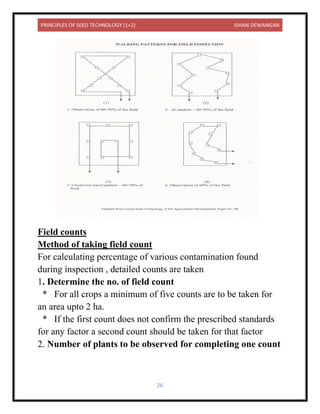
Field counts
Method of taking field count
For calculating percentage of various contamination found
during inspection , detailed counts are taken
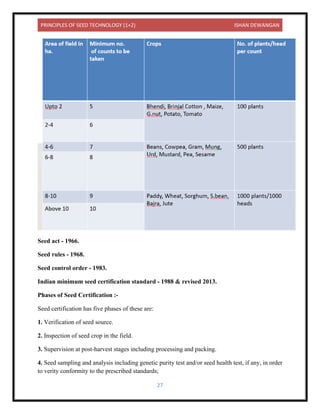
1. Determine the no. of field count
* For all crops a minimum of five counts are to be taken for
an area upto 2 ha.
* If the first count does not confirm the prescribed standards
for any factor a second count should be taken for that factor
2. Number of plants to be observed for completing one count
PRINCIPLES OF SEED TECHNOLOGY (1+2) ISHAN DEWANGAN
27
Seed act - 1966.
Seed rules - 1968.
Seed control order - 1983.
Indian minimum seed certification standard - 1988 & revised 2013.
Phases of Seed Certification :-
Seed certification has five phases of these are:
1. Verification of seed source.
2. Inspection of seed crop in the field.
3. Supervision at post-harvest stages including processing and packing.
4. Seed sampling and analysis including genetic purity test and/or seed health test, if any, in order
to verity conformity to the prescribed standards;
PRINCIPLES OF SEED TECHNOLOGY (1+2) ISHAN DEWANGAN
28
5. Grant of certificate, certification tag, tables and sealing.
or
1) Receipt and security of application with notarized agreement for registration of seed plot for
certification.
2) Verification of seed source, class used for raising the crop by checking certification tags, labels,
seed containers , cash memo or bills.
3) Field inspections of the seed plot to verify conformity to prescribed field standards.
4) Post harvest supervision of seed crop including sealing raw seed , issue T.C . supervision during
seed processing at registered seed processing plant.
5) Seed sampling and sending sample to STI for analysis to verify conformity to prescribed seed
standards as well as genetic purity( field test).
6) Grant of certification, tagging and sealing of the containers – Release of seed lot for seed
multiplication or marketing for commercial.
★ Procedure for seed certification 1. Determining the eligibility of the varieties for certification.
2. Verification of seed source.
3. Verification of land requirement.
4. Field inspections
5. Sampling.
6. Seed testing against quality standards.
7. Processing and bagging.
8. Labelling.
9. Conducting variety control plots; 10. Refusal of certification.
11. Validity period of the certificate (9 month from date of testing).
★ Field Inspection :- inspection of seed field and standing crop during various stage of growth
to verify the prescribed procedures are being followed, so that the seed produced meets the
requirements for certification ,is known as field inspection.
or
PRINCIPLES OF SEED TECHNOLOGY (1+2) ISHAN DEWANGAN
29
At the time of growing a crop for seed production purpose. The data should be obtained on trueness
to varietals purity, isolation of seed crop to prevent cropspollination, mechanical admixtures and
diseases dissemination, objectionable weeds and admixtures.
(A) Inspection of the seed crop :- the inspection of the seed crop are made at
different stages of crop growth, so as to make verifications and estimates of various
impurities and disease,etc.
1. Inspection at sowing time.
2. Inspection before flowering.
3. Inspection during flowering stage.
4. Inspection at maturity time.
5. Inspection at harvesting stage.
(B) After harvesting of the seed crop, threshing,drying,cleaning and grading
processes are performed, during which mechanical admixture may take place. So,it
is necessary to inspect the threshing floor, seed drying and storage facilities and bag
for storing seeds.
Principal of inspection :-
1. All field inspections must be made by well-trained and qualified personnel.The Inspector has to
know the pre requisites and standards for seed growing and has to be familiar with the character
of the varieties to be inspected.
2. The prescribed procedures and techniques of field inspection and the minimum number of
inspections specified in the certification standards should be strictly adhered to.
3. Inspection of cross pollinated crops during flowering, and those self pollinated crops which are
infected by designated seed-borne diseases during flowering stage, (e.g. wheat gets infected by
loose smut during the flowering stage) should be done by surprise inspection i.e. without prior
notice. In all other cases,inspections can be made with prior notice.
4. The seed inspector should achieve full cooperation from the seed growers, even in the case of
rejection of a field. This is possible if the inspector possesses a thorough knowledge, good conduct
and good manners. This is necessary for the smooth operation of a certification scheme. The seed
grower or his representative should be present at the time of field inspection and if possible,
acknowledge the suggested correction and advice by a signature on the inspection report.
PRINCIPLES OF SEED TECHNOLOGY (1+2) ISHAN DEWANGAN
30
5. Upon arrival at the seed farm, the inspector should check all information about the
species, variety, seed origin, cultivated area, class of seed, cropping history of the
field to be inspected and known adjacent fields of the same species, which may be
dangerous from the point of view of isolation. It is advisable, especially in tall crops
and crops requiring sizable isolation distances, to go completely around the outside
of the seed field and observe it and it’s border areas once before entering it.
6. Each field and its boundaries must be pointed by the seed grower. All parts and rows should be
covered and crossed by the inspector on foot as also the sensitive areas such as the vicinity of farm
buildings threshing areas and roads into or through the field, where the seeds of various species
and origin may have been dropped in waste or in transport. The walking in the field should be done
in a schematic pattern so that the maximum area possible can be covered (See figure). However,
If the plant population in the seed field is so thin that the entire population is less than the number
required for taking counts in a schematic manner, the entire population should be counted and
walked through. The inspector should also move out of the field when necessary, to check
isolation. When more than one inspection is made in a field, commence each inspection from a
different point.
7. During the walk in the field, the inspector must make estimates of other varieties
and impurities, diseases plants, general condition of the crop, applied farm practices
and possible yield. Estimates of impurities and diseased plants should invariably be
made through actual counts. These should never be written on a visual basis, even if
by observation it is clear that the seed crop will not conform to the required
standards. Barren rows or long gaps encountered during counts should be skipped
and not considered as part of the row steps. While counting patches or rows
containing off-types, diseased plants and impurities not covered in the counts may
be observed and observation recorded separately in the inspection report. If
necessary, their location should be shown by drawing a map.
9. For short crops, squat or bend periodically during inspection so that eye level
observations can be made at the top height of the plants.
PRINCIPLES OF SEED TECHNOLOGY (1+2) ISHAN DEWANGAN
31
10. Impurities, off-types and diseased plants need not normally be pulled out. However, if pulling
them and showing them helps in convincing the seed producer, it may be done.
11. In self-pollinated seed crops, if one third or more of the area is so heavily lodged
that taking field counts is impossible, the seed crop should be recommended for
rejection. That is unless there is a likelihood that the crop will stand up again before
maturity and that it will be possible to conduct a proper inspection subsequently.
12. In cross pollinated crops and hybrid seed fields, if one third or more of the seed
crop has lodged just prior to, or during flowering, and the inspection during flowering
is difficult, the seed crop should be recommended for rejection without taking field counts.
13. If rouged plants or heads etc., are observed lying on the ground within or on the
outskirts of seed fields where they could possibly cause contamination, the grower
should be directed to gather and remove them. These should not be included in the
counts.
14. During an inspection, if the seed field is found to be liable for rejection, in part or
in full, the prescribed number of field counts for that inspection must still be taken for the entire
field.
15. If during inspection, it is observed that contamination of the field has taken place
and the removal of contaminating factor and contaminated material could make the
crop conform to the prescribed standards, then their removal from the field may be
recommended or permitted. Re-inspection to confirm removal and conformity to
standards must be made. However, such re-inspection is permitted only once, over
and above the minimum number of inspections prescribed for the crop concerned.
PRINCIPLES OF SEED TECHNOLOGY (1+2) ISHAN DEWANGAN
32
4. DUTY AND POWERS OF SEED INSPECTOR,
OFFENCES AND PENALTIES, SEEDS CONTROL
ORDER 1983, VARIETAL IDENTIFICATION
THROUGH GROW OUT TEST AND
ELECTROPHORESIS, MOLECULAR AND
BIOCHEMICAL TEST
1. बीज निरीक्षक की शक्तिय ाँ (Powers of Seed Inspector):-
➢ ककसी भी बीज विक्र
े ि से ककसी भी ककस्म क
े बीज क
े िमूिे ले सकि है।
(He can take samples of any kind of seed from any seed seller.)
➢ बीज क
े िमूिे को उस क्षेत्र की SSTL में परीक्षण क
े ललए भेज सकि है।
(He can send the seed sample to the SSTL of that region for testing.)
➢ ककसी भी समय ककसी भी स्थ ि में प्रिेश कर बीज स्टॉक को चैक कर सकि है। यदि विक्र
े ि
गोि म क गेट खोलिे से इिक र करि है िो ि ल िोड़कर अंिर प्रिेश कर सकि है और ककसी
भी बंि पड़े क
ं टेिर को िोड़कर खोलकर बीजों को चैक कर सकि है। इस िौर ि 2 गि ह उपक्स्थि
होि अनिि यय है क्जिक
े ब ि में हस्ि क्षर भी ललए ज िे हैं।
(He can check the seed stock by entering any place at any time. If the seller
refuses to open the gate of the warehouse, he can break the lock and enter in and
break any locked container and check the seeds by opening. During this time it is
mandatory to present 2 witnesses, after which signatures are also taken.)
➢ ककसी भी संदिग्ध ररकॉर्य, रक्जस्टर, िस्ि िेज य स मग्री को चैक कर सकि है।
(He can check any suspicious record, register, document or material.)
➢ यदि कोई बीज विक्र
े ि स म न्य से अधधक मूल्य पर बीज बेच रह है िो उसक
े खखल फ क ययि
ही कर सकि है।
(If a seed seller is selling seed at a higher price than normal, he can take action
against him.)
2. बीज निरीक्षक क
े कियव्य (Duties of Seed Inspector):-
➢ निरीक्षण (Inspection):- फसल िृद्धध, बीज संस धि ि बीज भंर् रण क
े िौर ि उििी ब र नि
रीक्षण करिे ज एग क्जििी ब र SCA कहेगी।
(During crop growth, seed processing and seed storage, inspection will be done as
many times as SCA says.)
➢ संिुक्टट (Satisfaction):- अपिे आप को संिुटट करेग कक प्रम ण पत्र की शिों की अिुप लि
की ज रही है।
PRINCIPLES OF SEED TECHNOLOGY (1+2) ISHAN DEWANGAN
33
(He will satisfy himself that the conditions of the certificate are being fulfilled.)
➢ बीज उत्प िि, भंर् रण ि विक्रय क
े िौर ि बीज अधधनियम क
े नियमों क
े उल्लंघि क संिेह हो
िे पर बीज क
े िमूिे लेकर SSTL में भेजेग ।
(Seed samples will be sent to SSTL in case of suspicious violation of Seed Act rules
during seed production, storage and sale.)
➢ बीज क
े िमूिे लेिे से पहले बीज निरीक्षक को ललखखि में िोदटस िेि होग ।
(The seed inspector must give notice in writing before taking the seed samples.)
➢ बीज निरीक्षक को 3 बीज िमूिे लेकर उन्हें थैललयों में बंि करक
े धचक्न्हि करि होग ।
(The seed inspector will have to take 3 seed samples and enclose and labelled
them in bags.)
➢ 3 बीज िमूिों में से 1 िमूि बीज विक्र
े ि को िथ 1 िमूि परीक्षण क
े ललए SSTL को भेजि
होग । शेष बच 1 िमूि य िो बीज निरीक्षक अपिे प स रखेग अथि ध र 16 की उपध र 2 क
े
अंिगयि CSTL को भेजेग ।
(Out of 3 seed samples, 1 sample has to be sent to the seed seller and 1 sample
will have to be sent to SSTL for testing. The remaining 1 sample will either be
retained by the seed inspector or sent to CSTL under sub-section 2 of section 16.)
➢ लशक यि की ज ंच (Complaint
investigation):- अधधनियम क
े नियमों क
े उल्लंघि क
े सम्बंध में कोई लशक यि लमलिे पर उस
की ज ंच करि है।
(Investigates any complaint regarding a violation of the rules of the Act.)
PRINCIPLES OF SEED TECHNOLOGY (1+2) ISHAN DEWANGAN
34
➢ ररपोटय भेजि (Send
report):- अपिे द्ि र ककए गए क यों की ररपोटय बि कर SCA को भेजि है।
(Creates a report of the work done by him and sends it to SCA.)
➢ मुकिम करि (To sue):- अधधनियम क
े नियमों क उल्लंघि होिे पर मुकिम करि है।
(Sues if there is a violation of the rules of the Act.)
➢ ककस ि की लशक यि (Farmer's
Complaint):- यदि कोई ककस ि ललखखि में यह लशक यि करि है कक उसकी फसल खर ब होिे
क क रण उसे घदटय ककस्म क
े बीज की आपूनिय है िो बीज निरीक्षक लशक यिकि य क
े द्ि र प्रयु
ति बीज क
े लेबल, थैले ि बचे हुए बीज को अपिे कब्जे में लेि है ि कक प्रम ण लमल सक
े कक इि
बीजों की आपूनिय कह ाँ से हुई है। बचे हुए बीजों को SSTL में भेजि है। निटकषय की ररपोटय यथ शीघ्र
सक्षम अधधक री को प्रस्िुि करेग । िोषी होिे पर बीज क
ं पिी पर उधचि क ययि ही की ज िी है।
(If a farmer complains in writing that the reason for his crop destruction is the
supply of inferior seeds to him, then the seed inspector takes possession of the
labels, bags and the remaining seeds used by the complainant to get proof that
from where these seeds have been supplied. Sends the remaining seeds to SSTL.
He will submit the report of the findings to the higher authorities as soon as
possible. If guilty, appropriate action is taken against the seed company.)
अपर ध ि िंर् (Offences and Penalties):-
1. अपर ध (Offences):-
➢ बीज अधधनियम क
े नियमों क उल्लंघि होि ।
(Violation of rules of Seed Act.)
➢ ककस्म क
े बीज क गलि ब् ंर् से आय ि, विक्रय, स्टॉक, विक्रय क
े ललए प्रिशयि, अिल – बिली
ि आपूनिय करि ।
(Importing, selling, stocking, advertising for sale, exchanging and supplying with
the wrong brand of seed variety.)
➢ ककस्म क
े बीज क पंजीकरण प्रम णपत्र क
े बबि आय ि, विक्रय, स्टॉक विक्रय क
े ललए प्रिशयि,
अिल – बिली ि आपूनिय करि ।
(Importing, selling, stocking, advertising for sale, exchanging and supplying without
registration certificate of seed variety.)
➢ ऐस बीज बेचि जो शुद्धि , अंक
ु रण, स्ि स््य क
े म िकों को पूर िहीं करि हो।
(Selling seeds that do not meet the standards of purity, germination and health.)
➢ पंजीकरण सलमनि, उपसलमनि,
SCA, बीज निरीक्षक, बीज विश्लेषक आदि को क यय करिे से रोकि ।
(To prevent registration committee, sub-committee, SCA, seed inspector, seed
analyst etc. from working.)
PRINCIPLES OF SEED TECHNOLOGY (1+2) ISHAN DEWANGAN
35
2. िंर् (Penalties):-
➢ िोष लसद्ध होिे पर कम से कम 5000 रु. क जुम यि लग य ज सकि है। जुम यिे को अधधक
िम 25000रु. िक बढ़ य ज सकि है।
(If the offence is proved, at least a fine of Rs 5000 can be given. The fine can be
extended up to a maximum of Rs. 25000.)
5.
➢ यदि कोई व्यक्ति आिुि ंलशक शुद्धि क
े गलि आंकड़े प्रस्िुि करि है य ह निक रक बीज
को बेचि है िो 6 महीिे िक क क र ि स य 50,000 रु. जुम यि अथि िोिों क प्र िध ि होि है
।
(If a person presents incorrect data of genetic purity or sells harmful seeds, then
there is a provision of penalty Rs 50,000 or imprisonment up to 6 months or both.)
बीज नियंत्रण आिेश, 1983 (Seed Control Order, 1983):-
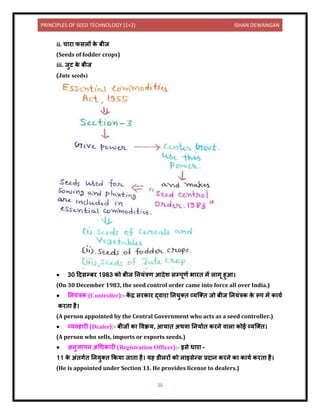
• आिश्यक िस्िु अधधनियम, 1955 (Essential Commodities Act, 1955):- ध र –
3 क
े द्ि र प्रिि शक्ति लमली हुई है। क
ें द्र सरक र िे इस शक्ति क प्रयोग करिे हुए 1983 में बीज
नियंत्रण आिेश ज री ककय ।
(The power conferred by Section 3. The Central Government, use this power and
issued a seed control order in 1983.)
• इस आिेश क
े द्ि र बुि ई अथि रोपण हेिु प्रयुति बीजों को आिश्यक िस्िुओं में सक्म्मलल
ि कर ललय गय ।
(By this order, the seeds used for sowing or planting were included in the
essential commodities.)
i. ख ध्य फसलों ि फल सक्ब्जयों क
े बीज
(Seeds of edible crops and fruit vegetables)
PRINCIPLES OF SEED TECHNOLOGY (1+2) ISHAN DEWANGAN
36
ii. च र फसलों क
े बीज
(Seeds of fodder crops)
iii. जुट क
े बीज
(Jute seeds)
• 30 दिसम्बर 1983 को बीज नियंत्रण आिेश सम्पूणय भ रि में ल गू हुआ।
(On 30 December 1983, the seed control order came into force all over India.)
• नियंत्रक (Controller):- क
ें द्र सरक र द्ि र नियुति व्यक्ति जो बीज नियंत्रक क
े रूप में क यय
करि है।
(A person appointed by the Central Government who acts as a seed controller.)
• व्यिह री (Dealer):- बीजों क विक्रय, आय ि अथि निय यि करिे ि ल कोई व्यक्ति।
(A person who sells, imports or exports seeds.)
• अिुज्ञ पि अधधक री (Registration Officer):- इसे ध र –
11 क
े अंिगयि नियुति ककय ज ि है। यह र्ीलरों को ल इसेन्स प्रि ि करिे क क यय करि है।
(He is appointed under Section 11. He provides license to dealers.)
PRINCIPLES OF SEED TECHNOLOGY (1+2) ISHAN DEWANGAN
37
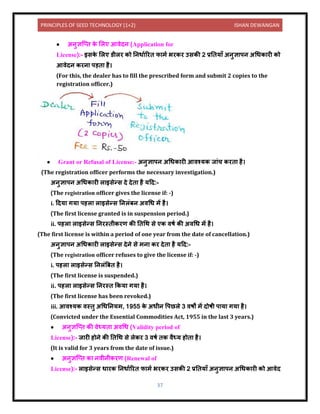
• अिुज्ञक्ति क
े ललए आिेिि (Application for
License):- इसक
े ललए र्ीलर को निध यररि फ मय भरकर उसकी 2 प्रनिय ाँ अिुज्ञ पि अधधक री को
आिेिि करि पड़ि है।
(For this, the dealer has to fill the prescribed form and submit 2 copies to the
registration officer.)
• Grant or Refusal of License:- अिुज्ञ पि अधधक री आिश्यक ज ंच करि है।
(The registration officer performs the necessary investigation.)
अिुज्ञ पि अधधक री ल इसेन्स िे िेि है यदि:-
(The registration officer gives the license if: -)
i. दिय गय पहल ल इसेन्स निलंबि अिधध में है।
(The first license granted is in suspension period.)
ii. पहल ल इसेन्स निरस्िीकरण की निधथ से एक िषय की अिधध में है।
(The first license is within a period of one year from the date of cancellation.)
अिुज्ञ पि अधधक री ल इसेन्स िेिे से मि कर िेि है यदि:-
(The registration officer refuses to give the license if: -)
i. पहल ल इसेन्स निलंबबि है।
(The first license is suspended.)
ii. पहल ल इसेन्स निरस्ि ककय गय है।
(The first license has been revoked.)
iii. आिश्यक िस्िु अधधनियम, 1955 क
े अधीि वपछले 3 िषों में िोषी प य गय है।
(Convicted under the Essential Commodities Act, 1955 in the last 3 years.)
• अिुज्ञक्ति की िेध्यि अिधध (Validity period of
License):- ज री होिे की निधथ से लेकर 3 िषय िक िैध्य होि है।
(It is valid for 3 years from the date of issue.)
• अिुज्ञक्ति क ििीिीकरण (Renewal of
License):- ल इसेन्स ध रक निध यररि फ मय भरकर उसकी 2 प्रनिय ाँ अिुज्ञ पि अधधक री को आिेि
PRINCIPLES OF SEED TECHNOLOGY (1+2) ISHAN DEWANGAN
38
ि करि है। िैध्यि खत्म होिे से पहले 20 रु. क शुल्क लगि है। जबकक िैध्यि खत्म होिे क
े 30
दिि क
े अंिर 25 रु. शुल्क िेि पड़ि है।
(The license holder filled the prescribed form and submit 2 copies of it to the
registration officer. A fee of Rs 20 is charged before the validity is over. However, within
30 days of expiration of validity, a fee of Rs 25 have to be paid.)
• मूल्य सूची (Rate
list):- विलभन्ि बीजों की मूल्य सूची बीज विक्र
े ि को प्रिलशयि करिी पड़िी है। प्रत्येक दिि प्र रक्म्भ
क ि अक्न्िम स्टॉक प्रिलशयि करि पड़ि है।
(The price list of different seeds has to be displayed by the seed seller. Initial and
final stocks have to be displayed every day.)
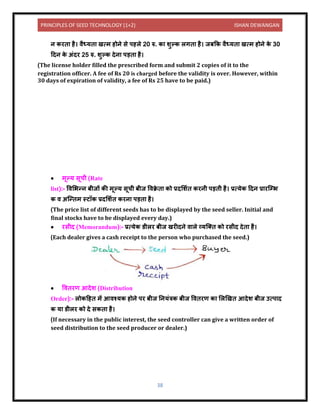
• रसीि (Memorandum):- प्रत्येक र्ीलर बीज खरीििे ि ले व्यक्ति को रसीि िेि है।
(Each dealer gives a cash receipt to the person who purchased the seed.)
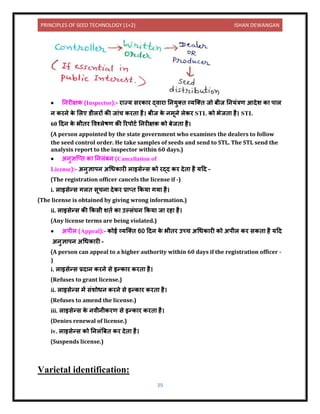
• वििरण आिेश (Distribution
Order):- लोकदहि में आिश्यक होिे पर बीज नियंत्रक बीज वििरण क ललखखि आिेश बीज उत्प ि
क य र्ीलर को िे सकि है।
(If necessary in the public interest, the seed controller can give a written order of
seed distribution to the seed producer or dealer.)
PRINCIPLES OF SEED TECHNOLOGY (1+2) ISHAN DEWANGAN
39
• निरीक्षक (Inspector):- र ज्य सरक र द्ि र नियुति व्यक्ति जो बीज नियंत्रण आिेश क प ल
ि करिे क
े ललए र्ीलरों की ज ंच करि है। बीज क
े िमूिे लेकर STL को भेजि है। STL
60 दिि क
े भीिर विश्लेषण की ररपोटय निरीक्षक को बेजि है।
(A person appointed by the state government who examines the dealers to follow
the seed control order. He take samples of seeds and send to STL. The STL send the
analysis report to the inspector within 60 days.)
• अिुज्ञक्ति क निलंबि (Cancellation of
License):- अिुज्ञ पि अधधक री ल इसेन्स को रद्ि कर िेि है यदि –
(The registration officer cancels the license if -)
i. ल इसेन्स गलि सूचि िेकर प्र ति ककय गय है।
(The license is obtained by giving wrong information.)
ii. ल इसेन्स की ककसी शिय क उल्लंघि ककय ज रह है।
(Any license terms are being violated.)
• अपील (Appeal):- कोई व्यक्ति 60 दिि क
े भीिर उच्च अधधक री को अपील कर सकि है यदि
अिुज्ञ पि अधधक री –
(A person can appeal to a higher authority within 60 days if the registration officer -
)
i. ल इसेन्स प्रि ि करिे से इन्क र करि है।
(Refuses to grant license.)
ii. ल इसेन्स में संशोधि करिे से इन्क र करि है।
(Refuses to amend the license.)
iii. ल इसेन्स क
े ििीिीकरण से इन्क र करि है।
(Denies renewal of license.)
iv. ल इसेन्स को निलंबबि कर िेि है।
(Suspends license.)
Varietal identification:
PRINCIPLES OF SEED TECHNOLOGY (1+2) ISHAN DEWANGAN
40
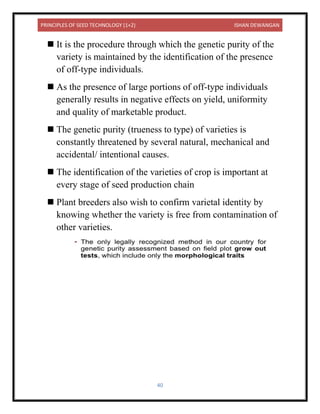
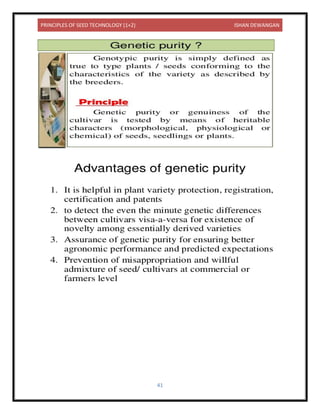
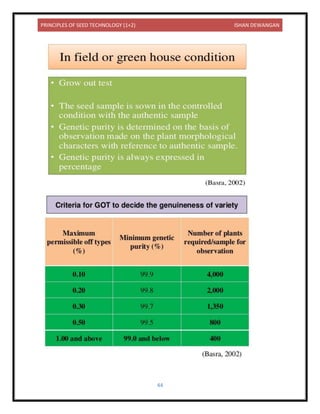
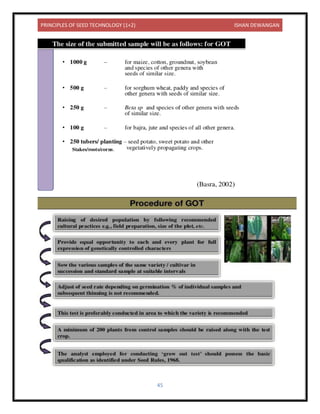
◼ It is the procedure through which the genetic purity of the
variety is maintained by the identification of the presence
of off-type individuals.
◼ As the presence of large portions of off-type individuals
generally results in negative effects on yield, uniformity
and quality of marketable product.
◼ The genetic purity (trueness to type) of varieties is
constantly threatened by several natural, mechanical and
accidental/ intentional causes.
◼ The identification of the varieties of crop is important at
every stage of seed production chain
◼ Plant breeders also wish to confirm varietal identity by
knowing whether the variety is free from contamination of
other varieties.
PRINCIPLES OF SEED TECHNOLOGY (1+2) ISHAN DEWANGAN
41
PRINCIPLES OF SEED TECHNOLOGY (1+2) ISHAN DEWANGAN
42
PRINCIPLES OF SEED TECHNOLOGY (1+2) ISHAN DEWANGAN
43
PRINCIPLES OF SEED TECHNOLOGY (1+2) ISHAN DEWANGAN
44
PRINCIPLES OF SEED TECHNOLOGY (1+2) ISHAN DEWANGAN
45
PRINCIPLES OF SEED TECHNOLOGY (1+2) ISHAN DEWANGAN
46
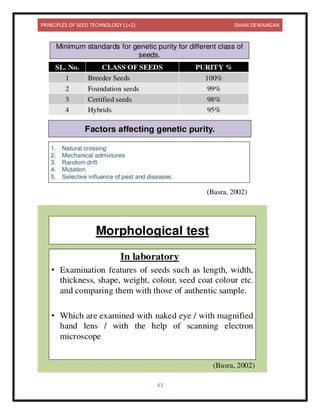
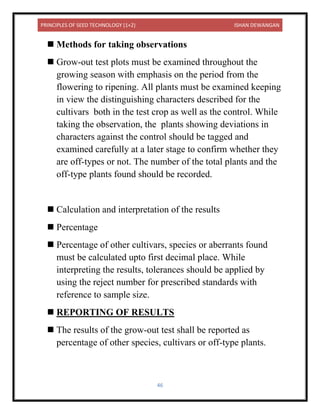
◼ Methods for taking observations
◼ Grow-out test plots must be examined throughout the
growing season with emphasis on the period from the
flowering to ripening. All plants must be examined keeping
in view the distinguishing characters described for the
cultivars both in the test crop as well as the control. While
taking the observation, the plants showing deviations in
characters against the control should be tagged and
examined carefully at a later stage to confirm whether they
are off-types or not. The number of the total plants and the
off-type plants found should be recorded.
◼ Calculation and interpretation of the results
◼ Percentage
◼ Percentage of other cultivars, species or aberrants found
must be calculated upto first decimal place. While
interpreting the results, tolerances should be applied by
using the reject number for prescribed standards with
reference to sample size.
◼ REPORTING OF RESULTS
◼ The results of the grow-out test shall be reported as
percentage of other species, cultivars or off-type plants.
PRINCIPLES OF SEED TECHNOLOGY (1+2) ISHAN DEWANGAN
47
◼ If the sample is found to be a cultivar other than stated by
the sender, the results shall be reported as such.
◼ If plants of other cultivars are more than 15 per cent, the
report shall state that the sample consists of mixture of
different cultivars.
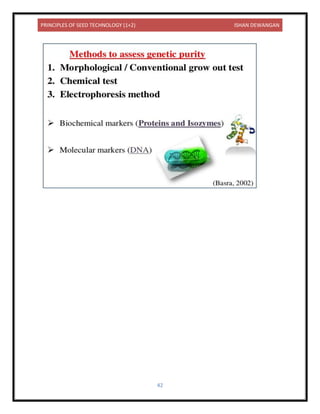
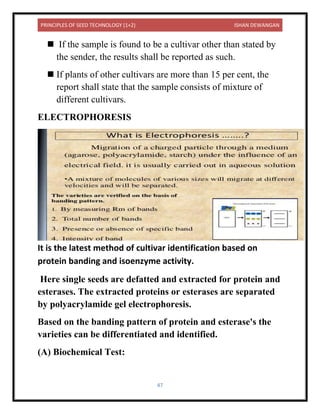
ELECTROPHORESIS
It is the latest method of cultivar identification based on
protein banding and isoenzyme activity.
Here single seeds are defatted and extracted for protein and
esterases. The extracted proteins or esterases are separated
by polyacrylamide gel electrophoresis.
Based on the banding pattern of protein and esterase's the
varieties can be differentiated and identified.
(A) Biochemical Test:
PRINCIPLES OF SEED TECHNOLOGY (1+2) ISHAN DEWANGAN
48
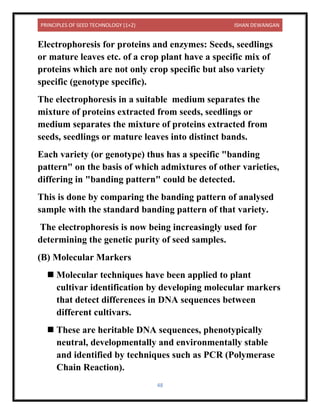
Electrophoresis for proteins and enzymes: Seeds, seedlings
or mature leaves etc. of a crop plant have a specific mix of
proteins which are not only crop specific but also variety
specific (genotype specific).
The electrophoresis in a suitable medium separates the
mixture of proteins extracted from seeds, seedlings or
medium separates the mixture of proteins extracted from
seeds, seedlings or mature leaves into distinct bands.
Each variety (or genotype) thus has a specific "banding
pattern" on the basis of which admixtures of other varieties,
differing in "banding pattern" could be detected.
This is done by comparing the banding pattern of analysed
sample with the standard banding pattern of that variety.
The electrophoresis is now being increasingly used for
determining the genetic purity of seed samples.
(B) Molecular Markers
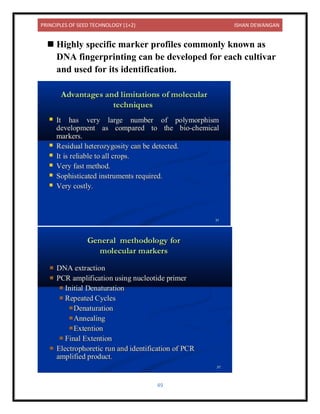
◼ Molecular techniques have been applied to plant
cultivar identification by developing molecular markers
that detect differences in DNA sequences between
different cultivars.
◼ These are heritable DNA sequences, phenotypically
neutral, developmentally and environmentally stable
and identified by techniques such as PCR (Polymerase
Chain Reaction).
PRINCIPLES OF SEED TECHNOLOGY (1+2) ISHAN DEWANGAN
49
◼ Highly specific marker profiles commonly known as
DNA fingerprinting can be developed for each cultivar
and used for its identification.
PRINCIPLES OF SEED TECHNOLOGY (1+2) ISHAN DEWANGAN
50
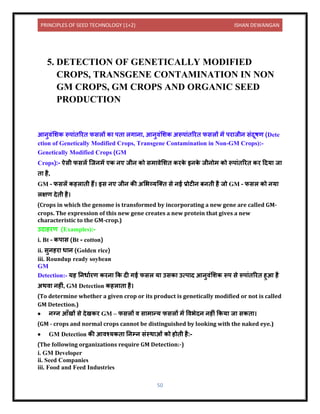
5. DETECTION OF GENETICALLY MODIFIED
CROPS, TRANSGENE CONTAMINATION IN NON
GM CROPS, GM CROPS AND ORGANIC SEED
PRODUCTION
आिुिंलशक रूप ंिररि फसलों क पि लग ि , आिुिंलशक अरूप ंिररि फसलों में पर जीि संिूषण (Dete
ction of Genetically Modified Crops, Transgene Contamination in Non-GM Crops):-
Genetically Modified Crops (GM
Crops):- ऐसी फसलें क्जिमें एक िए जीि को सम िेलशि करक
े इिक
े जीिोम को रूप ंिररि कर दिय ज
ि है,
GM – फसलें कहल िी हैं। इस िए जीि की अलभव्यक्ति से िई प्रोटीि बििी है जो GM – फसल को िय
लक्षण िेिी है।
(Crops in which the genome is transformed by incorporating a new gene are called GM-
crops. The expression of this new gene creates a new protein that gives a new
characteristic to the GM-crop.)
उि हरण (Examples):-
i. Bt – कप स (Bt - cotton)
ii. सुिहर ध ि (Golden rice)
iii. Roundup ready soybean
GM
Detection:- यह निध यरण करि कक िी गई फसल य उसक उत्प ि आिुिंलशक रूप से रूप ंिररि हुआ है
अथि िहीं, GM Detection कहल ि है।
(To determine whether a given crop or its product is genetically modified or not is called
GM Detection.)
• िग्ि आाँखों से िेखकर GM – फसलों ि स म न्य फसलों में विभेिि िहीं ककय ज सकि ।
(GM - crops and normal crops cannot be distinguished by looking with the naked eye.)
• GM Detection की आिश्यकि निम्ि संस्थ ओं को होिी है:-
(The following organizations require GM Detection:-)
i. GM Developer
ii. Seed Companies
iii. Food and Feed Industries
PRINCIPLES OF SEED TECHNOLOGY (1+2) ISHAN DEWANGAN
51
iv. Enforcement Authorities (Competent Authorities)
• GM Detection Methods:- इिक
े 2 मुख्य आध र हैं –
(They have 2 main bases -)
A. DNA आध ररि विधधय ाँ (DNA Based
Methods):- इसमें वििेशी DNA क पि लग य ज ि है। इसमें एक विधध आिी है –
(Foreign DNA is detected in these methods. There is one method in this -)
1. PCR Based Test
B. प्रोटीि आध ररि विधधय ाँ (Protein Based
Methods):- इसमें िई प्रोटीि क पि लग य ज ि है। इसमें 2 विधधय ाँ आिी हैं –
(New proteins are detected in these methods. There are 2 methods in this -)
2. Lateral Flow Strip Method
3. ELISA Test
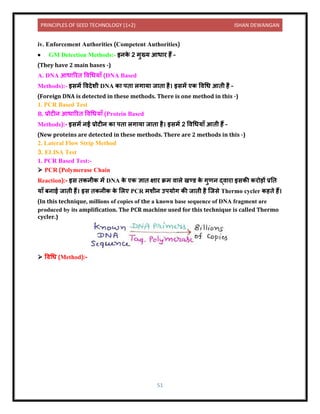
1. PCR Based Test:-
➢ PCR (Polymerase Chain
Reaction):- इस िकिीक में DNA क
े एक ज्ञ ि क्ष र क्रम ि ले खण्र् क
े गुणि द्ि र इसकी करोड़ों प्रनि
य ाँ बि ई ज िी हैं। इस िकिीक क
े ललए PCR मशीि उपयोग की ज िी है क्जसे Thermo cycler कहिे हैं।
(In this technique, millions of copies of the a known base sequence of DNA fragment are
produced by its amplification. The PCR machine used for this technique is called Thermo
cycler.)
➢ विधध (Method):-
PRINCIPLES OF SEED TECHNOLOGY (1+2) ISHAN DEWANGAN
52
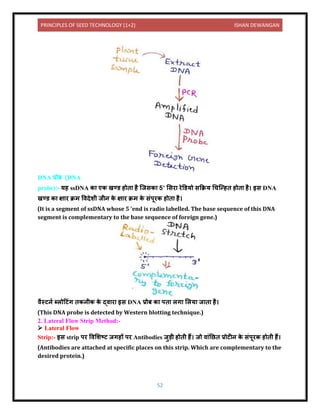
DNA प्रोब (DNA
probe):- यह ssDNA क एक खण्र् होि है क्जसक 5’ लसर रेडर्यो सकक्रय धचक्न्हि होि है। इस DNA
खण्र् क क्ष र क्रम वििेशी जीि क
े क्ष र क्रम क
े संपूरक होि है।
(It is a segment of ssDNA whose 5 'end is radio labelled. The base sequence of this DNA
segment is complementary to the base sequence of foreign gene.)
िैस्टिय ब्लोदटंग िकिीक क
े द्ि र इस DNA प्रोब क पि लग ललय ज ि है।
(This DNA probe is detected by Western blotting technique.)
2. Lateral Flow Strip Method:-
➢ Lateral Flow
Strip:- इस strip पर विलशटट जगहों पर Antibodies जुड़ी होिी हैं। जो ि ंनछि प्रोटीि क
े संपूरक होिी हैं।
(Antibodies are attached at specific places on this strip. Which are complementary to the
desired protein.)
PRINCIPLES OF SEED TECHNOLOGY (1+2) ISHAN DEWANGAN
53
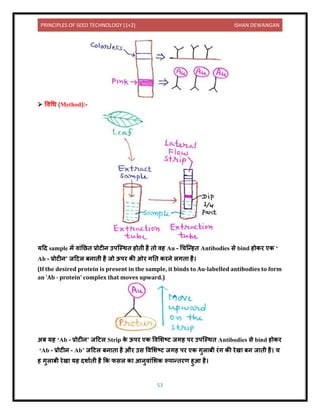
➢ विधध (Method):-
यदि sample में ि ंनछि प्रोटीि उपक्स्थि होिी है िो िह Au – धचक्न्हि Antibodies से bind होकर एक ‘
Ab – प्रोटीि’ जदटल बि िी है जो ऊपर की ओर गनि करिे लगि है।
(If the desired protein is present in the sample, it binds to Au-labelled antibodies to form
an 'Ab - protein' complex that moves upward.)
अब यह ‘Ab – प्रोटीि’ जदटल Strip क
े ऊपर एक विलशटट जगह पर उपक्स्थि Antibodies से bind होकर
‘Ab – प्रोटीि – Ab’ जदटल बि ि है और उस विलशटट जगह पर एक गुल बी रंग की रेख बि ज िी है। य
ह गुल बी रेख यह िश यिी है कक फसल क आिुि ंलशक रूप न्िरण हुआ है।
PRINCIPLES OF SEED TECHNOLOGY (1+2) ISHAN DEWANGAN
54
(Now this 'Ab - protein' complex binds to the antibodies at a specific place above the
strip to form the 'Ab - protein - Ab' complex and a pink line is developed at that specific
place. This pink line indicates that the crop has undergone a genetic transformation.)
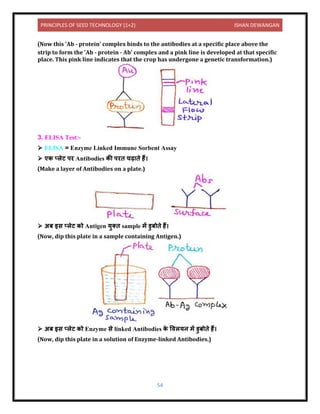
3. ELISA Test:-
➢ ELISA = Enzyme Linked Immune Sorbent Assay
➢ एक तलेट पर Antibodies की परि चढ़ िे हैं।
(Make a layer of Antibodies on a plate.)
➢ अब इस तलेट को Antigen युति sample में र्ुबोिे हैं।
(Now, dip this plate in a sample containing Antigen.)
➢ अब इस तलेट को Enzyme से linked Antibodies क
े विलयि में र्ुबोिे हैं।
(Now, dip this plate in a solution of Enzyme-linked Antibodies.)
PRINCIPLES OF SEED TECHNOLOGY (1+2) ISHAN DEWANGAN
55
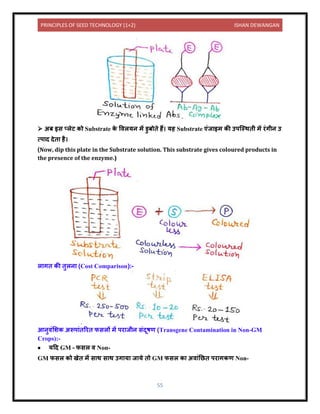
➢ अब इस तलेट को Substrate क
े विलयि में र्ुबोिे हैं। यह Substrate एंज इम की उपक्स्थिी में रंगीि उ
त्प ि िेि है।
(Now, dip this plate in the Substrate solution. This substrate gives coloured products in
the presence of the enzyme.)
ल गि की िुलि (Cost Comparison):-
आिुिंलशक अरूप ंिररि फसलों में पर जीि संिूषण (Transgene Contamination in Non-GM
Crops):-
• यदि GM – फसल ि Non-
GM फसल को खेि में स थ स थ उग य ज ये िो GM फसल क अि ंनछि पर गकण Non-
PRINCIPLES OF SEED TECHNOLOGY (1+2) ISHAN DEWANGAN
56
GM फसल को पर धगि कर सकि है। इससे Non-
GM फसल की ककस्म की आिुि ंलशक शुद्धि की ह नि हो ज िी है। क्जससे िह ककस्म िटट हो ज िी है।
(If GM-crop and Non-GM crop are grown together in the field, then undesired pollen of
GM crop can pollinate the Non-GM crop. This leads to loss of genetic purity of the non-GM
crop variety. Due to which that variety is destroyed.)
• इसक
े अनिररति GM – फसलें मृि में क
ु छ ऐसे रस यि छोड़िी हैं जो Non-
GM फसलों पर विपरीि प्रभ ि र् लिे हैं।
(Additionally, GM-crops release some chemicals into the soil that adversely affect non-
GM crops.)
6. SEED DRYING, PROCESSING AND THEIR STEPS,
SEED TESTING FOR QUALITY ASSESSMENT,
SEED TREATMENT, ITS IMPORTANCE, METHOD
OF APPLICATION AND SEED PACKING
बीज सुख ई (Seed Drying):-
1. पररचय (Introduction):-
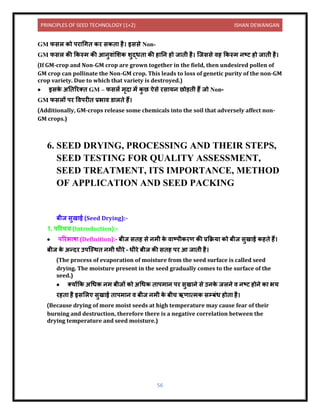
• पररभ ष (Definition):- बीज सिह से िमी क
े ि टपीकरण की प्रकक्रय को बीज सुख ई कहिे हैं।
बीज क
े अन्िर उपक्स्थि िमी धीरे – धीरे बीज की सिह पर आ ज िी है।
(The process of evaporation of moisture from the seed surface is called seed
drying. The moisture present in the seed gradually comes to the surface of the
seed.)
• तयोंकक अधधक िम बीजों को अधधक ि पम ि पर सुख िे से उिक
े जलिे ि िटट होिे क भय
रहि है इसललए सुख ई ि पम ि ि बीज िमी क
े बीच ऋण त्मक सम्बंध होि है।
(Because drying of more moist seeds at high temperature may cause fear of their
burning and destruction, therefore there is a negative correlation between the
drying temperature and seed moisture.)
PRINCIPLES OF SEED TECHNOLOGY (1+2) ISHAN DEWANGAN
57
7.
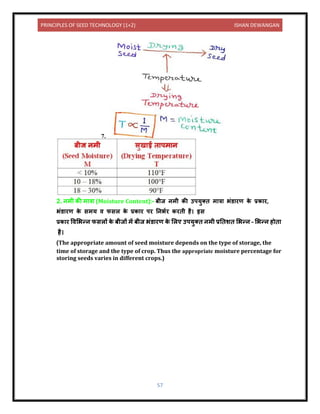
2. िमी की म त्र (Moisture Content):- बीज िमी की उपयुति म त्र भंर् रण क
े प्रक र,
भंर् रण क
े समय ि फसल क
े प्रक र पर निभयर करिी है। इस
प्रक र विलभन्ि फसलों क
े बीजों में बीज भंर् रण क
े ललए उपयुति िमी प्रनिशि लभन्ि – लभन्ि होि
है।
(The appropriate amount of seed moisture depends on the type of storage, the
time of storage and the type of crop. Thus the appropriate moisture percentage for
storing seeds varies in different crops.)
PRINCIPLES OF SEED TECHNOLOGY (1+2) ISHAN DEWANGAN
58
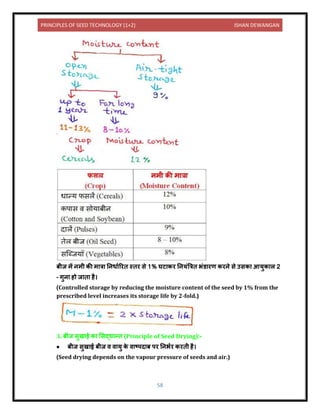
बीज में िमी की म त्र निध यररि स्िर से 1% घट कर नियंबत्रि भंर् रण करिे से उसक आयुक ल 2
– गुि हो ज ि है।
(Controlled storage by reducing the moisture content of the seed by 1% from the
prescribed level increases its storage life by 2-fold.)
3. बीज सुख ई क लसद्ध न्ि (Principle of Seed Drying):-
• बीज सुख ई बीज ि ि यु क
े ि टपि ब पर निभयर करिी है।
(Seed drying depends on the vapour pressure of seeds and air.)
PRINCIPLES OF SEED TECHNOLOGY (1+2) ISHAN DEWANGAN
59
➢ बीज सुख ई हो इसक
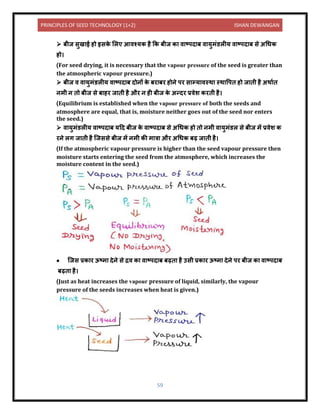
े ललए आिश्यक है कक बीज क ि टपि ब ि युमंर्लीय ि टपि ब से अधधक
हो।
(For seed drying, it is necessary that the vapour pressure of the seed is greater than
the atmospheric vapour pressure.)
➢ बीज ि ि युमंर्लीय ि टपि ब िोिों क
े बर बर होिे पर स म्य िस्थ स्थ वपि हो ज िी है अथ यि
िमी ि िो बीज से ब हर ज िी है और ि ही बीज क
े अन्िर प्रिेश करिी है।
(Equilibrium is established when the vapour pressure of both the seeds and
atmosphere are equal, that is, moisture neither goes out of the seed nor enters
the seed.)
➢ ि युमंर्लीय ि टपि ब यदि बीज क
े ि टपि ब से अधधक हो िो िमी ि युमंर्ल से बीज में प्रिेश क
रिे लग ज िी है क्जससे बीज में िमी की म त्र और अधधक बढ़ ज िी है।
(If the atmospheric vapour pressure is higher than the seed vapour pressure then
moisture starts entering the seed from the atmosphere, which increases the
moisture content in the seed.)
• क्जस प्रक र ऊटम िेिे से द्रि क ि टपि ब बढ़ि है उसी प्रक र ऊटम िेिे पर बीज क ि टपि ब
बढ़ि है।
(Just as heat increases the vapour pressure of liquid, similarly, the vapour
pressure of the seeds increases when heat is given.)
PRINCIPLES OF SEED TECHNOLOGY (1+2) ISHAN DEWANGAN
60
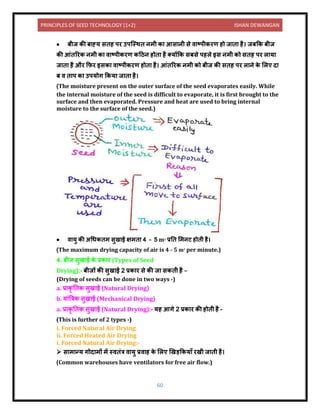
• बीज की ब ह्य सिह पर उपक्स्थि िमी क आस िी से ि टपीकरण हो ज ि है। जबकक बीज
की आंिररक िमी क ि टपीकरण कदिि होि है तयोंकक सबसे पहले इस िमी को सिह पर ल य
ज ि है और कफर इसक ि टपीकरण होि है। आंिररक िमी को बीज की सिह पर ल िे क
े ललए ि
ब ि ि प क उपयोग ककय ज ि है।
(The moisture present on the outer surface of the seed evaporates easily. While
the internal moisture of the seed is difficult to evaporate, it is first brought to the
surface and then evaporated. Pressure and heat are used to bring internal
moisture to the surface of the seed.)
• ि यु की अधधकिम सुख ई क्षमि 4 – 5 m3 प्रनि लमिट होिी है।
(The maximum drying capacity of air is 4 - 5 m3
per minute.)
4. बीज सुख ई क
े प्रक र (Types of Seed
Drying):- बीजों की सुख ई 2 प्रक र से की ज सकिी है –
(Drying of seeds can be done in two ways -)
a. प्र कृ निक सुख ई (Natural Drying)
b. य ंबत्रक सुख ई (Mechanical Drying)
a. प्र कृ निक सुख ई (Natural Drying):- यह आगे 2 प्रक र की होिी है –
(This is further of 2 types -)
i. Forced Natural Air Drying
ii. Forced Heated Air Drying
i. Forced Natural Air Drying:-
➢ स म न्य गोि मों में स्ििंत्र ि यु प्रि ह क
े ललए खखड़ककय ाँ रखी ज िी है।
(Common warehouses have ventilators for free air flow.)
PRINCIPLES OF SEED TECHNOLOGY (1+2) ISHAN DEWANGAN
61
➢ आधुनिक गोि मों में ि यु को िेज गनि से प्रि दहि करिे क
े ललए विधुि पंखों क उपयोग ककय ज ि
है।
(In modern warehouses, electric fins are used to make air flow faster.)
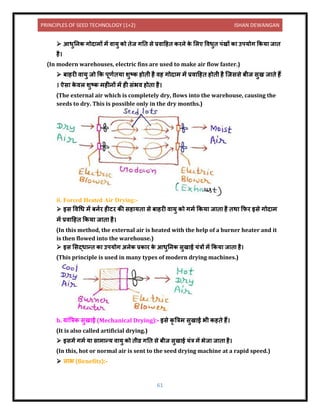
➢ ब हरी ि यु जो कक पूणयिय शुटक होिी है िह गोि म में प्रि दहि होिी है क्जससे बीज सुख ज िे हैं
। ऐस क
े िल शुटक महीिों में ही संभि होि है।
(The external air which is completely dry, flows into the warehouse, causing the
seeds to dry. This is possible only in the dry months.)
ii. Forced Heated Air Drying:-
➢ इस विधध में बियर हीटर की सह यि से ब हरी ि यु को गमय ककय ज ि है िथ कफर इसे गोि म
में प्रि दहि ककय ज ि है।
(In this method, the external air is heated with the help of a burner heater and it
is then flowed into the warehouse.)
➢ इस लसद्ध न्ि क उपयोग अिेक प्रक र क
े आधुनिक सुख ई यंत्रों में ककय ज ि है।
(This principle is used in many types of modern drying machines.)
b. य ंबत्रक सुख ई (Mechanical Drying):- इसे कृ बत्रम सुख ई भी कहिे हैं।
(It is also called artificial drying.)
➢ इसमें गमय य स म न्य ि यु को िीव्र गनि से बीज सुख ई यंत्र में भेज ज ि है।
(In this, hot or normal air is sent to the seed drying machine at a rapid speed.)
➢ ल भ (Benefits):-
PRINCIPLES OF SEED TECHNOLOGY (1+2) ISHAN DEWANGAN
62
i. िुरन्ि सुख ई (Quick Drying)
ii. बड़ी म त्र में सुख ई (Large quantity drying)
iii. उपयोग में उपकरण (Equipment used):- Seed Dryers (बीज सुख ई यंत्र)
➢ विलभन्ि प्रक र क
े बीज सुख ई यंत्र (Different types of Seed Dryers):-
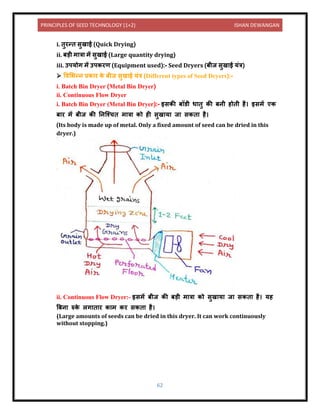
i. Batch Bin Dryer (Metal Bin Dryer)
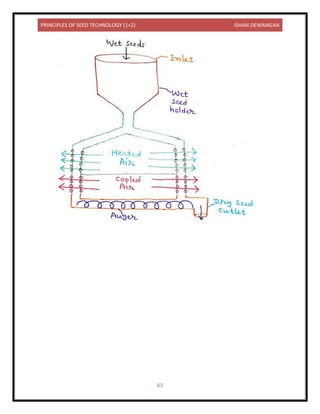
ii. Continuous Flow Dryer
i. Batch Bin Dryer (Metal Bin Dryer):- इसकी बॉर्ी ध िु की बिी होिी है। इसमें एक
ब र में बीज की निक्श्चि म त्र को ही सुख य ज सकि है।
(Its body is made up of metal. Only a fixed amount of seed can be dried in this
dryer.)
ii. Continuous Flow Dryer:- इसमें बीज की बड़ी म त्र को सुख य ज सकि है। यह
बबि रुक
े लग ि र क म कर सकि है।
(Large amounts of seeds can be dried in this dryer. It can work continuously
without stopping.)
PRINCIPLES OF SEED TECHNOLOGY (1+2) ISHAN DEWANGAN
63
PRINCIPLES OF SEED TECHNOLOGY (1+2) ISHAN DEWANGAN
64
SEED TESTING FOR QUALITY ASSESSMENT
गुणित्त निध यरण क
े ललए बीज परीक्षण (Seed Testing for Quality Assessment):-
बीज परीक्षण (Seed Testing):-
यह एक बीज ढेर क
े म िकों को निध यररि करिे की एक प्रकक्रय है ि कक ककस िों को गुणित्त सम्पन्ि बीज
उपलब्ध हो सक
े ।
(It is a process of determining the standards of a seed lot so that good quality seeds can
make available to the farmers.)
उद्िेश्य (Objectives):- बीज परीक्षण अिेक उद्िेश्यों क
े ललए ककय ज ि है –
(Seed testing is done for several purposes -)
➢ गुणित्त समस्य ओं ि उिक
े क रणों को पहच िि
(To identify quality problems and their causes)
➢ बीज सुख ई ि संस धि क
े ललए आिश्यकि ओं को निध यररि करि ।
(To determine the requirements for processing and seed drying.)
➢ यह निध यररि करि कक बीज गुणित्त म िकों को पूर करिे हैं अथि िहीं।
(To determine whether seeds meet quality standards or not.)
➢ कम गुणित्त क
े बीज रोपण से बचि ।
(To avoid planting of low quality seeds.)
अनिि यय (Compulsory):- बीज प्रम णीकरण ि बीज संबंधी नियमों को ल गू करिे क
े उद्िेश्य से बीज ि
मूिों क परीक्षण 1996 में बीज अधधनियम क
े अंिगयि अनिि यय कर दिय गय ।
( Testing of seed samples was made mandatory under the Seed Act in 1996 for the
purpose of seed certification and implementing seed related rules.)
गुणित्त निध यरण परीक्षण (Quality Assessment Tests):-
a. बीज िमी परीक्षण (Seed Moisture Test)
b. बीज अंक
ु रण परीक्षण (Seed Germination Test)
c. बीज जीिि क्षमि परीक्षण (Seed Viability Test)
d. भौनिक शुद्धि परीक्षण (Physical Purity Test)
e. बीज ओज परीक्षण (Seed Vigor Test)
f. बीज स्ि स््य परीक्षण (Seed Health Test)
g. ग्रो आउट परीक्षण (Grow Out Test)
a. बीज िमी परीक्षण (Seed Moisture Test):-
PRINCIPLES OF SEED TECHNOLOGY (1+2) ISHAN DEWANGAN
65
➢ बीज िमी प्रनिशि एक बहुि महत्िपूणय क रक है जो बीज गुणित्त ि भंर् रण क्षमि को प्रभ विि करि
है।
(Seed moisture percentage is a very important factor that affects seed quality and
storage ability.)
➢ बीज िमी प्रनिशि को ज्ञ ि करिे क
े ललए 2 विधधयों क उपयोग ककय ज ि है –
(To find the seed moisture percentage, 2 methods are used -)
i. Air Oven Method
ii. Moisture meter method
➢ बीज िमी प्रनिशि को प्रिलशयि करिे क
े 2 आध र हैं:-
(There are 2 bases for representing seed moisture percentage: -)
i. िम भ र आध र (Wet weight basis)
ii. शुटक भ र आध र (Dry weight basis)
i. िम भ र आध र (Wet weight basis):-
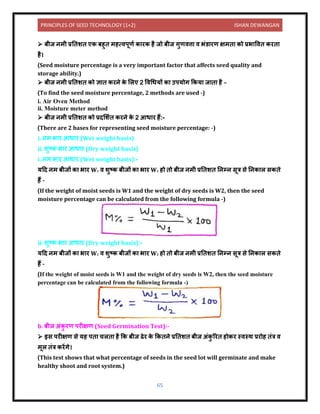
यदि िम बीजों क भ र W1 ि शुटक बीजों क भ र W2 हो िो बीज िमी प्रनिशि निम्ि सूत्र से निक ल सकिे
हैं -
(If the weight of moist seeds is W1 and the weight of dry seeds is W2, then the seed
moisture percentage can be calculated from the following formula -)
ii. शुटक भ र आध र (Dry weight basis):-
यदि िम बीजों क भ र W1 ि शुटक बीजों क भ र W2 हो िो बीज िमी प्रनिशि निम्ि सूत्र से निक ल सकिे
हैं -
(If the weight of moist seeds is W1 and the weight of dry seeds is W2, then the seed moisture
percentage can be calculated from the following formula -)
b. बीज अंक
ु रण परीक्षण (Seed Germination Test):-
➢ इस परीक्षण से यह पि चलि है कक बीज ढेर क
े ककििे प्रनिशि बीज अंक
ु ररि होकर स्िस्थ प्ररोह िंत्र ि
मूल िंत्र करेंगे।
(This test shows that what percentage of seeds in the seed lot will germinate and make
healthy shoot and root system.)
PRINCIPLES OF SEED TECHNOLOGY (1+2) ISHAN DEWANGAN
66
➢ प्रयोगश ल में अधधक ंश ज नियों क
े ललए इस परीक्षण में ि पम ि 18 से 22°C क
े मध्य रख ज ि है।
(The temperature in this test is kept between 18 and 22°C for most species in the
laboratory.)
➢ इस परीक्षण की अिधध 7 से 28 दिि िक हो सकिी है। यह फसल ज नि पर निभयर करिी है। उि हरण क
े
ललए ध न्य फसलों में 7 दिि में यह परीक्षण हो ज ि है।
(The duration of this test can range from 7 to 28 days. This depends on the crop species.
For example, in cereal crops, this test is done in 7 days.)
➢ अंक
ु रण प्रनिशि को निम्ि सूत्र से निक ल सकिे हैं:-
(The germination percentage can be calculated from the following formula:-)
c. बीज जीिि क्षमि परीक्षण (Seed Viability Test):-
➢ इसे Tz – परीक्षण य Tetrazolium – परीक्षण भी कहिे हैं।
(It is also called Tz - test or Tetrazolium - test.)
➢ इस परीक्षण से यह पि चलि है कक बीज ढेर क
े ककििे प्रनिशि बीज जीििक्षम हैं क्जिक अंक
ु ररि हो
ि अपेक्षक्षि ककय ज सकि है।
(This test shows that what percentage of seeds in the seed lot are viable which can be
expected to germinate.)
➢ इस परीक्षण में एक रंगहीि रस यि 2,3,5 – Triphenyl tetrazolium
chloride य bromide क उपयोग ककय ज ि है। जब इस रस यि क जीविि कोलशक ओं द्ि र अपच
यि होि है िो यह रस यि ल ल रंग विकलसि कर लेि है।
(In this test a colourless chemical 2,3,5 - Triphenyl tetrazolium chloride or bromide is
used. When this chemical is reduced by living cells, it develops red color.)
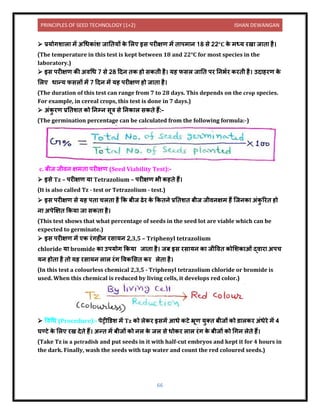
➢ विधध (Procedure):- पेट्रीडर्श में Tz को लेकर इसमें आधे कटे भ्रूण युति बीजों को र् लकर अंधेरे में 4
घण्टे क
े ललए रख िेिे हैं। अन्ि में बीजों को िल क
े जल से धोकर ल ल रंग क
े बीजों को धगि लेिे हैं।
(Take Tz in a petradish and put seeds in it with half-cut embryos and kept it for 4 hours in
the dark. Finally, wash the seeds with tap water and count the red coloured seeds.)
PRINCIPLES OF SEED TECHNOLOGY (1+2) ISHAN DEWANGAN
67
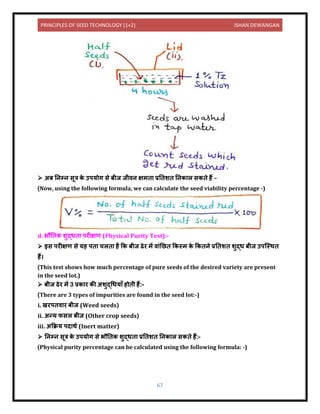
➢ अब निम्ि सूत्र क
े उपयोग से बीज जीिि क्षमि प्रनिशि निक ल सकिे हैं –
(Now, using the following formula, we can calculate the seed viability percentage -)
d. भौनिक शुद्धि परीक्षण (Physical Purity Test):-
➢ इस परीक्षण से यह पि चलि है कक बीज ढेर में ि ंनछि ककस्म क
े ककििे प्रनिशि शुद्ध बीज उपक्स्थि
हैं।
(This test shows how much percentage of pure seeds of the desired variety are present
in the seed lot.)
➢ बीज ढेर में 3 प्रक र की अशुद्धधय ाँ होिी हैं:-
(There are 3 types of impurities are found in the seed lot:-)
i. खरपिि र बीज (Weed seeds)
ii. अन्य फसल बीज (Other crop seeds)
iii. अकक्रय पि थय (Inert matter)
➢ निम्ि सूत्र क
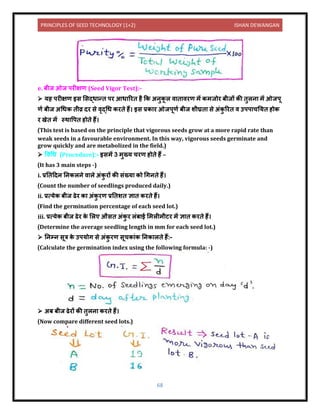
े उपयोग से भौनिक शुद्धि प्रनिशि निक ल सकिे हैं:-
(Physical purity percentage can be calculated using the following formula: -)
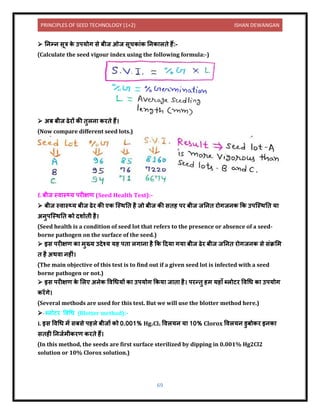
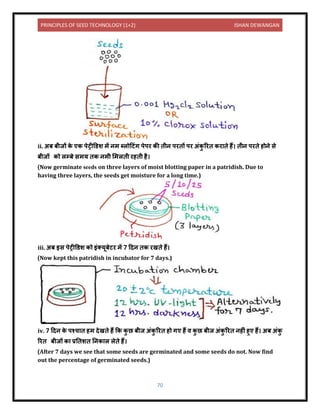
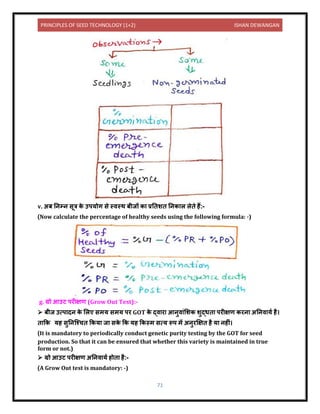
PRINCIPLES OF SEED TECHNOLOGY (1+2) ISHAN DEWANGAN
68
e. बीज ओज परीक्षण (Seed Vigor Test):-
➢ यह परीक्षण इस लसद्ध न्ि पर आध ररि है कक अिुक
ू ल ि ि िरण में कमजोर बीजों की िुलि में ओजपू
णय बीज अधधक िीव्र िर से िृद्धध करिे हैं। इस प्रक र ओजपूणय बीज शीघ्रि से अंक
ु ररि ि उपप चनयि होक
र खेि में स्थ वपि होिे हैं।
(This test is based on the principle that vigorous seeds grow at a more rapid rate than
weak seeds in a favourable environment. In this way, vigorous seeds germinate and
grow quickly and are metabolized in the field.)
➢ विधध (Procedure):- इसमें 3 मुख्य चरण होिे हैं –
(It has 3 main steps -)
i. प्रनिदिि निकलिे ि ले अंक
ु रों की संख्य को धगििे हैं।
(Count the number of seedlings produced daily.)
ii. प्रत्येक बीज ढेर क अंक
ु रण प्रनिशि ज्ञ ि करिे हैं।
(Find the germination percentage of each seed lot.)
iii. प्रत्येक बीज ढेर क
े ललए औसि अंक
ु र लंब ई लमलीमीटर में ज्ञ ि करिे हैं।
(Determine the average seedling length in mm for each seed lot.)
➢ निम्ि सूत्र क
े उपयोग से अंक
ु रण सूचक ंक निक लिे हैं:-
(Calculate the germination index using the following formula: -)
➢ अब बीज ढेरों की िुलि करिे हैं।
(Now compare different seed lots.)
PRINCIPLES OF SEED TECHNOLOGY (1+2) ISHAN DEWANGAN
69
➢ निम्ि सूत्र क
े उपयोग से बीज ओज सूचक ंक निक लिे हैं:-
(Calculate the seed vigour index using the following formula:-)
➢ अब बीज ढेरों की िुलि करिे हैं।
(Now compare different seed lots.)
f. बीज स्ि स््य परीक्षण (Seed Health Test):-
➢ बीज स्ि स््य बीज ढेर की एक क्स्थनि है जो बीज की सिह पर बीज जनिि रोगजिक कक उपक्स्थनि य
अिुपक्स्थनि को िश यिी है।
(Seed health is a condition of seed lot that refers to the presence or absence of a seed-
borne pathogen on the surface of the seed.)
➢ इस परीक्षण क मुख्य उिेश्य यह पि लग ि है कक दिय गय बीज ढेर बीज जनिि रोगजिक से संक्रलम
ि है अथि िहीं।
(The main objective of this test is to find out if a given seed lot is infected with a seed
borne pathogen or not.)
➢ इस परीक्षण क
े ललए अिेक विधधयों क उपयोग ककय ज ि है। परन्िु हम यह ाँ ब्लोटर विधध क उपयोग
करेंगे।
(Several methods are used for this test. But we will use the blotter method here.)
➢ ब्लोटर विधध (Blotter method):-
i. इस विधध में सबसे पहले बीजों को 0.001% Hg2Cl2 विलयि य 10% Clorox विलयि र्ुबोकर इिक
सिही निजयमीकरण करिे हैं।
(In this method, the seeds are first surface sterilized by dipping in 0.001% Hg2Cl2
solution or 10% Clorox solution.)
PRINCIPLES OF SEED TECHNOLOGY (1+2) ISHAN DEWANGAN
70
ii. अब बीजों क
े एक पेट्रीडर्श में िम ब्लोदटंग पेपर की िीि परिों पर अंक
ु ररि कर िे हैं। िीि परिे होिे से
बीजों को लम्बे समय िक िमी लमलिी रहिी है।
(Now germinate seeds on three layers of moist blotting paper in a patridish. Due to
having three layers, the seeds get moisture for a long time.)
iii. अब इस पेट्रीडर्श को इंतयूबेटर में 7 दिि िक रखिे हैं।
(Now kept this patridish in incubator for 7 days.)
iv. 7 दिि क
े पश्च ि हम िेखिे हैं कक क
ु छ बीज अंक
ु ररि हो गए हैं ि क
ु छ बीज अंक
ु ररि िहीं हुए हैं। अब अंक
ु
ररि बीजों क प्रनिशि निक ल लेिे हैं।
(After 7 days we see that some seeds are germinated and some seeds do not. Now find
out the percentage of germinated seeds.)
PRINCIPLES OF SEED TECHNOLOGY (1+2) ISHAN DEWANGAN
71
v. अब निम्ि सूत्र क
े उपयोग से स्िस्थ बीजों क प्रनिशि निक ल लेिे हैं:-
(Now calculate the percentage of healthy seeds using the following formula: -)
g. ग्रो आउट परीक्षण (Grow Out Test):-
➢ बीज उत्प िि क
े ललए समय समय पर GOT क
े द्ि र आिुि ंलशक शुद्धि परीक्षण करि अनिि यय है।
ि कक यह सुनिक्श्चि ककय ज सक
े कक यह ककस्म सत्य रूप में अिुरक्षक्षि है य िहीं।
(It is mandatory to periodically conduct genetic purity testing by the GOT for seed
production. So that it can be ensured that whether this variety is maintained in true
form or not.)
➢ ग्रो आउट परीक्षण अनिि यय होि है:-
(A Grow Out test is mandatory: -)
PRINCIPLES OF SEED TECHNOLOGY (1+2) ISHAN DEWANGAN
72
i. उि संकरों क
े ललए क्जन्हें हस्ि विपुंसि ि हस्ि पर गण क
े द्ि र उत्पन्ि ककय गय है।
(For hybrids that have been produced by hand emasculation and hand pollination.)
ii. उि जिक िंशक्रमों की शुद्धि क
े परीक्षण क
े ललए क्जन्हें संकर बीज उत्प िि में उपयोग ककय ज ि है।
(For testing the purity of parent lines that are to be used in hybrid seed production.)
SEED TREATMENT, ITS IMPORTANCE, METHOD OF
APPLICATION AND SEED PACKING
बीज उपच र (Seed Treatment):-
1. पररचय (Introduction):-
• बीज की सिह अथि बीज क
े अंिर अथि मृि में किक, जीि णु, ि यरस, कीट आदि हो सकिे हैं जो
अंक
ु र को संक्रलमि कर सकिे हैं। संक्रलमि फसली पौधों की िृद्धध िर कम हो ज िी है। इससे उिकी उपज
ि उत्प ि की गुणित्त भी कम हो ज िी है।
(There may be fungi, bacteria, viruses, insects etc. on the surface of the seed or inside the
seed or in the soil which can infect the seedling. The growth rate of infected crop plants
decreases. This also reduces the yield and product quality.)
• बीज उपच र (Seed Treatment):- यह बीज क
े ललए किकि शी, कीटि शी य िोिों क
े संयोजि
में अिुप्रयोग को प्रिलशयि करि है ि कक बीज जनिि य मृि जनिि रोगजिकों और भंर् रण कीटों
से उन्हें कीट णुरदहि ककय ज सक
े ।
(It refers to the application of fungicide, insecticide, or a combination of both, to seeds so as
to disinfect them from seed-borne or soil-borne pathogenic organisms and storage insects.)
• उद्िेश्य (Purpose):- रोगजिक, कीट ि अन्य पीड़क आदि बीज ि अंक
ु र पर आक्रमण करिे हैं। इन्हें
भंर् रण ि रोपण क
े पश्च ि कम करिे, नियंबत्रि करिे ि प्रनिकवषयि करिे क
े उद्िेश्य से ही बीज उपच र
ककय ज ि है।
(Pathogens, insects and other pests etc. attack seeds and seedlings. Seed treatment is
done with the aim of reducing, controlling and repelling them after storage and
planting.)
• महत्ि (Importance):-
i. प िप रोगों क
े फ
ै ल ि को रोकि है।
(Prevents spread of plant diseases.)
ii. बीज को सड़ि और अंक
ु र को झुलसिे से रक्ष करि है।
(Protects seed from seed rot and seedling blights.)
iii. अंक
ु रण में सुध र करि है।
(Improves germination.)
PRINCIPLES OF SEED TECHNOLOGY (1+2) ISHAN DEWANGAN
73
iv. भंर् रण कीटों से सुरक्ष प्रि ि करि है।
(Provides protection from storage insects.)
v. मृि कीटों को नियंबत्रि करि है।
(Controls soil insects.)
2. प्रक र (Types):-
a. बीज कीट णुशोधि (Seed disinfection):- यह किकीय बीज णुओं क
े उन्मूलि को प्रिलशयि करि है
जो बीज चोल क
े भीिर य और अधधक गहरे क्स्थि ऊिकों स्थ वपि हो गए हैं। प्रभ िी नियंत्रण क
े
ललए, किकि शी उपच र को ि स्िि में उपक्स्थि किक को म रिे क
े ललए बीज क
े अंिर घुसि
च दहए।
(It refers to the eradication of fungal spores that have become established within the seed coat,
or in more deep-seated tissues. For effective control, the fungicidal treatment must actually
penetrate the seed in order to kill the fungus that is present.)
b. बीज ककट णुि शि (Seed disinfestation):- यह सिह जनिि सूक्ष्मजीिों क
े विि श को प्रिलशयि
करि है क्जन्होंिे बीज की सिह को संिूवषि ककय है परन्िु बीज की सिह को संक्रलमि िहीं ककय
है। रस यि में र्ुबोि , लभगोि , किकि शी क धूल, ग र य िरल क
े रूप में उपयोग सफल प य गय
है।
(It refers to the destruction of surface-borne organisms that have contaminated the seed
surface but not infected the seed surface. Chemical dips, soaks, fungicides applied as dust,
slurry or liquid have been found successful.)
c. बीज संरक्षण (Seed Protection):- बीज संरक्षण क उद्िेश्य मृि में उपक्स्थि सूक्ष्मजीिों से बीज
और िरुण अंक
ु र की सुरक्ष करि है, जो अन्यथ अंक
ु रण से पहले बीज क क्षय कर सकिे हैं।
(The purpose of seed protection is to protect the seed and young seedling from organisms in the
soil which might otherwise cause decay of the seed before germination.)
िोट
(Note):- कीटि शी य किकि शी से उपच ररि बीज म िि उपभोग क
े अयोग्य होिे हैं जबकक Protectan
ts (Malathion, Reldan) से उपच ररि बीज म िि उपभोग क
े योग्य होिे हैं।
[Seeds treated with insecticides or fungicides are unfit for human consumption while
seeds treated with Protectants (Malathion, Reldan) are fit for human consumption.]
3. पररक्स्थनिय ाँ क्जिमें बीज को उपच ररि करि च दहए (Conditions under which seed must be
treated):-
a. क्षनिग्रस्ि बीज (Injured Seeds):- एक बीज क
े बीज चोल में कोई भी क्षनि, किक को बीज में
प्रिेश करिे और उसे म रिे क उत्कृ टट अिसर िेि है, य उससे उत्पन्ि होिे ि ले अंक
ु र को जग
िेि है। बीज संयोजि और थ्रेलशंग ऑपरेशि क
े िौर ि य अत्यधधक ऊ
ं च ई से धगर ए ज िे क
े िौर ि
बीज को य ंबत्रक क्षनि होिी है। िे मौसम य अिुधचि भंर् रण से भी क्षनिग्रस्ि हो सकिे हैं।
(Any break in the seed coat of a seed affords an excellent opportunity for fungi to enter the
seed and either kill it, or awaken the seedling that will be produced from it. Seeds suffer
mechanical injury during combining and threshing operations, or from being dropped from
excessive heights. They may also be injured by weather or improper storage.)
PRINCIPLES OF SEED TECHNOLOGY (1+2) ISHAN DEWANGAN
74
b. रोगी बीज (Diseased seed):- फसल की कट ई क
े समय भी रोगजिकों से बीज संक्रलमि हो सकि
है, अथि संस धि क
े िौर ि संक्रलमि हो सकि है यदि िूवषि मशीिरी पर संस धधि ककय ज ि है
य िूवषि क
ं टेिरों य गोि मों में संग्रदहि ककय ज ि है।
(Seed may be infected by disease organisms even at the time of harvest, or may become infected
during processing, if processed on contaminated machinery or if stored in contaminated
containers or warehouses.)
c. अि ंनछि मृि पररक्स्थनिय ाँ (Undesirable soil conditions):- बीज कभी-कभी प्रनिक
ू ल मृि
पररक्स्थनियों जैसे िंर्ी और िम मृि , य अत्यंि शुटक मृि में रोवपि ककए ज िे हैं। ऐसी प्रनिक
ू ल
मृि पररक्स्थनिय ं क
ु छ किकीय बीज णुओं की िृद्धध और विक स क
े ललए अिुक
ू ल हो सकिी हैं,
क्जससे िे बीज पर हमल करक
े उन्हें क्षनि पहुंच सकिे हैं।
(Seeds are sometimes planted under unfavourable soil conditions such as cold and damp soils,
or extremely dry soils. Such unfavourable soil conditions may be favourable to the growth and
development of certain fungi spores enabling them to attack and damage the seeds.)
d. रोग मुति बीज (Disease-free seed):- बीज को रोगजिकों द्ि र बबि ककसी आधथयक ह नि से
लेकर गंभीर आधथयक ह नि िक अनिक्श्चि रूप से संक्रलमि ककय ज ि है। बीज उपच र रोगों, मृि
जनिि सूक्ष्मजीिों क
े प्रनि एक अच्छी सुरक्ष प्रि ि करि है और इस प्रक र कमजोर बीजों को
संरक्षण िेि है क्जससे िे अंक
ु ररि होिे हैं और अंक
ु र पैि करिे हैं।
(Seeds are invariably infected, by disease organisms ranging from no economic consequence to
severe economic consequences. Seed treatment provides a good insurance against diseases,
soil-borne organisms and thus affords protection to weak seeds enabling them to germinate and
produce seedlings.)
4. Seed Pests:-
a. जीि णु ि किक (Bacteria and Fungi):-
➢ बीज में विलगि (rot) ि अपक्षय (decay) उत्पन्ि करिे हैं।
(They produce rot and decay in the seed.)
➢ अंक
ु र में Blight ि Smut उत्पन्ि करिे हैं।
(They produce blight and smut in the seedlings.)
b. मृि कीट (Soil Insects):-
➢ Seed corn maggot
➢ Wire worms
c. भंर् रण कीट (Storage Insects):-
➢ Weevil
➢ Moth larvae
➢ Beetles
d. पक्षी ि मूषक (Birds and Rodents):- ये भंर् ररि बीजों, रोवपि बीजों ि अंक
ु रों को ख िे हैं।
(They feed on stored seeds, planted seeds and seedlings.)
5. Ideal chemical for seed treatment:-
PRINCIPLES OF SEED TECHNOLOGY (1+2) ISHAN DEWANGAN
75
➢ No phytotoxicity:- बीज क
े ललए घ िक िहीं होि च दहए।
(It should not be lethal to the seed.)
➢ लम्बे समय िक स्थ यी होि च दहए।
(It should be stable for long duration.)
➢ बीज को समरूप लेपि प्रि ि करे।
(It should provide homogeneous coating to the seed.)
➢ अच्छी िरह से बीज से धचपक ज ये।
(It should stick well with the seeds.)
➢ मन्ि (Dull) य अि कवषयि दिख िट (unattractive appearance) ि हो।
(It does not have dull or unattractive appearance.)
➢ Seed drill machine में seed flow पर प्रभ ि र् लिे ि ल ि हो।
(Seed drill machine must not affect the seed flow.)
➢ सस्ि होि च दहए।
(It should be cheap.)
➢ उपयोग क
े ललए पंजीकृ ि होि च दहए।
(It must be registered for use.)
6. Equipments for seed treatment:-
a. Drum Mixer:-
➢ इसक उपयोग िब करिे हैं जब रस यि प उर्र रूप में होि है।
(It is used when the chemical is in powder form.)
➢ 10 – 15Kg बीज को प्रनि र उंर् उपच ररि करिे हैं।
(10 - 15 Kg seed is treated per round.)
b. Slurry treater:-
➢ इसक उपयोग िब करिे हैं जब रस यि को जल में घोलकर निलम्बि द्रि (Slurry) बि य ज ि है।
(It is used when the chemical is dissolved in water to make a slurry.)
➢ Slurry ि बीजों को Slurry cup में र् लिे हैं और Seed drum pan में mixing होिी है।
(Slurry and seeds are put in the Slurry cup and mixing is done in the Seed drum pan.)
PRINCIPLES OF SEED TECHNOLOGY (1+2) ISHAN DEWANGAN
76
c. Direct treater:-
➢ इसे Mist – o – matic treater भी कहिे हैं।
(It is also called Mist - o - matic treater.)
➢ यह Most recent development है।
(This is the most recent development.)
➢ इसमें रस यि की एक Mist क
े रूप में बीजों पर स्प्रे की ज िी है।
(In this, the chemical is sprayed on the seeds in the form of a mist.)
d. Grain Auger:-
➢ यह एक ऐस उपकरण है जो बीज प त्रों को बीज से भरिे क
े क म में ललय ज ि है।
(It is a device used to fill seed containers with seeds.)
➢ 3 – 4 स्थ िों पर Auger में द्रि रस यि की dripping की व्यिस्थ की ज िी है।
PRINCIPLES OF SEED TECHNOLOGY (1+2) ISHAN DEWANGAN
77
(Dripping of liquid chemical is arranged in Auger at 3 - 4 places.)
e. Shovel:-
➢ बीजों को एक clean dry surface पर फ
ै ल लेिे हैं। गहर ई 10 – 15cm होिी च दहए।
(Spread the seeds on a clean dry surface. Depth should be 10 - 15cm.)
➢ रस यि को जल से ििु करक
े बीजों पर sprinkling की ज िी है।
(The chemical is diluted with water and sprinkling is done on the seeds.)
➢ अब Shovel की सह यि से स थ – स थ mixing करिे रहिे हैं। इस प्रकक्रय को 20 ब र िोहर िे हैं।
(Now keep mixing together with the help of Shovel. Repeat this process 20 times.)
7. विधधय ाँ (Methods):-
a. बीज ड्रैलसंग (Seed dressing):- यह बीज उपच र की सबसे स म न्य विधध है। बीज की य िो सूखे
प उर्र क
े स थ ड्रैलसंग की ज िी है य घोल य द्रि क
े स थ िम उपच ररि ककय ज ि है। ड्रैलसंग
खेि ि उद्योग िोिों पर की ज सकिी है। कम ल गि ि ले लमट्टी क
े गमलों क उपयोग
कीटि शकों को बीज क
े स थ लमधिि करिे क
े ललए ककय ज सकि है य बीज को एक पॉलीथीि
PRINCIPLES OF SEED TECHNOLOGY (1+2) ISHAN DEWANGAN
78
शीट पर फ
ै ल य ज सकि है और आिश्यक म त्र में रस यिों को बीज ढेर पर नछड़क ज सकि है
और य ंबत्रक रूप से ककस िों द्ि र लमधिि ककय ज सकि है।
(This is the most common method of seed treatment. The seed is dressed with either a dry
formulation or wet treated with a slurry or liquid formulation. Dressings can be applied at
both farm and industries. Low cost earthen pots can be used for mixing pesticides with seed or
seed can be spread on a polythene sheet and required quantity of chemical can be sprinkled on
seed lot and mixed mechanically by the farmers.)
b. बीज कोदटंग (Seed coating):- एक विशेष ब ंधिे ि ले रस यि क उपयोग मुख्य रस यि क
े स थ
करिे से बीज से धचपकिे की क्षमि बढ़ ज िी है। कोदटंग क
े ललए उद्योग द्ि र उन्िि उपच र
िकिीक की आिश्यकि होिी है।
(A special binder is used with a formulation to enhance adherence to the seed. Coating requires
advanced treatment technology, by the industry.)
c. बीज पैलेदटंग (Seed pelleting):- सबसे पररटकृ ि बीजोपच र िकिीक, क्जसक
े पररण मस्िरूप बीज
की भौनिक आकृ नि को बिलिे क
े ललए पैलेट निम यण क्षमि और हैंर्ललंग को बढ़ य ज ि है।
Pelleting को विशेष अिुप्रयोग मशीिरी और िकिीकों की आिश्यकि होिी है और यह सबसे
महंग अिुप्रयोग है।
(The most sophisticated Seed Treatment Technology, resulting in changing physical shape of a
seed to enhance pelletibility and handling. Pelleting requires specialized application machinery
and techniques and is the most expensive application.)
8. बीज उपच र में स िध निय ाँ (Precautions in Seed Treatment:-)
➢ बीज क
े उपच र में उपयोग ककए ज िे ि ले अधधक ंश उत्प ि मिुटयों क
े ललए ह निक रक होिे हैं,
परन्िु िे बीज क
े ललए भी ह निक रक हो सकिे हैं। यह सुनिक्श्चि करिे क
े ललए अत्यधधक स िध िी
की आिश्यकि है कक उपच ररि बीज क उपयोग म िि य पशु भोजि क
े रूप में कभी िहीं ककय
ज ि है। इस संभ िि को कम करिे क
े ललए, उपच ररि बीज को स्पटट रूप से लेबल ककय ज ि
च दहए, यदि इि बीजों को ख ि स्ि स््य क
े ललए ह निक रक है। बबि बबक
े उपच ररि बीज क
उपयोग म िि य पशु च र क
े ललए करिे क
े प्रलोभि से बच ज सकि है यदि स िध िीपूियक बीज
की क
े िल उििी ही म त्र को उपच ररि करि च दहए क्जसक
े ललए बबक्री क आश्ि सि दिय ज ि
है।
(Most products used in the treatment of seeds are harmful to humans, but they can also be
harmful to seeds. Extreme care is required to ensure that treated seed is never used as human
or animal food. To minimise this possibility, treated seed should be clearly labelled as being
dangerous, if consumed. The temptation to use unsold treated seed for human or animal feed
can be avoided if care is taken to treat only the quantity for which sales are assured.)
➢ सही िर पर बीज क
े उपच र क
े ललए भी स िध िी रखी ज िी च दहए; बहुि अधधक य बहुि कम
रस यि से उपच ररि करि ह निक रक हो सकि है क्जिि कक कभी भी बबि उपच र क
े हो सकि
है। बहुि ही उच्च िमी युति बीज क्षनि क
े ललए अनिसंिेििशील होिे हैं जब क
ु छ स न्द्र द्रि उत्प िों
क
े स थ उपच ररि ककय ज ि है।
PRINCIPLES OF SEED TECHNOLOGY (1+2) ISHAN DEWANGAN
79
(Care must also be taken to treat seed at the correct dosage rate; applying too much or too little
material can be as damaging as never treating at all. Seed with a very high moisture content is
very susceptible to injury when treated with some of the concentrated liquid products.)
➢ यदि बीज क उपच र जीि णु संिधयिों क
े स थ भी ककय ज ि है, िो बीज उपच र निम्ि क्रम में
ककय ज ि च दहए: -
(If the seeds are to be treated with bacterial cultures also, the order in which seed treatments
should be done shall be as follows:-)
i. र स यनिक उपच र
(Chemical treatments)
ii. कीटि शक और किकि शी उपच र
(Insecticide and fungicide treatments)
iii. विशेष उपच र
(Special treatments)
9. विलभन्ि फसलों क
े ललए बीज उपच र की लसफ ररशें (Recommendation of seed treatment for
different crops):-
PRINCIPLES OF SEED TECHNOLOGY (1+2) ISHAN DEWANGAN
80
बीज पैककं ग (Seed packing):- यह बीज से थैलों को भरिे, िौलिे और लसल ई करिे की प्रकक्रय है।
एक आिशय भंर् रण सुविध को निम्िललखखि आिश्यकि ओं को पूर करि च दहए: -
(It is the process of filling, weighing and sewing of bags with seed. An ideal storage facility
should satisfy the following requirements:-)
➢ इसे जमीि की िमी, ब ररश, कीट पीड़क, मोल्र्, कृ न्िकों, पक्षक्षयों आदि से अधधकिम संभि सुरक्ष
प्रि ि करिी च दहए।
(It should provide maximum possible protection from ground moisture, rain, insect pests,
moulds, rodents, birds etc.)
➢ इसे निरीक्षण, कीट णुशोधि, लोडर्ंग, उिर ई, सफ ई और मरम्मि क
े ललए आिश्यक सुविध प्रि ि
करिी च दहए।
(It should provide the necessary facility for inspection, disinfection, loading, unloading,
cleaning and reconditioning.)
➢ इसे बीजों को अत्यधधक िमी और ि पम ि से बच ि च दहए जो कीट और किक िोिों क
े विक स
क
े ललए अिुक
ू ल होिे हैं।
(It should protect seeds from excessive moisture and temperature favourable to both insect
and mould development.)
➢ यह एक विशेष क्स्थनि क
े ललए ककफ यिी और उपयुति होि च दहए।
(It should be economical and suitable for a particular situation.)
पैककं ग स मग्री क चयि करिे समय ध्य ि में रखिे ि ले क रक (The factors to be considered
while selecting the packaging materials are):-
➢ पैक ककए ज िे ि ले बीज क प्रक र
(Kind of seeds to be packed)
PRINCIPLES OF SEED TECHNOLOGY (1+2) ISHAN DEWANGAN
81
➢ बीज की म त्र
(Quantity of seed)
➢ बीज क मूल्य
(Value of seed)
➢ पैक
े क्जंग स मग्री की ल गि
(Cost of packaging material)
➢ भंर् रण ि ि िरण क्जसमें पैक स मग्री रखी ज एगी
(Storage environment in which the packed materials will be held)
➢ भंर् रण की अिधध
(Period of storage)
➢ बीज क पररिहि
(Transport of seed)
7. SEED STORAGE;GENERAL PRINCIPLES, STAGES
AND FACTORS AFFECTING SEED LONGEVITY
DURING STORAGE. MEASURES FOR PEST AND
DISEASE CONTROL
बीज भंर् रण (Seed Storage):-
1. बीज भंर् रण क स म न्य लसद्ध न्ि (General Principle of Seed Storage):-
• प्र कृ निक ि ि िरण ि कमरे की पररक्स्थनियों में स पेक्षक्षक आद्रयि ि ि पम ि लग ि र पररिनियि हो
िे रहिे हैं। भंर् ररि बीजों को इिक स मि करि पड़ि है।
(In the natural environment and room conditions, the relative humidity and
temperature are constantly changing. Stored seeds have to face it.)
• यदि हम बीजों को नियंबत्रि पररक्स्थनियों में अिुरक्षक्षि कर लें िो हम:-
(If we maintain the seeds under controlled conditions then we:-)
i. बीजों की उप पचय कक्रय को कम कर सकिे हैं।
(can reduce the metabolism of seeds.)
PRINCIPLES OF SEED TECHNOLOGY (1+2) ISHAN DEWANGAN
82
ii. बीजों की जीणयि प्रकक्रय को कम कर सकिे हैं।
(can reduce the ageing of seeds.)
iii. बीज ढेर की िीघ ययुि को बढ़ सकिे हैं।
(can increase the longevity of the seed lot.)
• अधधक ंश बीजों क
े ललए िंर् ि शुटक ि ि िरण उपयुति म ि ज ि है।
(A cool and dry environment is considered suitable for most seeds.)
2. िियम ि क्स्थनि (Present Situation):-
• विक सशील िेशों में फसल कट ई से उपभोग िक 25 – 50% िक grain
value की ह नि हो ज िी है।
(In developing countries there is a loss of grain value up to 25 - 50% from harvesting to
consumption.)
Grain Value = Quality + Quantity
• उपरोति स रणी से स्पटट है कक grain
value की अधधकिम ह नि Storage ि Milling क
े िौर ि होिी है।
(It is clear from the above table that maximum loss of grain value occurs during storage
and milling.)
• Post harvest loss क
े क रण (Causes of post harvest loss):-
i. भंर् रण क
े ललए कमजोर उत्प ि (Poor product) आि है।
(Poor product for storage.)
ii. खर ब भंर् रण प्रबंधि
(Poor storage management)
PRINCIPLES OF SEED TECHNOLOGY (1+2) ISHAN DEWANGAN
83
iii. खर ब लमललंग िकिीक
ें
(Poor milling techniques)
3. बीज अपक्षय (Seed
Deterioration):- बीज की भंर् रण आयु में कमी की प्रकक्रय को बीज अपक्षय कहिे हैं।
(The process of reduction in the storage life of seeds is called seed deterioration.)
• बीज िमी पर स (Seed moisture range) = 5 – 14%
इस पर स में यदि 1% बीज िमी को बढ़ िे हैं िो बीज अपिी आधी भंर् रण आयु खो िेि है।
(If 1% of the seed moisture increase in this range, the seed loses half of its storage life.)
• भंर् रण ि पम ि पर स (Storage temperature range) = 0°C – 50°C
इस पर स में यदि 5°C भंर् रण ि पम ि को बढ़ िे हैं िो बीज अपिी आधी भंर् रण आयु खो िेि है।
(If you increase the storage temperature by 5 ° C in this range, the seed loses half of its
storage life.)
4. बीज िीघ ययुि को प्रभ विि करिे ि ले क रक (Factors affecting seed longevity):-
• बीज प्रक र (Seed type)
• बीज गुणित्त (Seed quality)
• संरक्षक्षि बीज चोल की अखंर्ि (Integrity of the protective seed coat)
• बीज िमी म त्र (Seed moisture content)
• भंर् रण ि ि िरण (Storage environment)
5. बीजों क
े प्रक र (Types of seeds):- बीज िीघ ययुि क
े आध र पर बीज 3 प्रक र क
े होिे हैं –
(There are 3 types of seeds based on seed longevity -)
a. Orthodox Seeds
b. Recalcitrant Seeds
c. Intermediate Seeds
a. Orthodox Seeds:-
➢ इन्हें लम्बे समय िक भंर् ररि ककय ज सकि है इसललए इन्हें Long lived seeds भी कहिे हैं।
(They can be stored for a long time, hence they are also called long lived seeds.)
➢ ऐसे बीज क्जन्हें कम िमी प्रनिशि िक बबि क्षनि हुए सुख य ज सकि है, ओथोर्ॉतस बीज कहल िे
हैं।
(Seeds that can be dried to a low moisture percentage without damaging, are called
orthodox seeds.)
➢ ये बीज 5% िमी प्रनिशि िक क
े शुटकि को सहि कर सकिे हैं। अथ यि इिकी जीिि क्षमि में ह नि
िहीं होगी।
(These seeds can tolerate drying up to 5% moisture content. That is, there will be no loss
in their viability.)
PRINCIPLES OF SEED TECHNOLOGY (1+2) ISHAN DEWANGAN
84
➢ इन्हें कम ि पम ि पर भंर् ररि ककय ज सकि है।
(They can be stored at low temperatures.)
➢ उि हरण (Examples):- ध ि, मतक आदि।
(Rice, Maize etc.)
b. Recalcitrant Seeds:-
➢ इन्हें लम्बे समय िक भंर् ररि िहीं ककय ज सकि तयोंकक सूखिे पर ये जीविि िहीं रह सकिे। इस
ललए इन्हें Short lived seeds भी कहिे हैं।
(They cannot be stored for a long time because they cannot survive on drying. Therefore,
they are also called short lived seeds.)
➢ ऐसे बीज क्जन्हें कम िमी प्रनिशि िक बबि क्षनि हुए सुख य िहीं ज सकि है, ररक
ै ल्सीट्रेंट बीज कह
ल िे हैं। 15 – 20% िमी िक सुख िे पर इिकी मृत्यु हो ज िी है।
(Seeds that cannot be dried to a low moisture percentage without damaging, are called
recalcitrant seeds. They die upon drying to 15 - 20% moisture.)
➢ इन्हें कम ि पम ि पर भंर् ररि िहीं ककय ज सकि ।
(They cannot be stored at low temperatures.)
➢ उि हरण (Examples):- आम, कटहल आदि।
(Mango, Jack fruit etc.)
c. Intermediate Seeds:-
➢ इन्हें भी लम्बे समय िक भंर् ररि ककय ज सकि है। परन्िु इन्हें कम ि पम ि पर भंर् ररि िहीं कर
सकिे तयोंकक इिकी जीिि क्षमि की अधधक िेजी से ह नि हो ज िी है।
(These can also be stored for a long time. However, they cannot be stored at low
temperatures because their viability is rapidly lost.)
➢ ये 10 – 12% िमी की म त्र िक बीजों को बबि क्षनि हुए सुख य ज सकि है।
(These seeds can be dried up to 10 - 12% moisture content without damaging.)
➢ उि हरण (Examples):- ि लें, पपीि , िींबू आदि।
(Pulses, Papaya, Citrus etc.)
6. सफल बीज भंर् रण (Successful Seed Storage):-
• यह निध यररि करिे हैं कक कौिस बीज भंर् ररि हो सकि है।
(Determine which seed can be stored.)
• अब स्िस्थ ि पररपति बीजों को एकबत्रि करिे हैं।
(Now collect healthy and mature seeds.)
• बीजों को पृथक करक
े इिकी सफ ई कर लेिे हैं।
(Separate and clean the seeds.)
• अब भंर् रण क
े ललए बीजों को उपयुति िमी प्रनिशि िक सूख िे हैं।
PRINCIPLES OF SEED TECHNOLOGY (1+2) ISHAN DEWANGAN
85
(Now dry the seeds up to the appropriate moisture percentage for storage.)
• क
ु छ बीजों को अंक
ु ररि करक
े िेखिे हैं कक िे अच्छी अिस्थ में हैं, िभी बीजों को भंर् रण क
े ललए पैक
करिे हैं।
(Germinate some seeds and see that they are in good condition, then pack the seeds for
storage.)
• अब बीजों को भंर् ररि करिे हैं।
(Now store the seeds.)
• यदि बीजों को लंबे समय क
े ललए भंर् ररि ककय है िो समय – समय पर बीज िमूिे लेकर अंक
ु ररि क
रक
े यह सुनिक्श्चि करिे रहिे हैं कक बीज अभी िक अच्छी अिस्थ में हैं।
(If the seeds are stored for a long time, then periodically take seed samples and
germinate them to ensure that the seeds are still in good condition.)
7. बीज भंर् रण क
े िौर ि अिुरक्षण (Maintenance during Seed Storage):-
a. िंर्ी पररक्स्थनियों को बि ए रखि (Maintain Cool Conditions):-
➢ बीजों को सूयय क
े प्रक श से िूर ककसी िंर्े स्थ ि पर रखिे हैं ि कक ि पम ि में विविधि ि हो।
(Store the seeds in a cool place away from sunlight so that the temperature does not
vary.)
➢ बीजों को निम्ि स्थ िों पर भंर् ररि कर सकिे हैं:-
(Seeds can be stored at the following places: -)
i. Cold closet
ii. Basement
iii. A room on the north side of your home that remains cool throughout the year
➢ लघुक ललक भंर् रण क
े ललए दहमीकरण की आिश्यकि िहीं होिी है। परन्िु बीजों को पूणय रूप से सुख
कर फ्रीजर में भंर् ररि कर सकिे हैं।
(Short-term storage does not require freezing. But seeds can be dried completely and
stored in the freezer.)
b. शुटक पररक्स्थनियों को बि ए रखि (Maintain Dry Conditions):-
➢ बीजों को क
ं टेिर में सील करिे से पहले यह सुनिक्श्चि करिे हैं कक कहीं बीज अधधक िम िो िहीं हैं। अ
गर बीज अधधक िम हों िो उन्हें सुख य ज ि है।
(Before sealing the seeds in the container, ensure that the seeds are not too moist. If the
seeds are more moist then they should be dried.)
➢ फ्रीजर में भंर् रण (Storing in Freezer):- यदि बीज बहुि अधधक िम हैं िो इिकी rotting य Frost
damaging हो सकिी है।
(If the seeds are too moist, they may be rotting or frost damaging.)
➢ बीजों को ि युरुद्ध क
ं टेिर में रख ज ि है।
(The seeds are kept in airtight containers.)
PRINCIPLES OF SEED TECHNOLOGY (1+2) ISHAN DEWANGAN
86
8. भंर् रण में बीज िीघ ययुि को प्रभ विि करिे ि ले क रक (Factors Affecting Seed Longevity in
Storage):-
a. बीज क प्रक र (Kind of Seed):- क
ु छ फसलों क
े बीज प्र कृ निक रूप से short
lived होिे हैं। उि हरण:- तय ज, सोय बीि आदि।
(The seeds of some crops are naturally short lived. Examples: Onion, Soybean etc.)
b. प्र रक्म्भक बीज गुणित्त (Initial Seed
Quality):- ओजपूणय ि अिअपक्षनयि बीजों की बीज िीघ ययुि अधधक होिी है जबकक कमजोर ि अपक्षनय
ि बीजों की बीज िीघ ययुि कम होिी है।
(The seed longevity of the vigorous and un-deteriorated seeds is high while the seed
longevity of the weak and deteriorated seeds is low.)
c. िमी प्रनिशि (Moisture
Content):- बीजों क
े भंर् रण क ल ि िमी प्रनिशि में ऋण त्मक सम्बंध होि है।
(There is a negative correlation between the storage life and moisture percentage of the
seeds.)
d. स पेक्षक्षक आद्रयि ि ि पम ि (Relative Humidity and
Temperature):- भंर् रण क
े ललए यह आिश्यक कक ि युमंर्ल की स पेक्षक्षक आद्रयि बीज िमी प्रनिशि क
े
लगभग बर बर होिी च दहए। भंर् रण क
े ललए ि पम ि भी उपयुति होि च दहए।
(For storage it is necessary that the relative humidity of the atmosphere should be
approximately equal to the seed moisture percentage. The temperature should also be
suitable for storage.)
PRINCIPLES OF SEED TECHNOLOGY (1+2) ISHAN DEWANGAN
87
e.
O2 ि ब (O2 Pressure):- बीजों क
े भंर् रण क ल ि O2 ि ब में ऋण त्मक सम्बंध होि है। O2 ि ब को कम
करिे क
े ललए Anti – oxidants क उपयोग कर सकिे हैं।
(There is a negative correlation between the storage life of the seeds and O2 pressure.
Anti-oxidants can be used to reduce O2 pressure.)
9. Measures for Pest and Disease Control during Storage:-
a. स्िछि (Sanitation):-
➢ बीज भंर् र में अच्छी स्िच्छि रखिे से कीटों ि क्रन्िकों से सुरक्ष हो ज िी है।
(Keeping good hygiene in seed stores protects from insects and rodents.)
➢ बीज भण्र् र की अच्छे से सफ ई करिी च दहए।
(The seed store should be thoroughly cleaned.)
➢ िषय में एक ब र बीज भण्र् र में कीटि शी क नछड़क ि करि च दहए।
(Insecticide should be sprayed once a year in the seed store.)
उि हरण (Examples):- DDT, Lindane, Malathion
b. बीज उपच र (Seed Treatment):-
➢ कीटि शी ि किकि शी को संयोजि में एक संरक्षक क
े रूप में उपयोग कर सकिे हैं।
(Insecticides and fungicides can be used as a preservative in combination.)
➢ DDT सबसे अधधक स म न्य रूप से उपयोग ककय ज ि है। इसक प्रभ ि लम्बे समय िक बि रहि
है।
(DDT is most commonly used. Its effect lasts for a long time.)
c. धूमि (Fumigation):-
➢ यह क
े िल ि युरुद्ध भण्र् र में प्रभ िी होि है।
(It is effective only in air-tight stores.)
➢ इसकी उपयुति र्ोज कीटों को प्रभ िी रूप से नियंबत्रि करिी हैं।
PRINCIPLES OF SEED TECHNOLOGY (1+2) ISHAN DEWANGAN
88
(Its appropriate doses effectively control insects.)
➢ इसकी अधधक स ंद्रि बीज अंक
ु रण पर विपरीि प्रभ ि र् लिी है।
(Its high concentration adversely affects seed germination.)
➢ 30°C से कम ि पम ि ि 12% से कम बीज िमी पर निम्ि रस यिों क उपयोग धूमि क
े ललए कर स
किे हैं:-
(At temperatures below 30°C and less than 12% seed moisture, the following chemicals
can be used for fumigation: -)
i. Methyl bromide
ii. Hydrogen cyanide
iii. Phosphine
iv. Phostoxin
v. Ethylene dichloride
vi. Carbon tetra chloride
vii. Carbon disulfide
viii. Naphthalene
d. बीज िमी प्रनिशि (Seed Moisture Content):-
➢ 8% से कम बीज िमी प्रनिशि पर कोई भी कीट कक्रय िहीं होिी है। यह बीज िमी प्रनिशि बीज भंर् र
ण क
े ललए उपयुति होिी है।
(There is no insect activity at less than 8% seed moisture content. This seed moisture
content is suitable for seed storage.)
e. ि पम ि ि स पेक्षक्षक आद्रयि नियंत्रण (Temperature and Relative Humidity Control):-
➢ कम ि पम ि पर बीज जीिि क्षमि ि बीज ओज अधधक रहिे हैं।
(At low temperatures, seed vitality and seed vigour remain high.)
➢ ि पम ि को निम्ि प्रक र नियंबत्रि कर सकिे हैं:-
(We can control the temperature as follows:-)
i. ि ि यि (Ventilation)
ii. ि प िरोधि (Insulation)
iii. प्रशीिि (Refrigeration)
➢ 28°C – 38°C ि पम ि कीट कक्रय क
े ललए उपयुति होि है।
(28°C – 38°C temperature is suitable for insect activity.)
PRINCIPLES OF SEED TECHNOLOGY (1+2) ISHAN DEWANGAN
89
➢ 17°C
– 22°C ि पम ि पर कीट कक्रय िहीं होिी है। इसललए यह ि पम ि बीज भंर् रण क
े ललए उपयुति होि
है।
(There is no insect activity at 17°C – 22°C temperature. Therefore, this temperature is
suitable for seed storage.)
➢ क
ु छ सूक्ष्मजीि 80°C ि पम ि पर भी जीविि रह सकिे हैं। अि: इिक
े नियंत्रण क
े ललए र्ीप फ्रीजर क
उपयोग कर सकिे हैं।
(Some microorganisms can survive even at 80°C temperature. Therefore, you can use
deep freezer to control them.)
➢ 80% से कम स पेक्षक्षक आद्रयि पर जीि णु पूणयिय निक्टक्रय हो ज िे हैं।
(Bacteria inactivate at relative humidity less than 80%.)
➢ 62% से कम स पेक्षक्षक आद्रयि पर किक पूणयिय निक्टक्रय हो ज िे हैं।
(Fungi become completely inactive at less than 62% relative humidity.)
f. भंर् र लेआउट (Store Layout):-
➢ पक्षक्षयों से बच ि क
े ललए Ventilation की Openings Sealed य Screened होिी च दहए।
(Ventilation openings must be sealed or screened to protect from birds.)
➢ कृ न्िकों से बच ि क
े ललए फशय से 0.9m ऊ
ं च ई पर ि पतक होि च दहए।
(To avoid rodents, it should be 0.9m above the floor and made up of concrete.)
8. SEED MARKETING: STRUCTURE AND
ORGANIZATION, SALES GENERATION ACTIVITIES,
PROMOTIONAL MEDIA, FACTORS AFFECTING SEED
PRINCIPLES OF SEED TECHNOLOGY (1+2) ISHAN DEWANGAN
90
MARKETING, ROLE OF WTO AND OECD IN SEED
MARKETING
बीज विपणि (Seed Marketing):-
1. पररचय (Introduction):-
• पररभ ष (Definition):- म ाँग क
े अिुस र बीज क उत्प िि िथ आिश्यकि क
े आध र पर बीज क
वििरण करिे क
े ललए एक ऐसी व्यिस्थ करि क्जससे प्रत्येक ककस ि को आिश्यकि िुस र उच्च गुणि
त्त सम्पन्ि बीज उधचि मूल्य पर सुलभि से लमल सक
े ।
(To arrange the production of seeds according to the demand and distribution of seeds
on the basis of need, so that every farmer can get the required high quality seeds at
reasonable prices.)
• इसमें विलभन्ि स्िरों पर सलमनियों य इक इयों को स्थ वपि ककय ज ि है जो निम्ि बबन्िुओं क
े आ
ध र पर क यय करिी हैं:-
(In this, committees or units are set up at different levels which work on the basis of the
following points: -)
i. पूरे क्षेत्र की आिश्यकि
(Requirement of Whole area)
ii. ब ज र की क्स्थनि
(Location of the market)
iii. विपणि िथ वििरण की व्यिस्थ
(Marketing and distribution system)
iv. निजी बीज वििरकों ि विक्र
े ि ओं की नियुक्ति
(Appointment of private seed distributors and dealers)
v. पररिहि की उधचि व्यिस्थ
(Arrangement of proper transport)
• इस प्रक र बीज विपणि बीज उध्योग क एक महत्िपूणय अंग है।
(Thus seed marketing is an important part of seed industry.)
• बीज विपणि में निम्ि क अध्ययि ककय ज ि है:-
(The following are studied in seed marketing:-)
i. Acquisition and selling of packed seeds
ii. Intermediate storage
iii. Delivery
iv. Sales promotion activities
2. बीज विपणि क
े मुख्य घटक (Major components of seed marketing):-
PRINCIPLES OF SEED TECHNOLOGY (1+2) ISHAN DEWANGAN
91
a. बीज की म ाँग क पूि यिुम ि (Forecasting of Seed Demand)
b. बीज की आपूनिय (Supply of Seed)
c. बीज ब ज र की संरचि (Structure of Seed Market)
d. बीज विक्रय प्रोत्स हि (Seed Sales Promotion)
a. बीज की म ाँग क पूि यिुम ि (Forecasting of Seed Demand):-
• बीज क उत्प िि बीज की आपूनिय पर निभयर करि है। बीज की आपूनिय बीज की म ाँग पर निभयर करिी
है। इसललए बीज की म ाँग क पूि यिुम ि लग ि अनि महत्िपूणय है।
(The production of seed depends on the supply of seed. Seed supply depends on the
demand for seed. Therefore it is very important to forecast the demand for seeds.)
• इस प्रक र पूि यिुम ि से बीजों क
े उत्प िि ि वििरण की योजि बि िे में सह यि लमलिी है क्जससे
बीजों की कमी क स मि िहीं करि पड़ि और मूल्य ि ल भ क्स्थर बिे रहिे हैं।
(Thus forecasting helps in planning the production and distribution of seeds so that we
do not have to face the shortage of seed and price and profit remain stable.)
• प्रक र (Types):- पूि यिुम ि 2 प्रक र क होि है –
(There are 2 types of forecasts-)
i. अल्पक ललक पूि यिुम ि (Short term
Forecast):- यह विक्र
े ि ओं क
े ललए कोट निध यररि करिे में िथ बीज मूल्य में संशोधि करिे में सह यक
होि है।
(This is helpful in determining the quota for the dealers and in revising the seed price.)
ii. िीघयक ललक पूि यिुम ि (Long Term Forecast):- यह निम्ि में सह यक होि है:-
(It is helpful in: -)
➢ पूंजी नििेश सम्बन्धी निणयय करिे में
(making capital investment decisions)
➢ उत्प िि ि भंर् रण इक इयों क
े स्थ ि क चयि करिे में
(selecting the location of production and storage units)
➢ विपणि क
े Infra – structure को विकलसि करिे में
(developing Infra-structure of marketing)
• िीघयक ललक म ाँग क पूि यिुम ि लग िे क
े ललए िो स ंक्ख्यकीय िकिीकों क उपयोग ककय ज ि है –
(Two statistical techniques are used to forecast long-term demand -)
i. क ल िेणी विश्लेषण (Time Series Analysis)
ii. समय िेणी विश्लेषण (Regression Analysis)
PRINCIPLES OF SEED TECHNOLOGY (1+2) ISHAN DEWANGAN
92
• बीज म ाँग क अिुम ि (Estimation of Seed Demand):-
i. सकल आिश्यकि (Gross requirement):-
ii. क
ु ल ि वषयक आिश्यकि (Net Annual requirement):-
• संकर बीजों की ब ज र म ाँग क आंकलि स्िपर धगि फसलों की िुलि में सरल होि है तयोंकक संकर
बीज प्रत्येक िषय बिले ज िे हैं।
(Assessing the market demand for hybrid seeds is simpler than that of self-pollinated
crops because hybrid seeds are replaced each year.)
• कृ वष िैज्ञ निक प्रत्येक 4 –
5 िषय में बीजों को बिलिे क सुझ ि िेिे हैं। परन्िु व्यिह र में ऐस िहीं होि है। तयोंकक ककस ि आस िी
से िई ककस्म पर विश्ि स िहीं करिे हैं।
(Agriculture scientists suggest changing the seeds every 4-5 years. But in practice this
does not happen. Because the farmers do not easily believe in the new variety.)
• बीज की म ाँग बीज क
े मूल्य ि गुणित्त से निध यररि होिी है।
(The demand for seed is determined by the price and quality of the seed.)
b. बीज की आपूनिय (Supply of Seed):-
• भ रि में बीज की आपूनिय निम्ि क
े द्ि र की ज िी है:-
(Seeds in India are supplied by:-)
i. निजी बीज उत्प िक (Private Seed Growers)
ii. बीज निगम (Seed Corporation)
PRINCIPLES OF SEED TECHNOLOGY (1+2) ISHAN DEWANGAN
93
iii. सहक री सलमनिय ाँ (Co – operatives societies)
• बीज की आपूनिय को निम्ि क रक प्रभ विि करिे हैं:-
(The following factors affect the supply of seed: -)
i. बीज उत्प िि (Seed production)
ii. आध र बीज क
े अंिगयि क्षेत्र (Area under foundation seed)
iii. क्षेत्रीय भंर् रण सुविध (Regional Storage Facilities)
iv. बीज वििरण व्यिस्थ (Seed distribution system)
v. बीज विशेष क मूल्य और म ाँग (Price and Demand of Particular Seed)
i. बीज उत्प िि (Seed production):-
➢ बीज उत्प िि अधधक होिे से बीज की अधधक आपूनिय की ज सकिी है।
(Higher seed production can lead to greater supply of seeds.)
➢ निम्ि क रणों से बीज उत्प िि एक जोखखम भर व्यिस य है:-
(Seed production is a risky business due to the following reasons:-)
✓ उच्च िकिीकी ज िक री च दहए होिी है।
(High technical information is required.)
✓ अत्यधधक वित्तीय उपलब्धि की आिश्यकि होिी है।
(Requires extreme financial availability.)
✓ बीज प्रम खणि ि होिे क खिर रहि है।
(There is a risk of the seed not being certified.)
➢ बीज उत्प िि ि विपणि में लगभग 18 महीिे क समय लगि है। इस अिधध में यदि प िप प्रजिक
ककसी और िई ककस्म क बीज निक ल िेिे हैं िो उत्प दिि बीज क स्थ ि िए बीज क
े द्ि र ले ललए ज िे
क भय रहि है।
(Seed production and marketing take about 18 months. In this period, if the plant
breeders release any other new variety of seed, there is a fear of replacing the produced
seed with the new seed.)
ii. आध र बीज क
े अंिगयि क्षेत्र (Area under foundation seed):-
➢ अधधक आध र बीज की उपलब्ध होिे से अधधक प्रम णीकृ ि बीज क उत्प िि ककय ज सकि है। क्जस
से अधधक बीज की आपूनिय ब ज र में की ज सकिी है।
(With more foundation seeds available, more certified seeds can be produced. Due to
which more seed can be supplied in the market.)
PRINCIPLES OF SEED TECHNOLOGY (1+2) ISHAN DEWANGAN
94
➢ आध र बीज उत्प िि शुरू से ही NSC क
े अधीि है। प्र रम्भ में बीज क
े िल क
े न्द्रीय फ मों पर िैय र कक
य ज ि थ । ब ि में अिुबंधधि उत्प िकों क
े फ मों ि र ज्य फ मों पर भी बीज िैय र ककय ज िे लग ।
(Foundation seed production is under the NSC right from the beginning. Initially, seeds
were produced only on central farms. Later, seed was also produced on the farms and
state farms of the contracted growers.)
iii. क्षेत्रीय भंर् रण सुविध (Regional Storage Facilities):-
➢ भंर् रण सुविध िहीं होिे पर बीज की आपूनिय में कमी आ ज िी है।
(There is decrease in seed supply when there is no storage facility.)
➢ NSC िे कई स्थ िों पर क्षेत्रीय बीज भण्र् र बि ए हैं।
(NSC has made regional seed stores at many places.)
➢ SSC र ज्य क
े अलग – अलग क्षेत्रों में बीज भण्र् र बि रह है।
(SSC is making seed stores in different regions of the state.)
➢ आप िक लीि बीज भण्र् र की सुविध भी होिी च दहए।
(There should also be an emergency seed storage facility.)
iv. बीज वििरण व्यिस्थ (Seed distribution system):-
➢ अच्छी वििरण व्यिस्थ से बीज की अधधक आपूनिय की ज सकिी है।
(Good distribution system can lead to more supply of seeds.)
➢ यदि ककस िों को समय पर उन्िि ककस्म क बीज अथि संकर बीज िहीं पहुाँच प ि , िो िे अपिे फ मय
पर उपलब्ध पुर िे बीज क प्रयोग करिे को वििश हो ज िे हैं।
(If the farmers are not able to get the improved seed or hybrid seed in time, then they
are forced to use the old seed available on their farm.)
➢ बीजों क वििरण प्र रम्भ में र ज्य सरक रों क
े कृ वष विभ ग िथ सहक री सलमनिय ाँ करिी थी। िियम ि
में बीज निगमों िे कई प्रमुख स्थ िों पर अपिे वििरक नियुति ककए हैं जह ाँ बीज सुलभ हो ज ि है।
(The seeds were initially distributed by the agricultural departments and cooperative
societies of the state governments. At present, seed corporations have appointed their
distributors at many major places where the seed becomes available.)
v. बीज विशेष क मूल्य और म ाँग (Price and Demand of Particular Seed):-
➢ बीज मूल्य क बीज की म ाँग ि आपूनिय क
े स थ ऋण त्मक सम्बंध होि है।
(Seed price has a negative relationship with the demand and supply of seeds.)
PRINCIPLES OF SEED TECHNOLOGY (1+2) ISHAN DEWANGAN
95
➢ अधधक मूल्य होिे पर बीज की म ंग कम हो ज िी है क्जससे बीज आपूनिय कम हो ज िी है।
(At higher prices, the demand for seeds reduces, which reduces the seed supply.)
➢ बीज क मूल्य अधधक होिे पर सीम न्ि ककस ि ि खणक्ज्यक उत्प ि को बीज क
े रूप में प्रयोग करिे हैं।
(When the price of seed is high, marginal farmers use commercial product as seed.)
c. बीज ब ज र की संरचि (Structure of Seed Market):-
i. ककस ि से ककस ि को वििरण (Distribution from farmer to
farmer):- कोई ककस ि पड़ोसी ककस ि को िकि भुगि ि करक
े बीज खरीि सकि है अथि पड़ोसी कक
स ि क
े स थ बीज क आि ि – प्रि ि कर सकि है।
(A farmer can purchase seeds by paying cash to the neighbouring farmer or exchange the
seeds with the neighbouring farmer.)
ii. पंजीकृ ि उत्प िकों द्ि र वििरण (Distribution by Registered
Growers):- कोई पंजीकृ ि उत्प िक ककस ि को िकि भुगि ि लेकर बीज बेच सकि है अथि ककस ि
क
े स थ बीज क आि ि – प्रि ि कर सकि है।
(A registered growers can sell the seeds by receiving cash from the farmer or exchange
the seeds with the farmer.)
iii. सहक री सलमनि द्ि र वििरण (Distribution by Co-operative
society):- सहक री सलमनि क
े द्ि र कम ि म पर ककस िों को बीज बेच ज सकि है।
(Seeds can be sold to farmers by cooperative societies at a low price.)
PRINCIPLES OF SEED TECHNOLOGY (1+2) ISHAN DEWANGAN
96
iv. कृ वष विभ गों द्ि र वििरण (Distribution by Agriculture
Departments):- बीज को सरक र क
े द्ि र खरीि ज ि है। उसक
े पश्च ि कृ वष अधधक री ि क्षेत्र विक स
अधधक री क
े द्ि र ककस िों को वििररि ककय ज ि है।
(The seed is purchased by the government. After that it is distributed to the farmers by
the Agriculture Officer and Area Development Officer.)
v. गैर सरक री य अधय सरक री संस्थ ओं द्ि र वििरण (Distribution by private or semi -
government
agencies):- इस विधध में बीज वििरकों एंि बीज विक्र
े ि ओं क
े फ
ै ले ज ल क
े द्ि र बीज क वििरण ककय
ज ि है।
(In this method, seeds are distributed through a network of seed distributors and seed
sellers.)
d. बीज विक्रय प्रोत्स हि (Seed Sales Promotion):-
• अच्छे बीज क
े ललए ककस ि की म ाँग को जग िे ि प्रेररि करिे की आिश्यकि होिी है।
(Farmers needs to awaken and motivate for the demand of good seed.)
• इसक
े ललए बीज निगम ि बीज विक्र
े ि िोिों की भ गीि री आिश्यक होिी है।
(For this, the participation of both the seed corporation and the seed seller is necessary.)
• इि िोिों क मुख्य क यय िए ज री ककए गए बीजों क
े गुणों को प्रिलशयि करि ि ककस िों को बीज खरी
ििे हेिु प्रेररि करि है।
(The main function of these two is to demonstrate the qualities of newly released seeds
and motivate farmers to buy seeds.)
• इसमें निम्ि कक्रय एाँ सक्म्मललि हैं:-
(It includes the following activities: -)
i. विलभन्ि प्रच र स मधग्रयों क उपयोग करि ।
(Using various promotional materials.)
ii. ककस िों से लमलि ।
(To meet the farmers.)
iii. स ियजनिक सभ ओं क आयोजि करि ।
(Organizing public meetings.)
iv. बीज क
े िमूिे दिख ि ।
(Display of seed samples.)
v. बीज क
े असफल होिे पर उिक पूर धि ि वपस करिे की ग रंटी िेिे हैं।
(If the seeds fail, they guarantee to return their entire money.)
vi. ककस िों को समय – समय पर आिश्यक ज िक री िेि ।
PRINCIPLES OF SEED TECHNOLOGY (1+2) ISHAN DEWANGAN
97
(Provide necessary information to the farmers periodically.)
vii. ककस िों की समस्य ओं क निर करि करि ।
(To solve the problems of the farmers.)
3. क
े न्द्रीय विपणि सेल (Central marketing
cell):- इसक क यय बीजों को संग्रदहि करक
े , उिक संस धि, पैककं ग करि ि फ
ु टकर विक्र
े ि ओं को बीज
क हस्ि ंिरण होिे िक भंर् ररि करि है। फ
ु टकर विक्र
े ि ओं की नियुक्ति, बबक्री प्रोत्स हि िथ मूल्य नि
ध यरण करि आदि भी इसी सेल क
े क यय हैं। इसकी क्षेत्रीय इक इयों क क यय फ
ु टकर विक्र
े ि ओं को बीज ि
थ प्रोत्स हि स मग्री की आपूनिय करि है।
(Its function is to store the seeds, process them, packing and storing them till the seeds
are transferred to the retailers. Appointment of retailers, sales promotion and pricing
etc. are also functions of this cell. The function of its regional units is to supply seeds and
promotional material to retailers.)
4. बीज विपणि में OECD की भूलमक (Role of OECD in Seed Marketing):-
• OECD = Organization for Economic Co-operation and Development
• OECD की स्थ पि 1958 में हुई थी।
(OECD was established in 1958.)
• यह संस्थ अन्िर यटट्रीय ब ज र में ज िे ि ले बीज क प्रम णीकरण करिी है।
PRINCIPLES OF SEED TECHNOLOGY (1+2) ISHAN DEWANGAN
98
(This organization certifies the seeds that go into the international market.)
• अब िक 61 िेश इसकी सिस्यि ले चुक
े हैं।
(Till now 61 countries have taken its membership.)
• इसक मुख्य उद्िेश्य उच्च गुणित्त सम्पन्ि बीज क
े उत्प िि ि उपयोग को प्रेररि करि है।
(Its main objective is to motivate the production and use of high quality seeds.)
5. बीज विपणि में WTO की भूलमक (Role of WTO in Seed Marketing):-
• WTO = World Trade Organization
• यह बीज क
े व्य प र को स्टीक (Smooth), ईम िि र (Fair) ि स्ििन्त्र (Free) बि िे िथ अिुम ि
लग िे में विलभन्ि िेशों की मिि करि है।
(It helps various countries to make the seed trade smooth, fair and free and to forecast
the seed demand.)
*************************END**********************
FOR ANY QUERY CONTACT :
ishandewangan102@gmail.com
Instagram: _____dewangan_ishan______
*******************THANKYOU*********************

principles of seed technology 5221 notes

  • 1.
    PRINCIPLES OF SEEDTECHNOLOGY (1+2) ISHAN DEWANGAN 1 Seed and seed technology: introduction, definition and importance DEFINITION: Seed :- seed is a propagating material. or Seed is a miniature plant. or A seed is an embryonic plant enclosed in a protective outer covering . The formation of the seed is part of the process of reproduction in seed plants, the spermatophytes, including the gymnosperm and angiosperm plants. Seed technology :- Seed technology is the science dealing with the methods of improving physical and genetical characteristics of seed. It involves such activities as variety development, evolution and release of varieties, seed production, seed processing, seed certification and storage & distributions of seed. Importance :- ★Higher At. production. ★Good quality seed. ★Timely supply of seed. ★Reasonable price of seeds.
  • 2.
    PRINCIPLES OF SEEDTECHNOLOGY (1+2) ISHAN DEWANGAN 2 Deterioration causes of crop varieties and their control; Maintenance of genetic purity during seed production Deterioration :- The action or process of becoming impaired or inferior in quality, functioning or condition. Variety :- It is a group of plant having clear distinguished characters which when reproduced either sexually or asexually retains these characters. Causes :- 1. Developmental variations. 2. Mechanical mixtures. 3. Mutations. 4. Natural crossing. 5. Minor genetic variations. 6. Selected influence of pest and diseases. 7. The techniques of the plant breeder. 1. Developmental variations :- • the crop is grown in different /difficult climate conditions. •For several consecutive generation the development variations May arise as differential growth response. Control:- To avoid or minimize such development variation the variety should always be grown in adoptable areas. 2. Mechanical mixtures :- • Contamination through field - self sown seed or volunteer plants • Seed drill - if same seed drill is used for sowing 2 or 3 varieties • Carrying 2 different varieties adjacent to each other. • Growing 2 different varieties adjacent to each other. • Threshing floor • Combine or threshers
  • 3.
    PRINCIPLES OF SEEDTECHNOLOGY (1+2) ISHAN DEWANGAN 3 • Bags or seed bins • During seed processing 3. Mutations. :- It is not of much importance as the occurrence of spontaneous mutations is very low i.e., 10-7. Control:- If any visible mutations are observed they should be removed by rouging. 4. Natural crossing. :- • It is an important source of contamination in sexually propagated crops due to introgression of genes from unrelated stocks/genotypes. • The extent of contamination depends upon the natural cross fertilization. • Natural crossing is main source of contamination in cross-fertilized or often cross-fertilized crops. The extent of genetic contamination depends on breeding system of the species, isolation distance, varietal mass and pollinating agent. Control :- To overcome the problem of natural crossing isolation distance has to be maintained. 5. Minor genetic variations :- • Some minor genetic changes may occur during production cycles due to difference in environment. • Due to these changes in the yields may be affected. Control :- To avoid such minor genetic variations periodic testing of the varieties must be done from breeder's seed and nucleus seed in self-pollinated crops • Minor genetic variation is a common feature in often cross- pollinated species: therefore care should be taken during maintenance of nucleus and breeder seed. 6. Selected influence of pest and diseases :- If the seed is used for sowing the seed crop is not treated with suitable chemical, it may carry
  • 4.
    PRINCIPLES OF SEEDTECHNOLOGY (1+2) ISHAN DEWANGAN 4 seed borne diseases and insects pests Which may attack the seed crop. So, scientific seed seed production measures are adopted. 7.The techniques of the plant breeder Instability may occur in a variety due to genetic irregularities if it is not properly assessed at the time of release. • Premature release of a variety, which has been breed for particular disease, leads to the production of resistant and susceptible plants which may be an important cause of deterioration. Control :- When songlike and Kalyan Sona wheat varieties were released in India for commercial cultivation the genetic variability in both the varieties was still in flowing stage and several secondary selections were made by the breeders. 1. Control of seed source 2. Selection of the field. 3. Isolation from the contamination. 4. Plant protection. 5. Harvesting and threshing, 6. Providing isolation to prevent cross fertilization or mechanical mixtures 7. Rouging of seed fields prior to planting 8. Periodic testing of varieties for. genetic purity 9. Grow in adapted areas only to avoid genetic shifts in the variety 10. Certification of seed crops to maintain genetic purity and quality 11. Adopting generation system. foundation and certified seed production in vegetables Potato (Solanum tuberosum) 1. Source of seed 2. Selection of the field 3. Isolation :- 5 meters and 50 meters for hybrid seed production
  • 5.
    PRINCIPLES OF SEEDTECHNOLOGY (1+2) ISHAN DEWANGAN 5 4. Preparation of the field 5. Sowing :- 15 sep.to 31 October and 25-30 quintals seed required. 60cm space between rows and 15-20 cm in plants. 10 cm deep sowing. 6. Fertilizers:- 100-125:80-100:80-100 kg/hac N:P:K 7. Irrigation :- 5-10 irrigation are required 8. Haulm cutting :- when the crop is well tuberized, hum cutting is done. Irrigation is withheld 10-15 days before the haulm cutting 9. Plant protection :- weeding by Siezine… Early blight, and late blight are main disease of potato use metasystox….for control of insect use heptcholer and thimet. 10. Roguing 11. Digging :- In the last week of January, digging is done. The tubers are washed with Bleaching powder, dried in shade for a week, diseased and injured tubers are removed and the tubers are graded. Tomato ( Lycopersicon asculation) 1. Source of seed 2. Selection of the field 3. Isolation :- 50 and 25 meters for foundation and certified seed. 4. Preparation of the field :- 5. Sowing :- in September and first week of December and transplanting in October and end of January to mid-February. 600-700 gm. seed required. 45-60 cm. space in rows and 45 cm in plants to plants 6. Fertilizers :- 100:60:60 kg N:P:K 7. Irrigation :- at weekly intervals required. 8. Plant protection :- weeding by hoeing… blight and damping off is control by Zineb and mineb… fruit borer are control by sevin.
  • 6.
    PRINCIPLES OF SEEDTECHNOLOGY (1+2) ISHAN DEWANGAN 6 9. Roguing 10. Harvesting :- When the fruits are fully ripened, the pickings are done. The fruits are crushed and left for fermentation for a day and immersed in water the next day. The seeds sink to the bottom and the un-decomposed pulp floats to the top. The seeds are collected and dried by spreading in trays to 8 % moisture content and stored. Sometimes, and acid HCL is also used to separate seeds form crushed fruits. Chilies ( Capsicum annum) 1. Source of seed 2. Selection of the field 3. Isolation :- 400 meters for foundation and 200 for certified seed 4. Sowing :- 700 gm seed required and 60 cm spacing into plants and 45 cm into plants. 5. Fertilizers :- 80:40:40 kg. N:P:K 6. Irrigation :- when required 7. Plant protection :- weeding by hoeing …. die back, and bacterial fruit spot are control by Agrosan G.N. 8. Roguing 9. Harvesting :- The fruits are picked when they are fully ripe and become red. These are dried in open air and sunshine and the seeds are collected. The seeds are further dried to 8 % moisture level and stored. Foundation and certified seed production of important cereals & fodder crops Production of foundation seed :- the seed is produced from the breeder’s seed under the supervision of the seed certification agency and every precaution is taken to maintain its
  • 7.
    PRINCIPLES OF SEEDTECHNOLOGY (1+2) ISHAN DEWANGAN 7 genetic purity and quality. It is protected from out crossing and mechanical admixture by keeping proper isolation during raising of a seed crop and during handling of the seeds and by roguing of seed fields. Production of Certified seed :- The seed produced from the foundation seed of an improved variety under the supervision of a seed certification agency, so that its quality is maintained according to the certification standards and is sold to the farmers for raising their crops, is known as certified seed. General principles & methods of seed production :- focus on these points 1. Control of seed source 2. Selection of the field 3. Isolation from contamination 4. Farm operations :- preparation of the field, sowing, manures and fertilizers, irrigation and drainage, Plant protection. 5. Roguing 6. Harvesting and threshing 7. Seed processing 8. Seed treatment 9. Seed storage 10. Seed testing 11. Bagging. Seed production in ‘wheat’ (Triticum aestivum) :- 1. Source of seed :- For production of foundation seed, breeder’s or foundation seed and for certified seed production, foundation seed is obtained from a source recognized by a certification agency. The class and purity of the seed is verified by
  • 8.
    PRINCIPLES OF SEEDTECHNOLOGY (1+2) ISHAN DEWANGAN 8 the labels attached with the seed bag before sowing and these labels are retained after sowing. 2. Selection of the field :- Field for seed production of wheat should be such, in which sowing of wheat was not done in the previous year. If the same variety was grown and the genetic purity of the seed fulfilled the certification standards, such field can be selected. The soil of the field should be fertile loam and there should be proper arrangement of drainage in the field. 3. Isolation :- Wheat is a self-pollinated crop. So, isolation of 3 meters of the seed field from other fields, is sufficient. But, for prevention from loose smut of wheat, an isolation distance of 150 meters is recommended. 4. Sowing :- Time of sowing is first fortnight of November. The spacing between rows should be 20 cm., depth of sowing is kept 4-5 cm. At the time of pre-sowing ploughing, B.H.C. 10% dust is mixed in the soil @ of 25 kg./hac. to prevent termite attack on the seed crop. If the seed has not been treated, then it should be treated with Vitavex 0.25 %. 5. Fertilizers :- N.= 120 kg., P.= 60 kg., K.= 40 kg… Foliar spray of urea 2.5 % at the time of seed setting helps in proper development of grains. 6. Irrigation :- Six irrigations are required , at every critical stage. 7. Plant protection :- (a) weed control :- To control broad leaved weeds in the seed crop, 0.5 kg. 2,4-D in 750 lit. of water /hac. should be sprayed after 30-35 days of sowing. For control of phalaris minor,Isoproturon (7 5 W.P.) 1 Kg. spray after one month of sowing. (b). Disease control :- use Dithane Z-78 or Mineb fungicides should be sprayed 3-4 for rusts control. ©.Insect control :- 1,25 liters. Thiodan or 750ml.Ecakex 25% E.C. or 500 ml. 8. Roguning :- All the off-type plants and plants infected with loose smut should be
  • 9.
    PRINCIPLES OF SEEDTECHNOLOGY (1+2) ISHAN DEWANGAN 9 removed at the time of flowering. Such plant should be completely eradicated and loose smutted plants are kept in envelopes or bags and carried away from the field. The remaining plants must be removed at the time of maturity. 9. Harvesting :- at 15 % moisture. 10. Threshing :- thresher should be well cleaned before threshing. 11. Processing :- After harvesting and threshing, the seed should be well dried and cleaned. The seed bags should also be cleaned and treated by dipping in 3 % of D.D.T. solution and then dried properly. 12. Storage :- The seed should be stored at low temp. The store should be moisture proof and well cleaned. The bags should be stacked on wooden pallets. The stacks should be separated. The store should be visited on 15 days intervals, if insects-pests are observed, the store should be fumigated. Rice ( Oryza sativa) 1. Source of seed :- 2. Selection of field :- 3. Isolation :- 3 meters 4. Sowing :- A. direct sowing in this method two type of sowing basis of water amount Un-puddled and puddling method B. transplanting method 5. Fertilizers :- 120:60:50 kg/hac NPK.and 15 kg zinc 6. Irrigation :- 2.5-5.0 cm standing water requirement. 7. Plant protection :- Stam F-34 and propanil for weed control Khaira,blast,brown spot and bacterial leaf blight are main disease of rice use suitable chemical for controlling disease. Gundhi bug, stemborer, Plant hopper are main pest of rice use satiable chemical 8. Roguing :-
  • 10.
    PRINCIPLES OF SEEDTECHNOLOGY (1+2) ISHAN DEWANGAN 10 9. Harvesting, threshing etc.:- When last inspection of the field is over the grains turn yellow and hardened and moisture content is below 25 %. the crop should be harvest. Maize ( Zea mays ) :- 1. Source of seed. 2. Selection of the field. 3. Isolation :- 400 meters for foundation seed and 200 meter for certified seeds. 4. Sowing :- in second week of June and spacing is 75cm. rows and 20 cm. in plants or 3-5 cm. depth.16-18 kg/hac seed required. 5. Fertilizers :- 120:65:40 kg/hac NPK. and 25 kg of zn 6. Irrigation :- Shallow irrigations, as and when required, particularly at flowering stage, should be given. 7. Plant protection :- Tafazine and simazine for weeding……. Kernel rot and seedling blight, downy mildew, stalk rot, leaf blight are main disease of maize use suitable chemicals… Stemborer are main insect of maize use thiodan and BHC. 8. Roguing. 9. Harvesting :- at 15% moisture
  • 11.
    PRINCIPLES OF SEEDTECHNOLOGY (1+2) ISHAN DEWANGAN 11 Sorghum/Jowar ( Sorghum bicolor) 1. Source of seed. 2. Selection of seed. 3. Isolation :- 200 metres 4. Sowing :- 12-15 kg. Seed at 45cm. spacing in rows and 7.5 spacing in plant at 3-4 cm depth in moth of last week of june. 5. Fertilizers :- 100:60:60 kg/hac. NPK. 6. Irrigation :- The crop should be irrigated as and when needed. The rain water should not be allowed to stagnate in the field. 7. Plant protection :- Atragine for weeding….For leaf spot disease use Ziram…. Shoot fly control by Thimet. 8. Roguing. 9. Harvesting, threshing, etc. :- when the grains become whitish yellow or reddish and hardened and moisture level is below 15%, the harvesting can be started. Bajra ( Pennisetum americanum) 1. Source of seed. 2. Selection of the field. 3. Isolation :- 1000meters. 4. Sowing :- 3-5 kg. seed/hac. 50cm spacing in rows and 20cm. in plants or 2.5 cm depth in mid-July 5. Fertilizers :- 100:50:50 kg/hac. 6. Irrigation :- 7. Plant protection :- Atrazine for weeding … Green ear, smut, ergot are disease of bajra use suitable chemicals … stem borer control by BHC. 8. Roguing.
  • 12.
    PRINCIPLES OF SEEDTECHNOLOGY (1+2) ISHAN DEWANGAN 12 9. Harvesting, threshing, etc. :- The seed crop is harvested at proper maturity. infected ear are removed and after threshing and drying, the seeds are stored. Berseem and Lucerne 1. Source of seed 2. Selection of the field 3. Isolation :- 400 meters of foundation seed and 100 meters for certified seed. 4. Preparation of the seed 5. Sowing : - in October November 30kg seed at 5cm.depth are required. 6. Fertilizers :- 25:50 kg NP. 7. Irrigation :- at 15=20 days intervals. 8. Plant protection :- weeding by hand pulling … semi-looper, thrips, aphids and caterpillar are major insect 9. Roguing 10. Harvesting :- Cutting for fodder are stopped by the end of February and the crop is allowed to produce seed. The seed crop is harvested when two third of the pods turn brown or black. The harvested crop is left in the field for 3-4 days for drying. After threshing and cleaning, the seeds are further dried to 7% moisture level and stored. Oats (Avena sativa) 1. Source of seed 2. Selection of the field 3. Isolation :- 3 meters for general crop and 150 meters for control of loose smut. 4. Preparation of the field 5. Sowing :- in mid october to mid November, 20-25 cm spacing at rows and plant to plant spacing is 5 cm. depth is 5-6 cm., 80-100 kg./hac. seed required. 6. Fertilizers :- 80:30 N:P
  • 13.
    PRINCIPLES OF SEEDTECHNOLOGY (1+2) ISHAN DEWANGAN 13 7. Irrigation :- First irrigation is given 20-25 DAS, and subsequent irrigation are given at 3 weeks intervals. Usually, the field is irrigated after each cutting. 8. Plant protection :- weeding should be done during 3 weeks after after sowing for control of weed…. for control of loose smut of oats, treated seed should be sown with Agrosan G.N.and 20 kg B.H.C. use for insect control 9. Roguing 10. Harvesting, threshing, etc. :- After the second cutting, the crop is allowed to grow for seed production. The seed crop is harvested at proper maturity on availability of certification report. Threshing is done at 14 % moisture content and the seeds are further dried to 10 % moisture level for safe storage.
  • 14.
    PRINCIPLES OF SEEDTECHNOLOGY (1+2) ISHAN DEWANGAN 14 Foundation & certified seed production of Pulses Gram ( Cicer arietinum) 1. Source of seed 2. Selection of the field 3. Isolation :- for foundation 10 meters and certified 5 meters. 4. Preparation of the field 5. Sowing :- at last week of October of first fortnight of November in rows 45-60 cm. apart and 60-75 kg/hac. is required. 6. Fertilizers :- 20:50:30 N:P:K 7. Irrigation :- if there is no rains, 1-2 irrigation may be given. 8. Plant protection :- weeding by hoeing,, Wilt blight and stem rot is main disease… for control of gram pod borer use 10 kg Aldrin 9. Roguing 10. Harvesting, threshing, etc. :- After the final inspection of the crop, when the pods become yellowish and the grains are hardened, the crop can be harvested. After harvesting, the crop is left in the field for drying for a week. After threshing, the seeds are dried to required moisture content, filled in the bags and stored. Pigeon Pea ( Cajanus cajan) 1. Source of seed 2. Selection of the field 3. Isolation :- 5-30 % cross pollination occurs. So, 200 meters for foundation seed and 100 meters for certified seed. 4. Preparation of the field 5. Sowing :- in last week of June or first week of July. 60-75 cm. spacing in lines and 25-30 cm. in plants. 12-15 kg. seed required/ hac.
  • 15.
    PRINCIPLES OF SEEDTECHNOLOGY (1+2) ISHAN DEWANGAN 15 6. Fertilizers :- 25:50:40 N:P:K 7. Irrigation :- The seed crop is irrigated as and when required. If there is no rains of the time of flowering, irrigation is required 8. Plant protection :- weeding by Lasso .. Wilt, leaf spot and mosaic, are the main disease of pigeon pea. The infected plants are eradicated… pod borer and leaf roller, control by Monocrotophos should be sprayed. 9. Roguing 10. Harvesting, threshing, etc. :- The crop is harvested at maturity. The harvested crop is left in the field to dry for about a week. After threshing and cleaning, the seed should be dried to 8-10 % moisture level before storage. Black gram and green gram 1. Source of seed 2. Selection of the field 3. Isolation :- for foundation seed 10 meters and 5 meters for certification seed. 4. Preparation of the field 5. Sowing :- in July, in rows, 30-45 cm apart, keeping 10 cm plant to plant distance for which 12-15 kg. seed/hac. required 6. Fertilizers :- 20:50:100 kg. N:P:K 7. Irrigation :- 3-4 irrigation. 8. Plant protection :- weeding by Treflan … Yellow mosaic are control by Metasystem and hairy catter piller control by Thiodan. 9. Roguing 10. Harvesting, threshing, etc. :- harvesting done when most of the pods turn black, whereas in case of green gram several pickings are made. After threshing, the seeds are dried to 8-9 % moisture level and store.
  • 16.
    PRINCIPLES OF SEEDTECHNOLOGY (1+2) ISHAN DEWANGAN 16 foundation and certified seed production of Oils Mustard ( Brassica campestris) 1. Source of seed 2. Selection of the field 3. Isolation :- 100 meters for foundation seed and 50 meters for certified seed production. 4. Preparation of the field 5. Sowing :- in mid-October to mid-November. 25-30 cm spacing in rows and 3 cm. depth and 5-8 kg. Seed are required 6. Fertilizers :- 75:40:40 kg N:P:K 7. Irrigation :- first at 4-6 leaf stage, second flowering stage. 8. Plant protection :- weeding by hoeing .,, blight control by Dithane M-45 and mustard saw fly by Endosulphan 9. Roguing 10. Harvesting, threshing, etc. harvested at plants turn yellow due to the problem of shattering. After drying 2-3 days in sunshine threshing can be done. The seed store at 8-9 % moisture. Groundnut ( Arachis hypogea) 1. Source of seed 2. Selection of the field 3. Isolation :- 3 meters 4. Preparation of the field 5. Sowing :- in 15 June to 15 July and spacing in rows is 45cm and 10 cm in plant to plant and 5 cm depth or seed requirement is 80-100 kg/hac. 6. Fertilizers :- 20:60:40 kg/hac N:P:K
  • 17.
    PRINCIPLES OF SEEDTECHNOLOGY (1+2) ISHAN DEWANGAN 17 7. Irrigation :- 2-3 irrigation 8. Plant protection :- Weeding by Lasso….Tikka, root rot and rosette is main disease of GN. and hairy caterpillar control by Thiodan 9. Roguing 10. Harvesting, threshing, etc. :- harvesting at when 80-90 % pods are ripened. On maturity of the crop, the leaves become yellow and the shells turn golden yellow and hard. Soyabean ( Glycine max) 1. Source of seed 2. Selection of the field 3. Isolation :- 3 meters 4. Preparation of the field 5. Sowing :- before monsoon sowing, row to row spacing is 60 cm and 5 cm in plant to plant at 3-4 cm depth is required or 65-75 kg. seed is required. 6. Fertilizers :- 25:100:50 kg./hac N:P:K 7. Irrigation :- 1-2 irrigation are required 8. Plant protection :- weeding by Lasso and hoeing … mosaic, rust are controlled by Malathion and Dithane...and hairy caterpillar are controlled by Thiodan 9. Roguing 10. Harvesting, threshing, etc.:- when all the leaves of crop plants fall down or turn yellow, the crop is harvested. The harvested crop is dried in small heaps for 2-3 days before threshing.
  • 18.
    PRINCIPLES OF SEEDTECHNOLOGY (1+2) ISHAN DEWANGAN 18 Sesame ( Sesamum indicum) 1. Source of seed 2. Selection of the field 3. Isolation :- 100 meters for foundation seed and 50 meters for certified seed production 4. Preparation of the field 5. Sowing :- in June and July 30-45cm spacing in rows and 15-20 cm in plants or 3-4 kg seed required 6. Fertilizers :- 30:20:30 kg N:P:K 7. Irrigation :- when required 8. Plant protection :- weeding by hoeing… Rosette or Phyllody and leaf spot is main diseases of sesamum. .leaf roller, gall fly are controlled by Parathion. 9. Roguing 10. Harvesting, threshing, etc..:- when the plants turn yellow, but the capsules are still green, the crop is harvested.
  • 19.
    PRINCIPLES OF SEEDTECHNOLOGY (1+2) ISHAN DEWANGAN 19 3. SEED CERTIFICATION, PHASES, PROCEDURE, FIELD INSEPECTION, SEED ACT AND SEED ENFORCEMENT SEED CERTIFICATION • Definition: Seed certification is a legally sanctioned system for quality control of seed multiplication and production. – Seed certification consist of field inspection for checking field standards and seed testing for checking seed standards in certification agencies and seed testing laboratory • Purpose of seed certification The purpose of seed certification is to maintain and make available to the public, through certification, high quality seeds and propagating materials of notified kind and varieties so grown and distributed as to ensure genetic identity and genetic purity. • Eligibility requirements for certification: • Any variety to become eligible for seed certification should meet the following requirement:- • General requirements • Field standards
  • 20.
    PRINCIPLES OF SEEDTECHNOLOGY (1+2) ISHAN DEWANGAN 20 • Specific requirements • Seed Standards • General requirements :Should be a notified variety under Section-5 of the Indian Seed Act, 1966, Should be in the production chain and its pedigree should be traceable. • Field standards Field standards include the selection of site, isolation requirements, spacing, planting ratio, border rows etc. • Specific Requirements Presence of off-types in any seed crop, disease affected plants, objectionable weed plants etc., should be within the maximum permissible levels for certification. • Seed Standards Seed standards include the germination, moisture, purity etc. Seed Certification Agencies • Seeds Act, 1966 provides for the establishment of Seed Certification Agencies in each State. • Seed Certification Agency should function on the following broad principles: Seed Certification agency should be an autonomous body.
  • 21.
    PRINCIPLES OF SEEDTECHNOLOGY (1+2) ISHAN DEWANGAN 21 Seed Certification Agency should not involve itself in the production and marketing of seeds. The Seed Certification Standards and procedures adapted by seed certification agency should be uniform, throughout the country. Seed Certification Agency should have close linkage with the technical and other related institutions. Its long-term objective should be to operate on no-profit no-loss basis. Adequate staff trained in seed certification should be maintained by the Certification Agency. It should serve the interests of seed producers and farmers/users. Seed Certification Phases • Seed Certification is carried out in five phases listed as under: i. Verification of seed source ii. Field Inspection of the seed crop in the field to verify the prescribed field standards iii. Supervision at harvesting and after harvesting . iv. Seed sampling and testing in seed testing laboratory v. Grant of certificate, issue of certification tags,labelling, sealing etc.
  • 22.
    PRINCIPLES OF SEEDTECHNOLOGY (1+2) ISHAN DEWANGAN 22 SEED CERTIFICATION PROCEDURE 1. Application for Seed certification : Any person/agency submit application to SSCA 2. Verification of application form : SCA verify that variety should be eligible and seed source is authentic. 3. Certification Fees : Application fees : 25/- Inspection Fees : 275/- Seed testing fees : 50/- per sample 4. Inspection of seed crop : Seed inspector makes inspection at appropriate stage of crop growth. He ensure minimum standards for isolation, planting ratio, preceding crop requirement, rouging etc.No. of inspection vary from crop to crop Crop stages for inspection Sowing time Pre flowering stage Flowering stage
  • 23.
    PRINCIPLES OF SEEDTECHNOLOGY (1+2) ISHAN DEWANGAN 23 Inspection during Post flowering and pre-harvesting stage Inspection during harvest 5. Inspection during seed processing : Maintained the identity of seed lot 6. Seed sampling and analysis : The representative seed sample is drawn from seed lot at time of processing Send to seed testing laboratory for evaluation Samples will be evaluated for purity analysis, germination percentage, moisture percentage, seed health. 7. Tagging and sealing : If report of STL is favourable , seed lot is issued certification label and tag with all information. The seed bags are then sealed 8. Rejecting seed lots : If does not meet general standards regarding genetic purity 9. Revocation of certificate : If the certificate is obtained by mis-representation of facts 10. Appeal : Any certified grower may appeal against the decision to the Appealate authority within 30 days 11. Control plot testing : SCA should arrange for post season GOT from random sample, certified during previous season.
  • 24.
    PRINCIPLES OF SEEDTECHNOLOGY (1+2) ISHAN DEWANGAN 24 FIELD INSPECTION Inspection of field during various crop growth stages to verify minimum standards for certification is known as field inspection Inspection of seed crop : 1. Inspection at sowing time- • Purpose is to verify and advise the grower about- specific land isolation distance seed source planting ratio male rows sowing time seed treatment etc. 2. Inspection before flowering – purpose is to advise for rouging and keep counting of disease infected plants 3. Inspection during flowering- purpose is to advise for continue rouging on basis of flower and detail count for contaminating factors
  • 25.
    PRINCIPLES OF SEEDTECHNOLOGY (1+2) ISHAN DEWANGAN 25 4. Inspection at maturity – Purpose is to take detailed counts to determine extent of contamination still present 5. Inspection at harvesting – It is last inspection to verify whether seed crop met all requirements for certification. (B) Seed Inspection : • To avoid admixture during processing it is necessary to inspect the threshing floor, seed drying, storage facility and bags • To ensure that the identity of seed lot is maintained at each level • Samples are sent to STL for analysis.
  • 26.
    PRINCIPLES OF SEEDTECHNOLOGY (1+2) ISHAN DEWANGAN 26 Field counts Method of taking field count For calculating percentage of various contamination found during inspection , detailed counts are taken 1. Determine the no. of field count * For all crops a minimum of five counts are to be taken for an area upto 2 ha. * If the first count does not confirm the prescribed standards for any factor a second count should be taken for that factor 2. Number of plants to be observed for completing one count
  • 27.
    PRINCIPLES OF SEEDTECHNOLOGY (1+2) ISHAN DEWANGAN 27 Seed act - 1966. Seed rules - 1968. Seed control order - 1983. Indian minimum seed certification standard - 1988 & revised 2013. Phases of Seed Certification :- Seed certification has five phases of these are: 1. Verification of seed source. 2. Inspection of seed crop in the field. 3. Supervision at post-harvest stages including processing and packing. 4. Seed sampling and analysis including genetic purity test and/or seed health test, if any, in order to verity conformity to the prescribed standards;
  • 28.
    PRINCIPLES OF SEEDTECHNOLOGY (1+2) ISHAN DEWANGAN 28 5. Grant of certificate, certification tag, tables and sealing. or 1) Receipt and security of application with notarized agreement for registration of seed plot for certification. 2) Verification of seed source, class used for raising the crop by checking certification tags, labels, seed containers , cash memo or bills. 3) Field inspections of the seed plot to verify conformity to prescribed field standards. 4) Post harvest supervision of seed crop including sealing raw seed , issue T.C . supervision during seed processing at registered seed processing plant. 5) Seed sampling and sending sample to STI for analysis to verify conformity to prescribed seed standards as well as genetic purity( field test). 6) Grant of certification, tagging and sealing of the containers – Release of seed lot for seed multiplication or marketing for commercial. ★ Procedure for seed certification 1. Determining the eligibility of the varieties for certification. 2. Verification of seed source. 3. Verification of land requirement. 4. Field inspections 5. Sampling. 6. Seed testing against quality standards. 7. Processing and bagging. 8. Labelling. 9. Conducting variety control plots; 10. Refusal of certification. 11. Validity period of the certificate (9 month from date of testing). ★ Field Inspection :- inspection of seed field and standing crop during various stage of growth to verify the prescribed procedures are being followed, so that the seed produced meets the requirements for certification ,is known as field inspection. or
  • 29.
    PRINCIPLES OF SEEDTECHNOLOGY (1+2) ISHAN DEWANGAN 29 At the time of growing a crop for seed production purpose. The data should be obtained on trueness to varietals purity, isolation of seed crop to prevent cropspollination, mechanical admixtures and diseases dissemination, objectionable weeds and admixtures. (A) Inspection of the seed crop :- the inspection of the seed crop are made at different stages of crop growth, so as to make verifications and estimates of various impurities and disease,etc. 1. Inspection at sowing time. 2. Inspection before flowering. 3. Inspection during flowering stage. 4. Inspection at maturity time. 5. Inspection at harvesting stage. (B) After harvesting of the seed crop, threshing,drying,cleaning and grading processes are performed, during which mechanical admixture may take place. So,it is necessary to inspect the threshing floor, seed drying and storage facilities and bag for storing seeds. Principal of inspection :- 1. All field inspections must be made by well-trained and qualified personnel.The Inspector has to know the pre requisites and standards for seed growing and has to be familiar with the character of the varieties to be inspected. 2. The prescribed procedures and techniques of field inspection and the minimum number of inspections specified in the certification standards should be strictly adhered to. 3. Inspection of cross pollinated crops during flowering, and those self pollinated crops which are infected by designated seed-borne diseases during flowering stage, (e.g. wheat gets infected by loose smut during the flowering stage) should be done by surprise inspection i.e. without prior notice. In all other cases,inspections can be made with prior notice. 4. The seed inspector should achieve full cooperation from the seed growers, even in the case of rejection of a field. This is possible if the inspector possesses a thorough knowledge, good conduct and good manners. This is necessary for the smooth operation of a certification scheme. The seed grower or his representative should be present at the time of field inspection and if possible, acknowledge the suggested correction and advice by a signature on the inspection report.
  • 30.
    PRINCIPLES OF SEEDTECHNOLOGY (1+2) ISHAN DEWANGAN 30 5. Upon arrival at the seed farm, the inspector should check all information about the species, variety, seed origin, cultivated area, class of seed, cropping history of the field to be inspected and known adjacent fields of the same species, which may be dangerous from the point of view of isolation. It is advisable, especially in tall crops and crops requiring sizable isolation distances, to go completely around the outside of the seed field and observe it and it’s border areas once before entering it. 6. Each field and its boundaries must be pointed by the seed grower. All parts and rows should be covered and crossed by the inspector on foot as also the sensitive areas such as the vicinity of farm buildings threshing areas and roads into or through the field, where the seeds of various species and origin may have been dropped in waste or in transport. The walking in the field should be done in a schematic pattern so that the maximum area possible can be covered (See figure). However, If the plant population in the seed field is so thin that the entire population is less than the number required for taking counts in a schematic manner, the entire population should be counted and walked through. The inspector should also move out of the field when necessary, to check isolation. When more than one inspection is made in a field, commence each inspection from a different point. 7. During the walk in the field, the inspector must make estimates of other varieties and impurities, diseases plants, general condition of the crop, applied farm practices and possible yield. Estimates of impurities and diseased plants should invariably be made through actual counts. These should never be written on a visual basis, even if by observation it is clear that the seed crop will not conform to the required standards. Barren rows or long gaps encountered during counts should be skipped and not considered as part of the row steps. While counting patches or rows containing off-types, diseased plants and impurities not covered in the counts may be observed and observation recorded separately in the inspection report. If necessary, their location should be shown by drawing a map. 9. For short crops, squat or bend periodically during inspection so that eye level observations can be made at the top height of the plants.
  • 31.
    PRINCIPLES OF SEEDTECHNOLOGY (1+2) ISHAN DEWANGAN 31 10. Impurities, off-types and diseased plants need not normally be pulled out. However, if pulling them and showing them helps in convincing the seed producer, it may be done. 11. In self-pollinated seed crops, if one third or more of the area is so heavily lodged that taking field counts is impossible, the seed crop should be recommended for rejection. That is unless there is a likelihood that the crop will stand up again before maturity and that it will be possible to conduct a proper inspection subsequently. 12. In cross pollinated crops and hybrid seed fields, if one third or more of the seed crop has lodged just prior to, or during flowering, and the inspection during flowering is difficult, the seed crop should be recommended for rejection without taking field counts. 13. If rouged plants or heads etc., are observed lying on the ground within or on the outskirts of seed fields where they could possibly cause contamination, the grower should be directed to gather and remove them. These should not be included in the counts. 14. During an inspection, if the seed field is found to be liable for rejection, in part or in full, the prescribed number of field counts for that inspection must still be taken for the entire field. 15. If during inspection, it is observed that contamination of the field has taken place and the removal of contaminating factor and contaminated material could make the crop conform to the prescribed standards, then their removal from the field may be recommended or permitted. Re-inspection to confirm removal and conformity to standards must be made. However, such re-inspection is permitted only once, over and above the minimum number of inspections prescribed for the crop concerned.
  • 32.
    PRINCIPLES OF SEEDTECHNOLOGY (1+2) ISHAN DEWANGAN 32 4. DUTY AND POWERS OF SEED INSPECTOR, OFFENCES AND PENALTIES, SEEDS CONTROL ORDER 1983, VARIETAL IDENTIFICATION THROUGH GROW OUT TEST AND ELECTROPHORESIS, MOLECULAR AND BIOCHEMICAL TEST 1. बीज निरीक्षक की शक्तिय ाँ (Powers of Seed Inspector):- ➢ ककसी भी बीज विक्र े ि से ककसी भी ककस्म क े बीज क े िमूिे ले सकि है। (He can take samples of any kind of seed from any seed seller.) ➢ बीज क े िमूिे को उस क्षेत्र की SSTL में परीक्षण क े ललए भेज सकि है। (He can send the seed sample to the SSTL of that region for testing.) ➢ ककसी भी समय ककसी भी स्थ ि में प्रिेश कर बीज स्टॉक को चैक कर सकि है। यदि विक्र े ि गोि म क गेट खोलिे से इिक र करि है िो ि ल िोड़कर अंिर प्रिेश कर सकि है और ककसी भी बंि पड़े क ं टेिर को िोड़कर खोलकर बीजों को चैक कर सकि है। इस िौर ि 2 गि ह उपक्स्थि होि अनिि यय है क्जिक े ब ि में हस्ि क्षर भी ललए ज िे हैं। (He can check the seed stock by entering any place at any time. If the seller refuses to open the gate of the warehouse, he can break the lock and enter in and break any locked container and check the seeds by opening. During this time it is mandatory to present 2 witnesses, after which signatures are also taken.) ➢ ककसी भी संदिग्ध ररकॉर्य, रक्जस्टर, िस्ि िेज य स मग्री को चैक कर सकि है। (He can check any suspicious record, register, document or material.) ➢ यदि कोई बीज विक्र े ि स म न्य से अधधक मूल्य पर बीज बेच रह है िो उसक े खखल फ क ययि ही कर सकि है। (If a seed seller is selling seed at a higher price than normal, he can take action against him.) 2. बीज निरीक्षक क े कियव्य (Duties of Seed Inspector):- ➢ निरीक्षण (Inspection):- फसल िृद्धध, बीज संस धि ि बीज भंर् रण क े िौर ि उििी ब र नि रीक्षण करिे ज एग क्जििी ब र SCA कहेगी। (During crop growth, seed processing and seed storage, inspection will be done as many times as SCA says.) ➢ संिुक्टट (Satisfaction):- अपिे आप को संिुटट करेग कक प्रम ण पत्र की शिों की अिुप लि की ज रही है।
  • 33.
    PRINCIPLES OF SEEDTECHNOLOGY (1+2) ISHAN DEWANGAN 33 (He will satisfy himself that the conditions of the certificate are being fulfilled.) ➢ बीज उत्प िि, भंर् रण ि विक्रय क े िौर ि बीज अधधनियम क े नियमों क े उल्लंघि क संिेह हो िे पर बीज क े िमूिे लेकर SSTL में भेजेग । (Seed samples will be sent to SSTL in case of suspicious violation of Seed Act rules during seed production, storage and sale.) ➢ बीज क े िमूिे लेिे से पहले बीज निरीक्षक को ललखखि में िोदटस िेि होग । (The seed inspector must give notice in writing before taking the seed samples.) ➢ बीज निरीक्षक को 3 बीज िमूिे लेकर उन्हें थैललयों में बंि करक े धचक्न्हि करि होग । (The seed inspector will have to take 3 seed samples and enclose and labelled them in bags.) ➢ 3 बीज िमूिों में से 1 िमूि बीज विक्र े ि को िथ 1 िमूि परीक्षण क े ललए SSTL को भेजि होग । शेष बच 1 िमूि य िो बीज निरीक्षक अपिे प स रखेग अथि ध र 16 की उपध र 2 क े अंिगयि CSTL को भेजेग । (Out of 3 seed samples, 1 sample has to be sent to the seed seller and 1 sample will have to be sent to SSTL for testing. The remaining 1 sample will either be retained by the seed inspector or sent to CSTL under sub-section 2 of section 16.) ➢ लशक यि की ज ंच (Complaint investigation):- अधधनियम क े नियमों क े उल्लंघि क े सम्बंध में कोई लशक यि लमलिे पर उस की ज ंच करि है। (Investigates any complaint regarding a violation of the rules of the Act.)
  • 34.
    PRINCIPLES OF SEEDTECHNOLOGY (1+2) ISHAN DEWANGAN 34 ➢ ररपोटय भेजि (Send report):- अपिे द्ि र ककए गए क यों की ररपोटय बि कर SCA को भेजि है। (Creates a report of the work done by him and sends it to SCA.) ➢ मुकिम करि (To sue):- अधधनियम क े नियमों क उल्लंघि होिे पर मुकिम करि है। (Sues if there is a violation of the rules of the Act.) ➢ ककस ि की लशक यि (Farmer's Complaint):- यदि कोई ककस ि ललखखि में यह लशक यि करि है कक उसकी फसल खर ब होिे क क रण उसे घदटय ककस्म क े बीज की आपूनिय है िो बीज निरीक्षक लशक यिकि य क े द्ि र प्रयु ति बीज क े लेबल, थैले ि बचे हुए बीज को अपिे कब्जे में लेि है ि कक प्रम ण लमल सक े कक इि बीजों की आपूनिय कह ाँ से हुई है। बचे हुए बीजों को SSTL में भेजि है। निटकषय की ररपोटय यथ शीघ्र सक्षम अधधक री को प्रस्िुि करेग । िोषी होिे पर बीज क ं पिी पर उधचि क ययि ही की ज िी है। (If a farmer complains in writing that the reason for his crop destruction is the supply of inferior seeds to him, then the seed inspector takes possession of the labels, bags and the remaining seeds used by the complainant to get proof that from where these seeds have been supplied. Sends the remaining seeds to SSTL. He will submit the report of the findings to the higher authorities as soon as possible. If guilty, appropriate action is taken against the seed company.) अपर ध ि िंर् (Offences and Penalties):- 1. अपर ध (Offences):- ➢ बीज अधधनियम क े नियमों क उल्लंघि होि । (Violation of rules of Seed Act.) ➢ ककस्म क े बीज क गलि ब् ंर् से आय ि, विक्रय, स्टॉक, विक्रय क े ललए प्रिशयि, अिल – बिली ि आपूनिय करि । (Importing, selling, stocking, advertising for sale, exchanging and supplying with the wrong brand of seed variety.) ➢ ककस्म क े बीज क पंजीकरण प्रम णपत्र क े बबि आय ि, विक्रय, स्टॉक विक्रय क े ललए प्रिशयि, अिल – बिली ि आपूनिय करि । (Importing, selling, stocking, advertising for sale, exchanging and supplying without registration certificate of seed variety.) ➢ ऐस बीज बेचि जो शुद्धि , अंक ु रण, स्ि स््य क े म िकों को पूर िहीं करि हो। (Selling seeds that do not meet the standards of purity, germination and health.) ➢ पंजीकरण सलमनि, उपसलमनि, SCA, बीज निरीक्षक, बीज विश्लेषक आदि को क यय करिे से रोकि । (To prevent registration committee, sub-committee, SCA, seed inspector, seed analyst etc. from working.)
  • 35.
    PRINCIPLES OF SEEDTECHNOLOGY (1+2) ISHAN DEWANGAN 35 2. िंर् (Penalties):- ➢ िोष लसद्ध होिे पर कम से कम 5000 रु. क जुम यि लग य ज सकि है। जुम यिे को अधधक िम 25000रु. िक बढ़ य ज सकि है। (If the offence is proved, at least a fine of Rs 5000 can be given. The fine can be extended up to a maximum of Rs. 25000.) 5. ➢ यदि कोई व्यक्ति आिुि ंलशक शुद्धि क े गलि आंकड़े प्रस्िुि करि है य ह निक रक बीज को बेचि है िो 6 महीिे िक क क र ि स य 50,000 रु. जुम यि अथि िोिों क प्र िध ि होि है । (If a person presents incorrect data of genetic purity or sells harmful seeds, then there is a provision of penalty Rs 50,000 or imprisonment up to 6 months or both.) बीज नियंत्रण आिेश, 1983 (Seed Control Order, 1983):- • आिश्यक िस्िु अधधनियम, 1955 (Essential Commodities Act, 1955):- ध र – 3 क े द्ि र प्रिि शक्ति लमली हुई है। क ें द्र सरक र िे इस शक्ति क प्रयोग करिे हुए 1983 में बीज नियंत्रण आिेश ज री ककय । (The power conferred by Section 3. The Central Government, use this power and issued a seed control order in 1983.) • इस आिेश क े द्ि र बुि ई अथि रोपण हेिु प्रयुति बीजों को आिश्यक िस्िुओं में सक्म्मलल ि कर ललय गय । (By this order, the seeds used for sowing or planting were included in the essential commodities.) i. ख ध्य फसलों ि फल सक्ब्जयों क े बीज (Seeds of edible crops and fruit vegetables)
  • 36.
    PRINCIPLES OF SEEDTECHNOLOGY (1+2) ISHAN DEWANGAN 36 ii. च र फसलों क े बीज (Seeds of fodder crops) iii. जुट क े बीज (Jute seeds) • 30 दिसम्बर 1983 को बीज नियंत्रण आिेश सम्पूणय भ रि में ल गू हुआ। (On 30 December 1983, the seed control order came into force all over India.) • नियंत्रक (Controller):- क ें द्र सरक र द्ि र नियुति व्यक्ति जो बीज नियंत्रक क े रूप में क यय करि है। (A person appointed by the Central Government who acts as a seed controller.) • व्यिह री (Dealer):- बीजों क विक्रय, आय ि अथि निय यि करिे ि ल कोई व्यक्ति। (A person who sells, imports or exports seeds.) • अिुज्ञ पि अधधक री (Registration Officer):- इसे ध र – 11 क े अंिगयि नियुति ककय ज ि है। यह र्ीलरों को ल इसेन्स प्रि ि करिे क क यय करि है। (He is appointed under Section 11. He provides license to dealers.)
  • 37.
    PRINCIPLES OF SEEDTECHNOLOGY (1+2) ISHAN DEWANGAN 37 • अिुज्ञक्ति क े ललए आिेिि (Application for License):- इसक े ललए र्ीलर को निध यररि फ मय भरकर उसकी 2 प्रनिय ाँ अिुज्ञ पि अधधक री को आिेिि करि पड़ि है। (For this, the dealer has to fill the prescribed form and submit 2 copies to the registration officer.) • Grant or Refusal of License:- अिुज्ञ पि अधधक री आिश्यक ज ंच करि है। (The registration officer performs the necessary investigation.) अिुज्ञ पि अधधक री ल इसेन्स िे िेि है यदि:- (The registration officer gives the license if: -) i. दिय गय पहल ल इसेन्स निलंबि अिधध में है। (The first license granted is in suspension period.) ii. पहल ल इसेन्स निरस्िीकरण की निधथ से एक िषय की अिधध में है। (The first license is within a period of one year from the date of cancellation.) अिुज्ञ पि अधधक री ल इसेन्स िेिे से मि कर िेि है यदि:- (The registration officer refuses to give the license if: -) i. पहल ल इसेन्स निलंबबि है। (The first license is suspended.) ii. पहल ल इसेन्स निरस्ि ककय गय है। (The first license has been revoked.) iii. आिश्यक िस्िु अधधनियम, 1955 क े अधीि वपछले 3 िषों में िोषी प य गय है। (Convicted under the Essential Commodities Act, 1955 in the last 3 years.) • अिुज्ञक्ति की िेध्यि अिधध (Validity period of License):- ज री होिे की निधथ से लेकर 3 िषय िक िैध्य होि है। (It is valid for 3 years from the date of issue.) • अिुज्ञक्ति क ििीिीकरण (Renewal of License):- ल इसेन्स ध रक निध यररि फ मय भरकर उसकी 2 प्रनिय ाँ अिुज्ञ पि अधधक री को आिेि
  • 38.
    PRINCIPLES OF SEEDTECHNOLOGY (1+2) ISHAN DEWANGAN 38 ि करि है। िैध्यि खत्म होिे से पहले 20 रु. क शुल्क लगि है। जबकक िैध्यि खत्म होिे क े 30 दिि क े अंिर 25 रु. शुल्क िेि पड़ि है। (The license holder filled the prescribed form and submit 2 copies of it to the registration officer. A fee of Rs 20 is charged before the validity is over. However, within 30 days of expiration of validity, a fee of Rs 25 have to be paid.) • मूल्य सूची (Rate list):- विलभन्ि बीजों की मूल्य सूची बीज विक्र े ि को प्रिलशयि करिी पड़िी है। प्रत्येक दिि प्र रक्म्भ क ि अक्न्िम स्टॉक प्रिलशयि करि पड़ि है। (The price list of different seeds has to be displayed by the seed seller. Initial and final stocks have to be displayed every day.) • रसीि (Memorandum):- प्रत्येक र्ीलर बीज खरीििे ि ले व्यक्ति को रसीि िेि है। (Each dealer gives a cash receipt to the person who purchased the seed.) • वििरण आिेश (Distribution Order):- लोकदहि में आिश्यक होिे पर बीज नियंत्रक बीज वििरण क ललखखि आिेश बीज उत्प ि क य र्ीलर को िे सकि है। (If necessary in the public interest, the seed controller can give a written order of seed distribution to the seed producer or dealer.)
  • 39.
    PRINCIPLES OF SEEDTECHNOLOGY (1+2) ISHAN DEWANGAN 39 • निरीक्षक (Inspector):- र ज्य सरक र द्ि र नियुति व्यक्ति जो बीज नियंत्रण आिेश क प ल ि करिे क े ललए र्ीलरों की ज ंच करि है। बीज क े िमूिे लेकर STL को भेजि है। STL 60 दिि क े भीिर विश्लेषण की ररपोटय निरीक्षक को बेजि है। (A person appointed by the state government who examines the dealers to follow the seed control order. He take samples of seeds and send to STL. The STL send the analysis report to the inspector within 60 days.) • अिुज्ञक्ति क निलंबि (Cancellation of License):- अिुज्ञ पि अधधक री ल इसेन्स को रद्ि कर िेि है यदि – (The registration officer cancels the license if -) i. ल इसेन्स गलि सूचि िेकर प्र ति ककय गय है। (The license is obtained by giving wrong information.) ii. ल इसेन्स की ककसी शिय क उल्लंघि ककय ज रह है। (Any license terms are being violated.) • अपील (Appeal):- कोई व्यक्ति 60 दिि क े भीिर उच्च अधधक री को अपील कर सकि है यदि अिुज्ञ पि अधधक री – (A person can appeal to a higher authority within 60 days if the registration officer - ) i. ल इसेन्स प्रि ि करिे से इन्क र करि है। (Refuses to grant license.) ii. ल इसेन्स में संशोधि करिे से इन्क र करि है। (Refuses to amend the license.) iii. ल इसेन्स क े ििीिीकरण से इन्क र करि है। (Denies renewal of license.) iv. ल इसेन्स को निलंबबि कर िेि है। (Suspends license.) Varietal identification:
  • 40.
    PRINCIPLES OF SEEDTECHNOLOGY (1+2) ISHAN DEWANGAN 40 ◼ It is the procedure through which the genetic purity of the variety is maintained by the identification of the presence of off-type individuals. ◼ As the presence of large portions of off-type individuals generally results in negative effects on yield, uniformity and quality of marketable product. ◼ The genetic purity (trueness to type) of varieties is constantly threatened by several natural, mechanical and accidental/ intentional causes. ◼ The identification of the varieties of crop is important at every stage of seed production chain ◼ Plant breeders also wish to confirm varietal identity by knowing whether the variety is free from contamination of other varieties.
  • 41.
    PRINCIPLES OF SEEDTECHNOLOGY (1+2) ISHAN DEWANGAN 41
  • 42.
    PRINCIPLES OF SEEDTECHNOLOGY (1+2) ISHAN DEWANGAN 42
  • 43.
    PRINCIPLES OF SEEDTECHNOLOGY (1+2) ISHAN DEWANGAN 43
  • 44.
    PRINCIPLES OF SEEDTECHNOLOGY (1+2) ISHAN DEWANGAN 44
  • 45.
    PRINCIPLES OF SEEDTECHNOLOGY (1+2) ISHAN DEWANGAN 45
  • 46.
    PRINCIPLES OF SEEDTECHNOLOGY (1+2) ISHAN DEWANGAN 46 ◼ Methods for taking observations ◼ Grow-out test plots must be examined throughout the growing season with emphasis on the period from the flowering to ripening. All plants must be examined keeping in view the distinguishing characters described for the cultivars both in the test crop as well as the control. While taking the observation, the plants showing deviations in characters against the control should be tagged and examined carefully at a later stage to confirm whether they are off-types or not. The number of the total plants and the off-type plants found should be recorded. ◼ Calculation and interpretation of the results ◼ Percentage ◼ Percentage of other cultivars, species or aberrants found must be calculated upto first decimal place. While interpreting the results, tolerances should be applied by using the reject number for prescribed standards with reference to sample size. ◼ REPORTING OF RESULTS ◼ The results of the grow-out test shall be reported as percentage of other species, cultivars or off-type plants.
  • 47.
    PRINCIPLES OF SEEDTECHNOLOGY (1+2) ISHAN DEWANGAN 47 ◼ If the sample is found to be a cultivar other than stated by the sender, the results shall be reported as such. ◼ If plants of other cultivars are more than 15 per cent, the report shall state that the sample consists of mixture of different cultivars. ELECTROPHORESIS It is the latest method of cultivar identification based on protein banding and isoenzyme activity. Here single seeds are defatted and extracted for protein and esterases. The extracted proteins or esterases are separated by polyacrylamide gel electrophoresis. Based on the banding pattern of protein and esterase's the varieties can be differentiated and identified. (A) Biochemical Test:
  • 48.
    PRINCIPLES OF SEEDTECHNOLOGY (1+2) ISHAN DEWANGAN 48 Electrophoresis for proteins and enzymes: Seeds, seedlings or mature leaves etc. of a crop plant have a specific mix of proteins which are not only crop specific but also variety specific (genotype specific). The electrophoresis in a suitable medium separates the mixture of proteins extracted from seeds, seedlings or medium separates the mixture of proteins extracted from seeds, seedlings or mature leaves into distinct bands. Each variety (or genotype) thus has a specific "banding pattern" on the basis of which admixtures of other varieties, differing in "banding pattern" could be detected. This is done by comparing the banding pattern of analysed sample with the standard banding pattern of that variety. The electrophoresis is now being increasingly used for determining the genetic purity of seed samples. (B) Molecular Markers ◼ Molecular techniques have been applied to plant cultivar identification by developing molecular markers that detect differences in DNA sequences between different cultivars. ◼ These are heritable DNA sequences, phenotypically neutral, developmentally and environmentally stable and identified by techniques such as PCR (Polymerase Chain Reaction).
  • 49.
    PRINCIPLES OF SEEDTECHNOLOGY (1+2) ISHAN DEWANGAN 49 ◼ Highly specific marker profiles commonly known as DNA fingerprinting can be developed for each cultivar and used for its identification.
  • 50.
    PRINCIPLES OF SEEDTECHNOLOGY (1+2) ISHAN DEWANGAN 50 5. DETECTION OF GENETICALLY MODIFIED CROPS, TRANSGENE CONTAMINATION IN NON GM CROPS, GM CROPS AND ORGANIC SEED PRODUCTION आिुिंलशक रूप ंिररि फसलों क पि लग ि , आिुिंलशक अरूप ंिररि फसलों में पर जीि संिूषण (Dete ction of Genetically Modified Crops, Transgene Contamination in Non-GM Crops):- Genetically Modified Crops (GM Crops):- ऐसी फसलें क्जिमें एक िए जीि को सम िेलशि करक े इिक े जीिोम को रूप ंिररि कर दिय ज ि है, GM – फसलें कहल िी हैं। इस िए जीि की अलभव्यक्ति से िई प्रोटीि बििी है जो GM – फसल को िय लक्षण िेिी है। (Crops in which the genome is transformed by incorporating a new gene are called GM- crops. The expression of this new gene creates a new protein that gives a new characteristic to the GM-crop.) उि हरण (Examples):- i. Bt – कप स (Bt - cotton) ii. सुिहर ध ि (Golden rice) iii. Roundup ready soybean GM Detection:- यह निध यरण करि कक िी गई फसल य उसक उत्प ि आिुिंलशक रूप से रूप ंिररि हुआ है अथि िहीं, GM Detection कहल ि है। (To determine whether a given crop or its product is genetically modified or not is called GM Detection.) • िग्ि आाँखों से िेखकर GM – फसलों ि स म न्य फसलों में विभेिि िहीं ककय ज सकि । (GM - crops and normal crops cannot be distinguished by looking with the naked eye.) • GM Detection की आिश्यकि निम्ि संस्थ ओं को होिी है:- (The following organizations require GM Detection:-) i. GM Developer ii. Seed Companies iii. Food and Feed Industries
  • 51.
    PRINCIPLES OF SEEDTECHNOLOGY (1+2) ISHAN DEWANGAN 51 iv. Enforcement Authorities (Competent Authorities) • GM Detection Methods:- इिक े 2 मुख्य आध र हैं – (They have 2 main bases -) A. DNA आध ररि विधधय ाँ (DNA Based Methods):- इसमें वििेशी DNA क पि लग य ज ि है। इसमें एक विधध आिी है – (Foreign DNA is detected in these methods. There is one method in this -) 1. PCR Based Test B. प्रोटीि आध ररि विधधय ाँ (Protein Based Methods):- इसमें िई प्रोटीि क पि लग य ज ि है। इसमें 2 विधधय ाँ आिी हैं – (New proteins are detected in these methods. There are 2 methods in this -) 2. Lateral Flow Strip Method 3. ELISA Test 1. PCR Based Test:- ➢ PCR (Polymerase Chain Reaction):- इस िकिीक में DNA क े एक ज्ञ ि क्ष र क्रम ि ले खण्र् क े गुणि द्ि र इसकी करोड़ों प्रनि य ाँ बि ई ज िी हैं। इस िकिीक क े ललए PCR मशीि उपयोग की ज िी है क्जसे Thermo cycler कहिे हैं। (In this technique, millions of copies of the a known base sequence of DNA fragment are produced by its amplification. The PCR machine used for this technique is called Thermo cycler.) ➢ विधध (Method):-
  • 52.
    PRINCIPLES OF SEEDTECHNOLOGY (1+2) ISHAN DEWANGAN 52 DNA प्रोब (DNA probe):- यह ssDNA क एक खण्र् होि है क्जसक 5’ लसर रेडर्यो सकक्रय धचक्न्हि होि है। इस DNA खण्र् क क्ष र क्रम वििेशी जीि क े क्ष र क्रम क े संपूरक होि है। (It is a segment of ssDNA whose 5 'end is radio labelled. The base sequence of this DNA segment is complementary to the base sequence of foreign gene.) िैस्टिय ब्लोदटंग िकिीक क े द्ि र इस DNA प्रोब क पि लग ललय ज ि है। (This DNA probe is detected by Western blotting technique.) 2. Lateral Flow Strip Method:- ➢ Lateral Flow Strip:- इस strip पर विलशटट जगहों पर Antibodies जुड़ी होिी हैं। जो ि ंनछि प्रोटीि क े संपूरक होिी हैं। (Antibodies are attached at specific places on this strip. Which are complementary to the desired protein.)
  • 53.
    PRINCIPLES OF SEEDTECHNOLOGY (1+2) ISHAN DEWANGAN 53 ➢ विधध (Method):- यदि sample में ि ंनछि प्रोटीि उपक्स्थि होिी है िो िह Au – धचक्न्हि Antibodies से bind होकर एक ‘ Ab – प्रोटीि’ जदटल बि िी है जो ऊपर की ओर गनि करिे लगि है। (If the desired protein is present in the sample, it binds to Au-labelled antibodies to form an 'Ab - protein' complex that moves upward.) अब यह ‘Ab – प्रोटीि’ जदटल Strip क े ऊपर एक विलशटट जगह पर उपक्स्थि Antibodies से bind होकर ‘Ab – प्रोटीि – Ab’ जदटल बि ि है और उस विलशटट जगह पर एक गुल बी रंग की रेख बि ज िी है। य ह गुल बी रेख यह िश यिी है कक फसल क आिुि ंलशक रूप न्िरण हुआ है।
  • 54.
    PRINCIPLES OF SEEDTECHNOLOGY (1+2) ISHAN DEWANGAN 54 (Now this 'Ab - protein' complex binds to the antibodies at a specific place above the strip to form the 'Ab - protein - Ab' complex and a pink line is developed at that specific place. This pink line indicates that the crop has undergone a genetic transformation.) 3. ELISA Test:- ➢ ELISA = Enzyme Linked Immune Sorbent Assay ➢ एक तलेट पर Antibodies की परि चढ़ िे हैं। (Make a layer of Antibodies on a plate.) ➢ अब इस तलेट को Antigen युति sample में र्ुबोिे हैं। (Now, dip this plate in a sample containing Antigen.) ➢ अब इस तलेट को Enzyme से linked Antibodies क े विलयि में र्ुबोिे हैं। (Now, dip this plate in a solution of Enzyme-linked Antibodies.)
  • 55.
    PRINCIPLES OF SEEDTECHNOLOGY (1+2) ISHAN DEWANGAN 55 ➢ अब इस तलेट को Substrate क े विलयि में र्ुबोिे हैं। यह Substrate एंज इम की उपक्स्थिी में रंगीि उ त्प ि िेि है। (Now, dip this plate in the Substrate solution. This substrate gives coloured products in the presence of the enzyme.) ल गि की िुलि (Cost Comparison):- आिुिंलशक अरूप ंिररि फसलों में पर जीि संिूषण (Transgene Contamination in Non-GM Crops):- • यदि GM – फसल ि Non- GM फसल को खेि में स थ स थ उग य ज ये िो GM फसल क अि ंनछि पर गकण Non-
  • 56.
    PRINCIPLES OF SEEDTECHNOLOGY (1+2) ISHAN DEWANGAN 56 GM फसल को पर धगि कर सकि है। इससे Non- GM फसल की ककस्म की आिुि ंलशक शुद्धि की ह नि हो ज िी है। क्जससे िह ककस्म िटट हो ज िी है। (If GM-crop and Non-GM crop are grown together in the field, then undesired pollen of GM crop can pollinate the Non-GM crop. This leads to loss of genetic purity of the non-GM crop variety. Due to which that variety is destroyed.) • इसक े अनिररति GM – फसलें मृि में क ु छ ऐसे रस यि छोड़िी हैं जो Non- GM फसलों पर विपरीि प्रभ ि र् लिे हैं। (Additionally, GM-crops release some chemicals into the soil that adversely affect non- GM crops.) 6. SEED DRYING, PROCESSING AND THEIR STEPS, SEED TESTING FOR QUALITY ASSESSMENT, SEED TREATMENT, ITS IMPORTANCE, METHOD OF APPLICATION AND SEED PACKING बीज सुख ई (Seed Drying):- 1. पररचय (Introduction):- • पररभ ष (Definition):- बीज सिह से िमी क े ि टपीकरण की प्रकक्रय को बीज सुख ई कहिे हैं। बीज क े अन्िर उपक्स्थि िमी धीरे – धीरे बीज की सिह पर आ ज िी है। (The process of evaporation of moisture from the seed surface is called seed drying. The moisture present in the seed gradually comes to the surface of the seed.) • तयोंकक अधधक िम बीजों को अधधक ि पम ि पर सुख िे से उिक े जलिे ि िटट होिे क भय रहि है इसललए सुख ई ि पम ि ि बीज िमी क े बीच ऋण त्मक सम्बंध होि है। (Because drying of more moist seeds at high temperature may cause fear of their burning and destruction, therefore there is a negative correlation between the drying temperature and seed moisture.)
  • 57.
    PRINCIPLES OF SEEDTECHNOLOGY (1+2) ISHAN DEWANGAN 57 7. 2. िमी की म त्र (Moisture Content):- बीज िमी की उपयुति म त्र भंर् रण क े प्रक र, भंर् रण क े समय ि फसल क े प्रक र पर निभयर करिी है। इस प्रक र विलभन्ि फसलों क े बीजों में बीज भंर् रण क े ललए उपयुति िमी प्रनिशि लभन्ि – लभन्ि होि है। (The appropriate amount of seed moisture depends on the type of storage, the time of storage and the type of crop. Thus the appropriate moisture percentage for storing seeds varies in different crops.)
  • 58.
    PRINCIPLES OF SEEDTECHNOLOGY (1+2) ISHAN DEWANGAN 58 बीज में िमी की म त्र निध यररि स्िर से 1% घट कर नियंबत्रि भंर् रण करिे से उसक आयुक ल 2 – गुि हो ज ि है। (Controlled storage by reducing the moisture content of the seed by 1% from the prescribed level increases its storage life by 2-fold.) 3. बीज सुख ई क लसद्ध न्ि (Principle of Seed Drying):- • बीज सुख ई बीज ि ि यु क े ि टपि ब पर निभयर करिी है। (Seed drying depends on the vapour pressure of seeds and air.)
  • 59.
    PRINCIPLES OF SEEDTECHNOLOGY (1+2) ISHAN DEWANGAN 59 ➢ बीज सुख ई हो इसक े ललए आिश्यक है कक बीज क ि टपि ब ि युमंर्लीय ि टपि ब से अधधक हो। (For seed drying, it is necessary that the vapour pressure of the seed is greater than the atmospheric vapour pressure.) ➢ बीज ि ि युमंर्लीय ि टपि ब िोिों क े बर बर होिे पर स म्य िस्थ स्थ वपि हो ज िी है अथ यि िमी ि िो बीज से ब हर ज िी है और ि ही बीज क े अन्िर प्रिेश करिी है। (Equilibrium is established when the vapour pressure of both the seeds and atmosphere are equal, that is, moisture neither goes out of the seed nor enters the seed.) ➢ ि युमंर्लीय ि टपि ब यदि बीज क े ि टपि ब से अधधक हो िो िमी ि युमंर्ल से बीज में प्रिेश क रिे लग ज िी है क्जससे बीज में िमी की म त्र और अधधक बढ़ ज िी है। (If the atmospheric vapour pressure is higher than the seed vapour pressure then moisture starts entering the seed from the atmosphere, which increases the moisture content in the seed.) • क्जस प्रक र ऊटम िेिे से द्रि क ि टपि ब बढ़ि है उसी प्रक र ऊटम िेिे पर बीज क ि टपि ब बढ़ि है। (Just as heat increases the vapour pressure of liquid, similarly, the vapour pressure of the seeds increases when heat is given.)
  • 60.
    PRINCIPLES OF SEEDTECHNOLOGY (1+2) ISHAN DEWANGAN 60 • बीज की ब ह्य सिह पर उपक्स्थि िमी क आस िी से ि टपीकरण हो ज ि है। जबकक बीज की आंिररक िमी क ि टपीकरण कदिि होि है तयोंकक सबसे पहले इस िमी को सिह पर ल य ज ि है और कफर इसक ि टपीकरण होि है। आंिररक िमी को बीज की सिह पर ल िे क े ललए ि ब ि ि प क उपयोग ककय ज ि है। (The moisture present on the outer surface of the seed evaporates easily. While the internal moisture of the seed is difficult to evaporate, it is first brought to the surface and then evaporated. Pressure and heat are used to bring internal moisture to the surface of the seed.) • ि यु की अधधकिम सुख ई क्षमि 4 – 5 m3 प्रनि लमिट होिी है। (The maximum drying capacity of air is 4 - 5 m3 per minute.) 4. बीज सुख ई क े प्रक र (Types of Seed Drying):- बीजों की सुख ई 2 प्रक र से की ज सकिी है – (Drying of seeds can be done in two ways -) a. प्र कृ निक सुख ई (Natural Drying) b. य ंबत्रक सुख ई (Mechanical Drying) a. प्र कृ निक सुख ई (Natural Drying):- यह आगे 2 प्रक र की होिी है – (This is further of 2 types -) i. Forced Natural Air Drying ii. Forced Heated Air Drying i. Forced Natural Air Drying:- ➢ स म न्य गोि मों में स्ििंत्र ि यु प्रि ह क े ललए खखड़ककय ाँ रखी ज िी है। (Common warehouses have ventilators for free air flow.)
  • 61.
    PRINCIPLES OF SEEDTECHNOLOGY (1+2) ISHAN DEWANGAN 61 ➢ आधुनिक गोि मों में ि यु को िेज गनि से प्रि दहि करिे क े ललए विधुि पंखों क उपयोग ककय ज ि है। (In modern warehouses, electric fins are used to make air flow faster.) ➢ ब हरी ि यु जो कक पूणयिय शुटक होिी है िह गोि म में प्रि दहि होिी है क्जससे बीज सुख ज िे हैं । ऐस क े िल शुटक महीिों में ही संभि होि है। (The external air which is completely dry, flows into the warehouse, causing the seeds to dry. This is possible only in the dry months.) ii. Forced Heated Air Drying:- ➢ इस विधध में बियर हीटर की सह यि से ब हरी ि यु को गमय ककय ज ि है िथ कफर इसे गोि म में प्रि दहि ककय ज ि है। (In this method, the external air is heated with the help of a burner heater and it is then flowed into the warehouse.) ➢ इस लसद्ध न्ि क उपयोग अिेक प्रक र क े आधुनिक सुख ई यंत्रों में ककय ज ि है। (This principle is used in many types of modern drying machines.) b. य ंबत्रक सुख ई (Mechanical Drying):- इसे कृ बत्रम सुख ई भी कहिे हैं। (It is also called artificial drying.) ➢ इसमें गमय य स म न्य ि यु को िीव्र गनि से बीज सुख ई यंत्र में भेज ज ि है। (In this, hot or normal air is sent to the seed drying machine at a rapid speed.) ➢ ल भ (Benefits):-
  • 62.
    PRINCIPLES OF SEEDTECHNOLOGY (1+2) ISHAN DEWANGAN 62 i. िुरन्ि सुख ई (Quick Drying) ii. बड़ी म त्र में सुख ई (Large quantity drying) iii. उपयोग में उपकरण (Equipment used):- Seed Dryers (बीज सुख ई यंत्र) ➢ विलभन्ि प्रक र क े बीज सुख ई यंत्र (Different types of Seed Dryers):- i. Batch Bin Dryer (Metal Bin Dryer) ii. Continuous Flow Dryer i. Batch Bin Dryer (Metal Bin Dryer):- इसकी बॉर्ी ध िु की बिी होिी है। इसमें एक ब र में बीज की निक्श्चि म त्र को ही सुख य ज सकि है। (Its body is made up of metal. Only a fixed amount of seed can be dried in this dryer.) ii. Continuous Flow Dryer:- इसमें बीज की बड़ी म त्र को सुख य ज सकि है। यह बबि रुक े लग ि र क म कर सकि है। (Large amounts of seeds can be dried in this dryer. It can work continuously without stopping.)
  • 63.
    PRINCIPLES OF SEEDTECHNOLOGY (1+2) ISHAN DEWANGAN 63
  • 64.
    PRINCIPLES OF SEEDTECHNOLOGY (1+2) ISHAN DEWANGAN 64 SEED TESTING FOR QUALITY ASSESSMENT गुणित्त निध यरण क े ललए बीज परीक्षण (Seed Testing for Quality Assessment):- बीज परीक्षण (Seed Testing):- यह एक बीज ढेर क े म िकों को निध यररि करिे की एक प्रकक्रय है ि कक ककस िों को गुणित्त सम्पन्ि बीज उपलब्ध हो सक े । (It is a process of determining the standards of a seed lot so that good quality seeds can make available to the farmers.) उद्िेश्य (Objectives):- बीज परीक्षण अिेक उद्िेश्यों क े ललए ककय ज ि है – (Seed testing is done for several purposes -) ➢ गुणित्त समस्य ओं ि उिक े क रणों को पहच िि (To identify quality problems and their causes) ➢ बीज सुख ई ि संस धि क े ललए आिश्यकि ओं को निध यररि करि । (To determine the requirements for processing and seed drying.) ➢ यह निध यररि करि कक बीज गुणित्त म िकों को पूर करिे हैं अथि िहीं। (To determine whether seeds meet quality standards or not.) ➢ कम गुणित्त क े बीज रोपण से बचि । (To avoid planting of low quality seeds.) अनिि यय (Compulsory):- बीज प्रम णीकरण ि बीज संबंधी नियमों को ल गू करिे क े उद्िेश्य से बीज ि मूिों क परीक्षण 1996 में बीज अधधनियम क े अंिगयि अनिि यय कर दिय गय । ( Testing of seed samples was made mandatory under the Seed Act in 1996 for the purpose of seed certification and implementing seed related rules.) गुणित्त निध यरण परीक्षण (Quality Assessment Tests):- a. बीज िमी परीक्षण (Seed Moisture Test) b. बीज अंक ु रण परीक्षण (Seed Germination Test) c. बीज जीिि क्षमि परीक्षण (Seed Viability Test) d. भौनिक शुद्धि परीक्षण (Physical Purity Test) e. बीज ओज परीक्षण (Seed Vigor Test) f. बीज स्ि स््य परीक्षण (Seed Health Test) g. ग्रो आउट परीक्षण (Grow Out Test) a. बीज िमी परीक्षण (Seed Moisture Test):-
  • 65.
    PRINCIPLES OF SEEDTECHNOLOGY (1+2) ISHAN DEWANGAN 65 ➢ बीज िमी प्रनिशि एक बहुि महत्िपूणय क रक है जो बीज गुणित्त ि भंर् रण क्षमि को प्रभ विि करि है। (Seed moisture percentage is a very important factor that affects seed quality and storage ability.) ➢ बीज िमी प्रनिशि को ज्ञ ि करिे क े ललए 2 विधधयों क उपयोग ककय ज ि है – (To find the seed moisture percentage, 2 methods are used -) i. Air Oven Method ii. Moisture meter method ➢ बीज िमी प्रनिशि को प्रिलशयि करिे क े 2 आध र हैं:- (There are 2 bases for representing seed moisture percentage: -) i. िम भ र आध र (Wet weight basis) ii. शुटक भ र आध र (Dry weight basis) i. िम भ र आध र (Wet weight basis):- यदि िम बीजों क भ र W1 ि शुटक बीजों क भ र W2 हो िो बीज िमी प्रनिशि निम्ि सूत्र से निक ल सकिे हैं - (If the weight of moist seeds is W1 and the weight of dry seeds is W2, then the seed moisture percentage can be calculated from the following formula -) ii. शुटक भ र आध र (Dry weight basis):- यदि िम बीजों क भ र W1 ि शुटक बीजों क भ र W2 हो िो बीज िमी प्रनिशि निम्ि सूत्र से निक ल सकिे हैं - (If the weight of moist seeds is W1 and the weight of dry seeds is W2, then the seed moisture percentage can be calculated from the following formula -) b. बीज अंक ु रण परीक्षण (Seed Germination Test):- ➢ इस परीक्षण से यह पि चलि है कक बीज ढेर क े ककििे प्रनिशि बीज अंक ु ररि होकर स्िस्थ प्ररोह िंत्र ि मूल िंत्र करेंगे। (This test shows that what percentage of seeds in the seed lot will germinate and make healthy shoot and root system.)
  • 66.
    PRINCIPLES OF SEEDTECHNOLOGY (1+2) ISHAN DEWANGAN 66 ➢ प्रयोगश ल में अधधक ंश ज नियों क े ललए इस परीक्षण में ि पम ि 18 से 22°C क े मध्य रख ज ि है। (The temperature in this test is kept between 18 and 22°C for most species in the laboratory.) ➢ इस परीक्षण की अिधध 7 से 28 दिि िक हो सकिी है। यह फसल ज नि पर निभयर करिी है। उि हरण क े ललए ध न्य फसलों में 7 दिि में यह परीक्षण हो ज ि है। (The duration of this test can range from 7 to 28 days. This depends on the crop species. For example, in cereal crops, this test is done in 7 days.) ➢ अंक ु रण प्रनिशि को निम्ि सूत्र से निक ल सकिे हैं:- (The germination percentage can be calculated from the following formula:-) c. बीज जीिि क्षमि परीक्षण (Seed Viability Test):- ➢ इसे Tz – परीक्षण य Tetrazolium – परीक्षण भी कहिे हैं। (It is also called Tz - test or Tetrazolium - test.) ➢ इस परीक्षण से यह पि चलि है कक बीज ढेर क े ककििे प्रनिशि बीज जीििक्षम हैं क्जिक अंक ु ररि हो ि अपेक्षक्षि ककय ज सकि है। (This test shows that what percentage of seeds in the seed lot are viable which can be expected to germinate.) ➢ इस परीक्षण में एक रंगहीि रस यि 2,3,5 – Triphenyl tetrazolium chloride य bromide क उपयोग ककय ज ि है। जब इस रस यि क जीविि कोलशक ओं द्ि र अपच यि होि है िो यह रस यि ल ल रंग विकलसि कर लेि है। (In this test a colourless chemical 2,3,5 - Triphenyl tetrazolium chloride or bromide is used. When this chemical is reduced by living cells, it develops red color.) ➢ विधध (Procedure):- पेट्रीडर्श में Tz को लेकर इसमें आधे कटे भ्रूण युति बीजों को र् लकर अंधेरे में 4 घण्टे क े ललए रख िेिे हैं। अन्ि में बीजों को िल क े जल से धोकर ल ल रंग क े बीजों को धगि लेिे हैं। (Take Tz in a petradish and put seeds in it with half-cut embryos and kept it for 4 hours in the dark. Finally, wash the seeds with tap water and count the red coloured seeds.)
  • 67.
    PRINCIPLES OF SEEDTECHNOLOGY (1+2) ISHAN DEWANGAN 67 ➢ अब निम्ि सूत्र क े उपयोग से बीज जीिि क्षमि प्रनिशि निक ल सकिे हैं – (Now, using the following formula, we can calculate the seed viability percentage -) d. भौनिक शुद्धि परीक्षण (Physical Purity Test):- ➢ इस परीक्षण से यह पि चलि है कक बीज ढेर में ि ंनछि ककस्म क े ककििे प्रनिशि शुद्ध बीज उपक्स्थि हैं। (This test shows how much percentage of pure seeds of the desired variety are present in the seed lot.) ➢ बीज ढेर में 3 प्रक र की अशुद्धधय ाँ होिी हैं:- (There are 3 types of impurities are found in the seed lot:-) i. खरपिि र बीज (Weed seeds) ii. अन्य फसल बीज (Other crop seeds) iii. अकक्रय पि थय (Inert matter) ➢ निम्ि सूत्र क े उपयोग से भौनिक शुद्धि प्रनिशि निक ल सकिे हैं:- (Physical purity percentage can be calculated using the following formula: -)
  • 68.
    PRINCIPLES OF SEEDTECHNOLOGY (1+2) ISHAN DEWANGAN 68 e. बीज ओज परीक्षण (Seed Vigor Test):- ➢ यह परीक्षण इस लसद्ध न्ि पर आध ररि है कक अिुक ू ल ि ि िरण में कमजोर बीजों की िुलि में ओजपू णय बीज अधधक िीव्र िर से िृद्धध करिे हैं। इस प्रक र ओजपूणय बीज शीघ्रि से अंक ु ररि ि उपप चनयि होक र खेि में स्थ वपि होिे हैं। (This test is based on the principle that vigorous seeds grow at a more rapid rate than weak seeds in a favourable environment. In this way, vigorous seeds germinate and grow quickly and are metabolized in the field.) ➢ विधध (Procedure):- इसमें 3 मुख्य चरण होिे हैं – (It has 3 main steps -) i. प्रनिदिि निकलिे ि ले अंक ु रों की संख्य को धगििे हैं। (Count the number of seedlings produced daily.) ii. प्रत्येक बीज ढेर क अंक ु रण प्रनिशि ज्ञ ि करिे हैं। (Find the germination percentage of each seed lot.) iii. प्रत्येक बीज ढेर क े ललए औसि अंक ु र लंब ई लमलीमीटर में ज्ञ ि करिे हैं। (Determine the average seedling length in mm for each seed lot.) ➢ निम्ि सूत्र क े उपयोग से अंक ु रण सूचक ंक निक लिे हैं:- (Calculate the germination index using the following formula: -) ➢ अब बीज ढेरों की िुलि करिे हैं। (Now compare different seed lots.)
  • 69.
    PRINCIPLES OF SEEDTECHNOLOGY (1+2) ISHAN DEWANGAN 69 ➢ निम्ि सूत्र क े उपयोग से बीज ओज सूचक ंक निक लिे हैं:- (Calculate the seed vigour index using the following formula:-) ➢ अब बीज ढेरों की िुलि करिे हैं। (Now compare different seed lots.) f. बीज स्ि स््य परीक्षण (Seed Health Test):- ➢ बीज स्ि स््य बीज ढेर की एक क्स्थनि है जो बीज की सिह पर बीज जनिि रोगजिक कक उपक्स्थनि य अिुपक्स्थनि को िश यिी है। (Seed health is a condition of seed lot that refers to the presence or absence of a seed- borne pathogen on the surface of the seed.) ➢ इस परीक्षण क मुख्य उिेश्य यह पि लग ि है कक दिय गय बीज ढेर बीज जनिि रोगजिक से संक्रलम ि है अथि िहीं। (The main objective of this test is to find out if a given seed lot is infected with a seed borne pathogen or not.) ➢ इस परीक्षण क े ललए अिेक विधधयों क उपयोग ककय ज ि है। परन्िु हम यह ाँ ब्लोटर विधध क उपयोग करेंगे। (Several methods are used for this test. But we will use the blotter method here.) ➢ ब्लोटर विधध (Blotter method):- i. इस विधध में सबसे पहले बीजों को 0.001% Hg2Cl2 विलयि य 10% Clorox विलयि र्ुबोकर इिक सिही निजयमीकरण करिे हैं। (In this method, the seeds are first surface sterilized by dipping in 0.001% Hg2Cl2 solution or 10% Clorox solution.)
  • 70.
    PRINCIPLES OF SEEDTECHNOLOGY (1+2) ISHAN DEWANGAN 70 ii. अब बीजों क े एक पेट्रीडर्श में िम ब्लोदटंग पेपर की िीि परिों पर अंक ु ररि कर िे हैं। िीि परिे होिे से बीजों को लम्बे समय िक िमी लमलिी रहिी है। (Now germinate seeds on three layers of moist blotting paper in a patridish. Due to having three layers, the seeds get moisture for a long time.) iii. अब इस पेट्रीडर्श को इंतयूबेटर में 7 दिि िक रखिे हैं। (Now kept this patridish in incubator for 7 days.) iv. 7 दिि क े पश्च ि हम िेखिे हैं कक क ु छ बीज अंक ु ररि हो गए हैं ि क ु छ बीज अंक ु ररि िहीं हुए हैं। अब अंक ु ररि बीजों क प्रनिशि निक ल लेिे हैं। (After 7 days we see that some seeds are germinated and some seeds do not. Now find out the percentage of germinated seeds.)
  • 71.
    PRINCIPLES OF SEEDTECHNOLOGY (1+2) ISHAN DEWANGAN 71 v. अब निम्ि सूत्र क े उपयोग से स्िस्थ बीजों क प्रनिशि निक ल लेिे हैं:- (Now calculate the percentage of healthy seeds using the following formula: -) g. ग्रो आउट परीक्षण (Grow Out Test):- ➢ बीज उत्प िि क े ललए समय समय पर GOT क े द्ि र आिुि ंलशक शुद्धि परीक्षण करि अनिि यय है। ि कक यह सुनिक्श्चि ककय ज सक े कक यह ककस्म सत्य रूप में अिुरक्षक्षि है य िहीं। (It is mandatory to periodically conduct genetic purity testing by the GOT for seed production. So that it can be ensured that whether this variety is maintained in true form or not.) ➢ ग्रो आउट परीक्षण अनिि यय होि है:- (A Grow Out test is mandatory: -)
  • 72.
    PRINCIPLES OF SEEDTECHNOLOGY (1+2) ISHAN DEWANGAN 72 i. उि संकरों क े ललए क्जन्हें हस्ि विपुंसि ि हस्ि पर गण क े द्ि र उत्पन्ि ककय गय है। (For hybrids that have been produced by hand emasculation and hand pollination.) ii. उि जिक िंशक्रमों की शुद्धि क े परीक्षण क े ललए क्जन्हें संकर बीज उत्प िि में उपयोग ककय ज ि है। (For testing the purity of parent lines that are to be used in hybrid seed production.) SEED TREATMENT, ITS IMPORTANCE, METHOD OF APPLICATION AND SEED PACKING बीज उपच र (Seed Treatment):- 1. पररचय (Introduction):- • बीज की सिह अथि बीज क े अंिर अथि मृि में किक, जीि णु, ि यरस, कीट आदि हो सकिे हैं जो अंक ु र को संक्रलमि कर सकिे हैं। संक्रलमि फसली पौधों की िृद्धध िर कम हो ज िी है। इससे उिकी उपज ि उत्प ि की गुणित्त भी कम हो ज िी है। (There may be fungi, bacteria, viruses, insects etc. on the surface of the seed or inside the seed or in the soil which can infect the seedling. The growth rate of infected crop plants decreases. This also reduces the yield and product quality.) • बीज उपच र (Seed Treatment):- यह बीज क े ललए किकि शी, कीटि शी य िोिों क े संयोजि में अिुप्रयोग को प्रिलशयि करि है ि कक बीज जनिि य मृि जनिि रोगजिकों और भंर् रण कीटों से उन्हें कीट णुरदहि ककय ज सक े । (It refers to the application of fungicide, insecticide, or a combination of both, to seeds so as to disinfect them from seed-borne or soil-borne pathogenic organisms and storage insects.) • उद्िेश्य (Purpose):- रोगजिक, कीट ि अन्य पीड़क आदि बीज ि अंक ु र पर आक्रमण करिे हैं। इन्हें भंर् रण ि रोपण क े पश्च ि कम करिे, नियंबत्रि करिे ि प्रनिकवषयि करिे क े उद्िेश्य से ही बीज उपच र ककय ज ि है। (Pathogens, insects and other pests etc. attack seeds and seedlings. Seed treatment is done with the aim of reducing, controlling and repelling them after storage and planting.) • महत्ि (Importance):- i. प िप रोगों क े फ ै ल ि को रोकि है। (Prevents spread of plant diseases.) ii. बीज को सड़ि और अंक ु र को झुलसिे से रक्ष करि है। (Protects seed from seed rot and seedling blights.) iii. अंक ु रण में सुध र करि है। (Improves germination.)
  • 73.
    PRINCIPLES OF SEEDTECHNOLOGY (1+2) ISHAN DEWANGAN 73 iv. भंर् रण कीटों से सुरक्ष प्रि ि करि है। (Provides protection from storage insects.) v. मृि कीटों को नियंबत्रि करि है। (Controls soil insects.) 2. प्रक र (Types):- a. बीज कीट णुशोधि (Seed disinfection):- यह किकीय बीज णुओं क े उन्मूलि को प्रिलशयि करि है जो बीज चोल क े भीिर य और अधधक गहरे क्स्थि ऊिकों स्थ वपि हो गए हैं। प्रभ िी नियंत्रण क े ललए, किकि शी उपच र को ि स्िि में उपक्स्थि किक को म रिे क े ललए बीज क े अंिर घुसि च दहए। (It refers to the eradication of fungal spores that have become established within the seed coat, or in more deep-seated tissues. For effective control, the fungicidal treatment must actually penetrate the seed in order to kill the fungus that is present.) b. बीज ककट णुि शि (Seed disinfestation):- यह सिह जनिि सूक्ष्मजीिों क े विि श को प्रिलशयि करि है क्जन्होंिे बीज की सिह को संिूवषि ककय है परन्िु बीज की सिह को संक्रलमि िहीं ककय है। रस यि में र्ुबोि , लभगोि , किकि शी क धूल, ग र य िरल क े रूप में उपयोग सफल प य गय है। (It refers to the destruction of surface-borne organisms that have contaminated the seed surface but not infected the seed surface. Chemical dips, soaks, fungicides applied as dust, slurry or liquid have been found successful.) c. बीज संरक्षण (Seed Protection):- बीज संरक्षण क उद्िेश्य मृि में उपक्स्थि सूक्ष्मजीिों से बीज और िरुण अंक ु र की सुरक्ष करि है, जो अन्यथ अंक ु रण से पहले बीज क क्षय कर सकिे हैं। (The purpose of seed protection is to protect the seed and young seedling from organisms in the soil which might otherwise cause decay of the seed before germination.) िोट (Note):- कीटि शी य किकि शी से उपच ररि बीज म िि उपभोग क े अयोग्य होिे हैं जबकक Protectan ts (Malathion, Reldan) से उपच ररि बीज म िि उपभोग क े योग्य होिे हैं। [Seeds treated with insecticides or fungicides are unfit for human consumption while seeds treated with Protectants (Malathion, Reldan) are fit for human consumption.] 3. पररक्स्थनिय ाँ क्जिमें बीज को उपच ररि करि च दहए (Conditions under which seed must be treated):- a. क्षनिग्रस्ि बीज (Injured Seeds):- एक बीज क े बीज चोल में कोई भी क्षनि, किक को बीज में प्रिेश करिे और उसे म रिे क उत्कृ टट अिसर िेि है, य उससे उत्पन्ि होिे ि ले अंक ु र को जग िेि है। बीज संयोजि और थ्रेलशंग ऑपरेशि क े िौर ि य अत्यधधक ऊ ं च ई से धगर ए ज िे क े िौर ि बीज को य ंबत्रक क्षनि होिी है। िे मौसम य अिुधचि भंर् रण से भी क्षनिग्रस्ि हो सकिे हैं। (Any break in the seed coat of a seed affords an excellent opportunity for fungi to enter the seed and either kill it, or awaken the seedling that will be produced from it. Seeds suffer mechanical injury during combining and threshing operations, or from being dropped from excessive heights. They may also be injured by weather or improper storage.)
  • 74.
    PRINCIPLES OF SEEDTECHNOLOGY (1+2) ISHAN DEWANGAN 74 b. रोगी बीज (Diseased seed):- फसल की कट ई क े समय भी रोगजिकों से बीज संक्रलमि हो सकि है, अथि संस धि क े िौर ि संक्रलमि हो सकि है यदि िूवषि मशीिरी पर संस धधि ककय ज ि है य िूवषि क ं टेिरों य गोि मों में संग्रदहि ककय ज ि है। (Seed may be infected by disease organisms even at the time of harvest, or may become infected during processing, if processed on contaminated machinery or if stored in contaminated containers or warehouses.) c. अि ंनछि मृि पररक्स्थनिय ाँ (Undesirable soil conditions):- बीज कभी-कभी प्रनिक ू ल मृि पररक्स्थनियों जैसे िंर्ी और िम मृि , य अत्यंि शुटक मृि में रोवपि ककए ज िे हैं। ऐसी प्रनिक ू ल मृि पररक्स्थनिय ं क ु छ किकीय बीज णुओं की िृद्धध और विक स क े ललए अिुक ू ल हो सकिी हैं, क्जससे िे बीज पर हमल करक े उन्हें क्षनि पहुंच सकिे हैं। (Seeds are sometimes planted under unfavourable soil conditions such as cold and damp soils, or extremely dry soils. Such unfavourable soil conditions may be favourable to the growth and development of certain fungi spores enabling them to attack and damage the seeds.) d. रोग मुति बीज (Disease-free seed):- बीज को रोगजिकों द्ि र बबि ककसी आधथयक ह नि से लेकर गंभीर आधथयक ह नि िक अनिक्श्चि रूप से संक्रलमि ककय ज ि है। बीज उपच र रोगों, मृि जनिि सूक्ष्मजीिों क े प्रनि एक अच्छी सुरक्ष प्रि ि करि है और इस प्रक र कमजोर बीजों को संरक्षण िेि है क्जससे िे अंक ु ररि होिे हैं और अंक ु र पैि करिे हैं। (Seeds are invariably infected, by disease organisms ranging from no economic consequence to severe economic consequences. Seed treatment provides a good insurance against diseases, soil-borne organisms and thus affords protection to weak seeds enabling them to germinate and produce seedlings.) 4. Seed Pests:- a. जीि णु ि किक (Bacteria and Fungi):- ➢ बीज में विलगि (rot) ि अपक्षय (decay) उत्पन्ि करिे हैं। (They produce rot and decay in the seed.) ➢ अंक ु र में Blight ि Smut उत्पन्ि करिे हैं। (They produce blight and smut in the seedlings.) b. मृि कीट (Soil Insects):- ➢ Seed corn maggot ➢ Wire worms c. भंर् रण कीट (Storage Insects):- ➢ Weevil ➢ Moth larvae ➢ Beetles d. पक्षी ि मूषक (Birds and Rodents):- ये भंर् ररि बीजों, रोवपि बीजों ि अंक ु रों को ख िे हैं। (They feed on stored seeds, planted seeds and seedlings.) 5. Ideal chemical for seed treatment:-
  • 75.
    PRINCIPLES OF SEEDTECHNOLOGY (1+2) ISHAN DEWANGAN 75 ➢ No phytotoxicity:- बीज क े ललए घ िक िहीं होि च दहए। (It should not be lethal to the seed.) ➢ लम्बे समय िक स्थ यी होि च दहए। (It should be stable for long duration.) ➢ बीज को समरूप लेपि प्रि ि करे। (It should provide homogeneous coating to the seed.) ➢ अच्छी िरह से बीज से धचपक ज ये। (It should stick well with the seeds.) ➢ मन्ि (Dull) य अि कवषयि दिख िट (unattractive appearance) ि हो। (It does not have dull or unattractive appearance.) ➢ Seed drill machine में seed flow पर प्रभ ि र् लिे ि ल ि हो। (Seed drill machine must not affect the seed flow.) ➢ सस्ि होि च दहए। (It should be cheap.) ➢ उपयोग क े ललए पंजीकृ ि होि च दहए। (It must be registered for use.) 6. Equipments for seed treatment:- a. Drum Mixer:- ➢ इसक उपयोग िब करिे हैं जब रस यि प उर्र रूप में होि है। (It is used when the chemical is in powder form.) ➢ 10 – 15Kg बीज को प्रनि र उंर् उपच ररि करिे हैं। (10 - 15 Kg seed is treated per round.) b. Slurry treater:- ➢ इसक उपयोग िब करिे हैं जब रस यि को जल में घोलकर निलम्बि द्रि (Slurry) बि य ज ि है। (It is used when the chemical is dissolved in water to make a slurry.) ➢ Slurry ि बीजों को Slurry cup में र् लिे हैं और Seed drum pan में mixing होिी है। (Slurry and seeds are put in the Slurry cup and mixing is done in the Seed drum pan.)
  • 76.
    PRINCIPLES OF SEEDTECHNOLOGY (1+2) ISHAN DEWANGAN 76 c. Direct treater:- ➢ इसे Mist – o – matic treater भी कहिे हैं। (It is also called Mist - o - matic treater.) ➢ यह Most recent development है। (This is the most recent development.) ➢ इसमें रस यि की एक Mist क े रूप में बीजों पर स्प्रे की ज िी है। (In this, the chemical is sprayed on the seeds in the form of a mist.) d. Grain Auger:- ➢ यह एक ऐस उपकरण है जो बीज प त्रों को बीज से भरिे क े क म में ललय ज ि है। (It is a device used to fill seed containers with seeds.) ➢ 3 – 4 स्थ िों पर Auger में द्रि रस यि की dripping की व्यिस्थ की ज िी है।
  • 77.
    PRINCIPLES OF SEEDTECHNOLOGY (1+2) ISHAN DEWANGAN 77 (Dripping of liquid chemical is arranged in Auger at 3 - 4 places.) e. Shovel:- ➢ बीजों को एक clean dry surface पर फ ै ल लेिे हैं। गहर ई 10 – 15cm होिी च दहए। (Spread the seeds on a clean dry surface. Depth should be 10 - 15cm.) ➢ रस यि को जल से ििु करक े बीजों पर sprinkling की ज िी है। (The chemical is diluted with water and sprinkling is done on the seeds.) ➢ अब Shovel की सह यि से स थ – स थ mixing करिे रहिे हैं। इस प्रकक्रय को 20 ब र िोहर िे हैं। (Now keep mixing together with the help of Shovel. Repeat this process 20 times.) 7. विधधय ाँ (Methods):- a. बीज ड्रैलसंग (Seed dressing):- यह बीज उपच र की सबसे स म न्य विधध है। बीज की य िो सूखे प उर्र क े स थ ड्रैलसंग की ज िी है य घोल य द्रि क े स थ िम उपच ररि ककय ज ि है। ड्रैलसंग खेि ि उद्योग िोिों पर की ज सकिी है। कम ल गि ि ले लमट्टी क े गमलों क उपयोग कीटि शकों को बीज क े स थ लमधिि करिे क े ललए ककय ज सकि है य बीज को एक पॉलीथीि
  • 78.
    PRINCIPLES OF SEEDTECHNOLOGY (1+2) ISHAN DEWANGAN 78 शीट पर फ ै ल य ज सकि है और आिश्यक म त्र में रस यिों को बीज ढेर पर नछड़क ज सकि है और य ंबत्रक रूप से ककस िों द्ि र लमधिि ककय ज सकि है। (This is the most common method of seed treatment. The seed is dressed with either a dry formulation or wet treated with a slurry or liquid formulation. Dressings can be applied at both farm and industries. Low cost earthen pots can be used for mixing pesticides with seed or seed can be spread on a polythene sheet and required quantity of chemical can be sprinkled on seed lot and mixed mechanically by the farmers.) b. बीज कोदटंग (Seed coating):- एक विशेष ब ंधिे ि ले रस यि क उपयोग मुख्य रस यि क े स थ करिे से बीज से धचपकिे की क्षमि बढ़ ज िी है। कोदटंग क े ललए उद्योग द्ि र उन्िि उपच र िकिीक की आिश्यकि होिी है। (A special binder is used with a formulation to enhance adherence to the seed. Coating requires advanced treatment technology, by the industry.) c. बीज पैलेदटंग (Seed pelleting):- सबसे पररटकृ ि बीजोपच र िकिीक, क्जसक े पररण मस्िरूप बीज की भौनिक आकृ नि को बिलिे क े ललए पैलेट निम यण क्षमि और हैंर्ललंग को बढ़ य ज ि है। Pelleting को विशेष अिुप्रयोग मशीिरी और िकिीकों की आिश्यकि होिी है और यह सबसे महंग अिुप्रयोग है। (The most sophisticated Seed Treatment Technology, resulting in changing physical shape of a seed to enhance pelletibility and handling. Pelleting requires specialized application machinery and techniques and is the most expensive application.) 8. बीज उपच र में स िध निय ाँ (Precautions in Seed Treatment:-) ➢ बीज क े उपच र में उपयोग ककए ज िे ि ले अधधक ंश उत्प ि मिुटयों क े ललए ह निक रक होिे हैं, परन्िु िे बीज क े ललए भी ह निक रक हो सकिे हैं। यह सुनिक्श्चि करिे क े ललए अत्यधधक स िध िी की आिश्यकि है कक उपच ररि बीज क उपयोग म िि य पशु भोजि क े रूप में कभी िहीं ककय ज ि है। इस संभ िि को कम करिे क े ललए, उपच ररि बीज को स्पटट रूप से लेबल ककय ज ि च दहए, यदि इि बीजों को ख ि स्ि स््य क े ललए ह निक रक है। बबि बबक े उपच ररि बीज क उपयोग म िि य पशु च र क े ललए करिे क े प्रलोभि से बच ज सकि है यदि स िध िीपूियक बीज की क े िल उििी ही म त्र को उपच ररि करि च दहए क्जसक े ललए बबक्री क आश्ि सि दिय ज ि है। (Most products used in the treatment of seeds are harmful to humans, but they can also be harmful to seeds. Extreme care is required to ensure that treated seed is never used as human or animal food. To minimise this possibility, treated seed should be clearly labelled as being dangerous, if consumed. The temptation to use unsold treated seed for human or animal feed can be avoided if care is taken to treat only the quantity for which sales are assured.) ➢ सही िर पर बीज क े उपच र क े ललए भी स िध िी रखी ज िी च दहए; बहुि अधधक य बहुि कम रस यि से उपच ररि करि ह निक रक हो सकि है क्जिि कक कभी भी बबि उपच र क े हो सकि है। बहुि ही उच्च िमी युति बीज क्षनि क े ललए अनिसंिेििशील होिे हैं जब क ु छ स न्द्र द्रि उत्प िों क े स थ उपच ररि ककय ज ि है।
  • 79.
    PRINCIPLES OF SEEDTECHNOLOGY (1+2) ISHAN DEWANGAN 79 (Care must also be taken to treat seed at the correct dosage rate; applying too much or too little material can be as damaging as never treating at all. Seed with a very high moisture content is very susceptible to injury when treated with some of the concentrated liquid products.) ➢ यदि बीज क उपच र जीि णु संिधयिों क े स थ भी ककय ज ि है, िो बीज उपच र निम्ि क्रम में ककय ज ि च दहए: - (If the seeds are to be treated with bacterial cultures also, the order in which seed treatments should be done shall be as follows:-) i. र स यनिक उपच र (Chemical treatments) ii. कीटि शक और किकि शी उपच र (Insecticide and fungicide treatments) iii. विशेष उपच र (Special treatments) 9. विलभन्ि फसलों क े ललए बीज उपच र की लसफ ररशें (Recommendation of seed treatment for different crops):-
  • 80.
    PRINCIPLES OF SEEDTECHNOLOGY (1+2) ISHAN DEWANGAN 80 बीज पैककं ग (Seed packing):- यह बीज से थैलों को भरिे, िौलिे और लसल ई करिे की प्रकक्रय है। एक आिशय भंर् रण सुविध को निम्िललखखि आिश्यकि ओं को पूर करि च दहए: - (It is the process of filling, weighing and sewing of bags with seed. An ideal storage facility should satisfy the following requirements:-) ➢ इसे जमीि की िमी, ब ररश, कीट पीड़क, मोल्र्, कृ न्िकों, पक्षक्षयों आदि से अधधकिम संभि सुरक्ष प्रि ि करिी च दहए। (It should provide maximum possible protection from ground moisture, rain, insect pests, moulds, rodents, birds etc.) ➢ इसे निरीक्षण, कीट णुशोधि, लोडर्ंग, उिर ई, सफ ई और मरम्मि क े ललए आिश्यक सुविध प्रि ि करिी च दहए। (It should provide the necessary facility for inspection, disinfection, loading, unloading, cleaning and reconditioning.) ➢ इसे बीजों को अत्यधधक िमी और ि पम ि से बच ि च दहए जो कीट और किक िोिों क े विक स क े ललए अिुक ू ल होिे हैं। (It should protect seeds from excessive moisture and temperature favourable to both insect and mould development.) ➢ यह एक विशेष क्स्थनि क े ललए ककफ यिी और उपयुति होि च दहए। (It should be economical and suitable for a particular situation.) पैककं ग स मग्री क चयि करिे समय ध्य ि में रखिे ि ले क रक (The factors to be considered while selecting the packaging materials are):- ➢ पैक ककए ज िे ि ले बीज क प्रक र (Kind of seeds to be packed)
  • 81.
    PRINCIPLES OF SEEDTECHNOLOGY (1+2) ISHAN DEWANGAN 81 ➢ बीज की म त्र (Quantity of seed) ➢ बीज क मूल्य (Value of seed) ➢ पैक े क्जंग स मग्री की ल गि (Cost of packaging material) ➢ भंर् रण ि ि िरण क्जसमें पैक स मग्री रखी ज एगी (Storage environment in which the packed materials will be held) ➢ भंर् रण की अिधध (Period of storage) ➢ बीज क पररिहि (Transport of seed) 7. SEED STORAGE;GENERAL PRINCIPLES, STAGES AND FACTORS AFFECTING SEED LONGEVITY DURING STORAGE. MEASURES FOR PEST AND DISEASE CONTROL बीज भंर् रण (Seed Storage):- 1. बीज भंर् रण क स म न्य लसद्ध न्ि (General Principle of Seed Storage):- • प्र कृ निक ि ि िरण ि कमरे की पररक्स्थनियों में स पेक्षक्षक आद्रयि ि ि पम ि लग ि र पररिनियि हो िे रहिे हैं। भंर् ररि बीजों को इिक स मि करि पड़ि है। (In the natural environment and room conditions, the relative humidity and temperature are constantly changing. Stored seeds have to face it.) • यदि हम बीजों को नियंबत्रि पररक्स्थनियों में अिुरक्षक्षि कर लें िो हम:- (If we maintain the seeds under controlled conditions then we:-) i. बीजों की उप पचय कक्रय को कम कर सकिे हैं। (can reduce the metabolism of seeds.)
  • 82.
    PRINCIPLES OF SEEDTECHNOLOGY (1+2) ISHAN DEWANGAN 82 ii. बीजों की जीणयि प्रकक्रय को कम कर सकिे हैं। (can reduce the ageing of seeds.) iii. बीज ढेर की िीघ ययुि को बढ़ सकिे हैं। (can increase the longevity of the seed lot.) • अधधक ंश बीजों क े ललए िंर् ि शुटक ि ि िरण उपयुति म ि ज ि है। (A cool and dry environment is considered suitable for most seeds.) 2. िियम ि क्स्थनि (Present Situation):- • विक सशील िेशों में फसल कट ई से उपभोग िक 25 – 50% िक grain value की ह नि हो ज िी है। (In developing countries there is a loss of grain value up to 25 - 50% from harvesting to consumption.) Grain Value = Quality + Quantity • उपरोति स रणी से स्पटट है कक grain value की अधधकिम ह नि Storage ि Milling क े िौर ि होिी है। (It is clear from the above table that maximum loss of grain value occurs during storage and milling.) • Post harvest loss क े क रण (Causes of post harvest loss):- i. भंर् रण क े ललए कमजोर उत्प ि (Poor product) आि है। (Poor product for storage.) ii. खर ब भंर् रण प्रबंधि (Poor storage management)
  • 83.
    PRINCIPLES OF SEEDTECHNOLOGY (1+2) ISHAN DEWANGAN 83 iii. खर ब लमललंग िकिीक ें (Poor milling techniques) 3. बीज अपक्षय (Seed Deterioration):- बीज की भंर् रण आयु में कमी की प्रकक्रय को बीज अपक्षय कहिे हैं। (The process of reduction in the storage life of seeds is called seed deterioration.) • बीज िमी पर स (Seed moisture range) = 5 – 14% इस पर स में यदि 1% बीज िमी को बढ़ िे हैं िो बीज अपिी आधी भंर् रण आयु खो िेि है। (If 1% of the seed moisture increase in this range, the seed loses half of its storage life.) • भंर् रण ि पम ि पर स (Storage temperature range) = 0°C – 50°C इस पर स में यदि 5°C भंर् रण ि पम ि को बढ़ िे हैं िो बीज अपिी आधी भंर् रण आयु खो िेि है। (If you increase the storage temperature by 5 ° C in this range, the seed loses half of its storage life.) 4. बीज िीघ ययुि को प्रभ विि करिे ि ले क रक (Factors affecting seed longevity):- • बीज प्रक र (Seed type) • बीज गुणित्त (Seed quality) • संरक्षक्षि बीज चोल की अखंर्ि (Integrity of the protective seed coat) • बीज िमी म त्र (Seed moisture content) • भंर् रण ि ि िरण (Storage environment) 5. बीजों क े प्रक र (Types of seeds):- बीज िीघ ययुि क े आध र पर बीज 3 प्रक र क े होिे हैं – (There are 3 types of seeds based on seed longevity -) a. Orthodox Seeds b. Recalcitrant Seeds c. Intermediate Seeds a. Orthodox Seeds:- ➢ इन्हें लम्बे समय िक भंर् ररि ककय ज सकि है इसललए इन्हें Long lived seeds भी कहिे हैं। (They can be stored for a long time, hence they are also called long lived seeds.) ➢ ऐसे बीज क्जन्हें कम िमी प्रनिशि िक बबि क्षनि हुए सुख य ज सकि है, ओथोर्ॉतस बीज कहल िे हैं। (Seeds that can be dried to a low moisture percentage without damaging, are called orthodox seeds.) ➢ ये बीज 5% िमी प्रनिशि िक क े शुटकि को सहि कर सकिे हैं। अथ यि इिकी जीिि क्षमि में ह नि िहीं होगी। (These seeds can tolerate drying up to 5% moisture content. That is, there will be no loss in their viability.)
  • 84.
    PRINCIPLES OF SEEDTECHNOLOGY (1+2) ISHAN DEWANGAN 84 ➢ इन्हें कम ि पम ि पर भंर् ररि ककय ज सकि है। (They can be stored at low temperatures.) ➢ उि हरण (Examples):- ध ि, मतक आदि। (Rice, Maize etc.) b. Recalcitrant Seeds:- ➢ इन्हें लम्बे समय िक भंर् ररि िहीं ककय ज सकि तयोंकक सूखिे पर ये जीविि िहीं रह सकिे। इस ललए इन्हें Short lived seeds भी कहिे हैं। (They cannot be stored for a long time because they cannot survive on drying. Therefore, they are also called short lived seeds.) ➢ ऐसे बीज क्जन्हें कम िमी प्रनिशि िक बबि क्षनि हुए सुख य िहीं ज सकि है, ररक ै ल्सीट्रेंट बीज कह ल िे हैं। 15 – 20% िमी िक सुख िे पर इिकी मृत्यु हो ज िी है। (Seeds that cannot be dried to a low moisture percentage without damaging, are called recalcitrant seeds. They die upon drying to 15 - 20% moisture.) ➢ इन्हें कम ि पम ि पर भंर् ररि िहीं ककय ज सकि । (They cannot be stored at low temperatures.) ➢ उि हरण (Examples):- आम, कटहल आदि। (Mango, Jack fruit etc.) c. Intermediate Seeds:- ➢ इन्हें भी लम्बे समय िक भंर् ररि ककय ज सकि है। परन्िु इन्हें कम ि पम ि पर भंर् ररि िहीं कर सकिे तयोंकक इिकी जीिि क्षमि की अधधक िेजी से ह नि हो ज िी है। (These can also be stored for a long time. However, they cannot be stored at low temperatures because their viability is rapidly lost.) ➢ ये 10 – 12% िमी की म त्र िक बीजों को बबि क्षनि हुए सुख य ज सकि है। (These seeds can be dried up to 10 - 12% moisture content without damaging.) ➢ उि हरण (Examples):- ि लें, पपीि , िींबू आदि। (Pulses, Papaya, Citrus etc.) 6. सफल बीज भंर् रण (Successful Seed Storage):- • यह निध यररि करिे हैं कक कौिस बीज भंर् ररि हो सकि है। (Determine which seed can be stored.) • अब स्िस्थ ि पररपति बीजों को एकबत्रि करिे हैं। (Now collect healthy and mature seeds.) • बीजों को पृथक करक े इिकी सफ ई कर लेिे हैं। (Separate and clean the seeds.) • अब भंर् रण क े ललए बीजों को उपयुति िमी प्रनिशि िक सूख िे हैं।
  • 85.
    PRINCIPLES OF SEEDTECHNOLOGY (1+2) ISHAN DEWANGAN 85 (Now dry the seeds up to the appropriate moisture percentage for storage.) • क ु छ बीजों को अंक ु ररि करक े िेखिे हैं कक िे अच्छी अिस्थ में हैं, िभी बीजों को भंर् रण क े ललए पैक करिे हैं। (Germinate some seeds and see that they are in good condition, then pack the seeds for storage.) • अब बीजों को भंर् ररि करिे हैं। (Now store the seeds.) • यदि बीजों को लंबे समय क े ललए भंर् ररि ककय है िो समय – समय पर बीज िमूिे लेकर अंक ु ररि क रक े यह सुनिक्श्चि करिे रहिे हैं कक बीज अभी िक अच्छी अिस्थ में हैं। (If the seeds are stored for a long time, then periodically take seed samples and germinate them to ensure that the seeds are still in good condition.) 7. बीज भंर् रण क े िौर ि अिुरक्षण (Maintenance during Seed Storage):- a. िंर्ी पररक्स्थनियों को बि ए रखि (Maintain Cool Conditions):- ➢ बीजों को सूयय क े प्रक श से िूर ककसी िंर्े स्थ ि पर रखिे हैं ि कक ि पम ि में विविधि ि हो। (Store the seeds in a cool place away from sunlight so that the temperature does not vary.) ➢ बीजों को निम्ि स्थ िों पर भंर् ररि कर सकिे हैं:- (Seeds can be stored at the following places: -) i. Cold closet ii. Basement iii. A room on the north side of your home that remains cool throughout the year ➢ लघुक ललक भंर् रण क े ललए दहमीकरण की आिश्यकि िहीं होिी है। परन्िु बीजों को पूणय रूप से सुख कर फ्रीजर में भंर् ररि कर सकिे हैं। (Short-term storage does not require freezing. But seeds can be dried completely and stored in the freezer.) b. शुटक पररक्स्थनियों को बि ए रखि (Maintain Dry Conditions):- ➢ बीजों को क ं टेिर में सील करिे से पहले यह सुनिक्श्चि करिे हैं कक कहीं बीज अधधक िम िो िहीं हैं। अ गर बीज अधधक िम हों िो उन्हें सुख य ज ि है। (Before sealing the seeds in the container, ensure that the seeds are not too moist. If the seeds are more moist then they should be dried.) ➢ फ्रीजर में भंर् रण (Storing in Freezer):- यदि बीज बहुि अधधक िम हैं िो इिकी rotting य Frost damaging हो सकिी है। (If the seeds are too moist, they may be rotting or frost damaging.) ➢ बीजों को ि युरुद्ध क ं टेिर में रख ज ि है। (The seeds are kept in airtight containers.)
  • 86.
    PRINCIPLES OF SEEDTECHNOLOGY (1+2) ISHAN DEWANGAN 86 8. भंर् रण में बीज िीघ ययुि को प्रभ विि करिे ि ले क रक (Factors Affecting Seed Longevity in Storage):- a. बीज क प्रक र (Kind of Seed):- क ु छ फसलों क े बीज प्र कृ निक रूप से short lived होिे हैं। उि हरण:- तय ज, सोय बीि आदि। (The seeds of some crops are naturally short lived. Examples: Onion, Soybean etc.) b. प्र रक्म्भक बीज गुणित्त (Initial Seed Quality):- ओजपूणय ि अिअपक्षनयि बीजों की बीज िीघ ययुि अधधक होिी है जबकक कमजोर ि अपक्षनय ि बीजों की बीज िीघ ययुि कम होिी है। (The seed longevity of the vigorous and un-deteriorated seeds is high while the seed longevity of the weak and deteriorated seeds is low.) c. िमी प्रनिशि (Moisture Content):- बीजों क े भंर् रण क ल ि िमी प्रनिशि में ऋण त्मक सम्बंध होि है। (There is a negative correlation between the storage life and moisture percentage of the seeds.) d. स पेक्षक्षक आद्रयि ि ि पम ि (Relative Humidity and Temperature):- भंर् रण क े ललए यह आिश्यक कक ि युमंर्ल की स पेक्षक्षक आद्रयि बीज िमी प्रनिशि क े लगभग बर बर होिी च दहए। भंर् रण क े ललए ि पम ि भी उपयुति होि च दहए। (For storage it is necessary that the relative humidity of the atmosphere should be approximately equal to the seed moisture percentage. The temperature should also be suitable for storage.)
  • 87.
    PRINCIPLES OF SEEDTECHNOLOGY (1+2) ISHAN DEWANGAN 87 e. O2 ि ब (O2 Pressure):- बीजों क े भंर् रण क ल ि O2 ि ब में ऋण त्मक सम्बंध होि है। O2 ि ब को कम करिे क े ललए Anti – oxidants क उपयोग कर सकिे हैं। (There is a negative correlation between the storage life of the seeds and O2 pressure. Anti-oxidants can be used to reduce O2 pressure.) 9. Measures for Pest and Disease Control during Storage:- a. स्िछि (Sanitation):- ➢ बीज भंर् र में अच्छी स्िच्छि रखिे से कीटों ि क्रन्िकों से सुरक्ष हो ज िी है। (Keeping good hygiene in seed stores protects from insects and rodents.) ➢ बीज भण्र् र की अच्छे से सफ ई करिी च दहए। (The seed store should be thoroughly cleaned.) ➢ िषय में एक ब र बीज भण्र् र में कीटि शी क नछड़क ि करि च दहए। (Insecticide should be sprayed once a year in the seed store.) उि हरण (Examples):- DDT, Lindane, Malathion b. बीज उपच र (Seed Treatment):- ➢ कीटि शी ि किकि शी को संयोजि में एक संरक्षक क े रूप में उपयोग कर सकिे हैं। (Insecticides and fungicides can be used as a preservative in combination.) ➢ DDT सबसे अधधक स म न्य रूप से उपयोग ककय ज ि है। इसक प्रभ ि लम्बे समय िक बि रहि है। (DDT is most commonly used. Its effect lasts for a long time.) c. धूमि (Fumigation):- ➢ यह क े िल ि युरुद्ध भण्र् र में प्रभ िी होि है। (It is effective only in air-tight stores.) ➢ इसकी उपयुति र्ोज कीटों को प्रभ िी रूप से नियंबत्रि करिी हैं।
  • 88.
    PRINCIPLES OF SEEDTECHNOLOGY (1+2) ISHAN DEWANGAN 88 (Its appropriate doses effectively control insects.) ➢ इसकी अधधक स ंद्रि बीज अंक ु रण पर विपरीि प्रभ ि र् लिी है। (Its high concentration adversely affects seed germination.) ➢ 30°C से कम ि पम ि ि 12% से कम बीज िमी पर निम्ि रस यिों क उपयोग धूमि क े ललए कर स किे हैं:- (At temperatures below 30°C and less than 12% seed moisture, the following chemicals can be used for fumigation: -) i. Methyl bromide ii. Hydrogen cyanide iii. Phosphine iv. Phostoxin v. Ethylene dichloride vi. Carbon tetra chloride vii. Carbon disulfide viii. Naphthalene d. बीज िमी प्रनिशि (Seed Moisture Content):- ➢ 8% से कम बीज िमी प्रनिशि पर कोई भी कीट कक्रय िहीं होिी है। यह बीज िमी प्रनिशि बीज भंर् र ण क े ललए उपयुति होिी है। (There is no insect activity at less than 8% seed moisture content. This seed moisture content is suitable for seed storage.) e. ि पम ि ि स पेक्षक्षक आद्रयि नियंत्रण (Temperature and Relative Humidity Control):- ➢ कम ि पम ि पर बीज जीिि क्षमि ि बीज ओज अधधक रहिे हैं। (At low temperatures, seed vitality and seed vigour remain high.) ➢ ि पम ि को निम्ि प्रक र नियंबत्रि कर सकिे हैं:- (We can control the temperature as follows:-) i. ि ि यि (Ventilation) ii. ि प िरोधि (Insulation) iii. प्रशीिि (Refrigeration) ➢ 28°C – 38°C ि पम ि कीट कक्रय क े ललए उपयुति होि है। (28°C – 38°C temperature is suitable for insect activity.)
  • 89.
    PRINCIPLES OF SEEDTECHNOLOGY (1+2) ISHAN DEWANGAN 89 ➢ 17°C – 22°C ि पम ि पर कीट कक्रय िहीं होिी है। इसललए यह ि पम ि बीज भंर् रण क े ललए उपयुति होि है। (There is no insect activity at 17°C – 22°C temperature. Therefore, this temperature is suitable for seed storage.) ➢ क ु छ सूक्ष्मजीि 80°C ि पम ि पर भी जीविि रह सकिे हैं। अि: इिक े नियंत्रण क े ललए र्ीप फ्रीजर क उपयोग कर सकिे हैं। (Some microorganisms can survive even at 80°C temperature. Therefore, you can use deep freezer to control them.) ➢ 80% से कम स पेक्षक्षक आद्रयि पर जीि णु पूणयिय निक्टक्रय हो ज िे हैं। (Bacteria inactivate at relative humidity less than 80%.) ➢ 62% से कम स पेक्षक्षक आद्रयि पर किक पूणयिय निक्टक्रय हो ज िे हैं। (Fungi become completely inactive at less than 62% relative humidity.) f. भंर् र लेआउट (Store Layout):- ➢ पक्षक्षयों से बच ि क े ललए Ventilation की Openings Sealed य Screened होिी च दहए। (Ventilation openings must be sealed or screened to protect from birds.) ➢ कृ न्िकों से बच ि क े ललए फशय से 0.9m ऊ ं च ई पर ि पतक होि च दहए। (To avoid rodents, it should be 0.9m above the floor and made up of concrete.) 8. SEED MARKETING: STRUCTURE AND ORGANIZATION, SALES GENERATION ACTIVITIES, PROMOTIONAL MEDIA, FACTORS AFFECTING SEED
  • 90.
    PRINCIPLES OF SEEDTECHNOLOGY (1+2) ISHAN DEWANGAN 90 MARKETING, ROLE OF WTO AND OECD IN SEED MARKETING बीज विपणि (Seed Marketing):- 1. पररचय (Introduction):- • पररभ ष (Definition):- म ाँग क े अिुस र बीज क उत्प िि िथ आिश्यकि क े आध र पर बीज क वििरण करिे क े ललए एक ऐसी व्यिस्थ करि क्जससे प्रत्येक ककस ि को आिश्यकि िुस र उच्च गुणि त्त सम्पन्ि बीज उधचि मूल्य पर सुलभि से लमल सक े । (To arrange the production of seeds according to the demand and distribution of seeds on the basis of need, so that every farmer can get the required high quality seeds at reasonable prices.) • इसमें विलभन्ि स्िरों पर सलमनियों य इक इयों को स्थ वपि ककय ज ि है जो निम्ि बबन्िुओं क े आ ध र पर क यय करिी हैं:- (In this, committees or units are set up at different levels which work on the basis of the following points: -) i. पूरे क्षेत्र की आिश्यकि (Requirement of Whole area) ii. ब ज र की क्स्थनि (Location of the market) iii. विपणि िथ वििरण की व्यिस्थ (Marketing and distribution system) iv. निजी बीज वििरकों ि विक्र े ि ओं की नियुक्ति (Appointment of private seed distributors and dealers) v. पररिहि की उधचि व्यिस्थ (Arrangement of proper transport) • इस प्रक र बीज विपणि बीज उध्योग क एक महत्िपूणय अंग है। (Thus seed marketing is an important part of seed industry.) • बीज विपणि में निम्ि क अध्ययि ककय ज ि है:- (The following are studied in seed marketing:-) i. Acquisition and selling of packed seeds ii. Intermediate storage iii. Delivery iv. Sales promotion activities 2. बीज विपणि क े मुख्य घटक (Major components of seed marketing):-
  • 91.
    PRINCIPLES OF SEEDTECHNOLOGY (1+2) ISHAN DEWANGAN 91 a. बीज की म ाँग क पूि यिुम ि (Forecasting of Seed Demand) b. बीज की आपूनिय (Supply of Seed) c. बीज ब ज र की संरचि (Structure of Seed Market) d. बीज विक्रय प्रोत्स हि (Seed Sales Promotion) a. बीज की म ाँग क पूि यिुम ि (Forecasting of Seed Demand):- • बीज क उत्प िि बीज की आपूनिय पर निभयर करि है। बीज की आपूनिय बीज की म ाँग पर निभयर करिी है। इसललए बीज की म ाँग क पूि यिुम ि लग ि अनि महत्िपूणय है। (The production of seed depends on the supply of seed. Seed supply depends on the demand for seed. Therefore it is very important to forecast the demand for seeds.) • इस प्रक र पूि यिुम ि से बीजों क े उत्प िि ि वििरण की योजि बि िे में सह यि लमलिी है क्जससे बीजों की कमी क स मि िहीं करि पड़ि और मूल्य ि ल भ क्स्थर बिे रहिे हैं। (Thus forecasting helps in planning the production and distribution of seeds so that we do not have to face the shortage of seed and price and profit remain stable.) • प्रक र (Types):- पूि यिुम ि 2 प्रक र क होि है – (There are 2 types of forecasts-) i. अल्पक ललक पूि यिुम ि (Short term Forecast):- यह विक्र े ि ओं क े ललए कोट निध यररि करिे में िथ बीज मूल्य में संशोधि करिे में सह यक होि है। (This is helpful in determining the quota for the dealers and in revising the seed price.) ii. िीघयक ललक पूि यिुम ि (Long Term Forecast):- यह निम्ि में सह यक होि है:- (It is helpful in: -) ➢ पूंजी नििेश सम्बन्धी निणयय करिे में (making capital investment decisions) ➢ उत्प िि ि भंर् रण इक इयों क े स्थ ि क चयि करिे में (selecting the location of production and storage units) ➢ विपणि क े Infra – structure को विकलसि करिे में (developing Infra-structure of marketing) • िीघयक ललक म ाँग क पूि यिुम ि लग िे क े ललए िो स ंक्ख्यकीय िकिीकों क उपयोग ककय ज ि है – (Two statistical techniques are used to forecast long-term demand -) i. क ल िेणी विश्लेषण (Time Series Analysis) ii. समय िेणी विश्लेषण (Regression Analysis)
  • 92.
    PRINCIPLES OF SEEDTECHNOLOGY (1+2) ISHAN DEWANGAN 92 • बीज म ाँग क अिुम ि (Estimation of Seed Demand):- i. सकल आिश्यकि (Gross requirement):- ii. क ु ल ि वषयक आिश्यकि (Net Annual requirement):- • संकर बीजों की ब ज र म ाँग क आंकलि स्िपर धगि फसलों की िुलि में सरल होि है तयोंकक संकर बीज प्रत्येक िषय बिले ज िे हैं। (Assessing the market demand for hybrid seeds is simpler than that of self-pollinated crops because hybrid seeds are replaced each year.) • कृ वष िैज्ञ निक प्रत्येक 4 – 5 िषय में बीजों को बिलिे क सुझ ि िेिे हैं। परन्िु व्यिह र में ऐस िहीं होि है। तयोंकक ककस ि आस िी से िई ककस्म पर विश्ि स िहीं करिे हैं। (Agriculture scientists suggest changing the seeds every 4-5 years. But in practice this does not happen. Because the farmers do not easily believe in the new variety.) • बीज की म ाँग बीज क े मूल्य ि गुणित्त से निध यररि होिी है। (The demand for seed is determined by the price and quality of the seed.) b. बीज की आपूनिय (Supply of Seed):- • भ रि में बीज की आपूनिय निम्ि क े द्ि र की ज िी है:- (Seeds in India are supplied by:-) i. निजी बीज उत्प िक (Private Seed Growers) ii. बीज निगम (Seed Corporation)
  • 93.
    PRINCIPLES OF SEEDTECHNOLOGY (1+2) ISHAN DEWANGAN 93 iii. सहक री सलमनिय ाँ (Co – operatives societies) • बीज की आपूनिय को निम्ि क रक प्रभ विि करिे हैं:- (The following factors affect the supply of seed: -) i. बीज उत्प िि (Seed production) ii. आध र बीज क े अंिगयि क्षेत्र (Area under foundation seed) iii. क्षेत्रीय भंर् रण सुविध (Regional Storage Facilities) iv. बीज वििरण व्यिस्थ (Seed distribution system) v. बीज विशेष क मूल्य और म ाँग (Price and Demand of Particular Seed) i. बीज उत्प िि (Seed production):- ➢ बीज उत्प िि अधधक होिे से बीज की अधधक आपूनिय की ज सकिी है। (Higher seed production can lead to greater supply of seeds.) ➢ निम्ि क रणों से बीज उत्प िि एक जोखखम भर व्यिस य है:- (Seed production is a risky business due to the following reasons:-) ✓ उच्च िकिीकी ज िक री च दहए होिी है। (High technical information is required.) ✓ अत्यधधक वित्तीय उपलब्धि की आिश्यकि होिी है। (Requires extreme financial availability.) ✓ बीज प्रम खणि ि होिे क खिर रहि है। (There is a risk of the seed not being certified.) ➢ बीज उत्प िि ि विपणि में लगभग 18 महीिे क समय लगि है। इस अिधध में यदि प िप प्रजिक ककसी और िई ककस्म क बीज निक ल िेिे हैं िो उत्प दिि बीज क स्थ ि िए बीज क े द्ि र ले ललए ज िे क भय रहि है। (Seed production and marketing take about 18 months. In this period, if the plant breeders release any other new variety of seed, there is a fear of replacing the produced seed with the new seed.) ii. आध र बीज क े अंिगयि क्षेत्र (Area under foundation seed):- ➢ अधधक आध र बीज की उपलब्ध होिे से अधधक प्रम णीकृ ि बीज क उत्प िि ककय ज सकि है। क्जस से अधधक बीज की आपूनिय ब ज र में की ज सकिी है। (With more foundation seeds available, more certified seeds can be produced. Due to which more seed can be supplied in the market.)
  • 94.
    PRINCIPLES OF SEEDTECHNOLOGY (1+2) ISHAN DEWANGAN 94 ➢ आध र बीज उत्प िि शुरू से ही NSC क े अधीि है। प्र रम्भ में बीज क े िल क े न्द्रीय फ मों पर िैय र कक य ज ि थ । ब ि में अिुबंधधि उत्प िकों क े फ मों ि र ज्य फ मों पर भी बीज िैय र ककय ज िे लग । (Foundation seed production is under the NSC right from the beginning. Initially, seeds were produced only on central farms. Later, seed was also produced on the farms and state farms of the contracted growers.) iii. क्षेत्रीय भंर् रण सुविध (Regional Storage Facilities):- ➢ भंर् रण सुविध िहीं होिे पर बीज की आपूनिय में कमी आ ज िी है। (There is decrease in seed supply when there is no storage facility.) ➢ NSC िे कई स्थ िों पर क्षेत्रीय बीज भण्र् र बि ए हैं। (NSC has made regional seed stores at many places.) ➢ SSC र ज्य क े अलग – अलग क्षेत्रों में बीज भण्र् र बि रह है। (SSC is making seed stores in different regions of the state.) ➢ आप िक लीि बीज भण्र् र की सुविध भी होिी च दहए। (There should also be an emergency seed storage facility.) iv. बीज वििरण व्यिस्थ (Seed distribution system):- ➢ अच्छी वििरण व्यिस्थ से बीज की अधधक आपूनिय की ज सकिी है। (Good distribution system can lead to more supply of seeds.) ➢ यदि ककस िों को समय पर उन्िि ककस्म क बीज अथि संकर बीज िहीं पहुाँच प ि , िो िे अपिे फ मय पर उपलब्ध पुर िे बीज क प्रयोग करिे को वििश हो ज िे हैं। (If the farmers are not able to get the improved seed or hybrid seed in time, then they are forced to use the old seed available on their farm.) ➢ बीजों क वििरण प्र रम्भ में र ज्य सरक रों क े कृ वष विभ ग िथ सहक री सलमनिय ाँ करिी थी। िियम ि में बीज निगमों िे कई प्रमुख स्थ िों पर अपिे वििरक नियुति ककए हैं जह ाँ बीज सुलभ हो ज ि है। (The seeds were initially distributed by the agricultural departments and cooperative societies of the state governments. At present, seed corporations have appointed their distributors at many major places where the seed becomes available.) v. बीज विशेष क मूल्य और म ाँग (Price and Demand of Particular Seed):- ➢ बीज मूल्य क बीज की म ाँग ि आपूनिय क े स थ ऋण त्मक सम्बंध होि है। (Seed price has a negative relationship with the demand and supply of seeds.)
  • 95.
    PRINCIPLES OF SEEDTECHNOLOGY (1+2) ISHAN DEWANGAN 95 ➢ अधधक मूल्य होिे पर बीज की म ंग कम हो ज िी है क्जससे बीज आपूनिय कम हो ज िी है। (At higher prices, the demand for seeds reduces, which reduces the seed supply.) ➢ बीज क मूल्य अधधक होिे पर सीम न्ि ककस ि ि खणक्ज्यक उत्प ि को बीज क े रूप में प्रयोग करिे हैं। (When the price of seed is high, marginal farmers use commercial product as seed.) c. बीज ब ज र की संरचि (Structure of Seed Market):- i. ककस ि से ककस ि को वििरण (Distribution from farmer to farmer):- कोई ककस ि पड़ोसी ककस ि को िकि भुगि ि करक े बीज खरीि सकि है अथि पड़ोसी कक स ि क े स थ बीज क आि ि – प्रि ि कर सकि है। (A farmer can purchase seeds by paying cash to the neighbouring farmer or exchange the seeds with the neighbouring farmer.) ii. पंजीकृ ि उत्प िकों द्ि र वििरण (Distribution by Registered Growers):- कोई पंजीकृ ि उत्प िक ककस ि को िकि भुगि ि लेकर बीज बेच सकि है अथि ककस ि क े स थ बीज क आि ि – प्रि ि कर सकि है। (A registered growers can sell the seeds by receiving cash from the farmer or exchange the seeds with the farmer.) iii. सहक री सलमनि द्ि र वििरण (Distribution by Co-operative society):- सहक री सलमनि क े द्ि र कम ि म पर ककस िों को बीज बेच ज सकि है। (Seeds can be sold to farmers by cooperative societies at a low price.)
  • 96.
    PRINCIPLES OF SEEDTECHNOLOGY (1+2) ISHAN DEWANGAN 96 iv. कृ वष विभ गों द्ि र वििरण (Distribution by Agriculture Departments):- बीज को सरक र क े द्ि र खरीि ज ि है। उसक े पश्च ि कृ वष अधधक री ि क्षेत्र विक स अधधक री क े द्ि र ककस िों को वििररि ककय ज ि है। (The seed is purchased by the government. After that it is distributed to the farmers by the Agriculture Officer and Area Development Officer.) v. गैर सरक री य अधय सरक री संस्थ ओं द्ि र वििरण (Distribution by private or semi - government agencies):- इस विधध में बीज वििरकों एंि बीज विक्र े ि ओं क े फ ै ले ज ल क े द्ि र बीज क वििरण ककय ज ि है। (In this method, seeds are distributed through a network of seed distributors and seed sellers.) d. बीज विक्रय प्रोत्स हि (Seed Sales Promotion):- • अच्छे बीज क े ललए ककस ि की म ाँग को जग िे ि प्रेररि करिे की आिश्यकि होिी है। (Farmers needs to awaken and motivate for the demand of good seed.) • इसक े ललए बीज निगम ि बीज विक्र े ि िोिों की भ गीि री आिश्यक होिी है। (For this, the participation of both the seed corporation and the seed seller is necessary.) • इि िोिों क मुख्य क यय िए ज री ककए गए बीजों क े गुणों को प्रिलशयि करि ि ककस िों को बीज खरी ििे हेिु प्रेररि करि है। (The main function of these two is to demonstrate the qualities of newly released seeds and motivate farmers to buy seeds.) • इसमें निम्ि कक्रय एाँ सक्म्मललि हैं:- (It includes the following activities: -) i. विलभन्ि प्रच र स मधग्रयों क उपयोग करि । (Using various promotional materials.) ii. ककस िों से लमलि । (To meet the farmers.) iii. स ियजनिक सभ ओं क आयोजि करि । (Organizing public meetings.) iv. बीज क े िमूिे दिख ि । (Display of seed samples.) v. बीज क े असफल होिे पर उिक पूर धि ि वपस करिे की ग रंटी िेिे हैं। (If the seeds fail, they guarantee to return their entire money.) vi. ककस िों को समय – समय पर आिश्यक ज िक री िेि ।
  • 97.
    PRINCIPLES OF SEEDTECHNOLOGY (1+2) ISHAN DEWANGAN 97 (Provide necessary information to the farmers periodically.) vii. ककस िों की समस्य ओं क निर करि करि । (To solve the problems of the farmers.) 3. क े न्द्रीय विपणि सेल (Central marketing cell):- इसक क यय बीजों को संग्रदहि करक े , उिक संस धि, पैककं ग करि ि फ ु टकर विक्र े ि ओं को बीज क हस्ि ंिरण होिे िक भंर् ररि करि है। फ ु टकर विक्र े ि ओं की नियुक्ति, बबक्री प्रोत्स हि िथ मूल्य नि ध यरण करि आदि भी इसी सेल क े क यय हैं। इसकी क्षेत्रीय इक इयों क क यय फ ु टकर विक्र े ि ओं को बीज ि थ प्रोत्स हि स मग्री की आपूनिय करि है। (Its function is to store the seeds, process them, packing and storing them till the seeds are transferred to the retailers. Appointment of retailers, sales promotion and pricing etc. are also functions of this cell. The function of its regional units is to supply seeds and promotional material to retailers.) 4. बीज विपणि में OECD की भूलमक (Role of OECD in Seed Marketing):- • OECD = Organization for Economic Co-operation and Development • OECD की स्थ पि 1958 में हुई थी। (OECD was established in 1958.) • यह संस्थ अन्िर यटट्रीय ब ज र में ज िे ि ले बीज क प्रम णीकरण करिी है।
  • 98.
    PRINCIPLES OF SEEDTECHNOLOGY (1+2) ISHAN DEWANGAN 98 (This organization certifies the seeds that go into the international market.) • अब िक 61 िेश इसकी सिस्यि ले चुक े हैं। (Till now 61 countries have taken its membership.) • इसक मुख्य उद्िेश्य उच्च गुणित्त सम्पन्ि बीज क े उत्प िि ि उपयोग को प्रेररि करि है। (Its main objective is to motivate the production and use of high quality seeds.) 5. बीज विपणि में WTO की भूलमक (Role of WTO in Seed Marketing):- • WTO = World Trade Organization • यह बीज क े व्य प र को स्टीक (Smooth), ईम िि र (Fair) ि स्ििन्त्र (Free) बि िे िथ अिुम ि लग िे में विलभन्ि िेशों की मिि करि है। (It helps various countries to make the seed trade smooth, fair and free and to forecast the seed demand.) *************************END********************** FOR ANY QUERY CONTACT : ishandewangan102@gmail.com Instagram: _____dewangan_ishan______ *******************THANKYOU*********************