Liver Cirrhosis
Objectives
1. Introduction
2. Definition
3. Classification
4. Signs and symptoms
5. Etiology
6. Pathogenesis
7. Clinical Features
8. Complication
9. Examination General and Systemic
10. Provisional Diagnosis
11. Investigation
12. Differential Diagnosis
13. Management Conventional and Naturopathy
The liver, the largest internal organ in the body, is essential in keeping
the body functioning properly. It removes or neutralizes poisons from
the blood, produces immune agents to control infection, and removes
germs and bacteria from the blood. It makes proteins that regulate
blood clotting and produces bile to help absorb fats and fat-soluble
vitamins.
.
Liver
In cirrhosis of the liver, scar tissue replaces normal, healthy tissue,
blocking the flow of blood through the organ and preventing it
from working as it should.
Introduction
• Chronic liver damage from a variety of causes leading to
scarring and liver failure.
• Hepatitis and chronic alcohol abuse are frequent causes. Liver
damage caused by cirrhosis can't be undone, but further
damage can be limited.
• Initially patients may experience fatigue, weakness and weight
loss. During later stages, patients may develop jaundice
(yellowing of the skin), gastrointestinal bleeding, abdominal
swelling and confusion.
Definition
The severity of cirrhosis is commonly classified with the Child–Pugh
score. This scoring system uses bilirubin, albumin, INR, the presence
and severity of ascites, and encephalopathy to classify patients into:
• Stage 1 cirrhosis involves some scarring of the liver, but few symptoms.
This stage is considered compensated cirrhosis, where there are no
complications.
• Stage 2 cirrhosis includes worsening portal hypertension and the
development of varices.
• Stage 3 cirrhosis involves the development of swelling in the abdomen and
advanced liver scarring. This stage marks decompensated cirrhosis, with
serious complications and possible liver failure.
• Stage 4 cirrhosis can be life threatening and people have developed end-
stage liver disease (ESLD), which is fatal without a transplant.
Classification:-
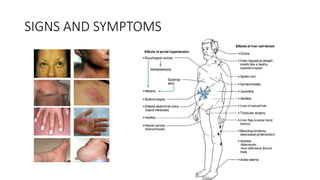
Many people with cirrhosis have no symptoms in the early stages of the disease.
However, as scar tissue replaces healthy cells, liver function starts to fail and a
person may experience one or more of the following symptoms:
• Exhaustion
• Fatigue
• Loss of appetite
• Nausea
• Weakness
• Weight loss
• Abdominal pain
• Spider-like blood vessels (spider angiomas) that develop on the skin
As the disease progresses, complications may develop. In some people,
these may be the first signs of the disease.
Signs and Symptoms:-
Initially patients may experience fatigue, weakness and weight loss. During later
stages, patients may develop jaundice (yellowing of the skin), gastrointestinal
bleeding, abdominal swelling and confusion.
People may experience:
Pain areas: in the abdomen
Gastrointestinal: bleeding, dark stool from digested blood, fluid in the abdomen,
nausea, passing excessive amounts of gas, vomiting blood, or water retention
Whole body: fatigue, loss of appetite, or reduced hormone production
Skin: web of swollen blood vessels in the skin or yellow skin and eyes
Weight: weight gain or weight loss
Also common: bleeding, breast augmentation, bruising, dark urine, enlarged veins
around belly button, itching, mental confusion, muscle weakness, shortness of
breath, swelling, swelling in extremities, or swollen veins in the lower oesophagus
Clinical Features:-
Epidemiology
• Cirrhosis is the twelfth leading cause of death by disease, killing about
26,000 people each year. Also, the cost of cirrhosis in terms of human
suffering, hospital costs, and lost productivity is high
Epidemiology
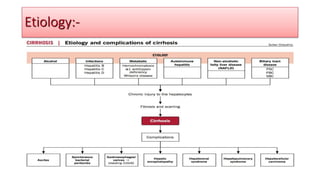
Etiology:-
• Alcoholic: https://youtu.be/fCzf3i4UzE0
• NAFLD: https://youtu.be/5vOggLL5_lY
• https://www.youtube.com/watch?v=f46VFQG2S84 pathology
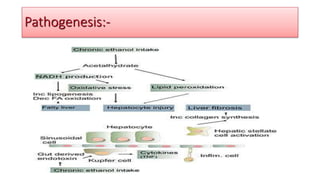
Pathogenesis:-
•Edema and ascites- When the liver loses its ability to make the protein albumin,
water accumulates in the legs (edema) and abdomen (ascites).
•Bruising and bleeding- When the liver slows or stops production of the proteins
needed for blood clotting, a person will bruise or bleed easily. The palms of the
hands may be reddish and blotchy with palmar erythema.
•Jaundice- Jaundice is a yellowing of the skin and eyes that occurs when the
diseased liver does not absorb enough bilirubin.
Complications:-
Itching- Bile products deposited in the skin may cause intense itching.
Gallstones- If cirrhosis prevents bile from reaching the gallbladder, gallstones may
develop.
Toxins in the blood or brain- A damaged liver cannot remove toxins from the
blood, causing them to accumulate in the blood and eventually the brain. There,
toxins can dull mental functioning and cause personality changes, coma, and even
death. Signs of the buildup of toxins in the brain include neglect of personal
appearance, unresponsiveness, forgetfulness, trouble concentrating, or changes in
sleep habits.
Sensitivity to medication. Cirrhosis slows the liver's ability to filter medications from
the blood. Because the liver does not remove drugs from the blood at the usual
rate, they act longer than expected and build up in the body. This causes a person
to be more sensitive to medications and their side effects.
Portal hypertension. Normally, blood from the intestines and spleen is carried to
the liver through the portal vein. But cirrhosis slows the normal flow of blood through
the portal vein, which increases the pressure inside it. This condition is called portal
hypertension.
Physical examination of patients with cirrhosis is usually remarkable for: jaundice, spider
angiomata, ascites, asterixis, spleenomegaly and palmar erythema.
• Appearance of the patient
• Patients with cirrhosis usually appear weak due to constitutional symptoms such as weight
loss, anorexia and muscle atrophy. Yellowish discoloration of skin and abdominal distension may
also be present due to ascites.
• Normal/low blood pressure with normal pulse pressure.
• Skin
• Jaundice : yellow discoloration of the skin, eyes, and mucus membranes due to
increased bilirubin (at least 2-3 mg/dL or 30 mmol/L). Urine may also appear dark.
• Pallor
• Bruises
• Palmar erythema on the thenar and hypothenar eminences, due to altered sex hormone
metabolism.
• Spider angiomata: Increased estradiol levels lead to the formation of vascular lesions consisting of
central arterioles surrounded by smaller vessels [1]
Examination:-
Abdomen
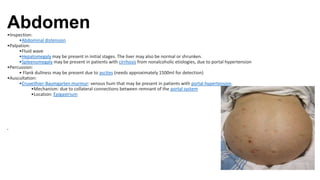
•Inspection:
•Abdominal distension
•Palpation:
•Fluid wave
•Hepatomegaly may be present in initial stages. The liver may also be normal or shrunken.
•Spleenomegaly may be present in patients with cirrhosis from nonalcoholic etiologies, due to portal hypertension
•Percussion:
• Flank dullness may be present due to ascites (needs approximately 1500ml for detection)
•Auscultation:
•Cruveilhier-Baumgarten murmur: venous hum that may be present in patients with portal hypertension.
•Mechanism: due to collateral connections between remnant of the portal system
•Location: Epigastrium
•
SIGNS AND SYMPTOMS
• Fatty Liver
• Liver Abcess
• (Decompensated) Alcoholic liver disease
• Viral liver disease
• Autoimmune liver disease, Wilson’s, HH etc
• Hepatocellular Carcinoma
• Pancreatic Cancer
• Cryptogenic Liver Cirrhosis
Provisonal Diagnosis:-
• Liver Biopsy
• Laboratory Findings
• Laboratory abnormalities may be the first indication of cirrhosis.
• Common abnormalities include:[1][2][3][4][5]
• Increased serum bilirubin levels[6]
• Abnormal aminotransferase levels [7][3][8][9][10][11][12][13][14][15][16]
• Elevated alkaline phosphatase
• Elevated gamma-glutamyl transpeptidase
• Prolonged prothrombin time/INR
• Thrombocytopenia
• Hyponatremia
• Liver function tests:
• Albumin:
• Albumin levels reflect synthetic function of the liver
• Serum albumin levels helps grade the severity of cirrhosis
• Hypoalbuminemia is non specific for liver disease and may be seen in:
• Bilirubin:
• Bilirubin levels may be normal or raised
• Prothrombin time: [27]
• Prothrombin time reflects the degree of hepatic synthetic function.
• Worsening coagulopathy correlates with the severity of hepatic dysfunction
Investigations:-
• .
• Metabolic panel:
• Hyponatremia[28]
• common in patients with cirrhosis and ascites and is related to an inability to excrete free water.
• Reflects poor prognosis
• Due to ADH elevation
• Progressive rise in serum creatinine: may be indicative of hepatorenal syndrome
• Hematologic abnormalities: [29]
• Thrombocytopenia: most common hematologic abnormality in cirrhosis
• Rarely results in a platelet count < 50,000/mL
• Mechanism of thrombocytopenia:
• caused by portal hypertension with congestive splenomegaly: sequesters circulating platelets
• decreased thrombopoietin levels
• Anemia
Bedside
• Observations, BM, fluid balance, weight
Blood tests
• LFTs (pre/post) (including albumin), INR
• FBC, U&Es, CRP
• Liver screen: autoantibodies, alpha-1 antitrypsin, caeruloplasmin, serum copper, ferritin,
viral hepatitis serology
Imaging
• US abdomen + portal vein doppler
• CXR, CT, MRI, MRCP
Special tests
• Ascitic tap, OGD (oesophageal varices), liver biopsy
Complications of CLD
• Portal hypertension: oesophageal varices, ascites
• SBP
• Hepatic encephalopathy (constipation, GI bleed, infection, renal failure)
• Hepatocellular carcinoma
• Hepato-renal syndrome
• Liver failure
• 5 year survival rate in cirrhotic CLD 50%
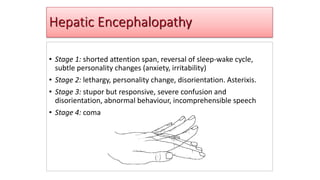
Hepatic Encephalopathy
• Stage 1: shorted attention span, reversal of sleep-wake cycle,
subtle personality changes (anxiety, irritability)
• Stage 2: lethargy, personality change, disorientation. Asterixis.
• Stage 3: stupor but responsive, severe confusion and
disorientation, abnormal behaviour, incomprehensible speech
• Stage 4: coma
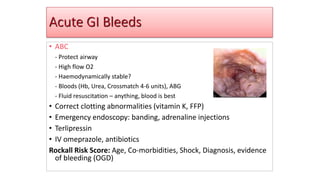
Acute GI Bleeds
• ABC
- Protect airway
- High flow O2
- Haemodynamically stable?
- Bloods (Hb, Urea, Crossmatch 4-6 units), ABG
- Fluid resuscitation – anything, blood is best
• Correct clotting abnormalities (vitamin K, FFP)
• Emergency endoscopy: banding, adrenaline injections
• Terlipressin
• IV omeprazole, antibiotics
Rockall Risk Score: Age, Co-morbidities, Shock, Diagnosis, evidence
of bleeding (OGD)
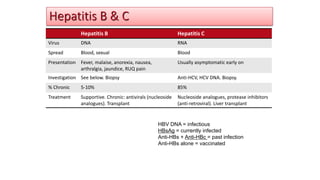
Hepatitis B & C
HBV DNA = infectious
HBsAg = currently infected
Anti-HBs + Anti-HBc = past infection
Anti-HBs alone = vaccinated
Hepatitis B Hepatitis C
Virus DNA RNA
Spread Blood, sexual Blood
Presentation Fever, malaise, anorexia, nausea,
arthralgia, jaundice, RUQ pain
Usually asymptomatic early on
Investigation See below. Biopsy Anti-HCV, HCV DNA. Biopsy.
% Chronic 5-10% 85%
Treatment Supportive. Chronic: antivirals (nucleoside
analogues). Transplant
Nucleoside analogues, protease inhibitors
(anti-retroviral). Liver transplant
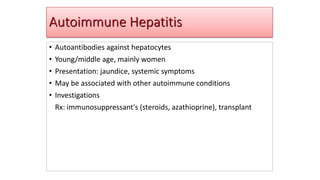
Autoimmune Hepatitis
• Autoantibodies against hepatocytes
• Young/middle age, mainly women
• Presentation: jaundice, systemic symptoms
• May be associated with other autoimmune conditions
• Investigations
Rx: immunosuppressant's (steroids, azathioprine), transplant
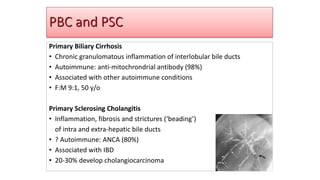
PBC and PSC
Primary Biliary Cirrhosis
• Chronic granulomatous inflammation of interlobular bile ducts
• Autoimmune: anti-mitochrondrial antibody (98%)
• Associated with other autoimmune conditions
• F:M 9:1, 50 y/o
Primary Sclerosing Cholangitis
• Inflammation, fibrosis and strictures (‘beading’)
of intra and extra-hepatic bile ducts
• ? Autoimmune: ANCA (80%)
• Associated with IBD
• 20-30% develop cholangiocarcinoma
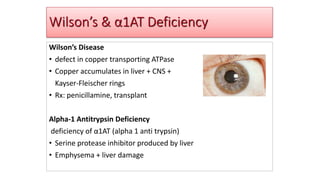
Wilson’s & α1AT Deficiency
Wilson’s Disease
• defect in copper transporting ATPase
• Copper accumulates in liver + CNS +
Kayser-Fleischer rings
• Rx: penicillamine, transplant
Alpha-1 Antitrypsin Deficiency
deficiency of α1AT (alpha 1 anti trypsin)
• Serine protease inhibitor produced by liver
• Emphysema + liver damage
Medical Management:
Conservative
• Alcohol abstinence, optimise nutrition, low salt diet, fluid restriction
Medical
• Vitamin B supplementation (IV/PO)
• Diuretics
• Paracentesis (give albumin)
• NG feeding
• Antibiotics (SBP Spontaneous bacterial peritonitis)
• Steroids + albumin Lactulose (in hepatic encephalopathy)
Surgical
• TIPSS(Transjugular intrahepatic portosystemic shunt)
• Liver transplantation
Management:-
• Hydrotherapy:
• Abdominal pack: 20-25 min
• Alternate Hip Bath: 15 min
• GH pack 30-40 min
• Steam bath along with cold chest pack
• Hot and cold fomenation
Massage: FBM
Partial massage
Management:-
• Mud Therapy: Mud bath
• Local mud pack
• Acupuncture: ST- 25, 36, 37, 39 DU 20, CV 4, 12

Liver Cirrhosis.pptx

  • 1.
  • 2.
    Objectives 1. Introduction 2. Definition 3.Classification 4. Signs and symptoms 5. Etiology 6. Pathogenesis 7. Clinical Features 8. Complication 9. Examination General and Systemic 10. Provisional Diagnosis 11. Investigation 12. Differential Diagnosis 13. Management Conventional and Naturopathy
  • 3.
    The liver, thelargest internal organ in the body, is essential in keeping the body functioning properly. It removes or neutralizes poisons from the blood, produces immune agents to control infection, and removes germs and bacteria from the blood. It makes proteins that regulate blood clotting and produces bile to help absorb fats and fat-soluble vitamins. . Liver
  • 4.
    In cirrhosis ofthe liver, scar tissue replaces normal, healthy tissue, blocking the flow of blood through the organ and preventing it from working as it should. Introduction
  • 5.
    • Chronic liverdamage from a variety of causes leading to scarring and liver failure. • Hepatitis and chronic alcohol abuse are frequent causes. Liver damage caused by cirrhosis can't be undone, but further damage can be limited. • Initially patients may experience fatigue, weakness and weight loss. During later stages, patients may develop jaundice (yellowing of the skin), gastrointestinal bleeding, abdominal swelling and confusion. Definition
  • 6.
    The severity ofcirrhosis is commonly classified with the Child–Pugh score. This scoring system uses bilirubin, albumin, INR, the presence and severity of ascites, and encephalopathy to classify patients into: • Stage 1 cirrhosis involves some scarring of the liver, but few symptoms. This stage is considered compensated cirrhosis, where there are no complications. • Stage 2 cirrhosis includes worsening portal hypertension and the development of varices. • Stage 3 cirrhosis involves the development of swelling in the abdomen and advanced liver scarring. This stage marks decompensated cirrhosis, with serious complications and possible liver failure. • Stage 4 cirrhosis can be life threatening and people have developed end- stage liver disease (ESLD), which is fatal without a transplant. Classification:-
  • 7.
    Many people withcirrhosis have no symptoms in the early stages of the disease. However, as scar tissue replaces healthy cells, liver function starts to fail and a person may experience one or more of the following symptoms: • Exhaustion • Fatigue • Loss of appetite • Nausea • Weakness • Weight loss • Abdominal pain • Spider-like blood vessels (spider angiomas) that develop on the skin As the disease progresses, complications may develop. In some people, these may be the first signs of the disease. Signs and Symptoms:-
  • 8.
    Initially patients mayexperience fatigue, weakness and weight loss. During later stages, patients may develop jaundice (yellowing of the skin), gastrointestinal bleeding, abdominal swelling and confusion. People may experience: Pain areas: in the abdomen Gastrointestinal: bleeding, dark stool from digested blood, fluid in the abdomen, nausea, passing excessive amounts of gas, vomiting blood, or water retention Whole body: fatigue, loss of appetite, or reduced hormone production Skin: web of swollen blood vessels in the skin or yellow skin and eyes Weight: weight gain or weight loss Also common: bleeding, breast augmentation, bruising, dark urine, enlarged veins around belly button, itching, mental confusion, muscle weakness, shortness of breath, swelling, swelling in extremities, or swollen veins in the lower oesophagus Clinical Features:-
  • 9.
    Epidemiology • Cirrhosis isthe twelfth leading cause of death by disease, killing about 26,000 people each year. Also, the cost of cirrhosis in terms of human suffering, hospital costs, and lost productivity is high Epidemiology
  • 10.
  • 11.
    • Alcoholic: https://youtu.be/fCzf3i4UzE0 •NAFLD: https://youtu.be/5vOggLL5_lY • https://www.youtube.com/watch?v=f46VFQG2S84 pathology
  • 12.
  • 13.
    •Edema and ascites-When the liver loses its ability to make the protein albumin, water accumulates in the legs (edema) and abdomen (ascites). •Bruising and bleeding- When the liver slows or stops production of the proteins needed for blood clotting, a person will bruise or bleed easily. The palms of the hands may be reddish and blotchy with palmar erythema. •Jaundice- Jaundice is a yellowing of the skin and eyes that occurs when the diseased liver does not absorb enough bilirubin. Complications:-
  • 14.
    Itching- Bile productsdeposited in the skin may cause intense itching. Gallstones- If cirrhosis prevents bile from reaching the gallbladder, gallstones may develop. Toxins in the blood or brain- A damaged liver cannot remove toxins from the blood, causing them to accumulate in the blood and eventually the brain. There, toxins can dull mental functioning and cause personality changes, coma, and even death. Signs of the buildup of toxins in the brain include neglect of personal appearance, unresponsiveness, forgetfulness, trouble concentrating, or changes in sleep habits. Sensitivity to medication. Cirrhosis slows the liver's ability to filter medications from the blood. Because the liver does not remove drugs from the blood at the usual rate, they act longer than expected and build up in the body. This causes a person to be more sensitive to medications and their side effects. Portal hypertension. Normally, blood from the intestines and spleen is carried to the liver through the portal vein. But cirrhosis slows the normal flow of blood through the portal vein, which increases the pressure inside it. This condition is called portal hypertension.
  • 15.
    Physical examination ofpatients with cirrhosis is usually remarkable for: jaundice, spider angiomata, ascites, asterixis, spleenomegaly and palmar erythema. • Appearance of the patient • Patients with cirrhosis usually appear weak due to constitutional symptoms such as weight loss, anorexia and muscle atrophy. Yellowish discoloration of skin and abdominal distension may also be present due to ascites. • Normal/low blood pressure with normal pulse pressure. • Skin • Jaundice : yellow discoloration of the skin, eyes, and mucus membranes due to increased bilirubin (at least 2-3 mg/dL or 30 mmol/L). Urine may also appear dark. • Pallor • Bruises • Palmar erythema on the thenar and hypothenar eminences, due to altered sex hormone metabolism. • Spider angiomata: Increased estradiol levels lead to the formation of vascular lesions consisting of central arterioles surrounded by smaller vessels [1] Examination:-
  • 16.
    Abdomen •Inspection: •Abdominal distension •Palpation: •Fluid wave •Hepatomegalymay be present in initial stages. The liver may also be normal or shrunken. •Spleenomegaly may be present in patients with cirrhosis from nonalcoholic etiologies, due to portal hypertension •Percussion: • Flank dullness may be present due to ascites (needs approximately 1500ml for detection) •Auscultation: •Cruveilhier-Baumgarten murmur: venous hum that may be present in patients with portal hypertension. •Mechanism: due to collateral connections between remnant of the portal system •Location: Epigastrium •
  • 17.
  • 18.
    • Fatty Liver •Liver Abcess • (Decompensated) Alcoholic liver disease • Viral liver disease • Autoimmune liver disease, Wilson’s, HH etc • Hepatocellular Carcinoma • Pancreatic Cancer • Cryptogenic Liver Cirrhosis Provisonal Diagnosis:-
  • 19.
    • Liver Biopsy •Laboratory Findings • Laboratory abnormalities may be the first indication of cirrhosis. • Common abnormalities include:[1][2][3][4][5] • Increased serum bilirubin levels[6] • Abnormal aminotransferase levels [7][3][8][9][10][11][12][13][14][15][16] • Elevated alkaline phosphatase • Elevated gamma-glutamyl transpeptidase • Prolonged prothrombin time/INR • Thrombocytopenia • Hyponatremia • Liver function tests: • Albumin: • Albumin levels reflect synthetic function of the liver • Serum albumin levels helps grade the severity of cirrhosis • Hypoalbuminemia is non specific for liver disease and may be seen in: • Bilirubin: • Bilirubin levels may be normal or raised • Prothrombin time: [27] • Prothrombin time reflects the degree of hepatic synthetic function. • Worsening coagulopathy correlates with the severity of hepatic dysfunction Investigations:-
  • 20.
    • . • Metabolicpanel: • Hyponatremia[28] • common in patients with cirrhosis and ascites and is related to an inability to excrete free water. • Reflects poor prognosis • Due to ADH elevation • Progressive rise in serum creatinine: may be indicative of hepatorenal syndrome • Hematologic abnormalities: [29] • Thrombocytopenia: most common hematologic abnormality in cirrhosis • Rarely results in a platelet count < 50,000/mL • Mechanism of thrombocytopenia: • caused by portal hypertension with congestive splenomegaly: sequesters circulating platelets • decreased thrombopoietin levels • Anemia
  • 21.
    Bedside • Observations, BM,fluid balance, weight Blood tests • LFTs (pre/post) (including albumin), INR • FBC, U&Es, CRP • Liver screen: autoantibodies, alpha-1 antitrypsin, caeruloplasmin, serum copper, ferritin, viral hepatitis serology Imaging • US abdomen + portal vein doppler • CXR, CT, MRI, MRCP Special tests • Ascitic tap, OGD (oesophageal varices), liver biopsy
  • 22.
    Complications of CLD •Portal hypertension: oesophageal varices, ascites • SBP • Hepatic encephalopathy (constipation, GI bleed, infection, renal failure) • Hepatocellular carcinoma • Hepato-renal syndrome • Liver failure • 5 year survival rate in cirrhotic CLD 50%
  • 23.
    Hepatic Encephalopathy • Stage1: shorted attention span, reversal of sleep-wake cycle, subtle personality changes (anxiety, irritability) • Stage 2: lethargy, personality change, disorientation. Asterixis. • Stage 3: stupor but responsive, severe confusion and disorientation, abnormal behaviour, incomprehensible speech • Stage 4: coma
  • 24.
    Acute GI Bleeds •ABC - Protect airway - High flow O2 - Haemodynamically stable? - Bloods (Hb, Urea, Crossmatch 4-6 units), ABG - Fluid resuscitation – anything, blood is best • Correct clotting abnormalities (vitamin K, FFP) • Emergency endoscopy: banding, adrenaline injections • Terlipressin • IV omeprazole, antibiotics Rockall Risk Score: Age, Co-morbidities, Shock, Diagnosis, evidence of bleeding (OGD)
  • 25.
    Hepatitis B &C HBV DNA = infectious HBsAg = currently infected Anti-HBs + Anti-HBc = past infection Anti-HBs alone = vaccinated Hepatitis B Hepatitis C Virus DNA RNA Spread Blood, sexual Blood Presentation Fever, malaise, anorexia, nausea, arthralgia, jaundice, RUQ pain Usually asymptomatic early on Investigation See below. Biopsy Anti-HCV, HCV DNA. Biopsy. % Chronic 5-10% 85% Treatment Supportive. Chronic: antivirals (nucleoside analogues). Transplant Nucleoside analogues, protease inhibitors (anti-retroviral). Liver transplant
  • 26.
    Autoimmune Hepatitis • Autoantibodiesagainst hepatocytes • Young/middle age, mainly women • Presentation: jaundice, systemic symptoms • May be associated with other autoimmune conditions • Investigations Rx: immunosuppressant's (steroids, azathioprine), transplant
  • 27.
    PBC and PSC PrimaryBiliary Cirrhosis • Chronic granulomatous inflammation of interlobular bile ducts • Autoimmune: anti-mitochrondrial antibody (98%) • Associated with other autoimmune conditions • F:M 9:1, 50 y/o Primary Sclerosing Cholangitis • Inflammation, fibrosis and strictures (‘beading’) of intra and extra-hepatic bile ducts • ? Autoimmune: ANCA (80%) • Associated with IBD • 20-30% develop cholangiocarcinoma
  • 28.
    Wilson’s & α1ATDeficiency Wilson’s Disease • defect in copper transporting ATPase • Copper accumulates in liver + CNS + Kayser-Fleischer rings • Rx: penicillamine, transplant Alpha-1 Antitrypsin Deficiency deficiency of α1AT (alpha 1 anti trypsin) • Serine protease inhibitor produced by liver • Emphysema + liver damage
  • 29.
    Medical Management: Conservative • Alcoholabstinence, optimise nutrition, low salt diet, fluid restriction Medical • Vitamin B supplementation (IV/PO) • Diuretics • Paracentesis (give albumin) • NG feeding • Antibiotics (SBP Spontaneous bacterial peritonitis) • Steroids + albumin Lactulose (in hepatic encephalopathy) Surgical • TIPSS(Transjugular intrahepatic portosystemic shunt) • Liver transplantation Management:-
  • 30.
    • Hydrotherapy: • Abdominalpack: 20-25 min • Alternate Hip Bath: 15 min • GH pack 30-40 min • Steam bath along with cold chest pack • Hot and cold fomenation Massage: FBM Partial massage Management:-
  • 31.
    • Mud Therapy:Mud bath • Local mud pack • Acupuncture: ST- 25, 36, 37, 39 DU 20, CV 4, 12