CHROMATOGRAPHY
Presented by
Savidha Sam
Msc I zoology
St.Gregorios College, Kottarakkara
WHAT IS CHROMATOGRAPHY?
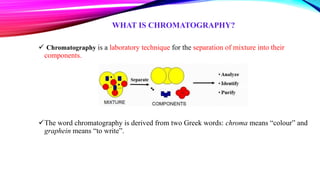
 Chromatography is a laboratory technique for the separation of mixture into their
components.
The word chromatography is derived from two Greek words: chroma means “colour” and
graphein means “to write”.
INVENTION OF CHROMATOGRAPHY
Column chromatography was developed by the American Chemist D T Day in 1900.
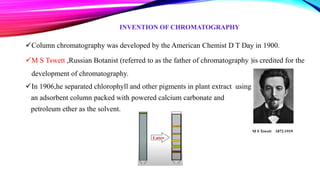
M S Tswett ,Russian Botanist (referred to as the father of chromatography )is credited for the
development of chromatography.
In 1906,he separated chlorophyll and other pigments in plant extract using
an adsorbent column packed with powered calcium carbonate and
petroleum ether as the solvent.
M S Tswett 1872-1919
PRINCIPLE AND DEFINITION
The basic principle behind is the differential distribution of sample components between two mutually
immiscible phases- a stationary phase and a mobile phase.
Stationary phase remains fixed while the mobile phase percolates through the intensities over the surface of
stationary phase.
 Stationary phase : A phase that is fixed in a place either in a column or in a planar surface. The stationary
phase can be solid or liquid.
Mobile phase : A phase that moves over or through the stationary phase, carrying with the analyte
mixture. It is also called the eluting fluid. The mobile phase can be gas or a liquid.
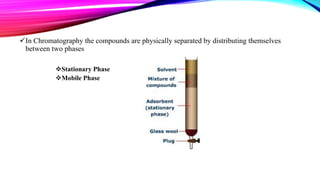
In Chromatography the compounds are physically separated by distributing themselves
between two phases
Stationary Phase
Mobile Phase
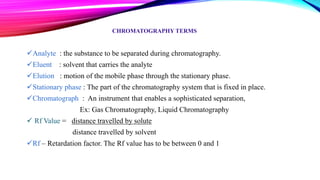
CHROMATOGRAPHY TERMS
Analyte : the substance to be separated during chromatography.
Eluent : solvent that carries the analyte
Elution : motion of the mobile phase through the stationary phase.
Stationary phase : The part of the chromatography system that is fixed in place.
Chromatograph : An instrument that enables a sophisticated separation,
Ex: Gas Chromatography, Liquid Chromatography
 Rf Value = distance travelled by solute
distance travelled by solvent
Rf – Retardation factor. The Rf value has to be between 0 and 1
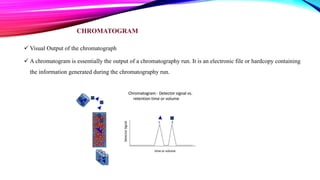
CHROMATOGRAM
 Visual Output of the chromatograph
 A chromatogram is essentially the output of a chromatography run. It is an electronic file or hardcopy containing
the information generated during the chromatography run.
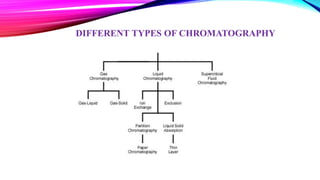
DIFFERENT TYPES OF CHROMATOGRAPHY
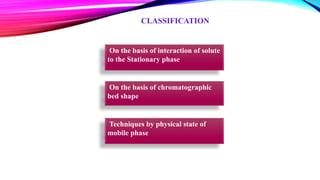
CLASSIFICATION
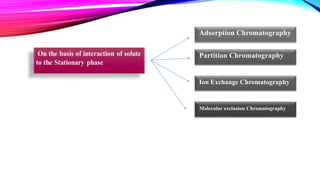
On the basis of interaction of solute
to the Stationary phase
On the basis of chromatographic
bed shape
Techniques by physical state of
mobile phase
Adsorption Chromatography
Partition Chromatography
Ion Exchange Chromatography
Molecular exclusion Chromatography
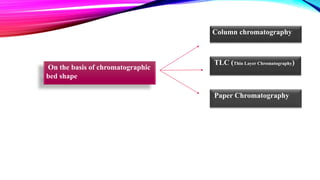
On the basis of chromatographic
bed shape
Column chromatography
TLC (Thin Layer Chromatography)
Paper Chromatography
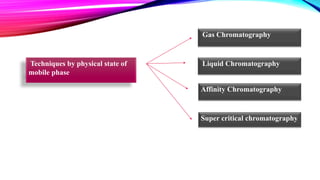
Techniques by physical state of
mobile phase
Gas Chromatography
Liquid Chromatography
Affinity Chromatography
Super critical chromatography
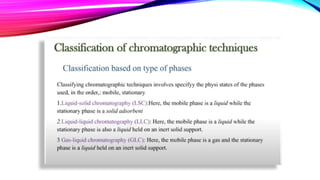
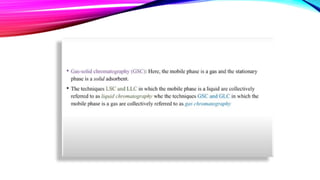
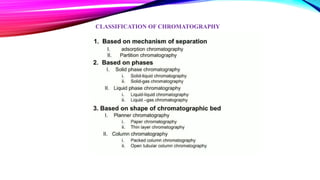
CLASSIFICATION OF CHROMATOGRAPHY
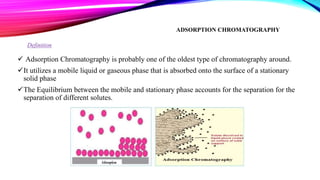
ADSORPTION CHROMATOGRAPHY
 Adsorption Chromatography is probably one of the oldest type of chromatography around.
It utilizes a mobile liquid or gaseous phase that is absorbed onto the surface of a stationary
solid phase
The Equilibrium between the mobile and stationary phase accounts for the separation for the
separation of different solutes.
Definition
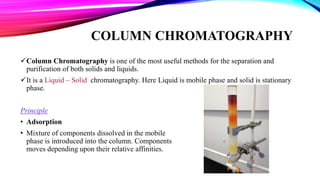
COLUMN CHROMATOGRAPHY
Column Chromatography is one of the most useful methods for the separation and
purification of both solids and liquids.
It is a Liquid – Solid chromatography. Here Liquid is mobile phase and solid is stationary
phase.
Principle
• Adsorption
• Mixture of components dissolved in the mobile
phase is introduced into the column. Components
moves depending upon their relative affinities.
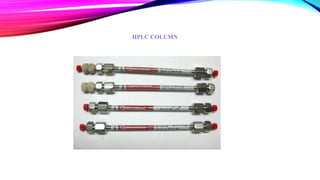
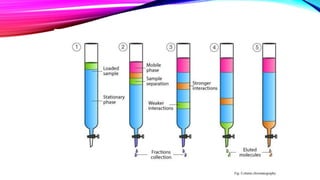
Fig: Column chromatography
Column Chromatography is a preparative technique used to purify
compounds depending on their polarity or hydrophobicity.
 In column chromatography, a mixture of molecules is separated based on
their differentials partitioning between a mobile phase and a stationary
phase
Column chromatography is suitable for the physical preparation of gram
quantities of material. A solvent act as the mobile phase while finely
divided solid surface act as the stationary phase.
Usually a glass tube with diameter from 1cm to 10 cm and a height of 20
cm to 50 cm with a tap at the bottom is used for this purpose.
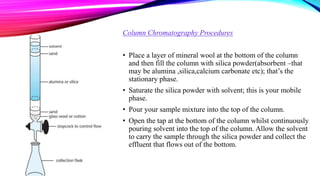
Column Chromatography Procedures
• Place a layer of mineral wool at the bottom of the column
and then fill the column with silica powder(absorbent –that
may be alumina ,silica,calcium carbonate etc); that’s the
stationary phase.
• Saturate the silica powder with solvent; this is your mobile
phase.
• Pour your sample mixture into the top of the column.
• Open the tap at the bottom of the column whilst continuously
pouring solvent into the top of the column. Allow the solvent
to carry the sample through the silica powder and collect the
effluent that flows out of the bottom.
TYPES OF COLUMN CHROMATOGRAPHY
Based on the difference of the flow rates of the mobile phase; column
chromatography can be several type
Gravity Column Chromatography
The mobile phase moves through the stationary phase by the influence of
gravitational force.
Flash Column Chromatography
The mobile phase is pushed by stream of air or nitrogen using special valves
(adaptor)
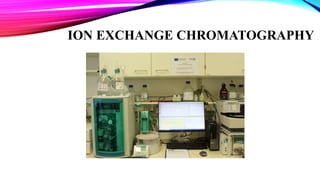
ION EXCHANGE CHROMATOGRAPHY
Ion exchange chromatography (or ion chromatography) is a process that allows the
separation of ions and polar molecules based on their affinity to ion exchangers.
It is a technique for separation of charged macromolecules such as
protiens,nucleotides,amino acids and sugars based on their affinity of the ion exchanger
Principle
It is based on the reversible electrostatic interaction of ions with the separation matrix. ie,In
the separation occurs by reversible exchange of ions between the ions present in the solution
and those present in the ion exchange resin.
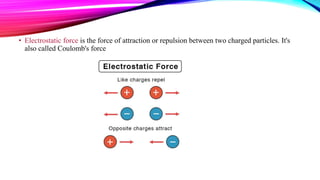
• Electrostatic force is the force of attraction or repulsion between two charged particles. It's
also called Coulomb's force
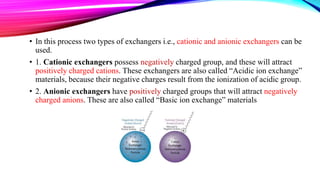
• In this process two types of exchangers i.e., cationic and anionic exchangers can be
used.
• 1. Cationic exchangers possess negatively charged group, and these will attract
positively charged cations. These exchangers are also called “Acidic ion exchange”
materials, because their negative charges result from the ionization of acidic group.
• 2. Anionic exchangers have positively charged groups that will attract negatively
charged anions. These are also called “Basic ion exchange” materials
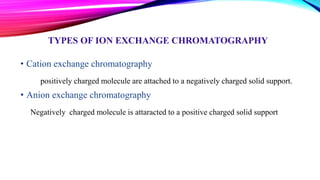
TYPES OF ION EXCHANGE CHROMATOGRAPHY
• Cation exchange chromatography
positively charged molecule are attached to a negatively charged solid support.
• Anion exchange chromatography
Negatively charged molecule is attaracted to a positive charged solid support
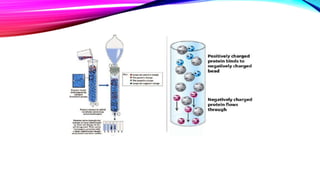
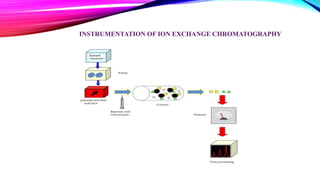
INSTRUMENTATION OF ION EXCHANGE CHROMATOGRAPHY
APPLICATIONS OF ION EXCHANGE CHROMATOGRAPHY
An important use of ion-exchange chromatography is in the routine analysis of amino acid
mixtures.
The 20 principal amino acids from blood serum or from the hydrolysis of proteins are
separated and used in clinical diagnosis.
 This is most effective method for water purification. Complete deionization of water (or) a
non-electrolyte solution is performed by exchanging solute cations for hydrogen ions and
solute anions for hydroxyl ions. This is usually achieved by method is used for softening of
drinking water.
 In the analysis of products of hydrolysis of nucleic acids. In this way, information is gained
about the structure of these molecules and how it relates to their biological function as
carriers of hereditary information.
ADVANTAGES OF ION EXCHANGE CHROMATOGRAPHY
• It is one of the most efficient methods for the separation of charged particles.
• It can be used for almost any kind of charged molecule including large proteins, small
nucleotides and amino acids.
• Ion exchange is used for both analytical and preparative purposes in the laboratory, the
analytical uses being the more common.
• 4. Inorganic ions also can be separated by ion-exchange chromatography.
Limitations of ion exchange chromatography
• Only charged molecules can be separated.
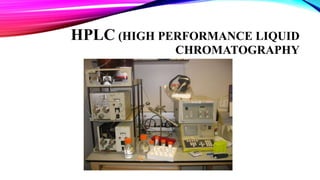
HPLC (HIGH PERFORMANCE LIQUID
CHROMATOGRAPHY
INTRODUCTION
HPLC stands for “High Performance Liquid Chromatography” (sometimes referred
to as the High Pressure Liquid Chromatography)
High Performance Liquid Chromatography is a powerful tool in analysis, it yields
High Performance and high speed compared to traditional column chromatography
because of the forcibly pumped mobile phase
High Performance Liquid Chromatography is a technique that can separate a
mixture of components.
PRINCIPLE
• High Performance Liquid Chromatography is a type of liquid
chromatography where the sample is forced through a column that is
packed with a stationary phase irregularly or spherically shaped particles at
high pressure
• High Performance Liquid Chromatography is a Chromatographic
technique used to separate a mixture of compounds in analytical chemistry
and biochemistry with the purpose of identifying, quantifying or purifying
the components in a mixture
FEATURES
 High Performance Liquid Chromatography
 High Pressure Liquid Chromatography
 it is column Chromatography
 it is Liquid Chromatography
 it can mainly divided by two types :-
• Normal phase HPLC
• Reversed Phase HPLC
 It is used as qualitative as well as quantitative analysis
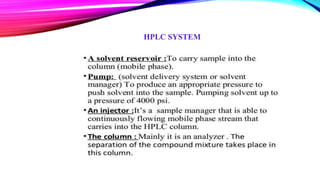
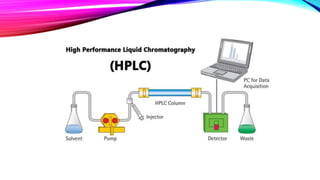
HPLC SYSTEM
HPLC COLUMN
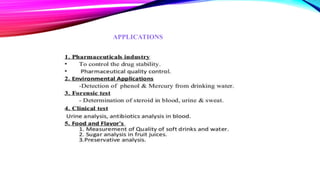
APPLICATIONS
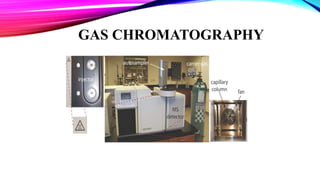
GAS CHROMATOGRAPHY
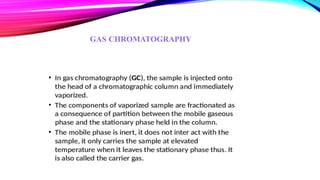
GAS CHROMATOGRAPHY
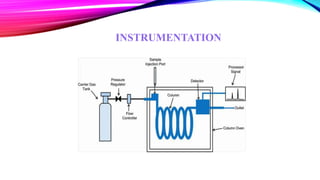
INSTRUMENTATION
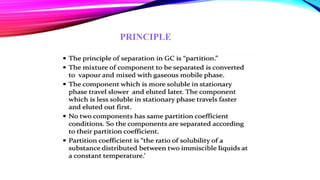
PRINCIPLE
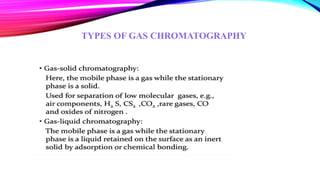
TYPES OF GAS CHROMATOGRAPHY
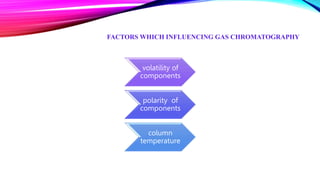
FACTORS WHICH INFLUENCING GAS CHROMATOGRAPHY
volatility of
components
polarity of
components
column
temperature
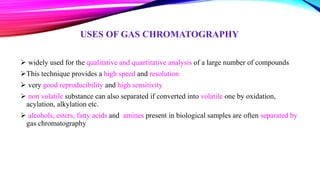
USES OF GAS CHROMATOGRAPHY
 widely used for the qualitative and quantitative analysis of a large number of compounds
This technique provides a high speed and resolution
 very good reproducibility and high sensitivity
 non volatile substance can also separated if converted into volatile one by oxidation,
acylation, alkylation etc.
 alcohols, esters, fatty acids and amines present in biological samples are often separated by
gas chromatography
THANK YOU

chromatography seminar.pptx

  • 1.
    CHROMATOGRAPHY Presented by Savidha Sam MscI zoology St.Gregorios College, Kottarakkara
  • 2.
    WHAT IS CHROMATOGRAPHY? Chromatography is a laboratory technique for the separation of mixture into their components. The word chromatography is derived from two Greek words: chroma means “colour” and graphein means “to write”.
  • 3.
    INVENTION OF CHROMATOGRAPHY Columnchromatography was developed by the American Chemist D T Day in 1900. M S Tswett ,Russian Botanist (referred to as the father of chromatography )is credited for the development of chromatography. In 1906,he separated chlorophyll and other pigments in plant extract using an adsorbent column packed with powered calcium carbonate and petroleum ether as the solvent. M S Tswett 1872-1919
  • 4.
    PRINCIPLE AND DEFINITION Thebasic principle behind is the differential distribution of sample components between two mutually immiscible phases- a stationary phase and a mobile phase. Stationary phase remains fixed while the mobile phase percolates through the intensities over the surface of stationary phase.  Stationary phase : A phase that is fixed in a place either in a column or in a planar surface. The stationary phase can be solid or liquid. Mobile phase : A phase that moves over or through the stationary phase, carrying with the analyte mixture. It is also called the eluting fluid. The mobile phase can be gas or a liquid.
  • 5.
    In Chromatography thecompounds are physically separated by distributing themselves between two phases Stationary Phase Mobile Phase
  • 6.
    CHROMATOGRAPHY TERMS Analyte :the substance to be separated during chromatography. Eluent : solvent that carries the analyte Elution : motion of the mobile phase through the stationary phase. Stationary phase : The part of the chromatography system that is fixed in place. Chromatograph : An instrument that enables a sophisticated separation, Ex: Gas Chromatography, Liquid Chromatography  Rf Value = distance travelled by solute distance travelled by solvent Rf – Retardation factor. The Rf value has to be between 0 and 1
  • 7.
    CHROMATOGRAM  Visual Outputof the chromatograph  A chromatogram is essentially the output of a chromatography run. It is an electronic file or hardcopy containing the information generated during the chromatography run.
  • 8.
    DIFFERENT TYPES OFCHROMATOGRAPHY
  • 9.
    CLASSIFICATION On the basisof interaction of solute to the Stationary phase On the basis of chromatographic bed shape Techniques by physical state of mobile phase
  • 10.
    Adsorption Chromatography Partition Chromatography IonExchange Chromatography Molecular exclusion Chromatography
  • 11.
    On the basisof chromatographic bed shape Column chromatography TLC (Thin Layer Chromatography) Paper Chromatography
  • 12.
    Techniques by physicalstate of mobile phase Gas Chromatography Liquid Chromatography Affinity Chromatography Super critical chromatography
  • 15.
  • 16.
    ADSORPTION CHROMATOGRAPHY  AdsorptionChromatography is probably one of the oldest type of chromatography around. It utilizes a mobile liquid or gaseous phase that is absorbed onto the surface of a stationary solid phase The Equilibrium between the mobile and stationary phase accounts for the separation for the separation of different solutes. Definition
  • 17.
    COLUMN CHROMATOGRAPHY Column Chromatographyis one of the most useful methods for the separation and purification of both solids and liquids. It is a Liquid – Solid chromatography. Here Liquid is mobile phase and solid is stationary phase. Principle • Adsorption • Mixture of components dissolved in the mobile phase is introduced into the column. Components moves depending upon their relative affinities.
  • 18.
  • 19.
    Column Chromatography isa preparative technique used to purify compounds depending on their polarity or hydrophobicity.  In column chromatography, a mixture of molecules is separated based on their differentials partitioning between a mobile phase and a stationary phase Column chromatography is suitable for the physical preparation of gram quantities of material. A solvent act as the mobile phase while finely divided solid surface act as the stationary phase. Usually a glass tube with diameter from 1cm to 10 cm and a height of 20 cm to 50 cm with a tap at the bottom is used for this purpose.
  • 20.
    Column Chromatography Procedures •Place a layer of mineral wool at the bottom of the column and then fill the column with silica powder(absorbent –that may be alumina ,silica,calcium carbonate etc); that’s the stationary phase. • Saturate the silica powder with solvent; this is your mobile phase. • Pour your sample mixture into the top of the column. • Open the tap at the bottom of the column whilst continuously pouring solvent into the top of the column. Allow the solvent to carry the sample through the silica powder and collect the effluent that flows out of the bottom.
  • 21.
    TYPES OF COLUMNCHROMATOGRAPHY Based on the difference of the flow rates of the mobile phase; column chromatography can be several type Gravity Column Chromatography The mobile phase moves through the stationary phase by the influence of gravitational force. Flash Column Chromatography The mobile phase is pushed by stream of air or nitrogen using special valves (adaptor)
  • 23.
  • 24.
    ION EXCHANGE CHROMATOGRAPHY Ionexchange chromatography (or ion chromatography) is a process that allows the separation of ions and polar molecules based on their affinity to ion exchangers. It is a technique for separation of charged macromolecules such as protiens,nucleotides,amino acids and sugars based on their affinity of the ion exchanger Principle It is based on the reversible electrostatic interaction of ions with the separation matrix. ie,In the separation occurs by reversible exchange of ions between the ions present in the solution and those present in the ion exchange resin.
  • 25.
    • Electrostatic forceis the force of attraction or repulsion between two charged particles. It's also called Coulomb's force
  • 26.
    • In thisprocess two types of exchangers i.e., cationic and anionic exchangers can be used. • 1. Cationic exchangers possess negatively charged group, and these will attract positively charged cations. These exchangers are also called “Acidic ion exchange” materials, because their negative charges result from the ionization of acidic group. • 2. Anionic exchangers have positively charged groups that will attract negatively charged anions. These are also called “Basic ion exchange” materials
  • 27.
    TYPES OF IONEXCHANGE CHROMATOGRAPHY • Cation exchange chromatography positively charged molecule are attached to a negatively charged solid support. • Anion exchange chromatography Negatively charged molecule is attaracted to a positive charged solid support
  • 29.
    INSTRUMENTATION OF IONEXCHANGE CHROMATOGRAPHY
  • 30.
    APPLICATIONS OF IONEXCHANGE CHROMATOGRAPHY An important use of ion-exchange chromatography is in the routine analysis of amino acid mixtures. The 20 principal amino acids from blood serum or from the hydrolysis of proteins are separated and used in clinical diagnosis.  This is most effective method for water purification. Complete deionization of water (or) a non-electrolyte solution is performed by exchanging solute cations for hydrogen ions and solute anions for hydroxyl ions. This is usually achieved by method is used for softening of drinking water.  In the analysis of products of hydrolysis of nucleic acids. In this way, information is gained about the structure of these molecules and how it relates to their biological function as carriers of hereditary information.
  • 31.
    ADVANTAGES OF IONEXCHANGE CHROMATOGRAPHY • It is one of the most efficient methods for the separation of charged particles. • It can be used for almost any kind of charged molecule including large proteins, small nucleotides and amino acids. • Ion exchange is used for both analytical and preparative purposes in the laboratory, the analytical uses being the more common. • 4. Inorganic ions also can be separated by ion-exchange chromatography. Limitations of ion exchange chromatography • Only charged molecules can be separated.
  • 32.
    HPLC (HIGH PERFORMANCELIQUID CHROMATOGRAPHY
  • 33.
    INTRODUCTION HPLC stands for“High Performance Liquid Chromatography” (sometimes referred to as the High Pressure Liquid Chromatography) High Performance Liquid Chromatography is a powerful tool in analysis, it yields High Performance and high speed compared to traditional column chromatography because of the forcibly pumped mobile phase High Performance Liquid Chromatography is a technique that can separate a mixture of components.
  • 34.
    PRINCIPLE • High PerformanceLiquid Chromatography is a type of liquid chromatography where the sample is forced through a column that is packed with a stationary phase irregularly or spherically shaped particles at high pressure • High Performance Liquid Chromatography is a Chromatographic technique used to separate a mixture of compounds in analytical chemistry and biochemistry with the purpose of identifying, quantifying or purifying the components in a mixture
  • 35.
    FEATURES  High PerformanceLiquid Chromatography  High Pressure Liquid Chromatography  it is column Chromatography  it is Liquid Chromatography  it can mainly divided by two types :- • Normal phase HPLC • Reversed Phase HPLC  It is used as qualitative as well as quantitative analysis
  • 36.
  • 38.
  • 39.
  • 40.
  • 41.
  • 42.
  • 43.
  • 44.
    TYPES OF GASCHROMATOGRAPHY
  • 45.
    FACTORS WHICH INFLUENCINGGAS CHROMATOGRAPHY volatility of components polarity of components column temperature
  • 46.
    USES OF GASCHROMATOGRAPHY  widely used for the qualitative and quantitative analysis of a large number of compounds This technique provides a high speed and resolution  very good reproducibility and high sensitivity  non volatile substance can also separated if converted into volatile one by oxidation, acylation, alkylation etc.  alcohols, esters, fatty acids and amines present in biological samples are often separated by gas chromatography
  • 47.