SRI PARAMAKALYANI COLLEGE
REACCREDITED WITH BGRADE WITH A CGPA OF 2.71 INTHESECOND CYCLE OF NAAC
AFFILIATED TO MANOMANIUMSUNDARANARUNIVERSITY, TIRUNELVELI.
ALWARKURICHI 627 412, TAMIL NADU, INDIA
POST GRADUATE & RESEARCH CENTRE
DEPARTMENT OF MICROBIOLOGY
(Government Aided)
ACADEMIC YEAR 2021-2022
II SEM CORE: IMMUNOLOGY - (ZMBM22)
UNIT- 1
RESISTANCE
Submitted by,
S.Indhumathi
Reg.No:20211232516110
I M.Sc.Microbiology.
Submitted to,
Guide: Dr.S.Viswanathan Ph.D.
Assistant professor and Head,
Departmentof microbiology. Assignedon:23/02/2022
Takenon:--/04/2022
1. MEDICAL TERMS RELATED TO TOPICS
2. INTRODUCTION
3. HISTORY
4. TYPES
5. MECHANISM
6. PREVENTION OF DRUG RESISTANCE
7. CURRENT RESEARCH & PUBLICATIONS
8. REFERENCE
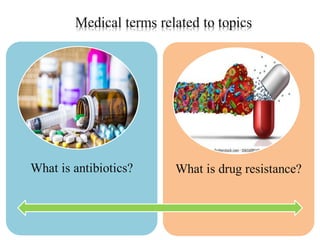
What is antibiotics? What is drug resistance?
➢ Drug resistance is the reduction in effectiveness of a medication
such as an antimicrobial or an antineoplastic in treating
a disease or condition. The term is used in the context of resistance
that pathogen or cancers have "acquired", i.e., resistance has
evolved.
➢ Antimicrobial resistance occurs when microbes evolve
mechanisms that protect them from the effects of antimicrobials.
➢ Antibiotic resistance is a subset of AMR, that applies specifically
to bacteria that become resistant to antibiotics.
➢ Microbes resistant to multiple antimicrobials are called multidrug
resistance (MDR).
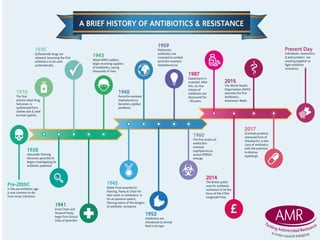
➢ The antibiotic era had truly begun and in 1945 Fleming, Florey and
Chain were jointly awarded the Nobel Prize in Physiology or
Medicine.
➢ In his Nobel lecture in 1945, Fleming presciently warned about the
dangers of misusing penicillin.
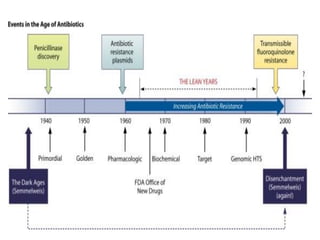
➢ The first case of penicillin resistance was observed in 1947. The
period between 1950 and 1960 is often referred to as the golden
age of antibiotic discovery, as one-half of the antibiotics
commonly used today were discovered during these years.
INTRINSIC/NATURAL ACQUIRED
Biochemical mechanism
(Non-genetics)
Genetic methods
1. By producing
enzymes.
2. Preventingdrug
accumulation.
3. Modifying target
site.
4. Use alternative
pathway.
5. Quorumsensing.
Lack of metabolic
process/ target site
Chromosomal
methods.
Ex: Mutation.
Extra chromosomal
methods.
Ex: plasmids within
or b/w bacteria
Intrinsic / natural resistance
➢ Stable genetic property encoded in the chromosome and shared by
all strains of the species.
➢ Usually related to structural features.
➢ i.e., permeability of the cellwall. E.g. Pseudomonas cell wall limits
penetration of antibiotics.
➢ Mutation affecting specific binding protein of the 30s subunit
→Streptomycin-resistant M.tuberculosis & S.faecalis
➢ Mutation in porin proteins →impaired antibiotic transport into the
cell →lead to multiple resistance →P.aeruginosa
➢ Mutation in PBPs →strep pneumoniae
➢ Altered dna gyrase →quinolone-resistant E.coli.
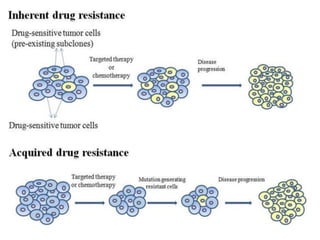
➢ Species develop ability to resist an antimicrobial drug to which it
is as a whole naturally susceptible.
✓ Genetically
Chromosomal - Mutational
Extra Chromosomal - genetic exchange.
✓ Biochemically
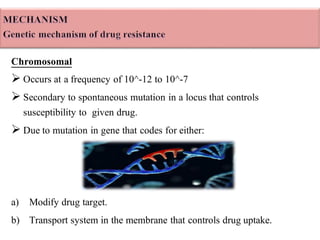
Chromosomal
➢ Occurs at a frequency of 10^-12 to 10^-7
➢ Secondary to spontaneous mutation in a locus that controls
susceptibility to given drug.
➢ Due to mutation in gene that codes for either:
a) Modify drug target.
b) Transport system in the membrane that controls drug uptake.
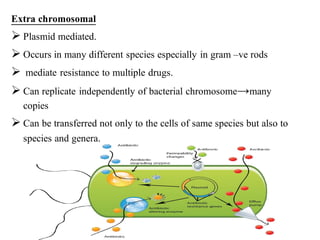
Extra chromosomal
➢ Plasmid mediated.
➢ Occurs in many different species especially in gram –ve rods
➢ mediate resistance to multiple drugs.
➢ Can replicate independently of bacterial chromosome→many
copies
➢ Can be transferred not only to the cells of same species but also to
species and genera.
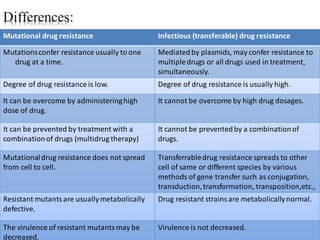
Mutational drug resistance Infectious (transferable) drug resistance
Mutationsconfer resistance usually to one
drug at a time.
Mediatedby plasmids, may confer resistance to
multipledrugs or all drugs used in treatment,
simultaneously.
Degree of drug resistance is low. Degree of drug resistance is usually high.
It can be overcome by administeringhigh
dose of drug.
It cannot be overcome by high drug dosages.
It can be prevented by treatment with a
combinationof drugs (multidrug therapy)
It cannot be preventedby a combinationof
drugs.
Mutationaldrug resistance does not spread
from cell to cell.
Transferrabledrug resistance spreads to other
cell of same or different species by various
methods of gene transfer such as conjugation,
transduction,transformation, transposition,etc.,
Resistant mutantsare usuallymetabolically
defective.
Drug resistant strainsare metabolicallynormal.
The virulence of resistant mutantsmay be
decreased.
Virulence is not decreased.
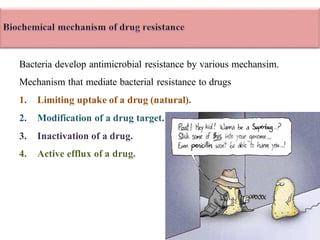
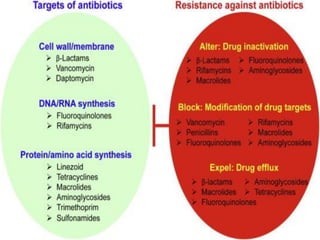
Bacteria develop antimicrobial resistance by various mechansim.
Mechanism that mediate bacterial resistance to drugs
1. Limiting uptake of a drug (natural).
2. Modification of a drug target.
3. Inactivation of a drug.
4. Active efflux of a drug.
1.Limiting uptake of a drug
➢ There is a natural difference in the ability of bacteria to limit the
uptake of antimicrobial agents.
➢ The structure and function of LPS layer of gram –ve bacteria
provides a barrier to certain types of molecules
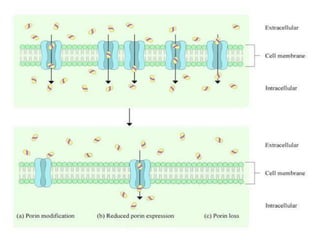
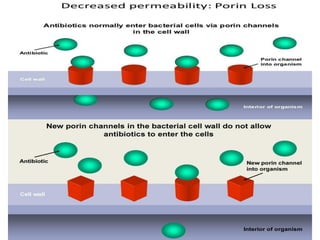
➢ Certainn bacteria modify their cell membrane porin channels,
thereby preventing the antimicrobials from entering into the
cell.(genetics)
TWO MAIN WAYS:
• porins changes can limit a drug uptake ,a decrease in the
number of porins present.
• Mutations that can change the selectivity of porin channel.
Examples
▪ This strategy has been observed in many gram –ve bacteria
such as Psuedomonas Enterobacter and Klebsiella species
against drug such as imipenem ,aminoglycosides and
quinolones.
▪ Gram positive bacteria Staphylococcus aureus has recently
developed resistance to vancomycin.
The mechanism that s.aureus uses against the vancomycin.
▪ It produce a thickened cell wall which makes it difficult for the
drug to enter the cell and provides an intermediate resistance
to vancomycin
2.Modification of a drug target
➢ There are multiple components in the bacterial cell that may be
targets of antimicrobial agents and there are just as many targets that
may be modified by the bacteria to enable resistance of those
drugs.(genetic).
3.Inactivation of a drug
➢ There are two main ways in which bacteria inactivate drugs.
1. Actual degradation of the drug, or
2. Transfer of a chemical group to the drug.
Actual degradation of the drug
Thereare a large numberof tranferasesthathave beenidentified. Acetylation is the mostdiversely
usedmechanism and is known to be usedagainstthe aminoglycosides.
Drug inactivation by transfer of a chemicalgroupto the drug(ACETYL GROUP)
The beta lactamasesare a very largegroupof drug hydrolyzingenzymes.Anotherdrugthat can be
inactivated by hydroxylationis tetracycline,via tetX gene.
4.Active efflux of a drug
• The efflux pumps function primarily to rid the bacterial cell of
toxic substances, and many of these pumps will transport a large
variety of compounds(multidrug efflux pump)
BACTERIA POSSESS DIFFERENT TYPES OF ELLUX PUMP:
1. The ATP binding cassette (ABC) family.
2. The multidrug and toxic compound extrusion (MATE) family.
3. The small multidrug resistance (SMR) family.
4. The major facilitator superfamily (MFS).
5. The resistance nodulation cell division (RND) family.
Prevention of drug resistance
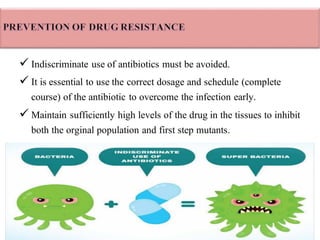
✓ Indiscriminate use of antibiotics must be avoided.
✓ It is essential to use the correct dosage and schedule (complete
course) of the antibiotic to overcome the infection early.
✓ Maintain sufficiently high levels of the drug in the tissues to inhibit
both the orginal population and first step mutants.
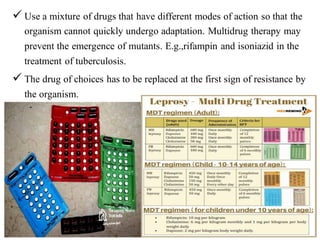
✓ Use a mixture of drugs that have different modes of action so that the
organism cannot quickly undergo adaptation. Multidrug therapy may
prevent the emergence of mutants. E.g.,rifampin and isoniazid in the
treatment of tuberculosis.
✓ The drug of choices has to be replaced at the first sign of resistance by
the organism.
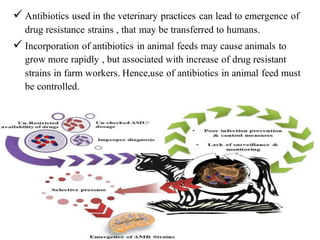
✓ Antibiotics used in the veterinary practices can lead to emergence of
drug resistance strains , that may be transferred to humans.
✓ Incorporation of antibiotics in animal feeds may cause animals to
grow more rapidly , but associated with increase of drug resistant
strains in farm workers. Hence,use of antibiotics in animal feed must
be controlled.
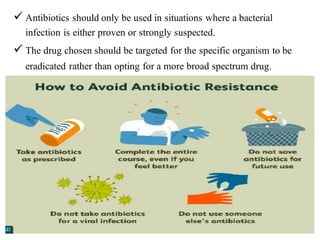
✓ Antibiotics should only be used in situations where a bacterial
infection is either proven or strongly suspected.
✓ The drug chosen should be targeted for the specific organism to be
eradicated rather than opting for a more broad spectrum drug.
ARTICLES:
Multi-drug resistance in cancer chemotherapeutics: mechanisms and lab approaches.
AUTHOR: Qiong Wu, Zhiping Yang, Yongzhan Nie, Yongquan Shi , Daiming Fan
Monitoring of drug resistance towards reducing the toxicity of pharmaceutical
compounds: past, present and future
AUTHOR : Elham Ahmadian et al. J Pharm Biomed Anal. 2020.
LATEST NEWS
https://www.niaid.nih.gov/news-events/trial-existing-antibiotic-treating-staphylococcus-aureus-bacteremia-begins
• http://archive.bio.ed.ac.uk/jdeacon/microbes/penicill.htm
• http://www.detectingdesign.com/antibioticresistance.html
• Institute of Medicine (US) Forum on Emerging Infections;
Knobler, S. L.; Lemon, S. M.; Najafi, M.; Burroughs, T.
(2003). Reading: The Resistance Phenomenon in Microbes
and Infectious Disease Vectors: Implications for Human
Health and Strategies for Containment -- Workshop Summary
- The National Academies
Press.nap.edu. doi:10.17226/10651. ISBN 978-0-309-08854-
1. PMID 22649806
• Optimal Mindset.
• Analytical skills
• CommunicationSkills.
• Level of Confidence.
• Gained Subject KnowledgeBetter.
• Presentation Skills.
SKILLS LEARNED
RESISTANCE (UNIT-1) S.Indhumathi.pdf

RESISTANCE (UNIT-1) S.Indhumathi.pdf

  • 1.
    SRI PARAMAKALYANI COLLEGE REACCREDITEDWITH BGRADE WITH A CGPA OF 2.71 INTHESECOND CYCLE OF NAAC AFFILIATED TO MANOMANIUMSUNDARANARUNIVERSITY, TIRUNELVELI. ALWARKURICHI 627 412, TAMIL NADU, INDIA POST GRADUATE & RESEARCH CENTRE DEPARTMENT OF MICROBIOLOGY (Government Aided) ACADEMIC YEAR 2021-2022 II SEM CORE: IMMUNOLOGY - (ZMBM22) UNIT- 1 RESISTANCE Submitted by, S.Indhumathi Reg.No:20211232516110 I M.Sc.Microbiology. Submitted to, Guide: Dr.S.Viswanathan Ph.D. Assistant professor and Head, Departmentof microbiology. Assignedon:23/02/2022 Takenon:--/04/2022
  • 2.
    1. MEDICAL TERMSRELATED TO TOPICS 2. INTRODUCTION 3. HISTORY 4. TYPES 5. MECHANISM 6. PREVENTION OF DRUG RESISTANCE 7. CURRENT RESEARCH & PUBLICATIONS 8. REFERENCE
  • 3.
    What is antibiotics?What is drug resistance?
  • 4.
    ➢ Drug resistanceis the reduction in effectiveness of a medication such as an antimicrobial or an antineoplastic in treating a disease or condition. The term is used in the context of resistance that pathogen or cancers have "acquired", i.e., resistance has evolved. ➢ Antimicrobial resistance occurs when microbes evolve mechanisms that protect them from the effects of antimicrobials. ➢ Antibiotic resistance is a subset of AMR, that applies specifically to bacteria that become resistant to antibiotics. ➢ Microbes resistant to multiple antimicrobials are called multidrug resistance (MDR).
  • 5.
    ➢ The antibioticera had truly begun and in 1945 Fleming, Florey and Chain were jointly awarded the Nobel Prize in Physiology or Medicine. ➢ In his Nobel lecture in 1945, Fleming presciently warned about the dangers of misusing penicillin. ➢ The first case of penicillin resistance was observed in 1947. The period between 1950 and 1960 is often referred to as the golden age of antibiotic discovery, as one-half of the antibiotics commonly used today were discovered during these years.
  • 8.
    INTRINSIC/NATURAL ACQUIRED Biochemical mechanism (Non-genetics) Geneticmethods 1. By producing enzymes. 2. Preventingdrug accumulation. 3. Modifying target site. 4. Use alternative pathway. 5. Quorumsensing. Lack of metabolic process/ target site Chromosomal methods. Ex: Mutation. Extra chromosomal methods. Ex: plasmids within or b/w bacteria
  • 9.
    Intrinsic / naturalresistance ➢ Stable genetic property encoded in the chromosome and shared by all strains of the species. ➢ Usually related to structural features. ➢ i.e., permeability of the cellwall. E.g. Pseudomonas cell wall limits penetration of antibiotics. ➢ Mutation affecting specific binding protein of the 30s subunit →Streptomycin-resistant M.tuberculosis & S.faecalis ➢ Mutation in porin proteins →impaired antibiotic transport into the cell →lead to multiple resistance →P.aeruginosa ➢ Mutation in PBPs →strep pneumoniae ➢ Altered dna gyrase →quinolone-resistant E.coli.
  • 10.
    ➢ Species developability to resist an antimicrobial drug to which it is as a whole naturally susceptible. ✓ Genetically Chromosomal - Mutational Extra Chromosomal - genetic exchange. ✓ Biochemically
  • 12.
    Chromosomal ➢ Occurs ata frequency of 10^-12 to 10^-7 ➢ Secondary to spontaneous mutation in a locus that controls susceptibility to given drug. ➢ Due to mutation in gene that codes for either: a) Modify drug target. b) Transport system in the membrane that controls drug uptake.
  • 13.
    Extra chromosomal ➢ Plasmidmediated. ➢ Occurs in many different species especially in gram –ve rods ➢ mediate resistance to multiple drugs. ➢ Can replicate independently of bacterial chromosome→many copies ➢ Can be transferred not only to the cells of same species but also to species and genera.
  • 14.
    Mutational drug resistanceInfectious (transferable) drug resistance Mutationsconfer resistance usually to one drug at a time. Mediatedby plasmids, may confer resistance to multipledrugs or all drugs used in treatment, simultaneously. Degree of drug resistance is low. Degree of drug resistance is usually high. It can be overcome by administeringhigh dose of drug. It cannot be overcome by high drug dosages. It can be prevented by treatment with a combinationof drugs (multidrug therapy) It cannot be preventedby a combinationof drugs. Mutationaldrug resistance does not spread from cell to cell. Transferrabledrug resistance spreads to other cell of same or different species by various methods of gene transfer such as conjugation, transduction,transformation, transposition,etc., Resistant mutantsare usuallymetabolically defective. Drug resistant strainsare metabolicallynormal. The virulence of resistant mutantsmay be decreased. Virulence is not decreased.
  • 15.
    Bacteria develop antimicrobialresistance by various mechansim. Mechanism that mediate bacterial resistance to drugs 1. Limiting uptake of a drug (natural). 2. Modification of a drug target. 3. Inactivation of a drug. 4. Active efflux of a drug.
  • 16.
    1.Limiting uptake ofa drug ➢ There is a natural difference in the ability of bacteria to limit the uptake of antimicrobial agents. ➢ The structure and function of LPS layer of gram –ve bacteria provides a barrier to certain types of molecules ➢ Certainn bacteria modify their cell membrane porin channels, thereby preventing the antimicrobials from entering into the cell.(genetics) TWO MAIN WAYS: • porins changes can limit a drug uptake ,a decrease in the number of porins present. • Mutations that can change the selectivity of porin channel.
  • 17.
    Examples ▪ This strategyhas been observed in many gram –ve bacteria such as Psuedomonas Enterobacter and Klebsiella species against drug such as imipenem ,aminoglycosides and quinolones. ▪ Gram positive bacteria Staphylococcus aureus has recently developed resistance to vancomycin. The mechanism that s.aureus uses against the vancomycin. ▪ It produce a thickened cell wall which makes it difficult for the drug to enter the cell and provides an intermediate resistance to vancomycin
  • 19.
    2.Modification of adrug target ➢ There are multiple components in the bacterial cell that may be targets of antimicrobial agents and there are just as many targets that may be modified by the bacteria to enable resistance of those drugs.(genetic).
  • 21.
    3.Inactivation of adrug ➢ There are two main ways in which bacteria inactivate drugs. 1. Actual degradation of the drug, or 2. Transfer of a chemical group to the drug. Actual degradation of the drug Thereare a large numberof tranferasesthathave beenidentified. Acetylation is the mostdiversely usedmechanism and is known to be usedagainstthe aminoglycosides. Drug inactivation by transfer of a chemicalgroupto the drug(ACETYL GROUP) The beta lactamasesare a very largegroupof drug hydrolyzingenzymes.Anotherdrugthat can be inactivated by hydroxylationis tetracycline,via tetX gene.
  • 22.
    4.Active efflux ofa drug • The efflux pumps function primarily to rid the bacterial cell of toxic substances, and many of these pumps will transport a large variety of compounds(multidrug efflux pump) BACTERIA POSSESS DIFFERENT TYPES OF ELLUX PUMP: 1. The ATP binding cassette (ABC) family. 2. The multidrug and toxic compound extrusion (MATE) family. 3. The small multidrug resistance (SMR) family. 4. The major facilitator superfamily (MFS). 5. The resistance nodulation cell division (RND) family.
  • 24.
    Prevention of drugresistance ✓ Indiscriminate use of antibiotics must be avoided. ✓ It is essential to use the correct dosage and schedule (complete course) of the antibiotic to overcome the infection early. ✓ Maintain sufficiently high levels of the drug in the tissues to inhibit both the orginal population and first step mutants.
  • 25.
    ✓ Use amixture of drugs that have different modes of action so that the organism cannot quickly undergo adaptation. Multidrug therapy may prevent the emergence of mutants. E.g.,rifampin and isoniazid in the treatment of tuberculosis. ✓ The drug of choices has to be replaced at the first sign of resistance by the organism.
  • 26.
    ✓ Antibiotics usedin the veterinary practices can lead to emergence of drug resistance strains , that may be transferred to humans. ✓ Incorporation of antibiotics in animal feeds may cause animals to grow more rapidly , but associated with increase of drug resistant strains in farm workers. Hence,use of antibiotics in animal feed must be controlled.
  • 27.
    ✓ Antibiotics shouldonly be used in situations where a bacterial infection is either proven or strongly suspected. ✓ The drug chosen should be targeted for the specific organism to be eradicated rather than opting for a more broad spectrum drug.
  • 28.
    ARTICLES: Multi-drug resistance incancer chemotherapeutics: mechanisms and lab approaches. AUTHOR: Qiong Wu, Zhiping Yang, Yongzhan Nie, Yongquan Shi , Daiming Fan Monitoring of drug resistance towards reducing the toxicity of pharmaceutical compounds: past, present and future AUTHOR : Elham Ahmadian et al. J Pharm Biomed Anal. 2020. LATEST NEWS https://www.niaid.nih.gov/news-events/trial-existing-antibiotic-treating-staphylococcus-aureus-bacteremia-begins
  • 29.
    • http://archive.bio.ed.ac.uk/jdeacon/microbes/penicill.htm • http://www.detectingdesign.com/antibioticresistance.html •Institute of Medicine (US) Forum on Emerging Infections; Knobler, S. L.; Lemon, S. M.; Najafi, M.; Burroughs, T. (2003). Reading: The Resistance Phenomenon in Microbes and Infectious Disease Vectors: Implications for Human Health and Strategies for Containment -- Workshop Summary - The National Academies Press.nap.edu. doi:10.17226/10651. ISBN 978-0-309-08854- 1. PMID 22649806
  • 34.
    • Optimal Mindset. •Analytical skills • CommunicationSkills. • Level of Confidence. • Gained Subject KnowledgeBetter. • Presentation Skills. SKILLS LEARNED