STK1094 Analytical Chemistry I
Dayang Norafizan binti Awang Che
Faculty of Resource Science and Technology
Universiti Malaysia Sarawak
This OpenCourseWare@UNIMAS and its related course materials are licensed under
a Creative Commons Attribution-NonCommercial-ShareAlike 4.0 International License.
LU 8: Analytical Separation
Techniques
Learning Objectives
At the end of this lesson, students should be
able to:
• Define the chromatography term
• Explain different types of chromatography
• Explain the principles of chromatography
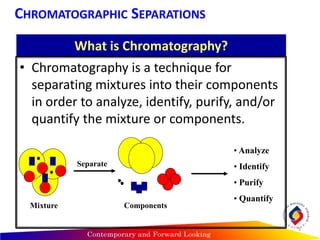
What is Chromatography?
• Chromatography is a technique for
separating mixtures into their components
in order to analyze, identify, purify, and/or
quantify the mixture or components.
3
Separate
• Analyze
• Identify
• Purify
• Quantify
ComponentsMixture
CHROMATOGRAPHIC SEPARATIONS
Uses of Chromatography
• Chromatography is used by scientists to:
• Analyze – examine a mixture, its components,
and their relations to one another
• Identify – determine the identity of a mixture
or components based on known components
• Purify – separate components in order to
isolate one of interest for further study
• Quantify – determine the amount of a
mixture and/or the components present in
the sample
4
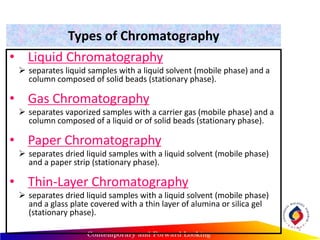
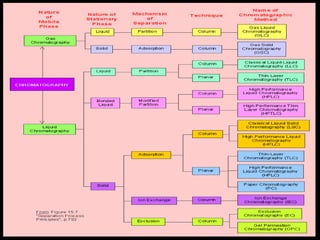
Types of Chromatography
• Liquid Chromatography
 separates liquid samples with a liquid solvent (mobile phase) and a
column composed of solid beads (stationary phase).
• Gas Chromatography
 separates vaporized samples with a carrier gas (mobile phase) and a
column composed of a liquid or of solid beads (stationary phase).
• Paper Chromatography
 separates dried liquid samples with a liquid solvent (mobile phase)
and a paper strip (stationary phase).
• Thin-Layer Chromatography
 separates dried liquid samples with a liquid solvent (mobile phase)
and a glass plate covered with a thin layer of alumina or silica gel
(stationary phase).
5
*Terms in Separation Techniques*
• Stationary phase: a phase that is fixed in place
either in a column or on a planar surface.
• Mobile phase :a phase that moves over or
through the stationary phase, carrying the
analyte with it.
• Eluent: a solvent used to carry the
components of a mixture through stationary
phase.
6
Chromatography
• Greek word chroma – “color” and graphein
– “to write”.
• Separations method - differences in
partitioning behavior (migration rates)
between a flowing mobile phase and a
stationary phase to separate the
components in a mixture.
• Column holds the stationary phase and the
mobile phase carries the sample through it.
8
Chromatography Basics
How it works:
 sample is loaded onto the polar stationary phase.
 Polar compounds will adsorb onto the stationary
phase to a greater extent than non-polar
compounds.
 The mobile phase (eluting phase) helps “push” or
elute the compounds either down a column (for
CC) or up a plate (for TLC).
The main concept to consider in chromatography is polarity.
9
Polarity & Intermolecular Attractive
Forces
• More polar compounds will be more attracted to silica gel than non-polar
compounds due to intermolecular attractive forces
- a dipole-dipole interaction.
• The more non-polar compounds will travel more easily and more quickly
through the stationary phase.
• The mobile phase helps carry the compounds through the stationary
phase.
•Separation of compounds in a mixture is possible because compounds
have different polarities. Non-polar compounds will elute first and polar
compounds will elute last.
Si
OH
O
O
O
Si
+
-
-
-
+
Silica gel, [SiO2]n
10
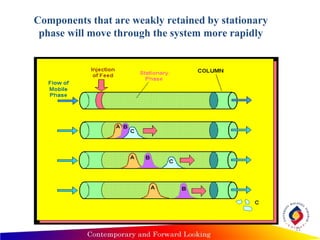
Components that are weakly retained by stationary
phase will move through the system more rapidly
11
REFLECTION
•What is
chromatography?
•What are the examples
of chromatography?
•What is the principle of
chromatography?

Chromatography techniques

  • 1.
    STK1094 Analytical ChemistryI Dayang Norafizan binti Awang Che Faculty of Resource Science and Technology Universiti Malaysia Sarawak This OpenCourseWare@UNIMAS and its related course materials are licensed under a Creative Commons Attribution-NonCommercial-ShareAlike 4.0 International License.
  • 2.
    LU 8: AnalyticalSeparation Techniques Learning Objectives At the end of this lesson, students should be able to: • Define the chromatography term • Explain different types of chromatography • Explain the principles of chromatography
  • 3.
    What is Chromatography? •Chromatography is a technique for separating mixtures into their components in order to analyze, identify, purify, and/or quantify the mixture or components. 3 Separate • Analyze • Identify • Purify • Quantify ComponentsMixture CHROMATOGRAPHIC SEPARATIONS
  • 4.
    Uses of Chromatography •Chromatography is used by scientists to: • Analyze – examine a mixture, its components, and their relations to one another • Identify – determine the identity of a mixture or components based on known components • Purify – separate components in order to isolate one of interest for further study • Quantify – determine the amount of a mixture and/or the components present in the sample 4
  • 5.
    Types of Chromatography •Liquid Chromatography  separates liquid samples with a liquid solvent (mobile phase) and a column composed of solid beads (stationary phase). • Gas Chromatography  separates vaporized samples with a carrier gas (mobile phase) and a column composed of a liquid or of solid beads (stationary phase). • Paper Chromatography  separates dried liquid samples with a liquid solvent (mobile phase) and a paper strip (stationary phase). • Thin-Layer Chromatography  separates dried liquid samples with a liquid solvent (mobile phase) and a glass plate covered with a thin layer of alumina or silica gel (stationary phase). 5
  • 6.
    *Terms in SeparationTechniques* • Stationary phase: a phase that is fixed in place either in a column or on a planar surface. • Mobile phase :a phase that moves over or through the stationary phase, carrying the analyte with it. • Eluent: a solvent used to carry the components of a mixture through stationary phase. 6
  • 8.
    Chromatography • Greek wordchroma – “color” and graphein – “to write”. • Separations method - differences in partitioning behavior (migration rates) between a flowing mobile phase and a stationary phase to separate the components in a mixture. • Column holds the stationary phase and the mobile phase carries the sample through it. 8
  • 9.
    Chromatography Basics How itworks:  sample is loaded onto the polar stationary phase.  Polar compounds will adsorb onto the stationary phase to a greater extent than non-polar compounds.  The mobile phase (eluting phase) helps “push” or elute the compounds either down a column (for CC) or up a plate (for TLC). The main concept to consider in chromatography is polarity. 9
  • 10.
    Polarity & IntermolecularAttractive Forces • More polar compounds will be more attracted to silica gel than non-polar compounds due to intermolecular attractive forces - a dipole-dipole interaction. • The more non-polar compounds will travel more easily and more quickly through the stationary phase. • The mobile phase helps carry the compounds through the stationary phase. •Separation of compounds in a mixture is possible because compounds have different polarities. Non-polar compounds will elute first and polar compounds will elute last. Si OH O O O Si + - - - + Silica gel, [SiO2]n 10
  • 11.
    Components that areweakly retained by stationary phase will move through the system more rapidly 11
  • 12.
    REFLECTION •What is chromatography? •What arethe examples of chromatography? •What is the principle of chromatography?