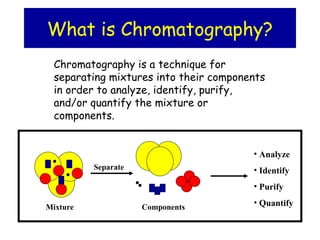
What is Chromatography?
Chromatographyis a technique for
separating mixtures into their components
in order to analyze, identify, purify,
and/or quantify the mixture or
components.
Separate
• Analyze
• Identify
• Purify
• Quantify
Components
Mixture
3.
Uses for Chromatography
Chromatographyis used by scientists to:
• Analyze – examine a mixture, its components,
and their relations to one another
• Identify – determine the identity of a mixture or
components based on known components
• Purify – separate components in order to isolate
one of interest for further study
• Quantify – determine the amount of the a mixture
and/or the components present in the sample
4.
Uses for Chromatography
Real-lifeexamples of uses for
chromatography:
• Pharmaceutical Company – determine amount of
each chemical found in new product
• Hospital – detect blood or alcohol levels in a
patient’s blood stream
• Law Enforcement – to compare a sample found at
a crime scene to samples from suspects
• Environmental Agency – determine the level of
pollutants in the water supply
• Manufacturing Plant – to purify a chemical
needed to make a product
5.
Definition of Chromatography
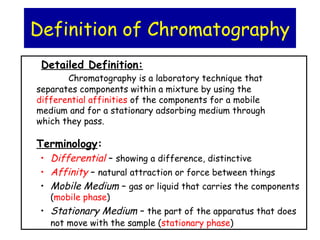
DetailedDefinition:
Chromatography is a laboratory technique that
separates components within a mixture by using the
differential affinities of the components for a mobile
medium and for a stationary adsorbing medium through
which they pass.
Terminology:
• Differential – showing a difference, distinctive
• Affinity – natural attraction or force between things
• Mobile Medium – gas or liquid that carries the components
(mobile phase)
• Stationary Medium – the part of the apparatus that does
not move with the sample (stationary phase)
6.
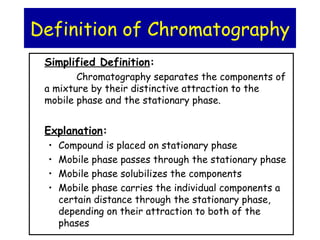
Simplified Definition:
Chromatography separatesthe components of
a mixture by their distinctive attraction to the
mobile phase and the stationary phase.
Explanation:
• Compound is placed on stationary phase
• Mobile phase passes through the stationary phase
• Mobile phase solubilizes the components
• Mobile phase carries the individual components a
certain distance through the stationary phase,
depending on their attraction to both of the
phases
Definition of Chromatography
7.
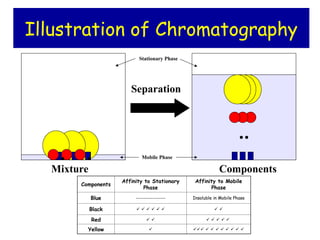
Illustration of Chromatography
Components
Affinityto Stationary
Phase
Affinity to Mobile
Phase
Blue ---------------- Insoluble in Mobile Phase
Black
Red
Yellow
Mixture Components
Separation
Stationary Phase
Mobile Phase
9.
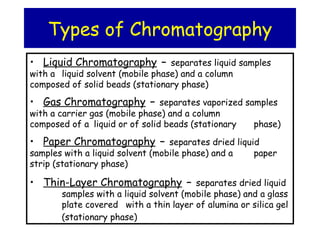
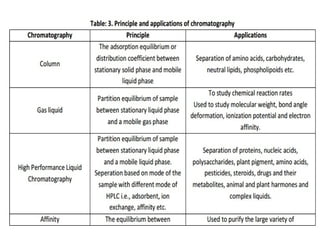
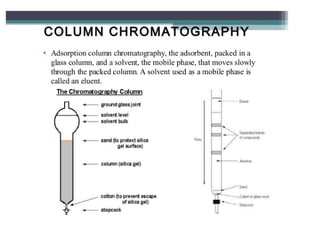
• Liquid Chromatography– separates liquid samples
with a liquid solvent (mobile phase) and a column
composed of solid beads (stationary phase)
• Gas Chromatography – separates vaporized samples
with a carrier gas (mobile phase) and a column
composed of a liquid or of solid beads (stationary phase)
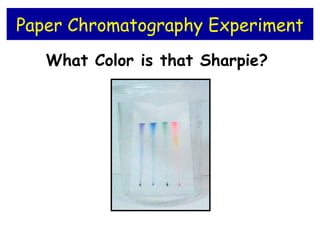
• Paper Chromatography – separates dried liquid
samples with a liquid solvent (mobile phase) and a paper
strip (stationary phase)
• Thin-Layer Chromatography – separates dried liquid
samples with a liquid solvent (mobile phase) and a glass
plate covered with a thin layer of alumina or silica gel
(stationary phase)
Types of Chromatography
Types of Chromatography
10.
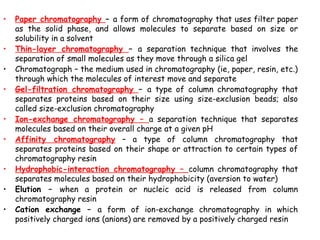
• Paper chromatography– a form of chromatography that uses filter paper
as the solid phase, and allows molecules to separate based on size or
solubility in a solvent
• Thin-layer chromatography – a separation technique that involves the
separation of small molecules as they move through a silica gel
• Chromatograph – the medium used in chromatography (ie, paper, resin, etc.)
through which the molecules of interest move and separate
• Gel-filtration chromatography – a type of column chromatography that
separates proteins based on their size using size-exclusion beads; also
called size-exclusion chromatography
• Ion-exchange chromatography – a separation technique that separates
molecules based on their overall charge at a given pH
• Affinity chromatography – a type of column chromatography that
separates proteins based on their shape or attraction to certain types of
chromatography resin
• Hydrophobic-interaction chromatography – column chromatography that
separates molecules based on their hydrophobicity (aversion to water)
• Elution – when a protein or nucleic acid is released from column
chromatography resin
• Cation exchange – a form of ion-exchange chromatography in which
positively charged ions (anions) are removed by a positively charged resin
11.
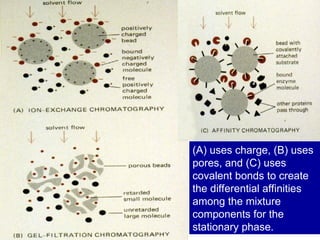
(A) uses charge,(B) uses
pores, and (C) uses
covalent bonds to create
the differential affinities
among the mixture
components for the
stationary phase.
12.
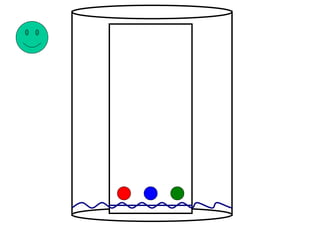
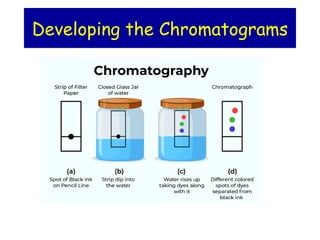
Principles of PaperChromatography
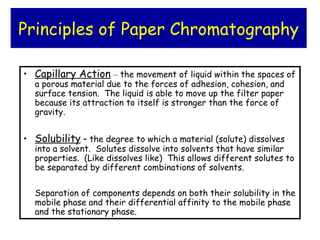
• Capillary Action – the movement of liquid within the spaces of
a porous material due to the forces of adhesion, cohesion, and
surface tension. The liquid is able to move up the filter paper
because its attraction to itself is stronger than the force of
gravity.
• Solubility – the degree to which a material (solute) dissolves
into a solvent. Solutes dissolve into solvents that have similar
properties. (Like dissolves like) This allows different solutes to
be separated by different combinations of solvents.
Separation of components depends on both their solubility in the
mobile phase and their differential affinity to the mobile phase
and the stationary phase.
13.
Chromatography is basedon the principle of differential partitioning
or differential adsorption of components of a mixture between a
stationary phase and a mobile phase.
Here's a more detailed explanation:
Differential Partitioning:
Different components of a mixture have varying affinities for the
stationary and mobile phases. This means they will be retained or
move through the system at different rates, leading to their
separation.
Mobile Phase:
The mobile phase is a fluid (liquid or gas) that carries the mixture
through the stationary phase.
Stationary Phase:
The stationary phase is a solid or a layer of a material that is fixed in
place, allowing the components of the mixture to interact with it.
Separation:
As the mobile phase moves through the stationary phase, the
components of the mixture interact differently with both phases,
causing them to separate based on their different affinities and
movement rates.
Overview of theExperiment
Purpose:
To introduce students to the principles and
terminology of chromatography and
demonstrate separation of the dyes in
Sharpie Pens with paper chromatography.
Time Required:
Prep. time: 10 minutes
Experiment time: 45 minutes
Costs:
Less than $10
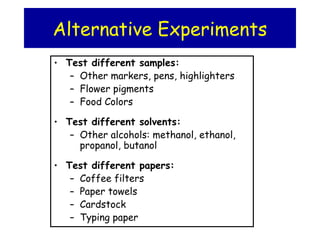
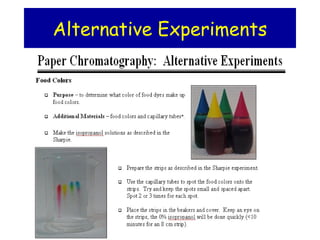
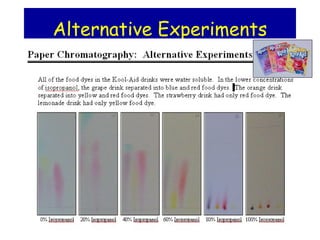
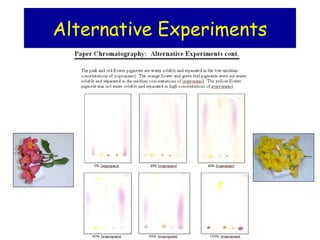
Alternative Experiments
• Testdifferent samples:
– Other markers, pens, highlighters
– Flower pigments
– Food Colors
• Test different solvents:
– Other alcohols: methanol, ethanol,
propanol, butanol
• Test different papers:
– Coffee filters
– Paper towels
– Cardstock
– Typing paper



![谷歌留痕技术 [ 𝙩𝙤𝙥 𝟮𝟯𝟯. 𝙘 𝙤𝙢 ]](https://cdn.slidesharecdn.com/ss_thumbnails/top233-260130174328-3833018c-thumbnail.jpg?width=640&height=640&fit=bounds)


