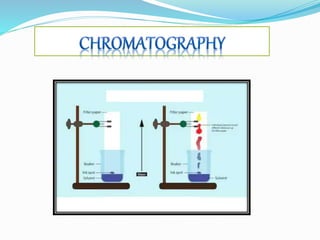
Chromatography is One of the most effective techniques for
accomplishing separation, purification and identification of chemical
compounds, biomolecules and their constituent monomers.
Greekwords:
Chroma=Colour;
Graphein=To write
Mickail T swettis credited with the original development of
chromatography technique in 1903
•Used for the separation of plant pigments using column of
calcium carbonate.
INTRODUCTION
Basis of chromatographic separation
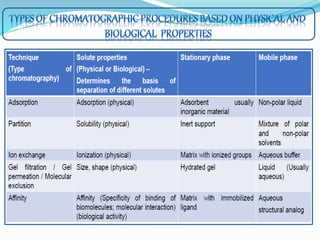
Mechanisms defining chromatographic processes
•Adsorption
•Partition
•Ionex change
•Molecular exclusion
•Affinity
Majority of chromatography processes exploit differences in physical
properties of compounds
•The exception being affinity chromatography, which is based on
specific ligand binding properties of biological macromolecules.
Choice of chromatography
•Based on dominant interactions between stationary phase and the
substances being separated.
Phases used in chromatographic
procedures
All chromatographic processes are based on separation in two phases
•Stationary phase
•Mobile phase
Stationary phase
Phase which does not move
Supported by matrix
Sample/solute/analyte is applied on stationary phase
Analyte should not interact (chemical or electrostatic) with the
surface of stationary phase (except in adsorption chromatography)
Chemical nature of stationary phase depends on particular form
of chromatography
Can be liquid, solid, gel, solid/liquid mix that is immobilized.
Solvent used for separation
Solvent that moves
Passed over immobilized stationary phase
Called eluent/eluant in case of column chromatography
Passed by capillary action in case of paper chromatography, thin
layer chromatography
Selection basis
Can be liquid or inert gas
Matrix used in chromatographicprocedures
Matrix
A material used to support the stationary phase
Ion exchanger or ligand associated with porous solid matrix can serve
as stationary phase in ion exchange and affinity chromatography,
respectively
Should have following properties
1. Inert (chemically unreactive)
2. Insoluble in various solvents used
3. Spherical–best packing characteristics are given by spherical
particles
4. Uniformsized
5. Good flow properties–allows easy flow of mobile phase
6. Uncharged
7. No non specific adsorption (except in case of adsorption
chromatography)
e.g., agarose, cellulose, dextran, polyacrylamide, polystyrene, silica, cross- linked polymers, etc.
Based on characteristics of analytes/solutes
For coloured analytes
a) Visual observation
b) Visible spectrophotometry
For colourless analytes
a) UV absorption
b) Fluorescence spectroscopy
c) Changes in refractive index of effluents
d) Presence of radio active emission atom
e) Oxidation or reduction of analyte by electro chemical
detector
Steps
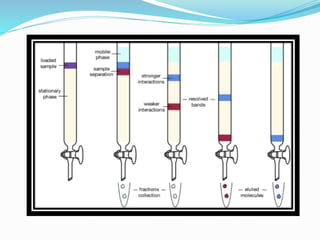
Packing of column with stationary phase
Loading of analyte mix
Passage of mobile phase
[Washing of unbound analytes in the mix and
elution of bound analytes in the mix by mobile phase]
Fraction collection
Detection of separated analytes
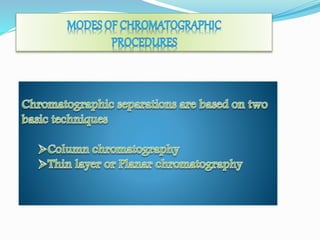
Columnchromatography
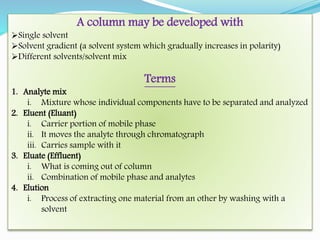
A column may be developed with
Single solvent
Solvent gradient (a solvent system which gradually increases in polarity)
Different solvents/solvent mix
Terms
1. Analyte mix
i. Mixture whose individual components have to be separated and analyzed
2. Eluent (Eluant)
i. Carrier portion of mobile phase
ii. It moves the analyte through chromatograph
iii. Carries sample with it
3. Eluate (Effluent)
i. What is coming out of column
ii. Combination of mobile phase and analytes
4. Elution
i. Process of extracting one material from an other by washing with a
solvent
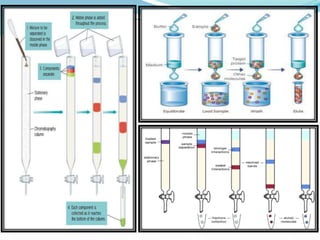
Stationary phase attached to suitable matrix is packed in column and equilibrated
[Uniform packing with no cracks or channels or bubbles]
[Stationary phase should be wet with the solvent]
[Supported at bottom by glasswool]
[Stop cock closed]
↓
Small volume (thin lamella) of analyte mix placed on stationary phase and allowed to
enter the column
↓
Mobile phase constantly passed through column
[By gravity feed / By pumping system / By applied gas pressure]
[Stop cock opened]
[Stationary phase should not be disturbed upon addition of mobile phase]
[Mobile phase added repeatedly as many times as needed throughout the process]
↓
Different solutes in the mix move through column, get separated and chromatogram
developed by flowing mobile phase
[Different washing and elution steps may be required]
↓
Separated solutes appear in the liquid leaving the column (eluate / effluent) when
particular volumes of mobile phase have passed through column
↓
Eluate collected as discrete fractions using automatic collector
[Component analytes thus purified from analyte mix]
↓
Separated components are identified by testing aliquots of each fraction by
spectrum measurements, chemical tests, radioactivity, etc., depending upon the
properties of analytes
Planar chromatography
Adsorption and partition chromatography procedures are performed both modes–
column and planar
It involves following steps
a. Formation of a thin layer of stationary phase (may be attached to matrix)
b. Spotting of analyte mix
c. Separation of component analytes (solutes) using mobile phase (solvent)
d. Detection
Examples
a. Paper chromatography
b. Thin layer chromatography (TLC)
Thin layer can be filter paper or thin layer of adsorbent
Matrix contains bound liquid
a. Water molecules bound to cellulose in paper chromatography
b. Solvent used to form thin layer is bound to support in TLC
Separation principle involves both adsorption and partition
The relative movement of each molecule is a result of a balance between a driving
force (i.e., the movement of mobile phase) and retarding effects (adsorption and / or
partition)
Comparison of retention factor or retardation factor, Rf with the known isused to
identify the analytes
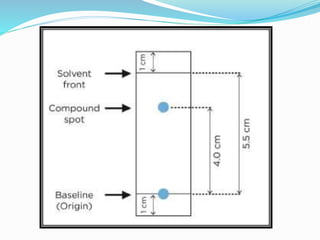
Retention factor
Defined as the distance travelled by the individual component divided by the total
distance travelled by the solvent
Ratio of distance travelled by solute (spot) to distance travelled by solvent
Comparison with known values help in identification of solutes
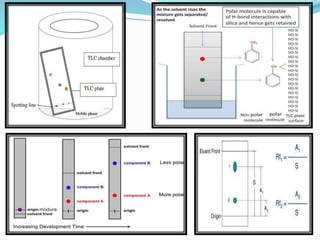
Rule of thumb for silica (polar adsorbent)
The component that travels the least distance on the TLC plate is the most polar,
since it binds to the silica most tightly (silica is polar adsorbent)
The component that travels the maximum distance is the least polar; it binds to the
silica least tightly
It is most soluble in the non polar solvent (mobile phase), and hence moves up the
plate with the solvent
Adsorption
chromatography
Type of liquid chromatography in which molecules are retained
based on their adsorption and desorption at the surface of the
support, which also acts as stationar yphase
It is liquid-solid chromatography
Adsorbents have the ability to hold molecules at their surface
Separation either in columns or on thin layers
Retention in this method is based on the competition of the analyte
with molecules of the mobile phase as both bind to the surface of the
support
The degree of molecule’s retention depends on
a) The binding strength of molecule to the support
b) The surface area of the support
c) The amount of mobile phase displaced from the support by
the molecule
d) The binding strength of the mobile phase to the support
Stationary phase or Matrix–solid (adsorbent)
a) Choice of adsorbent depends on the types of compounds to
be separated
b) Commonly used adsorbents are polar
c) e.g., Silica, Alumina, Activated carbon, Calcium phosphate
gel, Hydroxy apatite, Cellulose, Starch, Magnesium silicate
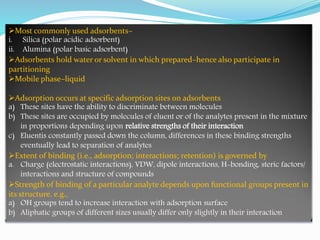
Most commonly used adsorbents–
i. Silica (polar acidic adsorbent)
ii. Alumina (polar basic adsorbent)
Adsorbents hold water or solvent in which prepared–hence also participate in
partitioning
Mobile phase–liquid
Adsorption occurs at specific adsorption sites on adsorbents
a) These sites have the ability to discriminate between molecules
b) These sites are occupied by molecules of eluent or of the analytes present in the mixture
in proportions depending upon relative strengths of their interaction
c) Eluentis constantly passed down the column, differences in these binding strengths
eventually lead to separation of analytes
Extent of binding (i.e., adsorption; interactions; retention) is governed by
a. Charge (electrostatic interactions), VDW, dipole interactions, H-bonding, steric factors/
interactions and structure of compounds
Strength of binding of a particular analyte depends upon functional groups present in
its structure. e.g.,
a) OH groups tend to increase interaction with adsorption surface
b) Aliphatic groups of different sizes usually differ only slightly in their interaction
Partition chromatography
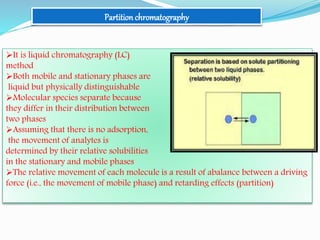
It is liquid chromatography (LC)
method
Both mobile and stationary phases are
liquid but physically distinguishable
Molecular species separate because
they differ in their distribution between
two phases
Assuming that there is no adsorption,
the movement of analytes is
determined by their relative solubilities
in the stationary and mobile phases
The relative movement of each molecule is a result of abalance between a driving
force (i.e., the movement of mobile phase) and retarding effects (partition)
Stationary phase is liquid or bonded liquid
a) If stationary phase is held stationary by a solid, then that solid
support is called support or matrix
b) Stationary phase does not fill the spaces between the particles of
support–this space is occupied by mobile phase
Matrix should not adsorb solute
Examples of matrices used-Silica, Diatomaceous Earth (Celite);
Certain cross linked dextran (Sephadex LH20); Cellulose powder
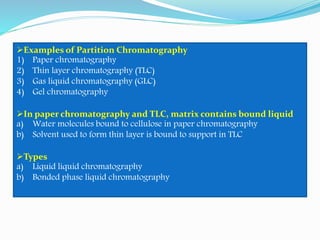
Examples of Partition Chromatography
1) Paper chromatography
2) Thin layer chromatography (TLC)
3) Gas liquid chromatography (GLC)
4) Gel chromatography
In paper chromatography and TLC, matrix contains bound liquid
a) Water molecules bound to cellulose in paper chromatography
b) Solvent used to form thin layer is bound to support in TLC
Types
a) Liquid liquid chromatography
b) Bonded phase liquid chromatography
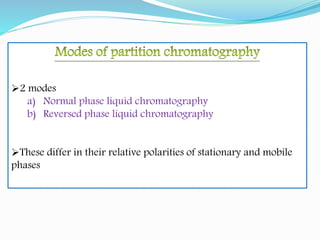
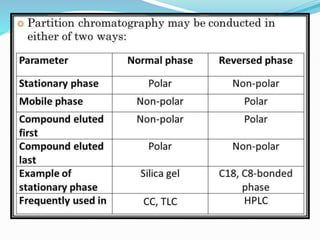
2 modes
a) Normal phase liquid chromatography
b) Reversed phase liquid chromatography
These differ in their relative polarities of stationary and mobile
phases
Stationary phase–polar– e.g., alkylnitrile, alkylamine bonded to silica
Mobile phase–relatively non polar–e.g., organic solvent as hydrocarbons in
combination with ethers, esters and chlorinated solvents; hexane, heptane,
dichloromethane, ethylacetate
When the solvent or gradient of solvents is passed, the less polar components
will be eluted faster than the more
polar ones
Order of elution–non polar > polar [the least
polar is eluted first and the most polar last]
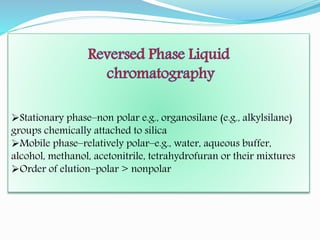
Stationary phase–non polar e.g., organosilane (e.g., alkylsilane)
groups chemically attached to silica
Mobile phase–relatively polar–e.g., water, aqueous buffer,
alcohol, methanol, acetonitrile, tetrahydrofuran or their mixtures
Order of elution–polar > nonpolar
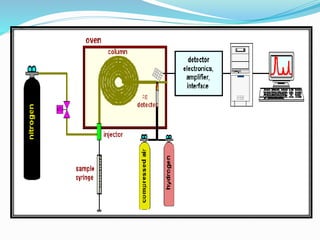
Based on a partition equilibrium of analyte between a solid or
viscous liquid stationary phase (often a liquid silicone-based
material) and a mobile gas (most often helium)
Stationary phase is adhered to the inside of a small-diameter glass
or fused-silica tube (a capillary column) or a solid matrix inside a
larger metal tube (a packed column)
Paper Chromatography
Planar chromatography system
Separation of compounds occurs on cellulose filter paper
Matrix
a) Cellulose fibers of paper
Stationary phase
a) Water adsorbed in cellulose fiber or
b) Cellulose filter paper itself
Mobile phase
a) Liquid passed over immobilized stationary phase by capillary
action
Principles
a) Partition chromatography
b) Adsorption chromatography
Modes of operation
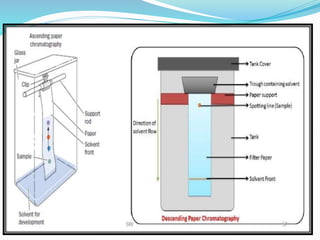
a) Ascending–movement through capillary action against
the gravitational pull; easy to setup
b) Descending–movement through capillary action in the
direction of gravitational pull; difficult to setup faster
The chromatography paper is cut into rectangular strips
A line is marked on the paper with pencil at about 2cm
from the bottom or top, at which spots of analytes are applied
Fitted in assembly as shown
Partition
Substances are partitioned between liquid phases
Stationary phase is water, which is held in the pores of the filter
paper used–hydrophilic stationary phase
Mobile phase is liquid
Compounds in the mixture get separated due to differences in the
affinity (solubility) towards entrapped water (in stationary phase)
and mobile phase solvents during the movement of mobile phase
under the capillary action of pores in the paper
Most of the applications of paper chromatography work on this
principle
Adsorption
Adsorption between solid and liquid phases
Stationary phase is the solid surface of paper (cellulose filter)
Mobile phase is liquid phase
Compounds in the mixture get separated due to differences in the adsorption on
cellulose filter paper; differently adsorbed compounds are then separated during
the movement of mobile phase under the capillary action of pores in the paper
The relative movement of each molecule is a result of a balance between a
driving force (i.e., the movement of mobile phase) and retarding effects (adsorption
and partition)
The migration rate of acompound is expressed as retention or retardation factor,
Rf, and compared with the known
Rf = Distance travelled by compound / distance travelled by solvent front
SRV
ThinLayer Chromatography(TLC)
A method of separation or identification of a mixture of components into
individual components by using finely divided adsorbent solid / (liquid) spread over
a glass plate and liquid as a mobile phase
Type of planar chromatography
Solid-liquid type of chromatography
Thinlayer
a) 0.1–0.25mm thick
Advantages as compared to paper
a) Faster runs22
b) Better separations
c) Choice between different adsorbents
For even better resolution and quantification, high-performance TLC (automated)
can be used
Stationary phase is normally a polar adsorbent (matrix itself)
a) e.g., silica, alumina, cellulose
Mobile phase can be a single solvent or combination of solvents
Principle – partition and adsorption
Partition
a. Stationary phase–solvent or water used to prepare thin layer bound to
support
b. Mobile phase–solvent used for separation
Adsorption
a. Stationary phase–support or matrix
b. Mobile phase–solvent used for separation
There lative movement of each molecule is a result of a balance between a
driving force (i.e., the movement of mobile phase) and retarding effects
(adsorption and partition)
The migration rate of a compound is expressed as retention or retardation
factor, Rf and compared with the known
Rf = Distance travelled by compound / distance travelled by solvent front
1. https://www.google.com/url?sa=t&rct=j&q=&esrc=s&source=web&cd=&cad=rja&uac
t=8&ved=2ahUKEwim-I7X-
ZXtAhU1yzgGHTSoAR0QFjAJegQICRAC&url=https%3A%2F%2Fen.wikipedia.org%
2Fwiki%2FChromatography&usg=AOvVaw3m5vSX36x2uh_Iw5DYWH8G
2. https://www.google.com/url?sa=t&rct=j&q=&esrc=s&source=web&cd=&cad=rja&uac
t=8&ved=2ahUKEwim-I7X-
ZXtAhU1yzgGHTSoAR0Qt9IBMBR6BAhKEAk&url=https%3A%2F%2Fwww.khanaca
demy.org%2Fscience%2Fclass-11-chemistry-india%2Fxfbb6cb8fc2bd00c8%3Ain-in-
organic-chemistry-some-basic-principles-and-
techniques%2Fxfbb6cb8fc2bd00c8%3Ain-in-methods-of-purification-of-organic-
compounds%2Fv%2Fbasics-of-chromatography&usg=AOvVaw1eeVA-
i5ItmVxpwb_ajhBw
3. www.sciencedirect.com
4. www.onecentralpress.com
5. http://stobiecka.net/teaching.htm
Chromatography

Chromatography

  • 3.
    Chromatography is Oneof the most effective techniques for accomplishing separation, purification and identification of chemical compounds, biomolecules and their constituent monomers. Greekwords: Chroma=Colour; Graphein=To write Mickail T swettis credited with the original development of chromatography technique in 1903 •Used for the separation of plant pigments using column of calcium carbonate. INTRODUCTION
  • 4.
    Basis of chromatographicseparation Mechanisms defining chromatographic processes •Adsorption •Partition •Ionex change •Molecular exclusion •Affinity Majority of chromatography processes exploit differences in physical properties of compounds •The exception being affinity chromatography, which is based on specific ligand binding properties of biological macromolecules. Choice of chromatography •Based on dominant interactions between stationary phase and the substances being separated.
  • 6.
    Phases used inchromatographic procedures All chromatographic processes are based on separation in two phases •Stationary phase •Mobile phase Stationary phase Phase which does not move Supported by matrix Sample/solute/analyte is applied on stationary phase Analyte should not interact (chemical or electrostatic) with the surface of stationary phase (except in adsorption chromatography) Chemical nature of stationary phase depends on particular form of chromatography Can be liquid, solid, gel, solid/liquid mix that is immobilized.
  • 7.
    Solvent used forseparation Solvent that moves Passed over immobilized stationary phase Called eluent/eluant in case of column chromatography Passed by capillary action in case of paper chromatography, thin layer chromatography Selection basis Can be liquid or inert gas
  • 8.
    Matrix used inchromatographicprocedures Matrix A material used to support the stationary phase Ion exchanger or ligand associated with porous solid matrix can serve as stationary phase in ion exchange and affinity chromatography, respectively Should have following properties 1. Inert (chemically unreactive) 2. Insoluble in various solvents used 3. Spherical–best packing characteristics are given by spherical particles 4. Uniformsized 5. Good flow properties–allows easy flow of mobile phase 6. Uncharged 7. No non specific adsorption (except in case of adsorption chromatography) e.g., agarose, cellulose, dextran, polyacrylamide, polystyrene, silica, cross- linked polymers, etc.
  • 9.
    Based on characteristicsof analytes/solutes For coloured analytes a) Visual observation b) Visible spectrophotometry For colourless analytes a) UV absorption b) Fluorescence spectroscopy c) Changes in refractive index of effluents d) Presence of radio active emission atom e) Oxidation or reduction of analyte by electro chemical detector
  • 12.
    Steps Packing of columnwith stationary phase Loading of analyte mix Passage of mobile phase [Washing of unbound analytes in the mix and elution of bound analytes in the mix by mobile phase] Fraction collection Detection of separated analytes Columnchromatography
  • 13.
    A column maybe developed with Single solvent Solvent gradient (a solvent system which gradually increases in polarity) Different solvents/solvent mix Terms 1. Analyte mix i. Mixture whose individual components have to be separated and analyzed 2. Eluent (Eluant) i. Carrier portion of mobile phase ii. It moves the analyte through chromatograph iii. Carries sample with it 3. Eluate (Effluent) i. What is coming out of column ii. Combination of mobile phase and analytes 4. Elution i. Process of extracting one material from an other by washing with a solvent
  • 14.
    Stationary phase attachedto suitable matrix is packed in column and equilibrated [Uniform packing with no cracks or channels or bubbles] [Stationary phase should be wet with the solvent] [Supported at bottom by glasswool] [Stop cock closed] ↓ Small volume (thin lamella) of analyte mix placed on stationary phase and allowed to enter the column ↓ Mobile phase constantly passed through column [By gravity feed / By pumping system / By applied gas pressure] [Stop cock opened] [Stationary phase should not be disturbed upon addition of mobile phase] [Mobile phase added repeatedly as many times as needed throughout the process] ↓ Different solutes in the mix move through column, get separated and chromatogram developed by flowing mobile phase [Different washing and elution steps may be required] ↓
  • 15.
    Separated solutes appearin the liquid leaving the column (eluate / effluent) when particular volumes of mobile phase have passed through column ↓ Eluate collected as discrete fractions using automatic collector [Component analytes thus purified from analyte mix] ↓ Separated components are identified by testing aliquots of each fraction by spectrum measurements, chemical tests, radioactivity, etc., depending upon the properties of analytes
  • 17.
    Planar chromatography Adsorption andpartition chromatography procedures are performed both modes– column and planar It involves following steps a. Formation of a thin layer of stationary phase (may be attached to matrix) b. Spotting of analyte mix c. Separation of component analytes (solutes) using mobile phase (solvent) d. Detection Examples a. Paper chromatography b. Thin layer chromatography (TLC) Thin layer can be filter paper or thin layer of adsorbent Matrix contains bound liquid a. Water molecules bound to cellulose in paper chromatography b. Solvent used to form thin layer is bound to support in TLC
  • 18.
    Separation principle involvesboth adsorption and partition The relative movement of each molecule is a result of a balance between a driving force (i.e., the movement of mobile phase) and retarding effects (adsorption and / or partition) Comparison of retention factor or retardation factor, Rf with the known isused to identify the analytes Retention factor Defined as the distance travelled by the individual component divided by the total distance travelled by the solvent Ratio of distance travelled by solute (spot) to distance travelled by solvent Comparison with known values help in identification of solutes Rule of thumb for silica (polar adsorbent) The component that travels the least distance on the TLC plate is the most polar, since it binds to the silica most tightly (silica is polar adsorbent) The component that travels the maximum distance is the least polar; it binds to the silica least tightly It is most soluble in the non polar solvent (mobile phase), and hence moves up the plate with the solvent
  • 19.
    Adsorption chromatography Type of liquidchromatography in which molecules are retained based on their adsorption and desorption at the surface of the support, which also acts as stationar yphase It is liquid-solid chromatography Adsorbents have the ability to hold molecules at their surface Separation either in columns or on thin layers Retention in this method is based on the competition of the analyte with molecules of the mobile phase as both bind to the surface of the support
  • 20.
    The degree ofmolecule’s retention depends on a) The binding strength of molecule to the support b) The surface area of the support c) The amount of mobile phase displaced from the support by the molecule d) The binding strength of the mobile phase to the support Stationary phase or Matrix–solid (adsorbent) a) Choice of adsorbent depends on the types of compounds to be separated b) Commonly used adsorbents are polar c) e.g., Silica, Alumina, Activated carbon, Calcium phosphate gel, Hydroxy apatite, Cellulose, Starch, Magnesium silicate
  • 22.
    Most commonly usedadsorbents– i. Silica (polar acidic adsorbent) ii. Alumina (polar basic adsorbent) Adsorbents hold water or solvent in which prepared–hence also participate in partitioning Mobile phase–liquid Adsorption occurs at specific adsorption sites on adsorbents a) These sites have the ability to discriminate between molecules b) These sites are occupied by molecules of eluent or of the analytes present in the mixture in proportions depending upon relative strengths of their interaction c) Eluentis constantly passed down the column, differences in these binding strengths eventually lead to separation of analytes Extent of binding (i.e., adsorption; interactions; retention) is governed by a. Charge (electrostatic interactions), VDW, dipole interactions, H-bonding, steric factors/ interactions and structure of compounds Strength of binding of a particular analyte depends upon functional groups present in its structure. e.g., a) OH groups tend to increase interaction with adsorption surface b) Aliphatic groups of different sizes usually differ only slightly in their interaction
  • 23.
    Partition chromatography It isliquid chromatography (LC) method Both mobile and stationary phases are liquid but physically distinguishable Molecular species separate because they differ in their distribution between two phases Assuming that there is no adsorption, the movement of analytes is determined by their relative solubilities in the stationary and mobile phases The relative movement of each molecule is a result of abalance between a driving force (i.e., the movement of mobile phase) and retarding effects (partition)
  • 24.
    Stationary phase isliquid or bonded liquid a) If stationary phase is held stationary by a solid, then that solid support is called support or matrix b) Stationary phase does not fill the spaces between the particles of support–this space is occupied by mobile phase Matrix should not adsorb solute Examples of matrices used-Silica, Diatomaceous Earth (Celite); Certain cross linked dextran (Sephadex LH20); Cellulose powder
  • 25.
    Examples of PartitionChromatography 1) Paper chromatography 2) Thin layer chromatography (TLC) 3) Gas liquid chromatography (GLC) 4) Gel chromatography In paper chromatography and TLC, matrix contains bound liquid a) Water molecules bound to cellulose in paper chromatography b) Solvent used to form thin layer is bound to support in TLC Types a) Liquid liquid chromatography b) Bonded phase liquid chromatography
  • 26.
    2 modes a) Normalphase liquid chromatography b) Reversed phase liquid chromatography These differ in their relative polarities of stationary and mobile phases
  • 27.
    Stationary phase–polar– e.g.,alkylnitrile, alkylamine bonded to silica Mobile phase–relatively non polar–e.g., organic solvent as hydrocarbons in combination with ethers, esters and chlorinated solvents; hexane, heptane, dichloromethane, ethylacetate When the solvent or gradient of solvents is passed, the less polar components will be eluted faster than the more polar ones Order of elution–non polar > polar [the least polar is eluted first and the most polar last]
  • 28.
    Stationary phase–non polare.g., organosilane (e.g., alkylsilane) groups chemically attached to silica Mobile phase–relatively polar–e.g., water, aqueous buffer, alcohol, methanol, acetonitrile, tetrahydrofuran or their mixtures Order of elution–polar > nonpolar
  • 30.
    Based on apartition equilibrium of analyte between a solid or viscous liquid stationary phase (often a liquid silicone-based material) and a mobile gas (most often helium) Stationary phase is adhered to the inside of a small-diameter glass or fused-silica tube (a capillary column) or a solid matrix inside a larger metal tube (a packed column)
  • 32.
    Paper Chromatography Planar chromatographysystem Separation of compounds occurs on cellulose filter paper Matrix a) Cellulose fibers of paper Stationary phase a) Water adsorbed in cellulose fiber or b) Cellulose filter paper itself Mobile phase a) Liquid passed over immobilized stationary phase by capillary action Principles a) Partition chromatography b) Adsorption chromatography
  • 33.
    Modes of operation a)Ascending–movement through capillary action against the gravitational pull; easy to setup b) Descending–movement through capillary action in the direction of gravitational pull; difficult to setup faster The chromatography paper is cut into rectangular strips A line is marked on the paper with pencil at about 2cm from the bottom or top, at which spots of analytes are applied Fitted in assembly as shown
  • 35.
    Partition Substances are partitionedbetween liquid phases Stationary phase is water, which is held in the pores of the filter paper used–hydrophilic stationary phase Mobile phase is liquid Compounds in the mixture get separated due to differences in the affinity (solubility) towards entrapped water (in stationary phase) and mobile phase solvents during the movement of mobile phase under the capillary action of pores in the paper Most of the applications of paper chromatography work on this principle
  • 36.
    Adsorption Adsorption between solidand liquid phases Stationary phase is the solid surface of paper (cellulose filter) Mobile phase is liquid phase Compounds in the mixture get separated due to differences in the adsorption on cellulose filter paper; differently adsorbed compounds are then separated during the movement of mobile phase under the capillary action of pores in the paper The relative movement of each molecule is a result of a balance between a driving force (i.e., the movement of mobile phase) and retarding effects (adsorption and partition) The migration rate of acompound is expressed as retention or retardation factor, Rf, and compared with the known Rf = Distance travelled by compound / distance travelled by solvent front SRV
  • 38.
    ThinLayer Chromatography(TLC) A methodof separation or identification of a mixture of components into individual components by using finely divided adsorbent solid / (liquid) spread over a glass plate and liquid as a mobile phase Type of planar chromatography Solid-liquid type of chromatography Thinlayer a) 0.1–0.25mm thick Advantages as compared to paper a) Faster runs22 b) Better separations c) Choice between different adsorbents For even better resolution and quantification, high-performance TLC (automated) can be used Stationary phase is normally a polar adsorbent (matrix itself) a) e.g., silica, alumina, cellulose Mobile phase can be a single solvent or combination of solvents
  • 39.
    Principle – partitionand adsorption Partition a. Stationary phase–solvent or water used to prepare thin layer bound to support b. Mobile phase–solvent used for separation Adsorption a. Stationary phase–support or matrix b. Mobile phase–solvent used for separation There lative movement of each molecule is a result of a balance between a driving force (i.e., the movement of mobile phase) and retarding effects (adsorption and partition) The migration rate of a compound is expressed as retention or retardation factor, Rf and compared with the known Rf = Distance travelled by compound / distance travelled by solvent front
  • 41.