Progressive migration from ‘e’ to
SystemVerilog : Case Study

Monday, May 11, 2009
Chris Brown
Agenda

• Briefly describe application space
• Describe advantages/challenges/solutions in
  staging the migration
• Describe an approach for allowing multiple vendor
  simulation solution
• Conclusions
TIUK SERDES
Design Team
• TIUK is part of TI ASIC business unit
• Design SERDES
   – very high speed low swing IOs
   – 12.5GBPs on 65nm technology
• Complex mixed signal designs
   – > 1 million CMOS elements
   – Very high speed digital
      • Bespoke DSP algorithms to recover data from highly lossy
        transmission lines
   – Complex high speed analog
      • PLLs, RX/TX analog front ends
      • 6GSS very low power ADCs
• E based verification environment
   – Developed/used for > 8 years
   – Many successful tape outs
Staged Migration

• Positives
  – Reduced risk
  – Allows learning in a small constrained environment
  – Team members can be trained in small groups to avoid
    all team out of office at same time
  – We don’t have the resource to stop everything to write a
    new testbench in one go
  – Resource requirements amortized over several projects
• Negatives
  – Takes longer to gain benefits
  – Specman/e must coexist with SVTB!
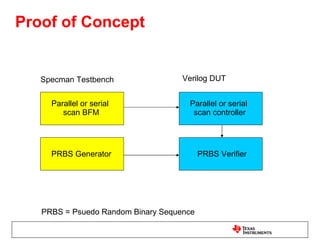
Proof of Concept


   Specman Testbench                Verilog DUT


     Parallel or serial              Parallel or serial
        scan BFM                      scan controller


     PRBS Generator                       PRBS Verifier


   PRBS = Psuedo Random Binary Sequence
Technical Challenges
with Migration
• Specman/e and SVTB may both need to progress
  time
  – Who is the master?
  – How does the time wheel work?
• Some parts of the testbench in E others in SVTB
  – 2 testcases!
  – How do you communicate between the 2 different
    parts?
Solutions

• SVTB is the master
• Testcase written in SVTB as if everything has
  been converted
• SVTB tells remaining E code what to do
• Partition testbench to minimize communications
  between SVTB and E
• Pass information via verilog
  – SVTB sends information to verilog via an interface
  – Extend E units to add code to extract information from
    verilog instead of from other E units/structs
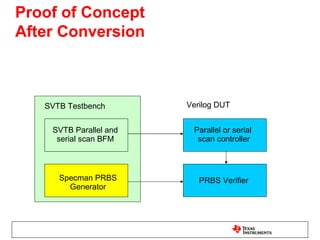
Proof of Concept
After Conversion


   SVTB Testbench       Verilog DUT


    SVTB Parallel and    Parallel or serial
     serial scan BFM      scan controller


      Specman PRBS         PRBS Verifier
        Generator
Multi-simulator support

• TIUK provides hard IP to internal/external customers
• Provide verilog models for customers to simulate at chip
  level
• Customers can use all 3 major verilog simulators and
  verilog model must be verified on these simulators
• E allowed testbench to be used with all 3 simulators
  without modification
• SVTB is currently 1 standard language with at least 3
  dialects
   – Use lowest common denominators? Yuk!
• Variable legal latency through IP means must use
  intelligent testbench and not vector playback
Pioneer Testbench
tool (SNPS)
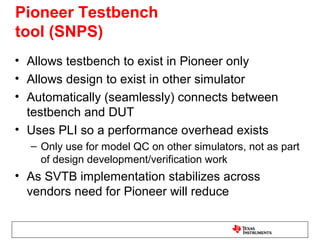
• Allows testbench to exist in Pioneer only
• Allows design to exist in other simulator
• Automatically (seamlessly) connects between
  testbench and DUT
• Uses PLI so a performance overhead exists
  – Only use for model QC on other simulators, not as part
    of design development/verification work
• As SVTB implementation stabilizes across
  vendors need for Pioneer will reduce
Pioneer


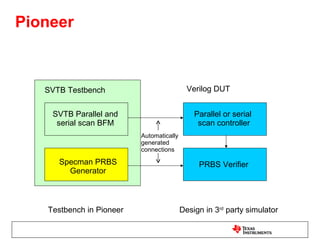
   SVTB Testbench                           Verilog DUT


    SVTB Parallel and                         Parallel or serial
     serial scan BFM                           scan controller
                          Automatically
                          generated
                          connections

      Specman PRBS                             PRBS Verifier
        Generator


   Testbench in Pioneer                   Design in 3rd party simulator
Conclusions

• Have presented staged migration from E to an
  SVTB
  – Staged migration minimizes risk and amortizes
    conversion costs across multiple projects
• Pioneer enables multi-vendor IP simulation
  – avoids need to use lowest common denominator of the
    vendor implementations
Acknowledgements
• Dave Wiltshire (TIUK)
• Neil Bulman (TIUK)
• Yassine Eben Amine (SNPS)
Questions?

Chris brown ti

  • 1.
    Progressive migration from‘e’ to SystemVerilog : Case Study Monday, May 11, 2009 Chris Brown
  • 2.
    Agenda • Briefly describeapplication space • Describe advantages/challenges/solutions in staging the migration • Describe an approach for allowing multiple vendor simulation solution • Conclusions
  • 3.
    TIUK SERDES Design Team •TIUK is part of TI ASIC business unit • Design SERDES – very high speed low swing IOs – 12.5GBPs on 65nm technology • Complex mixed signal designs – > 1 million CMOS elements – Very high speed digital • Bespoke DSP algorithms to recover data from highly lossy transmission lines – Complex high speed analog • PLLs, RX/TX analog front ends • 6GSS very low power ADCs • E based verification environment – Developed/used for > 8 years – Many successful tape outs
  • 4.
    Staged Migration • Positives – Reduced risk – Allows learning in a small constrained environment – Team members can be trained in small groups to avoid all team out of office at same time – We don’t have the resource to stop everything to write a new testbench in one go – Resource requirements amortized over several projects • Negatives – Takes longer to gain benefits – Specman/e must coexist with SVTB!
  • 5.
    Proof of Concept Specman Testbench Verilog DUT Parallel or serial Parallel or serial scan BFM scan controller PRBS Generator PRBS Verifier PRBS = Psuedo Random Binary Sequence
  • 6.
    Technical Challenges with Migration •Specman/e and SVTB may both need to progress time – Who is the master? – How does the time wheel work? • Some parts of the testbench in E others in SVTB – 2 testcases! – How do you communicate between the 2 different parts?
  • 7.
    Solutions • SVTB isthe master • Testcase written in SVTB as if everything has been converted • SVTB tells remaining E code what to do • Partition testbench to minimize communications between SVTB and E • Pass information via verilog – SVTB sends information to verilog via an interface – Extend E units to add code to extract information from verilog instead of from other E units/structs
  • 8.
    Proof of Concept AfterConversion SVTB Testbench Verilog DUT SVTB Parallel and Parallel or serial serial scan BFM scan controller Specman PRBS PRBS Verifier Generator
  • 9.
    Multi-simulator support • TIUKprovides hard IP to internal/external customers • Provide verilog models for customers to simulate at chip level • Customers can use all 3 major verilog simulators and verilog model must be verified on these simulators • E allowed testbench to be used with all 3 simulators without modification • SVTB is currently 1 standard language with at least 3 dialects – Use lowest common denominators? Yuk! • Variable legal latency through IP means must use intelligent testbench and not vector playback
  • 10.
    Pioneer Testbench tool (SNPS) •Allows testbench to exist in Pioneer only • Allows design to exist in other simulator • Automatically (seamlessly) connects between testbench and DUT • Uses PLI so a performance overhead exists – Only use for model QC on other simulators, not as part of design development/verification work • As SVTB implementation stabilizes across vendors need for Pioneer will reduce
  • 11.
    Pioneer SVTB Testbench Verilog DUT SVTB Parallel and Parallel or serial serial scan BFM scan controller Automatically generated connections Specman PRBS PRBS Verifier Generator Testbench in Pioneer Design in 3rd party simulator
  • 12.
    Conclusions • Have presentedstaged migration from E to an SVTB – Staged migration minimizes risk and amortizes conversion costs across multiple projects • Pioneer enables multi-vendor IP simulation – avoids need to use lowest common denominator of the vendor implementations
  • 13.
    Acknowledgements • Dave Wiltshire(TIUK) • Neil Bulman (TIUK) • Yassine Eben Amine (SNPS)
  • 14.