Stop Writing Assertions!
Efficient Verification Methodology
  Dave Whipp – DVClub SV, August 2008
Todays Talk


         An Overview of Methodology Creation
                      Methodology as User Interface


         Making ESL work as a Hardware Design Flow
                      Evolution of a Interface Definition Language
                      Transaction Level Assertions
                      Transaction Level Debug


NVIDIA Confidential
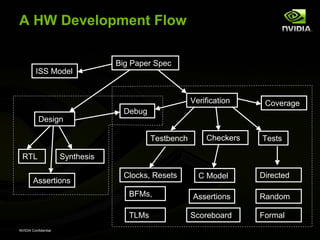
A HW Development Flow

                                  Big Paper Spec
         ISS Model


                                                        Verification    Coverage
                                    Debug
           Design

                                            Testbench       Checkers   Tests

 RTL                  Synthesis

                                    Clocks, Resets        C Model      Directed
        Assertions
                                     BFMs,              Assertions     Random

                                     TLMs               Scoreboard     Formal
NVIDIA Confidential
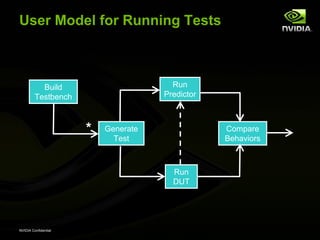
User Model for Running Tests


           Build                       Run
         Testbench                   Predictor


                      *   Generate               Compare
                            Test                 Behaviors


                                       Run
                                       DUT


NVIDIA Confidential
Part 1

Methodology Design
Purpose of a Flow

         Conceptual Framework
                      Where do things live?
                      How do things work?


         Keep out of the way
                      Don’t make life difficult for people


         Define Metaphors
                      Subtly influence future directions


         Anchor for Variation
                      Give people something to complain about

NVIDIA Confidential
Two Philosophies


         Conformity
                      Emphasize Standardization


         Diversity
                      Emphasize Innovation


         Synergy or Conflict?


NVIDIA Confidential
Understanding Variation


         To understand what to standardize:
                      you need to understand what not to standardize


         Personal Preferences
         Technical Aspects of the Designs
         Supporting Legacy
         Seeking the Next Big Thing


NVIDIA Confidential
Personal Preferences

                      Emacs!


                      vi


NVIDIA Confidential
Personal Preferences


         Choice of editor doesn’t affect others
                      At least, not much
         Choice of scripting language has greater impact
                      But is encapsulated
                      A script’s users don’t see the implementation language
         Choice of HVL affects whole team
                      Can’t write “E” tests for a “Vera” testbench!
                      But a unit testbench isn’t seen by other units


         A good flow will allow encapsulation of preferences
                      I can go to any unit and build & run its tests
                      Enables rapid localization of infrastructure issues
NVIDIA Confidential
Technological Differences


NVIDIA Confidential
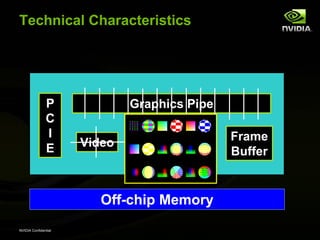
Technical Characteristics


               P              Graphics Pipe
               C
               I                              Frame
               E      Video
                                              Buffer


                         Off-chip Memory
NVIDIA Confidential
Reuse Vs Stagnation

         Reuse considered Good
                      Avoid reinventing the wheel
                      Build on the shoulders of giants
         Reuse invites Inertia
                      Reuse can propagate dependencies
                      Dependencies make things harder to change
                      Resistance to change is known as inertia


         Inertia can lead to Stagnation
                      Improper reuse accumulates dependencies
                      Reused code that is not understood will bit-rot
                      To avoid stagnation, inject agitation

NVIDIA Confidential
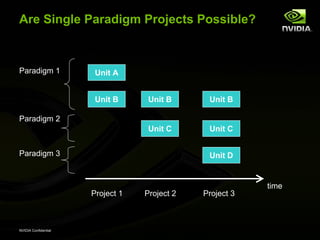
Are Single Paradigm Projects Possible?


Paradigm 1             Unit A


                       Unit B      Unit B      Unit B

Paradigm 2
                                   Unit C      Unit C


Paradigm 3                                     Unit D


                                                          time
                      Project 1   Project 2   Project 3


NVIDIA Confidential
Watch some Real Users


NVIDIA Confidential     Image courtesy of DAZ Productions
How to “Watch” Users


         Meetings and Discussions
         Coffee-Break Grousing

         Bug Reports
         Keep Track of Support Requests
                      create FAQs


         VNC (Remote Desktop)
         Instrumentation


NVIDIA Confidential
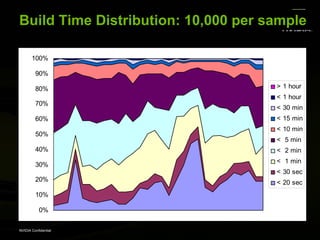
Build Time Distribution: 10,000 per sample

       100%

         90%

         80%                         > 1 hour
                                     < 1 hour
         70%
                                     < 30 min
         60%                         < 15 min
                                     < 10 min
         50%
                                     < 5 min
         40%                         < 2 min
                                     < 1 min
         30%
                                     < 30 sec
         20%                         < 20 sec
         10%

           0%

NVIDIA Confidential
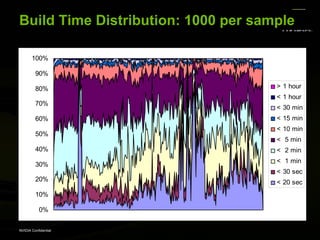
Build Time Distribution: 1000 per sample

       100%

         90%

         80%                         > 1 hour
                                     < 1 hour
         70%
                                     < 30 min
         60%                         < 15 min
                                     < 10 min
         50%
                                     < 5 min
         40%                         < 2 min
                                     < 1 min
         30%
                                     < 30 sec
         20%                         < 20 sec
         10%

           0%


NVIDIA Confidential
Part 2

ESL for Transaction Design
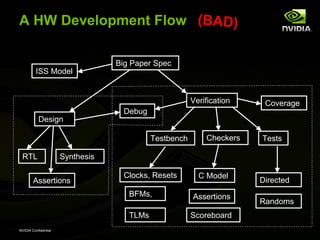
A HW Development Flow (BAD)

                                  Big Paper Spec
         ISS Model


                                                        Verification    Coverage
                                    Debug
           Design

                                            Testbench       Checkers   Tests

 RTL                  Synthesis

                                    Clocks, Resets        C Model
        Assertions                                                     Directed
                                     BFMs,              Assertions
                                                                       Randoms
                                     TLMs               Scoreboard
NVIDIA Confidential
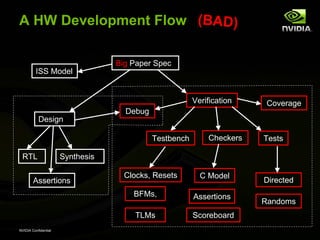
A HW Development Flow (BAD)

                                  Big Paper Spec
         ISS Model


                                                        Verification    Coverage
                                    Debug
           Design

                                            Testbench       Checkers   Tests

 RTL                  Synthesis

                                    Clocks, Resets        C Model
        Assertions                                                     Directed
                                      BFMs,             Assertions
                                                                       Randoms
                                      TLMs              Scoreboard
NVIDIA Confidential
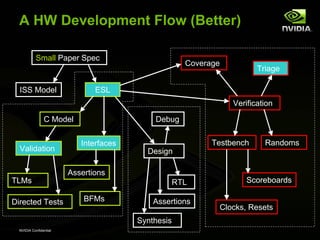
A HW Development Flow (Better)

           Small Paper Spec
                                                      Coverage
                                                                        Triage

  ISS Model                    ESL
                                                                 Verification

                C Model                     Debug


                           Interfaces                       Testbench     Randoms
  Validation                              Design

                        Assertions
TLMs                                                RTL              Scoreboards

Directed Tests              BFMs            Assertions
                                                             Clocks, Resets
                                        Synthesis
  NVIDIA Confidential
Who Writes Assertions?


         Designers
                      Bottom Up Assumptions
         Verification Engineers
                      Top-down Intent


NVIDIA Confidential
Who Writes Assertions?


         Designers
                      Bottom Up Assumptions
         Verification Engineers
                      Top-down Intent


         Architects
                      The Specification
                      Top Down Assumptions
                      Bottom Up Intent


NVIDIA Confidential
Where to Write Assertions


         The RTL
                      Inline
                      Bound
         The Testbench
                      Scoreboard
         Environment
                      E.g. Post Process Log file


NVIDIA Confidential
Where to Write Assertions


         The RTL
                      Inline
                      Bound
         The Testbench
                      Scoreboard
         Environment
                      Post Process Log files


         The Specification
                      C Models (?)


NVIDIA Confidential
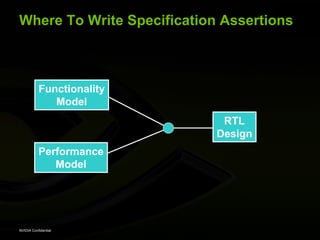
Where To Write Specification Assertions


           Functionality
              Model
                             RTL
                            Design
           Performance
              Model


NVIDIA Confidential
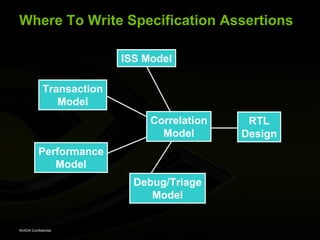
Where To Write Specification Assertions

                           ISS Model

             Transaction
                Model
                                Correlation    RTL
                                  Model       Design
           Performance
              Model
                             Debug/Triage
                                Model


NVIDIA Confidential
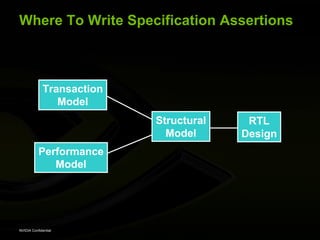
Where To Write Specification Assertions


             Transaction
                Model
                           Structural    RTL
                             Model      Design
           Performance
              Model


NVIDIA Confidential
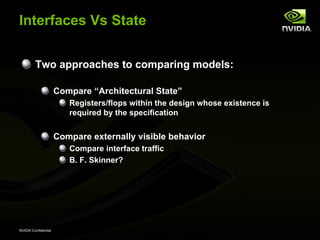
Interfaces Vs State


         Two approaches to comparing models:

                      Compare “Architectural State”
                         Registers/flops within the design whose existence is
                         required by the specification


                      Compare externally visible behavior
                         Compare interface traffic
                         B. F. Skinner?


NVIDIA Confidential
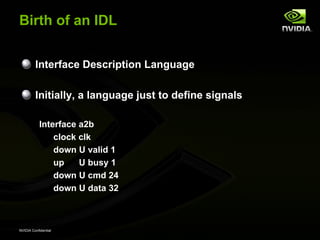
Birth of an IDL


         Interface Description Language

         Initially, a language just to define signals

           Interface a2b
               clock clk
               down U valid 1
               up    U busy 1
               down U cmd 24
               down U data 32


NVIDIA Confidential
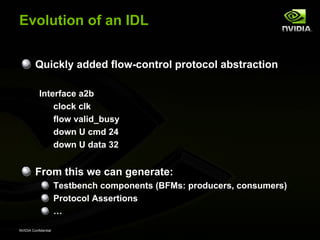
Evolution of an IDL


         Quickly added flow-control protocol abstraction

           Interface a2b
               clock clk
               flow valid_busy
               down U cmd 24
               down U data 32


         From this we can generate:
                      Testbench components (BFMs: producers, consumers)
                      Protocol Assertions
                      …
NVIDIA Confidential
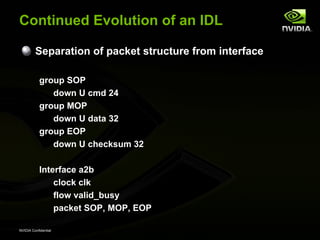
Continued Evolution of an IDL

         Separation of packet structure from interface

           group SOP
              down U cmd 24
           group MOP
              down U data 32
           group EOP
              down U checksum 32

           Interface a2b
               clock clk
               flow valid_busy
               packet SOP, MOP, EOP

NVIDIA Confidential
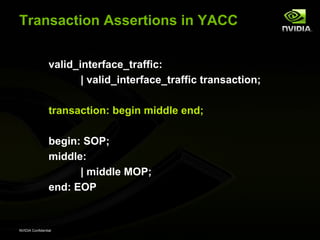
Transaction Assertions in YACC


                 valid_interface_traffic:
                        | valid_interface_traffic transaction;

                 transaction: begin middle end;

                 begin: SOP;
                 middle:
                       | middle MOP;
                 end: EOP


NVIDIA Confidential
Cycle Level Assertions in SVA
 clk

 cmd                  SOP   MOP   MOP EOP


         sequence valid_trans;
            (cmd==SOP)
            (##1 cmd != SOP && cmd != EOP) [*0:$]
            ##1 cmd == EOP
         endsequence

         a_well_formed_transaction: assert @(posedge clk)
           cmd == SOP |-> sequence (valid_trans)

NVIDIA Confidential
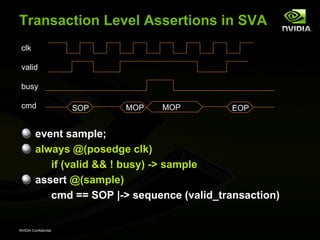
Transaction Level Assertions in SVA
 clk

 valid

 cmd                  SOP   MOP   MOP        EOP


         sequence valid_transaction;
            (cmd==SOP)
            (##1 cmd != SOP && cmd != EOP) [*0:$]
            ##1 cmd == EOP
         endsequence


NVIDIA Confidential
Transaction Level Assertions in SVA
 clk

 valid

 busy

 cmd                  SOP   MOP   MOP         EOP


         event sample;
         always @(posedge clk)
            if (valid && ! busy) -> sample
         assert @(sample)
            cmd == SOP |-> sequence (valid_transaction)


NVIDIA Confidential
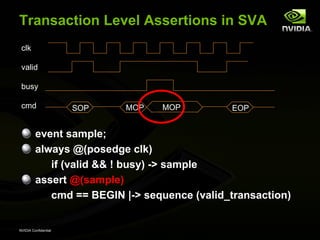
Transaction Level Assertions in SVA
 clk

 valid

 busy

 cmd                  SOP   MOP   MOP        EOP


         event sample;
         always @(posedge clk)
            if (valid && ! busy) -> sample
         assert @(sample)
            cmd == BEGIN |-> sequence (valid_transaction)


NVIDIA Confidential
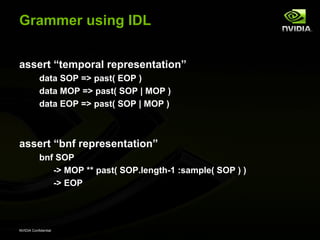
Grammer using IDL


assert “temporal representation”
           data SOP => past( EOP )
           data MOP => past( SOP | MOP )
           data EOP => past( SOP | MOP )


assert “bnf representation”
           bnf SOP
              -> MOP ** past( SOP.length-1 :sample( SOP ) )
              -> EOP


NVIDIA Confidential
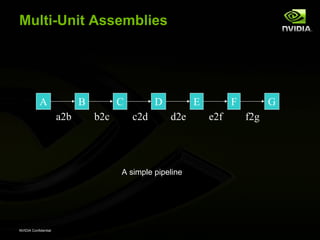
Multi-Unit Assemblies


            A               B         C         D         E         F         G
                      a2b       b2c       c2d       d2e       e2f       f2g


                                      A simple pipeline


NVIDIA Confidential
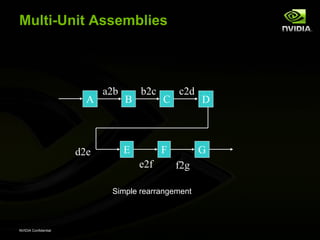
Multi-Unit Assemblies


                            a2b       b2c       c2d
                        A         B         C         D


                      d2e         E         F         G
                                      e2f       f2g

                             Simple rearrangement


NVIDIA Confidential
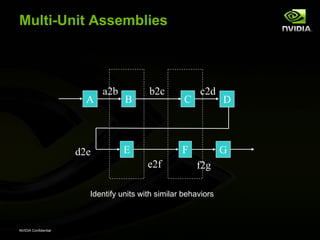
Multi-Unit Assemblies


                            a2b          b2c            c2d
                        A         B                 C           D


                      d2e         E                F            G
                                         e2f            f2g

                        Identify units with similar behaviors


NVIDIA Confidential
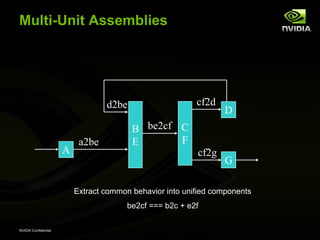
Multi-Unit Assemblies


                                  d2be                    cf2d
                                                                 D
                                         B be2cf C
                           a2be          E       F
                      A                                   cf2g
                                                                 G

                          Extract common behavior into unified components
                                        be2cf === b2c + e2f

NVIDIA Confidential
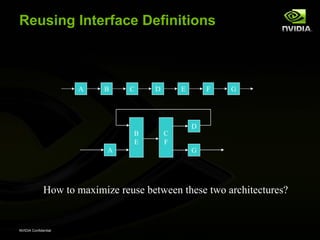
Reusing Interface Definitions


                      A    B     C    D       E       F   G


                                                  D
                                  B       C
                                  E       F
                            A                     G


              How to maximize reuse between these two architectures?


NVIDIA Confidential
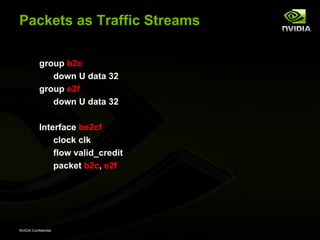
Packets as Traffic Streams

           group b2c
              down U data 32
           group e2f
              down U data 32

           Interface be2cf
               clock clk
               flow valid_credit
               packet b2c, e2f


NVIDIA Confidential
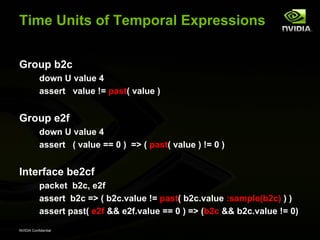
Time Units of Temporal Expressions


Group b2c
           down U value 4
           assert value != past( value )


Group e2f
           down U value 4
           assert ( value == 0 ) => ( past( value ) != 0 )


Interface be2cf
           packet b2c, e2f
           assert b2c => ( b2c.value != past( b2c.value :sample(b2c) ) )
           assert past( e2f && e2f.value == 0 ) => (b2c && b2c.value != 0)
NVIDIA Confidential
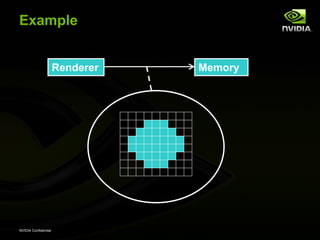
Example


                      Renderer   Memory


NVIDIA Confidential
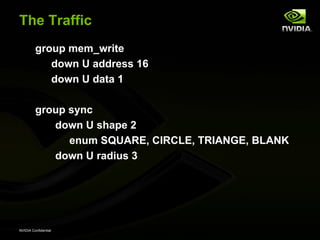
The Traffic
         group mem_write
            down U address 16
            down U data 1

         group sync
            down U shape 2
               enum SQUARE, CIRCLE, TRIANGE, BLANK
            down U radius 3


NVIDIA Confidential
Accumulate Memory State


group mem_write

         down U address 16
         down U data 1

         assign mem[ x = 0 .. 15 ][ y = 0 .. 15 ]
            = past( data :sample( address == {x,y} ))


NVIDIA Confidential
Add Predicates


group_more mem_write

         assign is_circle[ r = 0..7 ] = “&&”(
            [ x = -8 .. 7 ]
            [ y = -8 .. 7 ]
               mem[ x+8 ][ y+8 ] == ( x**2 + y**2 <= r**2 )
         )


NVIDIA Confidential
Define the interface

interface render2memory
   clock mem_clk
   flow valid_busy
   packet sync, mem_write

         assert “correct sync shape”
            sync && sync.shape == CIRCLE
                  => past( mem_write.is_circle[ sync.radius ] )


NVIDIA Confidential
Example


Renderer                                           Memory


    assert “correct sync shape”
          sync && sync.shape == CIRCLE
            => past( mem_write.is_circle[ sync.radius ] )


NVIDIA Confidential
Summary


         Efficient Verification
                      Understand Variation
                      Encourage Diversity
                         avoid anarchy
                      Encourage Standardization
                         avoid stagnation


         Frontload The Schedule
                      Provide Verification with Executable Spec (ESL)
                         C Model, Correlation Model (pre validated)
                         Interfaces, Transactions (definitions for code generators)
                         Assertions, Testpoints (neutral language, pre validated)


NVIDIA Confidential
Questions

http://dave.whipp.name/dv
Summary


         Architects should write assertions
                      Validated assertions are input to Verification


         Assertions must be directly reusable across models
                      Manual recoding invites errors


         Explicitly model the structure that is common to
         architectural models and to design
                      Tie assertions to these common points


NVIDIA Confidential
Threading Models


         Thread Follows Resource
                      Traditional SystemC approach
         Thread Follows Transaction
                      Think “Multithreaded ISS”
         Cycle-based Model
                      The “Old” way of doing things
                      A non-threaded version of “thread follows resource”


         Different models are convenient at various times
                      But SystemC forces you to commit early to one approach
                      Therefore need extra code for transaction level debug


NVIDIA Confidential
70%


         70% of schedule is Verification

         What is correct figure

         0%
                      synthesize architectural models, constraints
                      Correct by construction!


         100%
                      synthesize verification models, constraints
                      no design needed!

NVIDIA Confidential
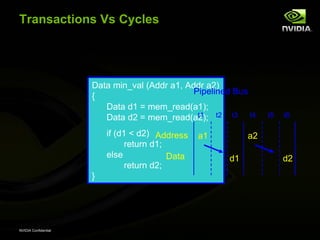
Transactions Vs Cycles


                      Data min_val (Addr a1, Addr a2)
                                               Pipelined Bus
                      {
                         Data d1 = mem_read(a1);
                         Data d2 = mem_read(a2); t2 t3 t4
                                                t1               t5   t6

                          if (d1 < d2) Address    a1        a2
                                return d1;
                          else             Data        d1             d2
                                return d2;
                      }


NVIDIA Confidential
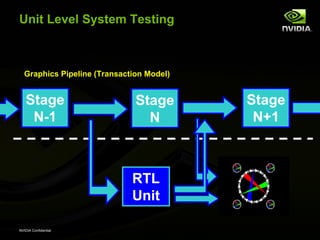
Unit Level System Testing


  Graphics Pipeline (Transaction Model)


   Stage                      Stage       Stage
    N-1                         N          N+1


                             RTL
                                          DIFF
                             Unit

NVIDIA Confidential
Avoiding Stagnation


      New Challenges
      New Tools
      New Platforms
      New People
      New Ideas

      Refactoring
      Testability
      D.R.Y.


NVIDIA Confidential

Whipp q3 2008_sv

  • 1.
    Stop Writing Assertions! EfficientVerification Methodology Dave Whipp – DVClub SV, August 2008
  • 2.
    Todays Talk An Overview of Methodology Creation Methodology as User Interface Making ESL work as a Hardware Design Flow Evolution of a Interface Definition Language Transaction Level Assertions Transaction Level Debug NVIDIA Confidential
  • 3.
    A HW DevelopmentFlow Big Paper Spec ISS Model Verification Coverage Debug Design Testbench Checkers Tests RTL Synthesis Clocks, Resets C Model Directed Assertions BFMs, Assertions Random TLMs Scoreboard Formal NVIDIA Confidential
  • 4.
    User Model forRunning Tests Build Run Testbench Predictor * Generate Compare Test Behaviors Run DUT NVIDIA Confidential
  • 5.
  • 6.
    Purpose of aFlow Conceptual Framework Where do things live? How do things work? Keep out of the way Don’t make life difficult for people Define Metaphors Subtly influence future directions Anchor for Variation Give people something to complain about NVIDIA Confidential
  • 7.
    Two Philosophies Conformity Emphasize Standardization Diversity Emphasize Innovation Synergy or Conflict? NVIDIA Confidential
  • 8.
    Understanding Variation To understand what to standardize: you need to understand what not to standardize Personal Preferences Technical Aspects of the Designs Supporting Legacy Seeking the Next Big Thing NVIDIA Confidential
  • 9.
    Personal Preferences Emacs! vi NVIDIA Confidential
  • 10.
    Personal Preferences Choice of editor doesn’t affect others At least, not much Choice of scripting language has greater impact But is encapsulated A script’s users don’t see the implementation language Choice of HVL affects whole team Can’t write “E” tests for a “Vera” testbench! But a unit testbench isn’t seen by other units A good flow will allow encapsulation of preferences I can go to any unit and build & run its tests Enables rapid localization of infrastructure issues NVIDIA Confidential
  • 11.
  • 12.
    Technical Characteristics P Graphics Pipe C I Frame E Video Buffer Off-chip Memory NVIDIA Confidential
  • 13.
    Reuse Vs Stagnation Reuse considered Good Avoid reinventing the wheel Build on the shoulders of giants Reuse invites Inertia Reuse can propagate dependencies Dependencies make things harder to change Resistance to change is known as inertia Inertia can lead to Stagnation Improper reuse accumulates dependencies Reused code that is not understood will bit-rot To avoid stagnation, inject agitation NVIDIA Confidential
  • 14.
    Are Single ParadigmProjects Possible? Paradigm 1 Unit A Unit B Unit B Unit B Paradigm 2 Unit C Unit C Paradigm 3 Unit D time Project 1 Project 2 Project 3 NVIDIA Confidential
  • 15.
    Watch some RealUsers NVIDIA Confidential Image courtesy of DAZ Productions
  • 16.
    How to “Watch”Users Meetings and Discussions Coffee-Break Grousing Bug Reports Keep Track of Support Requests create FAQs VNC (Remote Desktop) Instrumentation NVIDIA Confidential
  • 17.
    Build Time Distribution:10,000 per sample 100% 90% 80% > 1 hour < 1 hour 70% < 30 min 60% < 15 min < 10 min 50% < 5 min 40% < 2 min < 1 min 30% < 30 sec 20% < 20 sec 10% 0% NVIDIA Confidential
  • 18.
    Build Time Distribution:1000 per sample 100% 90% 80% > 1 hour < 1 hour 70% < 30 min 60% < 15 min < 10 min 50% < 5 min 40% < 2 min < 1 min 30% < 30 sec 20% < 20 sec 10% 0% NVIDIA Confidential
  • 19.
    Part 2 ESL forTransaction Design
  • 20.
    A HW DevelopmentFlow (BAD) Big Paper Spec ISS Model Verification Coverage Debug Design Testbench Checkers Tests RTL Synthesis Clocks, Resets C Model Assertions Directed BFMs, Assertions Randoms TLMs Scoreboard NVIDIA Confidential
  • 21.
    A HW DevelopmentFlow (BAD) Big Paper Spec ISS Model Verification Coverage Debug Design Testbench Checkers Tests RTL Synthesis Clocks, Resets C Model Assertions Directed BFMs, Assertions Randoms TLMs Scoreboard NVIDIA Confidential
  • 22.
    A HW DevelopmentFlow (Better) Small Paper Spec Coverage Triage ISS Model ESL Verification C Model Debug Interfaces Testbench Randoms Validation Design Assertions TLMs RTL Scoreboards Directed Tests BFMs Assertions Clocks, Resets Synthesis NVIDIA Confidential
  • 23.
    Who Writes Assertions? Designers Bottom Up Assumptions Verification Engineers Top-down Intent NVIDIA Confidential
  • 24.
    Who Writes Assertions? Designers Bottom Up Assumptions Verification Engineers Top-down Intent Architects The Specification Top Down Assumptions Bottom Up Intent NVIDIA Confidential
  • 25.
    Where to WriteAssertions The RTL Inline Bound The Testbench Scoreboard Environment E.g. Post Process Log file NVIDIA Confidential
  • 26.
    Where to WriteAssertions The RTL Inline Bound The Testbench Scoreboard Environment Post Process Log files The Specification C Models (?) NVIDIA Confidential
  • 27.
    Where To WriteSpecification Assertions Functionality Model RTL Design Performance Model NVIDIA Confidential
  • 28.
    Where To WriteSpecification Assertions ISS Model Transaction Model Correlation RTL Model Design Performance Model Debug/Triage Model NVIDIA Confidential
  • 29.
    Where To WriteSpecification Assertions Transaction Model Structural RTL Model Design Performance Model NVIDIA Confidential
  • 30.
    Interfaces Vs State Two approaches to comparing models: Compare “Architectural State” Registers/flops within the design whose existence is required by the specification Compare externally visible behavior Compare interface traffic B. F. Skinner? NVIDIA Confidential
  • 31.
    Birth of anIDL Interface Description Language Initially, a language just to define signals Interface a2b clock clk down U valid 1 up U busy 1 down U cmd 24 down U data 32 NVIDIA Confidential
  • 32.
    Evolution of anIDL Quickly added flow-control protocol abstraction Interface a2b clock clk flow valid_busy down U cmd 24 down U data 32 From this we can generate: Testbench components (BFMs: producers, consumers) Protocol Assertions … NVIDIA Confidential
  • 33.
    Continued Evolution ofan IDL Separation of packet structure from interface group SOP down U cmd 24 group MOP down U data 32 group EOP down U checksum 32 Interface a2b clock clk flow valid_busy packet SOP, MOP, EOP NVIDIA Confidential
  • 34.
    Transaction Assertions inYACC valid_interface_traffic: | valid_interface_traffic transaction; transaction: begin middle end; begin: SOP; middle: | middle MOP; end: EOP NVIDIA Confidential
  • 35.
    Cycle Level Assertionsin SVA clk cmd SOP MOP MOP EOP sequence valid_trans; (cmd==SOP) (##1 cmd != SOP && cmd != EOP) [*0:$] ##1 cmd == EOP endsequence a_well_formed_transaction: assert @(posedge clk) cmd == SOP |-> sequence (valid_trans) NVIDIA Confidential
  • 36.
    Transaction Level Assertionsin SVA clk valid cmd SOP MOP MOP EOP sequence valid_transaction; (cmd==SOP) (##1 cmd != SOP && cmd != EOP) [*0:$] ##1 cmd == EOP endsequence NVIDIA Confidential
  • 37.
    Transaction Level Assertionsin SVA clk valid busy cmd SOP MOP MOP EOP event sample; always @(posedge clk) if (valid && ! busy) -> sample assert @(sample) cmd == SOP |-> sequence (valid_transaction) NVIDIA Confidential
  • 38.
    Transaction Level Assertionsin SVA clk valid busy cmd SOP MOP MOP EOP event sample; always @(posedge clk) if (valid && ! busy) -> sample assert @(sample) cmd == BEGIN |-> sequence (valid_transaction) NVIDIA Confidential
  • 39.
    Grammer using IDL assert“temporal representation” data SOP => past( EOP ) data MOP => past( SOP | MOP ) data EOP => past( SOP | MOP ) assert “bnf representation” bnf SOP -> MOP ** past( SOP.length-1 :sample( SOP ) ) -> EOP NVIDIA Confidential
  • 40.
    Multi-Unit Assemblies A B C D E F G a2b b2c c2d d2e e2f f2g A simple pipeline NVIDIA Confidential
  • 41.
    Multi-Unit Assemblies a2b b2c c2d A B C D d2e E F G e2f f2g Simple rearrangement NVIDIA Confidential
  • 42.
    Multi-Unit Assemblies a2b b2c c2d A B C D d2e E F G e2f f2g Identify units with similar behaviors NVIDIA Confidential
  • 43.
    Multi-Unit Assemblies d2be cf2d D B be2cf C a2be E F A cf2g G Extract common behavior into unified components be2cf === b2c + e2f NVIDIA Confidential
  • 44.
    Reusing Interface Definitions A B C D E F G D B C E F A G How to maximize reuse between these two architectures? NVIDIA Confidential
  • 45.
    Packets as TrafficStreams group b2c down U data 32 group e2f down U data 32 Interface be2cf clock clk flow valid_credit packet b2c, e2f NVIDIA Confidential
  • 46.
    Time Units ofTemporal Expressions Group b2c down U value 4 assert value != past( value ) Group e2f down U value 4 assert ( value == 0 ) => ( past( value ) != 0 ) Interface be2cf packet b2c, e2f assert b2c => ( b2c.value != past( b2c.value :sample(b2c) ) ) assert past( e2f && e2f.value == 0 ) => (b2c && b2c.value != 0) NVIDIA Confidential
  • 47.
    Example Renderer Memory NVIDIA Confidential
  • 48.
    The Traffic group mem_write down U address 16 down U data 1 group sync down U shape 2 enum SQUARE, CIRCLE, TRIANGE, BLANK down U radius 3 NVIDIA Confidential
  • 49.
    Accumulate Memory State groupmem_write down U address 16 down U data 1 assign mem[ x = 0 .. 15 ][ y = 0 .. 15 ] = past( data :sample( address == {x,y} )) NVIDIA Confidential
  • 50.
    Add Predicates group_more mem_write assign is_circle[ r = 0..7 ] = “&&”( [ x = -8 .. 7 ] [ y = -8 .. 7 ] mem[ x+8 ][ y+8 ] == ( x**2 + y**2 <= r**2 ) ) NVIDIA Confidential
  • 51.
    Define the interface interfacerender2memory clock mem_clk flow valid_busy packet sync, mem_write assert “correct sync shape” sync && sync.shape == CIRCLE => past( mem_write.is_circle[ sync.radius ] ) NVIDIA Confidential
  • 52.
    Example Renderer Memory assert “correct sync shape” sync && sync.shape == CIRCLE => past( mem_write.is_circle[ sync.radius ] ) NVIDIA Confidential
  • 53.
    Summary Efficient Verification Understand Variation Encourage Diversity avoid anarchy Encourage Standardization avoid stagnation Frontload The Schedule Provide Verification with Executable Spec (ESL) C Model, Correlation Model (pre validated) Interfaces, Transactions (definitions for code generators) Assertions, Testpoints (neutral language, pre validated) NVIDIA Confidential
  • 54.
  • 55.
    Summary Architects should write assertions Validated assertions are input to Verification Assertions must be directly reusable across models Manual recoding invites errors Explicitly model the structure that is common to architectural models and to design Tie assertions to these common points NVIDIA Confidential
  • 56.
    Threading Models Thread Follows Resource Traditional SystemC approach Thread Follows Transaction Think “Multithreaded ISS” Cycle-based Model The “Old” way of doing things A non-threaded version of “thread follows resource” Different models are convenient at various times But SystemC forces you to commit early to one approach Therefore need extra code for transaction level debug NVIDIA Confidential
  • 57.
    70% 70% of schedule is Verification What is correct figure 0% synthesize architectural models, constraints Correct by construction! 100% synthesize verification models, constraints no design needed! NVIDIA Confidential
  • 58.
    Transactions Vs Cycles Data min_val (Addr a1, Addr a2) Pipelined Bus { Data d1 = mem_read(a1); Data d2 = mem_read(a2); t2 t3 t4 t1 t5 t6 if (d1 < d2) Address a1 a2 return d1; else Data d1 d2 return d2; } NVIDIA Confidential
  • 59.
    Unit Level SystemTesting Graphics Pipeline (Transaction Model) Stage Stage Stage N-1 N N+1 RTL DIFF Unit NVIDIA Confidential
  • 60.
    Avoiding Stagnation New Challenges New Tools New Platforms New People New Ideas Refactoring Testability D.R.Y. NVIDIA Confidential