Choledochal Cyst
(Greek chol- bile + docho- duct)
Jibran Mohsin
Resident, Surgical Unit I
SIMS/Services Hospital, Lahore
A 35 year old female resident of Lahore presented in medical
emergency on 29 December 2014 with
presenting complaint of severe epigastric pain radiating directly to
back for last 3 days, relieved on leaning forward and medication.
A 35 year old female resident of Lahore presented in medical
emergency on 29 December 2014 with
presenting complaint of severe epigastric pain radiating directly
to back for last 3 days, relieved on leaning forward and
medication.
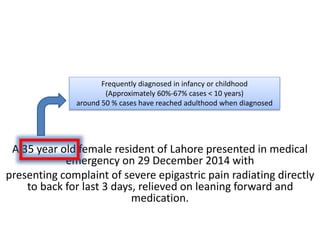
Frequently diagnosed in infancy or childhood
(Approximately 60%-67% cases < 10 years)
around 50 % cases have reached adulthood when diagnosed
A 35 year old female resident of Lahore presented in medical
emergency on 29 December 2014 with
presenting complaint of severe epigastric pain radiating directly to
back for last 3 days, relieved on leaning forward and medication.
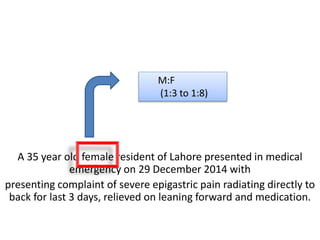
M:F
(1:3 to 1:8)
A 35 year old female resident of Lahore presented in medical emergency
on 29 December 2014 with
presenting complaint of severe epigastric pain radiating directly to back
for last 3 days, relieved on leaning forward and medication.
Much more prevalent in Asia than in Western countries(1: 100,000 – 1: 150,000)
Approximately 33-50% of reported cases come from Japan( as high as 1:1000)
A 35 year old female resident of Lahore presented in medical emergency
on 29 December 2014 with
presenting complaint of severe epigastric pain radiating directly to back
for last 3 days, relieved on leaning forward and medication, associated
with 4-5 episodes of greenish colored vomiting
Adults
Present with one or more severe complications
(obstructive jaundice, pancreatitis and cholangitis)
Frequently, adults with choledochal cysts complain of vague epigastric or right
upper quadrant pain and can develop jaundice or cholangitis.
Most common symptom in adults is abdominal pain.
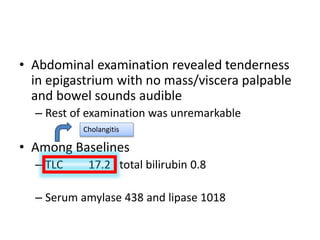
• Abdominal examination revealed tenderness
in epigastrium with no mass/viscera palpable
and bowel sounds audible
– Rest of examination was unremarkable
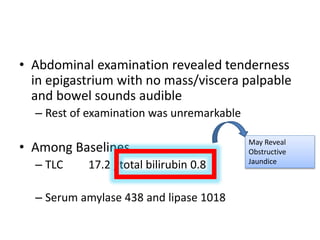
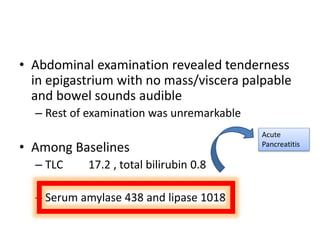
• Among Baselines
– TLC 17.2 , total bilirubin 0.8
– Serum amylase 438 and lipase 1018
Classic Triad of abdominal pain, jaundice and RUQ mass seen in
only 10-20 % cases
• Abdominal examination revealed tenderness
in epigastrium with no mass/viscera palpable
and bowel sounds audible
– Rest of examination was unremarkable
• Among Baselines
– TLC 17.2 , total bilirubin 0.8
– Serum amylase 438 and lipase 1018
• Abdominal examination revealed tenderness
in epigastrium with no mass/viscera palpable
and bowel sounds audible
– Rest of examination was unremarkable
• Among Baselines
– TLC 17.2 , total bilirubin 0.8
– Serum amylase 438 and lipase 1018
Cholangitis
• Abdominal examination revealed tenderness
in epigastrium with no mass/viscera palpable
and bowel sounds audible
– Rest of examination was unremarkable
• Among Baselines
– TLC 17.2 , total bilirubin 0.8
– Serum amylase 438 and lipase 1018
May Reveal
Obstructive
Jaundice
• Abdominal examination revealed tenderness
in epigastrium with no mass/viscera palpable
and bowel sounds audible
– Rest of examination was unremarkable
• Among Baselines
– TLC 17.2 , total bilirubin 0.8
– Serum amylase 438 and lipase 1018
Acute
Pancreatitis
Patient was admitted on medical floor and was
managed and worked up on lines of
ACUTE PANCREATITIS
&
Departmental USG abdomen was done
Patient was admitted on medical floor and was
managed and worked up on lines of
ACUTE PANCREATITIS
&
Departmental USG abdomen was done
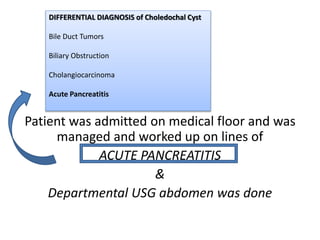
DIFFERENTIAL DIAGNOSIS of Choledochal Cyst
Bile Duct Tumors
Biliary Obstruction
Cholangiocarcinoma
Acute Pancreatitis
Patient was admitted on medical floor and was
managed and worked up on lines of
ACUTE PANCREATITIS
&
Departmental USG abdomen was done
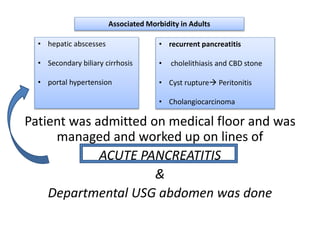
Associated Morbidity in Adults
• hepatic abscesses
• Secondary biliary cirrhosis
• portal hypertension
• recurrent pancreatitis
• cholelithiasis and CBD stone
• Cyst rupture Peritonitis
• Cholangiocarcinoma
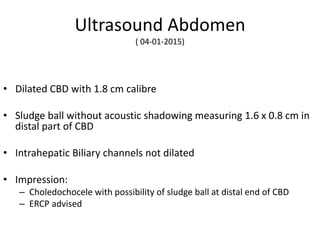
Ultrasound Abdomen
( 04-01-2015)
• Dilated CBD with 1.8 cm calibre
• Sludge ball without acoustic shadowing measuring 1.6 x 0.8 cm in
distal part of CBD
• Intrahepatic Biliary channels not dilated
• Impression:
– Choledochocele with possibility of sludge ball at distal end of CBD
– ERCP advised
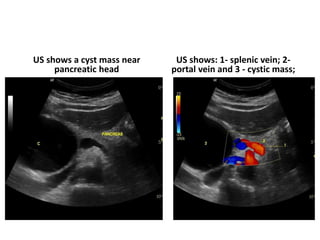
US shows a cyst mass near
pancreatic head
US shows: 1- splenic vein; 2-
portal vein and 3 - cystic mass;
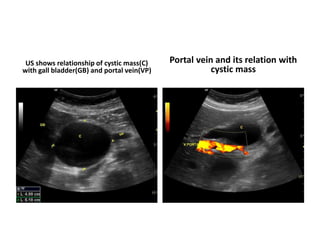
US shows relationship of cystic mass(C)
with gall bladder(GB) and portal vein(VP)
Portal vein and its relation with
cystic mass
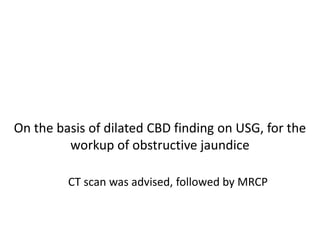
On the basis of dilated CBD finding on USG, for the
workup of obstructive jaundice
CT scan was advised, followed by MRCP
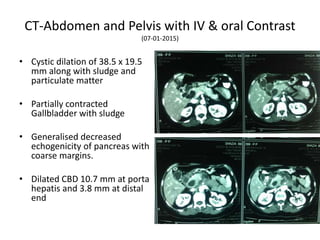
CT-Abdomen and Pelvis with IV & oral Contrast
(07-01-2015)
• Cystic dilation of 38.5 x 19.5
mm along with sludge and
particulate matter
• Partially contracted
Gallbladder with sludge
• Generalised decreased
echogenicity of pancreas with
coarse margins.
• Dilated CBD 10.7 mm at porta
hepatis and 3.8 mm at distal
end
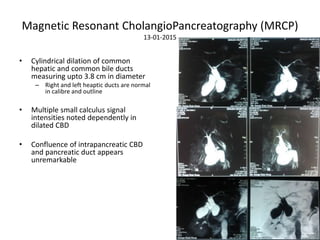
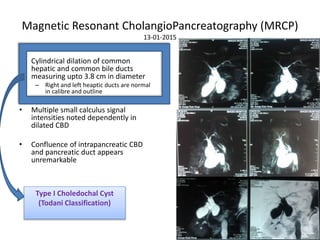
Magnetic Resonant CholangioPancreatography (MRCP)
13-01-2015
• Cylindrical dilation of common
hepatic and common bile ducts
measuring upto 3.8 cm in diameter
– Right and left heaptic ducts are normal
in calibre and outline
• Multiple small calculus signal
intensities noted dependently in
dilated CBD
• Confluence of intrapancreatic CBD
and pancreatic duct appears
unremarkable
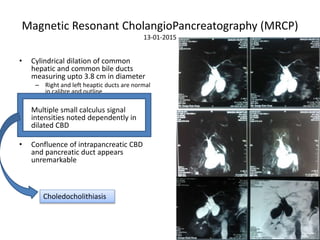
Magnetic Resonant CholangioPancreatography (MRCP)
13-01-2015
• Cylindrical dilation of common
hepatic and common bile ducts
measuring upto 3.8 cm in diameter
– Right and left heaptic ducts are normal
in calibre and outline
• Multiple small calculus signal
intensities noted dependently in
dilated CBD
• Confluence of intrapancreatic CBD
and pancreatic duct appears
unremarkable
Type I Choledochal Cyst
(Todani Classification)
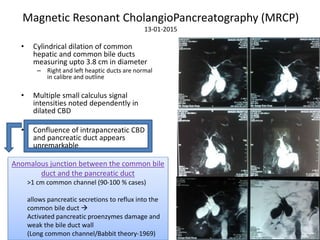
Magnetic Resonant CholangioPancreatography (MRCP)
13-01-2015
• Cylindrical dilation of common
hepatic and common bile ducts
measuring upto 3.8 cm in diameter
– Right and left heaptic ducts are normal
in calibre and outline
• Multiple small calculus signal
intensities noted dependently in
dilated CBD
• Confluence of intrapancreatic CBD
and pancreatic duct appears
unremarkable
Choledocholithiasis
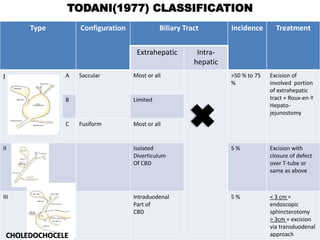
Magnetic Resonant CholangioPancreatography (MRCP)
13-01-2015
• Cylindrical dilation of common
hepatic and common bile ducts
measuring upto 3.8 cm in diameter
– Right and left heaptic ducts are normal
in calibre and outline
• Multiple small calculus signal
intensities noted dependently in
dilated CBD
• Confluence of intrapancreatic CBD
and pancreatic duct appears
unremarkable
Anomalous junction between the common bile
duct and the pancreatic duct
>1 cm common channel (90-100 % cases)
allows pancreatic secretions to reflux into the
common bile duct 
Activated pancreatic proenzymes damage and
weak the bile duct wall
(Long common channel/Babbit theory-1969)
Type Configuration Biliary Tract Incidence Treatment
Extrahepatic Intra-
hepatic
I A Saccular Most or all >50 % to 75
%
Excision of
involved portion
of extrahepatic
tract + Roux-en-Y
Hepato-
jejunostomy
B Limited
C Fusiform Most or all
II Isolated
Diverticulum
Of CBD
5 % Excision with
closure of defect
over T-tube or
same as above
III Intraduodenal
Part of
CBD
5 % < 3 cm =
endoscopic
sphincterotomy
> 3cm = excision
via transduodenal
approachCHOLEDOCHOCELE
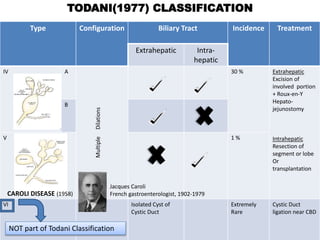
TODANI(1977) CLASSIFICATION
Type Configuration Biliary Tract Incidence Treatment
Extrahepatic Intra-
hepatic
IV A
MultipleDilations
30 % Extrahepatic
Excision of
involved portion
+ Roux-en-Y
Hepato-
jejunostomy
Intrahepatic
Resection of
segment or lobe
Or
transplantation
B
V 1 %
VI Isolated Cyst of
Cystic Duct
Extremely
Rare
Cystic Duct
ligation near CBD
CAROLI DISEASE (1958)
NOT part of Todani Classification
TODANI(1977) CLASSIFICATION
Jacques Caroli
French gastroenterologist, 1902-1979
• Call to Surgical Unit on Call was sent on 16-01-
2015 and patient shifted to Surgical floor for
further management.
• Time for ERCP ( 09-02-2015) taken for
choledocholithiasis and managed conservatively
and sent on leave
• ERCP team deferred ERCP as patient was
asymptomatic with normal LFTs and no
obstruction and referred back to surgery
After optimizing the patient for general anesthesia,
patient was operated on 16-02-2015
After optimizing the patient for general anesthesia,
patient was operated on 16-02-2015
surgery is the only currently available
definitive therapy
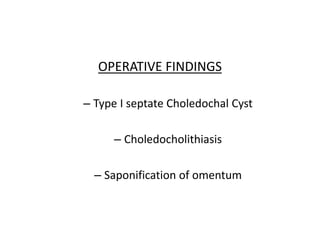
OPERATIVE FINDINGS
– Type I septate Choledochal Cyst
– Choledocholithiasis
– Saponification of omentum
OPERATIVE FINDINGS
– Type I septate Choledochal Cyst
– Choledocholithiasis
– Saponification of omentum
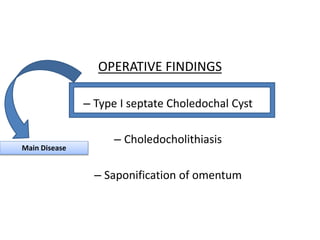
Main Disease
OPERATIVE FINDINGS
– Type I septate Choledochal Cyst
– Choledocholithiasis
– Saponification of omentum
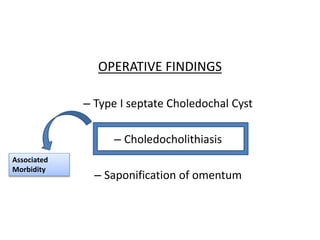
Associated
Morbidity
OPERATIVE FINDINGS
– Type I septate Choledochal Cyst
– Choledocholithiasis
– Saponification of omentum
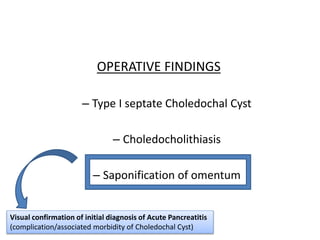
Visual confirmation of initial diagnosis of Acute Pancreatitis
(complication/associated morbidity of Choledochal Cyst)
PROCEDURE
Excision of choledochal Cyst +
Roux-en-Y hepatojejunostomy +
Cholecystectomy
PROCEDURE
Excision of choledochal Cyst +
Roux-en-Y hepatojejunostomy +
Cholecystectomy
PRINCIPLE OF SURGERY
Treatment of choice for choledochal cysts is complete excision of the cyst
+
with construction of a biliary-enteric anastomosis to restore
continuity with the GI tract
PROCEDURE
Excision of choledochal Cyst +
Roux-en-Y hepatojejunostomy +
Cholecystectomy
MUST in all cases of choledochal Cyst
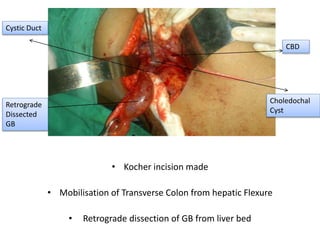
• Kocher incision made
• Mobilisation of Transverse Colon from hepatic Flexure
• Retrograde dissection of GB from liver bed
• Kocher incision made
• Mobilisation of Transverse Colon from hepatic Flexure
• Retrograde dissection of GB from liver bed
Retrograde
Dissected
GB
Cystic Duct
Choledochal
Cyst
CBD
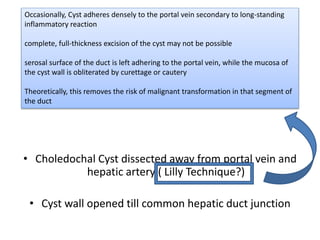
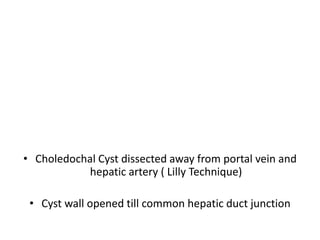
• Choledochal Cyst dissected away from portal vein and
hepatic artery ( Lilly Technique)
• Cyst wall opened till common hepatic duct junction
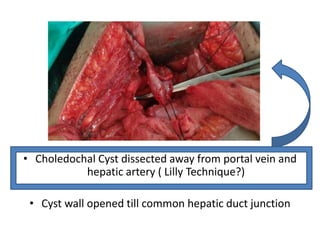
• Choledochal Cyst dissected away from portal vein and
hepatic artery ( Lilly Technique?)
• Cyst wall opened till common hepatic duct junction
• Choledochal Cyst dissected away from portal vein and
hepatic artery ( Lilly Technique?)
• Cyst wall opened till common hepatic duct junction
Occasionally, Cyst adheres densely to the portal vein secondary to long-standing
inflammatory reaction
complete, full-thickness excision of the cyst may not be possible
serosal surface of the duct is left adhering to the portal vein, while the mucosa of
the cyst wall is obliterated by curettage or cautery
Theoretically, this removes the risk of malignant transformation in that segment of
the duct
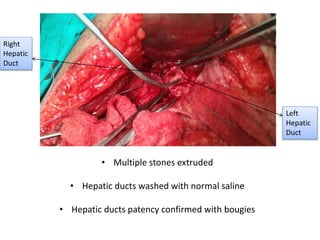
• Multiple stones extruded
• Hepatic ducts washed with normal saline
• Hepatic ducts patency confirmed with bougies
• Multiple stones extruded
• Hepatic ducts washed with normal saline
• Hepatic ducts patency confirmed with bougies
Left
Hepatic
Duct
Right
Hepatic
Duct
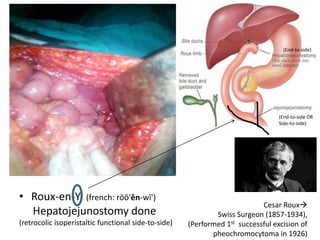
• Roux-en-Y (french: rōō'ěn-wī')
Hepatojejunostomy done
(retrocolic isoperistaltic functional side-to-side)
Cesar Roux
Swiss Surgeon (1857-1934),
(Performed 1st successful excision of
pheochromocytoma in 1926)
(End-to-side)
(End-to-side OR
Side-to-side)
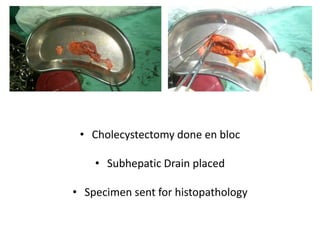
• Cholecystectomy done en bloc
• Subhepatic Drain placed
• Specimen sent for histopathology
• Cholecystectomy done en bloc
• Subhepatic Drain placed
• Specimen sent for histopathology
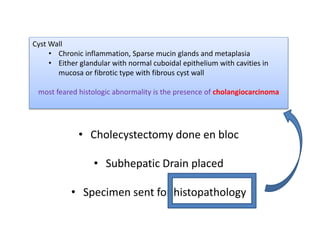
Cyst Wall
• Chronic inflammation, Sparse mucin glands and metaplasia
• Either glandular with normal cuboidal epithelium with cavities in
mucosa or fibrotic type with fibrous cyst wall
most feared histologic abnormality is the presence of cholangiocarcinoma
Post Operative Recovery
• Patient kept NPO for 72 hours
• Early mobilization
• Chest Physiotherapy and Incentive Spirometry
• IV fluids, antibiotics(Zinacef, then Tinem), PPI and analgesics
• Drain removed on 5th POD (21-02-2015)
– 24 hours after removal of drain (6th POD) patient start complaining of RHC pain
along with swinging fever(max. 1030F)
– Drain site wound bandage slightly soaked with bile stained fluid
– USG guided Drain was replaced through previous drain wound with 600 ml of
greenish fluid aspirated BUT minimal fluid drained till then
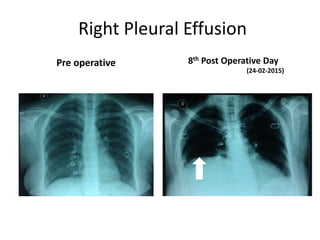
Right Pleural Effusion
Pre operative 8th Post Operative Day
(24-02-2015)
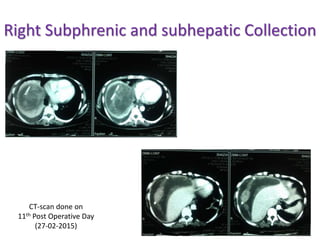
Right Subphrenic and subhepatic Collection
CT-scan done on
11th Post Operative Day
(27-02-2015)
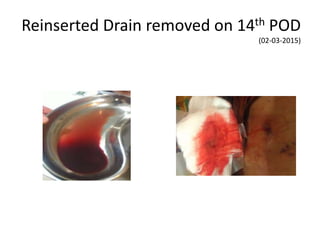
Reinserted Drain removed on 14th POD
(02-03-2015)
Further Plan
USG-guided Aspiration
Versus
Re-exploration
Follow Up
Lifelong follow-up because of the increased risk of
cholangiocarcinoma,
even after complete excision of the cyst
(even at site of anastomosis)
Follow Up
Lifelong follow-up because of the increased risk of
cholangiocarcinoma,
even after complete excision of the cyst
(even at site of anastomosis)
Cholangiocarcinoma: most feared complication
(9 -28% cases; increases with age; more common with type I and V )
Choledochal cyst

Choledochal cyst

  • 1.
    Choledochal Cyst (Greek chol-bile + docho- duct) Jibran Mohsin Resident, Surgical Unit I SIMS/Services Hospital, Lahore
  • 2.
    A 35 yearold female resident of Lahore presented in medical emergency on 29 December 2014 with presenting complaint of severe epigastric pain radiating directly to back for last 3 days, relieved on leaning forward and medication.
  • 3.
    A 35 yearold female resident of Lahore presented in medical emergency on 29 December 2014 with presenting complaint of severe epigastric pain radiating directly to back for last 3 days, relieved on leaning forward and medication. Frequently diagnosed in infancy or childhood (Approximately 60%-67% cases < 10 years) around 50 % cases have reached adulthood when diagnosed
  • 4.
    A 35 yearold female resident of Lahore presented in medical emergency on 29 December 2014 with presenting complaint of severe epigastric pain radiating directly to back for last 3 days, relieved on leaning forward and medication. M:F (1:3 to 1:8)
  • 5.
    A 35 yearold female resident of Lahore presented in medical emergency on 29 December 2014 with presenting complaint of severe epigastric pain radiating directly to back for last 3 days, relieved on leaning forward and medication. Much more prevalent in Asia than in Western countries(1: 100,000 – 1: 150,000) Approximately 33-50% of reported cases come from Japan( as high as 1:1000)
  • 6.
    A 35 yearold female resident of Lahore presented in medical emergency on 29 December 2014 with presenting complaint of severe epigastric pain radiating directly to back for last 3 days, relieved on leaning forward and medication, associated with 4-5 episodes of greenish colored vomiting Adults Present with one or more severe complications (obstructive jaundice, pancreatitis and cholangitis) Frequently, adults with choledochal cysts complain of vague epigastric or right upper quadrant pain and can develop jaundice or cholangitis. Most common symptom in adults is abdominal pain.
  • 7.
    • Abdominal examinationrevealed tenderness in epigastrium with no mass/viscera palpable and bowel sounds audible – Rest of examination was unremarkable • Among Baselines – TLC 17.2 , total bilirubin 0.8 – Serum amylase 438 and lipase 1018
  • 8.
    Classic Triad ofabdominal pain, jaundice and RUQ mass seen in only 10-20 % cases • Abdominal examination revealed tenderness in epigastrium with no mass/viscera palpable and bowel sounds audible – Rest of examination was unremarkable • Among Baselines – TLC 17.2 , total bilirubin 0.8 – Serum amylase 438 and lipase 1018
  • 9.
    • Abdominal examinationrevealed tenderness in epigastrium with no mass/viscera palpable and bowel sounds audible – Rest of examination was unremarkable • Among Baselines – TLC 17.2 , total bilirubin 0.8 – Serum amylase 438 and lipase 1018 Cholangitis
  • 10.
    • Abdominal examinationrevealed tenderness in epigastrium with no mass/viscera palpable and bowel sounds audible – Rest of examination was unremarkable • Among Baselines – TLC 17.2 , total bilirubin 0.8 – Serum amylase 438 and lipase 1018 May Reveal Obstructive Jaundice
  • 11.
    • Abdominal examinationrevealed tenderness in epigastrium with no mass/viscera palpable and bowel sounds audible – Rest of examination was unremarkable • Among Baselines – TLC 17.2 , total bilirubin 0.8 – Serum amylase 438 and lipase 1018 Acute Pancreatitis
  • 12.
    Patient was admittedon medical floor and was managed and worked up on lines of ACUTE PANCREATITIS & Departmental USG abdomen was done
  • 13.
    Patient was admittedon medical floor and was managed and worked up on lines of ACUTE PANCREATITIS & Departmental USG abdomen was done DIFFERENTIAL DIAGNOSIS of Choledochal Cyst Bile Duct Tumors Biliary Obstruction Cholangiocarcinoma Acute Pancreatitis
  • 14.
    Patient was admittedon medical floor and was managed and worked up on lines of ACUTE PANCREATITIS & Departmental USG abdomen was done Associated Morbidity in Adults • hepatic abscesses • Secondary biliary cirrhosis • portal hypertension • recurrent pancreatitis • cholelithiasis and CBD stone • Cyst rupture Peritonitis • Cholangiocarcinoma
  • 15.
    Ultrasound Abdomen ( 04-01-2015) •Dilated CBD with 1.8 cm calibre • Sludge ball without acoustic shadowing measuring 1.6 x 0.8 cm in distal part of CBD • Intrahepatic Biliary channels not dilated • Impression: – Choledochocele with possibility of sludge ball at distal end of CBD – ERCP advised
  • 16.
    US shows acyst mass near pancreatic head US shows: 1- splenic vein; 2- portal vein and 3 - cystic mass;
  • 17.
    US shows relationshipof cystic mass(C) with gall bladder(GB) and portal vein(VP) Portal vein and its relation with cystic mass
  • 18.
    On the basisof dilated CBD finding on USG, for the workup of obstructive jaundice CT scan was advised, followed by MRCP
  • 19.
    CT-Abdomen and Pelviswith IV & oral Contrast (07-01-2015) • Cystic dilation of 38.5 x 19.5 mm along with sludge and particulate matter • Partially contracted Gallbladder with sludge • Generalised decreased echogenicity of pancreas with coarse margins. • Dilated CBD 10.7 mm at porta hepatis and 3.8 mm at distal end
  • 20.
    Magnetic Resonant CholangioPancreatography(MRCP) 13-01-2015 • Cylindrical dilation of common hepatic and common bile ducts measuring upto 3.8 cm in diameter – Right and left heaptic ducts are normal in calibre and outline • Multiple small calculus signal intensities noted dependently in dilated CBD • Confluence of intrapancreatic CBD and pancreatic duct appears unremarkable
  • 21.
    Magnetic Resonant CholangioPancreatography(MRCP) 13-01-2015 • Cylindrical dilation of common hepatic and common bile ducts measuring upto 3.8 cm in diameter – Right and left heaptic ducts are normal in calibre and outline • Multiple small calculus signal intensities noted dependently in dilated CBD • Confluence of intrapancreatic CBD and pancreatic duct appears unremarkable Type I Choledochal Cyst (Todani Classification)
  • 22.
    Magnetic Resonant CholangioPancreatography(MRCP) 13-01-2015 • Cylindrical dilation of common hepatic and common bile ducts measuring upto 3.8 cm in diameter – Right and left heaptic ducts are normal in calibre and outline • Multiple small calculus signal intensities noted dependently in dilated CBD • Confluence of intrapancreatic CBD and pancreatic duct appears unremarkable Choledocholithiasis
  • 23.
    Magnetic Resonant CholangioPancreatography(MRCP) 13-01-2015 • Cylindrical dilation of common hepatic and common bile ducts measuring upto 3.8 cm in diameter – Right and left heaptic ducts are normal in calibre and outline • Multiple small calculus signal intensities noted dependently in dilated CBD • Confluence of intrapancreatic CBD and pancreatic duct appears unremarkable Anomalous junction between the common bile duct and the pancreatic duct >1 cm common channel (90-100 % cases) allows pancreatic secretions to reflux into the common bile duct  Activated pancreatic proenzymes damage and weak the bile duct wall (Long common channel/Babbit theory-1969)
  • 24.
    Type Configuration BiliaryTract Incidence Treatment Extrahepatic Intra- hepatic I A Saccular Most or all >50 % to 75 % Excision of involved portion of extrahepatic tract + Roux-en-Y Hepato- jejunostomy B Limited C Fusiform Most or all II Isolated Diverticulum Of CBD 5 % Excision with closure of defect over T-tube or same as above III Intraduodenal Part of CBD 5 % < 3 cm = endoscopic sphincterotomy > 3cm = excision via transduodenal approachCHOLEDOCHOCELE TODANI(1977) CLASSIFICATION
  • 25.
    Type Configuration BiliaryTract Incidence Treatment Extrahepatic Intra- hepatic IV A MultipleDilations 30 % Extrahepatic Excision of involved portion + Roux-en-Y Hepato- jejunostomy Intrahepatic Resection of segment or lobe Or transplantation B V 1 % VI Isolated Cyst of Cystic Duct Extremely Rare Cystic Duct ligation near CBD CAROLI DISEASE (1958) NOT part of Todani Classification TODANI(1977) CLASSIFICATION Jacques Caroli French gastroenterologist, 1902-1979
  • 26.
    • Call toSurgical Unit on Call was sent on 16-01- 2015 and patient shifted to Surgical floor for further management. • Time for ERCP ( 09-02-2015) taken for choledocholithiasis and managed conservatively and sent on leave • ERCP team deferred ERCP as patient was asymptomatic with normal LFTs and no obstruction and referred back to surgery
  • 27.
    After optimizing thepatient for general anesthesia, patient was operated on 16-02-2015
  • 28.
    After optimizing thepatient for general anesthesia, patient was operated on 16-02-2015 surgery is the only currently available definitive therapy
  • 29.
    OPERATIVE FINDINGS – TypeI septate Choledochal Cyst – Choledocholithiasis – Saponification of omentum
  • 30.
    OPERATIVE FINDINGS – TypeI septate Choledochal Cyst – Choledocholithiasis – Saponification of omentum Main Disease
  • 31.
    OPERATIVE FINDINGS – TypeI septate Choledochal Cyst – Choledocholithiasis – Saponification of omentum Associated Morbidity
  • 32.
    OPERATIVE FINDINGS – TypeI septate Choledochal Cyst – Choledocholithiasis – Saponification of omentum Visual confirmation of initial diagnosis of Acute Pancreatitis (complication/associated morbidity of Choledochal Cyst)
  • 33.
    PROCEDURE Excision of choledochalCyst + Roux-en-Y hepatojejunostomy + Cholecystectomy
  • 34.
    PROCEDURE Excision of choledochalCyst + Roux-en-Y hepatojejunostomy + Cholecystectomy PRINCIPLE OF SURGERY Treatment of choice for choledochal cysts is complete excision of the cyst + with construction of a biliary-enteric anastomosis to restore continuity with the GI tract
  • 35.
    PROCEDURE Excision of choledochalCyst + Roux-en-Y hepatojejunostomy + Cholecystectomy MUST in all cases of choledochal Cyst
  • 36.
    • Kocher incisionmade • Mobilisation of Transverse Colon from hepatic Flexure • Retrograde dissection of GB from liver bed
  • 37.
    • Kocher incisionmade • Mobilisation of Transverse Colon from hepatic Flexure • Retrograde dissection of GB from liver bed Retrograde Dissected GB Cystic Duct Choledochal Cyst CBD
  • 38.
    • Choledochal Cystdissected away from portal vein and hepatic artery ( Lilly Technique) • Cyst wall opened till common hepatic duct junction
  • 39.
    • Choledochal Cystdissected away from portal vein and hepatic artery ( Lilly Technique?) • Cyst wall opened till common hepatic duct junction
  • 40.
    • Choledochal Cystdissected away from portal vein and hepatic artery ( Lilly Technique?) • Cyst wall opened till common hepatic duct junction Occasionally, Cyst adheres densely to the portal vein secondary to long-standing inflammatory reaction complete, full-thickness excision of the cyst may not be possible serosal surface of the duct is left adhering to the portal vein, while the mucosa of the cyst wall is obliterated by curettage or cautery Theoretically, this removes the risk of malignant transformation in that segment of the duct
  • 41.
    • Multiple stonesextruded • Hepatic ducts washed with normal saline • Hepatic ducts patency confirmed with bougies
  • 42.
    • Multiple stonesextruded • Hepatic ducts washed with normal saline • Hepatic ducts patency confirmed with bougies Left Hepatic Duct Right Hepatic Duct
  • 43.
    • Roux-en-Y (french:rōō'ěn-wī') Hepatojejunostomy done (retrocolic isoperistaltic functional side-to-side) Cesar Roux Swiss Surgeon (1857-1934), (Performed 1st successful excision of pheochromocytoma in 1926) (End-to-side) (End-to-side OR Side-to-side)
  • 44.
    • Cholecystectomy doneen bloc • Subhepatic Drain placed • Specimen sent for histopathology
  • 45.
    • Cholecystectomy doneen bloc • Subhepatic Drain placed • Specimen sent for histopathology Cyst Wall • Chronic inflammation, Sparse mucin glands and metaplasia • Either glandular with normal cuboidal epithelium with cavities in mucosa or fibrotic type with fibrous cyst wall most feared histologic abnormality is the presence of cholangiocarcinoma
  • 46.
    Post Operative Recovery •Patient kept NPO for 72 hours • Early mobilization • Chest Physiotherapy and Incentive Spirometry • IV fluids, antibiotics(Zinacef, then Tinem), PPI and analgesics • Drain removed on 5th POD (21-02-2015) – 24 hours after removal of drain (6th POD) patient start complaining of RHC pain along with swinging fever(max. 1030F) – Drain site wound bandage slightly soaked with bile stained fluid – USG guided Drain was replaced through previous drain wound with 600 ml of greenish fluid aspirated BUT minimal fluid drained till then
  • 47.
    Right Pleural Effusion Preoperative 8th Post Operative Day (24-02-2015)
  • 48.
    Right Subphrenic andsubhepatic Collection CT-scan done on 11th Post Operative Day (27-02-2015)
  • 49.
    Reinserted Drain removedon 14th POD (02-03-2015)
  • 50.
  • 51.
    Follow Up Lifelong follow-upbecause of the increased risk of cholangiocarcinoma, even after complete excision of the cyst (even at site of anastomosis)
  • 52.
    Follow Up Lifelong follow-upbecause of the increased risk of cholangiocarcinoma, even after complete excision of the cyst (even at site of anastomosis) Cholangiocarcinoma: most feared complication (9 -28% cases; increases with age; more common with type I and V )