Basic Principles of Liver
Resection
Anup Shrestha
History
 first recognized by the
Greeks.
 Langenbuch was
credited with the first
liver resection for a
tumor in 1888.
 Hepatic inflow occlusion
was first used by James
Hogarth Pringle an
Australian born British
surgeon in 1908.
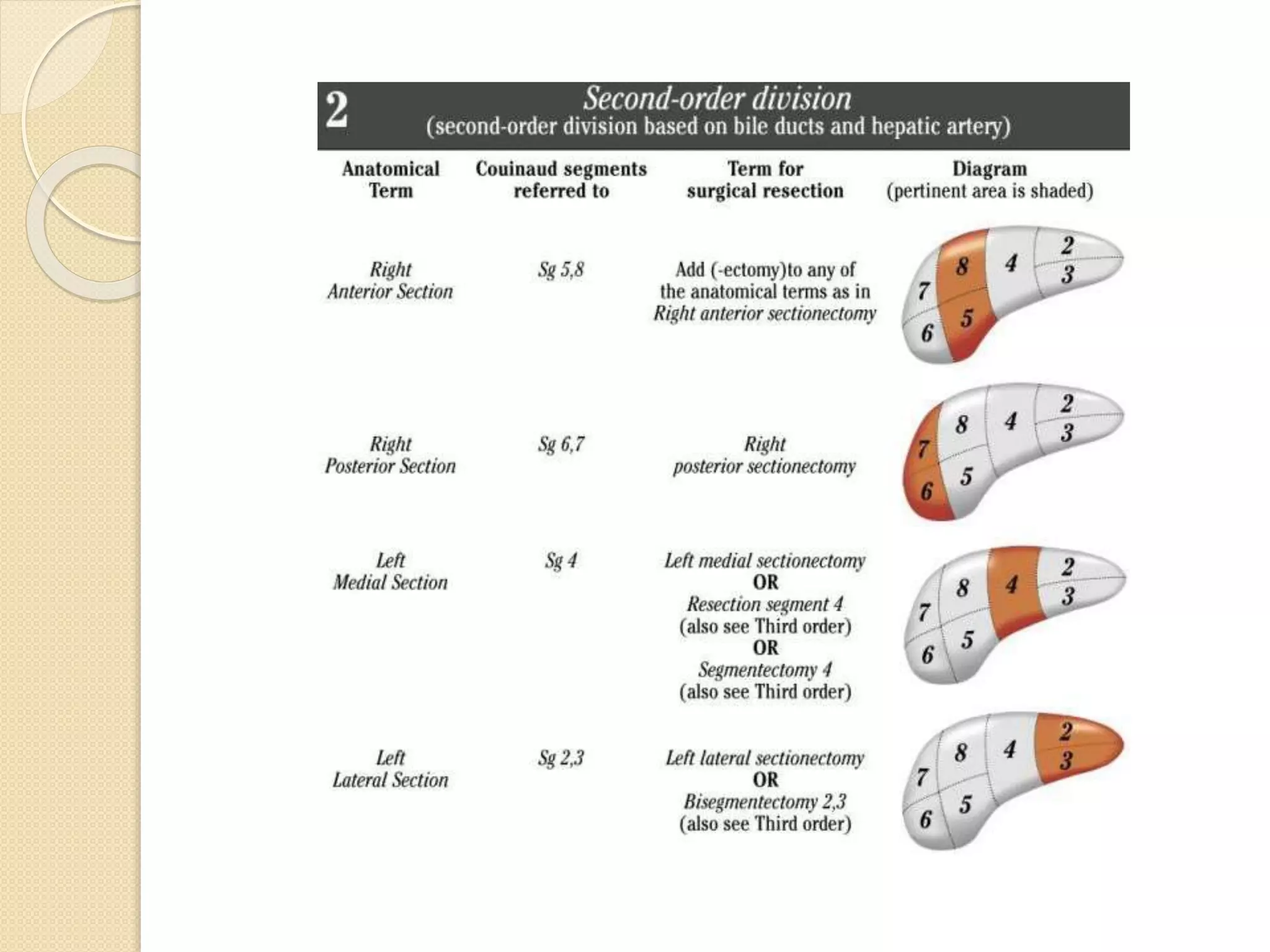
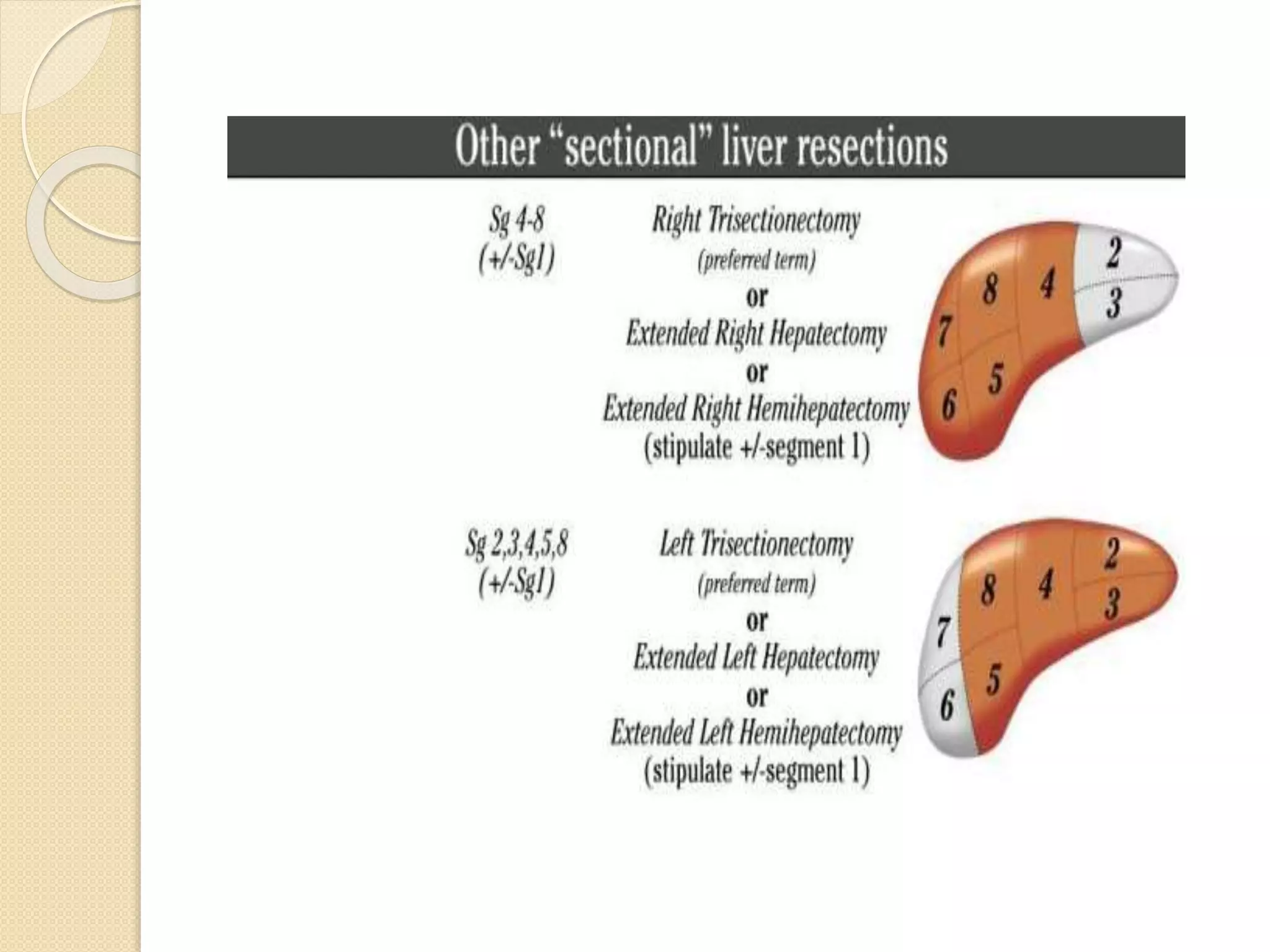
Surgical Anatomy And
Nomenclature
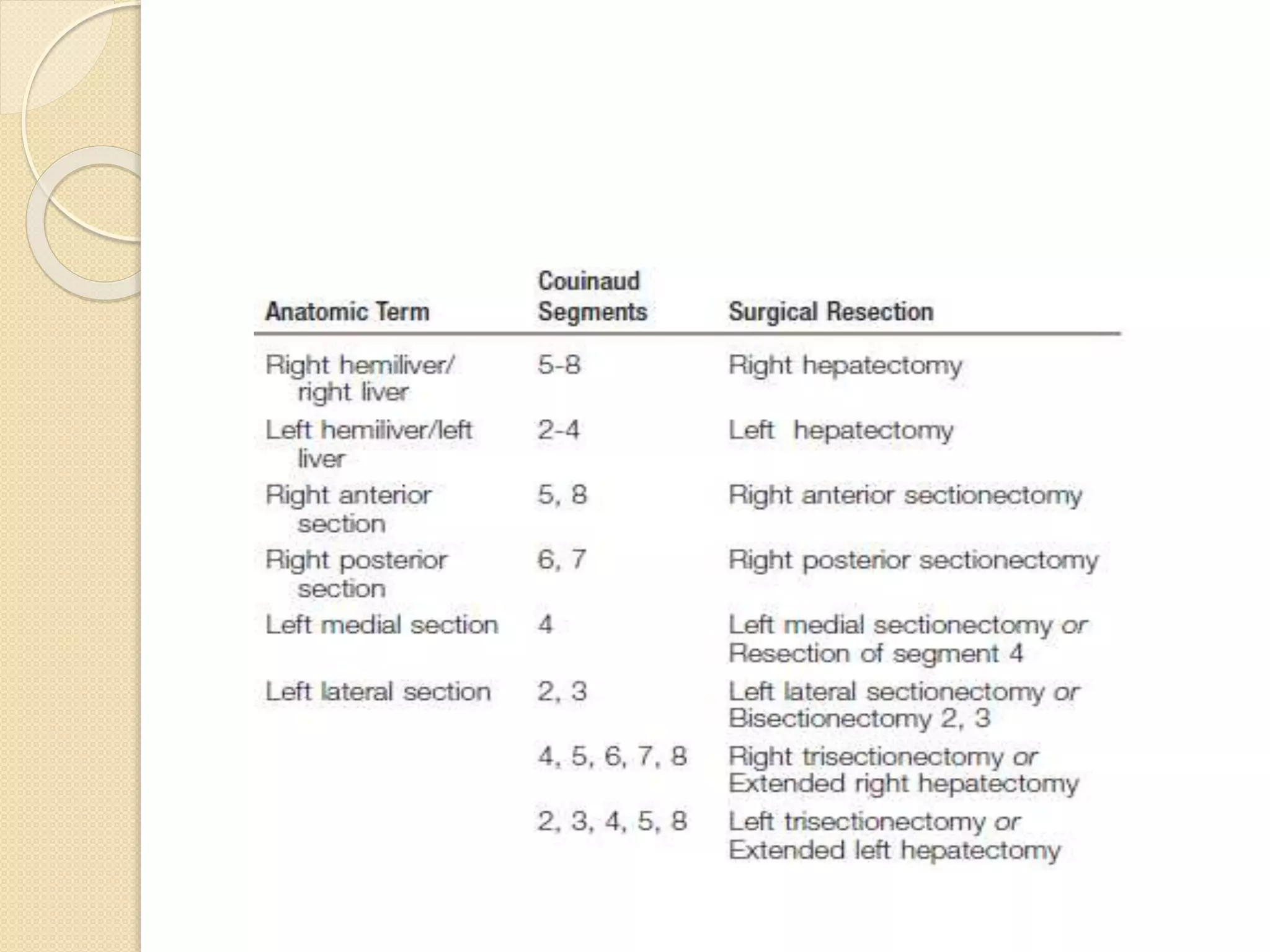
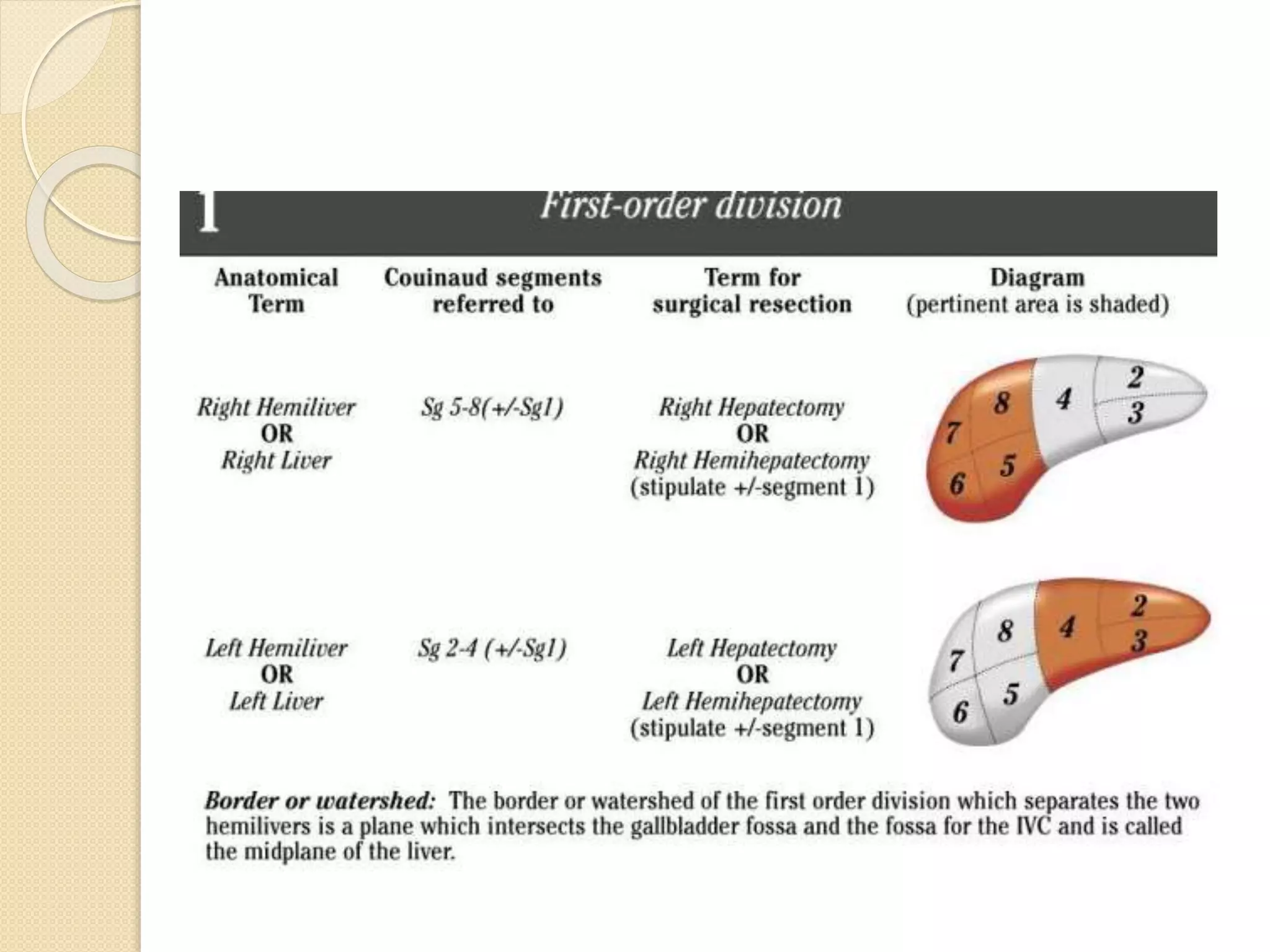
 French anatomist,
Couinaud, based his
description on the
distribution of the portal
pedicles and the location
of the hepatic veins.
 The recommendations of
the committee were
adopted at the World
Congress of the IHPBA in
Brisbane in 2000 and
were termed “The
Brisbane 2000
terminology of liver
Concept of Liver
Regeneration
 A normal human liver tolerates resections of
up to 70% of its functioning mass.
 Liver regeneration after surgical resection is
carried out by proliferation of existing mature
cellular populations.
 Immediately after liver resection, the rate of
DNA synthesis in hepatocytes begins to
increase while they exit the resting state of
the cell cycle (G0) and enter G1, traverse to
DNA synthesis (S phase), and ultimately
undergo mitosis (M phase).
 Significant amount of regeneration occurs in
human within 2 weeks following resection
and is nearly complete at 3 months following
resection
Pre-Op Preparation
 vigorous chest physiotherapy, deep breathing
exercises, incentive spirometry
 parenteral or enteral hyperalimentation with high
protein content
 bowel preparation
 Jaundiced patients are hydrated well with intravenous
crystalloids over a period of 2–3 days
 Prothrombin time is corrected using vitamin K
injections
 A broadspectrum parenteral antibiotic regimen is
started on the day of operation, before the patient is
shifted to the operating room
Surgical Techniques
 Low Central Venous Pressure-reducing the
central venous pressure (CVP) to around 5
cm water helps to reduce the bleeding
 -change of posture: placed in a 15⁰
Trendelenburg position
Methods of Liver Transection
Liver transection involves division of hepatocytic
parenchymal tissue (collective hepatic lobules),
the branching portal triad inflow structures (portal
vein, hepatic artery, bile duct, lymphatics and
vagal nerve fibres)
 Finger Fracture or Clamp Crushing :Softer
parenchymal tissue is crushed between surgical
clamps to expose more significant vessels,
which can be ligated by any variety of method
according to their size. This method is quick,
cost-effective and remains a reference point
from which all other techniques are compared.
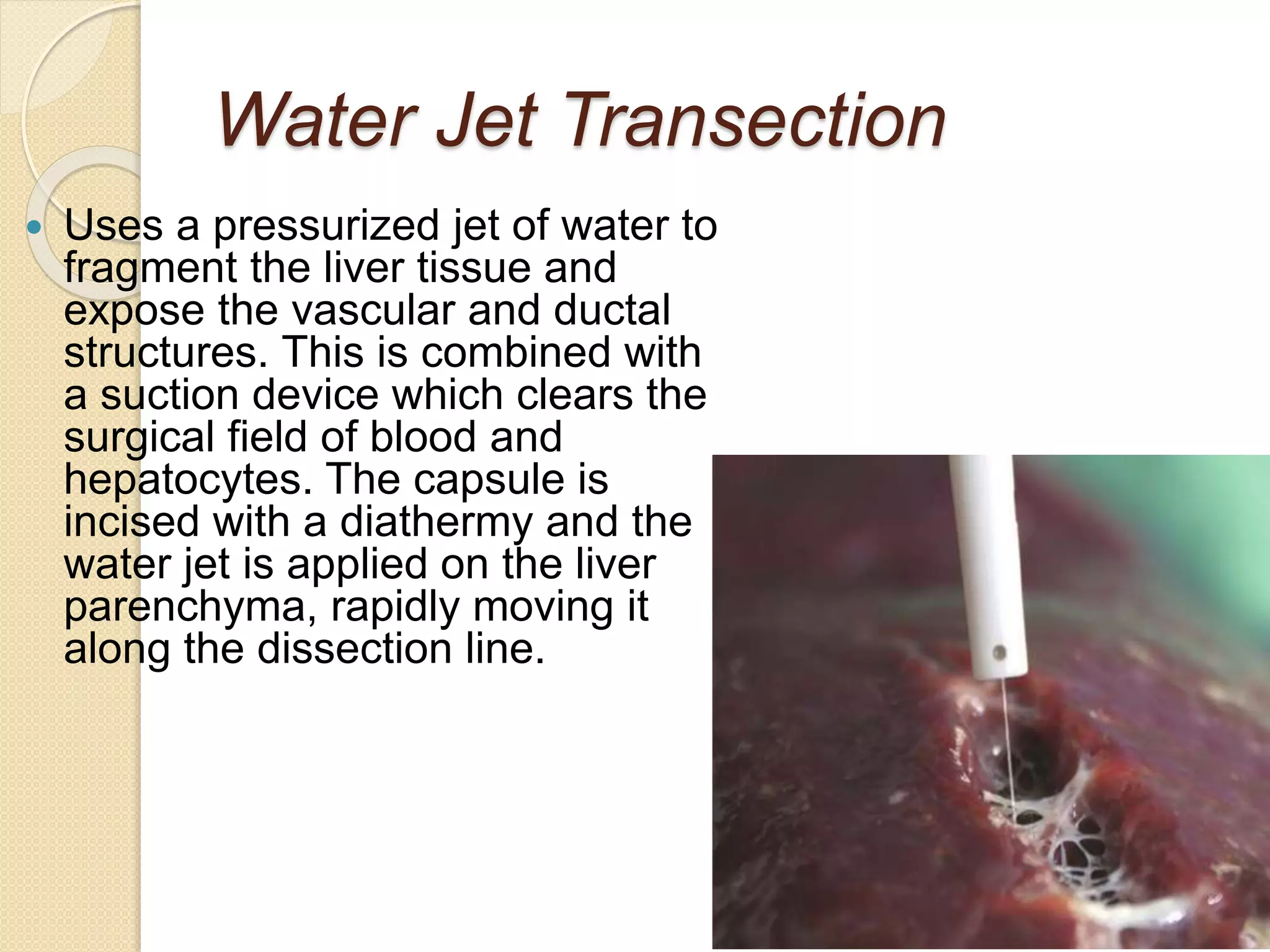
Water Jet Transection
 Uses a pressurized jet of water to
fragment the liver tissue and
expose the vascular and ductal
structures. This is combined with
a suction device which clears the
surgical field of blood and
hepatocytes. The capsule is
incised with a diathermy and the
water jet is applied on the liver
parenchyma, rapidly moving it
along the dissection line.
CUSA
 The Cavitron Ultrasonic
Surgical Aspirator
(CUSA, TycoHealthcare)
is currently the preferred
method of parenchymal
dissection
 The device combines
ultrasonic energy with
continuous suction to
disrupt and aspirate
susceptible tissue,
exposing structures
greater than 2 mm for
individual control
Ligasure
 This is an ingenious system for sealing
blood vessels. The Ligasure system
(Covidien) uses a combination of
pressure and energy to seal the blood
vessels.
 The heat generated from the bipolar
energy causes the fusion of collagen and
elastin in the walls of the vessel with the
creation of a permanent sealed zone. An
acoustic signal informs the surgeon
when the vessel is sealed and it can be
Tissue Link Dissecting Sealer
 The thermal effect generated by ionic agitation
caused by radiofrequency generator system can
also be used to coagulate tissue. The tissue link
dissecting sealer is a new technology developed for
liver transection using saline linked radiofrequency
energy.
 This device offers parenchymal dissection as well
as coagulation of small surface vessels
Use of Vascular Staplers in Liver
Transection
 Vascular staplers make this task safer
and faster.They can also be used to
divide the liver parenchyma. Care should
be taken while applying the vascular
stapler at the inflow especially in large
tumors close to the confluence.
 If not applied with care there is a risk of
narrowing or occluding the hepatic duct
confluence. With staplers there is an
increased risk of bile leak because the
staples are not very effective in sealing
small bile ducts.
TECHNIQUES OF VASCULAR
CONTROL
 Broadly, these techniques can be
grouped into three types:
1. Ligation of inflow and outflow vessels
for hemihepatectomies.
2. The liver hanging maneuver
3. Methods of temporary vascular
control.
Ligation of inflow and outflow
vessels for hemihepatectomies
 First described by Lortat-Jacob
 Involves the ligation of right portal pedicle
and the RHV before-hand to reduce the
blood loss during parenchymal transection
 The extrahepatic isolation of RHV needs
to be carried out judiciously avoiding any
injury to RHV and IVC which can lead to a
fatal massive hemorrhage or an air
embolism
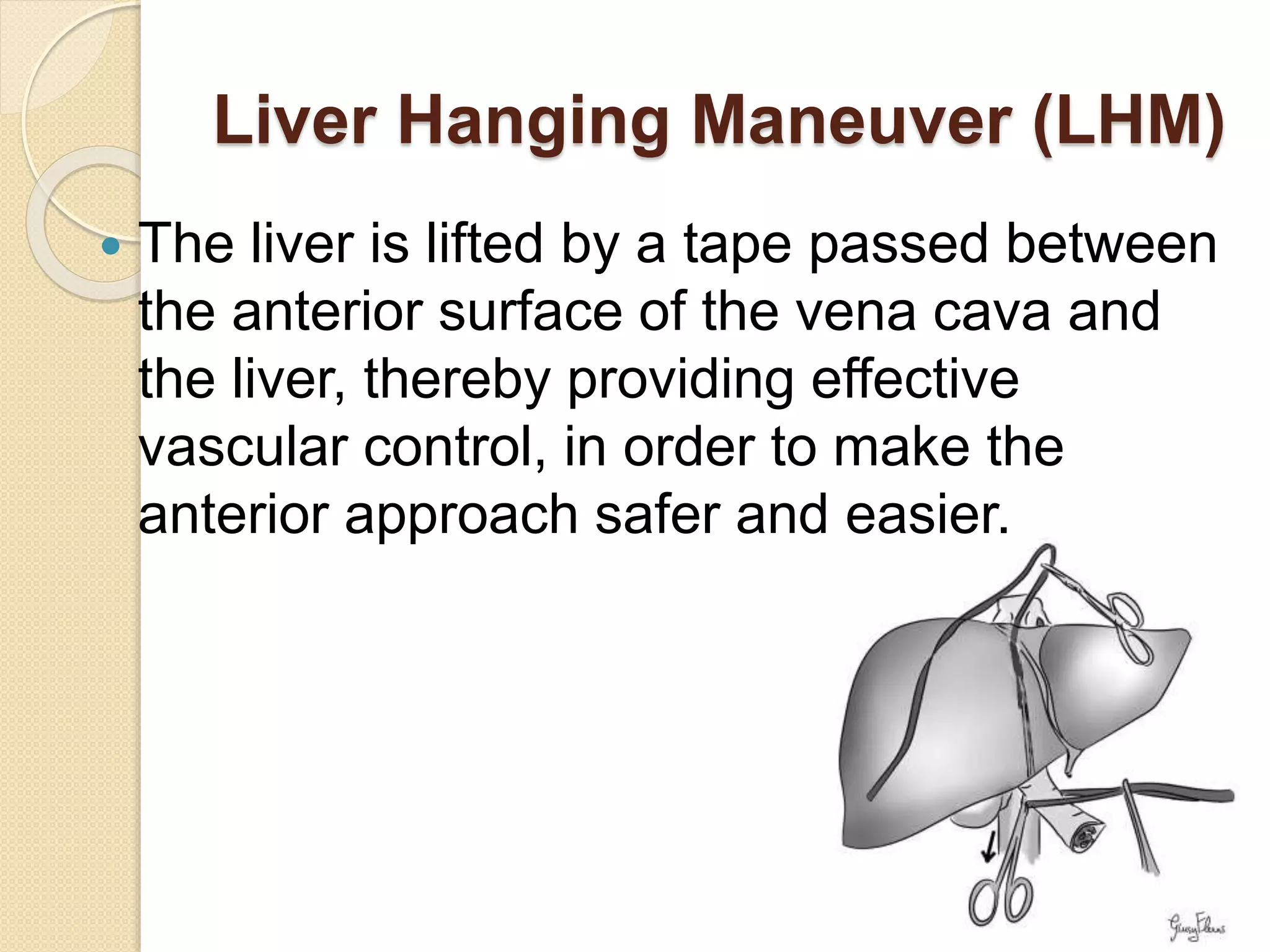
Liver Hanging Maneuver (LHM)
 The liver is lifted by a tape passed between
the anterior surface of the vena cava and
the liver, thereby providing effective
vascular control, in order to make the
anterior approach safer and easier.
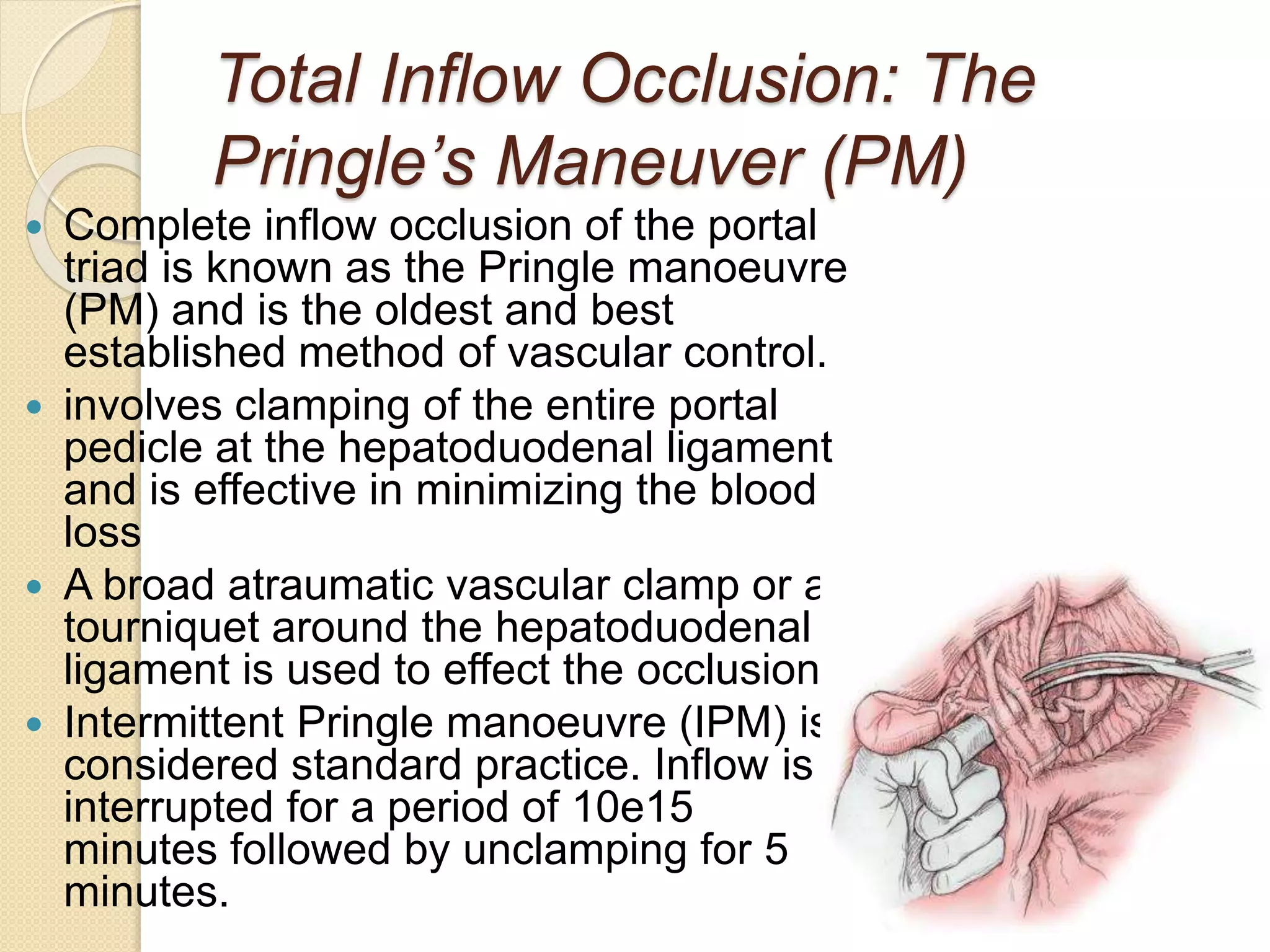
Total Inflow Occlusion: The
Pringle’s Maneuver (PM)
 Complete inflow occlusion of the portal
triad is known as the Pringle manoeuvre
(PM) and is the oldest and best
established method of vascular control.
 involves clamping of the entire portal
pedicle at the hepatoduodenal ligament
and is effective in minimizing the blood
loss
 A broad atraumatic vascular clamp or a
tourniquet around the hepatoduodenal
ligament is used to effect the occlusion
 Intermittent Pringle manoeuvre (IPM) is
considered standard practice. Inflow is
interrupted for a period of 10e15
minutes followed by unclamping for 5
minutes.
Hepatic Tolerance and
Preconditioning
 an initial period of ischemia for 10
minutes followed by reperfusion for 10
minutes protects the liver against
subsequent prolonged ischemia. It is
called preconditioning of the liver.
 This technique was found to be
hepatoprotective. The intermittent
release of the clamp also allows
gradual haemostasis during a
prolonged period of time over smaller
transaction areas.
Total Hepatic Vascular
Exclusion
 The IVC and major hepatic veins are
clamped to isolate the liver completely from
the systemic circulation. This technique
decreases the risk of retrograde bleeding
from the hepatic veins and the risk of air
embolism
 THVE has significant physiological
consequences and is poorly tolerated.
Clamping of the IVC causes a reduction in
venous return of up to 60% and a reduction
in cardiac output.
Postoperative Management
 Fluid and Electrolyte Management -
maintenance of adequate fluid balance and
renal function is important.
-Postoperative ascites is controlled with salt
restriction (<2 g/day), potassium sparing and
loop diuretics, fluid and electrolyte
replacement and albumin infusions
Nutrition
 The preoperative hyperalimentation and
resumption of early feeding in the
postoperative period helps in faster recovery
and is likely to reduce the morbidity due to
sepsis and ascites.
 Patients are in a catabolic state after liver
resection and require glucose and other
nutrients
 Malnourished patients and those with
cirrhosis should preferably be given by the
enteral route.
 Supplementation with BCAA in patients with
advanced cirrhosis resulted in better
nutritional status and lower rate of
Pain Management
 Good pain relief after liver resection
allows early mobilization and better
respiratory function
 Epidural analgesia reduces chest
infection, duration of ileus and
provides better pain control
 However, there is risk of epidural
hematoma, spinal cord injury and
epidural abscess with these catheters
Liver Failure
 Postoperative liver failure is the most
important and common cause of in-
hospital mortality
 The signs of postoperative liver failure
include progressive hyperbilirubinemia
with normal transaminases, glucose
intolerance or refractory
hypoglycemia, progressive ascites
and mental obtundation.
The End

Basic principle of liver resection

  • 1.
    Basic Principles ofLiver Resection Anup Shrestha
  • 2.
    History  first recognizedby the Greeks.  Langenbuch was credited with the first liver resection for a tumor in 1888.  Hepatic inflow occlusion was first used by James Hogarth Pringle an Australian born British surgeon in 1908.
  • 3.
    Surgical Anatomy And Nomenclature French anatomist, Couinaud, based his description on the distribution of the portal pedicles and the location of the hepatic veins.  The recommendations of the committee were adopted at the World Congress of the IHPBA in Brisbane in 2000 and were termed “The Brisbane 2000 terminology of liver
  • 9.
    Concept of Liver Regeneration A normal human liver tolerates resections of up to 70% of its functioning mass.  Liver regeneration after surgical resection is carried out by proliferation of existing mature cellular populations.  Immediately after liver resection, the rate of DNA synthesis in hepatocytes begins to increase while they exit the resting state of the cell cycle (G0) and enter G1, traverse to DNA synthesis (S phase), and ultimately undergo mitosis (M phase).  Significant amount of regeneration occurs in human within 2 weeks following resection and is nearly complete at 3 months following resection
  • 10.
    Pre-Op Preparation  vigorouschest physiotherapy, deep breathing exercises, incentive spirometry  parenteral or enteral hyperalimentation with high protein content  bowel preparation  Jaundiced patients are hydrated well with intravenous crystalloids over a period of 2–3 days  Prothrombin time is corrected using vitamin K injections  A broadspectrum parenteral antibiotic regimen is started on the day of operation, before the patient is shifted to the operating room
  • 11.
    Surgical Techniques  LowCentral Venous Pressure-reducing the central venous pressure (CVP) to around 5 cm water helps to reduce the bleeding  -change of posture: placed in a 15⁰ Trendelenburg position
  • 12.
    Methods of LiverTransection Liver transection involves division of hepatocytic parenchymal tissue (collective hepatic lobules), the branching portal triad inflow structures (portal vein, hepatic artery, bile duct, lymphatics and vagal nerve fibres)  Finger Fracture or Clamp Crushing :Softer parenchymal tissue is crushed between surgical clamps to expose more significant vessels, which can be ligated by any variety of method according to their size. This method is quick, cost-effective and remains a reference point from which all other techniques are compared.
  • 13.
    Water Jet Transection Uses a pressurized jet of water to fragment the liver tissue and expose the vascular and ductal structures. This is combined with a suction device which clears the surgical field of blood and hepatocytes. The capsule is incised with a diathermy and the water jet is applied on the liver parenchyma, rapidly moving it along the dissection line.
  • 14.
    CUSA  The CavitronUltrasonic Surgical Aspirator (CUSA, TycoHealthcare) is currently the preferred method of parenchymal dissection  The device combines ultrasonic energy with continuous suction to disrupt and aspirate susceptible tissue, exposing structures greater than 2 mm for individual control
  • 15.
    Ligasure  This isan ingenious system for sealing blood vessels. The Ligasure system (Covidien) uses a combination of pressure and energy to seal the blood vessels.  The heat generated from the bipolar energy causes the fusion of collagen and elastin in the walls of the vessel with the creation of a permanent sealed zone. An acoustic signal informs the surgeon when the vessel is sealed and it can be
  • 16.
    Tissue Link DissectingSealer  The thermal effect generated by ionic agitation caused by radiofrequency generator system can also be used to coagulate tissue. The tissue link dissecting sealer is a new technology developed for liver transection using saline linked radiofrequency energy.  This device offers parenchymal dissection as well as coagulation of small surface vessels
  • 17.
    Use of VascularStaplers in Liver Transection  Vascular staplers make this task safer and faster.They can also be used to divide the liver parenchyma. Care should be taken while applying the vascular stapler at the inflow especially in large tumors close to the confluence.  If not applied with care there is a risk of narrowing or occluding the hepatic duct confluence. With staplers there is an increased risk of bile leak because the staples are not very effective in sealing small bile ducts.
  • 18.
    TECHNIQUES OF VASCULAR CONTROL Broadly, these techniques can be grouped into three types: 1. Ligation of inflow and outflow vessels for hemihepatectomies. 2. The liver hanging maneuver 3. Methods of temporary vascular control.
  • 19.
    Ligation of inflowand outflow vessels for hemihepatectomies  First described by Lortat-Jacob  Involves the ligation of right portal pedicle and the RHV before-hand to reduce the blood loss during parenchymal transection  The extrahepatic isolation of RHV needs to be carried out judiciously avoiding any injury to RHV and IVC which can lead to a fatal massive hemorrhage or an air embolism
  • 20.
    Liver Hanging Maneuver(LHM)  The liver is lifted by a tape passed between the anterior surface of the vena cava and the liver, thereby providing effective vascular control, in order to make the anterior approach safer and easier.
  • 21.
    Total Inflow Occlusion:The Pringle’s Maneuver (PM)  Complete inflow occlusion of the portal triad is known as the Pringle manoeuvre (PM) and is the oldest and best established method of vascular control.  involves clamping of the entire portal pedicle at the hepatoduodenal ligament and is effective in minimizing the blood loss  A broad atraumatic vascular clamp or a tourniquet around the hepatoduodenal ligament is used to effect the occlusion  Intermittent Pringle manoeuvre (IPM) is considered standard practice. Inflow is interrupted for a period of 10e15 minutes followed by unclamping for 5 minutes.
  • 22.
    Hepatic Tolerance and Preconditioning an initial period of ischemia for 10 minutes followed by reperfusion for 10 minutes protects the liver against subsequent prolonged ischemia. It is called preconditioning of the liver.  This technique was found to be hepatoprotective. The intermittent release of the clamp also allows gradual haemostasis during a prolonged period of time over smaller transaction areas.
  • 23.
    Total Hepatic Vascular Exclusion The IVC and major hepatic veins are clamped to isolate the liver completely from the systemic circulation. This technique decreases the risk of retrograde bleeding from the hepatic veins and the risk of air embolism  THVE has significant physiological consequences and is poorly tolerated. Clamping of the IVC causes a reduction in venous return of up to 60% and a reduction in cardiac output.
  • 24.
    Postoperative Management  Fluidand Electrolyte Management - maintenance of adequate fluid balance and renal function is important. -Postoperative ascites is controlled with salt restriction (<2 g/day), potassium sparing and loop diuretics, fluid and electrolyte replacement and albumin infusions
  • 25.
    Nutrition  The preoperativehyperalimentation and resumption of early feeding in the postoperative period helps in faster recovery and is likely to reduce the morbidity due to sepsis and ascites.  Patients are in a catabolic state after liver resection and require glucose and other nutrients  Malnourished patients and those with cirrhosis should preferably be given by the enteral route.  Supplementation with BCAA in patients with advanced cirrhosis resulted in better nutritional status and lower rate of
  • 26.
    Pain Management  Goodpain relief after liver resection allows early mobilization and better respiratory function  Epidural analgesia reduces chest infection, duration of ileus and provides better pain control  However, there is risk of epidural hematoma, spinal cord injury and epidural abscess with these catheters
  • 27.
    Liver Failure  Postoperativeliver failure is the most important and common cause of in- hospital mortality  The signs of postoperative liver failure include progressive hyperbilirubinemia with normal transaminases, glucose intolerance or refractory hypoglycemia, progressive ascites and mental obtundation.
  • 28.

Editor's Notes

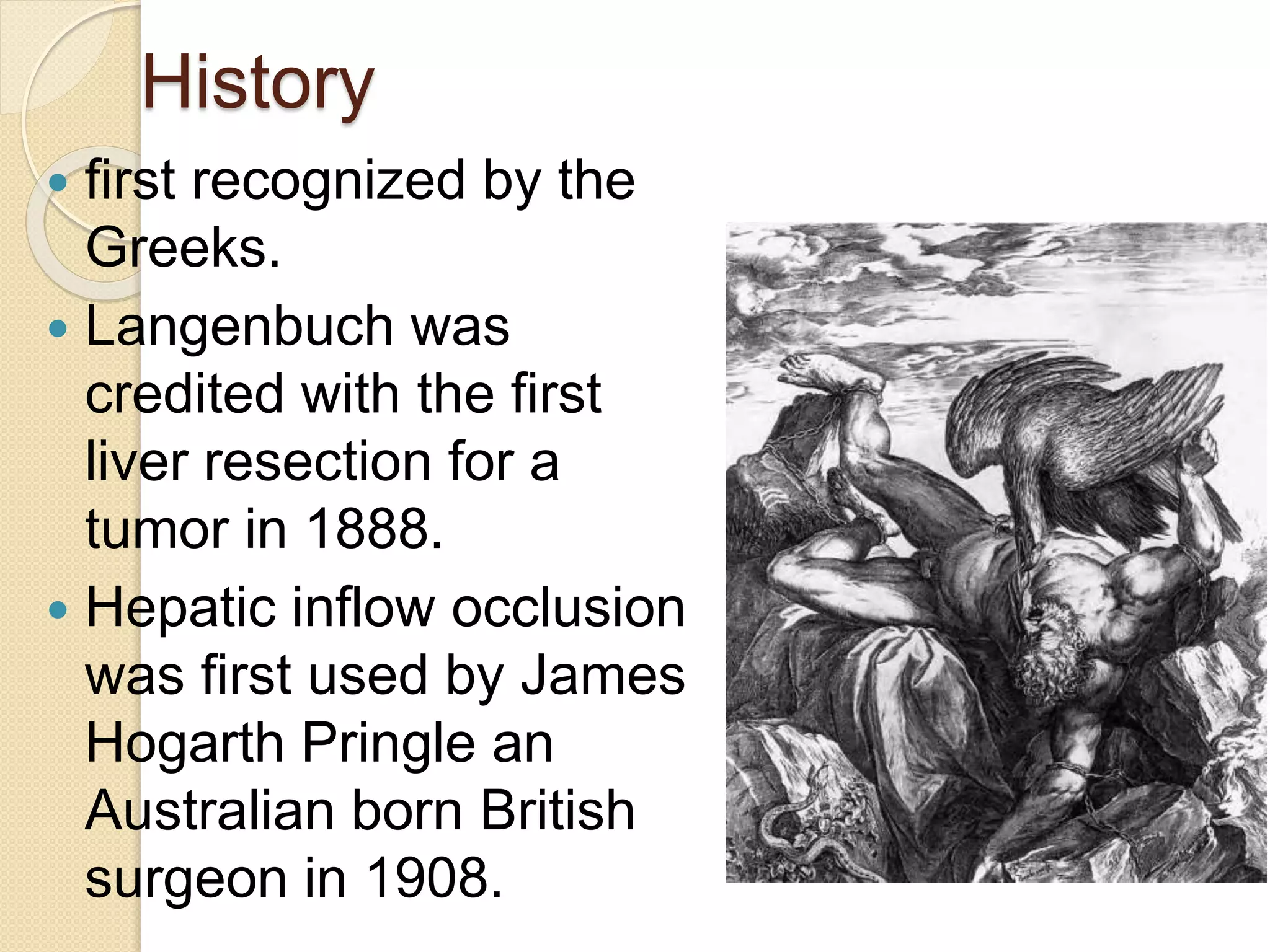
  • #3 Prometheus stole fire from the Gods and gave it to man. For this, he was punished by Zeus and was chained to a rock. An eagle came and ate his liver by day and it regenerated by night. So, the eagle would return every day to feed on his liver.
  • #10 Hepatocyte proliferation starts in the periportal areas of the lobules (Rabes et al, 1976) and then proceeds to the pericentral areas by 36 to 48 hours
  • #11 in cirrhotic patients with HCC undergoing liver resection, significantly reduced the incidence of postoperative septic complications
  • #12 There is a risk of air embolism when a low CVP is maintaine
  • #14 The water jet has not become very popular because of the fear of splash back of the water from the tissues. There is also a risk of contamination of the operation theater and dissemination of cancer cells