CHOLEDOCHAL CYST
DR. MOHSIN
KHAN
Introduction
 Focal or Diffuse cystic Dilatation of the biliary system
 Diagnosis and treatment are essential as the cysts predispose to
Choledocholithiasis, Cholangitis, Portal Hypertension and
Cholangiocarcinoma.
Epidemiology
 Choledochal cysts are rare, occurring in less than 1/100,000 patients.
 More common in those of Asian descents and are three to eight times more
common in women than men.
 They are commonly diagnosed in infancy but many present in adulthood.
Pathogenesis
 Choledochal cysts may be congenital or Acquired.
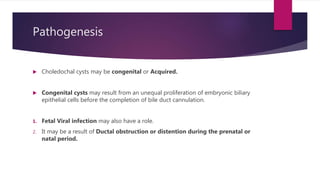
 Congenital cysts may result from an unequal proliferation of embryonic biliary
epithelial cells before the completion of bile duct cannulation.
1. Fetal Viral infection may also have a role.
2. It may be a result of Ductal obstruction or distention during the prenatal or
natal period.
Pathogenesis
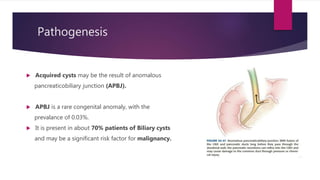
 Acquired cysts may be the result of anomalous
pancreaticobiliary junction (APBJ).
 APBJ is a rare congenital anomaly, with the
prevalance of 0.03%.
 It is present in about 70% patients of Biliary cysts
and may be a significant risk factor for malignancy.
Classification
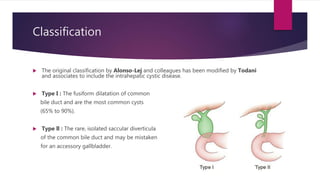
 The original classification by Alonso-Lej and colleagues has been modified by Todani
and associates to include the intrahepatic cystic disease.
 Type I : The fusiform dilatation of common
bile duct and are the most common cysts
(65% to 90%).
 Type ll : The rare, isolated saccular diverticula
of the common bile duct and may be mistaken
for an accessory gallbladder.
Classification
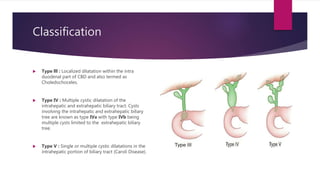
 Type lll : Localized dilatation within the intra
duodenal part of CBD and also termed as
Choledochoceles.
 Type IV : Multiple cystic dilatation of the
intrahepatic and extrahepatic biliary tract. Cysts
involving the intrahepatic and extrahepatic biliary
tree are known as type IVa with type IVb being
multiple cysts limited to the extrahepatic biliary
tree.
 Type V : Single or multiple cystic dilatations in the
intrahepatic portion of biliary tract (Caroli Disease).
Clinical Presentation
 The classic presentation of Jaundice, Right upper quadrant pain, and a Palpable mass occurs rarely. Most
patients have two of the three symptoms, with Jaundice being the most consistent symptom prior to
undergoing any diagnostic imaging. Other symptoms include Nausea, Pruritus, and Weight loss.
 Cholangitis, Pancreatitis, Hepatic fibrosis, and Malignancy have all been reported at the time of presentation.
 An unusual presentation is that of acute rupture of the cyst with subsequent Bile peritonitis.
 Most cystic biliary lesions are originally identified and subsequently diagnosed by Imaging, because the common
presenting symptoms are Nonspecific.
Investigations
 Transabdominal Ultrasound
 Computed Tomography (CT Scan)
 Endoscopic Ultrasound (EUS)
 Endoscopic retrograde cholangiopancreatography (ERCP)
 Magnetic retrograde cholangiopancreatography (MRCP)
Transabdominal Ultrasound
 First Imaging modality required to evaluate the choledochal cyst
 Have sensitivity of 71% to 97%
 Can not detect Type III and Type IV choledochal cysts
Factors that may limit the usefulness of Ultrasound are
 Patient`s body habitus
 Presence of bowel gases
 Limited visualization due to overlying structures
Computed Tomography (CT Scan)
 Can detect all types of Biliary cysts
 Can evaluate the presence of Malignancy
 Can determine the extent of intrahepatic disease in patients with Type IVa
or Type V choledochal cyst.
Endoscopic Ultrasound (EUS)
 EUS can demonstrate extrahepatic biliary cysts and provide detailed
images of the cyst wall and pancreaticobiliary junction
 Unlike transabdominal U/S, it is not limited by body habitus, bowel gas, or
overlying structures.
Cholangiography
 Direct cholangiography (whether intraoperative, percutaneous or endoscopic) has
a sensitivity of up to100% for diagnosing biliary cysts and previously was a
commonly obtained test.
 Can identify abnormal pancreatobiliary junction and filling defects due to stones
or malignancy.
 Increase risk of cholangitis and pancreatitis. [Patients with cystic disease are
greater risk for these complications]
Magnetic resonance
cholangiopancreatography (MRCP)
 Does not have the risks of cholangitis and pancreatitis as direct cholangiography.
 Sensitivity 73 – 100%
 Less sensitive than direct cholangiography for excluding obstruction.
 The data are variable with regard to its ability to diagnose an abnormal
pancreatobiliary junction. [46-75%]
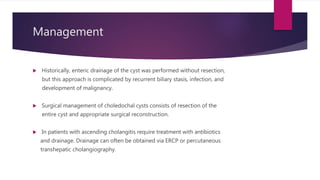
Management
 Historically, enteric drainage of the cyst was performed without resection,
but this approach is complicated by recurrent biliary stasis, infection, and
development of malignancy.
 Surgical management of choledochal cysts consists of resection of the
entire cyst and appropriate surgical reconstruction.
 In patients with ascending cholangitis require treatment with antibiotics
and drainage. Drainage can often be obtained via ERCP or percutaneous
transhepatic cholangiography.
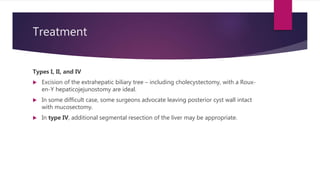
Treatment
Types I, II, and IV
 Excision of the extrahepatic biliary tree – including cholecystectomy, with a Roux-
en-Y hepaticojejunostomy are ideal.
 In some difficult case, some surgeons advocate leaving posterior cyst wall intact
with mucosectomy.
 In type IV, additional segmental resection of the liver may be appropriate.
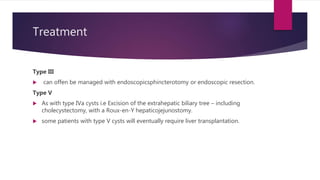
Treatment
Type III
 can offen be managed with endoscopicsphincterotomy or endoscopic resection.
Type V
 As with type IVa cysts i.e Excision of the extrahepatic biliary tree – including
cholecystectomy, with a Roux-en-Y hepaticojejunostomy.
 some patients with type V cysts will eventually require liver transplantation.
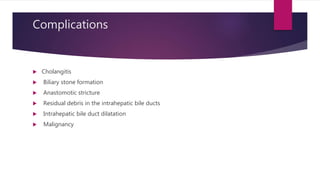
Complications
 Cholangitis
 Biliary stone formation
 Anastomotic stricture
 Residual debris in the intrahepatic bile ducts
 Intrahepatic bile duct dilatation
 Malignancy
Thank You
BY
DR. MOHSIN KHAN,
GENERAL SURGERY RESIDENT,
SURGICAL UNIT IV,
CIVIL HOSPITAL KARACHI.

Choledochal cyst

  • 1.
  • 2.
    Introduction  Focal orDiffuse cystic Dilatation of the biliary system  Diagnosis and treatment are essential as the cysts predispose to Choledocholithiasis, Cholangitis, Portal Hypertension and Cholangiocarcinoma.
  • 3.
    Epidemiology  Choledochal cystsare rare, occurring in less than 1/100,000 patients.  More common in those of Asian descents and are three to eight times more common in women than men.  They are commonly diagnosed in infancy but many present in adulthood.
  • 4.
    Pathogenesis  Choledochal cystsmay be congenital or Acquired.  Congenital cysts may result from an unequal proliferation of embryonic biliary epithelial cells before the completion of bile duct cannulation. 1. Fetal Viral infection may also have a role. 2. It may be a result of Ductal obstruction or distention during the prenatal or natal period.
  • 5.
    Pathogenesis  Acquired cystsmay be the result of anomalous pancreaticobiliary junction (APBJ).  APBJ is a rare congenital anomaly, with the prevalance of 0.03%.  It is present in about 70% patients of Biliary cysts and may be a significant risk factor for malignancy.
  • 6.
    Classification  The originalclassification by Alonso-Lej and colleagues has been modified by Todani and associates to include the intrahepatic cystic disease.  Type I : The fusiform dilatation of common bile duct and are the most common cysts (65% to 90%).  Type ll : The rare, isolated saccular diverticula of the common bile duct and may be mistaken for an accessory gallbladder.
  • 7.
    Classification  Type lll: Localized dilatation within the intra duodenal part of CBD and also termed as Choledochoceles.  Type IV : Multiple cystic dilatation of the intrahepatic and extrahepatic biliary tract. Cysts involving the intrahepatic and extrahepatic biliary tree are known as type IVa with type IVb being multiple cysts limited to the extrahepatic biliary tree.  Type V : Single or multiple cystic dilatations in the intrahepatic portion of biliary tract (Caroli Disease).
  • 8.
    Clinical Presentation  Theclassic presentation of Jaundice, Right upper quadrant pain, and a Palpable mass occurs rarely. Most patients have two of the three symptoms, with Jaundice being the most consistent symptom prior to undergoing any diagnostic imaging. Other symptoms include Nausea, Pruritus, and Weight loss.  Cholangitis, Pancreatitis, Hepatic fibrosis, and Malignancy have all been reported at the time of presentation.  An unusual presentation is that of acute rupture of the cyst with subsequent Bile peritonitis.  Most cystic biliary lesions are originally identified and subsequently diagnosed by Imaging, because the common presenting symptoms are Nonspecific.
  • 9.
    Investigations  Transabdominal Ultrasound Computed Tomography (CT Scan)  Endoscopic Ultrasound (EUS)  Endoscopic retrograde cholangiopancreatography (ERCP)  Magnetic retrograde cholangiopancreatography (MRCP)
  • 10.
    Transabdominal Ultrasound  FirstImaging modality required to evaluate the choledochal cyst  Have sensitivity of 71% to 97%  Can not detect Type III and Type IV choledochal cysts Factors that may limit the usefulness of Ultrasound are  Patient`s body habitus  Presence of bowel gases  Limited visualization due to overlying structures
  • 11.
    Computed Tomography (CTScan)  Can detect all types of Biliary cysts  Can evaluate the presence of Malignancy  Can determine the extent of intrahepatic disease in patients with Type IVa or Type V choledochal cyst.
  • 12.
    Endoscopic Ultrasound (EUS) EUS can demonstrate extrahepatic biliary cysts and provide detailed images of the cyst wall and pancreaticobiliary junction  Unlike transabdominal U/S, it is not limited by body habitus, bowel gas, or overlying structures.
  • 13.
    Cholangiography  Direct cholangiography(whether intraoperative, percutaneous or endoscopic) has a sensitivity of up to100% for diagnosing biliary cysts and previously was a commonly obtained test.  Can identify abnormal pancreatobiliary junction and filling defects due to stones or malignancy.  Increase risk of cholangitis and pancreatitis. [Patients with cystic disease are greater risk for these complications]
  • 14.
    Magnetic resonance cholangiopancreatography (MRCP) Does not have the risks of cholangitis and pancreatitis as direct cholangiography.  Sensitivity 73 – 100%  Less sensitive than direct cholangiography for excluding obstruction.  The data are variable with regard to its ability to diagnose an abnormal pancreatobiliary junction. [46-75%]
  • 15.
    Management  Historically, entericdrainage of the cyst was performed without resection, but this approach is complicated by recurrent biliary stasis, infection, and development of malignancy.  Surgical management of choledochal cysts consists of resection of the entire cyst and appropriate surgical reconstruction.  In patients with ascending cholangitis require treatment with antibiotics and drainage. Drainage can often be obtained via ERCP or percutaneous transhepatic cholangiography.
  • 16.
    Treatment Types I, II,and IV  Excision of the extrahepatic biliary tree – including cholecystectomy, with a Roux- en-Y hepaticojejunostomy are ideal.  In some difficult case, some surgeons advocate leaving posterior cyst wall intact with mucosectomy.  In type IV, additional segmental resection of the liver may be appropriate.
  • 17.
    Treatment Type III  canoffen be managed with endoscopicsphincterotomy or endoscopic resection. Type V  As with type IVa cysts i.e Excision of the extrahepatic biliary tree – including cholecystectomy, with a Roux-en-Y hepaticojejunostomy.  some patients with type V cysts will eventually require liver transplantation.
  • 18.
    Complications  Cholangitis  Biliarystone formation  Anastomotic stricture  Residual debris in the intrahepatic bile ducts  Intrahepatic bile duct dilatation  Malignancy
  • 19.
    Thank You BY DR. MOHSINKHAN, GENERAL SURGERY RESIDENT, SURGICAL UNIT IV, CIVIL HOSPITAL KARACHI.