A PRESENTATION TOPIC ON-
CHLOROPHYLL
SHRI SHANKARACHARYA MAHAVIDYALAYA, BHILAI
GUIDED BY-
Dr. BHUNESHWARI NAYAK MAM
Dr. RACHNA CHOUDHARY MAM
HEAD OF MICROBIOLOGY DEPT.
SUBMITTED BY-
ANISHA KAZI,
M.Sc SEMESTER - 3 (MICROBIOLOGY)
SYNOPSIS-
● INTRODUCTION
● HISTORY
● DEFINITION
● TYPES OF CHLOROPHYLL PIGMENT
● STRUCTURE OF CHLOROPHYLL
● CHLOROPLAST
● CHLOROPHYLL AS PIGMENT IN PHOTOSYNTHESIS
● PHOTOSYSTEM
● BACTERIOCHLOROPHYLL
● SYNTHESIS OF CHLOROPHYLL
● BENEFITS OF CHLOROPHYLL
● CONCLUSION
● REFERENCES
INTRODUCTION:
Chlorophyll is a photosynthetic pigment that is involved in
absorbing electromagnetic radiation and aids in the conversion
of light energy to chemical energy via the synthesis of organic
compound.
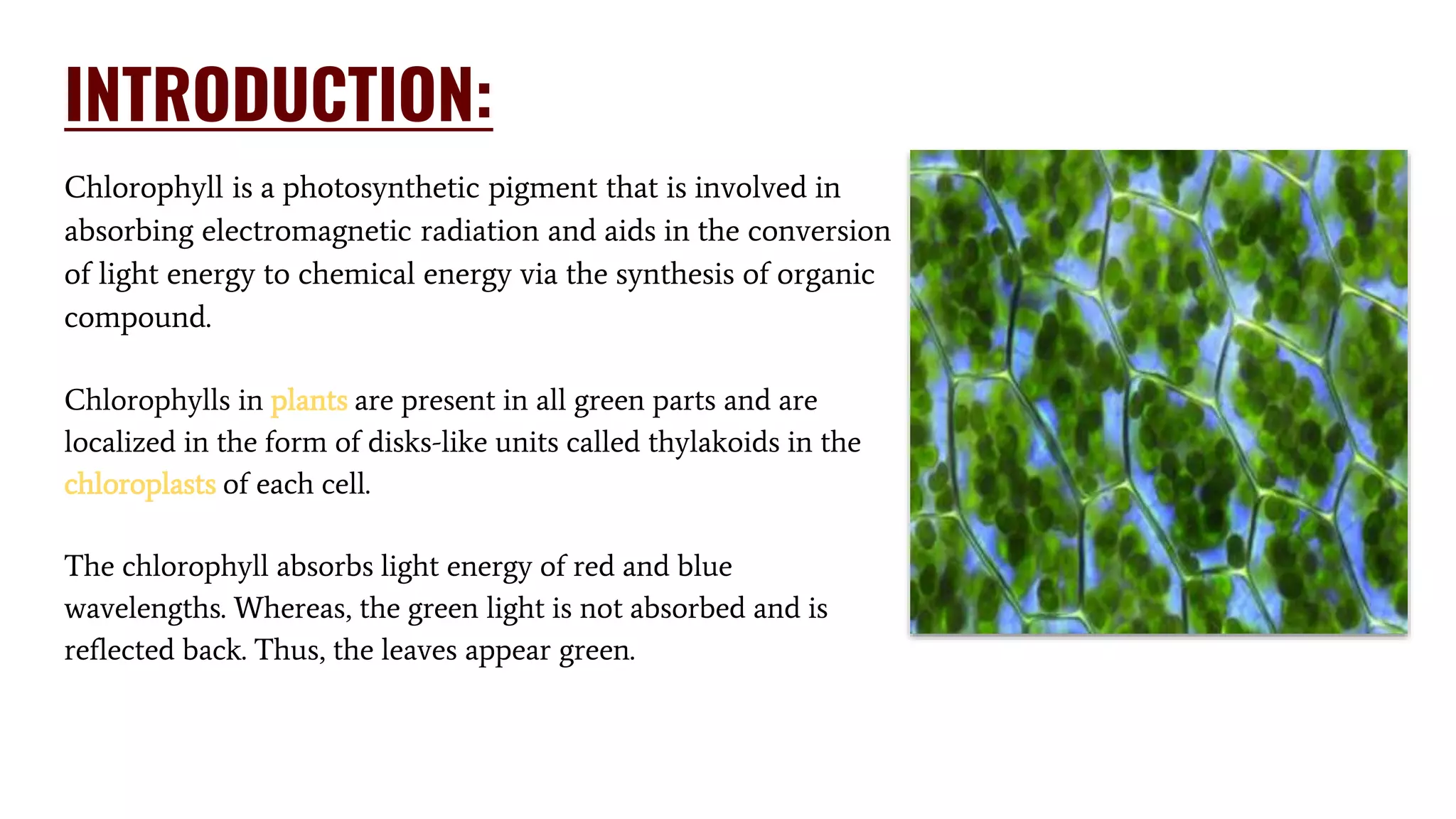
Chlorophylls in plants are present in all green parts and are
localized in the form of disks-like units called thylakoids in the
chloroplasts of each cell.
The chlorophyll absorbs light energy of red and blue
wavelengths. Whereas, the green light is not absorbed and is
reflected back. Thus, the leaves appear green.
HISTORY:
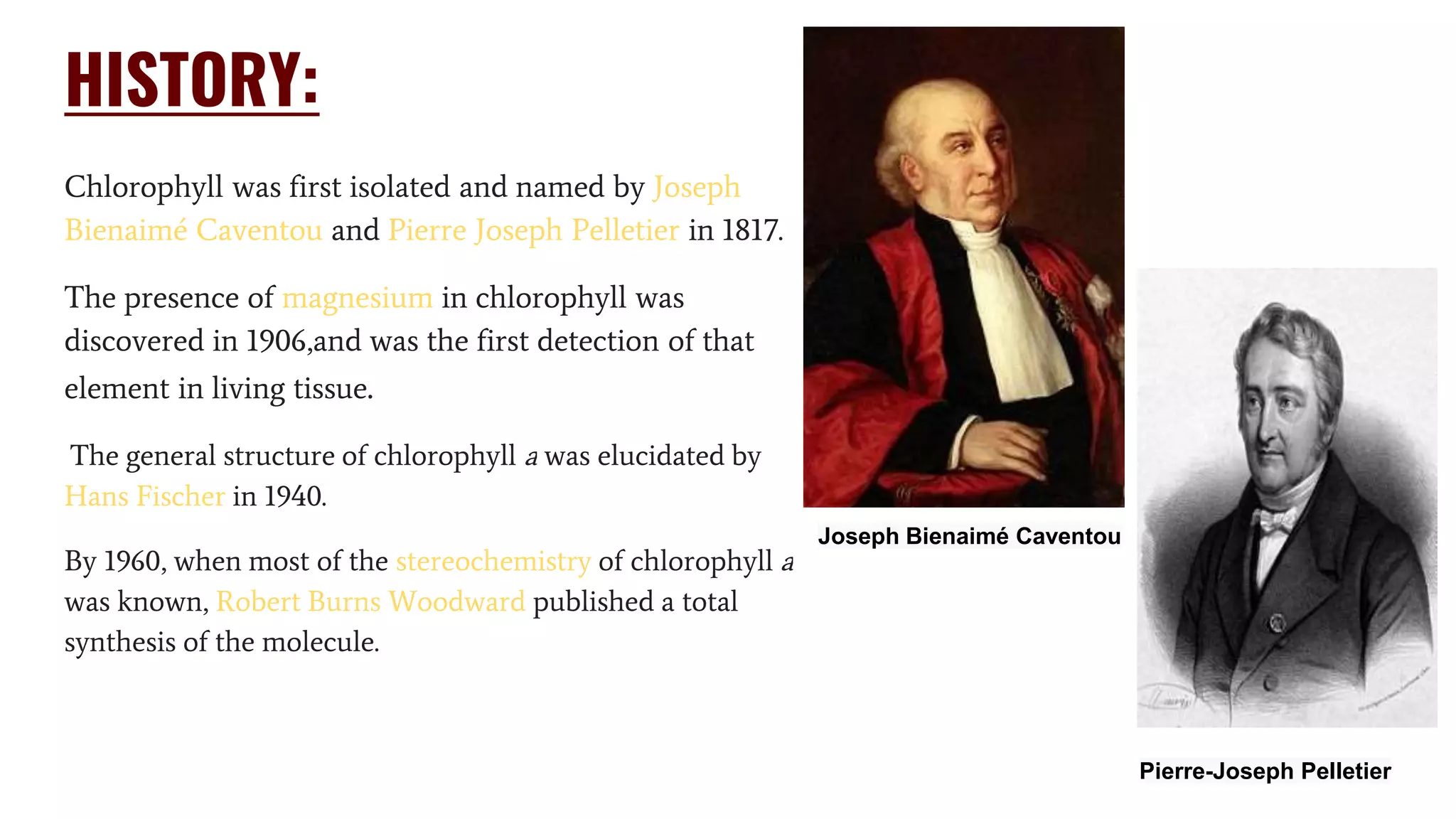
Chlorophyll was first isolated and named by Joseph
Bienaimé Caventou and Pierre Joseph Pelletier in 1817.
The presence of magnesium in chlorophyll was
discovered in 1906,and was the first detection of that
element in living tissue.
The general structure of chlorophyll a was elucidated by
Hans Fischer in 1940.
By 1960, when most of the stereochemistry of chlorophyll a
was known, Robert Burns Woodward published a total
synthesis of the molecule.
Pierre-Joseph Pelletier
Joseph Bienaimé Caventou
DEFINITION:
“Chlorophyll is an essential class of pigment molecules that act as a principal photoreceptor in the
case of most green plants.It is an important pigment that is responsible for the absorption of
energy from light and its transfer into the chemical form so that it can be utilized by living
organisms.”
TYPES OF CHLOROPHYLL:
There are six major types of chlorophyll known-
● CHLOROPHYLL a
● CHLOROPHYLL b
● CHLOROPHYLL c
● CHLOROPHYLL d
● CHLOROPHYLL e
● CHLOROPHYLL f
Types Features Best Wavelength
Spectrum
Absorption
Examples
Chlorophyll a The main light-harvesting pigment present in all
photosynthetic organisms
Molecular formula: C55H72O5N4Mg
400-450 nm and
650-700 nm
higher plants, red algae, green
algae
Chlorophyll b It functions as a light-harvesting pigment that passes on the
light excitation to chlorophyll a.
Molecular formula: C55H70O6N4Mg
450-500 nm and
600-650 nm
higher plants, green algae
Chlorophyll c An accessory pigment found in certain marine algae
Molecular formula: C35H28O5N4Mg
447–452 nm diatoms, dinoflagellates, brown
algae
Chlorophyll d The form of chlorophyll found in photosynthetic organisms
thriving in moderately deep water
Molecular formula: C54H70O6N4Mg
Infrared light red algae, cyanobacteria (blue-
green algae)
Chlorophyll e An accessory pigment and a rare type, isolated from very few
algal species, such as in some golden algae.
[no data] Tribonema bombycinum and
Vaucheria hamata
Chlorophyll f The form of chlorophyll in aquatic organisms that enable the
absorption of near-infrared light
Near-infrared
light
Cyanobacteria
STRUCTURE OF CHLOROPHYLL:
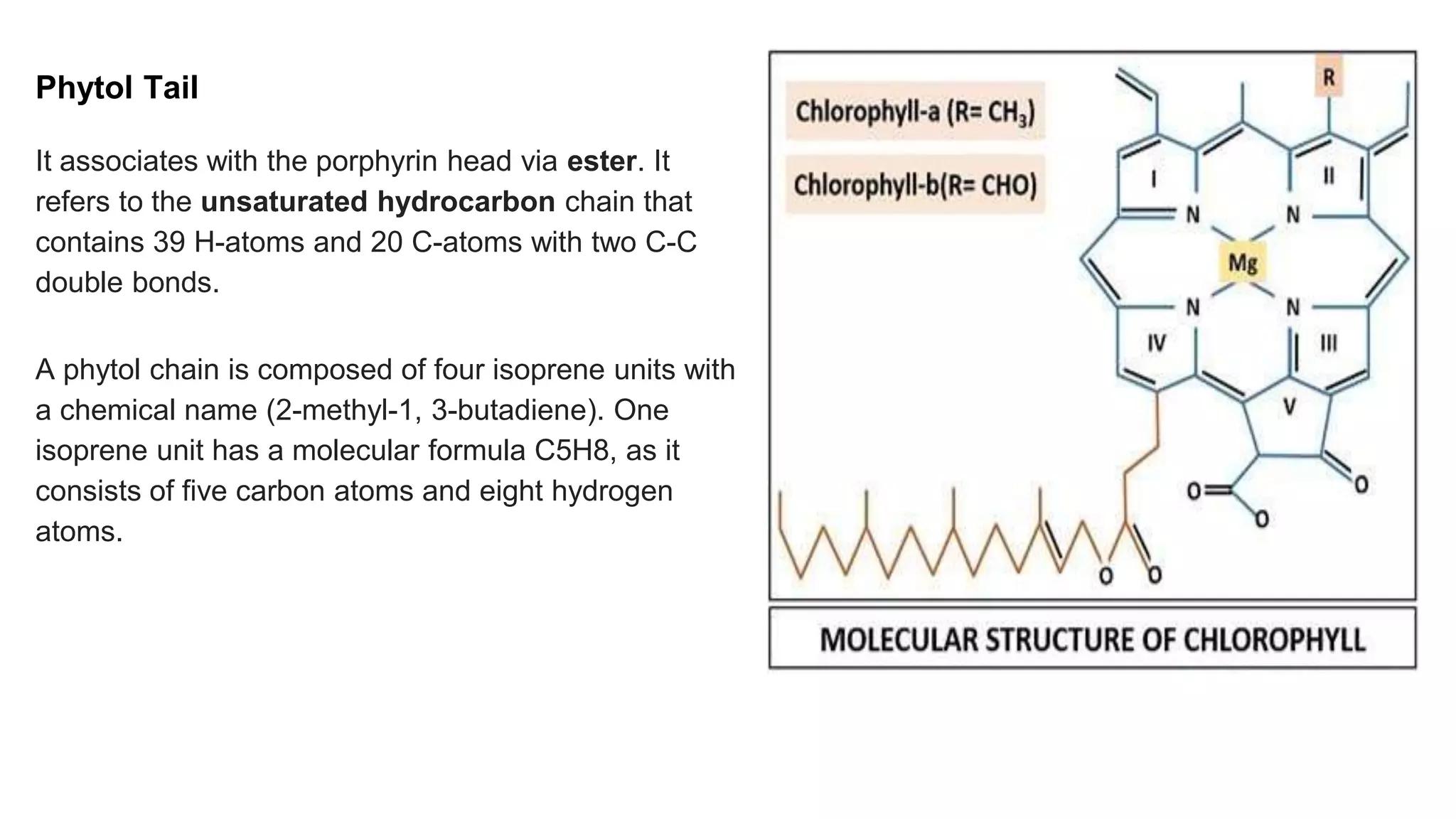
A typical composition of chlorophyll comprises a porphyrin head and a
long phytol tail. Chlorophyll is a chelating ligand, which includes a
central metal ion attached to the complex organic compound containing a
mixture of carbon, nitrogen and hydrogen elements.
The structure of chlorophyll is characterized by:
● The presence of magnesium (Mg2+) as a central metal ion.
● A varying side chain.
● The presence of an extra fifth ring or isocyclic ring, fixed to the
porphyrin head.
Porphyrin Head:It typically includes four pyrrole rings fixed to the
coordinated central metal and called “Tetrapyrroles”. The first pyrrole
ring is substituted with the side chain differing in both the chlorophyll
pigments. The chlorophyll pigments, i.e. chl-a and b, have a different side
chain, CH3 and CHO, respectively.
Phytol Tail
It associates with the porphyrin head via ester. It
refers to the unsaturated hydrocarbon chain that
contains 39 H-atoms and 20 C-atoms with two C-C
double bonds.
A phytol chain is composed of four isoprene units with
a chemical name (2-methyl-1, 3-butadiene). One
isoprene unit has a molecular formula C5H8, as it
consists of five carbon atoms and eight hydrogen
atoms.
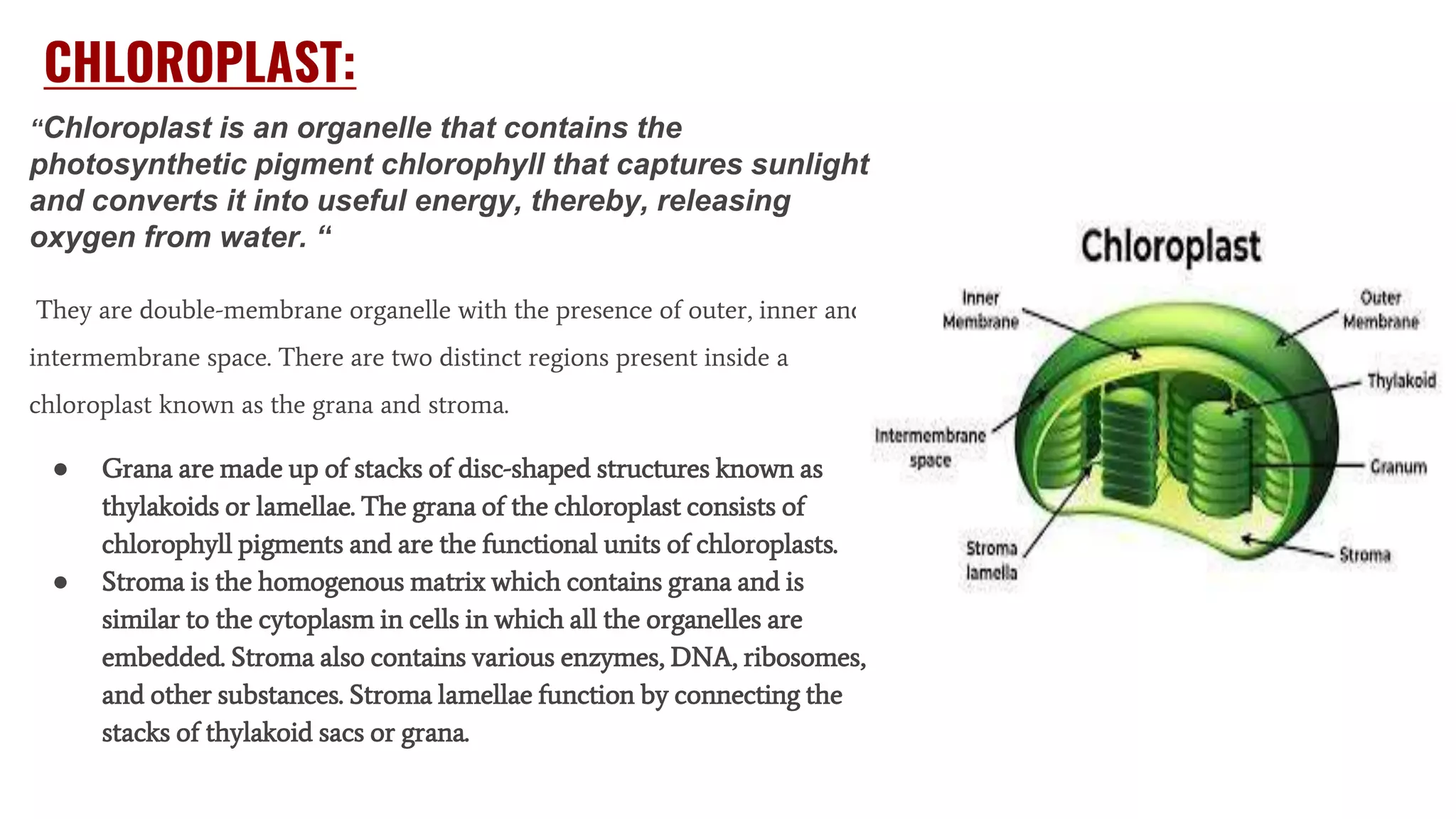
CHLOROPLAST:
“Chloroplast is an organelle that contains the
photosynthetic pigment chlorophyll that captures sunlight
and converts it into useful energy, thereby, releasing
oxygen from water. “
They are double-membrane organelle with the presence of outer, inner and
intermembrane space. There are two distinct regions present inside a
chloroplast known as the grana and stroma.
● Grana are made up of stacks of disc-shaped structures known as
thylakoids or lamellae. The grana of the chloroplast consists of
chlorophyll pigments and are the functional units of chloroplasts.
● Stroma is the homogenous matrix which contains grana and is
similar to the cytoplasm in cells in which all the organelles are
embedded. Stroma also contains various enzymes, DNA, ribosomes,
and other substances. Stroma lamellae function by connecting the
stacks of thylakoid sacs or grana.
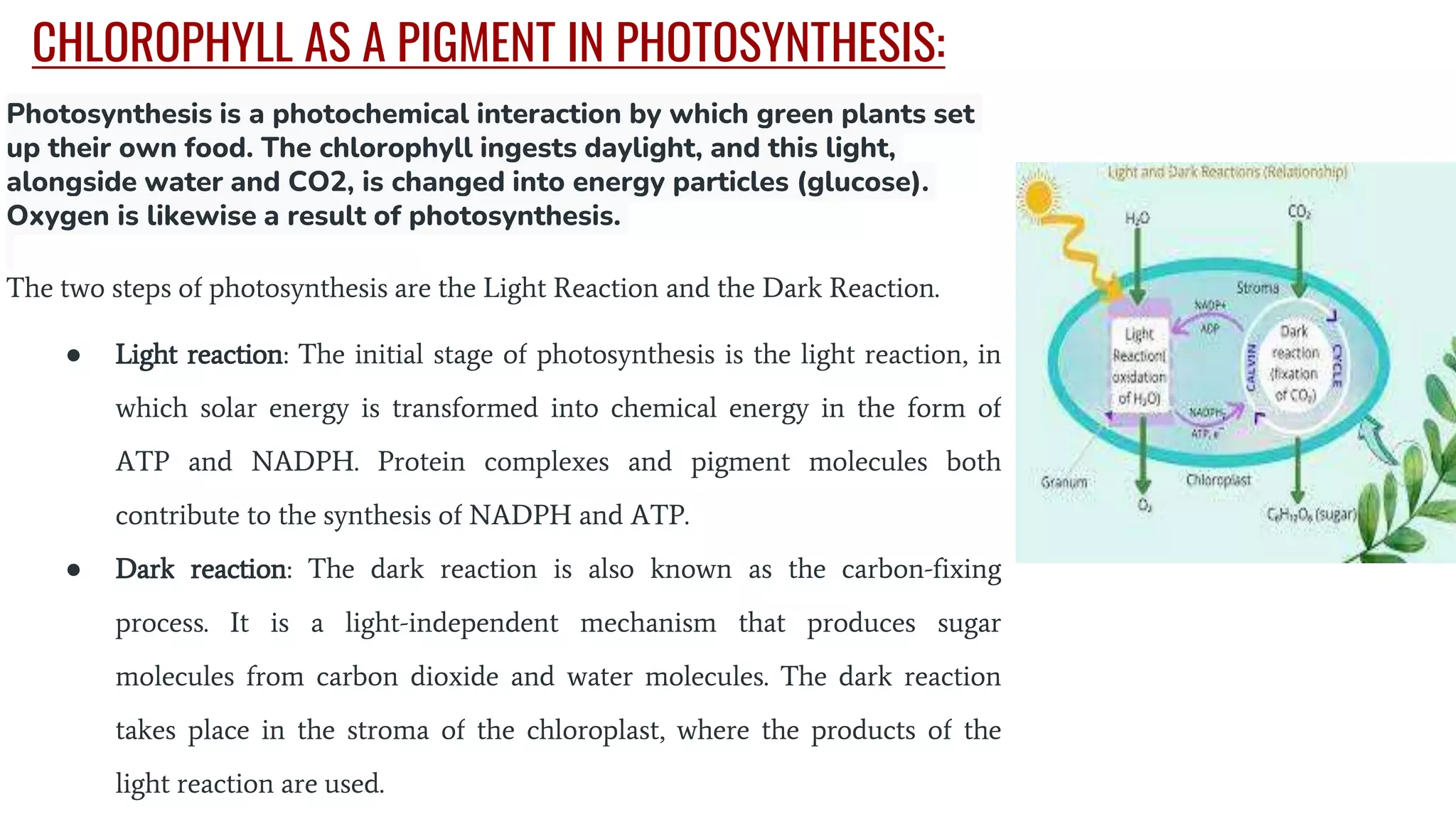
CHLOROPHYLL AS A PIGMENT IN PHOTOSYNTHESIS:
Photosynthesis is a photochemical interaction by which green plants set
up their own food. The chlorophyll ingests daylight, and this light,
alongside water and CO2, is changed into energy particles (glucose).
Oxygen is likewise a result of photosynthesis.
The two steps of photosynthesis are the Light Reaction and the Dark Reaction.
● Light reaction: The initial stage of photosynthesis is the light reaction, in
which solar energy is transformed into chemical energy in the form of
ATP and NADPH. Protein complexes and pigment molecules both
contribute to the synthesis of NADPH and ATP.
● Dark reaction: The dark reaction is also known as the carbon-fixing
process. It is a light-independent mechanism that produces sugar
molecules from carbon dioxide and water molecules. The dark reaction
takes place in the stroma of the chloroplast, where the products of the
light reaction are used.
LIGHT REACTION HAS THREE STAGES:
Photon Excitation- Absorption of light photon whose energy is used to split water releasing electrons.
Electron transport- Harnessing the energy in electron to form an electrochemical gradient.
They are of further two types:
● Cyclic Electron Flow
● Non Cyclic Electron Flow
Photophosphorylation(Chemiosmosis)- ATP synthesis due to electro-chemical gradient and proton
motive force
PHOTOSYSTEM:
Photosystems are the functional and structural elements of photosynthetic protein complexes.
They work together to carry out the basic photochemistry of photosynthesis: light absorption , energy and electron
transport.
Photosystem I and Photosystem II are the two types of photosystems.
Components of photosystem:
The photosystem is divided into two halves.
1. Antenna Complex: It is a light-harvesting complex made up of proteins and numerous
chlorophyll a, chlorophyll b, and carotenoid molecules.
2. Reaction centers: One or more molecules of chlorophyll a, as well as the principal electron
acceptor and related electron carriers of the electron transport system, make up the reaction
center.
The two photosystems differ essentially in their reaction centers.
The reaction center of Photosystem I is P700 whereas the reaction center of Photosystem II is P680.
P700 is the reaction center that is most reactive and best in absorbing at 700nm (far-red light).
P680 is the reaction center that is best at absorbing light at 680nm (red light).
Apart from that, Photosystem II is also responsible for the ‘splitting of water components’ during the
photosynthesis process.
TYPES OF ELECTRON TRANSPORT MECHANISM:
➔ NON-CYCLIC ELECTRON FLOW
➔ CYCLIC ELECTRON FLOW
NON CYCLIC ELECTRON FLOW MECHANISM:
PS II absorbs light.
Excited electron in reaction centre chlorophyll(P680) captured by primary electron acceptor.
P680 now losses an electron is a very strong oxidizing agent.
Electrons are excited from water to replace the missing electronic P680.
As a result, water is split into oxygen and hydrogen ions.
Electron captured by primary electron acceptor of PSII will now be passed through an electron chain.
The electron is first transferred to pheophytin.
Pheophytin very rapidly passes its extra electrons to a protein bound , plastoquinone,PQA.
Which in turns passes through another , more loosely bound plastoquinone PQB
4P680 + 4H+ +2PQB + 4 Photons 4P680+2PQH2
Pq is a mobile component within the thylakoid membrane.Electrons are transferred from Pq to
cytochrome complex.
Protons across are pumped against its concentration gradient from step a across thylakoid membrane to
the lumen
Electrons are transferred to plastoquinone(Pc).
Pc is a movable component on lumen side of the thylakoid membrane.
Electrons on P700 excited by light and captured by the primary electron acceptor leaving P700 oxidized.
Electrons transferred from Pc to P700 replaces electrons that were lost.
Electron undergo a second transport chain.
First phylloquinone (a1) accepts electron and passes it to an iron sulphur protein.
Electrons are transferred to ferredoxin(Fd)
Fd is an iron containing mobile component on the strong side of the thylakoid membrane.
Electrons transferred by enzyme NADP+ reductase took the final electron acceptor NADP+.
NADP+ is reduce to NADPH.
ATP SYNTHASE:
Protons pumped into the lumen pass through - ATP synthase using the same mechanism as seen in cellular
respiration.
ATP is produced in the stroma.
Cyclic Electron Flow:
Only involves photosystem 1.
Ferredoxin returns electrons back to cytochrome complex.
Protons pumped into like to produce more ATP through Chemiosmosis.
No NADPH produced.
BACTERIOCHLOROPHYLL:
Bacteriochlorophylls (BChl) are photosynthetic pigments that occur in various phototrophic bacteria. They were
discovered by C. B. van Niel in 1932. They are related to chlorophylls. Organisms that contain bacteriochlorophyll
conduct photosynthesis to sustain their energy requirements, but the process is anoxygenic and does not produce
oxygen as a byproduct. They use wavelengths of light not absorbed by plants or cyanobacteria. Replacement of
Mg2+ with protons gives bacteriophaeophytin (BPh), the phaeophytin form.
Pigment Taxa in vivo infrared absorption maximum (nm)
BChl a Purple bacteria, Heliobacteria, Green Sulfur
Bacteria, Chloroflexota, Chloracidobacterium
thermophilum[2]
805, 830–890
BChl b Purple bacteria 835–850, 1020–1040
BChl c Green sulfur bacteria, Chloroflexota, C.
thermophilum,[2] C. tepidum
745–755
BChl d Green sulfur bacteria 705–740
BChl e Green sulfur bacteria 719–726
BChl f (Discovered by mutation of BChl e synthesis by
analogy to BChl c/d. Not evolutionarily
favorable.)[3]
700–710
BChl g Heliobacteria 670, 788
STRUCTURE OF BACTERIOCHLOROPHYLL :
Bacteriochlorophylls a, b, and g are bacteriochlorins, meaning
their molecules have a bacteriochlorin macrocycle ring with two
reduced pyrrole rings (B and D). Bacteriochlorophylls c, d, e, and
f are chlorins, meaning their molecules have a chlorin
macrocycle ring with one reduced pyrrole ring (D).
Bacteriochlorophyll
SYNTHESIS OF CHLOROPHYLL:
Chlorophyll is produced within the chloroplast from an abundant precursor,
glutamate. The processes occur in the plastid stroma and are catalysed by soluble
enzymes from glutamate to the tetrapyrrole protoporphyrin IX, where the route
splits between chlorophyll and heme.
Functions of Chlorophyll:
The chlorophyll pigment is responsible for plants’ green colouration. Chlorophyll is
one of several pigments that are employed in photosynthesis to transform sunlight
energy into chemical energy.
BENEFITS OF CHLOROPHYLL:
● Tissue repair: Chlorophyll is used to enhance wound healing and reduce inflammation. It seems
to speed up healing as it can reduce bacterial growth.
● Natural deodorant: Chlorophyll is also used in helping neutralize the odor of bad breath, urine, or
feces. So, this is used by people who have fecal incontinence or who have had a colostomy.
● Detoxification: It is claimed to have detoxifying effects and beneficial effects against certain
cancers.
CONCLUSION:
Chlorophyll is a pigment present in all green plants and a few other organisms. It is required for
photosynthesis, which is the process by which light energy is converted into chemical
energy.Chlorophyll exists in several forms but chlorophyll a and chlorophyll b are the most common
– typically found in higher plants and green algae. Chlorophyll c is found in certain marine algae and
Chlorophyll d is found in certain species of cyanobacteria. Even rarer is Chlorophyll e – found only
in some golden algae.
REFERENCES:
❖ TEXTBOOK OF MICROBIOLOGY BY R.C DUBEY & D.K MAHESHWARI BY
S.CHAND PUBLICATIONS.
❖ PRESCOTT’S MICROBIOLOGY BY JOANNE WILEY , KATHLEEN
SANDMAN, DOROTHY WOOD.
❖ TEXTBOOK OF MICROBIOLOGY BY P.D SHARMA.
❖ INTRODUCTION TO MICROBIOLOGY BY M.G SEQUEIRA, K.K KAPOOR
,K.S YADAV , & P TAURO BY NEW AGE INTERNATIONAL PUBLISHERS.
❖ TEXTBOOK OF MICROBIOLOGY , C.P BAVEJA BY ARYA PUBLISHING
COMPANY.

CHLOROPHYLL PIGMENT (1).pptx

  • 1.
    A PRESENTATION TOPICON- CHLOROPHYLL SHRI SHANKARACHARYA MAHAVIDYALAYA, BHILAI GUIDED BY- Dr. BHUNESHWARI NAYAK MAM Dr. RACHNA CHOUDHARY MAM HEAD OF MICROBIOLOGY DEPT. SUBMITTED BY- ANISHA KAZI, M.Sc SEMESTER - 3 (MICROBIOLOGY)
  • 2.
    SYNOPSIS- ● INTRODUCTION ● HISTORY ●DEFINITION ● TYPES OF CHLOROPHYLL PIGMENT ● STRUCTURE OF CHLOROPHYLL ● CHLOROPLAST ● CHLOROPHYLL AS PIGMENT IN PHOTOSYNTHESIS ● PHOTOSYSTEM ● BACTERIOCHLOROPHYLL ● SYNTHESIS OF CHLOROPHYLL ● BENEFITS OF CHLOROPHYLL ● CONCLUSION ● REFERENCES
  • 3.
    INTRODUCTION: Chlorophyll is aphotosynthetic pigment that is involved in absorbing electromagnetic radiation and aids in the conversion of light energy to chemical energy via the synthesis of organic compound. Chlorophylls in plants are present in all green parts and are localized in the form of disks-like units called thylakoids in the chloroplasts of each cell. The chlorophyll absorbs light energy of red and blue wavelengths. Whereas, the green light is not absorbed and is reflected back. Thus, the leaves appear green.
  • 4.
    HISTORY: Chlorophyll was firstisolated and named by Joseph Bienaimé Caventou and Pierre Joseph Pelletier in 1817. The presence of magnesium in chlorophyll was discovered in 1906,and was the first detection of that element in living tissue. The general structure of chlorophyll a was elucidated by Hans Fischer in 1940. By 1960, when most of the stereochemistry of chlorophyll a was known, Robert Burns Woodward published a total synthesis of the molecule. Pierre-Joseph Pelletier Joseph Bienaimé Caventou
  • 5.
    DEFINITION: “Chlorophyll is anessential class of pigment molecules that act as a principal photoreceptor in the case of most green plants.It is an important pigment that is responsible for the absorption of energy from light and its transfer into the chemical form so that it can be utilized by living organisms.” TYPES OF CHLOROPHYLL: There are six major types of chlorophyll known- ● CHLOROPHYLL a ● CHLOROPHYLL b ● CHLOROPHYLL c ● CHLOROPHYLL d ● CHLOROPHYLL e ● CHLOROPHYLL f
  • 6.
    Types Features BestWavelength Spectrum Absorption Examples Chlorophyll a The main light-harvesting pigment present in all photosynthetic organisms Molecular formula: C55H72O5N4Mg 400-450 nm and 650-700 nm higher plants, red algae, green algae Chlorophyll b It functions as a light-harvesting pigment that passes on the light excitation to chlorophyll a. Molecular formula: C55H70O6N4Mg 450-500 nm and 600-650 nm higher plants, green algae Chlorophyll c An accessory pigment found in certain marine algae Molecular formula: C35H28O5N4Mg 447–452 nm diatoms, dinoflagellates, brown algae Chlorophyll d The form of chlorophyll found in photosynthetic organisms thriving in moderately deep water Molecular formula: C54H70O6N4Mg Infrared light red algae, cyanobacteria (blue- green algae) Chlorophyll e An accessory pigment and a rare type, isolated from very few algal species, such as in some golden algae. [no data] Tribonema bombycinum and Vaucheria hamata Chlorophyll f The form of chlorophyll in aquatic organisms that enable the absorption of near-infrared light Near-infrared light Cyanobacteria
  • 7.
    STRUCTURE OF CHLOROPHYLL: Atypical composition of chlorophyll comprises a porphyrin head and a long phytol tail. Chlorophyll is a chelating ligand, which includes a central metal ion attached to the complex organic compound containing a mixture of carbon, nitrogen and hydrogen elements. The structure of chlorophyll is characterized by: ● The presence of magnesium (Mg2+) as a central metal ion. ● A varying side chain. ● The presence of an extra fifth ring or isocyclic ring, fixed to the porphyrin head. Porphyrin Head:It typically includes four pyrrole rings fixed to the coordinated central metal and called “Tetrapyrroles”. The first pyrrole ring is substituted with the side chain differing in both the chlorophyll pigments. The chlorophyll pigments, i.e. chl-a and b, have a different side chain, CH3 and CHO, respectively.
  • 8.
    Phytol Tail It associateswith the porphyrin head via ester. It refers to the unsaturated hydrocarbon chain that contains 39 H-atoms and 20 C-atoms with two C-C double bonds. A phytol chain is composed of four isoprene units with a chemical name (2-methyl-1, 3-butadiene). One isoprene unit has a molecular formula C5H8, as it consists of five carbon atoms and eight hydrogen atoms.
  • 9.
    CHLOROPLAST: “Chloroplast is anorganelle that contains the photosynthetic pigment chlorophyll that captures sunlight and converts it into useful energy, thereby, releasing oxygen from water. “ They are double-membrane organelle with the presence of outer, inner and intermembrane space. There are two distinct regions present inside a chloroplast known as the grana and stroma. ● Grana are made up of stacks of disc-shaped structures known as thylakoids or lamellae. The grana of the chloroplast consists of chlorophyll pigments and are the functional units of chloroplasts. ● Stroma is the homogenous matrix which contains grana and is similar to the cytoplasm in cells in which all the organelles are embedded. Stroma also contains various enzymes, DNA, ribosomes, and other substances. Stroma lamellae function by connecting the stacks of thylakoid sacs or grana.
  • 10.
    CHLOROPHYLL AS APIGMENT IN PHOTOSYNTHESIS: Photosynthesis is a photochemical interaction by which green plants set up their own food. The chlorophyll ingests daylight, and this light, alongside water and CO2, is changed into energy particles (glucose). Oxygen is likewise a result of photosynthesis. The two steps of photosynthesis are the Light Reaction and the Dark Reaction. ● Light reaction: The initial stage of photosynthesis is the light reaction, in which solar energy is transformed into chemical energy in the form of ATP and NADPH. Protein complexes and pigment molecules both contribute to the synthesis of NADPH and ATP. ● Dark reaction: The dark reaction is also known as the carbon-fixing process. It is a light-independent mechanism that produces sugar molecules from carbon dioxide and water molecules. The dark reaction takes place in the stroma of the chloroplast, where the products of the light reaction are used.
  • 11.
    LIGHT REACTION HASTHREE STAGES: Photon Excitation- Absorption of light photon whose energy is used to split water releasing electrons. Electron transport- Harnessing the energy in electron to form an electrochemical gradient. They are of further two types: ● Cyclic Electron Flow ● Non Cyclic Electron Flow Photophosphorylation(Chemiosmosis)- ATP synthesis due to electro-chemical gradient and proton motive force PHOTOSYSTEM: Photosystems are the functional and structural elements of photosynthetic protein complexes. They work together to carry out the basic photochemistry of photosynthesis: light absorption , energy and electron transport. Photosystem I and Photosystem II are the two types of photosystems.
  • 12.
    Components of photosystem: Thephotosystem is divided into two halves. 1. Antenna Complex: It is a light-harvesting complex made up of proteins and numerous chlorophyll a, chlorophyll b, and carotenoid molecules. 2. Reaction centers: One or more molecules of chlorophyll a, as well as the principal electron acceptor and related electron carriers of the electron transport system, make up the reaction center. The two photosystems differ essentially in their reaction centers. The reaction center of Photosystem I is P700 whereas the reaction center of Photosystem II is P680. P700 is the reaction center that is most reactive and best in absorbing at 700nm (far-red light). P680 is the reaction center that is best at absorbing light at 680nm (red light). Apart from that, Photosystem II is also responsible for the ‘splitting of water components’ during the photosynthesis process.
  • 13.
    TYPES OF ELECTRONTRANSPORT MECHANISM: ➔ NON-CYCLIC ELECTRON FLOW ➔ CYCLIC ELECTRON FLOW NON CYCLIC ELECTRON FLOW MECHANISM:
  • 15.
    PS II absorbslight. Excited electron in reaction centre chlorophyll(P680) captured by primary electron acceptor. P680 now losses an electron is a very strong oxidizing agent. Electrons are excited from water to replace the missing electronic P680. As a result, water is split into oxygen and hydrogen ions. Electron captured by primary electron acceptor of PSII will now be passed through an electron chain. The electron is first transferred to pheophytin. Pheophytin very rapidly passes its extra electrons to a protein bound , plastoquinone,PQA. Which in turns passes through another , more loosely bound plastoquinone PQB 4P680 + 4H+ +2PQB + 4 Photons 4P680+2PQH2 Pq is a mobile component within the thylakoid membrane.Electrons are transferred from Pq to cytochrome complex. Protons across are pumped against its concentration gradient from step a across thylakoid membrane to the lumen
  • 16.
    Electrons are transferredto plastoquinone(Pc). Pc is a movable component on lumen side of the thylakoid membrane. Electrons on P700 excited by light and captured by the primary electron acceptor leaving P700 oxidized. Electrons transferred from Pc to P700 replaces electrons that were lost. Electron undergo a second transport chain. First phylloquinone (a1) accepts electron and passes it to an iron sulphur protein. Electrons are transferred to ferredoxin(Fd) Fd is an iron containing mobile component on the strong side of the thylakoid membrane. Electrons transferred by enzyme NADP+ reductase took the final electron acceptor NADP+. NADP+ is reduce to NADPH. ATP SYNTHASE: Protons pumped into the lumen pass through - ATP synthase using the same mechanism as seen in cellular respiration. ATP is produced in the stroma.
  • 17.
    Cyclic Electron Flow: Onlyinvolves photosystem 1. Ferredoxin returns electrons back to cytochrome complex. Protons pumped into like to produce more ATP through Chemiosmosis. No NADPH produced.
  • 18.
    BACTERIOCHLOROPHYLL: Bacteriochlorophylls (BChl) arephotosynthetic pigments that occur in various phototrophic bacteria. They were discovered by C. B. van Niel in 1932. They are related to chlorophylls. Organisms that contain bacteriochlorophyll conduct photosynthesis to sustain their energy requirements, but the process is anoxygenic and does not produce oxygen as a byproduct. They use wavelengths of light not absorbed by plants or cyanobacteria. Replacement of Mg2+ with protons gives bacteriophaeophytin (BPh), the phaeophytin form. Pigment Taxa in vivo infrared absorption maximum (nm) BChl a Purple bacteria, Heliobacteria, Green Sulfur Bacteria, Chloroflexota, Chloracidobacterium thermophilum[2] 805, 830–890 BChl b Purple bacteria 835–850, 1020–1040 BChl c Green sulfur bacteria, Chloroflexota, C. thermophilum,[2] C. tepidum 745–755 BChl d Green sulfur bacteria 705–740 BChl e Green sulfur bacteria 719–726 BChl f (Discovered by mutation of BChl e synthesis by analogy to BChl c/d. Not evolutionarily favorable.)[3] 700–710 BChl g Heliobacteria 670, 788
  • 19.
    STRUCTURE OF BACTERIOCHLOROPHYLL: Bacteriochlorophylls a, b, and g are bacteriochlorins, meaning their molecules have a bacteriochlorin macrocycle ring with two reduced pyrrole rings (B and D). Bacteriochlorophylls c, d, e, and f are chlorins, meaning their molecules have a chlorin macrocycle ring with one reduced pyrrole ring (D). Bacteriochlorophyll
  • 20.
    SYNTHESIS OF CHLOROPHYLL: Chlorophyllis produced within the chloroplast from an abundant precursor, glutamate. The processes occur in the plastid stroma and are catalysed by soluble enzymes from glutamate to the tetrapyrrole protoporphyrin IX, where the route splits between chlorophyll and heme. Functions of Chlorophyll: The chlorophyll pigment is responsible for plants’ green colouration. Chlorophyll is one of several pigments that are employed in photosynthesis to transform sunlight energy into chemical energy.
  • 21.
    BENEFITS OF CHLOROPHYLL: ●Tissue repair: Chlorophyll is used to enhance wound healing and reduce inflammation. It seems to speed up healing as it can reduce bacterial growth. ● Natural deodorant: Chlorophyll is also used in helping neutralize the odor of bad breath, urine, or feces. So, this is used by people who have fecal incontinence or who have had a colostomy. ● Detoxification: It is claimed to have detoxifying effects and beneficial effects against certain cancers. CONCLUSION: Chlorophyll is a pigment present in all green plants and a few other organisms. It is required for photosynthesis, which is the process by which light energy is converted into chemical energy.Chlorophyll exists in several forms but chlorophyll a and chlorophyll b are the most common – typically found in higher plants and green algae. Chlorophyll c is found in certain marine algae and Chlorophyll d is found in certain species of cyanobacteria. Even rarer is Chlorophyll e – found only in some golden algae.
  • 22.
    REFERENCES: ❖ TEXTBOOK OFMICROBIOLOGY BY R.C DUBEY & D.K MAHESHWARI BY S.CHAND PUBLICATIONS. ❖ PRESCOTT’S MICROBIOLOGY BY JOANNE WILEY , KATHLEEN SANDMAN, DOROTHY WOOD. ❖ TEXTBOOK OF MICROBIOLOGY BY P.D SHARMA. ❖ INTRODUCTION TO MICROBIOLOGY BY M.G SEQUEIRA, K.K KAPOOR ,K.S YADAV , & P TAURO BY NEW AGE INTERNATIONAL PUBLISHERS. ❖ TEXTBOOK OF MICROBIOLOGY , C.P BAVEJA BY ARYA PUBLISHING COMPANY.