University Of Gujrat (UOG)
                06-04-2012


                             1
2
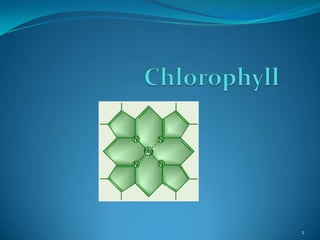
Chlorophyll:
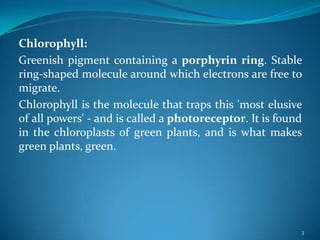
Greenish pigment containing a porphyrin ring. Stable
ring-shaped molecule around which electrons are free to
migrate.
Chlorophyll is the molecule that traps this 'most elusive
of all powers' - and is called a photoreceptor. It is found
in the chloroplasts of green plants, and is what makes
green plants, green.


                                                          3
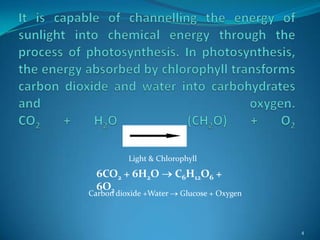
Light & Chlorophyll
  6CO2 + 6H2O           C6H12O6 +
  6O2
Carbon dioxide +Water   Glucose + Oxygen


                                           4
Photosystem Organization
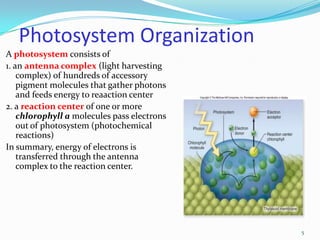
A photosystem consists of
1. an antenna complex (light harvesting
    complex) of hundreds of accessory
    pigment molecules that gather photons
    and feeds energy to reaaction center
2. a reaction center of one or more
    chlorophyll a molecules pass electrons
    out of photosystem (photochemical
    reactions)
In summary, energy of electrons is
    transferred through the antenna
    complex to the reaction center.


                                             5
Photosystem Organization
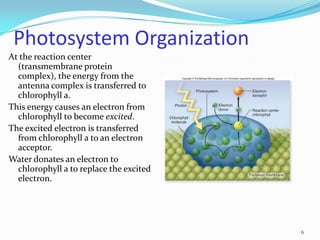
At the reaction center
  (transmembrane protein
  complex), the energy from the
  antenna complex is transferred to
  chlorophyll a.
This energy causes an electron from
  chlorophyll to become excited.
The excited electron is transferred
  from chlorophyll a to an electron
  acceptor.
Water donates an electron to
  chlorophyll a to replace the excited
  electron.


                                         6
Chlorophyll “a”:
This is the molecule which makes photosynthesis possible, by
passing its energized electrons on to molecules which will
manufacture sugars. All plants, algae, and cyanobacteria
which photosynthesize contain chlorophyll "a".
Chlorophyll "b“:
It occurs only in "green algae" and in the plants.
The small difference in one of the side chains allows each type
of chlorophyll to absorb light at slightly different
wavelengths.
Chlorophyll "c“:
Found only in the photosynthetic members of the Chromista
as well as the dinoflagellates.                                 8
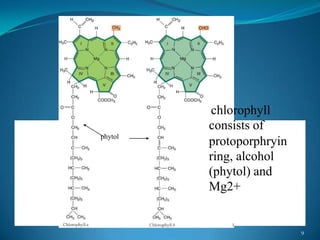
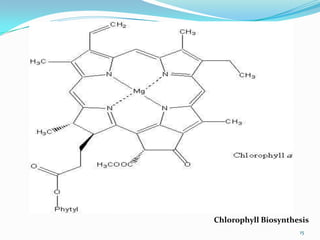
chlorophyll
         consists of
phytol
         protoporphryin
         ring, alcohol
         (phytol) and
         Mg2+


                          9
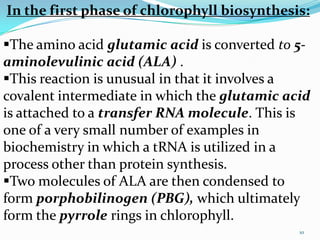
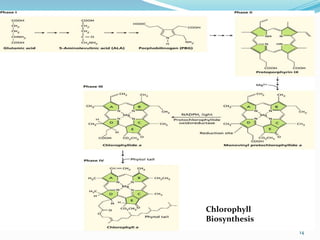
In the first phase of chlorophyll biosynthesis:

The amino acid glutamic acid is converted to 5-
aminolevulinic acid (ALA) .
This reaction is unusual in that it involves a
covalent intermediate in which the glutamic acid
is attached to a transfer RNA molecule. This is
one of a very small number of examples in
biochemistry in which a tRNA is utilized in a
process other than protein synthesis.
Two molecules of ALA are then condensed to
form porphobilinogen (PBG), which ultimately
form the pyrrole rings in chlorophyll.
                                              10
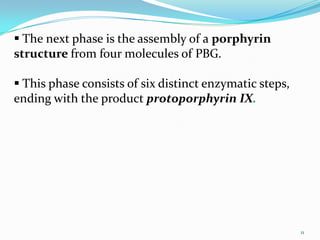
 The next phase is the assembly of a porphyrin
structure from four molecules of PBG.

 This phase consists of six distinct enzymatic steps,
ending with the product protoporphyrin IX.


                                                         11
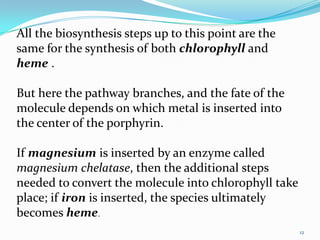
All the biosynthesis steps up to this point are the
same for the synthesis of both chlorophyll and
heme .

But here the pathway branches, and the fate of the
molecule depends on which metal is inserted into
the center of the porphyrin.

If magnesium is inserted by an enzyme called
magnesium chelatase, then the additional steps
needed to convert the molecule into chlorophyll take
place; if iron is inserted, the species ultimately
becomes heme.
                                                       12
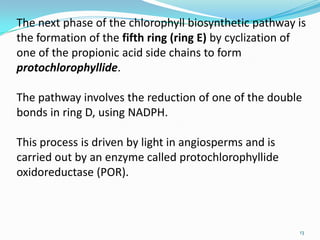
The next phase of the chlorophyll biosynthetic pathway is
the formation of the fifth ring (ring E) by cyclization of
one of the propionic acid side chains to form
protochlorophyllide.

The pathway involves the reduction of one of the double
bonds in ring D, using NADPH.

This process is driven by light in angiosperms and is
carried out by an enzyme called protochlorophyllide
oxidoreductase (POR).


                                                        13
Chlorophyll
Biosynthesis
               14
Chlorophyll Biosynthesis
                     15
Control of chlorophyll synthesis :
– ALA synthetase is the rate limiting step in the process , ALA
  synthetase is inducible enzyme ( Photo inducible ) i.e.
  formation of this enzyme increase in light.
– Enzymes From ALA to protoporphyrin are constitutive (not
  induced) i. e. conc .remain fairly constant and not
  regulated .
– Some kind of RNA synthesis is required for large scale
  production of chlorophyll.


                                                                  16
Chlorophyll is often called the blood of plants because it is
remarkably similar molecular structure to our own blood. It
has the same pH as that of healthy blood. It also functions
similarly by releasing oxygen into the air just as hemoglobin
releases human oxygen into human tissue. In the 1930s and
40s when scientists discovered these similarities, they
suspected that chlorophyll might be able to regenerate
human blood.            So, they conducted extensive medical
studies, which demonstrated that chlorophyll did indeed
help:
    1.Build healthy blood
    2.Improve circulation
    3.Cleanse the organs and gastrointestinal tract.
    4.Heal gum disease and ulcers
    5.Create an unfavorable environment for bacteria
    6.Freshen the breath and neutralize body odors


                                                                17
18

Chlorophyll

  • 1.
    University Of Gujrat(UOG) 06-04-2012 1
  • 2.
  • 3.
    Chlorophyll: Greenish pigment containinga porphyrin ring. Stable ring-shaped molecule around which electrons are free to migrate. Chlorophyll is the molecule that traps this 'most elusive of all powers' - and is called a photoreceptor. It is found in the chloroplasts of green plants, and is what makes green plants, green. 3
  • 4.
    Light & Chlorophyll 6CO2 + 6H2O C6H12O6 + 6O2 Carbon dioxide +Water Glucose + Oxygen 4
  • 5.
    Photosystem Organization A photosystemconsists of 1. an antenna complex (light harvesting complex) of hundreds of accessory pigment molecules that gather photons and feeds energy to reaaction center 2. a reaction center of one or more chlorophyll a molecules pass electrons out of photosystem (photochemical reactions) In summary, energy of electrons is transferred through the antenna complex to the reaction center. 5
  • 6.
    Photosystem Organization At thereaction center (transmembrane protein complex), the energy from the antenna complex is transferred to chlorophyll a. This energy causes an electron from chlorophyll to become excited. The excited electron is transferred from chlorophyll a to an electron acceptor. Water donates an electron to chlorophyll a to replace the excited electron. 6
  • 7.
    Chlorophyll “a”: This isthe molecule which makes photosynthesis possible, by passing its energized electrons on to molecules which will manufacture sugars. All plants, algae, and cyanobacteria which photosynthesize contain chlorophyll "a". Chlorophyll "b“: It occurs only in "green algae" and in the plants. The small difference in one of the side chains allows each type of chlorophyll to absorb light at slightly different wavelengths. Chlorophyll "c“: Found only in the photosynthetic members of the Chromista as well as the dinoflagellates. 8
  • 8.
    chlorophyll consists of phytol protoporphryin ring, alcohol (phytol) and Mg2+ 9
  • 9.
    In the firstphase of chlorophyll biosynthesis: The amino acid glutamic acid is converted to 5- aminolevulinic acid (ALA) . This reaction is unusual in that it involves a covalent intermediate in which the glutamic acid is attached to a transfer RNA molecule. This is one of a very small number of examples in biochemistry in which a tRNA is utilized in a process other than protein synthesis. Two molecules of ALA are then condensed to form porphobilinogen (PBG), which ultimately form the pyrrole rings in chlorophyll. 10
  • 10.
     The nextphase is the assembly of a porphyrin structure from four molecules of PBG.  This phase consists of six distinct enzymatic steps, ending with the product protoporphyrin IX. 11
  • 11.
    All the biosynthesissteps up to this point are the same for the synthesis of both chlorophyll and heme . But here the pathway branches, and the fate of the molecule depends on which metal is inserted into the center of the porphyrin. If magnesium is inserted by an enzyme called magnesium chelatase, then the additional steps needed to convert the molecule into chlorophyll take place; if iron is inserted, the species ultimately becomes heme. 12
  • 12.
    The next phaseof the chlorophyll biosynthetic pathway is the formation of the fifth ring (ring E) by cyclization of one of the propionic acid side chains to form protochlorophyllide. The pathway involves the reduction of one of the double bonds in ring D, using NADPH. This process is driven by light in angiosperms and is carried out by an enzyme called protochlorophyllide oxidoreductase (POR). 13
  • 13.
  • 14.
  • 15.
    Control of chlorophyllsynthesis : – ALA synthetase is the rate limiting step in the process , ALA synthetase is inducible enzyme ( Photo inducible ) i.e. formation of this enzyme increase in light. – Enzymes From ALA to protoporphyrin are constitutive (not induced) i. e. conc .remain fairly constant and not regulated . – Some kind of RNA synthesis is required for large scale production of chlorophyll. 16
  • 16.
    Chlorophyll is oftencalled the blood of plants because it is remarkably similar molecular structure to our own blood. It has the same pH as that of healthy blood. It also functions similarly by releasing oxygen into the air just as hemoglobin releases human oxygen into human tissue. In the 1930s and 40s when scientists discovered these similarities, they suspected that chlorophyll might be able to regenerate human blood. So, they conducted extensive medical studies, which demonstrated that chlorophyll did indeed help: 1.Build healthy blood 2.Improve circulation 3.Cleanse the organs and gastrointestinal tract. 4.Heal gum disease and ulcers 5.Create an unfavorable environment for bacteria 6.Freshen the breath and neutralize body odors 17
  • 17.