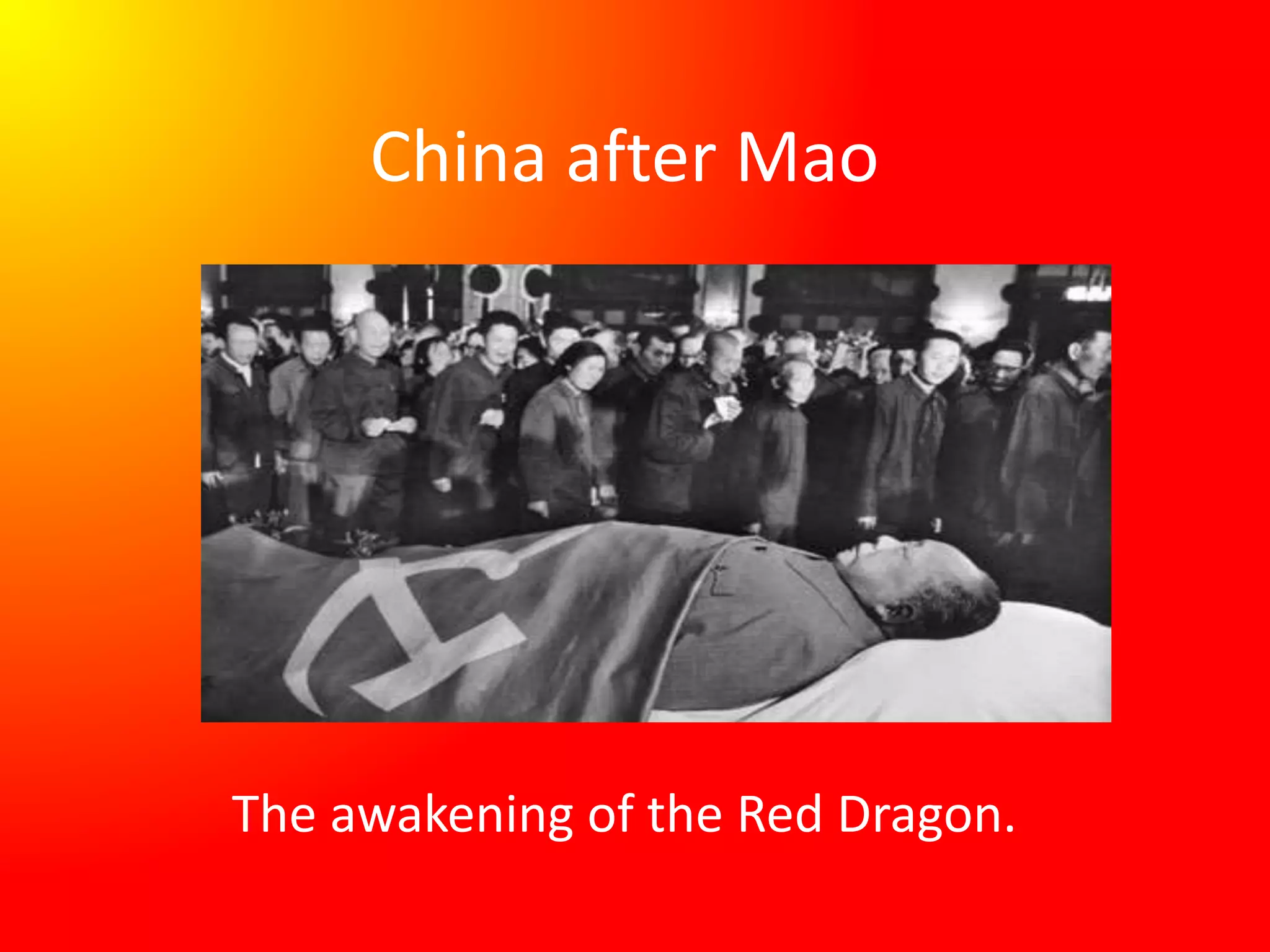
China after Mao
The awakening of the Red Dragon.
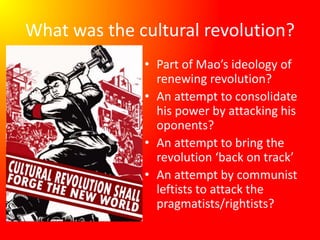
What was the cultural revolution?
• Part of Mao’s ideology of
renewing revolution?
• An attempt to consolidate
his power by attacking his
oponents?
• An attempt to bring the
revolution ‘back on track’
• An attempt by communist
leftists to attack the
pragmatists/rightists?
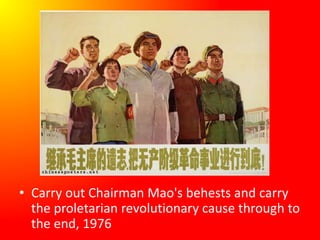
• Carry out Chairman Mao's behests and carry
the proletarian revolutionary cause through to
the end, 1976
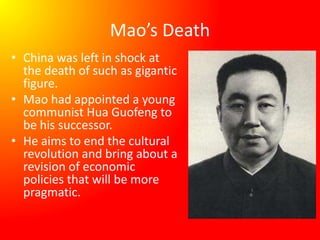
Mao’s Death
• China was left in shock at
the death of such as gigantic
figure.
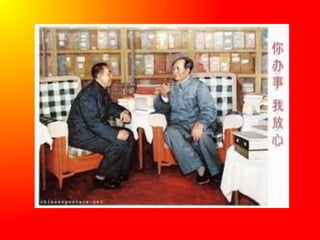
• Mao had appointed a young
communist Hua Guofeng to
be his successor.
• He aims to end the cultural
revolution and bring about a
revision of economic
policies that will be more
pragmatic.
Leftists Vs Rightists
Leftists: Strictly adhere to Mao’s policies.
Rightists: China needs pragmatic economic policies
to keep China economically functioning.
Leftists: Believed that rightists were ‘Capitalist
roaders’
Rightists were targeted during the cultural
revolution.
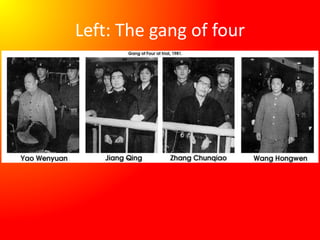
Left: The gang of four
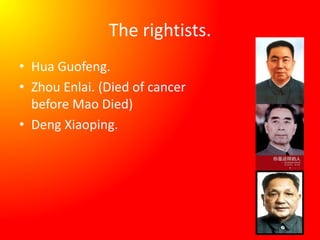
The rightists.
• Hua Guofeng.
• Zhou Enlai. (Died of cancer
before Mao Died)
• Deng Xiaoping.
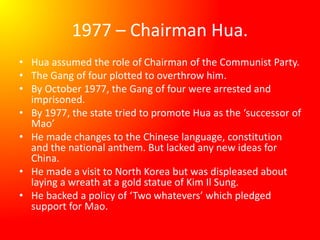
1977 – Chairman Hua.
• Hua assumed the role of Chairman of the Communist Party.
• The Gang of four plotted to overthrow him.
• By October 1977, the Gang of four were arrested and
imprisoned.
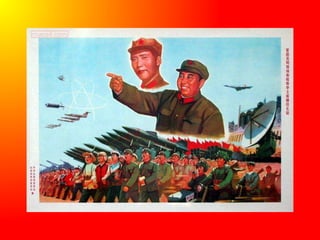
• By 1977, the state tried to promote Hua as the ‘successor of
Mao’
• He made changes to the Chinese language, constitution
and the national anthem. But lacked any new ideas for
China.
• He made a visit to North Korea but was displeased about
laying a wreath at a gold statue of Kim Il Sung.
• He backed a policy of ‘Two whatevers’ which pledged
support for Mao.
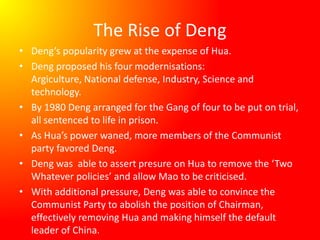
The Rise of Deng
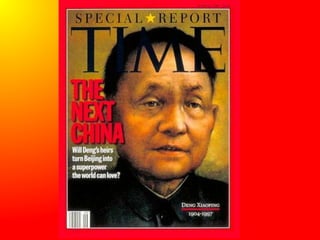
• Deng’s popularity grew at the expense of Hua.
• Deng proposed his four modernisations:
Argiculture, National defense, Industry, Science and
technology.
• By 1980 Deng arranged for the Gang of four to be put on trial,
all sentenced to life in prison.
• As Hua’s power waned, more members of the Communist
party favored Deng.
• Deng was able to assert presure on Hua to remove the ‘Two
Whatever policies’ and allow Mao to be criticised.
• With additional pressure, Deng was able to convince the
Communist Party to abolish the position of Chairman,
effectively removing Hua and making himself the default
leader of China.
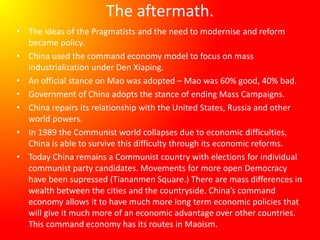
The aftermath.
• The ideas of the Pragmatists and the need to modernise and reform
became policy.
• China used the command economy model to focus on mass
industrialization under Den Xiaping.
• An official stance on Mao was adopted – Mao was 60% good, 40% bad.
• Government of China adopts the stance of ending Mass Campaigns.
• China repairs its relationship with the United States, Russia and other
world powers.
• In 1989 the Communist world collapses due to economic difficulties,
China is able to survive this difficulty through its economic reforms.
• Today China remains a Communist country with elections for individual
communist party candidates. Movements for more open Democracy
have been supressed (Tiananmen Square.) There are mass differences in
wealth between the cities and the countryside. China’s command
economy allows it to have much more long term economic policies that
will give it much more of an economic advantage over other countries.
This command economy has its routes in Maoism.

China after mao MYP 5.

  • 1.
    China after Mao Theawakening of the Red Dragon.
  • 2.
    What was thecultural revolution? • Part of Mao’s ideology of renewing revolution? • An attempt to consolidate his power by attacking his oponents? • An attempt to bring the revolution ‘back on track’ • An attempt by communist leftists to attack the pragmatists/rightists?
  • 3.
    • Carry outChairman Mao's behests and carry the proletarian revolutionary cause through to the end, 1976
  • 4.
    Mao’s Death • Chinawas left in shock at the death of such as gigantic figure. • Mao had appointed a young communist Hua Guofeng to be his successor. • He aims to end the cultural revolution and bring about a revision of economic policies that will be more pragmatic.
  • 5.
    Leftists Vs Rightists Leftists:Strictly adhere to Mao’s policies. Rightists: China needs pragmatic economic policies to keep China economically functioning. Leftists: Believed that rightists were ‘Capitalist roaders’ Rightists were targeted during the cultural revolution.
  • 6.
  • 7.
    The rightists. • HuaGuofeng. • Zhou Enlai. (Died of cancer before Mao Died) • Deng Xiaoping.
  • 8.
    1977 – ChairmanHua. • Hua assumed the role of Chairman of the Communist Party. • The Gang of four plotted to overthrow him. • By October 1977, the Gang of four were arrested and imprisoned. • By 1977, the state tried to promote Hua as the ‘successor of Mao’ • He made changes to the Chinese language, constitution and the national anthem. But lacked any new ideas for China. • He made a visit to North Korea but was displeased about laying a wreath at a gold statue of Kim Il Sung. • He backed a policy of ‘Two whatevers’ which pledged support for Mao.
  • 12.
    The Rise ofDeng • Deng’s popularity grew at the expense of Hua. • Deng proposed his four modernisations: Argiculture, National defense, Industry, Science and technology. • By 1980 Deng arranged for the Gang of four to be put on trial, all sentenced to life in prison. • As Hua’s power waned, more members of the Communist party favored Deng. • Deng was able to assert presure on Hua to remove the ‘Two Whatever policies’ and allow Mao to be criticised. • With additional pressure, Deng was able to convince the Communist Party to abolish the position of Chairman, effectively removing Hua and making himself the default leader of China.
  • 14.
    The aftermath. • Theideas of the Pragmatists and the need to modernise and reform became policy. • China used the command economy model to focus on mass industrialization under Den Xiaping. • An official stance on Mao was adopted – Mao was 60% good, 40% bad. • Government of China adopts the stance of ending Mass Campaigns. • China repairs its relationship with the United States, Russia and other world powers. • In 1989 the Communist world collapses due to economic difficulties, China is able to survive this difficulty through its economic reforms. • Today China remains a Communist country with elections for individual communist party candidates. Movements for more open Democracy have been supressed (Tiananmen Square.) There are mass differences in wealth between the cities and the countryside. China’s command economy allows it to have much more long term economic policies that will give it much more of an economic advantage over other countries. This command economy has its routes in Maoism.