Changes under Mao: 1949-1963
Learning Objectives:
To examine how the agricultural reforms altered China between 1949-1957
Key Words:
Common
Programme
Agrarian Reform
Law
Peoples Courts
Speak Bitterness
Meetings
Mutual Aid Teams
Co-Operatives
Collectives
Five Year Plan
What problems did Mao & the
CCP face in 1949?
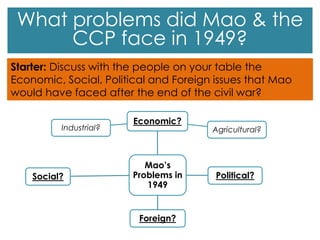
Starter: Discuss with the people on your table the
Economic, Social, Political and Foreign issues that Mao
would have faced after the end of the civil war?
Mao’s
Problems in
1949
Economic?
Industrial? Agricultural?
Political?
Foreign?
Social?
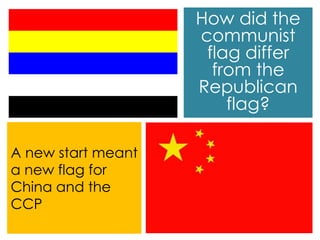
How did the
communist
flag differ
from the
Republican
flag?
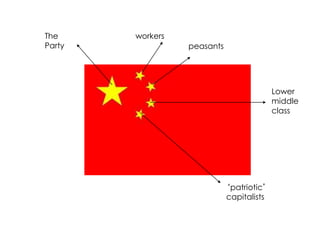
A new start meant
a new flag for
China and the
CCP
The
Party
workers
peasants
Lower
middle
class
‘patriotic’
capitalists
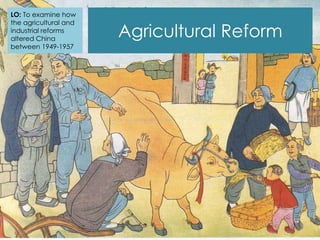
Agricultural Reform
LO: To examine how
the agricultural and
industrial reforms
altered China
between 1949-1957
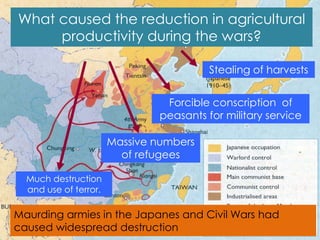
Stealing of harvests
Forcible conscription of
peasants for military service
Massive numbers
of refugees
Much destruction
and use of terror.
Maurding armies in the Japanes and Civil Wars had
caused widespread destruction
What caused the reduction in agricultural
productivity during the wars?
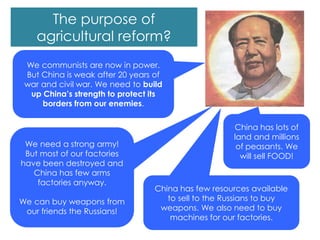
We communists are now in power.
But China is weak after 20 years of
war and civil war. We need to build
up China’s strength to protect its
borders from our enemies.
We need a strong army!
But most of our factories
have been destroyed and
China has few arms
factories anyway.
We can buy weapons from
our friends the Russians!
China has few resources available
to sell to the Russians to buy
weapons. We also need to buy
machines for our factories.
China has lots of
land and millions
of peasants. We
will sell FOOD!
The purpose of
agricultural reform?
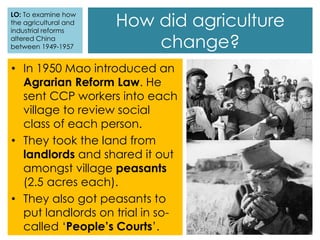
• In 1950 Mao introduced an
Agrarian Reform Law. He
sent CCP workers into each
village to review social
class of each person.
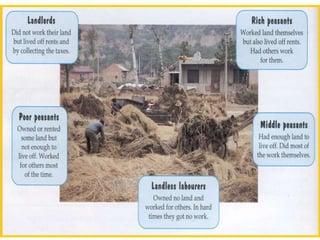
• They took the land from
landlords and shared it out
amongst village peasants
(2.5 acres each).
• They also got peasants to
put landlords on trial in so-
called ‘People’s Courts’.
How did agriculture
change?
LO: To examine how
the agricultural and
industrial reforms
altered China
between 1949-1957
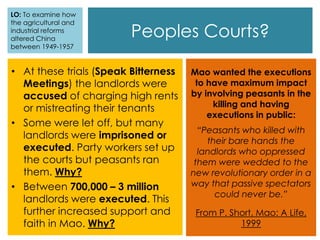
• At these trials (Speak Bitterness
Meetings) the landlords were
accused of charging high rents
or mistreating their tenants
• Some were let off, but many
landlords were imprisoned or
executed. Party workers set up
the courts but peasants ran
them. Why?
• Between 700,000 – 3 million
landlords were executed. This
further increased support and
faith in Mao. Why?
Peoples Courts?
Mao wanted the executions
to have maximum impact
by involving peasants in the
killing and having
executions in public:
“Peasants who killed with
their bare hands the
landlords who oppressed
them were wedded to the
new revolutionary order in a
way that passive spectators
could never be.”
From P. Short, Mao: A Life,
1999
LO: To examine how
the agricultural and
industrial reforms
altered China
between 1949-1957
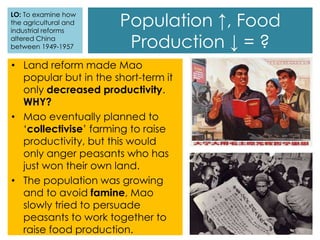
• Land reform made Mao
popular but in the short-term it
only decreased productivity.
WHY?
• Mao eventually planned to
‘collectivise’ farming to raise
productivity, but this would
only anger peasants who has
just won their own land.
• The population was growing
and to avoid famine, Mao
slowly tried to persuade
peasants to work together to
raise food production.
Population ↑, Food
Production ↓ = ?
LO: To examine how
the agricultural and
industrial reforms
altered China
between 1949-1957
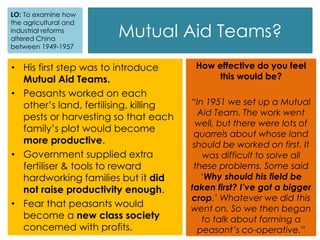
• His first step was to introduce
Mutual Aid Teams.
• Peasants worked on each
other’s land, fertilising, killing
pests or harvesting so that each
family’s plot would become
more productive.
• Government supplied extra
fertiliser & tools to reward
hardworking families but it did
not raise productivity enough.
• Fear that peasants would
become a new class society
concerned with profits.
Mutual Aid Teams?
How effective do you feel
this would be?
“In 1951 we set up a Mutual
Aid Team. The work went
well, but there were lots of
quarrels about whose land
should be worked on first. It
was difficult to solve all
these problems. Some said
‘Why should his field be
taken first? I’ve got a bigger
crop.’ Whatever we did this
went on. So we then began
to talk about forming a
peasant’s co-operative.”
LO: To examine how
the agricultural and
industrial reforms
altered China
between 1949-1957
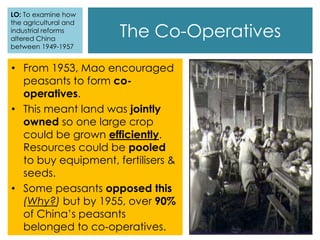
• From 1953, Mao encouraged
peasants to form co-
operatives.
• This meant land was jointly
owned so one large crop
could be grown efficiently.
Resources could be pooled
to buy equipment, fertilisers &
seeds.
• Some peasants opposed this
(Why?) but by 1955, over 90%
of China’s peasants
belonged to co-operatives.
The Co-Operatives
LO: To examine how
the agricultural and
industrial reforms
altered China
between 1949-1957
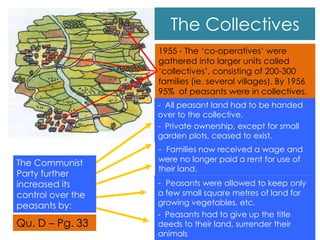
1955 - The ‘co-operatives’ were
gathered into larger units called
‘collectives’, consisting of 200-300
families (ie. several villages). By 1956
95% of peasants were in collectives.
The Communist
Party further
increased its
control over the
peasants by:
- All peasant land had to be handed
over to the collective.
- Private ownership, except for small
garden plots, ceased to exist.
- Peasants had to give up the title
deeds to their land, surrender their
animals
- Families now received a wage and
were no longer paid a rent for use of
their land.
- Peasants were allowed to keep only
a few small square metres of land for
growing vegetables, etc.
The Collectives
Qu. D – Pg. 33
f
0
50
100
150
200
250
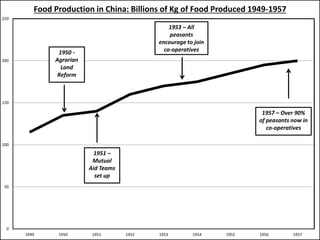
1949 1950 1951 1952 1953 1954 1955 1956 1957
Food Production in China: Billions of Kg of Food Produced 1949-1957
1950 -
Agrarian
Land
Reform
1951 –
Mutual
Aid Teams
set up
1953 – All
peasants
encourage to join
co-operatives
1957 – Over 90%
of peasants now in
co-operatives
How did Agriculture
Change?
Plenary:
1. What was Chinese farming like before 1949?
2. Why did Mao introduce the Peoples Courts?
3. How did farming methods change?
4. What were the aims of the PRC in introducing Co-
operatives?
5. Did peasants attitudes to reforms change over time?
6. Were the changes in farming successful?
7. Did this achieve the stated purpose of the Common
Programme?
LO: To examine how
the agricultural and
industrial reforms
altered China
between 1949-1957
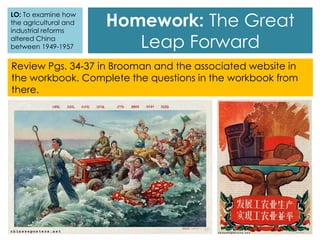
Review Pgs. 34-37 in Brooman and the associated website in
the workbook. Complete the questions in the workbook from
there.
Homework: The Great
Leap Forward
LO: To examine how
the agricultural and
industrial reforms
altered China
between 1949-1957

Changes Under Mao - Agriculture

  • 1.
    Changes under Mao:1949-1963 Learning Objectives: To examine how the agricultural reforms altered China between 1949-1957 Key Words: Common Programme Agrarian Reform Law Peoples Courts Speak Bitterness Meetings Mutual Aid Teams Co-Operatives Collectives Five Year Plan
  • 2.
    What problems didMao & the CCP face in 1949? Starter: Discuss with the people on your table the Economic, Social, Political and Foreign issues that Mao would have faced after the end of the civil war? Mao’s Problems in 1949 Economic? Industrial? Agricultural? Political? Foreign? Social?
  • 3.
    How did the communist flagdiffer from the Republican flag? A new start meant a new flag for China and the CCP
  • 4.
  • 5.
    Agricultural Reform LO: Toexamine how the agricultural and industrial reforms altered China between 1949-1957
  • 6.
    Stealing of harvests Forcibleconscription of peasants for military service Massive numbers of refugees Much destruction and use of terror. Maurding armies in the Japanes and Civil Wars had caused widespread destruction What caused the reduction in agricultural productivity during the wars?
  • 7.
    We communists arenow in power. But China is weak after 20 years of war and civil war. We need to build up China’s strength to protect its borders from our enemies. We need a strong army! But most of our factories have been destroyed and China has few arms factories anyway. We can buy weapons from our friends the Russians! China has few resources available to sell to the Russians to buy weapons. We also need to buy machines for our factories. China has lots of land and millions of peasants. We will sell FOOD! The purpose of agricultural reform?
  • 8.
    • In 1950Mao introduced an Agrarian Reform Law. He sent CCP workers into each village to review social class of each person. • They took the land from landlords and shared it out amongst village peasants (2.5 acres each). • They also got peasants to put landlords on trial in so- called ‘People’s Courts’. How did agriculture change? LO: To examine how the agricultural and industrial reforms altered China between 1949-1957
  • 10.
    • At thesetrials (Speak Bitterness Meetings) the landlords were accused of charging high rents or mistreating their tenants • Some were let off, but many landlords were imprisoned or executed. Party workers set up the courts but peasants ran them. Why? • Between 700,000 – 3 million landlords were executed. This further increased support and faith in Mao. Why? Peoples Courts? Mao wanted the executions to have maximum impact by involving peasants in the killing and having executions in public: “Peasants who killed with their bare hands the landlords who oppressed them were wedded to the new revolutionary order in a way that passive spectators could never be.” From P. Short, Mao: A Life, 1999 LO: To examine how the agricultural and industrial reforms altered China between 1949-1957
  • 11.
    • Land reformmade Mao popular but in the short-term it only decreased productivity. WHY? • Mao eventually planned to ‘collectivise’ farming to raise productivity, but this would only anger peasants who has just won their own land. • The population was growing and to avoid famine, Mao slowly tried to persuade peasants to work together to raise food production. Population ↑, Food Production ↓ = ? LO: To examine how the agricultural and industrial reforms altered China between 1949-1957
  • 12.
    • His firststep was to introduce Mutual Aid Teams. • Peasants worked on each other’s land, fertilising, killing pests or harvesting so that each family’s plot would become more productive. • Government supplied extra fertiliser & tools to reward hardworking families but it did not raise productivity enough. • Fear that peasants would become a new class society concerned with profits. Mutual Aid Teams? How effective do you feel this would be? “In 1951 we set up a Mutual Aid Team. The work went well, but there were lots of quarrels about whose land should be worked on first. It was difficult to solve all these problems. Some said ‘Why should his field be taken first? I’ve got a bigger crop.’ Whatever we did this went on. So we then began to talk about forming a peasant’s co-operative.” LO: To examine how the agricultural and industrial reforms altered China between 1949-1957
  • 13.
    • From 1953,Mao encouraged peasants to form co- operatives. • This meant land was jointly owned so one large crop could be grown efficiently. Resources could be pooled to buy equipment, fertilisers & seeds. • Some peasants opposed this (Why?) but by 1955, over 90% of China’s peasants belonged to co-operatives. The Co-Operatives LO: To examine how the agricultural and industrial reforms altered China between 1949-1957
  • 14.
    1955 - The‘co-operatives’ were gathered into larger units called ‘collectives’, consisting of 200-300 families (ie. several villages). By 1956 95% of peasants were in collectives. The Communist Party further increased its control over the peasants by: - All peasant land had to be handed over to the collective. - Private ownership, except for small garden plots, ceased to exist. - Peasants had to give up the title deeds to their land, surrender their animals - Families now received a wage and were no longer paid a rent for use of their land. - Peasants were allowed to keep only a few small square metres of land for growing vegetables, etc. The Collectives Qu. D – Pg. 33
  • 15.
    f 0 50 100 150 200 250 1949 1950 19511952 1953 1954 1955 1956 1957 Food Production in China: Billions of Kg of Food Produced 1949-1957 1950 - Agrarian Land Reform 1951 – Mutual Aid Teams set up 1953 – All peasants encourage to join co-operatives 1957 – Over 90% of peasants now in co-operatives
  • 16.
    How did Agriculture Change? Plenary: 1.What was Chinese farming like before 1949? 2. Why did Mao introduce the Peoples Courts? 3. How did farming methods change? 4. What were the aims of the PRC in introducing Co- operatives? 5. Did peasants attitudes to reforms change over time? 6. Were the changes in farming successful? 7. Did this achieve the stated purpose of the Common Programme? LO: To examine how the agricultural and industrial reforms altered China between 1949-1957
  • 17.
    Review Pgs. 34-37in Brooman and the associated website in the workbook. Complete the questions in the workbook from there. Homework: The Great Leap Forward LO: To examine how the agricultural and industrial reforms altered China between 1949-1957

Editor's Notes

  • #3 Review of questions for homework
  • #7 No incentive for landlords to use modern techniques because they could just force the peasants. No incentive for peasants to work as could not sell crops they produced.
  • #9 Decide whether they were landlords, rich peasants, middle or poor peasants. ‘Peoples Courts’ – speak bitterness campaign
  • #12 CCP could control the peasants easier – keep an eye on communes and feed them propaganda
  • #15 Where peasants better of in 1949 or 1956?