IDEOLOGICAL ONE PARTY STATE
(TOTALITARIAN)
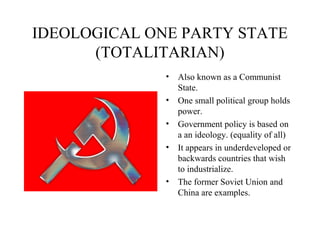
• Also known as a Communist
State.
• One small political group holds
power.
• Government policy is based on
a an ideology. (equality of all)
• It appears in underdeveloped or
backwards countries that wish
to industrialize.
• The former Soviet Union and
China are examples.
Karl Marx
• Marx said one day there
would be a revolution that
would overthrow the
ruling class and set up a
system he called
communism.
• Under communism, all
farms, factories, mines
and profit were to be
shared equally.
• Marx wrote his ideas in
two books, The
Communist Manifesto &
Das Kapital.
FASCISM VS. COMMUNISM
FASCISM
• Draws support from lower
classes & business.
• Makes decisions in the interest
of the state.
• Focuses activities on the state.
(national)
• Corporate state (private
enterprise)
• Elitism
• Ultra-nationalism(ethnocentric)
• racist
COMMUNISM
• Draws support from working
classes.
• Makes decisions in the interest
of the working class.
• Desire to help working class
around the world.
(international)
• State ownership of the means of
production.
• Nationalities unimportant
(equally)
THE RISE AND FALL
OF THE SOVIET
UNION
The Russian Revolution of 1917
• Karl Marx believed that
Russia was an unlikely place
for a communist Revolution
because it was a non-
industrialist nation.
• Bolsheviks seized power
through a coup; people faced
food shortages, soldiers
rioted.
• Communists led by Lenin
seized telephone lines,
railways, banks, electric
plants, etc.
• Communist Control of Soviet
Union was complete in 1921.
THE BOLSHEVIKS
• One revolutionary group called
the Bolsheviks took their ideas
from a German writer named
Karl Marx.
• Marx said one day there would
be a revolution that would
overthrow the ruling class and
set up a system he called
communism.
• Under communism, all farms,
factories, mines and profit were
to be shared equally.
• Marx wrote his ideas in two
books, The Communist
Manifesto & Das Kapital.
Values, Assumptions, and Myths
• Communists claimed that the
new country was a democracy.
– Set up govt. that on paper was
democratic
– Govt. based on a constitution
(1922)
– CPSU refers to itself as
democratic because it rules in
the interest of the majority.
• Real power was with the CPSU.
– Maintained a monopoly of
power by controlling
• Access to positions of
leadership
• Content of communication
• Direction of the economy
• Culture and education
Democratic Forms
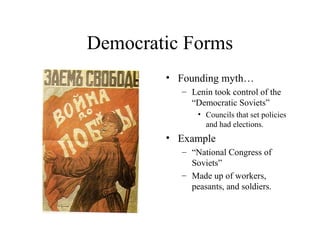
• Founding myth…
– Lenin took control of the
“Democratic Soviets”
• Councils that set policies
and had elections.
• Example
– “National Congress of
Soviets”
– Made up of workers,
peasants, and soldiers.
Authoritarian Essence
• The CP was the only legal political party
• This was justified by
– Only one class (proletariat) therefore only one party
needed.
– Party was the “vanguard of the proletariat” and
protector of communism.
• Lenin also believed that elections in
capitalist countries were simply a “sham”
(illusion of real choice).
Democratic Centralism
• Issues are discussed bottom up, then resolved by
the party congress with the expectation that all
party members will obey.
• Eventually used by Stalin to purge all opposition
and became a justification for strict censorship,
imprisonment and executions.
• In this way, Stalin ended up controlling the party,
which controlled the government, which
controlled the USSR.
Authoritarian Essence cont…
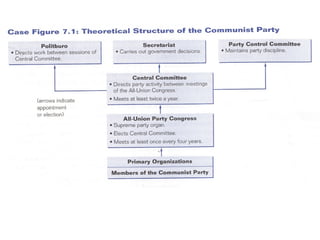
Structure of Communist Party
Politburo:
– Supreme policy making body
– 15 members
Secretariat:
– Supervised the Politburo
– Managed daily activities of the party
– Supervised all state and government appointments
– Implemented policies
– Led by General-Secretary
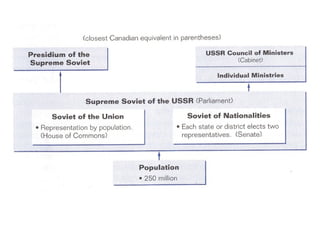
Structure of Soviet Government
• Though appearing both democratic and federal in
nature the Supreme Soviet (parliament) was not
effectively democratic.
– Met 2 times per year
– Laws first past by Presidium so Supreme Soviet simply
rubber stamped legislation.
• Real purpose of Supreme Soviet was simply to
spread message of Presidium.
• Elections were not considered democratic because
there was usually only one name on ballot.
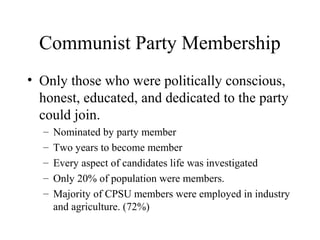
Communist Party Membership
• Only those who were politically conscious,
honest, educated, and dedicated to the party
could join.
– Nominated by party member
– Two years to become member
– Every aspect of candidates life was investigated
– Only 20% of population were members.
– Majority of CPSU members were employed in industry
and agriculture. (72%)
Large Secret Police Force
• Cheka (1917) : Lenin
• NKVD (1934) : Stalin
– People’s Commissarat of Internal Affairs
• KGB (1954)
– Committee for State Security
Soviet Government
• Federal system
• Little autonomy to republics.
Autonomy: right to make own decisions
• Government controls all levels of
government. (Moscow: Kremlin)
Vocab
• Tsar
• Proletariat
• Democratic centralism
• Great purges
• Perestroika
• Glasnost
• USSR
• CIS
• Politburo
• Secreteriat
• Protectorate
• Platt Amendment
China
After 1949 …
China becomes a Communist State
• 1949, Mao Zedong
revolts against the
Kuomintang (Chinese
Nationalist Party) and
turns China into a
communist state.
The People’s Republic of China
• Mao adopted a country that was politically
and economically backwards.
– Lack of political unity
– Primitive technology
– Population explosion
– Famine
• Began a campaign of abolishing private
property, collectivization of agriculture and
5 year plans.
Great Leap Forward (1958-1960)• Economic and social plan to turn China from an
agrarian society into a modern industrialized
communist society.
• The hope was to industrialize by making use of the
massive supply of cheap labor (unemployed) and
avoid having to import heavy machinery. (People’s
Communes)
• Plan was a disaster “Great Leap Backwards”
– Unorganized (more workers dedicated to industry than to
agriculture caused food shortages)
– Unrealistic work assignments
– typhoons, floods
– Mao stepped aside from the government as he had lost
support of the communist party. (though still a “father
figure” to the masses of Chinese people)
Foreign Policy
• After the death of Stalin a bitter rift developed
between China and the Soviets.
• Mao was ignored by Stalin successors which
forced Mao to solicit support from other
communist nations.
• Mao criticized Khrushchev for his policy of
peaceful co-existence.
• USSR offered moderate aid to the Chinese but did
not want to help them become a global power.
– Ordered all Soviet technicians and scientists in China to
return home in 1960.
Foreign Policy cont…
• Tensions between China & the USSR grew
when Brezhnev (1964) became the new
leader. (Brezhnev Doctrine)
• This resulted in friendlier relations with the
USA. (ping pong diplomacy)
• 1970’s China retreated from socialism to
more of a modified private enterprise
system.
Cultural Revolution (1966-1976)
• A method to regain control of
the party after the disastrous
Great Leap Forward.
• Mao’s strategy was to use the
youth (Red Guard) of China to
raise mass consciousness of the
dangers of privilege and
modified capitalism. (destroy
all symbols of the past)
• Over 12 million students
activists took part in mass
rallies in support of Mao.
– Large bands of protesters all
over China left chaos and
political instability.
OUTCOME…
• Premier Zhou Enlai ordered the People’s Army to restore
order by force.
– 400 000 people died
– 17 million sent to work camps
– Millions more sent to correctional camps to be re-educated.
• Mao Zedong dies in 1976.
• Government of China rounds of the “Gang of Four” puts
them on trial for role in Cultural Revolution.
• Sentenced to death (later changed to life imprisonment)
• Deng Xiaoping takes control of China.
– Favored better relations with the west in trade.
LIFE UNDER THE CEAUSESCUS
(ROMANIA)
• Ruled Romania from (1965-1989).
• Owned 40 homes
• Elena owned 40 fur coats and 2000
gowns.
• Elena never past grade four but had
claimed she discovered compounds
she named after herself.(received
72 degrees)
• One in three people were secret
police agents.
• Bedrooms of high ranking officials
bugged with microphones.
• Program of Scientific Nourishment
was started.
• Abortions made illegal. (spied on
mothers)
• Sold babies of single mothers.
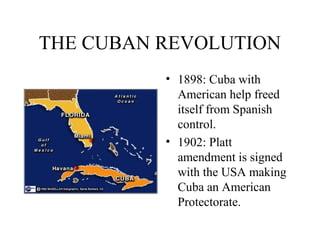
THE CUBAN REVOLUTION
• 1898: Cuba with
American help freed
itself from Spanish
control.
• 1902: Platt
amendment is signed
with the USA making
Cuba an American
Protectorate.
THE REVOLUTION of 1933
• Cubans’ dissatisfaction over their country’s
political system turned into riots.
• 1933: government was overthrown by the
military and Batista ruled Cuba through
puppet presidents.
– USA supported overthrow because Batista
promised concessions. (i.e. protect foreign
investments.)
– Supplied weapons and trained Cuban officers.
FIDEL CASTRO
• Born in 1926 came from a
wealthy family.
• In 1950 graduated from law
school but was disinterested.
• Unhappy with the Batista
regime decided to organize an
armed uprising.(1952)
– Uprising ended in failure and
Castro was given 15 year
prison sentence.
– While in prison mapped out
strategy to overthrow Batista.
• Freed from prison in 1955
(political amnesty) and fled to
Mexico.
FIDEL CASTRO
• Castro and Che Guevara (friend) began to train a small
force in guerilla warfare.
– Announced he would return to Cuba in 1956.
• Landing was a disaster and Castro was forced to hide
(regroup) in the Sierra Maestra mountains.
• Castro gained supporters and they began winning small
conflicts, broadcasting on “Radio Rebelde” and using
propaganda.
• USA stopped all shipments of weapons to Cuba (Castro
promised protection of foreign investments, private
enterprise, etc.)
• 1958: Cuban government collapsed and Fidel Castro
became the leader of Cuba.
USA and CUBA
• Once Castro was in power, it became obvious that
Castro was not willing to cooperate with the United
States.
• Tensions came to a head during the Cold War when
Cuban rebels (backed by the USA) attempted to
overthrow Castro and failed.
• This is known as the BAY OF PIGS.
• Following this, Castro allowed Khrushchev to place
missiles in Cuba, the USA placed a quarantine on Cuba,
preventing all trade.
• To date, the USA has a trade embargo on Cuba, which
has greatly burdened the Cuban economy.
• Much of Castro’s popularity within Cuba has been
based on his Anti-American stance.
• After 49 years of rule, Castro resigns as
dictator of Cuba!
• Currently, his brother, Raul Castro, has
taken over as leader
• Will the USA lift their current trade
sanctions………………????
In General, All Dictatorships…
•Promise to remake society on a grand scale
•Penetrate all aspects of society
- Army, schools, must be a party member to get ahead
- No individual rights, subordinate to the state
• Party is dominated by an all-powerful, charismatic leader
•Party and leader’s power are maintained by force (militarized
society)
•Monopolization of the flow of ideas
•Rule supported by terrorist activities
- Parliamentary activities, Secret Police
• Law is only what the state dictates
•State control of the economy
- Different if fascist or communist!)
DEMOCRACY
DICTATORSHIP
scapegoating
Munich Putsch
Enabling Act
propaganda
Nuremburg Laws
Gestapo
II Duce
Anti-Semitism
Controlled participation
March on Rome
Mien Kampf
Reichstag
indoctrination
Squadristi
Fuhrer
Totalitarian
Third Reich
Junta
Fascism
“Great Man” theory

6. communism

  • 1.
    IDEOLOGICAL ONE PARTYSTATE (TOTALITARIAN) • Also known as a Communist State. • One small political group holds power. • Government policy is based on a an ideology. (equality of all) • It appears in underdeveloped or backwards countries that wish to industrialize. • The former Soviet Union and China are examples.
  • 2.
    Karl Marx • Marxsaid one day there would be a revolution that would overthrow the ruling class and set up a system he called communism. • Under communism, all farms, factories, mines and profit were to be shared equally. • Marx wrote his ideas in two books, The Communist Manifesto & Das Kapital.
  • 3.
    FASCISM VS. COMMUNISM FASCISM •Draws support from lower classes & business. • Makes decisions in the interest of the state. • Focuses activities on the state. (national) • Corporate state (private enterprise) • Elitism • Ultra-nationalism(ethnocentric) • racist COMMUNISM • Draws support from working classes. • Makes decisions in the interest of the working class. • Desire to help working class around the world. (international) • State ownership of the means of production. • Nationalities unimportant (equally)
  • 4.
    THE RISE ANDFALL OF THE SOVIET UNION
  • 5.
    The Russian Revolutionof 1917 • Karl Marx believed that Russia was an unlikely place for a communist Revolution because it was a non- industrialist nation. • Bolsheviks seized power through a coup; people faced food shortages, soldiers rioted. • Communists led by Lenin seized telephone lines, railways, banks, electric plants, etc. • Communist Control of Soviet Union was complete in 1921.
  • 6.
    THE BOLSHEVIKS • Onerevolutionary group called the Bolsheviks took their ideas from a German writer named Karl Marx. • Marx said one day there would be a revolution that would overthrow the ruling class and set up a system he called communism. • Under communism, all farms, factories, mines and profit were to be shared equally. • Marx wrote his ideas in two books, The Communist Manifesto & Das Kapital.
  • 7.
    Values, Assumptions, andMyths • Communists claimed that the new country was a democracy. – Set up govt. that on paper was democratic – Govt. based on a constitution (1922) – CPSU refers to itself as democratic because it rules in the interest of the majority. • Real power was with the CPSU. – Maintained a monopoly of power by controlling • Access to positions of leadership • Content of communication • Direction of the economy • Culture and education
  • 8.
    Democratic Forms • Foundingmyth… – Lenin took control of the “Democratic Soviets” • Councils that set policies and had elections. • Example – “National Congress of Soviets” – Made up of workers, peasants, and soldiers.
  • 9.
    Authoritarian Essence • TheCP was the only legal political party • This was justified by – Only one class (proletariat) therefore only one party needed. – Party was the “vanguard of the proletariat” and protector of communism. • Lenin also believed that elections in capitalist countries were simply a “sham” (illusion of real choice).
  • 10.
    Democratic Centralism • Issuesare discussed bottom up, then resolved by the party congress with the expectation that all party members will obey. • Eventually used by Stalin to purge all opposition and became a justification for strict censorship, imprisonment and executions. • In this way, Stalin ended up controlling the party, which controlled the government, which controlled the USSR. Authoritarian Essence cont…
  • 11.
    Structure of CommunistParty Politburo: – Supreme policy making body – 15 members Secretariat: – Supervised the Politburo – Managed daily activities of the party – Supervised all state and government appointments – Implemented policies – Led by General-Secretary
  • 13.
    Structure of SovietGovernment • Though appearing both democratic and federal in nature the Supreme Soviet (parliament) was not effectively democratic. – Met 2 times per year – Laws first past by Presidium so Supreme Soviet simply rubber stamped legislation. • Real purpose of Supreme Soviet was simply to spread message of Presidium. • Elections were not considered democratic because there was usually only one name on ballot.
  • 15.
    Communist Party Membership •Only those who were politically conscious, honest, educated, and dedicated to the party could join. – Nominated by party member – Two years to become member – Every aspect of candidates life was investigated – Only 20% of population were members. – Majority of CPSU members were employed in industry and agriculture. (72%)
  • 16.
    Large Secret PoliceForce • Cheka (1917) : Lenin • NKVD (1934) : Stalin – People’s Commissarat of Internal Affairs • KGB (1954) – Committee for State Security
  • 17.
    Soviet Government • Federalsystem • Little autonomy to republics. Autonomy: right to make own decisions • Government controls all levels of government. (Moscow: Kremlin)
  • 18.
    Vocab • Tsar • Proletariat •Democratic centralism • Great purges • Perestroika • Glasnost • USSR • CIS • Politburo • Secreteriat • Protectorate • Platt Amendment
  • 19.
  • 20.
    China becomes aCommunist State • 1949, Mao Zedong revolts against the Kuomintang (Chinese Nationalist Party) and turns China into a communist state.
  • 21.
    The People’s Republicof China • Mao adopted a country that was politically and economically backwards. – Lack of political unity – Primitive technology – Population explosion – Famine • Began a campaign of abolishing private property, collectivization of agriculture and 5 year plans.
  • 22.
    Great Leap Forward(1958-1960)• Economic and social plan to turn China from an agrarian society into a modern industrialized communist society. • The hope was to industrialize by making use of the massive supply of cheap labor (unemployed) and avoid having to import heavy machinery. (People’s Communes) • Plan was a disaster “Great Leap Backwards” – Unorganized (more workers dedicated to industry than to agriculture caused food shortages) – Unrealistic work assignments – typhoons, floods – Mao stepped aside from the government as he had lost support of the communist party. (though still a “father figure” to the masses of Chinese people)
  • 23.
    Foreign Policy • Afterthe death of Stalin a bitter rift developed between China and the Soviets. • Mao was ignored by Stalin successors which forced Mao to solicit support from other communist nations. • Mao criticized Khrushchev for his policy of peaceful co-existence. • USSR offered moderate aid to the Chinese but did not want to help them become a global power. – Ordered all Soviet technicians and scientists in China to return home in 1960.
  • 24.
    Foreign Policy cont… •Tensions between China & the USSR grew when Brezhnev (1964) became the new leader. (Brezhnev Doctrine) • This resulted in friendlier relations with the USA. (ping pong diplomacy) • 1970’s China retreated from socialism to more of a modified private enterprise system.
  • 25.
    Cultural Revolution (1966-1976) •A method to regain control of the party after the disastrous Great Leap Forward. • Mao’s strategy was to use the youth (Red Guard) of China to raise mass consciousness of the dangers of privilege and modified capitalism. (destroy all symbols of the past) • Over 12 million students activists took part in mass rallies in support of Mao. – Large bands of protesters all over China left chaos and political instability.
  • 26.
    OUTCOME… • Premier ZhouEnlai ordered the People’s Army to restore order by force. – 400 000 people died – 17 million sent to work camps – Millions more sent to correctional camps to be re-educated. • Mao Zedong dies in 1976. • Government of China rounds of the “Gang of Four” puts them on trial for role in Cultural Revolution. • Sentenced to death (later changed to life imprisonment) • Deng Xiaoping takes control of China. – Favored better relations with the west in trade.
  • 27.
    LIFE UNDER THECEAUSESCUS (ROMANIA) • Ruled Romania from (1965-1989). • Owned 40 homes • Elena owned 40 fur coats and 2000 gowns. • Elena never past grade four but had claimed she discovered compounds she named after herself.(received 72 degrees) • One in three people were secret police agents. • Bedrooms of high ranking officials bugged with microphones. • Program of Scientific Nourishment was started. • Abortions made illegal. (spied on mothers) • Sold babies of single mothers.
  • 28.
    THE CUBAN REVOLUTION •1898: Cuba with American help freed itself from Spanish control. • 1902: Platt amendment is signed with the USA making Cuba an American Protectorate.
  • 29.
    THE REVOLUTION of1933 • Cubans’ dissatisfaction over their country’s political system turned into riots. • 1933: government was overthrown by the military and Batista ruled Cuba through puppet presidents. – USA supported overthrow because Batista promised concessions. (i.e. protect foreign investments.) – Supplied weapons and trained Cuban officers.
  • 30.
    FIDEL CASTRO • Bornin 1926 came from a wealthy family. • In 1950 graduated from law school but was disinterested. • Unhappy with the Batista regime decided to organize an armed uprising.(1952) – Uprising ended in failure and Castro was given 15 year prison sentence. – While in prison mapped out strategy to overthrow Batista. • Freed from prison in 1955 (political amnesty) and fled to Mexico.
  • 31.
    FIDEL CASTRO • Castroand Che Guevara (friend) began to train a small force in guerilla warfare. – Announced he would return to Cuba in 1956. • Landing was a disaster and Castro was forced to hide (regroup) in the Sierra Maestra mountains. • Castro gained supporters and they began winning small conflicts, broadcasting on “Radio Rebelde” and using propaganda. • USA stopped all shipments of weapons to Cuba (Castro promised protection of foreign investments, private enterprise, etc.) • 1958: Cuban government collapsed and Fidel Castro became the leader of Cuba.
  • 32.
    USA and CUBA •Once Castro was in power, it became obvious that Castro was not willing to cooperate with the United States. • Tensions came to a head during the Cold War when Cuban rebels (backed by the USA) attempted to overthrow Castro and failed. • This is known as the BAY OF PIGS. • Following this, Castro allowed Khrushchev to place missiles in Cuba, the USA placed a quarantine on Cuba, preventing all trade. • To date, the USA has a trade embargo on Cuba, which has greatly burdened the Cuban economy. • Much of Castro’s popularity within Cuba has been based on his Anti-American stance.
  • 33.
    • After 49years of rule, Castro resigns as dictator of Cuba! • Currently, his brother, Raul Castro, has taken over as leader • Will the USA lift their current trade sanctions………………????
  • 34.
    In General, AllDictatorships… •Promise to remake society on a grand scale •Penetrate all aspects of society - Army, schools, must be a party member to get ahead - No individual rights, subordinate to the state • Party is dominated by an all-powerful, charismatic leader •Party and leader’s power are maintained by force (militarized society) •Monopolization of the flow of ideas •Rule supported by terrorist activities - Parliamentary activities, Secret Police • Law is only what the state dictates •State control of the economy - Different if fascist or communist!)
  • 36.
  • 37.
  • 38.
  • 39.
  • 40.
  • 41.
  • 42.
  • 43.
  • 44.
  • 45.
  • 46.
  • 47.
  • 48.
  • 49.
  • 50.
  • 51.
  • 52.
  • 53.
  • 54.
  • 55.
  • 56.
  • 57.