Understanding  Mental Health  & Mental Illness
What is  Mental Health?? Mental health refers to the maintenance of  successful mental activity .
What is  Mental Health?? Mental health refers to the maintenance of  successful mental activity .  This includes maintaining  productive daily activities  and maintaining  fulfilling relationships with others .  It also includes maintaining the abilities to  adapt to change and to  cope with stresses .
It is definitely  NOT  easy being a teenager!  Sometimes it’s tough to avoid feeling stressed, and pressure can build up in many areas of life (socially, in school, at home, and while making big life decisions)
Worrying about these pressures is  NORMAL.   But feeling  VERY  sad, hopeless or worthless might be a sign of a mental health problem.
Mental illness can occur when the brain  (or part of the brain) is  not   working well  or is working in the wrong way.
Thinking When the brain is  not working properly ,  one or more of its  6 functions  will be disrupted  Perception Emotion Signaling Behavior Physical
Symptoms   can include Sleep problems Extreme emotional highs and lows Thinking difficulties or problems focusing attention
When these symptoms  significantly disrupt  a person’s life,  we say that the person has a mental disorder   or a  mental illness .
So, what are the   CAUSES   of mental illness??
Well, the causes of mental illness are   COMPLICATED!! Genetics Environment + -> Brain Disorder
 What do we know about the  causes of mental illness? The symptoms of mental illness are a result of abnormal brain functioning.  Mental illness is a brain disorder.  Mental illness is rarely if ever caused by stress alone
 What do we know about the  causes of mental illness? It is not the consequence of poor parenting or bad behavior.  It is not the result of personal weakness or deficits in personality. It is not the manifestation of malevolent spiritual intent.  Only in exceptional cases is it caused by nutritional factors. It is not caused by poverty.
Many mental illnesses begin during  childhood  and persist into adolescence.  Some of these include: Attention Deficit Hyperactivity Disorder (ADHD) Autism Spectrum Disorders (ASD) Generalized Anxiety Disorder (GAD
BUT… some illnesses begin during  adolescence .  The illnesses that most often begin during adolescence include: Major Depression (MD) Schizophrenia Bipolar Disorder (BD) Panic disorder Social Anxiety Disorder Eating Disorders Obsessive Compulsive Disorder Addictions
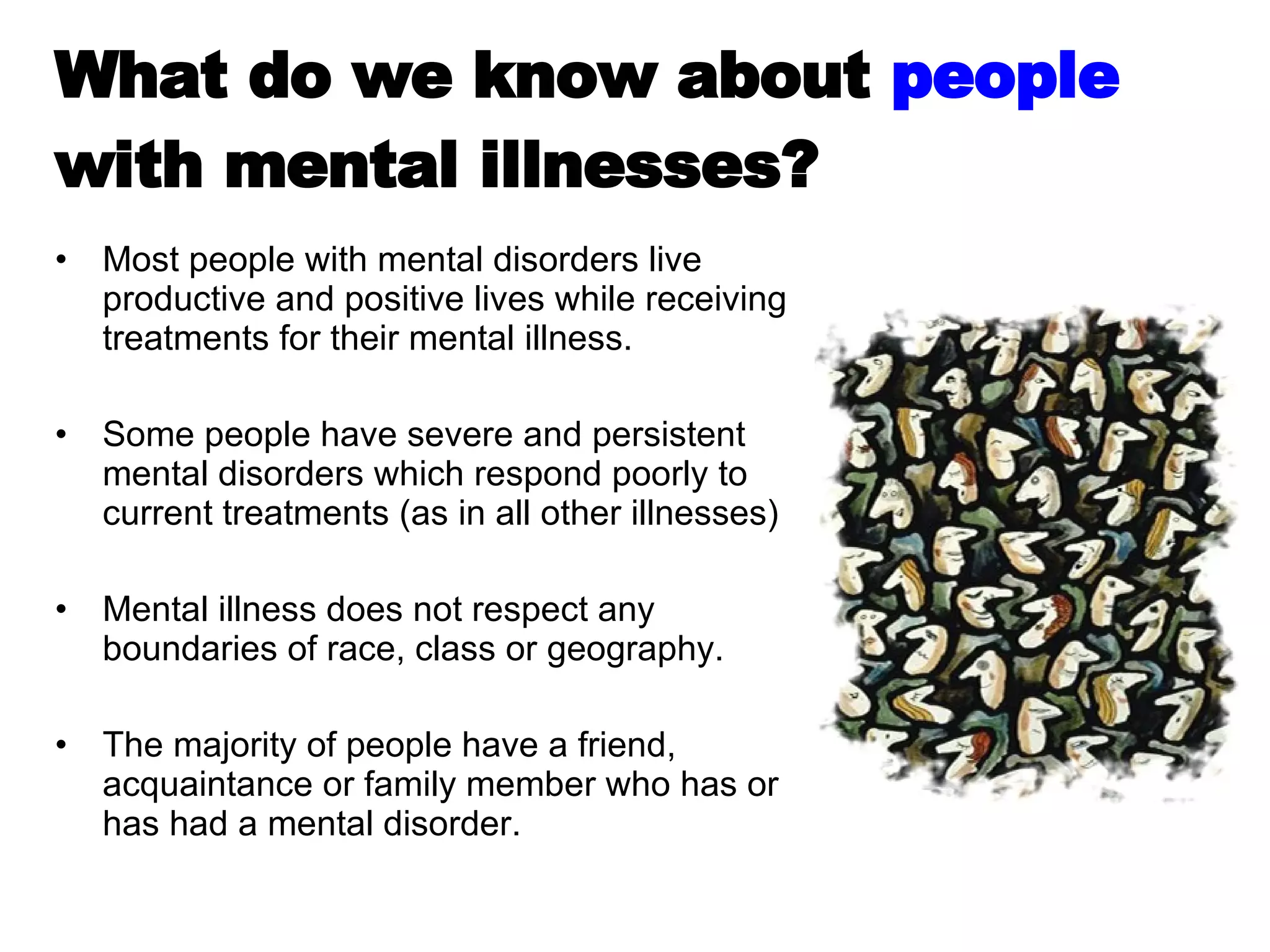
Most people with mental disorders live productive and positive lives while receiving treatments for their mental illness. Some people have severe and persistent mental disorders which respond poorly to current treatments (as in all other illnesses) Mental illness does not respect any boundaries of race, class or geography. The majority of people have a friend, acquaintance or family member who has or has had a mental disorder. What do we know about  people  with mental illnesses?
Mental health problems can be treated!   If you feel  VERY  sad, stressed or worried, it might help to talk to someone about how you are feeling.
Do you ever… Often feel very angry or very worried? Do reckless things that could harm you or others? Feel grief for a long time after a loss or a death? Think your mind is controlled or out of control? Use alcohol or drugs? Exercise, diet and/or binge-eat obsessively? Hurt other people or destroy property?
Do you ever… Often feel very angry or very worried? Do reckless things that could harm you or others? Feel grief for a long time after a loss or a death? Think your mind is controlled or out of control? Use alcohol or drugs? Exercise, diet and/or binge-eat obsessively? Hurt other people or destroy property? If you feel any of these things, it might help to talk to a parent, teacher, school counselor or physician.
Sun Life Financial Chair In Adolescent Mental Health For more information visit WWW.TEENMENTALHEALTH.ORG
Image Credits Slide 1:  Paulo Correa aka Nookiez -  http://www.sxc.hu/profile/nookiez   Slide 14:  mohsen rasoulov -  www.moosville.com/photoblog Slide 15: Paulo Correa aka Nookiez -  http://www.sxc.hu/profile/nookiez

Understanding Mental Health and Mental Illness

  • 1.
    Understanding MentalHealth & Mental Illness
  • 2.
    What is Mental Health?? Mental health refers to the maintenance of successful mental activity .
  • 3.
    What is Mental Health?? Mental health refers to the maintenance of successful mental activity . This includes maintaining productive daily activities and maintaining fulfilling relationships with others . It also includes maintaining the abilities to adapt to change and to cope with stresses .
  • 4.
    It is definitely NOT easy being a teenager! Sometimes it’s tough to avoid feeling stressed, and pressure can build up in many areas of life (socially, in school, at home, and while making big life decisions)
  • 5.
    Worrying about thesepressures is NORMAL. But feeling VERY sad, hopeless or worthless might be a sign of a mental health problem.
  • 6.
    Mental illness canoccur when the brain (or part of the brain) is not working well or is working in the wrong way.
  • 7.
    Thinking When thebrain is not working properly , one or more of its 6 functions will be disrupted Perception Emotion Signaling Behavior Physical
  • 8.
    Symptoms can include Sleep problems Extreme emotional highs and lows Thinking difficulties or problems focusing attention
  • 9.
    When these symptoms significantly disrupt a person’s life, we say that the person has a mental disorder or a mental illness .
  • 10.
    So, what arethe CAUSES of mental illness??
  • 11.
    Well, the causesof mental illness are COMPLICATED!! Genetics Environment + -> Brain Disorder
  • 12.
     What dowe know about the causes of mental illness? The symptoms of mental illness are a result of abnormal brain functioning. Mental illness is a brain disorder. Mental illness is rarely if ever caused by stress alone
  • 13.
     What dowe know about the causes of mental illness? It is not the consequence of poor parenting or bad behavior. It is not the result of personal weakness or deficits in personality. It is not the manifestation of malevolent spiritual intent. Only in exceptional cases is it caused by nutritional factors. It is not caused by poverty.
  • 14.
    Many mental illnessesbegin during childhood and persist into adolescence. Some of these include: Attention Deficit Hyperactivity Disorder (ADHD) Autism Spectrum Disorders (ASD) Generalized Anxiety Disorder (GAD
  • 15.
    BUT… some illnessesbegin during adolescence . The illnesses that most often begin during adolescence include: Major Depression (MD) Schizophrenia Bipolar Disorder (BD) Panic disorder Social Anxiety Disorder Eating Disorders Obsessive Compulsive Disorder Addictions
  • 16.
    Most people withmental disorders live productive and positive lives while receiving treatments for their mental illness. Some people have severe and persistent mental disorders which respond poorly to current treatments (as in all other illnesses) Mental illness does not respect any boundaries of race, class or geography. The majority of people have a friend, acquaintance or family member who has or has had a mental disorder. What do we know about people with mental illnesses?
  • 17.
    Mental health problemscan be treated! If you feel VERY sad, stressed or worried, it might help to talk to someone about how you are feeling.
  • 18.
    Do you ever…Often feel very angry or very worried? Do reckless things that could harm you or others? Feel grief for a long time after a loss or a death? Think your mind is controlled or out of control? Use alcohol or drugs? Exercise, diet and/or binge-eat obsessively? Hurt other people or destroy property?
  • 19.
    Do you ever…Often feel very angry or very worried? Do reckless things that could harm you or others? Feel grief for a long time after a loss or a death? Think your mind is controlled or out of control? Use alcohol or drugs? Exercise, diet and/or binge-eat obsessively? Hurt other people or destroy property? If you feel any of these things, it might help to talk to a parent, teacher, school counselor or physician.
  • 20.
    Sun Life FinancialChair In Adolescent Mental Health For more information visit WWW.TEENMENTALHEALTH.ORG
  • 21.
    Image Credits Slide1: Paulo Correa aka Nookiez - http://www.sxc.hu/profile/nookiez Slide 14: mohsen rasoulov - www.moosville.com/photoblog Slide 15: Paulo Correa aka Nookiez - http://www.sxc.hu/profile/nookiez