68
Child
Development
Principles and
Theories
4After studying this chapter, you will be able to
describe the areas and principles of
development.
define windows of opportunity as related to
brain development.
summarize how theories about
development can be used as practical
guides to early care and education.
contrast the developmental theories of
Erikson, Piaget, Vygotsky, and Gardner.
Chapter 4 Child Development Principles and Theories 69
Terms to Know
development
infant
toddler
preschooler
physical development
gross-motor development
fine-motor development
cognitive development
social-emotional development
cephalocaudal principle
proximodistal principle
maturation
neurons
synapses
windows of opportunity
theory
schemata
sensorimotor stage
preoperational stage
concrete operations stage
multiple intelligences
Studying and understanding child
growth and development are important
parts of teaching young children. No two
children are alike. Children differ in physical,
cognitive, social, and emotional growth
patterns. Even identical twins, who have the
same genetic makeup, are not exactly alike.
They may differ in the way they respond to
play, affection, objects, and people in their
environment.
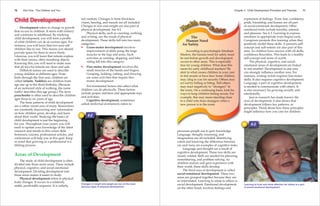
Think of the children you know. Each
is different from the others, 4-1. Some
always appear to be happy. Other children’s
personalities may not seem as pleasant. Some
children are active. Still others are typically
quiet. You may even find that some children
are easier to like.
To help all these children, you need
to understand the sequence of their
development. Knowledge of the areas of
child development is basic to guiding young
children. Linked to this is the understanding
of healthy brain development.
Healthy brain development results from
healthy human contact. Positive stimuli
are a major factor in brain development.
These stimuli begin at birth. Therefore, it is
vital for children to have loving caregivers.
Young children need dependable, trusting
relationships. They thrive in environments
that are predictable and nurturing.
Understanding theories about how
people develop helps form your knowledge
base in caring for young children. This
combined knowledge will help you plan
appropriate curriculum.
Knowledge of child development can help you
understand how to work with children who have very
different personalities.
4-1
This sample chapter is for review purposes only. Copyright © The Goodheart-Willcox Co., Inc. All rights reserved.
70 Part One The Children and You
Child Development
Development refers to change or growth
that occurs in children. It starts with infancy
and continues to adulthood. By studying
child development, you will form a profile
of what children can do at various ages. For
instance, you will learn that two-year-old
children like to run. This means you should
provide space for them to move freely.
Likewise, you will learn that infants explore
with their senses, often mouthing objects.
Knowing this, you will need to make sure
that all toys for infants are clean and safe.
Different names are used to describe
young children at different ages. From
birth through the first year, children are
called infants. Toddlers are children from
age one up to the third birthday. (Because
of an awkward style of walking, the name
toddler describes this age group.) The term
preschooler is often used to describe children
ages three to six years of age.
The basic patterns of child development
are a rather recent area of study. Researchers
are constantly discovering new information
on how children grow, develop, and learn
about their world. Studying the basics of
child development is just the beginning
for you. Throughout your career, you will
need to update your knowledge of the latest
research and trends in this career field.
Seminars, courses, professional articles, and
conferences will help you in this goal. Keep
in mind that growing as a professional is a
lifelong process.
Areas of Development
The study of child development is often
divided into three main areas. These include
physical, cognitive, and social-emotional
development. Dividing development into
these areas makes it easier to study.
Physical development refers to physical
body changes. It occurs in a relatively
stable, predictable sequence. It is orderly,
not random. Changes in bone thickness,
vision, hearing, and muscle are all included.
Changes in size and weight are also part of
physical development. See 4-2.
Physical skills, such as crawling, walking,
and writing, are the result of physical
development. These skills fall into two main
categories:
Gross-motor development involves
improvement of skills using the large
muscles in the legs and arms. Such
activities as running, skipping, and bike
riding fall into this category.
Fine-motor development involves the
small muscles of the hands and fingers.
Grasping, holding, cutting, and drawing
are some activities that require fine-
motor development.
Environmental factors also affect what
children can do physically. These factors
include proper nutrition and appropriate toys
and activities.
Cognitive development, sometimes
called intellectual development, refers to
Changes in height and weight are two of the most
obvious signs of physical development.
4-2
Chapter 4 Child Development Principles and Theories 71
processes people use to gain knowledge.
Language, thought, reasoning, and
imagination are all included. Identifying
colors and knowing the difference between
one and many are examples of cognitive tasks.
Language and thought are a result of
cognitive development. These two skills are
closely related. Both are needed for planning,
remembering, and problem solving. As
children mature and gain experience with
their world, these skills develop.
The third area of development is called
social-emotional development. These two
areas are grouped together because they are
so interrelated. Learning to relate to others is
social development. Emotional development,
on the other hand, involves feelings and
expression of feelings. Trust, fear, confidence,
pride, friendship, and humor are all part
of social-emotional development. Other
emotional traits include timidity, interest,
and pleasure. See 4-3. Learning to express
emotions in appropriate ways begins early.
Caregivers promote this learning when they
positively model these skills. A person’s self-
concept and self-esteem are also part of this
area. As children have success with all skills,
confidence flourishes. This leads to a healthy
self-concept and sense of worth.
The physical, cognitive, and social-
emotional areas of development are linked
to one another. Development in one area
can strongly influence another area. For
instance, writing words requires fine-motor
skills. It also requires cognitive development.
Language, a part of cognitive development,
is needed to communicate with others. It
is also necessary for growing socially and
emotionally.
Just as research has made known the
areas of development, it also shows that
development follows key patterns, or
principles. Think about how these principles
might influence how you care for children.
lttt dd
aaa eee
The
Human Need
for Safety
According to psychologist Abraham
Maslow, the human need for safety must
be met before growth and development
occurs in other areas. This is especially
true for young children. What does this
mean for early childhood teachers? Be
alert to what causes children in your care
to feel unsafe or have fear. Some children
may cling to you for security. Others may
act out by hitting or biting. Still others
may react negatively to “strangers” in
the room. On a continuing basis, look for
ways to keep children feeling secure. For
example, this may mean standing close
to a child who fears strangers when a
new person is in the room.
Learning to trust and show affection for others is a part
of social-emotional development.
4-3
72 Part One The Children and You
Principles of Development
Although each child is unique, the
basic patterns, or principles, of growth and
development are universal, predictable, and
orderly. Through careful observation and
interaction with children, researchers and
those who work with children understand the
characteristics of the principles that follow.
Development tends to proceed from
the head downward. This is called the
cephalocaudal principle. According to
this principle, the child first gains control
of the head, then the arms, then the legs.
Infants gain control of head and face
movements within the first two months
after birth. In the next few months, they
are able to lift themselves up using their
arms. By 6 to 12 months of age, infants
start to gain leg control and may be able
to crawl, stand, or walk.
Development also proceeds from the
center of the body outward according to
the proximodistal principle. Accordingly,
the spinal cord develops before other parts
of the body. The child’s arms develop
before the hands, and the hands and
feet develop before the fingers and toes.
Fingers and toes are the last to develop.
Development also depends on maturation.
Maturation refers to the sequence of
biological changes in children. These
orderly changes give children new
abilities. Much of the maturation depends
on changes in the brain and the nervous
system. These changes assist children to
improve their thinking abilities and motor
skills. Arich learning environment helps
children develop to their potential.
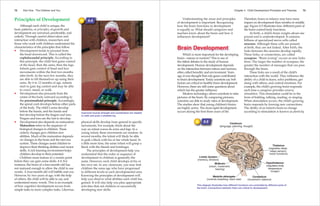
Children must mature to a certain point
before they can gain some skills, 4-4. For
instance, the brain of a four-month-old has
not matured enough to allow the child to use
words. A four-month-old will babble and coo.
However, by two years of age, with the help
of others, the child will be able to say and
understand many words. This is an example
of how cognitive development occurs from
simple tasks to more complex tasks. Likewise,
physical skills develop from general to specific
movements. For example, think about the
way an infant waves its arms and legs. In a
young infant, these movements are random. In
several months, the infant will likely be able
to grab a block with his or her whole hand. In
a little more time, the same infant will grasp a
block with the thumb and forefinger.
The principles of development help you
understand that the order or sequence of
development in children is generally the
same. However, each child develops at his or
her own rate. In any classroom, you may find
children the same age who have progressed
to different levels in each developmental area.
Knowing the principles of development will
help you observe what abilities each child has
gained. It will also help you plan appropriate
activities that aid children in successfully
developing new skills.
Improved muscle strength and coordination are needed
to walk and push a wheeled toy.
4-4
Chapter 4 Child Development Principles and Theories 73
Understanding the areas and principles
of development is important. Recognizing
how the brain functions in development
is equally so. What should caregivers and
teachers know about the brain and how it
influences development?
Brain Development
Which is more important for the developing
brain—nature or nurture? This is one of
the oldest debates in the study of human
development. Human development depends
on the interaction between nature and nurture,
often called heredity and environment. Years
ago, it was thought that only genes contributed
to brain development. Today scientists say both
factors are critical to healthy brain development.
However, there are still some questions about
which has the greater influence.
Modern technology allows scientists to take
pictures of the brain. By comparing pictures,
scientists are able to study rates of development.
The studies show that young children’s brains
are highly active. The most rapid development
occurs during the first three years of life.
Therefore, hours in infancy may have more
impact on development than months in middle
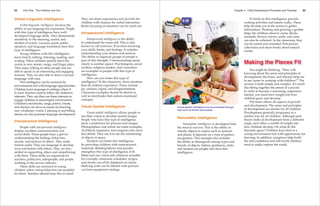
age. Figure 4-5 illustrates how different parts of
the brain control body functions.
At birth, a child’s brain weighs about one
pound and is underdeveloped. It contains
billions of specialized nerve cells called
neurons. Although these cells are present
at birth, they are not linked. After birth, the
links between the neurons develop rapidly.
These links, or connections, are called
synapses. “Brain wiring” occurs as new links
form. The larger the number of synapses, the
greater the number of messages that can pass
through the brain.
These links are a result of the child’s
interaction with the world. They influence the
ability of a child to learn, solve problems, get
along with others, and control emotions. For
example, the child’s growing brain responds
each time a caregiver provides sensory
stimulation. This stimulation could be in the
form of holding, talking, reading, or singing.
When stimulation occurs, the child’s growing
brain responds by forming new connections.
The ability of an infant’s brain to change
according to stimulation is known as plasticity.
Cerebellum
(movement, balance)
Medulla oblongata
(controls breathing, heart rate)
Midbrain
(vision, movement,
hearing)
Limbic System
(memory, emotion)
Hypothalamus
(regulates body
temperature
hunger)
Thalamus
(regulates sleep,
relays sensory
motor functions)
Cerebrum
(language, planning, thought)
This diagram illustrates how different functions are controlled by different parts of
the brain. Connections between them are critical to development.
4-5
74 Part One The Children and You
Early care has a long-lasting impact on
how children develop. The number of brain
connections children form and keep depends
on the care they receive. Warm, nurturing,
consistent, and responsive care causes
positive changes in the brain. Likewise,
children need environmental stimulation.
A wide variety of visual, auditory, and
sensory experiences will help promote brain
connections.
On the other hand, a lack of nurturing
and interaction can limit a child’s potential.
Some children are deprived of stimulation
either intentionally or unintentionally.
These children receive fewer touches. They
are spoken to less often. They may also not
receive much visual stimulation. This neglect
can impair brain development and the child’s
potential.
The amount of stress created by negative
experiences also affects brain development.
Overstimulation, a flood of sounds and
sights, is one factor that can cause harmful
stress to infants. When under stress, the
body produces a steroid called cortisol. High
levels of this hormone wash over the brain
like an acid. Over a long length of time,
cortisol can lead to problems with memory
and regulating emotion. A child constantly
exposed to stress can develop connections
that trigger anxiety, fear, and mistrust. These
children may grow up to be unhappy, sad,
or even angry. They may also have problems
with self-control. Chart 4-6 contains a list of
factors that can interfere with healthy brain
development.
Windows of Opportunity
The brain has a remarkable capacity to
change. However, timing is important. The
parts of the brain develop at different times
and different rates. Studies show that there
are windows of opportunity, or a specific
span of time, for the normal development
of certain types of skills. During these key
times, appropriate stimulation is needed
for the brain synapses to link easily and
efficiently.
After these key periods, chances for
creating stable, long-lasting pathways in
the brain tend to diminish. Learning will
continue to occur for the remainder of the
person’s life. However, the skill mastery level
may not be as high. Chart 4-7 contains a
list of brain functions and the approximate
windows of opportunity for each. Read the
following to further your understanding
about windows of opportunity.
Vision: Birth to Six Months
At birth, an infant’s brain is not wired
for sight. The first six months of life is a
key period for developing vision. Covering
newborns’ eyes or keeping infants in a
dark room during this time will affect their
vision. Their sight may not develop normally.
Once passed, this window of opportunity
is impossible to recover. For this reason,
newborns’ eyes are examined after birth.
If a cataract covering the lens of the eye is
present, it needs to be removed.
Vision is one area that develops with
little stimulation. Infants need interesting
objects to look at, including toys and people.
As you carry infants, point out interesting
objects, pictures, people, and places.
Any of these factors can interfere with the ability of a
child’s brain to develop.
i t f ith th bilit f
4-6
Risk Factors for Healthy
Brain Development
trauma
emotional or physical abuse
poverty
exposure to environmental toxins such
as lead
parents who suffer from substance
abuse, both during the prenatal period
and after birth
Chapter 4 Child Development Principles and Theories 75
Vocabulary/Speech: Birth to
Three Years
Infants must hear language to learn it.
The speech a child hears during the first
three years of life will determine his or her
adult vocabulary. Children at this age have an
incredible capacity for learning language. On
the other hand, infants and toddlers who hear
fewer words develop smaller vocabularies.
It is important for caregivers to speak
in full sentences. Talk to children often. Tell
them what you are doing, what they are
doing, and what you will do next. Read them
stories and play music. Engage them in social
interactions that require language.
Emotional Control: Birth to
Three Years
The critical period for emotional control
occurs between birth and three years of
age. Emotional development includes the
abilities to identify feelings, manage strong
emotions, and develop empathy. Severe stress
or early abuse can damage a child’s emotional
development.
Infants and toddlers thrive in stable
relationships. In early childhood programs,
they should be assigned a primary caregiver.
Children need caregivers who can read
their cues, respond promptly, and meet
their needs in a nurturing manner. By using
caring words, caregivers reassure children
that they are valued. Caregivers can also
support emotional understanding by labeling
children’s feelings. Storybooks are effective in
helping to promote this type of development.
Math/Logic Development: One to
Four Years
The critical timing for promoting brain
connections related to math is from one
to four years of age. Young children need
chances for working with materials that offer
an appropriate level of challenge. Blocks
and rhythm instruments are examples of
toys that encourage sensory exploration
related to math. Caregivers can introduce
experiences requiring matching and sorting
by size, shape, and color, 4-8. Learning how
objects are alike and different is an important
skill. When appropriate, caregivers need to
introduce words to describe color, size, shape,
and texture. They also need to introduce
math words, such as bigger, smaller, more, less,
and one more.
The ages for these windows of opportunity are estimates and can vary according to an individual’s development.ngg tto anan ii ddndiiiiividdidual’l’ss ddedevevellopmpmenentt
4-7
Brain Function Approximate Window of Opportunity
Vision Birth to 6 months
Motor development Prenatal to 8 years
Emotional control Birth to 3 years
Vocabulary/speech Birth to 3 years
Math/logic 1 to 4 years
76 Part One The Children and You
Motor Development: Prenatal to
Eight years
Motor development requires complex
brain networking. The window of
opportunity begins before children are even
born. The window lasts for the first eight
years. During this time, stable, long-lasting
structures can be created. Young children
need a variety of gross- and fine-motor
activities to support motor development.
Theories of
Development
Psychologists continue to study human
development. They are learning more about
what people are like and how they develop.
Over the past century, many psychologists
have provided theories that are considered
practical guides. A theory is a principle
or idea that is proposed, researched, and
generally accepted as an explanation.
Developmental theories provide insights
into how children grow and learn. Theories
are helpful for understanding and guiding
developmental processes.
Theories can be useful decision-making
tools. Since a variety of theories exists,
teachers need to understand these different
approaches for working with children.
Theories will help you form your personal
values and beliefs about learning. They
will also help you understand strategies for
promoting children’s development.
Four major theories about how children
learn are discussed in this chapter. These
include theories of mid-twentieth-century
psychologists Erik Erikson, Jean Piaget, and Lev
Vygotsky. The final theorist, Howard Gardner,
is a twenty-first-century developmental
psychologist. These theories are based on
observation and experiences with children.
Think about the children you know as you read
about theories that helped form today’s ideas
about working with young children.
Erikson’s Psychosocial
Theory
Erik Erikson proposed a theory of
psychosocial development. He believed
development occurs throughout the life
span. His theory provided new insights into
the formation of a healthy personality. It
emphasizes the social and emotional aspects
of growth. Children’s personalities develop in
response to their social environment. The same
is true of their skills for social interaction.
Erikson’s theory includes eight stages. At
each stage, a social conflict or crisis occurs.
These are not generally tragic situations;
however, they require solutions that are
satisfying both personally and socially. Erikson
believed that each stage must be resolved before
children can ascend to the next stage.
Maturity and social forces help in the
resolution of the crisis or conflict. Therefore,
Blocks of different shapes, sizes, and colors can help
promote brain connections related to math and logic.
4-8
Chapter 4 Child Development Principles and Theories 77
teachers and parents play a powerful role in
recognizing each stage. By providing social
opportunity and support, teachers and parents
can help children overcome each crisis. Chart 4-9
contains the first four stages of Erikson’s theory.
These stages occur during the early childhood
years. The paragraphs that follow give a brief
overview of these early stages.
Stage 1: Trust Versus Mistrust
During the first eighteen months of
life, children learn to trust or mistrust their
environment. To develop trust, they need
to have warm, consistent, predictable, and
attentive care. See 4-10. They need caregivers
who will accurately read and respond to their
signals. When infants are distressed, they
need to be comforted. They also need loving
physical contact, nourishment, cleanliness,
and warmth. Then they will develop a sense
of confidence and trust that the world is safe
and dependable. Mistrust will occur if an
infant experiences an unpredictable world
and is handled harshly.
Stage 2: Autonomy Versus Shame
and Doubt
This second stage occurs between eighteen
months and three years of age. During this
stage, toddlers use their new motor and
mental skills. They want to be independent
and do things for themselves. They are in
the process of discovering their own bodies
and practicing their developing locomotor
(physical movement) and language skills.
The objective of this stage is to gain
self-control without a loss of self-esteem.
Fostering independence in children is
important. At this age, toddlers start to
become self-sufficient. They need to learn
to choose and decide for themselves. To
do this, toddlers need a loving, supportive
environment. Positive opportunities for self-
feeding, toileting, dressing, and exploration
will result in autonomy, or independence.
On the other hand, overprotection or lack of
adequate activities results in self-doubt, poor
achievement, and shame.
Stage 3: Initiative Versus Guilt
Between three and five years of age, the
third stage occurs. According to Erikson,
it emerges as a result of the many skills
children have developed. Now children
have the capacity and are ready to learn
constructive ways of dealing with people
and things. They are learning how to take
initiative without being hurtful to others.
They are also busy discovering how the
The first four stages of Erikson’s theory concern children from birth to twelve years.yeaears
4-9
Erikson’s Stages of Development During Early Childhood
Stage Approximate Age Psychosocial Crisis
I Birth–18 months Trust versus mistrust
II 18 months–3 years Autonomy versus shame and doubt
III 3–5 years Initiative versus guilt
IV 6–12 years Industry versus inferiority
78 Part One The Children and You
world works. Children begin to realize that
what they do can have an effect on the world,
too. Challenged by the environment, children
are constantly attempting and mastering new
tasks. Aided by strong initiative, they are
able to move ahead energetically and quickly
forget failures. This gives them a sense of
accomplishment.
Children at this stage need to develop a
sense of purpose. This happens when adults
direct children’s urges toward acceptable
social practices. If children are discouraged
by criticism, feelings of incompetence are
likely to emerge. This can also occur if
parents demand too much control.
Stage 4: Industry Versus Inferiority
The major crisis of this stage occurs
between six and twelve years of age. At this
time, children enjoy planning and carrying
out projects. This helps them learn society’s
rules and expectations. During this stage,
children gain approval by developing
intellectual skills such as reading, writing,
and math.
The way family, neighbors, teachers,
and friends respond to children affects their
future development. Realistic goals and
expectations enrich children’s sense of self.
Children can become frustrated by criticism
or discouragement, or if parents demand too
much control. Feelings of incompetence and
insecurity will emerge.
Piaget’s Cognitive
Development Theory
Jean Piaget’s thinking has challenged
teachers to focus on the ways children come
to know as opposed to what they know. His
theory of cognitive development focuses
on predictable cognitive (thinking) stages.
Piaget believed that thinking was different
during each stage of development. His theory
explained mental operations. This includes
how children perceive, think, understand,
and learn about their world.
Piaget believed that children naturally
attempt to understand what they do not
know. Knowledge is gathered gradually
during active involvement in real-life
experiences. By physically handling objects,
young children discover that relationships
exist between them, 4-11. Terms Piaget used
to describe these processes were schemata,
adaptation, assimilation, and accommodation.
These processes occur during each stage of
development.
Schemata are mental representations
or concepts. As children receive new
This child builds trust by forming a loving, caring
relationship with her teacher.
4-10
Chapter 4 Child Development Principles and Theories 79
information, they are constantly creating,
modifying, organizing, and reorganizing
schemata.
Adaptation is a term Piaget used for
children mentally organizing what they
perceive in their environment. When new
information or experiences occur, children
must adapt to include this information in
their thinking. If this new information does
not fit with what children already know,
a state of imbalance occurs. To return to
balance, adaptation occurs through either
assimilation or accommodation.
Assimilation is the process of taking in
new information and adding it to what
the child already knows.
Accommodation is adjusting what
is already known to fit the new
information. This process is how people
organize their thoughts and develop
intellectual structures.
Piaget’s stages of cognitive development
are the same for all children. Most children
proceed through the stages in order. Each
stage builds on a previous stage. However,
the age at which a child progresses through
these stages is variable due to differences in
maturation.
Although Piaget did not apply his
theory directly to education, he did strongly
influence children’s early education. Many
teaching strategies have evolved from
his work. Caregivers and teachers now
know that learning is an active process.
Providing children with stimulating, hands-
on activities helps them build knowledge,
4-12. Piaget’s theory includes four stages:
sensorimotor, preoperational, concrete, and
formal operations. The first three stages occur
during early childhood and the early school-
age years. The following paragraphs describe
these stages.
Piaget’s Stages of Development
The sensorimotor stage takes place
between birth and two years of age. Infants
use all their senses to explore and learn. In
this way, sensory experiences and motor
According to Piaget, children construct their knowledge
of the world through activities.
4-11
Piaget believed that dramatic play is essential to
development.
4-12
80 Part One The Children and You
development promote cognitive development.
Babies’ physical actions, such as sucking,
grasping, and hitting, help them learn about
their surroundings. Movements are random
at first. Gradually they become intentional
as behaviors are repeated. Children begin
to learn that objects still exist even when
they are out of sight. This is known as
object permanence. Through exploration and
exposure to new experiences, new concepts
are learned.
The preoperational stage takes place
between ages two and seven. Children
during this stage are very egocentric. This
means that they assume others see the world
the same way they do. Children do not
yet have the ability to see others’ points of
view. During this time, representation skills
are learned. These skills include language,
symbolic play, and drawing. See 4-13.
Children learn to use symbols and internal
images, but their thinking is illogical. It is
very different from that of adults. Children
begin to understand that changing the
physical appearance of something does
not change the amount of it. They are able
to recognize the difference between size
and volume. For example, a ball of clay can
be stretched into a long rope. Even if the
physical appearance changes, the amount of
the object does not change. This skill is called
conservation. At this stage, children can also
classify groups of objects and put objects in a
series in order.
During the ages of seven to eleven years,
concrete operations begin. Children develop
the capacity to think systematically, but only
when they can refer to actual objects and
use hands-on activities. Then they begin
to internalize some tasks. This means they
no longer need to depend on what is seen.
They become capable of reversing operations.
For example, they understand that 3 + 1 is
the same as 1 + 3. When real situations are
presented, they are beginning to understand
others’ points of view.
The fourth stage, formal operations, takes
place from eleven years of age to adulthood
(the age range you are in right now).
According to Piaget, young people develop
the capacity to think in purely abstract ways.
They no longer need concrete examples.
Problem solving and reasoning are key skills
developed during this stage.
Vygotsky’s Sociocultural
Theory
Both Jean Piaget and Lev Vygotsky
believed that children build knowledge
through experiences. Piaget believed this
This child is at the preoperational stage of Piaget’s
cognitive development. She is using her finger to
represent a baby bottle.
4-13
Chapter 4 Child Development Principles and Theories 81
happened through exploration with hands-
on activities. Vygotsky, on the other hand,
believed that children learn through social and
cultural experiences. Interactions with peers
and adults help children in this process. While
interacting with others, children learn the
customs, values, beliefs, and language of their
culture. For this reason, families and teachers
should provide plenty of social interaction for
young children. See 4-14.
Vygotsky believed language is an
important tool for thought and plays a key
role in cognitive development. He introduced
the term private speech, or self-talk. This
refers to when children “think out loud.”
After learning language, children engage in
this self-talk to help guide their activity and
develop their thinking. Generally, self-talk
continues until children reach school age.
One of Vygotsky’s most important
contributions was the zone of proximal
development (ZPD). This concept presents
learning as a scale. One end of the scale or
“zone” includes the tasks that are within the
child’s current developmental level. The other
end of the scale includes tasks too difficult
for children to accomplish, even with help.
In the middle are the tasks children cannot
accomplish alone. These are achieved with
help from another knowledgeable peer or
adult. The term used for this assistance is
scaffolding. Just as a painter needs a structure
on which to stand and paint a building,
scaffolding provides the structure for
learning to occur. For example, a teacher
could scaffold a child’s learning while
constructing a puzzle. The teacher might
demonstrate how a piece fits or provide clues
regarding color, shape, or size. The “zone”
is constantly changing. In contrast to Piaget,
Vygotsky believed that learning was not
limited by stage or maturation. Children
move forward in their cognitive development
with the right social interaction and guided
learning, 4-15.
Gardner’s Multiple
Intelligences Theory
Howard Gardner has helped teachers
rethink how they work with young children.
Traditional intelligence tests mainly focus on
language and math/logic skills. In contrast,
According to Vygotsky, children learn the rules of social
interaction through play.
4-14
Vygotsky believed it is important to support language
development. During storytelling, the teacher extends
the experience by asking questions.
4-15
82 Part One The Children and You
Gardner’s theory of multiple intelligences
emphasizes that there are different kinds
of intelligences used by the human brain.
Gardner believes intelligence is the result
of complex interactions between children’s
heredity and experiences. This theory focuses
on how cultures shape human potential.
Gardner claims that children learn and
express themselves in many different ways.
In the process, they are using several types
of intelligence. Each intelligence functions
separately, but all are closely linked.
According to Gardner, a potential intelligence
will not develop unless it is nurtured.
Learning can best be achieved by using a
child’s strongest intelligence. Gardner claims,
however, that all children need opportunities
to develop all areas of intelligence.
The multiple intelligence theory allows
teachers to see the positive attributes of all
children. Teachers also view Gardner’s theory
as a meaningful guide for making curriculum
decisions. It gives them a chance to assess
children’s learning strengths. From this data,
teachers can plan a wide variety of learning
experiences. Chart 4-16 lists Gardner’s eight
intelligences. The paragraphs that follow
explain these intelligences in detail.
Bodily-Kinesthetic Intelligence
Bodily-kinesthetic intelligence involves
the ability to control body movements.
This includes using parts of the body
to solve problems, handle objects, and
express emotions. People with this type of
The relationship between multiple intelligences is the foundation of Gardner’s theory .theheh ory
4-16
Gardner’s Eight Intelligences
Bodily-kinesthetic Ability to control one’s own body movements and manipulate objects
Use of fingers, hands, arms, and legs to solve problems, express
ideas, construct, and repair
Musical-rhythmic Ability to recognize, create, and appreciate pitch, rhythm, tone quality
Ability to use different forms of musical expression
Logical-mathematical Ability to use logic, reason, mathematics to solve problems
Ability to apply principles of cause-and-effect and prediction
Appreciation of patterns as well as relationships
Verbal-linguistic Ability to use well-developed language skills to express self and
understand others
Sensitivity to sounds, rhythm, and meaning of words
Interpersonal Ability to understand feelings, behaviors, and motives of others
Ability to work effectively with others
Intrapersonal Ability to understand personal strengths, weaknesses, talents, and
interests
Knowledge of skills, limitations, emotions, desires, and motivations
Visual-spatial Ability to form mental images
Ability to visualize the relationship of objects in space
Naturalistic Ability to distinguish between living things such as plants and animals
Chapter 4 Child Development Principles and Theories 83
intelligence typically enjoy sports, dance,
or creative drama. They are able to express
themselves with their entire bodies. Children
will benefit from creative-movement
experiences and role-playing.
Children with this type of intelligence
process knowledge through sensation. They
enjoy touch and creating with their hands.
Therefore, daily opportunities should be
provided for hands-on activities. Clay,
sand, dough, feely boxes, and other sensory
activities help them develop fine-motor skills.
Movement is also needed for gross-motor
skills and coordination. It is important for
caregivers and teachers to provide activities
involving physical challenges. These may
include playing kickball, jumping rope, and
moving to music.
Musical-Rhythmic Intelligence
Musical-rhythmic intelligence involves the
ability to recognize musical patterns. It also
includes the ability to produce and appreciate
music. Since music evokes emotion, this is
one of the earliest intelligences to emerge.
Composers and musicians are examples of
people with this type of intelligence.
Children with this type of intelligence love
listening to music. They are drawn to the art
of sound and appreciate all forms of musical
expression. They have a well-developed
auditory sense and can discriminate tone,
pitch, and rhythmic patterns. As a result, they
often cannot get songs out of their minds.
You will hear them repeatedly singing or
humming. This helps them understand
concepts and remember information.
Activities to support musical intelligence
can be included throughout the day.
Offer opportunities for sound exploration
through listening and singing. Use songs for
directions and moving children from one
activity to another. Play background music
during self-selected play. Include songs
during large and small group activities.
Record the children creating their own music
while singing or chanting. Explore rhythm
by moving to recorded music. Use different
instruments and instruments from other
cultures to add variety.
Logical-Mathematical Intelligence
Logical-mathematical intelligence is more
than just the ability to use math. It is the ability
to use logic and reason to solve problems.
Math experts have this form of intelligence.
Scientists and composers may also have it.
This intelligence involves the ability to explore
categories, patterns, and other relationships.
It includes applying the principle of cause
and effect. It also involves the skill to make
predictions about patterns, 4-17.
Children with this type of intelligence
take pleasure in finding patterns and
relationships. They enjoy discovering
similarities and differences. Manipulatives
for matching, measuring, and counting
should be provided. Blocks can encourage
the children’s problem-solving and reasoning
skills. Storybooks that show a sequence of
events hold appeal for this type of intelligence.
Water and sand activities with different-size
containers help teach the concept of volume.
Children with logical-mathematical intelligence enjoy
discovering similarities and differences.
4-17
84 Part One The Children and You
Verbal-Linguistic Intelligence
Verbal-linguistic intelligence involves the
ability to use language for expression. People
with this type of intelligence have well-
developed language skills. They demonstrate
sensitivity to the meaning, sound, and
rhythm of words. Lawyers, poets, public
speakers, and language translators have this
type of intelligence.
Young children with this intelligence
learn best by talking, listening, reading, and
writing. These children quickly learn the
words to new stories, songs, and finger plays.
They enjoy talking to other people and are
able to speak in an interesting and engaging
manner. They are also able to learn a second
language with ease.
This intelligence can be nurtured by
environments rich with language opportunities.
Children learn language in settings where it
is used. Teachers need to follow the children’s
interests. They can then use these interests to
engage children in meaningful conversations.
Children’s storybooks, songs, poetry, chants,
and rhymes can serve as means for learning
new vocabulary words. Listening to and telling
stories can also promote language development.
Interpersonal Intelligence
People with interpersonal intelligence
display excellent communication and
social skills. These people have a gift for
understanding the feelings, behaviors,
moods, and motives of others. They make
friends easily. They use language to develop
trust and bonds with others. They are also
skilled in supporting others and empathizing
with them. These skills are important for
teachers, politicians, salespeople, and people
working in the service industry.
These skills are nurtured in young
children when caring behaviors are modeled
for them. Teachers should keep this in mind.
They can share experiences and provide the
children with chances for verbal interaction.
Books focusing on emotions can be acted out.
Intrapersonal Intelligence
Intrapersonal intelligence is the ability
to understand the inner self. This is also
known as self-awareness. It involves knowing
your skills, limits, and feelings. It includes
understanding your desires and motives.
The ability to organize groups of people is
part of this strength. Communicating needs
clearly is another aspect. Psychologists, social
workers, religious leaders, and counselors
are examples of people with this type of
intelligence.
How can you foster this type of
intelligence? In the classroom, share emotions
that all children experience. These include
joy, sadness, regret, and disappointment.
Classroom examples should be shared as
well as storybooks that contain emotional
concepts.
Visual-Spatial Intelligence
Visual-spatial intelligence allows people to
use their vision to develop mental images.
People who have this type of intelligence
show a preference for pictures and images.
Photographers and artists are some examples.
Architects, engineers, and surgeons also need
this ability. They use it to see the relationship
of objects in space.
Teachers can foster this intelligence
by providing children with unstructured
materials. Building blocks and puzzles
strengthen this type of intelligence, 4-18.
Make and use visual aids wherever possible.
For example, classroom schedules, recipes,
and stories can all be displayed on charts.
Shelving units can be labeled with pictures
cut from equipment catalogs.
Chapter 4 Child Development Principles and Theories 85
Naturalistic Intelligence
Naturalistic intelligence is developed from
the need to survive. This is the ability to
classify objects in nature such as animals
and plants. It depends on a type of pattern
recognition. This strength also includes
the ability to distinguish among types and
brands of objects. Sailors, gardeners, chefs,
and farmers are people who have this
intelligence.
To build on this intelligence, provide
cooking activities and nature walks. These
help develop use of the senses to gather
information. Planting and growing a garden
helps the children observe cycles. Rocks,
seashells, flowers, leaves, seeds, and coins
can also be collected. In the classroom, they
can be sorted and classified. Post picture
collections and share books about natural
events.
Making the Pieces Fit
You might be thinking, “How will
knowing about the areas and principles of
development, the brain, and theories help me
in my career in working with children?” The
answer is both simple and complex. It’s much
like fitting together the pieces of a puzzle.
In order to become a nurturing, responsive
teacher, you must have insight into how
children grow and develop.
The brain affects all aspects of growth
and development. The areas and principles
of development are similar for all children.
Development generally progresses in a
similar way for all children. Although each
theory looks at development from a different
angle, each offers a wealth of insight into
how children develop. On what do the
theorists agree? Children learn best in a
caring environment rich with opportunity for
learning. In addition, caregivers help build
the self-confidence and self-worth children
need to safely explore the world.
Visual-spatial intelligence can be promoted through
toys such as blocks and puzzles.
4-18
Summary
86 Part One The Children and You
Understanding child development will
help make you a successful caregiver or
early childhood teacher. The study of child
development is divided into three main areas—
physical, cognitive, and social-emotional
development.
Brain development occurs rapidly during
the first three years of life. The connections
between nerve cells are created as a child
interacts with the environment. The links allow a
greater number of messages to pass through the
brain. Therefore, infant care and interaction with
caregivers is crucial to brain development.
Theories of development can help caregivers
understand how to best work with children. Some
of the most prominent theories include the eight
stages of Erikson’s psychosocial theory and the
four stages of Piaget’s cognitive development
theory. Vygotsky claimed that children learn
through social and cultural expression. Gardner
developed a theory of multiple intelligences used
by the human brain. All these theories provide
insight into children’s development.
Review and Reflect
1. Changes in bone thickness, vision, and
hearing are part of _____.
2. True or false. Trust, fear, and pride are part
of cognitive development.
3. List and explain three principles of
development.
4. True or false. Nurture is more important for
the developing brain than nature.
5. Describe how stress created by negative
experiences can affect the brain.
6. What are windows of opportunity? Why
are they important?
7. List the stages of Erikson’s psychosocial
theory that take place during the early
childhood years.
8. What do infants need to develop trust?
9. List and explain Piaget’s stages of
development.
10. The term Vygotsky used to describe
assistance provided to a child by a
knowledgeable peer or adult is_____.
11. _____ believes intelligence is the result of
complex interactions between children’s
heredity and experiences.
12. Which type of intelligence allows people to
use their vision to develop mental images?
A. Bodily-kinesthetic.
B. Logical-mathematical.
C. Visual-spatial.
D. Naturalistic.
Chapter 4 Child Development Principles and Theories 87
Apply and Explore Interview an
early childhood teacher.
Ask the teacher if his or
her teaching methods are based
specifically on any particular child
development theory or theories. If the
teacher mentions any theorists who are
not discussed in this chapter, research them
and their theories. Does the teacher seem to
focus equally on physical, cognitive, or
social-emotional development? Write a
report on your findings to share with the
class.
InI terview an
early childhood teacher.
Ask the teacher if his or
her teaching methods are based
specifically on any particular child
development theory or theories. If the
teacher mentions any theorists who are
not discussed in this chapter, research them
and their theories. Does the teacher seem to
focus equally on physical, cognitive, or
social-emotional development? Write a
report on your findings to share with the
class.
W
orkplace Link
Cross-Curricular Link
1. Visit an infant or toddler program. Observe
and record strategies used by teachers to
promote the development of trust.
2. Observe a group of preschool children.
Record examples of teachers scaffolding
the children’s learning.
3. Review Gardner’s theory of multiple
intelligences. Describe the intelligence
area that you believe is your strength.
Social Studies
1. Visit the Web site www.pyschology.about.com
to review theories of development discussed
in this chapter.
Technology
2. Read the information at the Web site Zero
to Three (www.zerotothree.org) about
stimulating the infant’s developing brain
through touch, voice, movement, and
vision.

Child development theories

  • 1.
    68 Child Development Principles and Theories 4After studyingthis chapter, you will be able to describe the areas and principles of development. define windows of opportunity as related to brain development. summarize how theories about development can be used as practical guides to early care and education. contrast the developmental theories of Erikson, Piaget, Vygotsky, and Gardner. Chapter 4 Child Development Principles and Theories 69 Terms to Know development infant toddler preschooler physical development gross-motor development fine-motor development cognitive development social-emotional development cephalocaudal principle proximodistal principle maturation neurons synapses windows of opportunity theory schemata sensorimotor stage preoperational stage concrete operations stage multiple intelligences Studying and understanding child growth and development are important parts of teaching young children. No two children are alike. Children differ in physical, cognitive, social, and emotional growth patterns. Even identical twins, who have the same genetic makeup, are not exactly alike. They may differ in the way they respond to play, affection, objects, and people in their environment. Think of the children you know. Each is different from the others, 4-1. Some always appear to be happy. Other children’s personalities may not seem as pleasant. Some children are active. Still others are typically quiet. You may even find that some children are easier to like. To help all these children, you need to understand the sequence of their development. Knowledge of the areas of child development is basic to guiding young children. Linked to this is the understanding of healthy brain development. Healthy brain development results from healthy human contact. Positive stimuli are a major factor in brain development. These stimuli begin at birth. Therefore, it is vital for children to have loving caregivers. Young children need dependable, trusting relationships. They thrive in environments that are predictable and nurturing. Understanding theories about how people develop helps form your knowledge base in caring for young children. This combined knowledge will help you plan appropriate curriculum. Knowledge of child development can help you understand how to work with children who have very different personalities. 4-1 This sample chapter is for review purposes only. Copyright © The Goodheart-Willcox Co., Inc. All rights reserved.
  • 2.
    70 Part OneThe Children and You Child Development Development refers to change or growth that occurs in children. It starts with infancy and continues to adulthood. By studying child development, you will form a profile of what children can do at various ages. For instance, you will learn that two-year-old children like to run. This means you should provide space for them to move freely. Likewise, you will learn that infants explore with their senses, often mouthing objects. Knowing this, you will need to make sure that all toys for infants are clean and safe. Different names are used to describe young children at different ages. From birth through the first year, children are called infants. Toddlers are children from age one up to the third birthday. (Because of an awkward style of walking, the name toddler describes this age group.) The term preschooler is often used to describe children ages three to six years of age. The basic patterns of child development are a rather recent area of study. Researchers are constantly discovering new information on how children grow, develop, and learn about their world. Studying the basics of child development is just the beginning for you. Throughout your career, you will need to update your knowledge of the latest research and trends in this career field. Seminars, courses, professional articles, and conferences will help you in this goal. Keep in mind that growing as a professional is a lifelong process. Areas of Development The study of child development is often divided into three main areas. These include physical, cognitive, and social-emotional development. Dividing development into these areas makes it easier to study. Physical development refers to physical body changes. It occurs in a relatively stable, predictable sequence. It is orderly, not random. Changes in bone thickness, vision, hearing, and muscle are all included. Changes in size and weight are also part of physical development. See 4-2. Physical skills, such as crawling, walking, and writing, are the result of physical development. These skills fall into two main categories: Gross-motor development involves improvement of skills using the large muscles in the legs and arms. Such activities as running, skipping, and bike riding fall into this category. Fine-motor development involves the small muscles of the hands and fingers. Grasping, holding, cutting, and drawing are some activities that require fine- motor development. Environmental factors also affect what children can do physically. These factors include proper nutrition and appropriate toys and activities. Cognitive development, sometimes called intellectual development, refers to Changes in height and weight are two of the most obvious signs of physical development. 4-2 Chapter 4 Child Development Principles and Theories 71 processes people use to gain knowledge. Language, thought, reasoning, and imagination are all included. Identifying colors and knowing the difference between one and many are examples of cognitive tasks. Language and thought are a result of cognitive development. These two skills are closely related. Both are needed for planning, remembering, and problem solving. As children mature and gain experience with their world, these skills develop. The third area of development is called social-emotional development. These two areas are grouped together because they are so interrelated. Learning to relate to others is social development. Emotional development, on the other hand, involves feelings and expression of feelings. Trust, fear, confidence, pride, friendship, and humor are all part of social-emotional development. Other emotional traits include timidity, interest, and pleasure. See 4-3. Learning to express emotions in appropriate ways begins early. Caregivers promote this learning when they positively model these skills. A person’s self- concept and self-esteem are also part of this area. As children have success with all skills, confidence flourishes. This leads to a healthy self-concept and sense of worth. The physical, cognitive, and social- emotional areas of development are linked to one another. Development in one area can strongly influence another area. For instance, writing words requires fine-motor skills. It also requires cognitive development. Language, a part of cognitive development, is needed to communicate with others. It is also necessary for growing socially and emotionally. Just as research has made known the areas of development, it also shows that development follows key patterns, or principles. Think about how these principles might influence how you care for children. lttt dd aaa eee The Human Need for Safety According to psychologist Abraham Maslow, the human need for safety must be met before growth and development occurs in other areas. This is especially true for young children. What does this mean for early childhood teachers? Be alert to what causes children in your care to feel unsafe or have fear. Some children may cling to you for security. Others may act out by hitting or biting. Still others may react negatively to “strangers” in the room. On a continuing basis, look for ways to keep children feeling secure. For example, this may mean standing close to a child who fears strangers when a new person is in the room. Learning to trust and show affection for others is a part of social-emotional development. 4-3
  • 3.
    72 Part OneThe Children and You Principles of Development Although each child is unique, the basic patterns, or principles, of growth and development are universal, predictable, and orderly. Through careful observation and interaction with children, researchers and those who work with children understand the characteristics of the principles that follow. Development tends to proceed from the head downward. This is called the cephalocaudal principle. According to this principle, the child first gains control of the head, then the arms, then the legs. Infants gain control of head and face movements within the first two months after birth. In the next few months, they are able to lift themselves up using their arms. By 6 to 12 months of age, infants start to gain leg control and may be able to crawl, stand, or walk. Development also proceeds from the center of the body outward according to the proximodistal principle. Accordingly, the spinal cord develops before other parts of the body. The child’s arms develop before the hands, and the hands and feet develop before the fingers and toes. Fingers and toes are the last to develop. Development also depends on maturation. Maturation refers to the sequence of biological changes in children. These orderly changes give children new abilities. Much of the maturation depends on changes in the brain and the nervous system. These changes assist children to improve their thinking abilities and motor skills. Arich learning environment helps children develop to their potential. Children must mature to a certain point before they can gain some skills, 4-4. For instance, the brain of a four-month-old has not matured enough to allow the child to use words. A four-month-old will babble and coo. However, by two years of age, with the help of others, the child will be able to say and understand many words. This is an example of how cognitive development occurs from simple tasks to more complex tasks. Likewise, physical skills develop from general to specific movements. For example, think about the way an infant waves its arms and legs. In a young infant, these movements are random. In several months, the infant will likely be able to grab a block with his or her whole hand. In a little more time, the same infant will grasp a block with the thumb and forefinger. The principles of development help you understand that the order or sequence of development in children is generally the same. However, each child develops at his or her own rate. In any classroom, you may find children the same age who have progressed to different levels in each developmental area. Knowing the principles of development will help you observe what abilities each child has gained. It will also help you plan appropriate activities that aid children in successfully developing new skills. Improved muscle strength and coordination are needed to walk and push a wheeled toy. 4-4 Chapter 4 Child Development Principles and Theories 73 Understanding the areas and principles of development is important. Recognizing how the brain functions in development is equally so. What should caregivers and teachers know about the brain and how it influences development? Brain Development Which is more important for the developing brain—nature or nurture? This is one of the oldest debates in the study of human development. Human development depends on the interaction between nature and nurture, often called heredity and environment. Years ago, it was thought that only genes contributed to brain development. Today scientists say both factors are critical to healthy brain development. However, there are still some questions about which has the greater influence. Modern technology allows scientists to take pictures of the brain. By comparing pictures, scientists are able to study rates of development. The studies show that young children’s brains are highly active. The most rapid development occurs during the first three years of life. Therefore, hours in infancy may have more impact on development than months in middle age. Figure 4-5 illustrates how different parts of the brain control body functions. At birth, a child’s brain weighs about one pound and is underdeveloped. It contains billions of specialized nerve cells called neurons. Although these cells are present at birth, they are not linked. After birth, the links between the neurons develop rapidly. These links, or connections, are called synapses. “Brain wiring” occurs as new links form. The larger the number of synapses, the greater the number of messages that can pass through the brain. These links are a result of the child’s interaction with the world. They influence the ability of a child to learn, solve problems, get along with others, and control emotions. For example, the child’s growing brain responds each time a caregiver provides sensory stimulation. This stimulation could be in the form of holding, talking, reading, or singing. When stimulation occurs, the child’s growing brain responds by forming new connections. The ability of an infant’s brain to change according to stimulation is known as plasticity. Cerebellum (movement, balance) Medulla oblongata (controls breathing, heart rate) Midbrain (vision, movement, hearing) Limbic System (memory, emotion) Hypothalamus (regulates body temperature hunger) Thalamus (regulates sleep, relays sensory motor functions) Cerebrum (language, planning, thought) This diagram illustrates how different functions are controlled by different parts of the brain. Connections between them are critical to development. 4-5
  • 4.
    74 Part OneThe Children and You Early care has a long-lasting impact on how children develop. The number of brain connections children form and keep depends on the care they receive. Warm, nurturing, consistent, and responsive care causes positive changes in the brain. Likewise, children need environmental stimulation. A wide variety of visual, auditory, and sensory experiences will help promote brain connections. On the other hand, a lack of nurturing and interaction can limit a child’s potential. Some children are deprived of stimulation either intentionally or unintentionally. These children receive fewer touches. They are spoken to less often. They may also not receive much visual stimulation. This neglect can impair brain development and the child’s potential. The amount of stress created by negative experiences also affects brain development. Overstimulation, a flood of sounds and sights, is one factor that can cause harmful stress to infants. When under stress, the body produces a steroid called cortisol. High levels of this hormone wash over the brain like an acid. Over a long length of time, cortisol can lead to problems with memory and regulating emotion. A child constantly exposed to stress can develop connections that trigger anxiety, fear, and mistrust. These children may grow up to be unhappy, sad, or even angry. They may also have problems with self-control. Chart 4-6 contains a list of factors that can interfere with healthy brain development. Windows of Opportunity The brain has a remarkable capacity to change. However, timing is important. The parts of the brain develop at different times and different rates. Studies show that there are windows of opportunity, or a specific span of time, for the normal development of certain types of skills. During these key times, appropriate stimulation is needed for the brain synapses to link easily and efficiently. After these key periods, chances for creating stable, long-lasting pathways in the brain tend to diminish. Learning will continue to occur for the remainder of the person’s life. However, the skill mastery level may not be as high. Chart 4-7 contains a list of brain functions and the approximate windows of opportunity for each. Read the following to further your understanding about windows of opportunity. Vision: Birth to Six Months At birth, an infant’s brain is not wired for sight. The first six months of life is a key period for developing vision. Covering newborns’ eyes or keeping infants in a dark room during this time will affect their vision. Their sight may not develop normally. Once passed, this window of opportunity is impossible to recover. For this reason, newborns’ eyes are examined after birth. If a cataract covering the lens of the eye is present, it needs to be removed. Vision is one area that develops with little stimulation. Infants need interesting objects to look at, including toys and people. As you carry infants, point out interesting objects, pictures, people, and places. Any of these factors can interfere with the ability of a child’s brain to develop. i t f ith th bilit f 4-6 Risk Factors for Healthy Brain Development trauma emotional or physical abuse poverty exposure to environmental toxins such as lead parents who suffer from substance abuse, both during the prenatal period and after birth Chapter 4 Child Development Principles and Theories 75 Vocabulary/Speech: Birth to Three Years Infants must hear language to learn it. The speech a child hears during the first three years of life will determine his or her adult vocabulary. Children at this age have an incredible capacity for learning language. On the other hand, infants and toddlers who hear fewer words develop smaller vocabularies. It is important for caregivers to speak in full sentences. Talk to children often. Tell them what you are doing, what they are doing, and what you will do next. Read them stories and play music. Engage them in social interactions that require language. Emotional Control: Birth to Three Years The critical period for emotional control occurs between birth and three years of age. Emotional development includes the abilities to identify feelings, manage strong emotions, and develop empathy. Severe stress or early abuse can damage a child’s emotional development. Infants and toddlers thrive in stable relationships. In early childhood programs, they should be assigned a primary caregiver. Children need caregivers who can read their cues, respond promptly, and meet their needs in a nurturing manner. By using caring words, caregivers reassure children that they are valued. Caregivers can also support emotional understanding by labeling children’s feelings. Storybooks are effective in helping to promote this type of development. Math/Logic Development: One to Four Years The critical timing for promoting brain connections related to math is from one to four years of age. Young children need chances for working with materials that offer an appropriate level of challenge. Blocks and rhythm instruments are examples of toys that encourage sensory exploration related to math. Caregivers can introduce experiences requiring matching and sorting by size, shape, and color, 4-8. Learning how objects are alike and different is an important skill. When appropriate, caregivers need to introduce words to describe color, size, shape, and texture. They also need to introduce math words, such as bigger, smaller, more, less, and one more. The ages for these windows of opportunity are estimates and can vary according to an individual’s development.ngg tto anan ii ddndiiiiividdidual’l’ss ddedevevellopmpmenentt 4-7 Brain Function Approximate Window of Opportunity Vision Birth to 6 months Motor development Prenatal to 8 years Emotional control Birth to 3 years Vocabulary/speech Birth to 3 years Math/logic 1 to 4 years
  • 5.
    76 Part OneThe Children and You Motor Development: Prenatal to Eight years Motor development requires complex brain networking. The window of opportunity begins before children are even born. The window lasts for the first eight years. During this time, stable, long-lasting structures can be created. Young children need a variety of gross- and fine-motor activities to support motor development. Theories of Development Psychologists continue to study human development. They are learning more about what people are like and how they develop. Over the past century, many psychologists have provided theories that are considered practical guides. A theory is a principle or idea that is proposed, researched, and generally accepted as an explanation. Developmental theories provide insights into how children grow and learn. Theories are helpful for understanding and guiding developmental processes. Theories can be useful decision-making tools. Since a variety of theories exists, teachers need to understand these different approaches for working with children. Theories will help you form your personal values and beliefs about learning. They will also help you understand strategies for promoting children’s development. Four major theories about how children learn are discussed in this chapter. These include theories of mid-twentieth-century psychologists Erik Erikson, Jean Piaget, and Lev Vygotsky. The final theorist, Howard Gardner, is a twenty-first-century developmental psychologist. These theories are based on observation and experiences with children. Think about the children you know as you read about theories that helped form today’s ideas about working with young children. Erikson’s Psychosocial Theory Erik Erikson proposed a theory of psychosocial development. He believed development occurs throughout the life span. His theory provided new insights into the formation of a healthy personality. It emphasizes the social and emotional aspects of growth. Children’s personalities develop in response to their social environment. The same is true of their skills for social interaction. Erikson’s theory includes eight stages. At each stage, a social conflict or crisis occurs. These are not generally tragic situations; however, they require solutions that are satisfying both personally and socially. Erikson believed that each stage must be resolved before children can ascend to the next stage. Maturity and social forces help in the resolution of the crisis or conflict. Therefore, Blocks of different shapes, sizes, and colors can help promote brain connections related to math and logic. 4-8 Chapter 4 Child Development Principles and Theories 77 teachers and parents play a powerful role in recognizing each stage. By providing social opportunity and support, teachers and parents can help children overcome each crisis. Chart 4-9 contains the first four stages of Erikson’s theory. These stages occur during the early childhood years. The paragraphs that follow give a brief overview of these early stages. Stage 1: Trust Versus Mistrust During the first eighteen months of life, children learn to trust or mistrust their environment. To develop trust, they need to have warm, consistent, predictable, and attentive care. See 4-10. They need caregivers who will accurately read and respond to their signals. When infants are distressed, they need to be comforted. They also need loving physical contact, nourishment, cleanliness, and warmth. Then they will develop a sense of confidence and trust that the world is safe and dependable. Mistrust will occur if an infant experiences an unpredictable world and is handled harshly. Stage 2: Autonomy Versus Shame and Doubt This second stage occurs between eighteen months and three years of age. During this stage, toddlers use their new motor and mental skills. They want to be independent and do things for themselves. They are in the process of discovering their own bodies and practicing their developing locomotor (physical movement) and language skills. The objective of this stage is to gain self-control without a loss of self-esteem. Fostering independence in children is important. At this age, toddlers start to become self-sufficient. They need to learn to choose and decide for themselves. To do this, toddlers need a loving, supportive environment. Positive opportunities for self- feeding, toileting, dressing, and exploration will result in autonomy, or independence. On the other hand, overprotection or lack of adequate activities results in self-doubt, poor achievement, and shame. Stage 3: Initiative Versus Guilt Between three and five years of age, the third stage occurs. According to Erikson, it emerges as a result of the many skills children have developed. Now children have the capacity and are ready to learn constructive ways of dealing with people and things. They are learning how to take initiative without being hurtful to others. They are also busy discovering how the The first four stages of Erikson’s theory concern children from birth to twelve years.yeaears 4-9 Erikson’s Stages of Development During Early Childhood Stage Approximate Age Psychosocial Crisis I Birth–18 months Trust versus mistrust II 18 months–3 years Autonomy versus shame and doubt III 3–5 years Initiative versus guilt IV 6–12 years Industry versus inferiority
  • 6.
    78 Part OneThe Children and You world works. Children begin to realize that what they do can have an effect on the world, too. Challenged by the environment, children are constantly attempting and mastering new tasks. Aided by strong initiative, they are able to move ahead energetically and quickly forget failures. This gives them a sense of accomplishment. Children at this stage need to develop a sense of purpose. This happens when adults direct children’s urges toward acceptable social practices. If children are discouraged by criticism, feelings of incompetence are likely to emerge. This can also occur if parents demand too much control. Stage 4: Industry Versus Inferiority The major crisis of this stage occurs between six and twelve years of age. At this time, children enjoy planning and carrying out projects. This helps them learn society’s rules and expectations. During this stage, children gain approval by developing intellectual skills such as reading, writing, and math. The way family, neighbors, teachers, and friends respond to children affects their future development. Realistic goals and expectations enrich children’s sense of self. Children can become frustrated by criticism or discouragement, or if parents demand too much control. Feelings of incompetence and insecurity will emerge. Piaget’s Cognitive Development Theory Jean Piaget’s thinking has challenged teachers to focus on the ways children come to know as opposed to what they know. His theory of cognitive development focuses on predictable cognitive (thinking) stages. Piaget believed that thinking was different during each stage of development. His theory explained mental operations. This includes how children perceive, think, understand, and learn about their world. Piaget believed that children naturally attempt to understand what they do not know. Knowledge is gathered gradually during active involvement in real-life experiences. By physically handling objects, young children discover that relationships exist between them, 4-11. Terms Piaget used to describe these processes were schemata, adaptation, assimilation, and accommodation. These processes occur during each stage of development. Schemata are mental representations or concepts. As children receive new This child builds trust by forming a loving, caring relationship with her teacher. 4-10 Chapter 4 Child Development Principles and Theories 79 information, they are constantly creating, modifying, organizing, and reorganizing schemata. Adaptation is a term Piaget used for children mentally organizing what they perceive in their environment. When new information or experiences occur, children must adapt to include this information in their thinking. If this new information does not fit with what children already know, a state of imbalance occurs. To return to balance, adaptation occurs through either assimilation or accommodation. Assimilation is the process of taking in new information and adding it to what the child already knows. Accommodation is adjusting what is already known to fit the new information. This process is how people organize their thoughts and develop intellectual structures. Piaget’s stages of cognitive development are the same for all children. Most children proceed through the stages in order. Each stage builds on a previous stage. However, the age at which a child progresses through these stages is variable due to differences in maturation. Although Piaget did not apply his theory directly to education, he did strongly influence children’s early education. Many teaching strategies have evolved from his work. Caregivers and teachers now know that learning is an active process. Providing children with stimulating, hands- on activities helps them build knowledge, 4-12. Piaget’s theory includes four stages: sensorimotor, preoperational, concrete, and formal operations. The first three stages occur during early childhood and the early school- age years. The following paragraphs describe these stages. Piaget’s Stages of Development The sensorimotor stage takes place between birth and two years of age. Infants use all their senses to explore and learn. In this way, sensory experiences and motor According to Piaget, children construct their knowledge of the world through activities. 4-11 Piaget believed that dramatic play is essential to development. 4-12
  • 7.
    80 Part OneThe Children and You development promote cognitive development. Babies’ physical actions, such as sucking, grasping, and hitting, help them learn about their surroundings. Movements are random at first. Gradually they become intentional as behaviors are repeated. Children begin to learn that objects still exist even when they are out of sight. This is known as object permanence. Through exploration and exposure to new experiences, new concepts are learned. The preoperational stage takes place between ages two and seven. Children during this stage are very egocentric. This means that they assume others see the world the same way they do. Children do not yet have the ability to see others’ points of view. During this time, representation skills are learned. These skills include language, symbolic play, and drawing. See 4-13. Children learn to use symbols and internal images, but their thinking is illogical. It is very different from that of adults. Children begin to understand that changing the physical appearance of something does not change the amount of it. They are able to recognize the difference between size and volume. For example, a ball of clay can be stretched into a long rope. Even if the physical appearance changes, the amount of the object does not change. This skill is called conservation. At this stage, children can also classify groups of objects and put objects in a series in order. During the ages of seven to eleven years, concrete operations begin. Children develop the capacity to think systematically, but only when they can refer to actual objects and use hands-on activities. Then they begin to internalize some tasks. This means they no longer need to depend on what is seen. They become capable of reversing operations. For example, they understand that 3 + 1 is the same as 1 + 3. When real situations are presented, they are beginning to understand others’ points of view. The fourth stage, formal operations, takes place from eleven years of age to adulthood (the age range you are in right now). According to Piaget, young people develop the capacity to think in purely abstract ways. They no longer need concrete examples. Problem solving and reasoning are key skills developed during this stage. Vygotsky’s Sociocultural Theory Both Jean Piaget and Lev Vygotsky believed that children build knowledge through experiences. Piaget believed this This child is at the preoperational stage of Piaget’s cognitive development. She is using her finger to represent a baby bottle. 4-13 Chapter 4 Child Development Principles and Theories 81 happened through exploration with hands- on activities. Vygotsky, on the other hand, believed that children learn through social and cultural experiences. Interactions with peers and adults help children in this process. While interacting with others, children learn the customs, values, beliefs, and language of their culture. For this reason, families and teachers should provide plenty of social interaction for young children. See 4-14. Vygotsky believed language is an important tool for thought and plays a key role in cognitive development. He introduced the term private speech, or self-talk. This refers to when children “think out loud.” After learning language, children engage in this self-talk to help guide their activity and develop their thinking. Generally, self-talk continues until children reach school age. One of Vygotsky’s most important contributions was the zone of proximal development (ZPD). This concept presents learning as a scale. One end of the scale or “zone” includes the tasks that are within the child’s current developmental level. The other end of the scale includes tasks too difficult for children to accomplish, even with help. In the middle are the tasks children cannot accomplish alone. These are achieved with help from another knowledgeable peer or adult. The term used for this assistance is scaffolding. Just as a painter needs a structure on which to stand and paint a building, scaffolding provides the structure for learning to occur. For example, a teacher could scaffold a child’s learning while constructing a puzzle. The teacher might demonstrate how a piece fits or provide clues regarding color, shape, or size. The “zone” is constantly changing. In contrast to Piaget, Vygotsky believed that learning was not limited by stage or maturation. Children move forward in their cognitive development with the right social interaction and guided learning, 4-15. Gardner’s Multiple Intelligences Theory Howard Gardner has helped teachers rethink how they work with young children. Traditional intelligence tests mainly focus on language and math/logic skills. In contrast, According to Vygotsky, children learn the rules of social interaction through play. 4-14 Vygotsky believed it is important to support language development. During storytelling, the teacher extends the experience by asking questions. 4-15
  • 8.
    82 Part OneThe Children and You Gardner’s theory of multiple intelligences emphasizes that there are different kinds of intelligences used by the human brain. Gardner believes intelligence is the result of complex interactions between children’s heredity and experiences. This theory focuses on how cultures shape human potential. Gardner claims that children learn and express themselves in many different ways. In the process, they are using several types of intelligence. Each intelligence functions separately, but all are closely linked. According to Gardner, a potential intelligence will not develop unless it is nurtured. Learning can best be achieved by using a child’s strongest intelligence. Gardner claims, however, that all children need opportunities to develop all areas of intelligence. The multiple intelligence theory allows teachers to see the positive attributes of all children. Teachers also view Gardner’s theory as a meaningful guide for making curriculum decisions. It gives them a chance to assess children’s learning strengths. From this data, teachers can plan a wide variety of learning experiences. Chart 4-16 lists Gardner’s eight intelligences. The paragraphs that follow explain these intelligences in detail. Bodily-Kinesthetic Intelligence Bodily-kinesthetic intelligence involves the ability to control body movements. This includes using parts of the body to solve problems, handle objects, and express emotions. People with this type of The relationship between multiple intelligences is the foundation of Gardner’s theory .theheh ory 4-16 Gardner’s Eight Intelligences Bodily-kinesthetic Ability to control one’s own body movements and manipulate objects Use of fingers, hands, arms, and legs to solve problems, express ideas, construct, and repair Musical-rhythmic Ability to recognize, create, and appreciate pitch, rhythm, tone quality Ability to use different forms of musical expression Logical-mathematical Ability to use logic, reason, mathematics to solve problems Ability to apply principles of cause-and-effect and prediction Appreciation of patterns as well as relationships Verbal-linguistic Ability to use well-developed language skills to express self and understand others Sensitivity to sounds, rhythm, and meaning of words Interpersonal Ability to understand feelings, behaviors, and motives of others Ability to work effectively with others Intrapersonal Ability to understand personal strengths, weaknesses, talents, and interests Knowledge of skills, limitations, emotions, desires, and motivations Visual-spatial Ability to form mental images Ability to visualize the relationship of objects in space Naturalistic Ability to distinguish between living things such as plants and animals Chapter 4 Child Development Principles and Theories 83 intelligence typically enjoy sports, dance, or creative drama. They are able to express themselves with their entire bodies. Children will benefit from creative-movement experiences and role-playing. Children with this type of intelligence process knowledge through sensation. They enjoy touch and creating with their hands. Therefore, daily opportunities should be provided for hands-on activities. Clay, sand, dough, feely boxes, and other sensory activities help them develop fine-motor skills. Movement is also needed for gross-motor skills and coordination. It is important for caregivers and teachers to provide activities involving physical challenges. These may include playing kickball, jumping rope, and moving to music. Musical-Rhythmic Intelligence Musical-rhythmic intelligence involves the ability to recognize musical patterns. It also includes the ability to produce and appreciate music. Since music evokes emotion, this is one of the earliest intelligences to emerge. Composers and musicians are examples of people with this type of intelligence. Children with this type of intelligence love listening to music. They are drawn to the art of sound and appreciate all forms of musical expression. They have a well-developed auditory sense and can discriminate tone, pitch, and rhythmic patterns. As a result, they often cannot get songs out of their minds. You will hear them repeatedly singing or humming. This helps them understand concepts and remember information. Activities to support musical intelligence can be included throughout the day. Offer opportunities for sound exploration through listening and singing. Use songs for directions and moving children from one activity to another. Play background music during self-selected play. Include songs during large and small group activities. Record the children creating their own music while singing or chanting. Explore rhythm by moving to recorded music. Use different instruments and instruments from other cultures to add variety. Logical-Mathematical Intelligence Logical-mathematical intelligence is more than just the ability to use math. It is the ability to use logic and reason to solve problems. Math experts have this form of intelligence. Scientists and composers may also have it. This intelligence involves the ability to explore categories, patterns, and other relationships. It includes applying the principle of cause and effect. It also involves the skill to make predictions about patterns, 4-17. Children with this type of intelligence take pleasure in finding patterns and relationships. They enjoy discovering similarities and differences. Manipulatives for matching, measuring, and counting should be provided. Blocks can encourage the children’s problem-solving and reasoning skills. Storybooks that show a sequence of events hold appeal for this type of intelligence. Water and sand activities with different-size containers help teach the concept of volume. Children with logical-mathematical intelligence enjoy discovering similarities and differences. 4-17
  • 9.
    84 Part OneThe Children and You Verbal-Linguistic Intelligence Verbal-linguistic intelligence involves the ability to use language for expression. People with this type of intelligence have well- developed language skills. They demonstrate sensitivity to the meaning, sound, and rhythm of words. Lawyers, poets, public speakers, and language translators have this type of intelligence. Young children with this intelligence learn best by talking, listening, reading, and writing. These children quickly learn the words to new stories, songs, and finger plays. They enjoy talking to other people and are able to speak in an interesting and engaging manner. They are also able to learn a second language with ease. This intelligence can be nurtured by environments rich with language opportunities. Children learn language in settings where it is used. Teachers need to follow the children’s interests. They can then use these interests to engage children in meaningful conversations. Children’s storybooks, songs, poetry, chants, and rhymes can serve as means for learning new vocabulary words. Listening to and telling stories can also promote language development. Interpersonal Intelligence People with interpersonal intelligence display excellent communication and social skills. These people have a gift for understanding the feelings, behaviors, moods, and motives of others. They make friends easily. They use language to develop trust and bonds with others. They are also skilled in supporting others and empathizing with them. These skills are important for teachers, politicians, salespeople, and people working in the service industry. These skills are nurtured in young children when caring behaviors are modeled for them. Teachers should keep this in mind. They can share experiences and provide the children with chances for verbal interaction. Books focusing on emotions can be acted out. Intrapersonal Intelligence Intrapersonal intelligence is the ability to understand the inner self. This is also known as self-awareness. It involves knowing your skills, limits, and feelings. It includes understanding your desires and motives. The ability to organize groups of people is part of this strength. Communicating needs clearly is another aspect. Psychologists, social workers, religious leaders, and counselors are examples of people with this type of intelligence. How can you foster this type of intelligence? In the classroom, share emotions that all children experience. These include joy, sadness, regret, and disappointment. Classroom examples should be shared as well as storybooks that contain emotional concepts. Visual-Spatial Intelligence Visual-spatial intelligence allows people to use their vision to develop mental images. People who have this type of intelligence show a preference for pictures and images. Photographers and artists are some examples. Architects, engineers, and surgeons also need this ability. They use it to see the relationship of objects in space. Teachers can foster this intelligence by providing children with unstructured materials. Building blocks and puzzles strengthen this type of intelligence, 4-18. Make and use visual aids wherever possible. For example, classroom schedules, recipes, and stories can all be displayed on charts. Shelving units can be labeled with pictures cut from equipment catalogs. Chapter 4 Child Development Principles and Theories 85 Naturalistic Intelligence Naturalistic intelligence is developed from the need to survive. This is the ability to classify objects in nature such as animals and plants. It depends on a type of pattern recognition. This strength also includes the ability to distinguish among types and brands of objects. Sailors, gardeners, chefs, and farmers are people who have this intelligence. To build on this intelligence, provide cooking activities and nature walks. These help develop use of the senses to gather information. Planting and growing a garden helps the children observe cycles. Rocks, seashells, flowers, leaves, seeds, and coins can also be collected. In the classroom, they can be sorted and classified. Post picture collections and share books about natural events. Making the Pieces Fit You might be thinking, “How will knowing about the areas and principles of development, the brain, and theories help me in my career in working with children?” The answer is both simple and complex. It’s much like fitting together the pieces of a puzzle. In order to become a nurturing, responsive teacher, you must have insight into how children grow and develop. The brain affects all aspects of growth and development. The areas and principles of development are similar for all children. Development generally progresses in a similar way for all children. Although each theory looks at development from a different angle, each offers a wealth of insight into how children develop. On what do the theorists agree? Children learn best in a caring environment rich with opportunity for learning. In addition, caregivers help build the self-confidence and self-worth children need to safely explore the world. Visual-spatial intelligence can be promoted through toys such as blocks and puzzles. 4-18
  • 10.
    Summary 86 Part OneThe Children and You Understanding child development will help make you a successful caregiver or early childhood teacher. The study of child development is divided into three main areas— physical, cognitive, and social-emotional development. Brain development occurs rapidly during the first three years of life. The connections between nerve cells are created as a child interacts with the environment. The links allow a greater number of messages to pass through the brain. Therefore, infant care and interaction with caregivers is crucial to brain development. Theories of development can help caregivers understand how to best work with children. Some of the most prominent theories include the eight stages of Erikson’s psychosocial theory and the four stages of Piaget’s cognitive development theory. Vygotsky claimed that children learn through social and cultural expression. Gardner developed a theory of multiple intelligences used by the human brain. All these theories provide insight into children’s development. Review and Reflect 1. Changes in bone thickness, vision, and hearing are part of _____. 2. True or false. Trust, fear, and pride are part of cognitive development. 3. List and explain three principles of development. 4. True or false. Nurture is more important for the developing brain than nature. 5. Describe how stress created by negative experiences can affect the brain. 6. What are windows of opportunity? Why are they important? 7. List the stages of Erikson’s psychosocial theory that take place during the early childhood years. 8. What do infants need to develop trust? 9. List and explain Piaget’s stages of development. 10. The term Vygotsky used to describe assistance provided to a child by a knowledgeable peer or adult is_____. 11. _____ believes intelligence is the result of complex interactions between children’s heredity and experiences. 12. Which type of intelligence allows people to use their vision to develop mental images? A. Bodily-kinesthetic. B. Logical-mathematical. C. Visual-spatial. D. Naturalistic. Chapter 4 Child Development Principles and Theories 87 Apply and Explore Interview an early childhood teacher. Ask the teacher if his or her teaching methods are based specifically on any particular child development theory or theories. If the teacher mentions any theorists who are not discussed in this chapter, research them and their theories. Does the teacher seem to focus equally on physical, cognitive, or social-emotional development? Write a report on your findings to share with the class. InI terview an early childhood teacher. Ask the teacher if his or her teaching methods are based specifically on any particular child development theory or theories. If the teacher mentions any theorists who are not discussed in this chapter, research them and their theories. Does the teacher seem to focus equally on physical, cognitive, or social-emotional development? Write a report on your findings to share with the class. W orkplace Link Cross-Curricular Link 1. Visit an infant or toddler program. Observe and record strategies used by teachers to promote the development of trust. 2. Observe a group of preschool children. Record examples of teachers scaffolding the children’s learning. 3. Review Gardner’s theory of multiple intelligences. Describe the intelligence area that you believe is your strength. Social Studies 1. Visit the Web site www.pyschology.about.com to review theories of development discussed in this chapter. Technology 2. Read the information at the Web site Zero to Three (www.zerotothree.org) about stimulating the infant’s developing brain through touch, voice, movement, and vision.