By Shaista Vayani
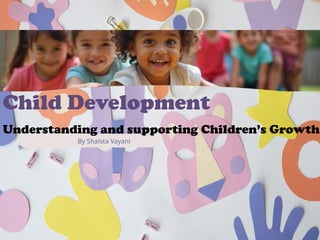
Child Development
Understanding and supporting Children’s Growth
What is Child Development?
Child Development includes
• Physical, emotional, cognitive, and social changes
• Each child is unique but follows general patterns
• Early years are critical for forming healthy
habits and strong brains
• Parents and caregivers play a vital role as first
teachers
• Development is a journey, not a race
• Early experiences shape learning, health, and behavior
• Strong foundation builds curiosity & emotional control
• Knowledge of development reduces misunderstandings
• Early support improves outcomes & empowers
caregivers to create loving and stimulating environments
Why is it important?
What are
Developmental Domain
Short video on Play: https://www.youtube.com/watch?v=SHO_L-7Rx1c
There are five developmental domains:
Physical, Cognitive, Language, Social and Emotional.
• All domains are connected and support each other.
• Activities should support all areas together.
• Observing domains helps track progress.
Developmental Domains
Physical Development
• Focuses on body growth and movement skills
• Involves gross motor skills like running and jumping
• Includes fine motor skills such as writing and cutting
• Improves strength, balance, and coordination
• Supports independence in daily tasks
• Affected by good nutrition, exercise, and health
Cognitive Development
•Involves thinking, learning, and problem-solving
•Helps develop memory, attention, and reasoning (video)
•Supports understanding of numbers, shapes, and time
•Encourages curiosity and exploration
•Builds foundation for school learning
•Strengthened by play and interaction with others
Language Development
•Involves speaking, listening, reading, and writing
•Builds vocabulary and communication skills
•Helps express thoughts and feelings clearly
•Supports social interaction and friendships
•Encouraged by storytelling and conversations
•Important for success in school and life
Social Development
•Focuses on relationships with others
•Involves sharing, cooperating, and taking turns
•Builds friendships and social confidence
•Teaches understanding of rules and fairness
•Supports teamwork and group activities
•Encouraged through play and family support
What is the Importance of
Play in Child Development?
Emotional Development
•Involves understanding and expressing emotions (video)
•Helps build self-confidence and self-control
•Supports coping with different feelings
•Teaches empathy and caring for others
•Strengthened by a safe, loving environment
•Important for overall mental well-being
Brain Development
The brain grows rapidly (90% by age 5)
Positive experiences build strong connections.
Responsive care, play, and nutrition are key.
Stressful environments can harm development. (video)
Play builds brain architecture and strengthens bonds.
Growth & Development
Growth is physical maturation resulting in increase
in the size of body parts and organ. It is a quantitative
change and stops after a certain age.
Factors effecting Growth & Development
• Heredity
• Nutrition
• Caregiver’s Attitude
• Stimulating Environment
Let’s watch a video
TED Talk: https://www.youtube.com/watch?
v=aISXCw0Pi94&t=311s
Milestones are skills most children achieve by certain ages
Milestones guide us but allow individual differences
Delays do not always mean problems
Tracking milestones helps parents and teachers
spot possible delays early on
Developmental Milestones
Achieving Milestones
• Sitting without support by 6–8 months, walking
around 12–15 months
• Saying first words around 12 months, simple
sentences by 2–3 years
• Playing with other children and sharing toys around
3–4 years
• Learning to dress themselves, follow simple
instructions, and understand feelings (video)
0–3 Months
•Lifts head briefly while on tummy
•Follows faces and objects with eyes
•Smiles at people (social smile)
•Makes cooing sounds and gurgles
•Opens & closes hands, brings hands
to mouth
•Recognizes caregiver’s voice and scent
•Turns head toward sounds
3–6 Months
•Rolls from tummy to back, then back
to tummy
•Reaches for and grasps objects
•Pushes up on arms during tummy time
•Recognizes familiar faces and responds
with excitement. Laughs and squeals
with joy
•Begins babbling (“ba,” “da”)
•Shows interest in surroundings
6–9 Months
•Sits without support
•Transfers objects between hands
•Starts crawling or scooting
•Responds to own name
•Understands “no” and simple words
•Imitates sounds and facial expressions
•Enjoys games like peekaboo
9–12 Months
•Pulls up to stand, may start cruising along
furniture
•Picks up small items using thumb and finger
(pincer grasp) and explores environment
eagerly
•Waves goodbye and claps hands
•Says simple words like “mama” or “dada”
•Understands simple instructions(come here
•Shows strong attachment to caregivers
1 to 2 Years
•Starts walking alone and may begin running
•Points to objects and pictures when named
•Says several single words and simple phrases
•Follows simple instructions (give me the ball)
•Shows interest in pretend play (feeding doll)
•Begins scribbling with crayons
•Shows growing independence & tantrums
2 to 3 Years
•Climbs on furniture and stairs by self
•Uses two- to three-word sentences
•Begins sorting shapes and colors
•Plays simple make-believe games
•Shows wide range of emotions
•Can dress and undress with help
•Follows two-step instructions (“pick up
toy and put it away”)
3 to 4 Years
•Rides tricycle or balances on one
foot
•Speaks in longer sentences and
tells simple stories
•Understands concepts like “same”
and “different”
•Plays cooperatively with other
children
•Draws simple shapes and people with
few parts
•Knows own name, age, and gender
•Shows affection and concern for friends
4–6 Years
•Hops, skips, and may start riding a
bicycle
•Uses full sentences, tells long stories
clearly
•Begins to read simple books and
write some words
•Understands basic time concepts
(“yesterday,” “tomorrow”)
•Knows own address and basic
personal information
•Draws more detailed people and shapes
•Plays cooperatively, understands turn-
taking and rules
•Shows strong emotions, starts controlling
impulses
•Enjoys group games and imaginative play
•Begins helping with simple chores at
home
6–8 Years
•Reads more fluently and enjoys
chapter books
•Solves more complex math
(addition, subtraction, simple
multiplication)
•Writes full sentences and short
paragraphs
•Develops close friendships and
values teamwork
•Shows stronger sense of empathy
• Can follow multi-step instructions
independently
• Enjoys hobbies, sports, and creative
activities
• Understands more abstract ideas
(time, money, cause and effect)
• Becomes more responsible with tasks
and belongings
• Expresses feelings and thoughts clearly
with others
Tracking and Supporting Development
• Observe children in daily routines.
• Use charts and checklists to track progress
• Talk, read, and sing to encourage growth
• Provide age-appropriate activities
• Celebrate achievements and seek help if worried
9
Create safe spaces for active play
and exploration.
4
3
Talk, read, and sing to build
language and thinking skills.
Supporting Development
Be patient and avoid comparing
children with each other.
5
Provide age-appropriate toys and
activities to encourage growth.
Regular discussions with teachers
and health workers can help.
Seek professional help if worried
about delays.
2
1
Watch children closely in daily
routines to understand their
abilities.
Celebrate progress rather than focusing only on gaps.
6
8
7
Use milestone charts from health
organizations or local clinics.
Early years are
especially important
for forming healthy
habits and strong
brains.
A supportive
environment shapes a
child’s future skills and
confidence.
Remember: Child
Development is not a
race but a journey.
Key Takeaways
Child development
describes the physical,
emotional, social, and
cognitive changes from
birth to adulthood.
Understanding
development helps us
support children’s
needs better.
Parents and caregivers
play a crucial role as
first teachers.
Each child is unique,
but there are common
patterns and
milestones.
Thank You for your time
and dedication!
Let’s support children to grow
& shine together…
References & Sources:
•Berk, L. E. (2022). Child development (10th ed.). Pearson.
•Centers for Disease Control and Prevention. (2024).
Child development: Milestones and information.
https://www.cdc.gov/ncbddd/childdevelopment/index.html
•Harvard University Center on the Developing Child. (n.d.).
Brain architecture.
https://developingchild.harvard.edu/science/key-concepts/brain-architecture/
•National Association for the Education of Young Children. (n.d.).
Developmentally appropriate practice. https://www.naeyc.org/resources/topics/dap
•UNICEF. (2024).
Early childhood development. https://www.unicef.org/early-childhood-development
•World Health Organization. (2024).
Early child development. https://www.who.int/health-topics/early-child-development

Child Development Final Presentation.pptx

  • 1.
    By Shaista Vayani ChildDevelopment Understanding and supporting Children’s Growth
  • 2.
    What is ChildDevelopment?
  • 3.
    Child Development includes •Physical, emotional, cognitive, and social changes • Each child is unique but follows general patterns • Early years are critical for forming healthy habits and strong brains • Parents and caregivers play a vital role as first teachers • Development is a journey, not a race
  • 4.
    • Early experiencesshape learning, health, and behavior • Strong foundation builds curiosity & emotional control • Knowledge of development reduces misunderstandings • Early support improves outcomes & empowers caregivers to create loving and stimulating environments Why is it important?
  • 5.
    What are Developmental Domain Shortvideo on Play: https://www.youtube.com/watch?v=SHO_L-7Rx1c
  • 6.
    There are fivedevelopmental domains: Physical, Cognitive, Language, Social and Emotional. • All domains are connected and support each other. • Activities should support all areas together. • Observing domains helps track progress. Developmental Domains
  • 7.
    Physical Development • Focuseson body growth and movement skills • Involves gross motor skills like running and jumping • Includes fine motor skills such as writing and cutting • Improves strength, balance, and coordination • Supports independence in daily tasks • Affected by good nutrition, exercise, and health
  • 8.
    Cognitive Development •Involves thinking,learning, and problem-solving •Helps develop memory, attention, and reasoning (video) •Supports understanding of numbers, shapes, and time •Encourages curiosity and exploration •Builds foundation for school learning •Strengthened by play and interaction with others
  • 9.
    Language Development •Involves speaking,listening, reading, and writing •Builds vocabulary and communication skills •Helps express thoughts and feelings clearly •Supports social interaction and friendships •Encouraged by storytelling and conversations •Important for success in school and life
  • 10.
    Social Development •Focuses onrelationships with others •Involves sharing, cooperating, and taking turns •Builds friendships and social confidence •Teaches understanding of rules and fairness •Supports teamwork and group activities •Encouraged through play and family support
  • 11.
    What is theImportance of Play in Child Development?
  • 12.
    Emotional Development •Involves understandingand expressing emotions (video) •Helps build self-confidence and self-control •Supports coping with different feelings •Teaches empathy and caring for others •Strengthened by a safe, loving environment •Important for overall mental well-being
  • 13.
    Brain Development The braingrows rapidly (90% by age 5) Positive experiences build strong connections. Responsive care, play, and nutrition are key. Stressful environments can harm development. (video) Play builds brain architecture and strengthens bonds.
  • 14.
    Growth & Development Growthis physical maturation resulting in increase in the size of body parts and organ. It is a quantitative change and stops after a certain age.
  • 15.
    Factors effecting Growth& Development • Heredity • Nutrition • Caregiver’s Attitude • Stimulating Environment
  • 16.
    Let’s watch avideo TED Talk: https://www.youtube.com/watch? v=aISXCw0Pi94&t=311s
  • 17.
    Milestones are skillsmost children achieve by certain ages Milestones guide us but allow individual differences Delays do not always mean problems Tracking milestones helps parents and teachers spot possible delays early on Developmental Milestones
  • 18.
    Achieving Milestones • Sittingwithout support by 6–8 months, walking around 12–15 months • Saying first words around 12 months, simple sentences by 2–3 years • Playing with other children and sharing toys around 3–4 years • Learning to dress themselves, follow simple instructions, and understand feelings (video)
  • 19.
    0–3 Months •Lifts headbriefly while on tummy •Follows faces and objects with eyes •Smiles at people (social smile) •Makes cooing sounds and gurgles •Opens & closes hands, brings hands to mouth •Recognizes caregiver’s voice and scent •Turns head toward sounds 3–6 Months •Rolls from tummy to back, then back to tummy •Reaches for and grasps objects •Pushes up on arms during tummy time •Recognizes familiar faces and responds with excitement. Laughs and squeals with joy •Begins babbling (“ba,” “da”) •Shows interest in surroundings
  • 20.
    6–9 Months •Sits withoutsupport •Transfers objects between hands •Starts crawling or scooting •Responds to own name •Understands “no” and simple words •Imitates sounds and facial expressions •Enjoys games like peekaboo 9–12 Months •Pulls up to stand, may start cruising along furniture •Picks up small items using thumb and finger (pincer grasp) and explores environment eagerly •Waves goodbye and claps hands •Says simple words like “mama” or “dada” •Understands simple instructions(come here •Shows strong attachment to caregivers
  • 21.
    1 to 2Years •Starts walking alone and may begin running •Points to objects and pictures when named •Says several single words and simple phrases •Follows simple instructions (give me the ball) •Shows interest in pretend play (feeding doll) •Begins scribbling with crayons •Shows growing independence & tantrums 2 to 3 Years •Climbs on furniture and stairs by self •Uses two- to three-word sentences •Begins sorting shapes and colors •Plays simple make-believe games •Shows wide range of emotions •Can dress and undress with help •Follows two-step instructions (“pick up toy and put it away”)
  • 22.
    3 to 4Years •Rides tricycle or balances on one foot •Speaks in longer sentences and tells simple stories •Understands concepts like “same” and “different” •Plays cooperatively with other children •Draws simple shapes and people with few parts •Knows own name, age, and gender •Shows affection and concern for friends
  • 23.
    4–6 Years •Hops, skips,and may start riding a bicycle •Uses full sentences, tells long stories clearly •Begins to read simple books and write some words •Understands basic time concepts (“yesterday,” “tomorrow”) •Knows own address and basic personal information •Draws more detailed people and shapes •Plays cooperatively, understands turn- taking and rules •Shows strong emotions, starts controlling impulses •Enjoys group games and imaginative play •Begins helping with simple chores at home
  • 24.
    6–8 Years •Reads morefluently and enjoys chapter books •Solves more complex math (addition, subtraction, simple multiplication) •Writes full sentences and short paragraphs •Develops close friendships and values teamwork •Shows stronger sense of empathy • Can follow multi-step instructions independently • Enjoys hobbies, sports, and creative activities • Understands more abstract ideas (time, money, cause and effect) • Becomes more responsible with tasks and belongings • Expresses feelings and thoughts clearly with others
  • 25.
    Tracking and SupportingDevelopment • Observe children in daily routines. • Use charts and checklists to track progress • Talk, read, and sing to encourage growth • Provide age-appropriate activities • Celebrate achievements and seek help if worried
  • 26.
    9 Create safe spacesfor active play and exploration. 4 3 Talk, read, and sing to build language and thinking skills. Supporting Development Be patient and avoid comparing children with each other. 5 Provide age-appropriate toys and activities to encourage growth. Regular discussions with teachers and health workers can help. Seek professional help if worried about delays. 2 1 Watch children closely in daily routines to understand their abilities. Celebrate progress rather than focusing only on gaps. 6 8 7 Use milestone charts from health organizations or local clinics.
  • 27.
    Early years are especiallyimportant for forming healthy habits and strong brains. A supportive environment shapes a child’s future skills and confidence. Remember: Child Development is not a race but a journey. Key Takeaways Child development describes the physical, emotional, social, and cognitive changes from birth to adulthood. Understanding development helps us support children’s needs better. Parents and caregivers play a crucial role as first teachers. Each child is unique, but there are common patterns and milestones.
  • 28.
    Thank You foryour time and dedication! Let’s support children to grow & shine together…
  • 29.
    References & Sources: •Berk,L. E. (2022). Child development (10th ed.). Pearson. •Centers for Disease Control and Prevention. (2024). Child development: Milestones and information. https://www.cdc.gov/ncbddd/childdevelopment/index.html •Harvard University Center on the Developing Child. (n.d.). Brain architecture. https://developingchild.harvard.edu/science/key-concepts/brain-architecture/ •National Association for the Education of Young Children. (n.d.). Developmentally appropriate practice. https://www.naeyc.org/resources/topics/dap •UNICEF. (2024). Early childhood development. https://www.unicef.org/early-childhood-development •World Health Organization. (2024). Early child development. https://www.who.int/health-topics/early-child-development

Editor's Notes

  • #5 Short video on play: https://www.youtube.com/watch?v=SHO_L-7Rx1c
  • #8 Play in Cognitive development: https://www.youtube.com/watch?v=lbLqRMuxtUI
  • #12 Another video on play: https://www.youtube.com/watch?v=nMp7sWRn2Bw
  • #13 https://www.youtube.com/watch?v=7Qb3DXY_7fU
  • #18 Milestones by Peadiatricians: https://www.youtube.com/watch?v=g4HdXxz25pw
  • #27 https://www.youtube.com/watch?v=SHO_L-7Rx1c The whole child video