CHI SQUARE TEST
INTRODUCTION
● A chi-squared test (symbolically represented as χ2) is basically a data
analysis on the basis of observations of a random set of variables.
● Usually, it is a comparison of two statistical data sets.
● This test was introduced by Karl Pearson in 1900 for categorical data
analysis and distribution. So it was mentioned as Pearson’s chi-
squared test.
● A chi-square test is a statistical test that is used to compare
observed and expected results.
● It estimates the size of inconsistency between the expected results
and the actual results when the size of the sample and the number
of variables in the relationship is mentioned.
● As a result, the chi-square test is an ideal choice for aiding in our
understanding and interpretation of the connection between our
two categorical variables.
WHO USES CHI SQUARE ANALYSIS ?
● Chi-square is most commonly used by researchers who
are studying survey response data because it applies to
categorical variables.
● Demography, consumer and marketing research,
political science, and economics are all examples of this
type of research.
CHI - SQUARE DISTRIBUTION
● When we consider, the null speculation as true, the sampling distribution of
the test statistic is called as chi-squared distribution.
● The chi-squared test helps to determine whether there is a notable difference
between the normal frequencies and the observed frequencies in one or more
classes or categories. It gives the probability of independent variables.
● Note: Chi-squared test is applicable only for categorical data, such as men and
women falling under the categories of Gender, Age, Height, etc.
FORMULA
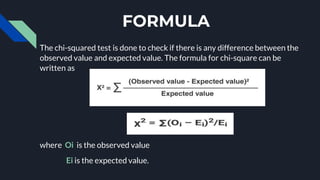
The chi-squared test is done to check if there is any difference between the
observed value and expected value. The formula for chi-square can be
written as
where Oi is the observed value
Ei is the expected value.
How to calculate CHI SQUARE TEST ?
The value of the Chi-squared statistic can be calculated using the formula given below:
For each observed number in the data,
subtract the expected value, i.e. (O — E).
Square the difference, (O — E)^2
Divide these squares by the expected value of each observation. i.e. [(O – E)^2 / E]
Now sum of these values.
Thus, the obtained value will be the chi-squared statistic.
EXAMPLE
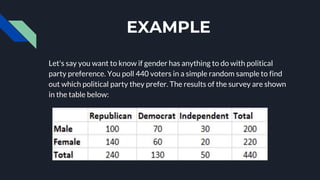
Let's say you want to know if gender has anything to do with political
party preference. You poll 440 voters in a simple random sample to find
out which political party they prefer. The results of the survey are shown
in the table below:
Step 1: Define the Hypothesis
H0: There is no link between gender and political party preference.
H1: There is a link between gender and political party preference.
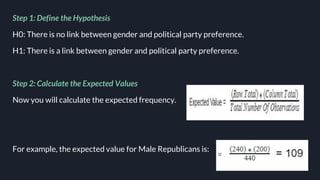
Step 2: Calculate the Expected Values
Now you will calculate the expected frequency.
For example, the expected value for Male Republicans is:
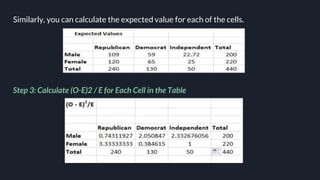
Similarly, you can calculate the expected value for each of the cells.
Step 3: Calculate (O-E)2 / E for Each Cell in the Table
Step 4: Calculate the Test Statistic X2
X2 is the sum of all the values in the last table
= 0.743 + 2.05 + 2.33 + 3.33 + 0.384 + 1
= 9.837
Before you can conclude, you must first determine the critical statistic,
which requires determining our degrees of freedom. The degrees of freedom
in this case are equal to the table's number of columns minus one multiplied
by the table's number of rows minus one, or (r-1) (c-1). We have (3-1)(2-1) =
2.
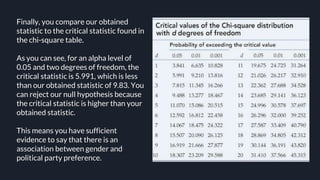
Finally, you compare our obtained
statistic to the critical statistic found in
the chi-square table.
As you can see, for an alpha level of
0.05 and two degrees of freedom, the
critical statistic is 5.991, which is less
than our obtained statistic of 9.83. You
can reject our null hypothesis because
the critical statistic is higher than your
obtained statistic.
This means you have sufficient
evidence to say that there is an
association between gender and
political party preference.
THANK YOU

Chi square test evidence based dentistry

  • 1.
  • 2.
    INTRODUCTION ● A chi-squaredtest (symbolically represented as χ2) is basically a data analysis on the basis of observations of a random set of variables. ● Usually, it is a comparison of two statistical data sets. ● This test was introduced by Karl Pearson in 1900 for categorical data analysis and distribution. So it was mentioned as Pearson’s chi- squared test.
  • 3.
    ● A chi-squaretest is a statistical test that is used to compare observed and expected results. ● It estimates the size of inconsistency between the expected results and the actual results when the size of the sample and the number of variables in the relationship is mentioned. ● As a result, the chi-square test is an ideal choice for aiding in our understanding and interpretation of the connection between our two categorical variables.
  • 4.
    WHO USES CHISQUARE ANALYSIS ? ● Chi-square is most commonly used by researchers who are studying survey response data because it applies to categorical variables. ● Demography, consumer and marketing research, political science, and economics are all examples of this type of research.
  • 5.
    CHI - SQUAREDISTRIBUTION ● When we consider, the null speculation as true, the sampling distribution of the test statistic is called as chi-squared distribution. ● The chi-squared test helps to determine whether there is a notable difference between the normal frequencies and the observed frequencies in one or more classes or categories. It gives the probability of independent variables. ● Note: Chi-squared test is applicable only for categorical data, such as men and women falling under the categories of Gender, Age, Height, etc.
  • 6.
    FORMULA The chi-squared testis done to check if there is any difference between the observed value and expected value. The formula for chi-square can be written as where Oi is the observed value Ei is the expected value.
  • 7.
    How to calculateCHI SQUARE TEST ? The value of the Chi-squared statistic can be calculated using the formula given below: For each observed number in the data, subtract the expected value, i.e. (O — E). Square the difference, (O — E)^2 Divide these squares by the expected value of each observation. i.e. [(O – E)^2 / E] Now sum of these values. Thus, the obtained value will be the chi-squared statistic.
  • 8.
    EXAMPLE Let's say youwant to know if gender has anything to do with political party preference. You poll 440 voters in a simple random sample to find out which political party they prefer. The results of the survey are shown in the table below:
  • 9.
    Step 1: Definethe Hypothesis H0: There is no link between gender and political party preference. H1: There is a link between gender and political party preference. Step 2: Calculate the Expected Values Now you will calculate the expected frequency. For example, the expected value for Male Republicans is:
  • 10.
    Similarly, you cancalculate the expected value for each of the cells. Step 3: Calculate (O-E)2 / E for Each Cell in the Table
  • 11.
    Step 4: Calculatethe Test Statistic X2 X2 is the sum of all the values in the last table = 0.743 + 2.05 + 2.33 + 3.33 + 0.384 + 1 = 9.837 Before you can conclude, you must first determine the critical statistic, which requires determining our degrees of freedom. The degrees of freedom in this case are equal to the table's number of columns minus one multiplied by the table's number of rows minus one, or (r-1) (c-1). We have (3-1)(2-1) = 2.
  • 12.
    Finally, you compareour obtained statistic to the critical statistic found in the chi-square table. As you can see, for an alpha level of 0.05 and two degrees of freedom, the critical statistic is 5.991, which is less than our obtained statistic of 9.83. You can reject our null hypothesis because the critical statistic is higher than your obtained statistic. This means you have sufficient evidence to say that there is an association between gender and political party preference.
  • 13.