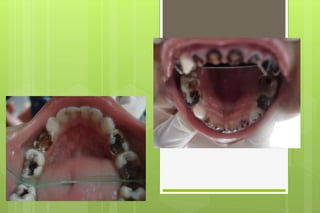
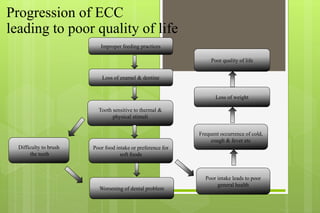
Progression of ECC
leading to poor quality of life
Improper feeding practices
Loss of enamel & dentine
Tooth sensitive to thermal &
physical stimuli
Poor food intake or preference for
soft foods
Worsening of dental problem
Frequent occurrence of cold,
cough & fever etc
Poor intake leads to poor
general health
Difficulty to brush
the teeth
Poor quality of life
Loss of weight
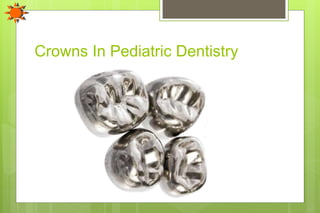
Crowns In Pediatric Dentistry
Introduction
 Introduced by Dr. William Humphrey in 1950
 Stainless steel (preformed) crowns are prefabricated crown forms
which can be adapted to individual primary molars and cemented
in place to provide a definitive restoration.
 Superior to large multi-surface amalgam restorations with longer
clinical lifespan
Classification of preformed metal crowns
 Based on Morphology
a. Untrimmed/Uncontoured crowns (e.g. Rocky mountain)
b. Pre trimmed crowns (e.g. Unitek stainless steel crowns, 3M
and Denovo Crowns).
c. Precontoured crowns (e.g. Ni-Chro Ion crowns and Unitek
stainless steel crowns)
Based on composition
1.Stainless steel Crowns
(18-8) Austentic Steel (Rocky Mountain, Unitek)
17-19% chromium
9-13% nickel
0.08-0.12%carbon
4% minor elements
2. Nickel-base crowns:
72 % nickel
14% chromium
6-10% Fe
0.04% carbon
0.35% manganese
0.2% silicon
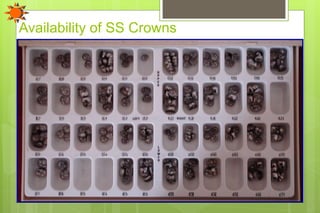
Availability of SS Crowns
Indications of SS Crown Restorations
1. Extensive decay in primary teeth
2. Following Pulp therapy
3. As a Preventive restoration
4. For teeth with developmental defects & anomalies
5. As an Abutment for a space maintainer or denture
6. Temporary restoration of Fractured incisors
7. In severe cases of Bruxism
8. Single Tooth Crossbite
9. Interim restoration until a more permanent
restoration can be done
Contraindications of SS Crown
Restorations
Esthetics
Teeth that are nearing exfoliation
Allergy
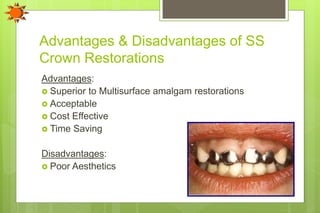
Advantages & Disadvantages of SS
Crown Restorations
Advantages:
 Superior to Multisurface amalgam restorations
 Acceptable
 Cost Effective
 Time Saving
Disadvantages:
 Poor Aesthetics
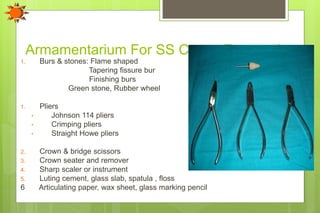
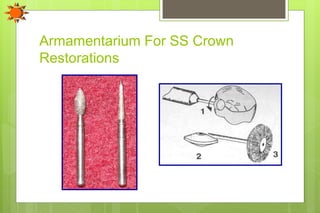
Armamentarium For SS Crown Restorations
1. Burs & stones: Flame shaped
Tapering fissure bur
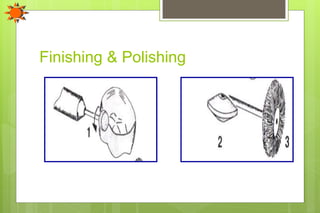
Finishing burs
Green stone, Rubber wheel
1. Pliers
• Johnson 114 pliers
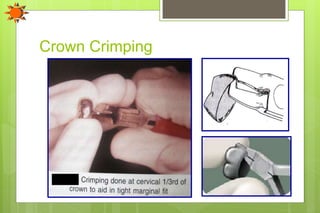
• Crimping pliers
• Straight Howe pliers
2. Crown & bridge scissors
3. Crown seater and remover
4. Sharp scaler or instrument
5. Luting cement, glass slab, spatula , floss
6 Articulating paper, wax sheet, glass marking pencil
Armamentarium For SS Crown
Restorations
Factors to be considered in preoperative
evaluation of patients for SS crown restorations
1. Dental age of the patient
2. Co-operation of the Patient
3. Motivation of the Parents
4. Medically compromised / Disabled Children
Clinical Procedure
Preliminary steps:
 Evaluate the preoperative occlusion
- replicate the existing occlusion
- assess dental midline and cusp fossa relation
- wax bite registration
 Local anesthesia
 Removal of Decay
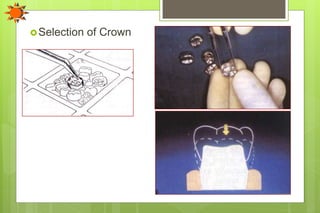
Selection of Crown
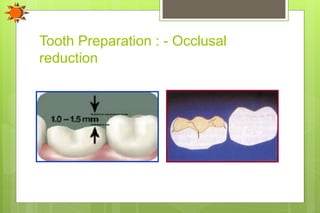
Tooth Preparation : - Occlusal
reduction
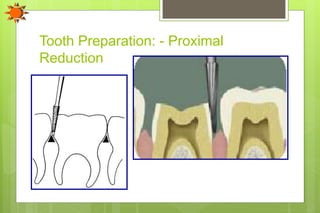
Tooth Preparation: - Proximal
Reduction
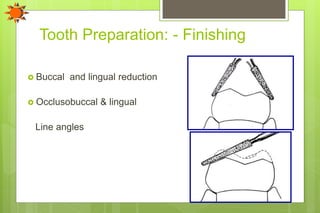
Tooth Preparation: - Finishing
 Buccal and lingual reduction
 Occlusobuccal & lingual
Line angles
Evaluation of tooth preparation
 Occlusal clearance
 Proximal contour
 Ledge formation
 Feather edge
 Buccal and lingual convergence
 Point angles and line angles
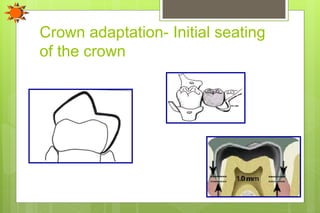
Crown adaptation- Initial seating
of the crown
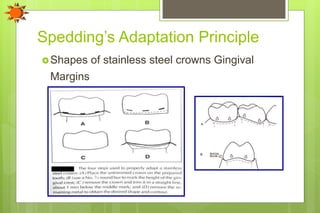
Spedding’s Adaptation Principle
Shapes of stainless steel crowns Gingival
Margins
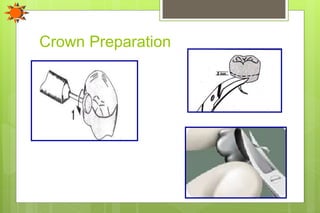
Crown Preparation
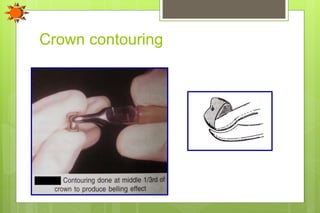
Crown contouring
Crown Crimping
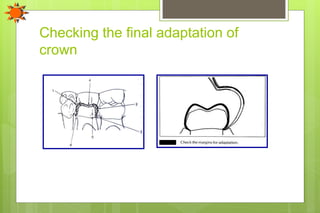
Checking the final adaptation of
crown
Finishing & Polishing
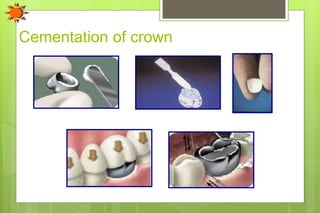
Cementation of crown
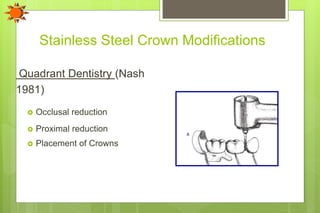
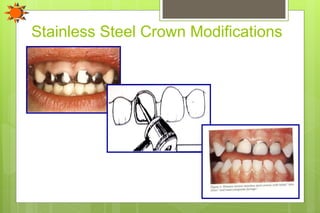
Stainless Steel Crown Modifications
Quadrant Dentistry (Nash
1981)
 Occlusal reduction
 Proximal reduction
 Placement of Crowns
Preparing a SS crown adjacent to a class II Amalgam
Restoration (Mc Evoy 1985)
Tooth preparation & class 2 cavity preparation
Cement the crown
Followed by adapt wedge & matrix band and amalgam
restoration
Space loss cases
 More than usual reduction in the tooth to be
crowned can be done- myers
Stainless Steel Crown Size Modifications
(MINK & HILL)
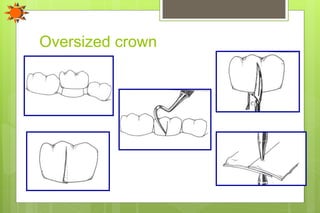
Oversized crown
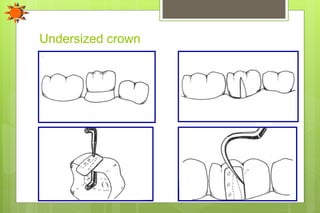
Undersized crown
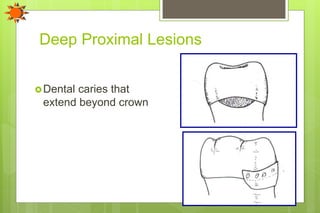
Deep Proximal Lesions
Dental caries that
extend beyond crown
4. Open contact
 Causes food packing, increased plaque retention and
subsequent gingivitis.
 Select a larger crown or an exaggerated interproximal
contour can be obtained with a 112( ball and socket) plier
to establish a closed contact.
 Interproximal contour can also be built by addition of
solder.
Stainless Steel Crown Modifications
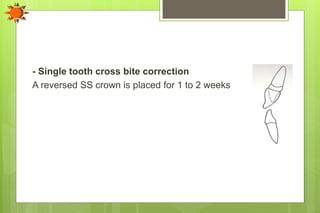
- Single tooth cross bite correction
A reversed SS crown is placed for 1 to 2 weeks
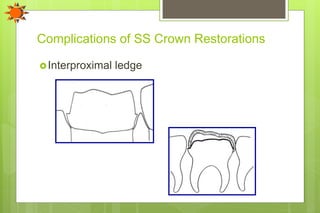
Complications of SS Crown Restorations
Interproximal ledge
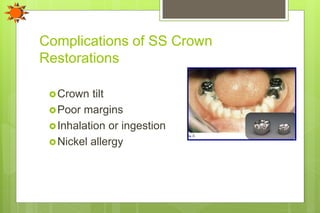
Complications of SS Crown
Restorations
Crown tilt
Poor margins
Inhalation or ingestion
Nickel allergy
SS Crowns for Permanent molars
Indications
 Extensive Caries
 Interim restoration
 Endodontic outcome uncertain
 Traumatically #ed Posterior tooth
 Developmental malformation
Crowns for primary anterior teeth
 Objectives of anterior aesthetic full coverage restorations
 Restoration of aesthetics
 Preventing psychological trauma
 Restoring the function
 Preventing #
 Indications
Multiple surface caries, incisal edges involved, high-risk patients,
extensive cervical decay, pulp therapy.
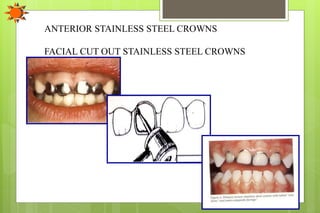
ANTERIOR STAINLESS STEEL CROWNS
FACIAL CUT OUT STAINLESS STEEL CROWNS
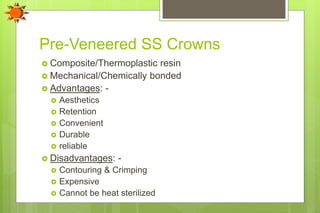
Pre-Veneered SS Crowns
 Composite/Thermoplastic resin
 Mechanical/Chemically bonded
 Advantages: -
 Aesthetics
 Retention
 Convenient
 Durable
 reliable
 Disadvantages: -
 Contouring & Crimping
 Expensive
 Cannot be heat sterilized
Commercially availbale veneered
SSC
 Cheng crowns
 Dura crowns
 Kinder krowns
 Pedo pearls
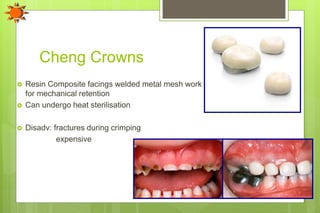
Cheng Crowns
 Resin Composite facings welded metal mesh work
for mechanical retention
 Can undergo heat sterilisation
 Disadv: fractures during crimping
expensive
Dura crowns
Crimped labially and lingually
Easily trimmed with scissors
Easily festooned
Full knife edge
More retentive than non-veneered
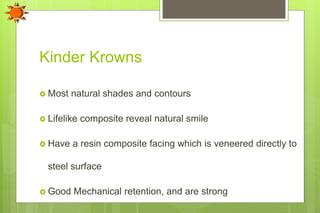
Kinder Krowns
 Most natural shades and contours
 Lifelike composite reveal natural smile
 Have a resin composite facing which is veneered directly to
steel surface
 Good Mechanical retention, and are strong
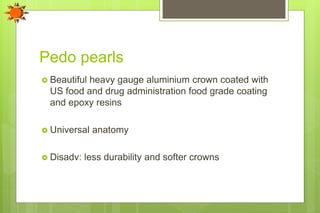
Pedo pearls
 Beautiful heavy gauge aluminium crown coated with
US food and drug administration food grade coating
and epoxy resins
 Universal anatomy
 Disadv: less durability and softer crowns
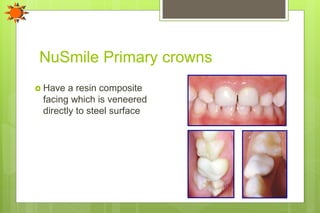
NuSmile Primary crowns
 Have a resin composite
facing which is veneered
directly to steel surface
Polycarbonate crowns
• Easy to trim
• Good anatomic form and esthetics in a wide range of sizes for incisors, canines and
premolars.
• Universal shade.
• Smooth surface finish.
• Polycarbonates are aromatic linear polyesters of carbonic acid
• Termed as thermoplastic resins, they are molded as solids by heat and pressure
into the desired form
• It is esthetic than SSC
• Extremely stable dimensionally and unaffected by acids, ether and alcohol
• Lack strength, DO NOT RESIS STRONG ABRASIVE FORCES- FRACTURE
• POOR ABRASION RESISTANCE
• Not indicated in bruxism and deep bite
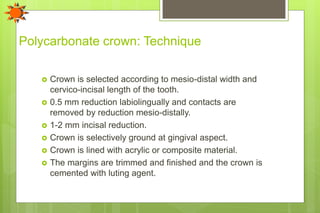
Polycarbonate crown: Technique
 Crown is selected according to mesio-distal width and
cervico-incisal length of the tooth.
 0.5 mm reduction labiolingually and contacts are
removed by reduction mesio-distally.
 1-2 mm incisal reduction.
 Crown is selectively ground at gingival aspect.
 Crown is lined with acrylic or composite material.
 The margins are trimmed and finished and the crown is
cemented with luting agent.
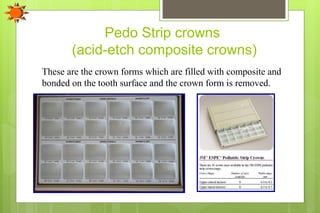
Pedo Strip crowns
(acid-etch composite crowns)
These are the crown forms which are filled with composite and
bonded on the tooth surface and the crown form is removed.
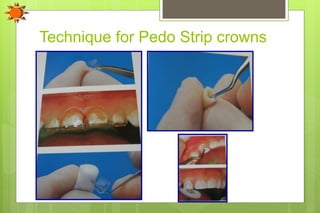
Technique for Pedo Strip crowns
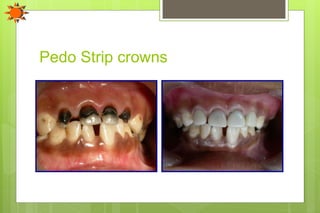
Pedo Strip crowns
Thank you..

Crowns in pediatric dentistry.ppt

  • 2.
    Progression of ECC leadingto poor quality of life Improper feeding practices Loss of enamel & dentine Tooth sensitive to thermal & physical stimuli Poor food intake or preference for soft foods Worsening of dental problem Frequent occurrence of cold, cough & fever etc Poor intake leads to poor general health Difficulty to brush the teeth Poor quality of life Loss of weight
  • 4.
  • 5.
    Introduction  Introduced byDr. William Humphrey in 1950  Stainless steel (preformed) crowns are prefabricated crown forms which can be adapted to individual primary molars and cemented in place to provide a definitive restoration.  Superior to large multi-surface amalgam restorations with longer clinical lifespan
  • 6.
    Classification of preformedmetal crowns  Based on Morphology a. Untrimmed/Uncontoured crowns (e.g. Rocky mountain) b. Pre trimmed crowns (e.g. Unitek stainless steel crowns, 3M and Denovo Crowns). c. Precontoured crowns (e.g. Ni-Chro Ion crowns and Unitek stainless steel crowns)
  • 7.
    Based on composition 1.Stainlesssteel Crowns (18-8) Austentic Steel (Rocky Mountain, Unitek) 17-19% chromium 9-13% nickel 0.08-0.12%carbon 4% minor elements 2. Nickel-base crowns: 72 % nickel 14% chromium 6-10% Fe 0.04% carbon 0.35% manganese 0.2% silicon
  • 8.
  • 9.
    Indications of SSCrown Restorations 1. Extensive decay in primary teeth 2. Following Pulp therapy 3. As a Preventive restoration 4. For teeth with developmental defects & anomalies 5. As an Abutment for a space maintainer or denture 6. Temporary restoration of Fractured incisors 7. In severe cases of Bruxism 8. Single Tooth Crossbite 9. Interim restoration until a more permanent restoration can be done
  • 10.
    Contraindications of SSCrown Restorations Esthetics Teeth that are nearing exfoliation Allergy
  • 11.
    Advantages & Disadvantagesof SS Crown Restorations Advantages:  Superior to Multisurface amalgam restorations  Acceptable  Cost Effective  Time Saving Disadvantages:  Poor Aesthetics
  • 12.
    Armamentarium For SSCrown Restorations 1. Burs & stones: Flame shaped Tapering fissure bur Finishing burs Green stone, Rubber wheel 1. Pliers • Johnson 114 pliers • Crimping pliers • Straight Howe pliers 2. Crown & bridge scissors 3. Crown seater and remover 4. Sharp scaler or instrument 5. Luting cement, glass slab, spatula , floss 6 Articulating paper, wax sheet, glass marking pencil
  • 13.
    Armamentarium For SSCrown Restorations
  • 14.
    Factors to beconsidered in preoperative evaluation of patients for SS crown restorations 1. Dental age of the patient 2. Co-operation of the Patient 3. Motivation of the Parents 4. Medically compromised / Disabled Children
  • 15.
    Clinical Procedure Preliminary steps: Evaluate the preoperative occlusion - replicate the existing occlusion - assess dental midline and cusp fossa relation - wax bite registration  Local anesthesia  Removal of Decay
  • 16.
  • 17.
    Tooth Preparation :- Occlusal reduction
  • 18.
    Tooth Preparation: -Proximal Reduction
  • 19.
    Tooth Preparation: -Finishing  Buccal and lingual reduction  Occlusobuccal & lingual Line angles
  • 20.
    Evaluation of toothpreparation  Occlusal clearance  Proximal contour  Ledge formation  Feather edge  Buccal and lingual convergence  Point angles and line angles
  • 21.
    Crown adaptation- Initialseating of the crown
  • 22.
    Spedding’s Adaptation Principle Shapesof stainless steel crowns Gingival Margins
  • 23.
  • 24.
  • 25.
  • 26.
    Checking the finaladaptation of crown
  • 27.
  • 28.
  • 29.
    Stainless Steel CrownModifications Quadrant Dentistry (Nash 1981)  Occlusal reduction  Proximal reduction  Placement of Crowns
  • 30.
    Preparing a SScrown adjacent to a class II Amalgam Restoration (Mc Evoy 1985) Tooth preparation & class 2 cavity preparation Cement the crown Followed by adapt wedge & matrix band and amalgam restoration
  • 31.
    Space loss cases More than usual reduction in the tooth to be crowned can be done- myers
  • 32.
    Stainless Steel CrownSize Modifications (MINK & HILL)
  • 33.
  • 34.
  • 35.
    Deep Proximal Lesions Dentalcaries that extend beyond crown
  • 36.
    4. Open contact Causes food packing, increased plaque retention and subsequent gingivitis.  Select a larger crown or an exaggerated interproximal contour can be obtained with a 112( ball and socket) plier to establish a closed contact.  Interproximal contour can also be built by addition of solder.
  • 37.
    Stainless Steel CrownModifications
  • 38.
    - Single toothcross bite correction A reversed SS crown is placed for 1 to 2 weeks
  • 39.
    Complications of SSCrown Restorations Interproximal ledge
  • 40.
    Complications of SSCrown Restorations Crown tilt Poor margins Inhalation or ingestion Nickel allergy
  • 41.
    SS Crowns forPermanent molars Indications  Extensive Caries  Interim restoration  Endodontic outcome uncertain  Traumatically #ed Posterior tooth  Developmental malformation
  • 42.
    Crowns for primaryanterior teeth  Objectives of anterior aesthetic full coverage restorations  Restoration of aesthetics  Preventing psychological trauma  Restoring the function  Preventing #  Indications Multiple surface caries, incisal edges involved, high-risk patients, extensive cervical decay, pulp therapy.
  • 43.
    ANTERIOR STAINLESS STEELCROWNS FACIAL CUT OUT STAINLESS STEEL CROWNS
  • 44.
    Pre-Veneered SS Crowns Composite/Thermoplastic resin  Mechanical/Chemically bonded  Advantages: -  Aesthetics  Retention  Convenient  Durable  reliable  Disadvantages: -  Contouring & Crimping  Expensive  Cannot be heat sterilized
  • 45.
    Commercially availbale veneered SSC Cheng crowns  Dura crowns  Kinder krowns  Pedo pearls
  • 46.
    Cheng Crowns  ResinComposite facings welded metal mesh work for mechanical retention  Can undergo heat sterilisation  Disadv: fractures during crimping expensive
  • 47.
    Dura crowns Crimped labiallyand lingually Easily trimmed with scissors Easily festooned Full knife edge More retentive than non-veneered
  • 48.
    Kinder Krowns  Mostnatural shades and contours  Lifelike composite reveal natural smile  Have a resin composite facing which is veneered directly to steel surface  Good Mechanical retention, and are strong
  • 49.
    Pedo pearls  Beautifulheavy gauge aluminium crown coated with US food and drug administration food grade coating and epoxy resins  Universal anatomy  Disadv: less durability and softer crowns
  • 50.
    NuSmile Primary crowns Have a resin composite facing which is veneered directly to steel surface
  • 51.
    Polycarbonate crowns • Easyto trim • Good anatomic form and esthetics in a wide range of sizes for incisors, canines and premolars. • Universal shade. • Smooth surface finish. • Polycarbonates are aromatic linear polyesters of carbonic acid • Termed as thermoplastic resins, they are molded as solids by heat and pressure into the desired form • It is esthetic than SSC • Extremely stable dimensionally and unaffected by acids, ether and alcohol • Lack strength, DO NOT RESIS STRONG ABRASIVE FORCES- FRACTURE • POOR ABRASION RESISTANCE • Not indicated in bruxism and deep bite
  • 52.
    Polycarbonate crown: Technique Crown is selected according to mesio-distal width and cervico-incisal length of the tooth.  0.5 mm reduction labiolingually and contacts are removed by reduction mesio-distally.  1-2 mm incisal reduction.  Crown is selectively ground at gingival aspect.  Crown is lined with acrylic or composite material.  The margins are trimmed and finished and the crown is cemented with luting agent.
  • 53.
    Pedo Strip crowns (acid-etchcomposite crowns) These are the crown forms which are filled with composite and bonded on the tooth surface and the crown form is removed.
  • 54.
    Technique for PedoStrip crowns
  • 55.
  • 56.

Editor's Notes

  • #6 Semi permanent restorations are those which last for months or years preserving the function of primary teeth until their normal exfoliation (Braff 1982).
  • #53 Water is applied and the crown should be removed several times so that the Acrylic dissipates the heat while setting. Blanching should be checked to avoid over extention.