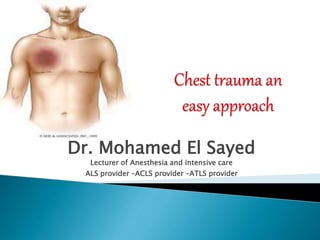
Dr. Mohamed El Sayed
Lecturer of Anesthesia and intensive care
ALS provider –ACLS provider –ATLS provider
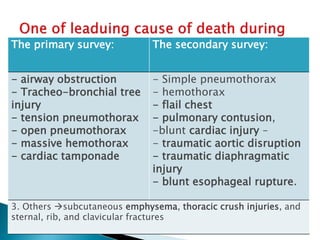
The primary survey: The secondary survey:
- airway obstruction
- Tracheo-bronchial tree
injury
- tension pneumothorax
- open pneumothorax
- massive hemothorax
- cardiac tamponade
- Simple pneumothorax
- hemothorax
- flail chest
- pulmonary contusion,
-blunt cardiac injury –
- traumatic aortic disruption
- traumatic diaphragmatic
injury
- blunt esophageal rupture.
3. Others subcutaneous emphysema, thoracic crush injuries, and
sternal, rib, and clavicular fractures
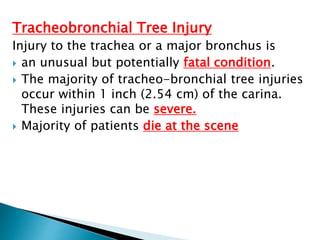
Tracheobronchial Tree Injury
Injury to the trachea or a major bronchus is
 an unusual but potentially fatal condition.
 The majority of tracheo-bronchial tree injuries
occur within 1 inch (2.54 cm) of the carina.
These injuries can be severe.
 Majority of patients die at the scene
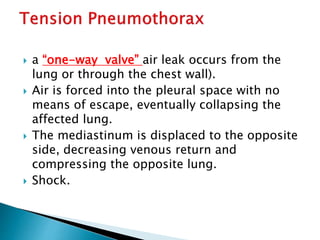
 a “one-way valve” air leak occurs from the
lung or through the chest wall).
 Air is forced into the pleural space with no
means of escape, eventually collapsing the
affected lung.
 The mediastinum is displaced to the opposite
side, decreasing venous return and
compressing the opposite lung.
 Shock.
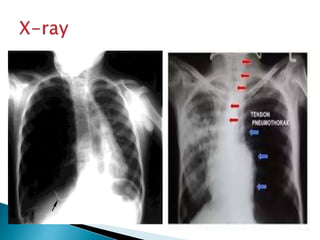
Tension pneumothorax
is a clinical diagnosis
reflecting air under
pressure in the
affected pleural
space.
Do not delay treatment
to obtain radiologic
confirmation.
 Patients who are mechanically ventilated manifest
hemodynamic collapse.
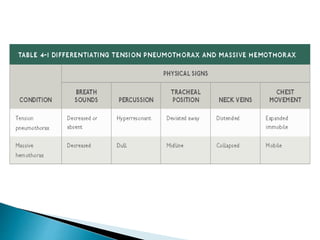
 Tension pneumothorax is characterized by some or
all of the following signs and symptoms:
 Chest pain + Air hunger
 Tachypnea + Respiratory distress
 Tachycardia + Hypotension
 Tracheal deviation away from the side of the injury
 Unilateral absence of breath sounds
 Elevated hemithorax without respiratory movement
 • Neck vein distention
 • Cyanosis (late manifestation)
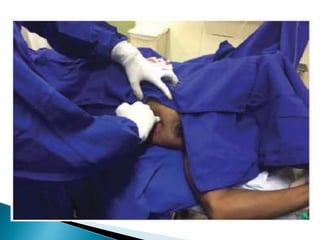
 Recent evidence supports placing the
large, over-the-needle catheter at the
fifth inter-space, slightly anterior to
the mid-axillary line.
 Successful needle decompression
converts tension pneumothorax to a
simple pneumothorax.
 Tube thoracostomy is mandatory after
needle or finger decompression of the
chest
** Open Pneumothorax
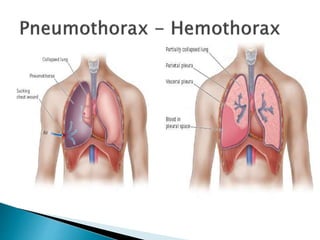
 Large injuries to the chest wall that remain
open can result in an open pneumothorax, also
known as a sucking chest wound .
 Equilibration between intrathoracic pressure
and atmospheric pressure is immediate.
 Open pneumothorax is commonly found and
treated at the scene by pre-hospital personnel.
** Massive hemothorax
 Accumulation of blood in pleura
 One of hidden places of bleeding
 Resuscitation and replacement
 Thoracotomy and repair
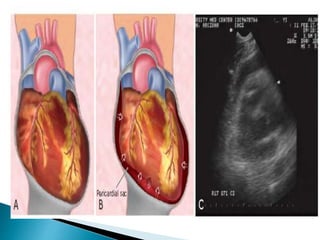
** Cardiac tamponade
 The classic clinical triad of
◦ Muffled heart sounds
◦ Hypotension
◦ Distended veins
 Focused assessment with sonography for
trauma (FAST) is a rapid and accurate
method of imaging the heart and
pericardium that can effectively identify
cardiac tamponade.
 Treatment subxiphoid pericardiocentesis
 . Simple pneumothorax
 • Hemothorax
 • Flail chest
 • Pulmonary contusion
 • Blunt cardiac injury
 • Traumatic aortic disruption
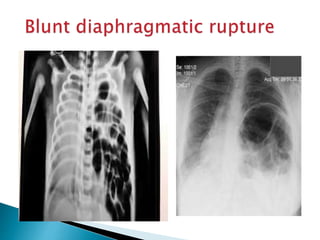
 • Traumatic diaphragmatic injury
 • Blunt esophageal rupture
 lung to collapse. A ventilation-perfusion
 Any pneumothorax is best treated with a
chest tube placed in the fifth intercostal
space, just anterior to the midaxillary line
 Pleural effusion in which blood (<1500
mL) accumulates in the pleural cavity
 Decision to operate on a patient with a
hemothorax,
◦ the patient’s physiologic status and the
volume of blood drainage
◦ Greater than 1500 mL of blood obtained
immediately through the chest tube
◦ Drainage of more than 200 mL/hr for 2 to 4 h
◦ if blood transfusion is required
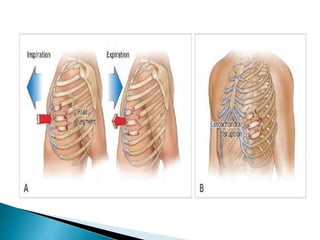
 A flail chest occurs when a segment of the chest
wall does not have bony continuity with the rest of
the thoracic cage
 Two or more adjacent ribs fractured in two or
more places.
 A pulmonary contusion = bruise of the lung,
caused by thoracic trauma.
 Pulmonary contusion can occur without rib
fractures or flail chest, particularly in young
patients without completely ossified ribs.
 Children have far more compliant chest walls than
adults and may suffer contusions and other
internal chest injury without overlying fractures.
 Abnormal respiratory motion and palpation of
crepitus from rib or cartilage fractures
 Patients with significant hypoxia (i.e., PaO2 <
60 mm Hg [8.6 kPa] or SaO2 < 90%) on room
air may require intubation and ventilation
within the first hour after injury.
 Associated medical conditions, such as chronic
requiring early intubation and mechanical
ventilation
Management 
1. Ensuring adequate oxygenation
2. Fluids restriction
3. Providing analgesia to improve ventilation
 Blunt cardiac injury can result in myocardial
muscle contusion, cardiac chamber rupture,
coronary artery dissection and/or thrombosis,
and valvular disruption.
 Clinically significant sequelae are hypotension,
dysrhythmias, and/or wall-motion abnormality
on two-dimensional echocardiograph
 The presence of cardiac troponins in
diagnosing blunt cardiac injury is inconclusive.
 Diagnosed by conduction abnormalities
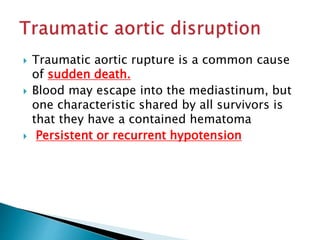
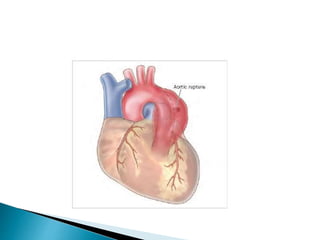
 Traumatic aortic rupture is a common cause
of sudden death.
 Blood may escape into the mediastinum, but
one characteristic shared by all survivors is
that they have a contained hematoma
 Persistent or recurrent hypotension
 Chest trauma one of leading causes of death
 Tension pneumothorax is a clinical diagnosis
 Needle or finger or tube thoracostomy insertion
5th intercostal space
 Hemothorax one of hidden places for bleeding
 Cardiac tamponade = clinical + FAST
 Flial chest = oxygenation +fluid restriction +
analgesia
 Donot forget aortic root rupture and
giaphragmatic rupture.
1. Rhee PM, Acosta J, Bridgeman A, et al. Survival after emergency
department thoracotomy: review of published data from the
past 25 years. J Am Coll Surg 2000;190(3):288–298.
2. Stafford RE, Linn J, Washington L. Incidence and management
of occult hemothoraces. Am J Surg 2006;192(6):722–726.
3. Karmy-Jones R, Jurkovich GJ, Nathens AB, et al. Timing of
urgent thoracotomy for hemorrhage after trauma: a
multicenter study. Archives of Surgery 2001;136(5):513–518.
4. Simon B, Cushman J, Barraco R, et al. Pain management in
blunt thoracic trauma: an EAST Practice Management
Guidelines Workgroup. J Trauma 2005;59:1256–1267.
5. Wilkerson RG, Stone MB. Sensitivity of bedside ultrasound and
supine anteroposterior chest radiographs for the identification
of pneumothorax after blunt trauma. [Review] [24 refs] Acad
Emerg Med 2010;17(1):11–17.
6. Inaba K, Lustenberger T, Recinos G, et al. Does size matter? A
prospective analysis of 28-32 versus 36-40 French chest tube
size in trauma. J Trauma 2012;72(2):422–427.
Thank you

Chest trauma m ibrahim copy

  • 1.
    Dr. Mohamed ElSayed Lecturer of Anesthesia and intensive care ALS provider –ACLS provider –ATLS provider
  • 3.
    The primary survey:The secondary survey: - airway obstruction - Tracheo-bronchial tree injury - tension pneumothorax - open pneumothorax - massive hemothorax - cardiac tamponade - Simple pneumothorax - hemothorax - flail chest - pulmonary contusion, -blunt cardiac injury – - traumatic aortic disruption - traumatic diaphragmatic injury - blunt esophageal rupture. 3. Others subcutaneous emphysema, thoracic crush injuries, and sternal, rib, and clavicular fractures
  • 4.
    Tracheobronchial Tree Injury Injuryto the trachea or a major bronchus is  an unusual but potentially fatal condition.  The majority of tracheo-bronchial tree injuries occur within 1 inch (2.54 cm) of the carina. These injuries can be severe.  Majority of patients die at the scene
  • 5.
     a “one-wayvalve” air leak occurs from the lung or through the chest wall).  Air is forced into the pleural space with no means of escape, eventually collapsing the affected lung.  The mediastinum is displaced to the opposite side, decreasing venous return and compressing the opposite lung.  Shock.
  • 6.
    Tension pneumothorax is aclinical diagnosis reflecting air under pressure in the affected pleural space. Do not delay treatment to obtain radiologic confirmation.
  • 7.
     Patients whoare mechanically ventilated manifest hemodynamic collapse.  Tension pneumothorax is characterized by some or all of the following signs and symptoms:  Chest pain + Air hunger  Tachypnea + Respiratory distress  Tachycardia + Hypotension  Tracheal deviation away from the side of the injury  Unilateral absence of breath sounds  Elevated hemithorax without respiratory movement  • Neck vein distention  • Cyanosis (late manifestation)
  • 9.
     Recent evidencesupports placing the large, over-the-needle catheter at the fifth inter-space, slightly anterior to the mid-axillary line.  Successful needle decompression converts tension pneumothorax to a simple pneumothorax.  Tube thoracostomy is mandatory after needle or finger decompression of the chest
  • 11.
    ** Open Pneumothorax Large injuries to the chest wall that remain open can result in an open pneumothorax, also known as a sucking chest wound .  Equilibration between intrathoracic pressure and atmospheric pressure is immediate.  Open pneumothorax is commonly found and treated at the scene by pre-hospital personnel. ** Massive hemothorax  Accumulation of blood in pleura  One of hidden places of bleeding  Resuscitation and replacement  Thoracotomy and repair
  • 14.
    ** Cardiac tamponade The classic clinical triad of ◦ Muffled heart sounds ◦ Hypotension ◦ Distended veins  Focused assessment with sonography for trauma (FAST) is a rapid and accurate method of imaging the heart and pericardium that can effectively identify cardiac tamponade.  Treatment subxiphoid pericardiocentesis
  • 16.
     . Simplepneumothorax  • Hemothorax  • Flail chest  • Pulmonary contusion  • Blunt cardiac injury  • Traumatic aortic disruption  • Traumatic diaphragmatic injury  • Blunt esophageal rupture
  • 17.
     lung tocollapse. A ventilation-perfusion  Any pneumothorax is best treated with a chest tube placed in the fifth intercostal space, just anterior to the midaxillary line
  • 18.
     Pleural effusionin which blood (<1500 mL) accumulates in the pleural cavity  Decision to operate on a patient with a hemothorax, ◦ the patient’s physiologic status and the volume of blood drainage ◦ Greater than 1500 mL of blood obtained immediately through the chest tube ◦ Drainage of more than 200 mL/hr for 2 to 4 h ◦ if blood transfusion is required
  • 19.
     A flailchest occurs when a segment of the chest wall does not have bony continuity with the rest of the thoracic cage  Two or more adjacent ribs fractured in two or more places.  A pulmonary contusion = bruise of the lung, caused by thoracic trauma.  Pulmonary contusion can occur without rib fractures or flail chest, particularly in young patients without completely ossified ribs.  Children have far more compliant chest walls than adults and may suffer contusions and other internal chest injury without overlying fractures.
  • 21.
     Abnormal respiratorymotion and palpation of crepitus from rib or cartilage fractures  Patients with significant hypoxia (i.e., PaO2 < 60 mm Hg [8.6 kPa] or SaO2 < 90%) on room air may require intubation and ventilation within the first hour after injury.  Associated medical conditions, such as chronic requiring early intubation and mechanical ventilation Management  1. Ensuring adequate oxygenation 2. Fluids restriction 3. Providing analgesia to improve ventilation
  • 22.
     Blunt cardiacinjury can result in myocardial muscle contusion, cardiac chamber rupture, coronary artery dissection and/or thrombosis, and valvular disruption.  Clinically significant sequelae are hypotension, dysrhythmias, and/or wall-motion abnormality on two-dimensional echocardiograph  The presence of cardiac troponins in diagnosing blunt cardiac injury is inconclusive.  Diagnosed by conduction abnormalities
  • 23.
     Traumatic aorticrupture is a common cause of sudden death.  Blood may escape into the mediastinum, but one characteristic shared by all survivors is that they have a contained hematoma  Persistent or recurrent hypotension
  • 26.
     Chest traumaone of leading causes of death  Tension pneumothorax is a clinical diagnosis  Needle or finger or tube thoracostomy insertion 5th intercostal space  Hemothorax one of hidden places for bleeding  Cardiac tamponade = clinical + FAST  Flial chest = oxygenation +fluid restriction + analgesia  Donot forget aortic root rupture and giaphragmatic rupture.
  • 27.
    1. Rhee PM,Acosta J, Bridgeman A, et al. Survival after emergency department thoracotomy: review of published data from the past 25 years. J Am Coll Surg 2000;190(3):288–298. 2. Stafford RE, Linn J, Washington L. Incidence and management of occult hemothoraces. Am J Surg 2006;192(6):722–726. 3. Karmy-Jones R, Jurkovich GJ, Nathens AB, et al. Timing of urgent thoracotomy for hemorrhage after trauma: a multicenter study. Archives of Surgery 2001;136(5):513–518. 4. Simon B, Cushman J, Barraco R, et al. Pain management in blunt thoracic trauma: an EAST Practice Management Guidelines Workgroup. J Trauma 2005;59:1256–1267. 5. Wilkerson RG, Stone MB. Sensitivity of bedside ultrasound and supine anteroposterior chest radiographs for the identification of pneumothorax after blunt trauma. [Review] [24 refs] Acad Emerg Med 2010;17(1):11–17. 6. Inaba K, Lustenberger T, Recinos G, et al. Does size matter? A prospective analysis of 28-32 versus 36-40 French chest tube size in trauma. J Trauma 2012;72(2):422–427.
  • 29.