

Painless labor
Dr. Mohamed Ibrahem El said
Lecturer of Anesthesia
Zagazig university
PAIN PATHWAYS IN LABOUR AND
CAESAREAN SECTION
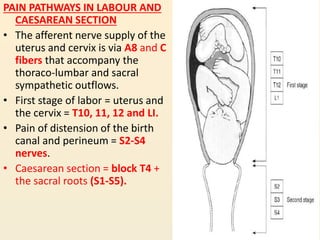
• The afferent nerve supply of the
uterus and cervix is via A8 and C
fibers that accompany the
thoraco-lumbar and sacral
sympathetic outflows.
• First stage of labor = uterus and
the cervix = T10, 11, 12 and LI.
• Pain of distension of the birth
canal and perineum = S2-S4
nerves.
• Caesarean section = block T4 +
the sacral roots (S1-S5).
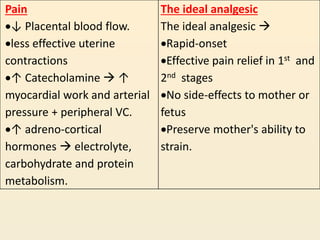
Pain
↓ Placental blood flow.
less effective uterine
contractions
↑ Catecholamine  ↑
myocardial work and arterial
pressure + peripheral VC.
↑ adreno-cortical
hormones  electrolyte,
carbohydrate and protein
metabolism.
The ideal analgesic
The ideal analgesic 
Rapid-onset
Effective pain relief in 1st and
2nd stages
No side-effects to mother or
fetus
Preserve mother's ability to
strain.
LABOUR ANALGESIA
• non-pharmacological
• Parenteral
• inhalation
• Regional.
Non-pharmacological analgesia
• Birth preparation classes
• Environment and the management of labor
• Transcutaneous electrical nerve stimulation (TENS)
• Hypnosis
Parenteral (systemic) analgesia pethidine
• Many opioids  pethidine, morphine …..
Pethidine 
• Two doses of 100 mg.
• Intramuscular injection  maximum effect after 1 h.
• The analgesic effects are variable
Adverse effects on mother
 Maternal sedation
 Nausea and vomiting
 Dysphoria
 Inhibition of gastric
emptying.
Adverse effects on the fetus as it
freely crosses the placenta
 CTG abnormalities and
 Respiratory depression
 Neurobehavioural
depression
Inhalation analgesia Nitrous oxide
• The ideal inhalation agent 
• Good analgesic in sub-anesthetic doses.
• Rapid onset of action and recovery and not accumulate.
• Nitrous oxide is relatively insoluble in blood and has
these properties.
• Isonox 50% nitrous oxide and 50% oxygen with 0.2%
isoflurane.
• Entonox 50% nitrous oxide and 50% oxygen under
pressure in a cylinder
• Entonox  on-demand valve with a face mask or
mouthpiece.
• Although Entonox is a reasonably effective analgesic,
many women feel faint and nauseated and may vomit or
become out of control.
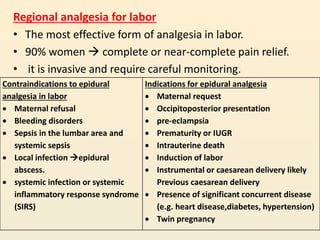
Regional analgesia for labor
• The most effective form of analgesia in labor.
• 90% women  complete or near-complete pain relief.
• it is invasive and require careful monitoring.
Contraindications to epidural
analgesia in labor
 Maternal refusal
 Bleeding disorders
 Sepsis in the lumbar area and
systemic sepsis
 Local infection epidural
abscess.
 systemic infection or systemic
inflammatory response syndrome
(SIRS)
Indications for epidural analgesia
 Maternal request
 Occipitoposterior presentation
 pre-eclampsia
 Prematurity or IUGR
 Intrauterine death
 Induction of labor
 Instrumental or caesarean delivery likely
Previous caesarean delivery
 Presence of significant concurrent disease
(e.g. heart disease,diabetes, hypertension)
 Twin pregnancy
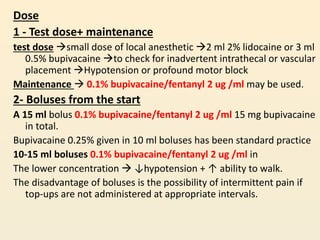
Dose
1 - Test dose+ maintenance
test dose small dose of local anesthetic 2 ml 2% lidocaine or 3 ml
0.5% bupivacaine to check for inadvertent intrathecal or vascular
placement Hypotension or profound motor block
Maintenance  0.1% bupivacaine/fentanyl 2 ug /ml may be used.
2- Boluses from the start
A 15 ml bolus 0.1% bupivacaine/fentanyl 2 ug /ml 15 mg bupivacaine
in total.
Bupivacaine 0.25% given in 10 ml boluses has been standard practice
10-15 ml boluses 0.1% bupivacaine/fentanyl 2 ug /ml in
The lower concentration  ↓hypotension + ↑ ability to walk.
The disadvantage of boluses is the possibility of intermittent pain if
top-ups are not administered at appropriate intervals.
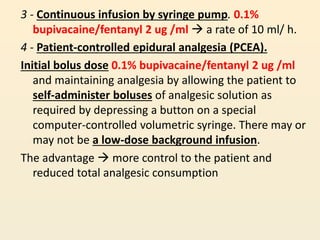
3 - Continuous infusion by syringe pump. 0.1%
bupivacaine/fentanyl 2 ug /ml  a rate of 10 ml/ h.
4 - Patient-controlled epidural analgesia (PCEA).
Initial bolus dose 0.1% bupivacaine/fentanyl 2 ug /ml
and maintaining analgesia by allowing the patient to
self-administer boluses of analgesic solution as
required by depressing a button on a special
computer-controlled volumetric syringe. There may or
may not be a low-dose background infusion.
The advantage  more control to the patient and
reduced total analgesic consumption
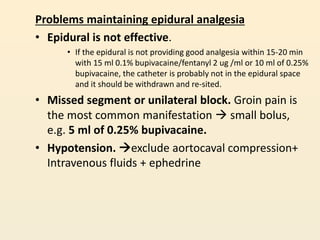
Problems maintaining epidural analgesia
• Epidural is not effective.
• If the epidural is not providing good analgesia within 15-20 min
with 15 ml 0.1% bupivacaine/fentanyl 2 ug /ml or 10 ml of 0.25%
bupivacaine, the catheter is probably not in the epidural space
and it should be withdrawn and re-sited.
• Missed segment or unilateral block. Groin pain is
the most common manifestation  small bolus,
e.g. 5 ml of 0.25% bupivacaine.
• Hypotension. exclude aortocaval compression+
Intravenous fluids + ephedrine
CSE for labour and the 'walking' epidural
• intrathecal injection of 1 ml 0.25% bupivacaine with 25
ug fentanyl is given.
• rapid-onset analgesia (< 5 min) and approximately 70%
of patients
• have normal or near-normal leg power such that they
may walk.
• commencing with a 15 ml bolus of bupivacaine 0.1%
bupivacaine/fentanyl 2 ug /ml without a test dose, as
described above. potentially making walking hazardous.
• The medicolegal position of the anesthetist in the
event of a fall of a parturient during a walking epidural
is unclear.
Thank you

Painless labor

  • 1.
    Painless labor Dr. MohamedIbrahem El said Lecturer of Anesthesia Zagazig university
  • 2.
    PAIN PATHWAYS INLABOUR AND CAESAREAN SECTION • The afferent nerve supply of the uterus and cervix is via A8 and C fibers that accompany the thoraco-lumbar and sacral sympathetic outflows. • First stage of labor = uterus and the cervix = T10, 11, 12 and LI. • Pain of distension of the birth canal and perineum = S2-S4 nerves. • Caesarean section = block T4 + the sacral roots (S1-S5).
  • 3.
    Pain ↓ Placental bloodflow. less effective uterine contractions ↑ Catecholamine  ↑ myocardial work and arterial pressure + peripheral VC. ↑ adreno-cortical hormones  electrolyte, carbohydrate and protein metabolism. The ideal analgesic The ideal analgesic  Rapid-onset Effective pain relief in 1st and 2nd stages No side-effects to mother or fetus Preserve mother's ability to strain.
  • 4.
    LABOUR ANALGESIA • non-pharmacological •Parenteral • inhalation • Regional. Non-pharmacological analgesia • Birth preparation classes • Environment and the management of labor • Transcutaneous electrical nerve stimulation (TENS) • Hypnosis
  • 5.
    Parenteral (systemic) analgesiapethidine • Many opioids  pethidine, morphine ….. Pethidine  • Two doses of 100 mg. • Intramuscular injection  maximum effect after 1 h. • The analgesic effects are variable Adverse effects on mother  Maternal sedation  Nausea and vomiting  Dysphoria  Inhibition of gastric emptying. Adverse effects on the fetus as it freely crosses the placenta  CTG abnormalities and  Respiratory depression  Neurobehavioural depression
  • 6.
    Inhalation analgesia Nitrousoxide • The ideal inhalation agent  • Good analgesic in sub-anesthetic doses. • Rapid onset of action and recovery and not accumulate. • Nitrous oxide is relatively insoluble in blood and has these properties. • Isonox 50% nitrous oxide and 50% oxygen with 0.2% isoflurane. • Entonox 50% nitrous oxide and 50% oxygen under pressure in a cylinder • Entonox  on-demand valve with a face mask or mouthpiece. • Although Entonox is a reasonably effective analgesic, many women feel faint and nauseated and may vomit or become out of control.
  • 7.
    Regional analgesia forlabor • The most effective form of analgesia in labor. • 90% women  complete or near-complete pain relief. • it is invasive and require careful monitoring. Contraindications to epidural analgesia in labor  Maternal refusal  Bleeding disorders  Sepsis in the lumbar area and systemic sepsis  Local infection epidural abscess.  systemic infection or systemic inflammatory response syndrome (SIRS) Indications for epidural analgesia  Maternal request  Occipitoposterior presentation  pre-eclampsia  Prematurity or IUGR  Intrauterine death  Induction of labor  Instrumental or caesarean delivery likely Previous caesarean delivery  Presence of significant concurrent disease (e.g. heart disease,diabetes, hypertension)  Twin pregnancy
  • 8.
    Dose 1 - Testdose+ maintenance test dose small dose of local anesthetic 2 ml 2% lidocaine or 3 ml 0.5% bupivacaine to check for inadvertent intrathecal or vascular placement Hypotension or profound motor block Maintenance  0.1% bupivacaine/fentanyl 2 ug /ml may be used. 2- Boluses from the start A 15 ml bolus 0.1% bupivacaine/fentanyl 2 ug /ml 15 mg bupivacaine in total. Bupivacaine 0.25% given in 10 ml boluses has been standard practice 10-15 ml boluses 0.1% bupivacaine/fentanyl 2 ug /ml in The lower concentration  ↓hypotension + ↑ ability to walk. The disadvantage of boluses is the possibility of intermittent pain if top-ups are not administered at appropriate intervals.
  • 9.
    3 - Continuousinfusion by syringe pump. 0.1% bupivacaine/fentanyl 2 ug /ml  a rate of 10 ml/ h. 4 - Patient-controlled epidural analgesia (PCEA). Initial bolus dose 0.1% bupivacaine/fentanyl 2 ug /ml and maintaining analgesia by allowing the patient to self-administer boluses of analgesic solution as required by depressing a button on a special computer-controlled volumetric syringe. There may or may not be a low-dose background infusion. The advantage  more control to the patient and reduced total analgesic consumption
  • 10.
    Problems maintaining epiduralanalgesia • Epidural is not effective. • If the epidural is not providing good analgesia within 15-20 min with 15 ml 0.1% bupivacaine/fentanyl 2 ug /ml or 10 ml of 0.25% bupivacaine, the catheter is probably not in the epidural space and it should be withdrawn and re-sited. • Missed segment or unilateral block. Groin pain is the most common manifestation  small bolus, e.g. 5 ml of 0.25% bupivacaine. • Hypotension. exclude aortocaval compression+ Intravenous fluids + ephedrine
  • 11.
    CSE for labourand the 'walking' epidural • intrathecal injection of 1 ml 0.25% bupivacaine with 25 ug fentanyl is given. • rapid-onset analgesia (< 5 min) and approximately 70% of patients • have normal or near-normal leg power such that they may walk. • commencing with a 15 ml bolus of bupivacaine 0.1% bupivacaine/fentanyl 2 ug /ml without a test dose, as described above. potentially making walking hazardous. • The medicolegal position of the anesthetist in the event of a fall of a parturient during a walking epidural is unclear.
  • 12.