Chemoinformatics: the first half
century
 Dr.Gurumeet C Wadhawa
 Assistant Professor ,Department of Chemistry
Rayat Shikshan Santa's Veer Wajekar Asc
College,Phunde
Overview
• Introduction to chemoinformatics
• What it is
• How it has developed
• Historically important papers
• Roughly chronological ordering
• A personal choice
• Many, many omissions
Chemoinformatics’ role
• The pharmaceutical industry has been one of the great
success stories of scientific research in the latter half of
the twentieth century
• Range of novel drugs for important therapeutic areas
• The computer has revolutionised how the industry uses
chemical (and increasingly biological) information
• Many of these developments are within the discipline we now
know as chemoinformatics
• Focus on lead discovery and lead optimisation phases of drug
discovery (also applicable to other types of specialty chemicals)
Definitions
• F.K. Brown (1998) Chemoinformatics: what it is and how does it
impact drug discovery? Annual Reports in Medicinal Chemistry,
33, 375-384
• “The use of information technology and management has become a critical
part of the drug discovery process. Chemoinformatics is the mixing of those
information resources to transform data into information and information into
knowledge for the intended purpose of making better decisions faster in the
area of drug lead identification and optimization”
• G. Paris (August 1999 ACS meeting), quoted by W.A. Warr at
http://www.warr.com/warrzone.htm
• “Chem(o)informatics is a generic term that encompasses the design,
creation, organization, management, retrieval, analysis, dissemination,
visualization and use of chemical information”
• J. Gasteiger and T. Engels (editors) (2003). Chemoinformatics:
a textbook. Wiley-VCH.
• “Chemoinformatics is the application of informatics methods to solve
chemical problems.”
Emergence of
chemoinformatics: I
• The principal driving force for current interest
was the emergence during the Nineties of
combinatorial synthesis and high-throughput
screening
• Aims to assist more directly in the discovery of
novel bioactive molecules than heretofore
• Integration of chemical information (archival
functions) and molecular modelling (small-scale
correlation)
• Development of effective and efficient tools that can
exploit the chemical and biological data explosion
• Other types of -informatics becoming common
• But chemoionformatics is by no means new...
Emergence of
chemoinformatics: II
• First appearance of the core, journal, Journal of
Chemical Documentation, in 1961
• First book on the subject appeared in 1971
• M.F. Lynch et al., Computer Handling of Chemical Structure
Information
• The first two textbooks with “chemoinformatics” in the
title appeared in 2003
• A.R. Leach and V.J. Gillet, An Introduction to Chemoinformatics
• J. Gasteiger and T. Engel (eds.) Chemoinformatics
• The first international conference on the subject was
held at Noordwijkerhout in 1973, and every three years
since 1987
Emergence of
chemoinformatics: III
• Introduction of first full university courses in 2001
• D.J. Wild and G. Wiggins (2006) Challenges for
chemoinformatics education in drug discovery.
Drug Drug Discovery Today, 11, 436-439
• Nomenclature
• Chemical informatics, chemical information
(management/science), chemiinformatics,
cheminformatics
P. Willett (2008) A bibliometric analysis of chemoinformatics.
Aslib Proceedings, 60, 4-17
• M. Hann and R. Green (1999) Chemoinformatics - a
new name for an old problem? Current Opinion in
Chemical Biology, 3, 379-383
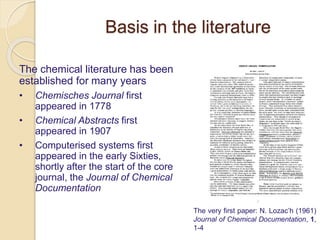
The chemical literature has been
established for many years
• Chemisches Journal first
appeared in 1778
• Chemical Abstracts first
appeared in 1907
• Computerised systems first
appeared in the early Sixties,
shortly after the start of the core
journal, the Journal of Chemical
Documentation
The very first paper: N. Lozac’h (1961)
Journal of Chemical Documentation, 1,
1-4
Basis in the literature
Development of the
journal
• Early issues of the Journal of Chemical Documentation
largely comprised papers presented at meetings of the
ACS Division of Chemical Literature
• First issue of Journal of Chemical Information and
Computer Sciences (1975)
• Largely comprised papers given at a National Academy of
Sciences conference on databases (both textual and chemical)
• First issue of Journal of Chemical Information and
Modeling (2005) with sections on
• Chemical information, Computational chemistry, Computational
biochemistry, Pharmaceutical modeling, and Bioinformatics
Many other journals now cover the
subject, most obviously...
• Molecular Informatics
• Started in 1982 as Quantitative Structure-Activity Relationships
• Journal of Molecular Graphics and Modelling
• Started in 1983 as the Journal of Molecular Graphics
• Journal of Computer-Aided Molecular Design
• Started in 1987
• Journal of Cheminformatics
• Open access journal started in 2009
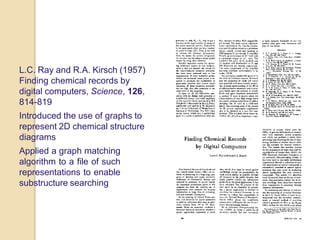
L.C. Ray and R.A. Kirsch (1957)
Finding chemical records by
digital computers, Science, 126,
814-819
Introduced the use of graphs to
represent 2D chemical structure
diagrams
Applied a graph matching
algorithm to a file of such
representations to enable
substructure searching
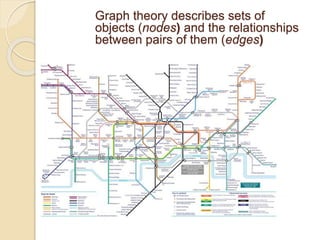
Graph theory describes sets of
objects (nodes) and the relationships
between pairs of them (edges)
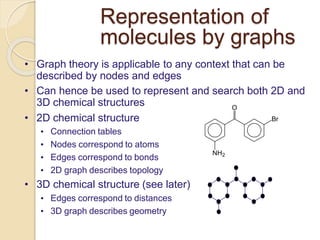
Representation of
molecules by graphs
• Graph theory is applicable to any context that can be
described by nodes and edges
• Can hence be used to represent and search both 2D and
3D chemical structures
• 2D chemical structure
• Connection tables
• Nodes correspond to atoms
• Edges correspond to bonds
• 2D graph describes topology
• 3D chemical structure (see later)
• Edges correspond to distances
• 3D graph describes geometry
O
NH2
Br
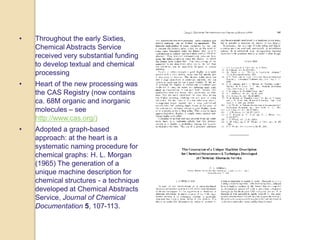
• Throughout the early Sixties,
Chemical Abstracts Service
received very substantial funding
to develop textual and chemical
processing
• Heart of the new processing was
the CAS Registry (now contains
ca. 68M organic and inorganic
molecules – see
http://www.cas.org/)
• Adopted a graph-based
approach: at the heart is a
systematic naming procedure for
chemical graphs: H. L. Morgan
(1965) The generation of a
unique machine description for
chemical structures - a technique
developed at Chemical Abstracts
Service, Journal of Chemical
Documentation 5, 107-113.
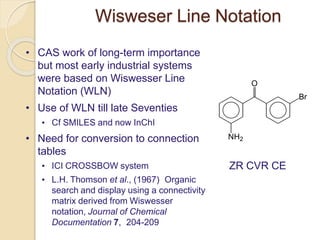
Wisweser Line Notation
• CAS work of long-term importance
but most early industrial systems
were based on Wiswesser Line
Notation (WLN)
• Use of WLN till late Seventies
• Cf SMILES and now InChI
• Need for conversion to connection
tables
• ICI CROSSBOW system
• L.H. Thomson et al., (1967) Organic
search and display using a connectivity
matrix derived from Wiswesser
notation, Journal of Chemical
Documentation 7, 204-209
O
NH2
Br
ZR CVR CE
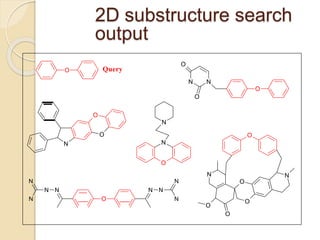
2D substructure search
output
Query
N
O
O
N N
O
O
O
O
N N
N
N
N N
N
N O
N
N
O
O
N
O
O
N
O
O
Substructure searching
• Ability to retrieve all molecules in a database
containing a user-defined substructure
• Use of a subgraph isomorphism algorithm
• Completely effective, but efficiency very low
• Standard methods such as set reduction
(Sussenguth, 1965) and relaxation (Ullmann, 1976)
underlie all operational substructure searching
systems (both 2D and 3D)
• Still not sufficiently fast so need for initial filter to eliminate
molecules from graph processing
• Encoding fragment screens describing query substructures
and database structures in a bit-string or fingerprint
Binary vector
C
C C C
C
O
C C C
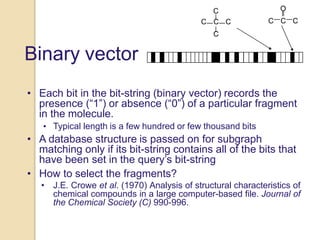
• Each bit in the bit-string (binary vector) records the
presence (“1”) or absence (“0”) of a particular fragment
in the molecule.
• Typical length is a few hundred or few thousand bits
• A database structure is passed on for subgraph
matching only if its bit-string contains all of the bits that
have been set in the query’s bit-string
• How to select the fragments?
• J.E. Crowe et al. (1970) Analysis of structural characteristics of
chemical compounds in a large computer-based file. Journal of
the Chemical Society (C) 990-996.
C
C
N C N
C
C C
C
C
b. Atom Sequence
C rs C rs C rd C
C
C C
C
C
C
C
C
C
C
N
C
C
N
C
a. Augmented Atom
C rs C rd C rs C
c. Bond Sequence
AA rs AA rs AA rd AA
d. Ring Composition
N rs C rd C rs C rs C rs
e. Ring Fusion
XX3 XX3 XX3 XX2 XX2
f. Atom Pair
N 0;3 - 2 - C 0;3
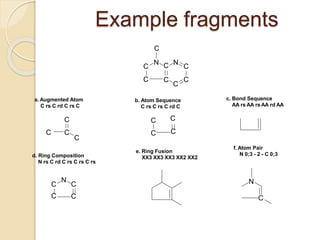
Example fragments
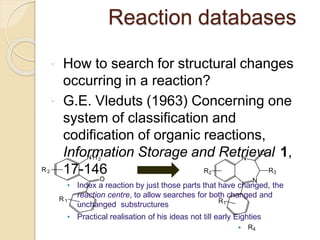
Reaction databases
 How to search for structural changes
occurring in a reaction?
 G.E. Vleduts (1963) Concerning one
system of classification and
codification of organic reactions,
Information Storage and Retrieval 1,
17-146
• Index a reaction by just those parts that have changed, the
reaction centre, to allow searches for both changed and
unchanged substructures
• Practical realisation of his ideas not till early Eighties
 R4
R1
R2
O
N H 2
N
N
O
R3
R2
R1
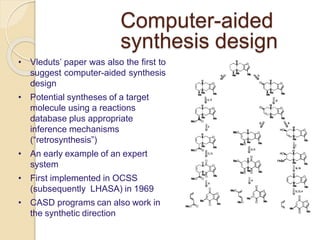
Computer-aided
synthesis design
• Vleduts’ paper was also the first to
suggest computer-aided synthesis
design
• Potential syntheses of a target
molecule using a reactions
database plus appropriate
inference mechanisms
(“retrosynthesis”)
• An early example of an expert
system
• First implemented in OCSS
(subsequently LHASA) in 1969
• CASD programs can also work in
the synthetic direction
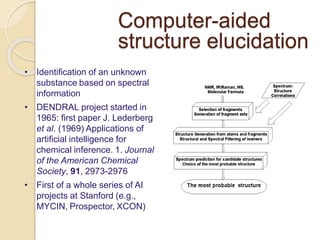
Computer-aided
structure elucidation
• Identification of an unknown
substance based on spectral
information
• DENDRAL project started in
1965: first paper J. Lederberg
et al. (1969) Applications of
artificial intelligence for
chemical inference. 1. Journal
of the American Chemical
Society, 91, 2973-2976
• First of a whole series of AI
projects at Stanford (e.g.,
MYCIN, Prospector, XCON)
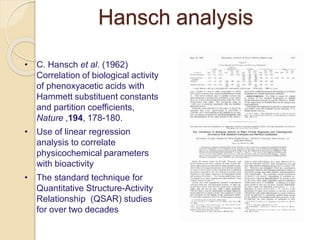
Hansch analysis
• C. Hansch et al. (1962)
Correlation of biological activity
of phenoxyacetic acids with
Hammett substituent constants
and partition coefficients,
Nature ,194, 178-180.
• Use of linear regression
analysis to correlate
physicochemical parameters
with bioactivity
• The standard technique for
Quantitative Structure-Activity
Relationship (QSAR) studies
for over two decades
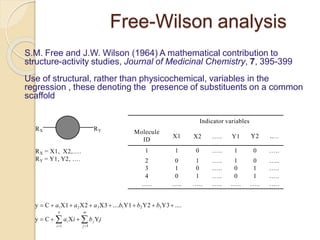
S.M. Free and J.W. Wilson (1964) A mathematical contribution to
structure-activity studies, Journal of Medicinal Chemistry, 7, 395-399
Use of structural, rather than physicochemical, variables in the
regression , these denoting the presence of substituents on a common
scaffold
RX = X1, X2,….
RY = Y1, Y2, ….
RY
RX
y  C  a1X1 a2X2  a3X3  ....b1Y1 b2Y2  b3Y3 ....
n m
y  C  ai Xi  bj Yj
i1 j1
1 0 ….. 1 0 …..
0 1 ….. 1 0 …..
1 0 ….. 0 1 …..
0 1 ….. 0 1 …..
….. ….. ….. ….. ….. …..
1
2
3
4
…..
Y2 …..
Indicator variables
X2 ….. Y1
X1
Molecule
ID
Free-Wilson analysis
Substructural analysis
• R.D. Cramer et al. (1974) Substructural analysis. A
novel approach to the problem of drug design, Journal of
Medicinal Chemistry, 17, 533-535
• Extension of Free-Wilson ideas to encompass
• Structurally diverse molecules
• Qualitative activity data
• Calculation of fragment weights
• Probability that a molecule containing that fragment will be
active, e.g., Nact/(Nact+Ninanct)
• Used in US government anti-cancer programme in
Eighties, but then in abeyance for many years till “re-
discovery” as naive Bayesian classifier
• First application of machine learning in virtual screening
Moving on
• Throughout the Seventies, chemical search
systems (mainly WLN-based) became widely
available across the pharmaceutical industry
• Extensive use of QSAR methods in lead
optimisation
• Computer hardware/software limitations meant
processing slow
• Things did not change much till the late-
Seventies/early-Eighties, with the advent of MDL
(now Accelrys) and CAS Online
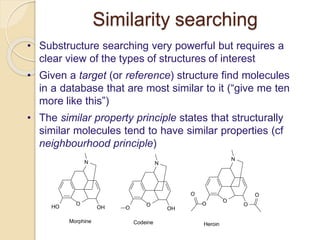
• Substructure searching very powerful but requires a
clear view of the types of structures of interest
• Given a target (or reference) structure find molecules
in a database that are most similar to it (“give me ten
more like this”)
• The similar property principle states that structurally
similar molecules tend to have similar properties (cf
neighbourhood principle)
Similarity searching
N
O
OH
HO
Morphine
N
O
OH
O
Codeine
N
O
O
O
O
O
Heroin
How to define
chemical similarity?
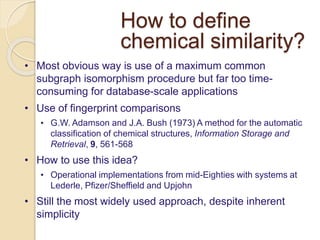
• Most obvious way is use of a maximum common
subgraph isomorphism procedure but far too time-
consuming for database-scale applications
• Use of fingerprint comparisons
• G.W. Adamson and J.A. Bush (1973) A method for the automatic
classification of chemical structures, Information Storage and
Retrieval, 9, 561-568
• How to use this idea?
• Operational implementations from mid-Eighties with systems at
Lederle, Pfizer/Sheffield and Upjohn
• Still the most widely used approach, despite inherent
simplicity
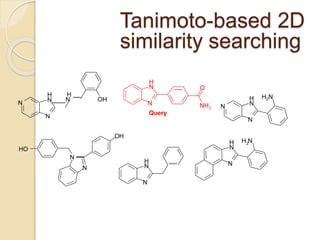
Tanimoto-based 2D
similarity searching
HO
N
N
OH
H
N
NH2
O
N
Query
N
H
N
N
H2N
H
N
N
H N
2
H
N
N
N
N
H H
N N OH
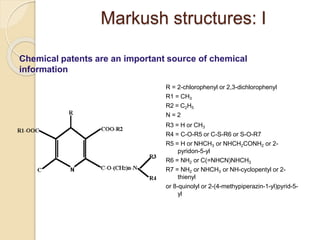
Markush structures: I
Chemical patents are an important source of chemical
information
R = 2-chlorophenyl or 2,3-dichlorophenyl
R1 = CH3
R2 = C2H5
N = 2
R3 = H or CH3
R4 = C-O-R5 or C-S-R6 or S-O-R7
R5 = H or NHCH3 or NHCH2CONH2 or 2-
pyridon-5-yl
R6 = NH2 or C(=NHCN)NHCH3
R7 = NH2 or NHCH3 or NH-cyclopentyl or 2-
thienyl
or 8-quinolyl or 2-(4-methypiperazin-1-yl)pyrid-5-
yl
Markush structures: II
• This example encodes 192 specific molecules; for many
patents, the number is not defined
• M.F. Lynch et al. (1981) Computer storage and retrieval
of generic chemical structures in patents, Part 1. Journal
of Chemical Information and Computer Sciences, 21,
148-150.
• Extension of fingerprint and graph matching methods for
specifics
• Work in collaboration with Derwent and CAS, resulting in
the operational systems Markush DARC (now Merged
Markush Service MMS) and MARPAT
3D substructure
searching: I
• P. Gund (1977) Three-dimensional pharmacophoric
pattern searching, Progress in Molecular and Subcellular
Biology, 5,117-143
• Recognition that the nodes and edges of a graph could
represent the atoms and inter-atomic distances (where
‘atom’ may include pharmacophore points, e.g., lone
pairs) of a 3D molecule
• But ideas not taken up for a decade:
• Lack of structural data (except for the Cambridge
Structural Database)
• There was no obvious way of carrying out a search
efficiently
3D substructure
searching: II
• Intense interest from mid/late Eighties as both
problems addressed
• Approximate 3D coordinates from structure-
generation programs
• CONCORD (Pearlman group at Austin, Texas)
• CORINA (Gasteiger group at Erlangen)
• Fingerprint- and graph-based searching methods
• S.E. Jakes and P. Willett (1986) Pharmacophoric pattern-
matching in files of 3-D chemical structures - selection of
interatomic distance screens, Journal of Molecular Graphics,
4, 12-20
• Basis of first systems at Pfizer and Lederle. Later
extensions to encompass conformational flexibility, with
industrial systems widely available from the mid-Nineties.
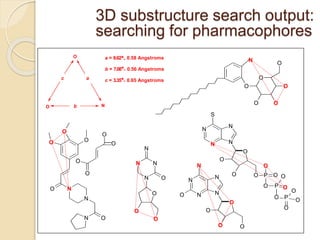
3D substructure search output:
searching for pharmacophores
O
O N
a
b
c
a = 8.62+- 0.58 Angstroms
b = 7.08+- 0.56 Angstroms
c = 3.35+- 0.65 Angstroms
O
O
O
O
O
O
N
O
O
O
N
N
N O
O
O
O
O
O
N
N
N
N
S
O
O
O
O
O
O
O P
O
O
O P O O
O P
N
N
N
N
N
O
O
O O
O
N
N
N
O
N
O
O
O
Pharmacophore mapping
• Given a set of bioactive molecules: what is the common
pharmacophore?
• Specify the points
• G.R. Marshall et al. (1979) The conformational parameter in drug
design: the active analogue approach in computer-assisted drug
design, ACS Symposium Series, 112, 205-226.
• No constraints
• Y.C. Martin et al. (1993) A fast new approach to pharmacophore
mapping and its application to dopaminergic and benzodiazepine
agonists, Journal of Computer-Aided Molecular Design, 7, 83-
102.
• Inclusion of flexibility
• G. Jones et al. (1995) A genetic algorithm for flexible molecular
overlay and pharmacophore detection, Journal of Computer-
Aided Molecular Design, 9, 532-549.
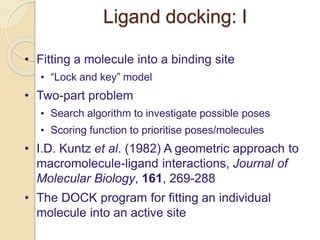
Ligand docking: I
• Fitting a molecule into a binding site
• “Lock and key” model
• Two-part problem
• Search algorithm to investigate possible poses
• Scoring function to prioritise poses/molecules
• I.D. Kuntz et al. (1982) A geometric approach to
macromolecule-ligand interactions, Journal of
Molecular Biology, 161, 269-288
• The DOCK program for fitting an individual
molecule into an active site
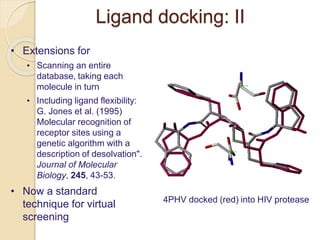
Ligand docking: II
• Extensions for
• Scanning an entire
database, taking each
molecule in turn
• Including ligand flexibility:
G. Jones et al. (1995)
Molecular recognition of
receptor sites using a
genetic algorithm with a
description of desolvation".
Journal of Molecular
Biology, 245, 43-53.
• Now a standard
technique for virtual
screening
4PHV docked (red) into HIV protease
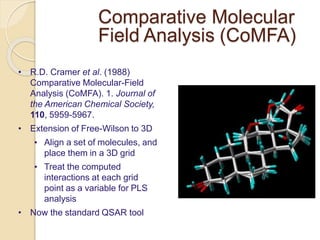
Comparative Molecular
Field Analysis (CoMFA)
• R.D. Cramer et al. (1988)
Comparative Molecular-Field
Analysis (CoMFA). 1. Journal of
the American Chemical Society,
110, 5959-5967.
• Extension of Free-Wilson to 3D
• Align a set of molecules, and
place them in a 3D grid
• Treat the computed
interactions at each grid
point as a variable for PLS
analysis
• Now the standard QSAR tool
Molecular diversity
analysis: I
• Technological developments in the early
Nineties led to a data explosion in the volumes
of chemical and biological data
• Many more compounds could be made: which
should be made?
• Need for tools to:
• Quantify diversity
• Select molecules so as to maximise diversity (NB not
a new question, e.g., early Pfizer/Upjohn clustering
work)
Molecular diversity
analysis: II
• Huge range of papers, focussing on fingerprint-
based similarity approaches
• E.J. Martin et al. (1995) Measuring diversity -
experimental-design of combinatorial libraries for drug
discovery, Journal of Medicinal Chemistry, 38, 1431-
1436.
• R.D. Brown and Y.C. Martin (1996) Use of structure-
activity data to compare structure-based clustering
methods and descriptors for use in compound
selection, Journal of Chemical Information and
Computer Sciences, 36, 572-584.
Diversity alone is not
enough
• It soon became clear that many of the molecules being
generated had poor ADME characteristics
• ADME traditionally studied during optimisation
• “Fail fast” paradigm implies that such molecules should be
filtered out as early as possible
• C.A. Lipinski et al. (1997) Experimental and
computational approaches to estimate solubility and
permeability in drug discovery and development settings.
Advanced Drug Delivery Reviews, 23, 3-25
• Criteria for oral activity: ideally, not more than 5 donors or 10
acceptors, MW under 500 and logP under 5
• Idea of drugability or drug-likeness
Conclusions
• Chemoinformatics integrates long-established research
into structure searching and bioactivity prediction
• Ever-increasing demands on the pharmaceutical industry
will make it even more important in the future, e.g.
• ADMETox prediction, Chemogenomics, and Virtual screening
• Histories
• W.L. Chen (2006) “Chemoinformatics: past, present and future”
Journal of Chemical Information and Modeling, 46, 2230-2255
• J. Gasteiger (2006) “Chemoinformatics: a new field with a long
tradition” Analytical and Bioanalytical Chemistry, 384, 57-64
• A.G. Maldonado et al. (2006) “Molecular similarity and diversity
in chemoinformatics: from theory to applications” Molecular
Diversity, 10, 39-79
• P. Willett (2008) “From chemical documentation to
chemoinformatics: fifty years of chemical information science.”
Journal of Information Science, 34, 477-499

chemoinformatics ppt 2.pptx

  • 1.
    Chemoinformatics: the firsthalf century  Dr.Gurumeet C Wadhawa  Assistant Professor ,Department of Chemistry Rayat Shikshan Santa's Veer Wajekar Asc College,Phunde
  • 2.
    Overview • Introduction tochemoinformatics • What it is • How it has developed • Historically important papers • Roughly chronological ordering • A personal choice • Many, many omissions
  • 3.
    Chemoinformatics’ role • Thepharmaceutical industry has been one of the great success stories of scientific research in the latter half of the twentieth century • Range of novel drugs for important therapeutic areas • The computer has revolutionised how the industry uses chemical (and increasingly biological) information • Many of these developments are within the discipline we now know as chemoinformatics • Focus on lead discovery and lead optimisation phases of drug discovery (also applicable to other types of specialty chemicals)
  • 4.
    Definitions • F.K. Brown(1998) Chemoinformatics: what it is and how does it impact drug discovery? Annual Reports in Medicinal Chemistry, 33, 375-384 • “The use of information technology and management has become a critical part of the drug discovery process. Chemoinformatics is the mixing of those information resources to transform data into information and information into knowledge for the intended purpose of making better decisions faster in the area of drug lead identification and optimization” • G. Paris (August 1999 ACS meeting), quoted by W.A. Warr at http://www.warr.com/warrzone.htm • “Chem(o)informatics is a generic term that encompasses the design, creation, organization, management, retrieval, analysis, dissemination, visualization and use of chemical information” • J. Gasteiger and T. Engels (editors) (2003). Chemoinformatics: a textbook. Wiley-VCH. • “Chemoinformatics is the application of informatics methods to solve chemical problems.”
  • 5.
    Emergence of chemoinformatics: I •The principal driving force for current interest was the emergence during the Nineties of combinatorial synthesis and high-throughput screening • Aims to assist more directly in the discovery of novel bioactive molecules than heretofore • Integration of chemical information (archival functions) and molecular modelling (small-scale correlation) • Development of effective and efficient tools that can exploit the chemical and biological data explosion • Other types of -informatics becoming common • But chemoionformatics is by no means new...
  • 6.
    Emergence of chemoinformatics: II •First appearance of the core, journal, Journal of Chemical Documentation, in 1961 • First book on the subject appeared in 1971 • M.F. Lynch et al., Computer Handling of Chemical Structure Information • The first two textbooks with “chemoinformatics” in the title appeared in 2003 • A.R. Leach and V.J. Gillet, An Introduction to Chemoinformatics • J. Gasteiger and T. Engel (eds.) Chemoinformatics • The first international conference on the subject was held at Noordwijkerhout in 1973, and every three years since 1987
  • 7.
    Emergence of chemoinformatics: III •Introduction of first full university courses in 2001 • D.J. Wild and G. Wiggins (2006) Challenges for chemoinformatics education in drug discovery. Drug Drug Discovery Today, 11, 436-439 • Nomenclature • Chemical informatics, chemical information (management/science), chemiinformatics, cheminformatics P. Willett (2008) A bibliometric analysis of chemoinformatics. Aslib Proceedings, 60, 4-17 • M. Hann and R. Green (1999) Chemoinformatics - a new name for an old problem? Current Opinion in Chemical Biology, 3, 379-383
  • 8.
    The chemical literaturehas been established for many years • Chemisches Journal first appeared in 1778 • Chemical Abstracts first appeared in 1907 • Computerised systems first appeared in the early Sixties, shortly after the start of the core journal, the Journal of Chemical Documentation The very first paper: N. Lozac’h (1961) Journal of Chemical Documentation, 1, 1-4 Basis in the literature
  • 9.
    Development of the journal •Early issues of the Journal of Chemical Documentation largely comprised papers presented at meetings of the ACS Division of Chemical Literature • First issue of Journal of Chemical Information and Computer Sciences (1975) • Largely comprised papers given at a National Academy of Sciences conference on databases (both textual and chemical) • First issue of Journal of Chemical Information and Modeling (2005) with sections on • Chemical information, Computational chemistry, Computational biochemistry, Pharmaceutical modeling, and Bioinformatics
  • 10.
    Many other journalsnow cover the subject, most obviously... • Molecular Informatics • Started in 1982 as Quantitative Structure-Activity Relationships • Journal of Molecular Graphics and Modelling • Started in 1983 as the Journal of Molecular Graphics • Journal of Computer-Aided Molecular Design • Started in 1987 • Journal of Cheminformatics • Open access journal started in 2009
  • 11.
    L.C. Ray andR.A. Kirsch (1957) Finding chemical records by digital computers, Science, 126, 814-819 Introduced the use of graphs to represent 2D chemical structure diagrams Applied a graph matching algorithm to a file of such representations to enable substructure searching
  • 12.
    Graph theory describessets of objects (nodes) and the relationships between pairs of them (edges)
  • 13.
    Representation of molecules bygraphs • Graph theory is applicable to any context that can be described by nodes and edges • Can hence be used to represent and search both 2D and 3D chemical structures • 2D chemical structure • Connection tables • Nodes correspond to atoms • Edges correspond to bonds • 2D graph describes topology • 3D chemical structure (see later) • Edges correspond to distances • 3D graph describes geometry O NH2 Br
  • 14.
    • Throughout theearly Sixties, Chemical Abstracts Service received very substantial funding to develop textual and chemical processing • Heart of the new processing was the CAS Registry (now contains ca. 68M organic and inorganic molecules – see http://www.cas.org/) • Adopted a graph-based approach: at the heart is a systematic naming procedure for chemical graphs: H. L. Morgan (1965) The generation of a unique machine description for chemical structures - a technique developed at Chemical Abstracts Service, Journal of Chemical Documentation 5, 107-113.
  • 15.
    Wisweser Line Notation •CAS work of long-term importance but most early industrial systems were based on Wiswesser Line Notation (WLN) • Use of WLN till late Seventies • Cf SMILES and now InChI • Need for conversion to connection tables • ICI CROSSBOW system • L.H. Thomson et al., (1967) Organic search and display using a connectivity matrix derived from Wiswesser notation, Journal of Chemical Documentation 7, 204-209 O NH2 Br ZR CVR CE
  • 16.
    2D substructure search output Query N O O NN O O O O N N N N N N N N O N N O O N O O N O O
  • 17.
    Substructure searching • Abilityto retrieve all molecules in a database containing a user-defined substructure • Use of a subgraph isomorphism algorithm • Completely effective, but efficiency very low • Standard methods such as set reduction (Sussenguth, 1965) and relaxation (Ullmann, 1976) underlie all operational substructure searching systems (both 2D and 3D) • Still not sufficiently fast so need for initial filter to eliminate molecules from graph processing • Encoding fragment screens describing query substructures and database structures in a bit-string or fingerprint
  • 18.
    Binary vector C C CC C O C C C • Each bit in the bit-string (binary vector) records the presence (“1”) or absence (“0”) of a particular fragment in the molecule. • Typical length is a few hundred or few thousand bits • A database structure is passed on for subgraph matching only if its bit-string contains all of the bits that have been set in the query’s bit-string • How to select the fragments? • J.E. Crowe et al. (1970) Analysis of structural characteristics of chemical compounds in a large computer-based file. Journal of the Chemical Society (C) 990-996.
  • 19.
    C C N C N C CC C C b. Atom Sequence C rs C rs C rd C C C C C C C C C C C N C C N C a. Augmented Atom C rs C rd C rs C c. Bond Sequence AA rs AA rs AA rd AA d. Ring Composition N rs C rd C rs C rs C rs e. Ring Fusion XX3 XX3 XX3 XX2 XX2 f. Atom Pair N 0;3 - 2 - C 0;3 Example fragments
  • 20.
    Reaction databases  Howto search for structural changes occurring in a reaction?  G.E. Vleduts (1963) Concerning one system of classification and codification of organic reactions, Information Storage and Retrieval 1, 17-146 • Index a reaction by just those parts that have changed, the reaction centre, to allow searches for both changed and unchanged substructures • Practical realisation of his ideas not till early Eighties  R4 R1 R2 O N H 2 N N O R3 R2 R1
  • 21.
    Computer-aided synthesis design • Vleduts’paper was also the first to suggest computer-aided synthesis design • Potential syntheses of a target molecule using a reactions database plus appropriate inference mechanisms (“retrosynthesis”) • An early example of an expert system • First implemented in OCSS (subsequently LHASA) in 1969 • CASD programs can also work in the synthetic direction
  • 22.
    Computer-aided structure elucidation • Identificationof an unknown substance based on spectral information • DENDRAL project started in 1965: first paper J. Lederberg et al. (1969) Applications of artificial intelligence for chemical inference. 1. Journal of the American Chemical Society, 91, 2973-2976 • First of a whole series of AI projects at Stanford (e.g., MYCIN, Prospector, XCON)
  • 23.
    Hansch analysis • C.Hansch et al. (1962) Correlation of biological activity of phenoxyacetic acids with Hammett substituent constants and partition coefficients, Nature ,194, 178-180. • Use of linear regression analysis to correlate physicochemical parameters with bioactivity • The standard technique for Quantitative Structure-Activity Relationship (QSAR) studies for over two decades
  • 24.
    S.M. Free andJ.W. Wilson (1964) A mathematical contribution to structure-activity studies, Journal of Medicinal Chemistry, 7, 395-399 Use of structural, rather than physicochemical, variables in the regression , these denoting the presence of substituents on a common scaffold RX = X1, X2,…. RY = Y1, Y2, …. RY RX y  C  a1X1 a2X2  a3X3  ....b1Y1 b2Y2  b3Y3 .... n m y  C  ai Xi  bj Yj i1 j1 1 0 ….. 1 0 ….. 0 1 ….. 1 0 ….. 1 0 ….. 0 1 ….. 0 1 ….. 0 1 ….. ….. ….. ….. ….. ….. ….. 1 2 3 4 ….. Y2 ….. Indicator variables X2 ….. Y1 X1 Molecule ID Free-Wilson analysis
  • 25.
    Substructural analysis • R.D.Cramer et al. (1974) Substructural analysis. A novel approach to the problem of drug design, Journal of Medicinal Chemistry, 17, 533-535 • Extension of Free-Wilson ideas to encompass • Structurally diverse molecules • Qualitative activity data • Calculation of fragment weights • Probability that a molecule containing that fragment will be active, e.g., Nact/(Nact+Ninanct) • Used in US government anti-cancer programme in Eighties, but then in abeyance for many years till “re- discovery” as naive Bayesian classifier • First application of machine learning in virtual screening
  • 26.
    Moving on • Throughoutthe Seventies, chemical search systems (mainly WLN-based) became widely available across the pharmaceutical industry • Extensive use of QSAR methods in lead optimisation • Computer hardware/software limitations meant processing slow • Things did not change much till the late- Seventies/early-Eighties, with the advent of MDL (now Accelrys) and CAS Online
  • 27.
    • Substructure searchingvery powerful but requires a clear view of the types of structures of interest • Given a target (or reference) structure find molecules in a database that are most similar to it (“give me ten more like this”) • The similar property principle states that structurally similar molecules tend to have similar properties (cf neighbourhood principle) Similarity searching N O OH HO Morphine N O OH O Codeine N O O O O O Heroin
  • 28.
    How to define chemicalsimilarity? • Most obvious way is use of a maximum common subgraph isomorphism procedure but far too time- consuming for database-scale applications • Use of fingerprint comparisons • G.W. Adamson and J.A. Bush (1973) A method for the automatic classification of chemical structures, Information Storage and Retrieval, 9, 561-568 • How to use this idea? • Operational implementations from mid-Eighties with systems at Lederle, Pfizer/Sheffield and Upjohn • Still the most widely used approach, despite inherent simplicity
  • 29.
  • 30.
    Markush structures: I Chemicalpatents are an important source of chemical information R = 2-chlorophenyl or 2,3-dichlorophenyl R1 = CH3 R2 = C2H5 N = 2 R3 = H or CH3 R4 = C-O-R5 or C-S-R6 or S-O-R7 R5 = H or NHCH3 or NHCH2CONH2 or 2- pyridon-5-yl R6 = NH2 or C(=NHCN)NHCH3 R7 = NH2 or NHCH3 or NH-cyclopentyl or 2- thienyl or 8-quinolyl or 2-(4-methypiperazin-1-yl)pyrid-5- yl
  • 31.
    Markush structures: II •This example encodes 192 specific molecules; for many patents, the number is not defined • M.F. Lynch et al. (1981) Computer storage and retrieval of generic chemical structures in patents, Part 1. Journal of Chemical Information and Computer Sciences, 21, 148-150. • Extension of fingerprint and graph matching methods for specifics • Work in collaboration with Derwent and CAS, resulting in the operational systems Markush DARC (now Merged Markush Service MMS) and MARPAT
  • 32.
    3D substructure searching: I •P. Gund (1977) Three-dimensional pharmacophoric pattern searching, Progress in Molecular and Subcellular Biology, 5,117-143 • Recognition that the nodes and edges of a graph could represent the atoms and inter-atomic distances (where ‘atom’ may include pharmacophore points, e.g., lone pairs) of a 3D molecule • But ideas not taken up for a decade: • Lack of structural data (except for the Cambridge Structural Database) • There was no obvious way of carrying out a search efficiently
  • 33.
    3D substructure searching: II •Intense interest from mid/late Eighties as both problems addressed • Approximate 3D coordinates from structure- generation programs • CONCORD (Pearlman group at Austin, Texas) • CORINA (Gasteiger group at Erlangen) • Fingerprint- and graph-based searching methods • S.E. Jakes and P. Willett (1986) Pharmacophoric pattern- matching in files of 3-D chemical structures - selection of interatomic distance screens, Journal of Molecular Graphics, 4, 12-20 • Basis of first systems at Pfizer and Lederle. Later extensions to encompass conformational flexibility, with industrial systems widely available from the mid-Nineties.
  • 34.
    3D substructure searchoutput: searching for pharmacophores O O N a b c a = 8.62+- 0.58 Angstroms b = 7.08+- 0.56 Angstroms c = 3.35+- 0.65 Angstroms O O O O O O N O O O N N N O O O O O O N N N N S O O O O O O O P O O O P O O O P N N N N N O O O O O N N N O N O O O
  • 35.
    Pharmacophore mapping • Givena set of bioactive molecules: what is the common pharmacophore? • Specify the points • G.R. Marshall et al. (1979) The conformational parameter in drug design: the active analogue approach in computer-assisted drug design, ACS Symposium Series, 112, 205-226. • No constraints • Y.C. Martin et al. (1993) A fast new approach to pharmacophore mapping and its application to dopaminergic and benzodiazepine agonists, Journal of Computer-Aided Molecular Design, 7, 83- 102. • Inclusion of flexibility • G. Jones et al. (1995) A genetic algorithm for flexible molecular overlay and pharmacophore detection, Journal of Computer- Aided Molecular Design, 9, 532-549.
  • 36.
    Ligand docking: I •Fitting a molecule into a binding site • “Lock and key” model • Two-part problem • Search algorithm to investigate possible poses • Scoring function to prioritise poses/molecules • I.D. Kuntz et al. (1982) A geometric approach to macromolecule-ligand interactions, Journal of Molecular Biology, 161, 269-288 • The DOCK program for fitting an individual molecule into an active site
  • 37.
    Ligand docking: II •Extensions for • Scanning an entire database, taking each molecule in turn • Including ligand flexibility: G. Jones et al. (1995) Molecular recognition of receptor sites using a genetic algorithm with a description of desolvation". Journal of Molecular Biology, 245, 43-53. • Now a standard technique for virtual screening 4PHV docked (red) into HIV protease
  • 38.
    Comparative Molecular Field Analysis(CoMFA) • R.D. Cramer et al. (1988) Comparative Molecular-Field Analysis (CoMFA). 1. Journal of the American Chemical Society, 110, 5959-5967. • Extension of Free-Wilson to 3D • Align a set of molecules, and place them in a 3D grid • Treat the computed interactions at each grid point as a variable for PLS analysis • Now the standard QSAR tool
  • 39.
    Molecular diversity analysis: I •Technological developments in the early Nineties led to a data explosion in the volumes of chemical and biological data • Many more compounds could be made: which should be made? • Need for tools to: • Quantify diversity • Select molecules so as to maximise diversity (NB not a new question, e.g., early Pfizer/Upjohn clustering work)
  • 40.
    Molecular diversity analysis: II •Huge range of papers, focussing on fingerprint- based similarity approaches • E.J. Martin et al. (1995) Measuring diversity - experimental-design of combinatorial libraries for drug discovery, Journal of Medicinal Chemistry, 38, 1431- 1436. • R.D. Brown and Y.C. Martin (1996) Use of structure- activity data to compare structure-based clustering methods and descriptors for use in compound selection, Journal of Chemical Information and Computer Sciences, 36, 572-584.
  • 41.
    Diversity alone isnot enough • It soon became clear that many of the molecules being generated had poor ADME characteristics • ADME traditionally studied during optimisation • “Fail fast” paradigm implies that such molecules should be filtered out as early as possible • C.A. Lipinski et al. (1997) Experimental and computational approaches to estimate solubility and permeability in drug discovery and development settings. Advanced Drug Delivery Reviews, 23, 3-25 • Criteria for oral activity: ideally, not more than 5 donors or 10 acceptors, MW under 500 and logP under 5 • Idea of drugability or drug-likeness
  • 42.
    Conclusions • Chemoinformatics integrateslong-established research into structure searching and bioactivity prediction • Ever-increasing demands on the pharmaceutical industry will make it even more important in the future, e.g. • ADMETox prediction, Chemogenomics, and Virtual screening • Histories • W.L. Chen (2006) “Chemoinformatics: past, present and future” Journal of Chemical Information and Modeling, 46, 2230-2255 • J. Gasteiger (2006) “Chemoinformatics: a new field with a long tradition” Analytical and Bioanalytical Chemistry, 384, 57-64 • A.G. Maldonado et al. (2006) “Molecular similarity and diversity in chemoinformatics: from theory to applications” Molecular Diversity, 10, 39-79 • P. Willett (2008) “From chemical documentation to chemoinformatics: fifty years of chemical information science.” Journal of Information Science, 34, 477-499