Introduction to Chemoinformatics


Dr. Igor V. Tetko
Helmholtz Zentrum München - German Research Center for Environmental Health (GmbH)
Institute of Bioinformatics & Systems Biology (HMGU)


Kyiv, 10 August 2009, Summer School
Layout


• Chemoiformatics??? What does it mean?
• Role of chemoinformatics
    •   in drug discovery
    •   Chemical Biology, NIH Roadmaps
    •   REACH, chemical safety
• Definitions of chemoinformatics
• OCHEM
• Overview of the course
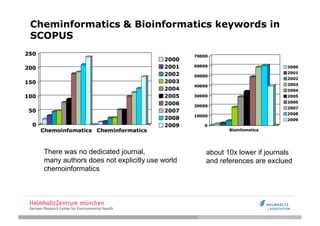
Cheminformatics & Bioinformatics keywords in
SCOPUS


  There was no dedicated journal,              about 10x lower if journals
  many authors does not explicitly use world   and references are exclued
  chemoinformatics
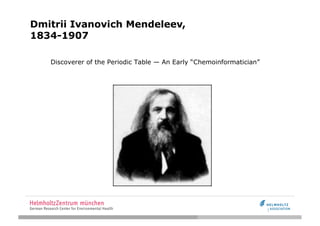
Dmitrii Ivanovich Mendeleev,
1834-1907

   Discoverer of the Periodic Table — An Early “Chemoinformatician”
Why Mendeleev?
Faced with a large amount of data, with many gaps, Mendeleev:
 • Sought patterns where none were obvious,
 • Made predictions about properties of unknown chemical substances,
   based on observed properties of known substances,
 • Created a great visualization tool!


 Why he? Why at that time?
 “The Law of transformation of Quantity into Quality”
    by Karl Marx
Quantity aspects of chemoinformatics
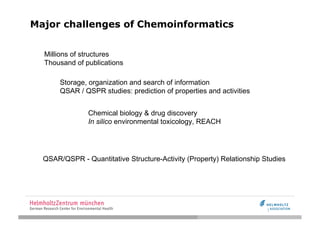
Major challenges of Chemoinformatics


  Millions of structures
  Thousand of publications

       Storage, organization and search of information
       QSAR / QSPR studies: prediction of properties and activities


               Chemical biology & drug discovery
               In silico environmental toxicology, REACH


  QSAR/QSPR - Quantitative Structure-Activity (Property) Relationship Studies
Goal of chemistry: Synthesis of Properties


                       The most fundamental and lasting objective
                                    of synthesis is
                         not production of new compounds
                                          but
                              production of properties


                                   George S. Hammond
                                   Norris Award Lecture, 1968
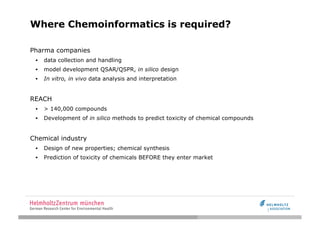
Where Chemoinformatics is required?

Pharma companies
 •   data collection and handling
 •   model development QSAR/QSPR, in silico design
 •   In vitro, in vivo data analysis and interpretation


REACH
 •   > 140,000 compounds
 •   Development of in silico methods to predict toxicity of chemical compounds


Chemical industry
 •   Design of new properties; chemical synthesis
 •   Prediction of toxicity of chemicals BEFORE they enter market
Pharma R&D: Cost and Productivity issues
Compound numbers
1.000.000 Cpds <5000 Cpds          < 500 Cpds      < 5 Cpds
                                                                    Up to 15 Years:
                                                                                       1 drug

                   Lead        Lead Optimisation   Lead Profiling       Clinics       Approval
Target Discovery   Discovery   ADME/T              ADME/T


 In vitro and in vivo property determination:
 Millions of screens for solubility, stability, absorption, metabolism, transport,
 reactive products, drug interactions, etc etc
        Preclinics Costs: > $300m PER COMPOUND to reach approval
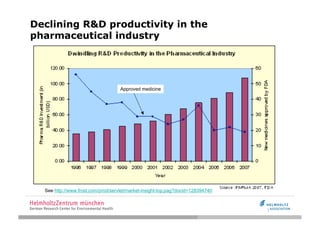
Declining R&D productivity in the
pharmaceutical industry


                                    Approved medicine


  See http://www.frost.com/prod/servlet/market-insight-top.pag?docid=128394740
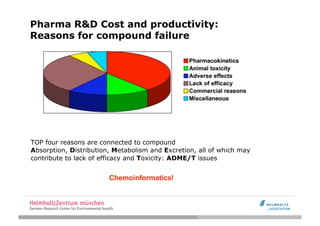
Pharma R&D Cost and productivity:
Reasons for compound failure


TOP four reasons are connected to compound
Absorption, Distribution, Metabolism and Excretion, all of which may
contribute to lack of efficacy and Toxicity: ADME/T issues


                        Chemoinformatics!
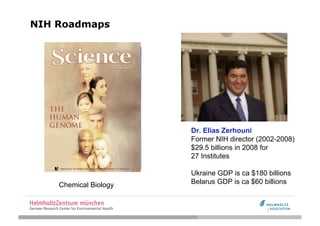
NIH Roadmaps


                       Dr. Elias Zerhouni
                       Former NIH director (2002-2008)
                       $29.5 billions in 2008 for
                       27 Institutes

                       Ukraine GDP is ca $180 billions
    Chemical Biology   Belarus GDP is ca $60 billions
NIH Roadmaps


New pathways to discovery                   Molecular Libraries Screening Center Network
 •   understand complex biological          (MLSCN)
     systems                                  •   10 centers were created
 •   understand their connections             •   250 assays to screen >200,000 molecules
 •   build better "toolbox" for
     researchers
                                            Chemoinfomatics!
Research teams of the future
                                              •   PubChem database to handle data
Re-engineering the clinical research team
REACH

Registration, Evaluation, Authorisation and
  Restriction of Chemical substances


European Chemicals Agency (ECHA) in Helsinki
REACH and Environmental Chemoinformatics


> 140,000 chemicals to be registered … is a lot!
It is expensive to measure all of them ($200,000 per compound), a lot of
    animal testing => !24 billions over next 10 years
QSAR models can be used to prioritize compounds
    •   Compound is predicted to be toxic
         • Biological testing will be done to prove/
           disprove the models
    •   Compound is predicted to be not toxic
         • tests can be avoided, saving money, animals
         • but ... only if we are confident in the predictions
Requirements of biological testing
following QSAR model prediction

    model                    prediction confidence

  prediction            high                   low               toxic
    toxic,          strong need        moderate need
 EC50 > LIMIT                           (depends on
                                      other properties)
  non-toxic,          no need             low need
 EC50 < LIMIT                           (depends on
                                      other properties)


                                                                  non-toxic

Acceptance of decisions is more accurate if confidence intervals (prediction
errors) are known and are taken into analysis: concept of applicability domain.

                               Environmental chemoinformatics!
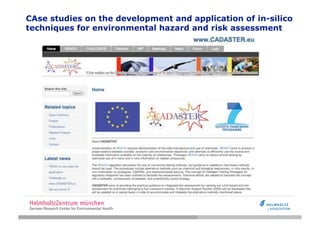
CAse studies on the development and application of in-silico
techniques for environmental hazard and risk assessment
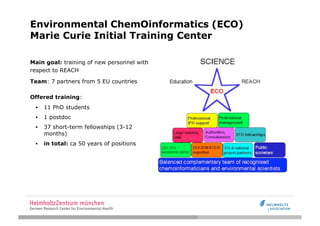
Environmental ChemOinformatics (ECO)
Marie Curie Initial Training Center

Main goal: training of new personnel with
respect to REACH

Team: 7 partners from 5 EU countries

Offered training:
 •   11 PhD students
 •   1 postdoc
 •   37 short-term fellowships (3-12
     months)
 •   in total: ca 50 years of positions
Definitions of Chemoinformatics

Chemoinformatics is a generic term that encompasses the design, creation, organization,
management, retrieval, analysis, dissemination, visualization, and use of chemical
information. G. Paris, 1988
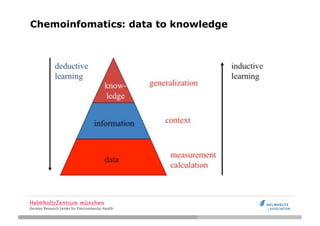
Chemoinformatics is the mixing of those information resources to transform data in to
information and information in to knowledge for the intended purpose of making better
decisions faster in the area of drug lead identification and optimization. F.K. Brown, 1998


Chemoinformatics is the application of informatics methods to solve chemical problems.
J. Gasteiger, 2004

Chemoinformatics is a field dealing with molecular objects (graphs, vectors) in
multidimensional chemical space. A. Varnek & A. Tropsha, 2007.
Chemoinfomatics: data to knowledge
What is required to create a good model?


 • Data -- the most essential part!
 • Appropriate representation of molecules (choice of
   descriptors is crucial!)
 • Good statistical methods
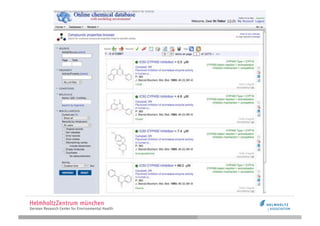
OCHEM - On-line CHEmical database and
        Modeling environment
Database schema
Simplified overview
      Property                                            Condition
                                 Filtering
                             Toxicology, Biology,         Temperature,
       logP = 0.5            Partition coefficient.         pH, species,
 Melting Point = 100 °C
                                                          tissue, method


           Tags                Data Point                   Introducer
                                                           Bill G., Sergey B.
    Toxicology, Biology,
    Partition coefficient.
                                                       Date of modification
                                                       Informationsystem


      Structure                                             Article
                              Manipulation
    Benzene, Urea, ...             Editing                  Garberg, P
                              Organization            “In vitro models for …”
                                Working sets<
Descriptors
Offered course
Monday (10.08, 10:00-13:00)
 •   Introduction to Chemoinformatics
 •   From 2D to 4D descriptors (Prof. V.E. Kuzmin, OSU, Ukraine)
 •   Developing chemoinformatics models: One can’t embrace
     unembraceable (Dr I.V. Tetko, HMGU, Germany)


Tuesday (11.08, 10:00-13:00)
 •   Role of 3D information in chemoinformatics: problem of chirality (Prof. V.E. Kuzmin)
 •   Introduction to predictive toxicology (Prof. W. Peijnenberg, 2 lectures)


Wednesday (12.08, 10:00-13:00)
 •   Introduction to OCHEM: database (Mr S. Novotarskyi, HMGU)
 •   Practical session (Mr S. Novotarskyi & I. Sushko, HMGU)


Thursday (13.08, 10:00-13:00)
 •   Introduction to OCHEM: models (Mr I. Sushko, HMGU, Germany)
 •   Overview of machine learning methods available at OCHEM (Dr. I. Tetko)
 •   Practical session (Mr S. Novotarskyi & I. Sushko, HMGU, Germany)
HMGU Team
Acknowledgement

 Prof. W. Peijnenburg             Mr I. Sushko
 Prof. V. Kuz!min                 Mr S. Novotarskyi

 Team members
 Mr A.K. Pandey
 Mr R. Körner
 Mr S. Brandmayer
 Dr. M. Rupp

           BMBF GO-Bio grant 0313883, CADASTER FP7 EU project,
                       Germany-Ukraine bilateral grant

                        Thank you for your attention!

Introduction to Chemoinfornatics

  • 1.
    Introduction to Chemoinformatics Dr.Igor V. Tetko Helmholtz Zentrum München - German Research Center for Environmental Health (GmbH) Institute of Bioinformatics & Systems Biology (HMGU) Kyiv, 10 August 2009, Summer School
  • 2.
    Layout • Chemoiformatics??? Whatdoes it mean? • Role of chemoinformatics • in drug discovery • Chemical Biology, NIH Roadmaps • REACH, chemical safety • Definitions of chemoinformatics • OCHEM • Overview of the course
  • 3.
    Cheminformatics & Bioinformaticskeywords in SCOPUS There was no dedicated journal, about 10x lower if journals many authors does not explicitly use world and references are exclued chemoinformatics
  • 4.
    Dmitrii Ivanovich Mendeleev, 1834-1907 Discoverer of the Periodic Table — An Early “Chemoinformatician”
  • 6.
    Why Mendeleev? Faced witha large amount of data, with many gaps, Mendeleev: • Sought patterns where none were obvious, • Made predictions about properties of unknown chemical substances, based on observed properties of known substances, • Created a great visualization tool! Why he? Why at that time? “The Law of transformation of Quantity into Quality” by Karl Marx
  • 7.
    Quantity aspects ofchemoinformatics
  • 8.
    Major challenges ofChemoinformatics Millions of structures Thousand of publications Storage, organization and search of information QSAR / QSPR studies: prediction of properties and activities Chemical biology & drug discovery In silico environmental toxicology, REACH QSAR/QSPR - Quantitative Structure-Activity (Property) Relationship Studies
  • 9.
    Goal of chemistry:Synthesis of Properties The most fundamental and lasting objective of synthesis is not production of new compounds but production of properties George S. Hammond Norris Award Lecture, 1968
  • 10.
    Where Chemoinformatics isrequired? Pharma companies • data collection and handling • model development QSAR/QSPR, in silico design • In vitro, in vivo data analysis and interpretation REACH • > 140,000 compounds • Development of in silico methods to predict toxicity of chemical compounds Chemical industry • Design of new properties; chemical synthesis • Prediction of toxicity of chemicals BEFORE they enter market
  • 11.
    Pharma R&D: Costand Productivity issues Compound numbers 1.000.000 Cpds <5000 Cpds < 500 Cpds < 5 Cpds Up to 15 Years: 1 drug Lead Lead Optimisation Lead Profiling Clinics Approval Target Discovery Discovery ADME/T ADME/T In vitro and in vivo property determination: Millions of screens for solubility, stability, absorption, metabolism, transport, reactive products, drug interactions, etc etc Preclinics Costs: > $300m PER COMPOUND to reach approval
  • 12.
    Declining R&D productivityin the pharmaceutical industry Approved medicine See http://www.frost.com/prod/servlet/market-insight-top.pag?docid=128394740
  • 13.
    Pharma R&D Costand productivity: Reasons for compound failure TOP four reasons are connected to compound Absorption, Distribution, Metabolism and Excretion, all of which may contribute to lack of efficacy and Toxicity: ADME/T issues Chemoinformatics!
  • 14.
    NIH Roadmaps Dr. Elias Zerhouni Former NIH director (2002-2008) $29.5 billions in 2008 for 27 Institutes Ukraine GDP is ca $180 billions Chemical Biology Belarus GDP is ca $60 billions
  • 15.
    NIH Roadmaps New pathwaysto discovery Molecular Libraries Screening Center Network • understand complex biological (MLSCN) systems • 10 centers were created • understand their connections • 250 assays to screen >200,000 molecules • build better "toolbox" for researchers Chemoinfomatics! Research teams of the future • PubChem database to handle data Re-engineering the clinical research team
  • 16.
    REACH Registration, Evaluation, Authorisationand Restriction of Chemical substances European Chemicals Agency (ECHA) in Helsinki
  • 17.
    REACH and EnvironmentalChemoinformatics > 140,000 chemicals to be registered … is a lot! It is expensive to measure all of them ($200,000 per compound), a lot of animal testing => !24 billions over next 10 years QSAR models can be used to prioritize compounds • Compound is predicted to be toxic • Biological testing will be done to prove/ disprove the models • Compound is predicted to be not toxic • tests can be avoided, saving money, animals • but ... only if we are confident in the predictions
  • 18.
    Requirements of biologicaltesting following QSAR model prediction model prediction confidence prediction high low toxic toxic, strong need moderate need EC50 > LIMIT (depends on other properties) non-toxic, no need low need EC50 < LIMIT (depends on other properties) non-toxic Acceptance of decisions is more accurate if confidence intervals (prediction errors) are known and are taken into analysis: concept of applicability domain. Environmental chemoinformatics!
  • 19.
    CAse studies onthe development and application of in-silico techniques for environmental hazard and risk assessment
  • 20.
    Environmental ChemOinformatics (ECO) MarieCurie Initial Training Center Main goal: training of new personnel with respect to REACH Team: 7 partners from 5 EU countries Offered training: • 11 PhD students • 1 postdoc • 37 short-term fellowships (3-12 months) • in total: ca 50 years of positions
  • 21.
    Definitions of Chemoinformatics Chemoinformaticsis a generic term that encompasses the design, creation, organization, management, retrieval, analysis, dissemination, visualization, and use of chemical information. G. Paris, 1988 Chemoinformatics is the mixing of those information resources to transform data in to information and information in to knowledge for the intended purpose of making better decisions faster in the area of drug lead identification and optimization. F.K. Brown, 1998 Chemoinformatics is the application of informatics methods to solve chemical problems. J. Gasteiger, 2004 Chemoinformatics is a field dealing with molecular objects (graphs, vectors) in multidimensional chemical space. A. Varnek & A. Tropsha, 2007.
  • 22.
  • 23.
    What is requiredto create a good model? • Data -- the most essential part! • Appropriate representation of molecules (choice of descriptors is crucial!) • Good statistical methods
  • 24.
    OCHEM - On-lineCHEmical database and Modeling environment
  • 27.
    Database schema Simplified overview Property Condition Filtering Toxicology, Biology, Temperature, logP = 0.5 Partition coefficient. pH, species, Melting Point = 100 °C tissue, method Tags Data Point Introducer Bill G., Sergey B. Toxicology, Biology, Partition coefficient. Date of modification Informationsystem Structure Article Manipulation Benzene, Urea, ... Editing Garberg, P Organization “In vitro models for …” Working sets<
  • 28.
  • 30.
    Offered course Monday (10.08,10:00-13:00) • Introduction to Chemoinformatics • From 2D to 4D descriptors (Prof. V.E. Kuzmin, OSU, Ukraine) • Developing chemoinformatics models: One can’t embrace unembraceable (Dr I.V. Tetko, HMGU, Germany) Tuesday (11.08, 10:00-13:00) • Role of 3D information in chemoinformatics: problem of chirality (Prof. V.E. Kuzmin) • Introduction to predictive toxicology (Prof. W. Peijnenberg, 2 lectures) Wednesday (12.08, 10:00-13:00) • Introduction to OCHEM: database (Mr S. Novotarskyi, HMGU) • Practical session (Mr S. Novotarskyi & I. Sushko, HMGU) Thursday (13.08, 10:00-13:00) • Introduction to OCHEM: models (Mr I. Sushko, HMGU, Germany) • Overview of machine learning methods available at OCHEM (Dr. I. Tetko) • Practical session (Mr S. Novotarskyi & I. Sushko, HMGU, Germany)
  • 31.
  • 32.
    Acknowledgement Prof. W.Peijnenburg Mr I. Sushko Prof. V. Kuz!min Mr S. Novotarskyi Team members Mr A.K. Pandey Mr R. Körner Mr S. Brandmayer Dr. M. Rupp BMBF GO-Bio grant 0313883, CADASTER FP7 EU project, Germany-Ukraine bilateral grant Thank you for your attention!