CheminformaticsNoel M. O’BoyleApr 2010Postgrad course on Comp Chem
CheminformaticsHard to define in words:David Wild: “The field that studies all aspects of the representation and use of chemical and related biological information on computers”Design, creation, organization, management, retrieval, analysis, dissemination, visualization and use of chemical informationHard to agree on spelling:Sometimes chemoinformaticsMore easily thought of as encompassing a range of concepts and techniquesMolecular similarityQuantitative-structure activity relationships (QSAR)Substructure search(Automated) Molecular depictionEncoding/decoding of molecular structures3D structure generation from a 2D or 0D structureConformer generationAlgorithms: ring perception, aromaticity, isomers
ReferencesCheminformatics, Johann Gasteiger and Thomas Engel (Eds)Molecular modelling – Principles and Applications, A. R. LeachI571 Chemical Information Technology, David Wild, University of Indiana, http://i571.wikispaces.com/An introduction to cheminformatics, A. R. Leach, V. J. Gillet
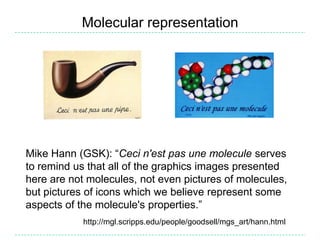
Molecular representationMike Hann (GSK): “Cecin'est pas une molecule serves to remind us that all of the graphics images presented here are not molecules, not even pictures of molecules, but pictures of icons which we believe represent some aspects of the molecule's properties.”http://mgl.scripps.edu/people/goodsell/mgs_art/hann.html
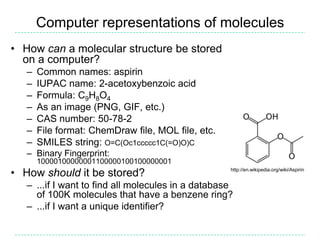
Computer representations of moleculesHow can a molecular structure be stored on a computer?Common names: aspirinIUPAC name: 2-acetoxybenzoic acidFormula: C9H8O4As an image (PNG, GIF, etc.)CAS number: 50-78-2File format: ChemDraw file, MOL file, etc.SMILES string: O=C(Oc1ccccc1C(=O)O)CBinary Fingerprint: 10000100000001100000100100000001How should it be stored?...if I want to find all molecules in a database of 100K molecules that have a benzene ring?...if I want a unique identifier?http://en.wikipedia.org/wiki/Aspirin
Computer representations of moleculesThe structure of a molecule can be represented by a graphGraph = collection of nodes and edges, nodes and edges have properties (atomic number, bond order)Represent the molecular graph somehowConnection table (which nodes are connected to which other nodes)Line notation (e.g. SMILES)Fig 12.2: Molecular modelling – principles and applications, Andrew R Leach, Pearson, 2ndedn.
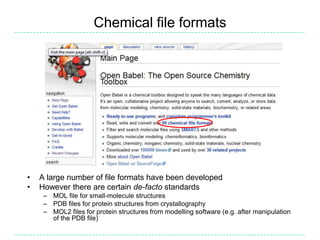
Chemical file formatsA large number of file formats have been developedHowever there are certain de-facto standardsMOL file for small-molecule structuresPDB files for protein structures from crystallographyMOL2 files for protein structures from modelling software (e.g. after manipulation of the PDB file)
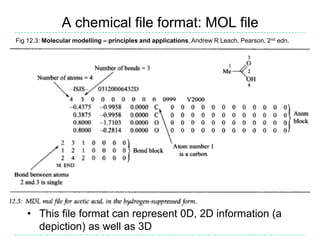
A chemical file format: MOL fileFig 12.3: Molecular modelling – principles and applications, Andrew R Leach, Pearson, 2ndedn.This file format can represent 0D, 2D information (a depiction) as well as 3D
SMILES formatSimplified Molecular Input Line Entry SystemWeininger, J ChemInfComputSci, 1988, 28, 31More recently, a community developed description: http://opensmiles.orgLinear format (“line notation”) that describes the connection table and stereochemistry of a molecule (i.e. 0D)Convenient to enter as a query on-line, store in a database, pass by email, etc.Examples:CC represents CH3CH3 (ethane)CC(=O)O represents CH3COOH (acetic acid)Basic guidelines:Hydrogens are implicitParentheses indicate branchesEach atom is connected to the preceding atom to its left (excluding branches in-between)Single bonds are implicit, = for double, # for tripleWhat is C(C)(C)(C)C?
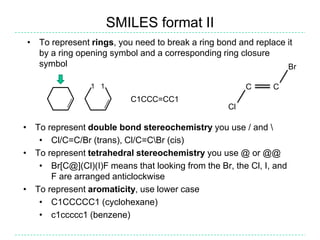
SMILES format IITo represent rings, you need to break a ring bond and replace it by a ring opening symbol and a corresponding ring closure symbolBr11CCC1CCC=CC1ClTo representdouble bond stereochemistry you use / and \
Cl/C=C/Br (trans), Cl/C=C\Br (cis)
To represent tetrahedral stereochemistryyou use @ or @@
Br[C@](Cl)(I)F means that looking from the Br, the Cl, I, and F are arranged anticlockwise
To represent aromaticity, use lower case
C1CCCCC1 (cyclohexane)
c1ccccc1 (benzene)Canonical SMILESIn general, many different SMILES strings can be written for the same moleculeNot a unique identifier (one-to-many)Algorithms for producing “canonical SMILES” have been developedThe same unique SMILES string is always created for a particular moleculeOne-to-one relationship between structure and representationNote however, that different software implement different canonicalisation algorithmsCan be used to remove duplicate molecules from a databaseGenerate the canonical SMILES for each molecule and ensure that they are unique
InChIInternational Chemical IdentifierLine notation developed by NIST and IUPACGoal: An index for uniquely identifying a moleculeAspirin: InChI=1/C9H8O4/c1-6(10)13-8-5-3-2-4-7(8)9(11)12/h2-5H,1H3,(H,11,12)/f/h11HFeaturesDerived from the structure (unlike CAS number)One-to-one relationship between InChI and structureLayers (of specificity)Can distinguish between stereoisomers, isotopes, or can leave out those layersDifferent tautomeric forms give rise to the same InChI (unlike SMILES)NotesNot human readable or writeableAll implementations use the same (open source) code which is provided by the InChI Trust“The Trust's goal is to enable the interlinking and combining of chemical, biological and related information, using unique machine-readable chemical structure representations to facilitate and expedite new scientific discoveries.”See http://inchi.info and Google “unofficial inchifaq”
A unique identifier makes it easy to link databasesDrugBankChEBI