Chemistry resources and tools
for compound selection
Cheminformatics
Dec 2013
EMBL-EBI/Wellcome Trust Course: Resources for
Computational Drug Discovery
Ben Bucior
ChE 451: March 6, 2018
Slides lightly adapted from:
Noel M. O’Boyle
NextMove Software and Open Babel developer
See also the original version of slides at
https://www.slideshare.net/baoilleach/cheminformatics-13581857
Cheminformatics
• Hard to define in words:
– David Wild: “The field that studies all aspects of the representation and use
of chemical and related biological information on computers”
– Design, creation, organization, management, retrieval, analysis,
dissemination, visualization and use of chemical information
• Hard to agree on spelling:
– Sometimes chemoinformatics
• More easily thought of as encompassing a range of concepts
and techniques
– Molecular similarity
– Quantitative-structure activity relationships (QSAR)
– Substructure search
– (Automated) Molecular depiction
– Encoding/decoding of molecular structures
– 3D structure generation from a 2D or 0D structure
– Conformer generation
– Algorithms: ring perception, aromaticity, isomers
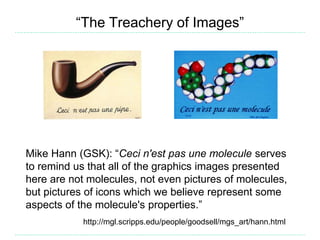
“The Treachery of Images”
Mike Hann (GSK): “Ceci n'est pas une molecule serves
to remind us that all of the graphics images presented
here are not molecules, not even pictures of molecules,
but pictures of icons which we believe represent some
aspects of the molecule's properties.”
http://mgl.scripps.edu/people/goodsell/mgs_art/hann.html
Computer representations of molecules
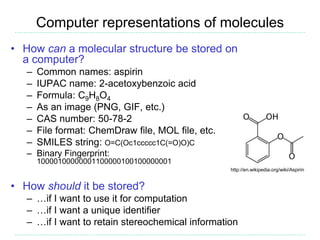
• How can a molecular structure be stored on
a computer?
– Common names: aspirin
– IUPAC name: 2-acetoxybenzoic acid
– Formula: C9H8O4
– As an image (PNG, GIF, etc.)
– CAS number: 50-78-2
– File format: ChemDraw file, MOL file, etc.
– SMILES string: O=C(Oc1ccccc1C(=O)O)C
– Binary Fingerprint:
10000100000001100000100100000001
• How should it be stored?
– …if I want to use it for computation
– …if I want a unique identifier
– …if I want to retain stereochemical information
http://en.wikipedia.org/wiki/Aspirin
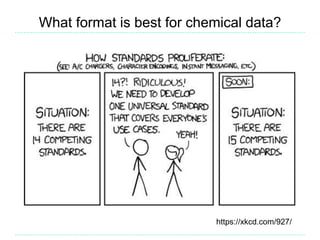
What format is best for chemical data?
https://xkcd.com/927/
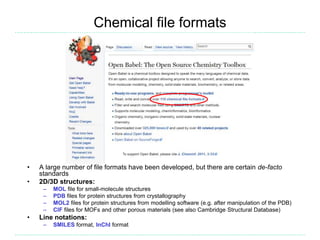
Chemical file formats
• A large number of file formats have been developed, but there are certain de-facto
standards
• 2D/3D structures:
– MOL file for small-molecule structures
– PDB files for protein structures from crystallography
– MOL2 files for protein structures from modelling software (e.g. after manipulation of the PDB)
– CIF files for MOFs and other porous materials (see also Cambridge Structural Database)
• Line notations:
– SMILES format, InChI format
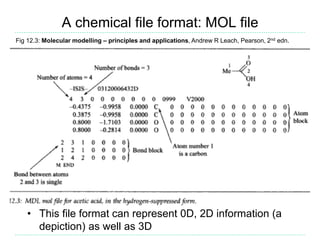
A chemical file format: MOL file
• This file format can represent 0D, 2D information (a
depiction) as well as 3D
Fig 12.3: Molecular modelling – principles and applications, Andrew R Leach, Pearson, 2nd edn.
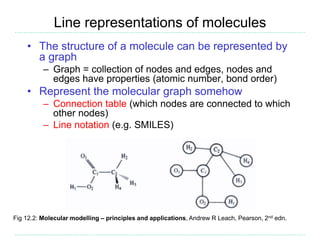
Line representations of molecules
• The structure of a molecule can be represented by
a graph
– Graph = collection of nodes and edges, nodes and
edges have properties (atomic number, bond order)
• Represent the molecular graph somehow
– Connection table (which nodes are connected to which
other nodes)
– Line notation (e.g. SMILES)
Fig 12.2: Molecular modelling – principles and applications, Andrew R Leach, Pearson, 2nd edn.
SMILES format
• Simplified Molecular Input Line Entry System
– Weininger, J Chem Inf Comput Sci, 1988, 28, 31
– See also http://www.daylight.com/dayhtml/doc/theory/
– More recently, a community developed description:
http://opensmiles.org
– Linear format (“line notation”) that describes the connection table
and stereochemistry of a molecule (i.e. 0D)
– Convenient to enter as a query on-line, store in a spreadsheet,
pass by email, etc.
• Examples:
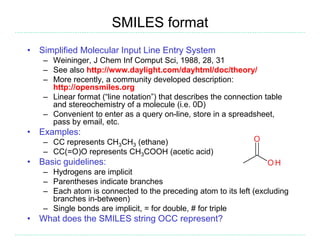
– CC represents CH3CH3 (ethane)
– CC(=O)O represents CH3COOH (acetic acid)
• Basic guidelines:
– Hydrogens are implicit
– Parentheses indicate branches
– Each atom is connected to the preceding atom to its left (excluding
branches in-between)
– Single bonds are implicit, = for double, # for triple
• What does the SMILES string OCC represent?
SMILES format II
• To represent rings, you need to break a ring bond and replace it
by a ring opening symbol and a corresponding ring closure
symbol
1 1
C1CCC=CC1
• To represent double bond stereochemistry you use / and 
• Cl/C=C/Br (trans), Cl/C=CBr (cis), ClC=CBr (unspecified)
• To represent tetrahedral stereochemistry you use @ or @@
• Br[C@](Cl)(I)F means that looking from the Br, the Cl, I, and
F are arranged anticlockwise
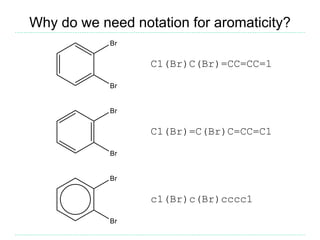
• To represent aromaticity, use lower case
• C1CCCCC1 (cyclohexane)
• c1ccccc1 (benzene)
Cl
C C
Br
Why do we need notation for aromaticity?
C1(Br)=C(Br)C=CC=C1
c1(Br)c(Br)cccc1
C1(Br)C(Br)=CC=CC=1
Canonical SMILES
• In general, many different SMILES strings can be written
for the same molecule
– Not a unique identifier (one-to-many)
– Ethanol: CCO, OCC, C(O)C
• Algorithms for producing “canonical SMILES” have been
developed
– The same unique SMILES string is always created for a
particular molecule
– One-to-one relationship between structure and
representation
– Note however, that different software implement different
canonicalisation algorithms
• Uses:
– Can be used to remove duplicate molecules from a database
• Generate the canonical SMILES for each molecule and ensure that
they are unique
– Check identity (compare two molecules)
• Did this software change the structure? Or get the stereochemistry
confused?
Be careful of reinventing the wheel
“The foundation of a chemical information system is its ability
to represent molecules in a computer and to
communicate a molecule's structure from one place to
another. This can seem like a simple problem at first glance
so that easy solutions are often proposed and implemented.
But a close examination of the problem reveals that several
subtle traps await the unwary and methods of avoiding
them must be considered before an effective computer
representation of a molecule can be designed.”
- Daylight Theory Manual
InChI
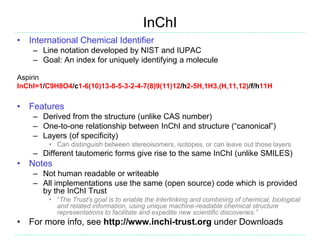
• International Chemical Identifier
– Line notation developed by NIST and IUPAC
– Goal: An index for uniquely identifying a molecule
Aspirin
InChI=1/C9H8O4/c1-6(10)13-8-5-3-2-4-7(8)9(11)12/h2-5H,1H3,(H,11,12)/f/h11H
• Features
– Derived from the structure (unlike CAS number)
– One-to-one relationship between InChI and structure (“canonical”)
– Layers (of specificity)
• Can distinguish between stereoisomers, isotopes, or can leave out those layers
– Different tautomeric forms give rise to the same InChI (unlike SMILES)
• Notes
– Not human readable or writeable
– All implementations use the same (open source) code which is provided
by the InChI Trust
• “The Trust's goal is to enable the interlinking and combining of chemical, biological
and related information, using unique machine-readable chemical structure
representations to facilitate and expedite new scientific discoveries.”
• For more info, see http://www.inchi-trust.org under Downloads
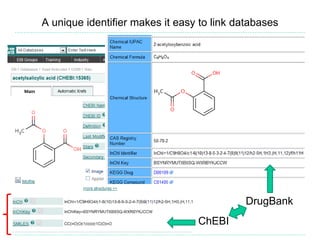
A unique identifier makes it easy to link databases
ChEBI
DrugBank
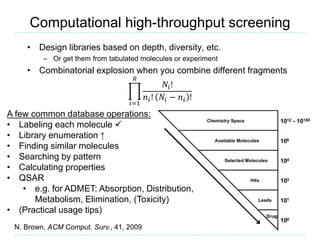
Computational high-throughput screening
• Design libraries based on depth, diversity, etc.
– Or get them from tabulated molecules or experiment
• Combinatorial explosion when you combine different fragments
𝑖=1
𝑅
𝑁𝑖!
𝑛𝑖! 𝑁𝑖 − 𝑛𝑖 !
N. Brown, ACM Comput. Surv., 41, 2009
A few common database operations:
• Labeling each molecule 
• Library enumeration ↑
• Finding similar molecules
• Searching by pattern
• Calculating properties
• QSAR
• e.g. for ADMET: Absorption, Distribution,
Metabolism, Elimination, (Toxicity)
• (Practical usage tips)
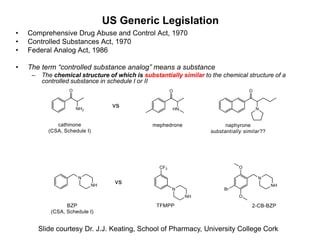
US Generic Legislation
• Comprehensive Drug Abuse and Control Act, 1970
• Controlled Substances Act, 1970
• Federal Analog Act, 1986
• The term “controlled substance analog” means a substance
– The chemical structure of which is substantially similar to the chemical structure of a
controlled substance in schedule I or II
Slide courtesy Dr. J.J. Keating, School of Pharmacy, University College Cork
Molecular similarity
• Similarity principle:
– Structurally similar molecules tend to have similar properties
• Properties: biological activity, solubility, color and so on
• If we can measure similarity somehow…
– Can construct a distance matrix
• Distance = inverse of similarity
• Such matrices can be used to cluster compounds, to create a 2D
depiction showing the spread of molecular structures in a dataset,
to select a diverse subset
– Can use to find molecules in a database similar to a
particular query
– Can use to see whether a particular property is correlated
with molecular similarity
• ...But how to measure similarity?
– One way is using molecular fingerprints
Molecular fingerprints
• A molecular fingerprint is an encoding of the molecular structure
onto a (long) binary string
– 100100010000001011000000000001...
• Path-based fingerprints (e.g. Daylight fingerprint)
– Break the molecule up into all possible fragments of length 1, 2,
3...7
– Create a string representing each fragment
– Hash each string onto a number between 1 and 1024 (for example)
• Wikipedia: “A hash function is any well-defined procedure or mathematical
function that converts a large, possibly variable-sized amount of data into a
small datum, usually a single integer that may serve as an index to an array”
– Set the corresponding bit of the fingerprint to 1 (all others will be 0)
• Key-based fingerprints (e.g. MACCS keys)
– A (long) list of pre-generated questions about a chemical structure
• “Are there fewer than 3 oxygens?”
• “Is there an S-S bond?”
• “Is there a ring of size 4?”
– Each answer, true or false, corresponds to a 1 or 0 in the binary
fingerprint
Similarity of molecular fingerprints
• Molecules with the same bits set will be more similar than
molecules with different bits set
• To quantify this, we can use the Tanimoto coefficient
– Tanimoto Similarity = Intersection/Union = (A ∩ B) / (A U B)
– Bounded by 0 and 1 (no similarity to perfect similarity)
– A value of greater than 0.7 or 0.8 indicates structural similarity
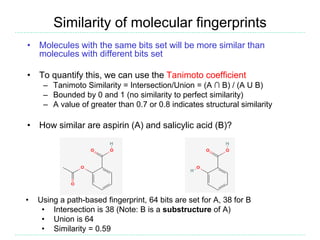
• How similar are aspirin (A) and salicylic acid (B)?
• Using a path-based fingerprint, 64 bits are set for A, 38 for B
• Intersection is 38 (Note: B is a substructure of A)
• Union is 64
• Similarity = 0.59
Substructure search using SMARTS
• SMARTS – an extension of SMILES for substructure searching
– Can be used to find molecules with a particular substructure
– Can be used to filter out molecules with a particular substructure
• Simple example
– Ether: [OD2]([#6])[#6]
• Any oxygen with exactly two bonds each to a carbon
• Can get (a lot) more complicated
– Carbonic Acid or Carbonic Acid-Ester:
[CX3](=[OX1])([OX2])[OX2H,OX1H0-1]
• Hits acid and conjugate base. Won't hit carbonic acid diester
– Many good examples online:
http://www.daylight.com/dayhtml_tutorials/languages/smarts/smarts_examples.html
• Examples of use
– Filtering structures
– Identify substructures that are associated with toxicological
problems
– Develop or use a group contribution descriptor such as TPSA
SMARTSviewer
http://smartsview.zbh.uni-hamburg.de/
K. Schomburg, H.-C. Ehrlich, K. Stierand,
M.Rarey. “From Structure Diagrams to Visual
Chemical Patterns” J. Chem. Inf. Model., 2010,
50, 1529.
[CX3](=[OX1])([OX2])[OX2H,OX1H0-1]
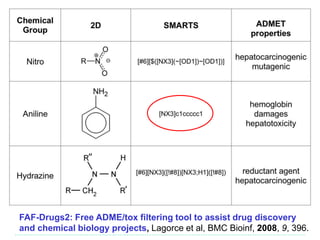
FAF-Drugs2: Free ADME/tox filtering tool to assist drug discovery
and chemical biology projects, Lagorce et al, BMC Bioinf, 2008, 9, 396.
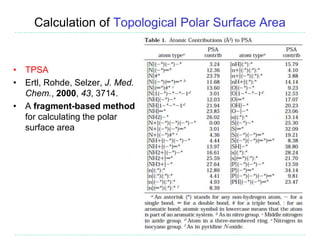
Calculation of Topological Polar Surface Area
• TPSA
• Ertl, Rohde, Selzer, J. Med.
Chem., 2000, 43, 3714.
• A fragment-based method
for calculating the polar
surface area
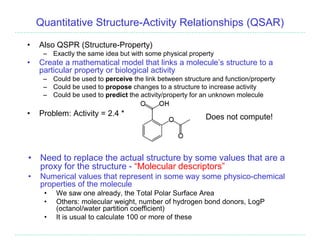
Quantitative Structure-Activity Relationships (QSAR)
• Also QSPR (Structure-Property)
– Exactly the same idea but with some physical property
• Create a mathematical model that links a molecule’s structure to a
particular property or biological activity
– Could be used to perceive the link between structure and function/property
– Could be used to propose changes to a structure to increase activity
– Could be used to predict the activity/property for an unknown molecule
• Problem: Activity = 2.4 * Does not compute!
• Need to replace the actual structure by some values that are a
proxy for the structure - “Molecular descriptors”
• Numerical values that represent in some way some physico-chemical
properties of the molecule
• We saw one already, the Total Polar Surface Area
• Others: molecular weight, number of hydrogen bond donors, LogP
(octanol/water partition coefficient)
• It is usual to calculate 100 or more of these
Building and testing a predictive QSAR model
• Need dataset with known values for the property of
interest
– Divide into 2/3 training set and 1/3 test set
• Choose a regression model
– Linear regression, artificial neural network, support vector
machine, random forest, etc.
• Train the model to predict the property values for the
training set based on their descriptors
• Apply the model to the test set
– Find the RMSEP and R2
• Root-mean squared error of prediction and correlation coefficient
• Practical Notes:
– Descriptors can be calculated with the CDK or RDKit
– Models can be built using R (r-project.org)
– For a combination of the two, see rcdk
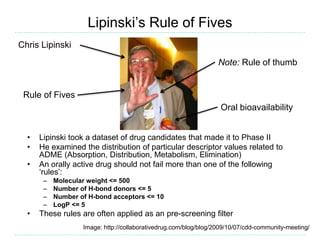
Lipinski’s Rule of Fives
• Lipinski took a dataset of drug candidates that made it to Phase II
• He examined the distribution of particular descriptor values related to
ADME (Absorption, Distribution, Metabolism, Elimination)
• An orally active drug should not fail more than one of the following
‘rules’:
– Molecular weight <= 500
– Number of H-bond donors <= 5
– Number of H-bond acceptors <= 10
– LogP <= 5
• These rules are often applied as an pre-screening filter
Chris Lipinski
Rule of Fives
Oral bioavailability
Image: http://collaborativedrug.com/blog/blog/2009/10/07/cdd-community-meeting/
Note: Rule of thumb
Open Source cheminformatics software resources
• GUI:
– Open Babel, Avogadro
– LICSS – Excel-CDK interface
• Command-line interface:
– Open Babel (“babel/obabel”)
– MayaChemTools
• Programming toolkits:
– Open Babel (C++, Perl, Python, .NET, Java), RDKit (C++, Python),
Chemistry Development Kit [CDK] (Java, Jython, ...), PerlMol (Perl),
MayaChemTools (Perl)
– Cinfony (by Noel!) presents a simplified interface to some of these
– Javascript libraries
– Materials simulation libraries: Pymatgen, ASE (Python)
• Specialized toolkits:
– OSRA: image to structure
– OPSIN: name to structure
– OSCAR: Identify chemical terms in text
Getting started with Open Babel
• Convert formats
– # -O specifies a file, -o specifies a format and prints to stdout by default
– obabel raspa_framework.pdb -O framework.cif
• Many import formats have input (-a) or output (-x) flags
– Open Babel detects bonds by default (sometimes expensive). Can
sometimes disable using the flag -ab
– https://openbabel.org/docs/dev/FileFormats/Overview.html
• Draw an SVG (or PNG) line structure, highlighting a pattern
– obabel caffeine.smi -O caffeine.svg -xe -xC -s "[#7][CH3]" "purple"
• Convert SMILES to InChIKey
– obabel -:"CC(=O)Cl" -oinchikey
• Get molecular properties
– obprop my_file.smi
• Make sure BABEL_DATADIR variable is set properly
• See also the Python module: import pybel, openbabel
– Warning: install the package openbabel to get both of these, NOT pybel
– Interoperable with rdkit, another powerful cheminformatics library
References
• An introduction to cheminformatics, A. R. Leach, V. J.
Gillet
• Cheminformatics, Johann Gasteiger and Thomas
Engel (Eds)
• Molecular modelling – Principles and Applications, A.
R. Leach
• Chemoinformatics—an Introduction for Computer
Scientists, N. Brown, ACM Comput. Surv., 41, 2009
• I571 Chemical Information Technology, David Wild,
University of Indiana http://i571.wikispaces.com/
– Note: this is a great resource but might be going offline in
summer 2018
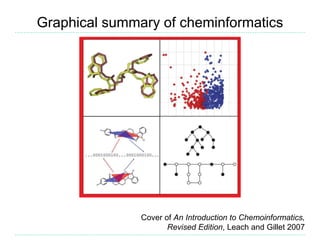
Graphical summary of cheminformatics
Cover of An Introduction to Chemoinformatics,
Revised Edition, Leach and Gillet 2007
Key takeaways on chem(o)informatics
• Chemical data management techniques are powerful
• SMILES is like a digital version of a chemistry line
drawing but has many subtleties
– Differences in canonicalization and other algorithms between
the various open source and “proprietary” implementations
– Aromaticity
– Implicit hydrogens
• Be careful of your SMARTS patterns (and software
flags) for substructure searching
• Try not to reinvent the wheel. Use/improve standard
chemistry software libraries, as available

Overview of cheminformatics

  • 1.
    Chemistry resources andtools for compound selection Cheminformatics Dec 2013 EMBL-EBI/Wellcome Trust Course: Resources for Computational Drug Discovery Ben Bucior ChE 451: March 6, 2018 Slides lightly adapted from: Noel M. O’Boyle NextMove Software and Open Babel developer See also the original version of slides at https://www.slideshare.net/baoilleach/cheminformatics-13581857
  • 2.
    Cheminformatics • Hard todefine in words: – David Wild: “The field that studies all aspects of the representation and use of chemical and related biological information on computers” – Design, creation, organization, management, retrieval, analysis, dissemination, visualization and use of chemical information • Hard to agree on spelling: – Sometimes chemoinformatics • More easily thought of as encompassing a range of concepts and techniques – Molecular similarity – Quantitative-structure activity relationships (QSAR) – Substructure search – (Automated) Molecular depiction – Encoding/decoding of molecular structures – 3D structure generation from a 2D or 0D structure – Conformer generation – Algorithms: ring perception, aromaticity, isomers
  • 3.
    “The Treachery ofImages” Mike Hann (GSK): “Ceci n'est pas une molecule serves to remind us that all of the graphics images presented here are not molecules, not even pictures of molecules, but pictures of icons which we believe represent some aspects of the molecule's properties.” http://mgl.scripps.edu/people/goodsell/mgs_art/hann.html
  • 4.
    Computer representations ofmolecules • How can a molecular structure be stored on a computer? – Common names: aspirin – IUPAC name: 2-acetoxybenzoic acid – Formula: C9H8O4 – As an image (PNG, GIF, etc.) – CAS number: 50-78-2 – File format: ChemDraw file, MOL file, etc. – SMILES string: O=C(Oc1ccccc1C(=O)O)C – Binary Fingerprint: 10000100000001100000100100000001 • How should it be stored? – …if I want to use it for computation – …if I want a unique identifier – …if I want to retain stereochemical information http://en.wikipedia.org/wiki/Aspirin
  • 5.
    What format isbest for chemical data? https://xkcd.com/927/
  • 6.
    Chemical file formats •A large number of file formats have been developed, but there are certain de-facto standards • 2D/3D structures: – MOL file for small-molecule structures – PDB files for protein structures from crystallography – MOL2 files for protein structures from modelling software (e.g. after manipulation of the PDB) – CIF files for MOFs and other porous materials (see also Cambridge Structural Database) • Line notations: – SMILES format, InChI format
  • 7.
    A chemical fileformat: MOL file • This file format can represent 0D, 2D information (a depiction) as well as 3D Fig 12.3: Molecular modelling – principles and applications, Andrew R Leach, Pearson, 2nd edn.
  • 8.
    Line representations ofmolecules • The structure of a molecule can be represented by a graph – Graph = collection of nodes and edges, nodes and edges have properties (atomic number, bond order) • Represent the molecular graph somehow – Connection table (which nodes are connected to which other nodes) – Line notation (e.g. SMILES) Fig 12.2: Molecular modelling – principles and applications, Andrew R Leach, Pearson, 2nd edn.
  • 9.
    SMILES format • SimplifiedMolecular Input Line Entry System – Weininger, J Chem Inf Comput Sci, 1988, 28, 31 – See also http://www.daylight.com/dayhtml/doc/theory/ – More recently, a community developed description: http://opensmiles.org – Linear format (“line notation”) that describes the connection table and stereochemistry of a molecule (i.e. 0D) – Convenient to enter as a query on-line, store in a spreadsheet, pass by email, etc. • Examples: – CC represents CH3CH3 (ethane) – CC(=O)O represents CH3COOH (acetic acid) • Basic guidelines: – Hydrogens are implicit – Parentheses indicate branches – Each atom is connected to the preceding atom to its left (excluding branches in-between) – Single bonds are implicit, = for double, # for triple • What does the SMILES string OCC represent?
  • 10.
    SMILES format II •To represent rings, you need to break a ring bond and replace it by a ring opening symbol and a corresponding ring closure symbol 1 1 C1CCC=CC1 • To represent double bond stereochemistry you use / and • Cl/C=C/Br (trans), Cl/C=CBr (cis), ClC=CBr (unspecified) • To represent tetrahedral stereochemistry you use @ or @@ • Br[C@](Cl)(I)F means that looking from the Br, the Cl, I, and F are arranged anticlockwise • To represent aromaticity, use lower case • C1CCCCC1 (cyclohexane) • c1ccccc1 (benzene) Cl C C Br
  • 11.
    Why do weneed notation for aromaticity? C1(Br)=C(Br)C=CC=C1 c1(Br)c(Br)cccc1 C1(Br)C(Br)=CC=CC=1
  • 12.
    Canonical SMILES • Ingeneral, many different SMILES strings can be written for the same molecule – Not a unique identifier (one-to-many) – Ethanol: CCO, OCC, C(O)C • Algorithms for producing “canonical SMILES” have been developed – The same unique SMILES string is always created for a particular molecule – One-to-one relationship between structure and representation – Note however, that different software implement different canonicalisation algorithms • Uses: – Can be used to remove duplicate molecules from a database • Generate the canonical SMILES for each molecule and ensure that they are unique – Check identity (compare two molecules) • Did this software change the structure? Or get the stereochemistry confused?
  • 13.
    Be careful ofreinventing the wheel “The foundation of a chemical information system is its ability to represent molecules in a computer and to communicate a molecule's structure from one place to another. This can seem like a simple problem at first glance so that easy solutions are often proposed and implemented. But a close examination of the problem reveals that several subtle traps await the unwary and methods of avoiding them must be considered before an effective computer representation of a molecule can be designed.” - Daylight Theory Manual
  • 14.
    InChI • International ChemicalIdentifier – Line notation developed by NIST and IUPAC – Goal: An index for uniquely identifying a molecule Aspirin InChI=1/C9H8O4/c1-6(10)13-8-5-3-2-4-7(8)9(11)12/h2-5H,1H3,(H,11,12)/f/h11H • Features – Derived from the structure (unlike CAS number) – One-to-one relationship between InChI and structure (“canonical”) – Layers (of specificity) • Can distinguish between stereoisomers, isotopes, or can leave out those layers – Different tautomeric forms give rise to the same InChI (unlike SMILES) • Notes – Not human readable or writeable – All implementations use the same (open source) code which is provided by the InChI Trust • “The Trust's goal is to enable the interlinking and combining of chemical, biological and related information, using unique machine-readable chemical structure representations to facilitate and expedite new scientific discoveries.” • For more info, see http://www.inchi-trust.org under Downloads
  • 15.
    A unique identifiermakes it easy to link databases ChEBI DrugBank
  • 16.
    Computational high-throughput screening •Design libraries based on depth, diversity, etc. – Or get them from tabulated molecules or experiment • Combinatorial explosion when you combine different fragments 𝑖=1 𝑅 𝑁𝑖! 𝑛𝑖! 𝑁𝑖 − 𝑛𝑖 ! N. Brown, ACM Comput. Surv., 41, 2009 A few common database operations: • Labeling each molecule  • Library enumeration ↑ • Finding similar molecules • Searching by pattern • Calculating properties • QSAR • e.g. for ADMET: Absorption, Distribution, Metabolism, Elimination, (Toxicity) • (Practical usage tips)
  • 17.
    US Generic Legislation •Comprehensive Drug Abuse and Control Act, 1970 • Controlled Substances Act, 1970 • Federal Analog Act, 1986 • The term “controlled substance analog” means a substance – The chemical structure of which is substantially similar to the chemical structure of a controlled substance in schedule I or II Slide courtesy Dr. J.J. Keating, School of Pharmacy, University College Cork
  • 18.
    Molecular similarity • Similarityprinciple: – Structurally similar molecules tend to have similar properties • Properties: biological activity, solubility, color and so on • If we can measure similarity somehow… – Can construct a distance matrix • Distance = inverse of similarity • Such matrices can be used to cluster compounds, to create a 2D depiction showing the spread of molecular structures in a dataset, to select a diverse subset – Can use to find molecules in a database similar to a particular query – Can use to see whether a particular property is correlated with molecular similarity • ...But how to measure similarity? – One way is using molecular fingerprints
  • 19.
    Molecular fingerprints • Amolecular fingerprint is an encoding of the molecular structure onto a (long) binary string – 100100010000001011000000000001... • Path-based fingerprints (e.g. Daylight fingerprint) – Break the molecule up into all possible fragments of length 1, 2, 3...7 – Create a string representing each fragment – Hash each string onto a number between 1 and 1024 (for example) • Wikipedia: “A hash function is any well-defined procedure or mathematical function that converts a large, possibly variable-sized amount of data into a small datum, usually a single integer that may serve as an index to an array” – Set the corresponding bit of the fingerprint to 1 (all others will be 0) • Key-based fingerprints (e.g. MACCS keys) – A (long) list of pre-generated questions about a chemical structure • “Are there fewer than 3 oxygens?” • “Is there an S-S bond?” • “Is there a ring of size 4?” – Each answer, true or false, corresponds to a 1 or 0 in the binary fingerprint
  • 20.
    Similarity of molecularfingerprints • Molecules with the same bits set will be more similar than molecules with different bits set • To quantify this, we can use the Tanimoto coefficient – Tanimoto Similarity = Intersection/Union = (A ∩ B) / (A U B) – Bounded by 0 and 1 (no similarity to perfect similarity) – A value of greater than 0.7 or 0.8 indicates structural similarity • How similar are aspirin (A) and salicylic acid (B)? • Using a path-based fingerprint, 64 bits are set for A, 38 for B • Intersection is 38 (Note: B is a substructure of A) • Union is 64 • Similarity = 0.59
  • 21.
    Substructure search usingSMARTS • SMARTS – an extension of SMILES for substructure searching – Can be used to find molecules with a particular substructure – Can be used to filter out molecules with a particular substructure • Simple example – Ether: [OD2]([#6])[#6] • Any oxygen with exactly two bonds each to a carbon • Can get (a lot) more complicated – Carbonic Acid or Carbonic Acid-Ester: [CX3](=[OX1])([OX2])[OX2H,OX1H0-1] • Hits acid and conjugate base. Won't hit carbonic acid diester – Many good examples online: http://www.daylight.com/dayhtml_tutorials/languages/smarts/smarts_examples.html • Examples of use – Filtering structures – Identify substructures that are associated with toxicological problems – Develop or use a group contribution descriptor such as TPSA
  • 22.
    SMARTSviewer http://smartsview.zbh.uni-hamburg.de/ K. Schomburg, H.-C.Ehrlich, K. Stierand, M.Rarey. “From Structure Diagrams to Visual Chemical Patterns” J. Chem. Inf. Model., 2010, 50, 1529. [CX3](=[OX1])([OX2])[OX2H,OX1H0-1]
  • 23.
    FAF-Drugs2: Free ADME/toxfiltering tool to assist drug discovery and chemical biology projects, Lagorce et al, BMC Bioinf, 2008, 9, 396.
  • 24.
    Calculation of TopologicalPolar Surface Area • TPSA • Ertl, Rohde, Selzer, J. Med. Chem., 2000, 43, 3714. • A fragment-based method for calculating the polar surface area
  • 25.
    Quantitative Structure-Activity Relationships(QSAR) • Also QSPR (Structure-Property) – Exactly the same idea but with some physical property • Create a mathematical model that links a molecule’s structure to a particular property or biological activity – Could be used to perceive the link between structure and function/property – Could be used to propose changes to a structure to increase activity – Could be used to predict the activity/property for an unknown molecule • Problem: Activity = 2.4 * Does not compute! • Need to replace the actual structure by some values that are a proxy for the structure - “Molecular descriptors” • Numerical values that represent in some way some physico-chemical properties of the molecule • We saw one already, the Total Polar Surface Area • Others: molecular weight, number of hydrogen bond donors, LogP (octanol/water partition coefficient) • It is usual to calculate 100 or more of these
  • 26.
    Building and testinga predictive QSAR model • Need dataset with known values for the property of interest – Divide into 2/3 training set and 1/3 test set • Choose a regression model – Linear regression, artificial neural network, support vector machine, random forest, etc. • Train the model to predict the property values for the training set based on their descriptors • Apply the model to the test set – Find the RMSEP and R2 • Root-mean squared error of prediction and correlation coefficient • Practical Notes: – Descriptors can be calculated with the CDK or RDKit – Models can be built using R (r-project.org) – For a combination of the two, see rcdk
  • 27.
    Lipinski’s Rule ofFives • Lipinski took a dataset of drug candidates that made it to Phase II • He examined the distribution of particular descriptor values related to ADME (Absorption, Distribution, Metabolism, Elimination) • An orally active drug should not fail more than one of the following ‘rules’: – Molecular weight <= 500 – Number of H-bond donors <= 5 – Number of H-bond acceptors <= 10 – LogP <= 5 • These rules are often applied as an pre-screening filter Chris Lipinski Rule of Fives Oral bioavailability Image: http://collaborativedrug.com/blog/blog/2009/10/07/cdd-community-meeting/ Note: Rule of thumb
  • 28.
    Open Source cheminformaticssoftware resources • GUI: – Open Babel, Avogadro – LICSS – Excel-CDK interface • Command-line interface: – Open Babel (“babel/obabel”) – MayaChemTools • Programming toolkits: – Open Babel (C++, Perl, Python, .NET, Java), RDKit (C++, Python), Chemistry Development Kit [CDK] (Java, Jython, ...), PerlMol (Perl), MayaChemTools (Perl) – Cinfony (by Noel!) presents a simplified interface to some of these – Javascript libraries – Materials simulation libraries: Pymatgen, ASE (Python) • Specialized toolkits: – OSRA: image to structure – OPSIN: name to structure – OSCAR: Identify chemical terms in text
  • 29.
    Getting started withOpen Babel • Convert formats – # -O specifies a file, -o specifies a format and prints to stdout by default – obabel raspa_framework.pdb -O framework.cif • Many import formats have input (-a) or output (-x) flags – Open Babel detects bonds by default (sometimes expensive). Can sometimes disable using the flag -ab – https://openbabel.org/docs/dev/FileFormats/Overview.html • Draw an SVG (or PNG) line structure, highlighting a pattern – obabel caffeine.smi -O caffeine.svg -xe -xC -s "[#7][CH3]" "purple" • Convert SMILES to InChIKey – obabel -:"CC(=O)Cl" -oinchikey • Get molecular properties – obprop my_file.smi • Make sure BABEL_DATADIR variable is set properly • See also the Python module: import pybel, openbabel – Warning: install the package openbabel to get both of these, NOT pybel – Interoperable with rdkit, another powerful cheminformatics library
  • 30.
    References • An introductionto cheminformatics, A. R. Leach, V. J. Gillet • Cheminformatics, Johann Gasteiger and Thomas Engel (Eds) • Molecular modelling – Principles and Applications, A. R. Leach • Chemoinformatics—an Introduction for Computer Scientists, N. Brown, ACM Comput. Surv., 41, 2009 • I571 Chemical Information Technology, David Wild, University of Indiana http://i571.wikispaces.com/ – Note: this is a great resource but might be going offline in summer 2018
  • 31.
    Graphical summary ofcheminformatics Cover of An Introduction to Chemoinformatics, Revised Edition, Leach and Gillet 2007
  • 32.
    Key takeaways onchem(o)informatics • Chemical data management techniques are powerful • SMILES is like a digital version of a chemistry line drawing but has many subtleties – Differences in canonicalization and other algorithms between the various open source and “proprietary” implementations – Aromaticity – Implicit hydrogens • Be careful of your SMARTS patterns (and software flags) for substructure searching • Try not to reinvent the wheel. Use/improve standard chemistry software libraries, as available

Editor's Notes

  • #2 Note about jargon. Resources and highlights of the main points at the end.
  • #4 Next time: More on Magritte
  • #5 Acetic acid
  • #9 Acetic acid
  • #15 Add year
  • #17 Tons of databases. Give example of methane storage in MOFs, plus pharma industry and $1B in development
  • #18 17
  • #20 Next time: Add some pictures
  • #21 Next time: Add example of what intersection and union mean graphically
  • #22 Do you care that it’s a CH3 on the RHS, or just that there’s a carbon there?
  • #30 Note: Using the SMARTS pattern “C=O” won’t work since the carbons are aromatic. Another caution on being specific on exactly what you mean
  • #33 Hopefully you can avoid some of the pitfalls I’ve made