Chemistry 
Chapter 1 
IT’S ALL ABOUT THE PROCESS!!!
Observation vs. Inference 
 Observation- What you pick up or perceive with your senses. 
 Ex: you smell smoke. 
 Inference- The conclusion you draw from what your senses 
pick up. 
 Ex: The smell of smoke tells you there must be a fire.
Note the Differences 
In laboratory exercises, record observations 
NOT inferences 
Inferences may be used when writing the 
conclusion in your lab report. 
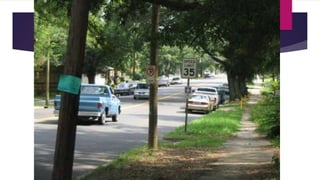
 Let’s test your observation skills…
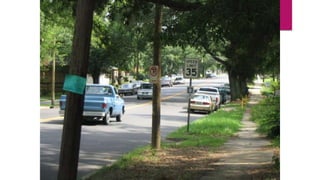
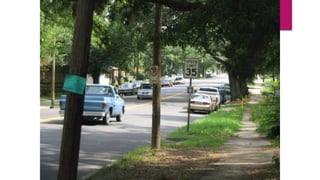
Question 1 
Are there cars parked on the sides of the road?
Question 2 
What color is the pickup truck driving in the road?
Question 3 
Any minivans around?
Question 4 
What does the blue sign say?
Question 5 
What's the speed limit?
Question 6 
Are there any pedestrians on the road?
Answers 
1. Yes 
2. Blue 
3. Yes 
4. Yard Sale 
5. 35 mph 
6. No
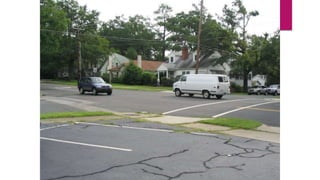
Observation Activity #2 
 Choose several people to be observers and choose two 
people to be investigators. 
 Allow the observers to look at the picture or this picture 
for 30 seconds. The investigators should not look at the 
picture. 
 After 30 seconds, the investigators should begin 
questioning the observers. Each Investigator should 
question each observer. Then, the Investigators should 
attempt to reconstruct the scene based on the 
"eyewitness testimony".
Questions Asked 
 How many cars were in the intersection? 
Answer: 2 
 Across the street, are there any parked cars on the side? 
Yes 
 Can you describe at least one of the cars driving through the intersection? 
 Are there any other potential witnesses? 
If they answer yes, ask the following question: What was this witness doing? 
Where was he? 
They should have noticed a person mowing a lawn across the street. 
 What was the speed limit? 
35 
 Was there anyone parked in the first parking spot? 
No
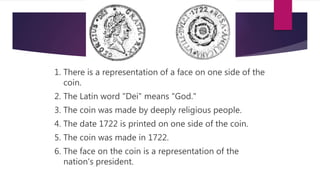
Observation vs Inference 
 On the next slide, state whether the statement is an observation or an inference.
1. There is a representation of a face on one side of the 
coin. 
2. The Latin word "Dei" means "God." 
3. The coin was made by deeply religious people. 
4. The date 1722 is printed on one side of the coin. 
5. The coin was made in 1722. 
6. The face on the coin is a representation of the 
nation's president.
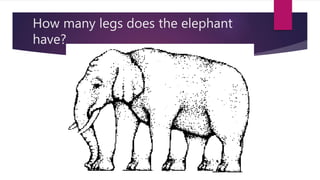
How many legs does the elephant 
have?
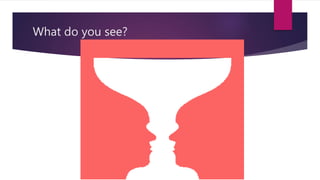
What do you see?
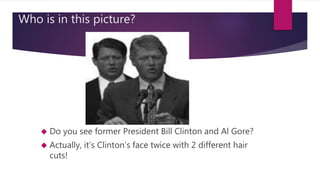
Who is in this picture? 
 Do you see former President Bill Clinton and Al Gore? 
 Actually, it’s Clinton’s face twice with 2 different hair 
cuts!
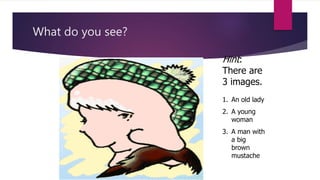
What do you see? 
Hint: 
There are 
3 images. 
1. An old lady 
2. A young 
woman 
3. A man with 
a big 
brown 
mustache
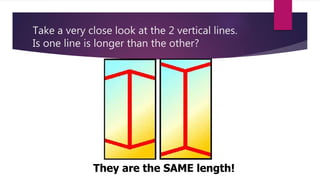
Take a very close look at the 2 vertical lines. 
Is one line is longer than the other? 
They are the SAME length!
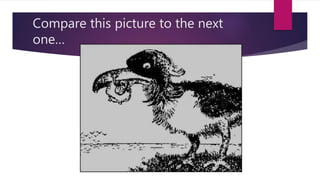
Compare this picture to the next 
one…
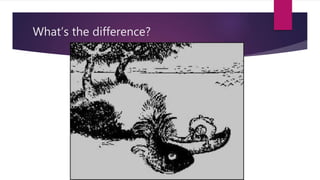
What’s the difference?
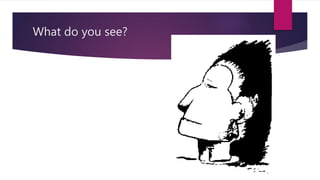
What do you see?
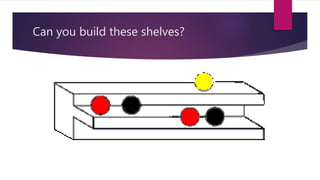
Can you build these shelves?
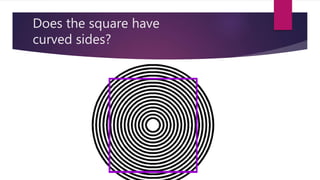
Does the square have 
curved sides?
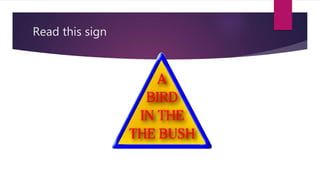
Read this sign
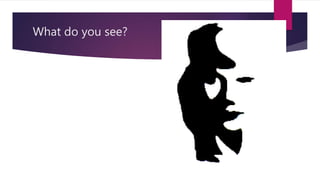
What do you see?
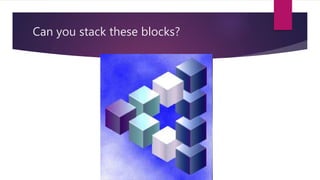
Can you stack these blocks?
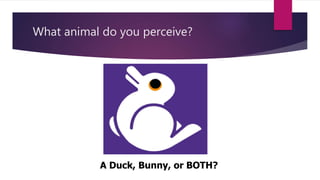
What animal do you perceive? 
A Duck, Bunny, or BOTH?
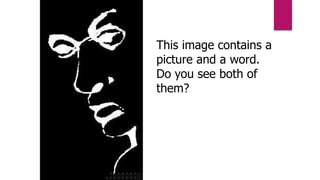
This image contains a 
picture and a word. 
Do you see both of 
them?
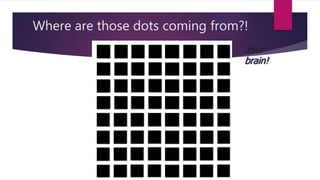
Where are those dots coming from?! 
Your 
brain!
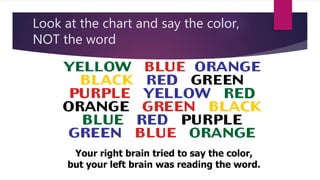
Look at the chart and say the color, 
NOT the word 
Your right brain tried to say the color, 
but your left brain was reading the word.
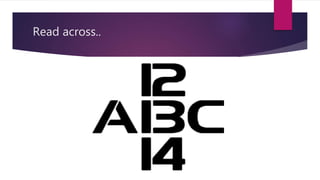
Read across..
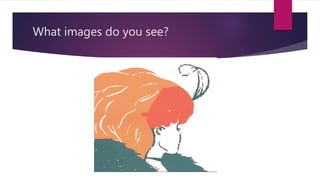
What images do you see?
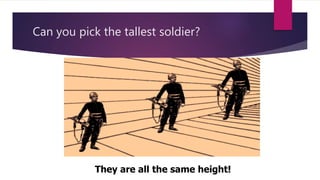
Can you pick the tallest soldier? 
They are all the same height!
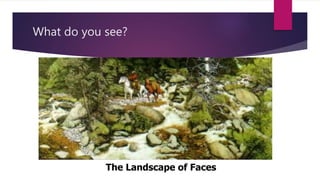
What do you see? 
The Landscape of Faces
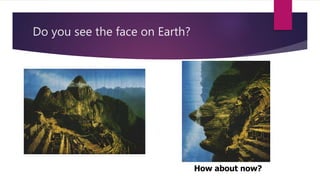
Do you see the face on Earth? 
How about now?
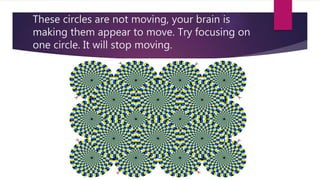
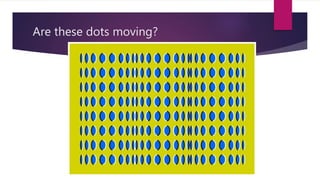
These circles are not moving, your brain is 
making them appear to move. Try focusing on 
one circle. It will stop moving.
Are these dots moving?
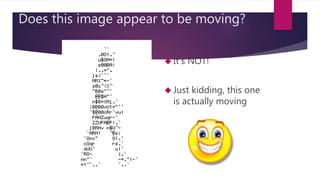
Does this image appear to be moving? 
 It’s NOT! 
 Just kidding, this one 
is actually moving
Variables and Controls 
 A variable is anything that can changed or tested in 
an experiment. 
 Independent variable: The variable being changed or 
tested by the scientist. 
Dependent variable: The variable being tested for or 
determined by the independent variable. 
 A valid experiment tests only one variable at a time.
The Scientific Method: A series of logical 
steps to follow in order to solve problems. 
 OBSERVE SOMETHING UNKNOWN OR NOT UNDERSTOOD. 
 FORMULATE A QUESTION. 
 FORM A HYPOTHESIS 
 DESIGN AND CONDUCT AN EXPERIMENT 
 MAKE OBSERVATIONS 
 COLLECT AND ANAYZE DATA 
 DRAW CONCLUSIONS 
 FORMULATE A THEORY and RETEST AND PUBLISH
Making Measurements 
measurements are made in this class using SI units. 
LENGTH: distance between 2 points 
VOLUME: space occupied. 
MASS: the amount of matter in an object. 
WEIGHT: the force with which gravity pulls on a 
quantity of matter.
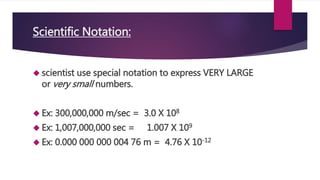
Scientific Notation: 
 scientist use special notation to express VERY LARGE 
or very small numbers. 
 Ex: 300,000,000 m/sec = 3.0 X 10⁸ 
 Ex: 1,007,000,000 sec = 1.007 X 10⁹ 
 Ex: 0.000 000 000 004 76 m = 4.76 X 10⁻¹²
Accuracy, Precision, and Error 
Accuracy 
 1. The nearness of a 
measurement to its accepted 
value b. Systematic errors can 
cause results to be precise but 
not accurate 
Precision 
 The agreement between 
numerical values of two or 
more measurements that have 
been made in the same way 
 a. You can be precise without 
being accurate
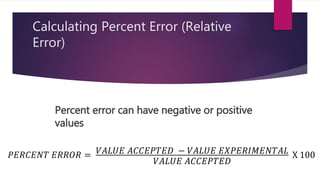
Calculating Percent Error (Relative 
Error) 
Percent error can have negative or positive 
values 
푃퐸푅퐶퐸푁푇 퐸푅푅푂푅 = 푉퐴퐿푈퐸 퐴퐶퐶퐸푃푇퐸퐷 − 푉퐴퐿푈퐸 퐸푋푃퐸푅퐼푀퐸푁푇퐴퐿 
푉퐴퐿푈퐸 퐴퐶퐶퐸푃푇퐸퐷 
X 100
Error in Measurement 
1. Some error or uncertainty exists in all 
measurement 
a. no measurement is known to an infinite number of 
decimal places 
2. All measurements should include every digit 
known with certainty plus the first digit that is 
uncertain - these are the significant figures

Chemisty chapter 1 notes

  • 1.
    Chemistry Chapter 1 IT’S ALL ABOUT THE PROCESS!!!
  • 2.
    Observation vs. Inference  Observation- What you pick up or perceive with your senses.  Ex: you smell smoke.  Inference- The conclusion you draw from what your senses pick up.  Ex: The smell of smoke tells you there must be a fire.
  • 3.
    Note the Differences In laboratory exercises, record observations NOT inferences Inferences may be used when writing the conclusion in your lab report.  Let’s test your observation skills…
  • 5.
    Question 1 Arethere cars parked on the sides of the road?
  • 6.
    Question 2 Whatcolor is the pickup truck driving in the road?
  • 7.
    Question 3 Anyminivans around?
  • 8.
    Question 4 Whatdoes the blue sign say?
  • 9.
    Question 5 What'sthe speed limit?
  • 10.
    Question 6 Arethere any pedestrians on the road?
  • 12.
    Answers 1. Yes 2. Blue 3. Yes 4. Yard Sale 5. 35 mph 6. No
  • 14.
    Observation Activity #2  Choose several people to be observers and choose two people to be investigators.  Allow the observers to look at the picture or this picture for 30 seconds. The investigators should not look at the picture.  After 30 seconds, the investigators should begin questioning the observers. Each Investigator should question each observer. Then, the Investigators should attempt to reconstruct the scene based on the "eyewitness testimony".
  • 16.
    Questions Asked How many cars were in the intersection? Answer: 2  Across the street, are there any parked cars on the side? Yes  Can you describe at least one of the cars driving through the intersection?  Are there any other potential witnesses? If they answer yes, ask the following question: What was this witness doing? Where was he? They should have noticed a person mowing a lawn across the street.  What was the speed limit? 35  Was there anyone parked in the first parking spot? No
  • 17.
    Observation vs Inference  On the next slide, state whether the statement is an observation or an inference.
  • 18.
    1. There isa representation of a face on one side of the coin. 2. The Latin word "Dei" means "God." 3. The coin was made by deeply religious people. 4. The date 1722 is printed on one side of the coin. 5. The coin was made in 1722. 6. The face on the coin is a representation of the nation's president.
  • 19.
    How many legsdoes the elephant have?
  • 20.
  • 21.
    Who is inthis picture?  Do you see former President Bill Clinton and Al Gore?  Actually, it’s Clinton’s face twice with 2 different hair cuts!
  • 22.
    What do yousee? Hint: There are 3 images. 1. An old lady 2. A young woman 3. A man with a big brown mustache
  • 23.
    Take a veryclose look at the 2 vertical lines. Is one line is longer than the other? They are the SAME length!
  • 24.
    Compare this pictureto the next one…
  • 25.
  • 26.
  • 27.
    Can you buildthese shelves?
  • 28.
    Does the squarehave curved sides?
  • 30.
  • 31.
  • 32.
    Can you stackthese blocks?
  • 33.
    What animal doyou perceive? A Duck, Bunny, or BOTH?
  • 34.
    This image containsa picture and a word. Do you see both of them?
  • 36.
    Where are thosedots coming from?! Your brain!
  • 37.
    Look at thechart and say the color, NOT the word Your right brain tried to say the color, but your left brain was reading the word.
  • 38.
  • 39.
  • 40.
    Can you pickthe tallest soldier? They are all the same height!
  • 41.
    What do yousee? The Landscape of Faces
  • 42.
    Do you seethe face on Earth? How about now?
  • 43.
    These circles arenot moving, your brain is making them appear to move. Try focusing on one circle. It will stop moving.
  • 44.
  • 45.
    Does this imageappear to be moving?  It’s NOT!  Just kidding, this one is actually moving
  • 46.
    Variables and Controls  A variable is anything that can changed or tested in an experiment.  Independent variable: The variable being changed or tested by the scientist. Dependent variable: The variable being tested for or determined by the independent variable.  A valid experiment tests only one variable at a time.
  • 47.
    The Scientific Method:A series of logical steps to follow in order to solve problems.  OBSERVE SOMETHING UNKNOWN OR NOT UNDERSTOOD.  FORMULATE A QUESTION.  FORM A HYPOTHESIS  DESIGN AND CONDUCT AN EXPERIMENT  MAKE OBSERVATIONS  COLLECT AND ANAYZE DATA  DRAW CONCLUSIONS  FORMULATE A THEORY and RETEST AND PUBLISH
  • 48.
    Making Measurements measurementsare made in this class using SI units. LENGTH: distance between 2 points VOLUME: space occupied. MASS: the amount of matter in an object. WEIGHT: the force with which gravity pulls on a quantity of matter.
  • 49.
    Scientific Notation: scientist use special notation to express VERY LARGE or very small numbers.  Ex: 300,000,000 m/sec = 3.0 X 10⁸  Ex: 1,007,000,000 sec = 1.007 X 10⁹  Ex: 0.000 000 000 004 76 m = 4.76 X 10⁻¹²
  • 50.
    Accuracy, Precision, andError Accuracy  1. The nearness of a measurement to its accepted value b. Systematic errors can cause results to be precise but not accurate Precision  The agreement between numerical values of two or more measurements that have been made in the same way  a. You can be precise without being accurate
  • 51.
    Calculating Percent Error(Relative Error) Percent error can have negative or positive values 푃퐸푅퐶퐸푁푇 퐸푅푅푂푅 = 푉퐴퐿푈퐸 퐴퐶퐶퐸푃푇퐸퐷 − 푉퐴퐿푈퐸 퐸푋푃퐸푅퐼푀퐸푁푇퐴퐿 푉퐴퐿푈퐸 퐴퐶퐶퐸푃푇퐸퐷 X 100
  • 52.
    Error in Measurement 1. Some error or uncertainty exists in all measurement a. no measurement is known to an infinite number of decimal places 2. All measurements should include every digit known with certainty plus the first digit that is uncertain - these are the significant figures