NCERT
Solutions
Solutions
Solutions
Chemistry
For Revised Syllabus Session 2024-25
Artham
Resource Material
10
Powered by
Class
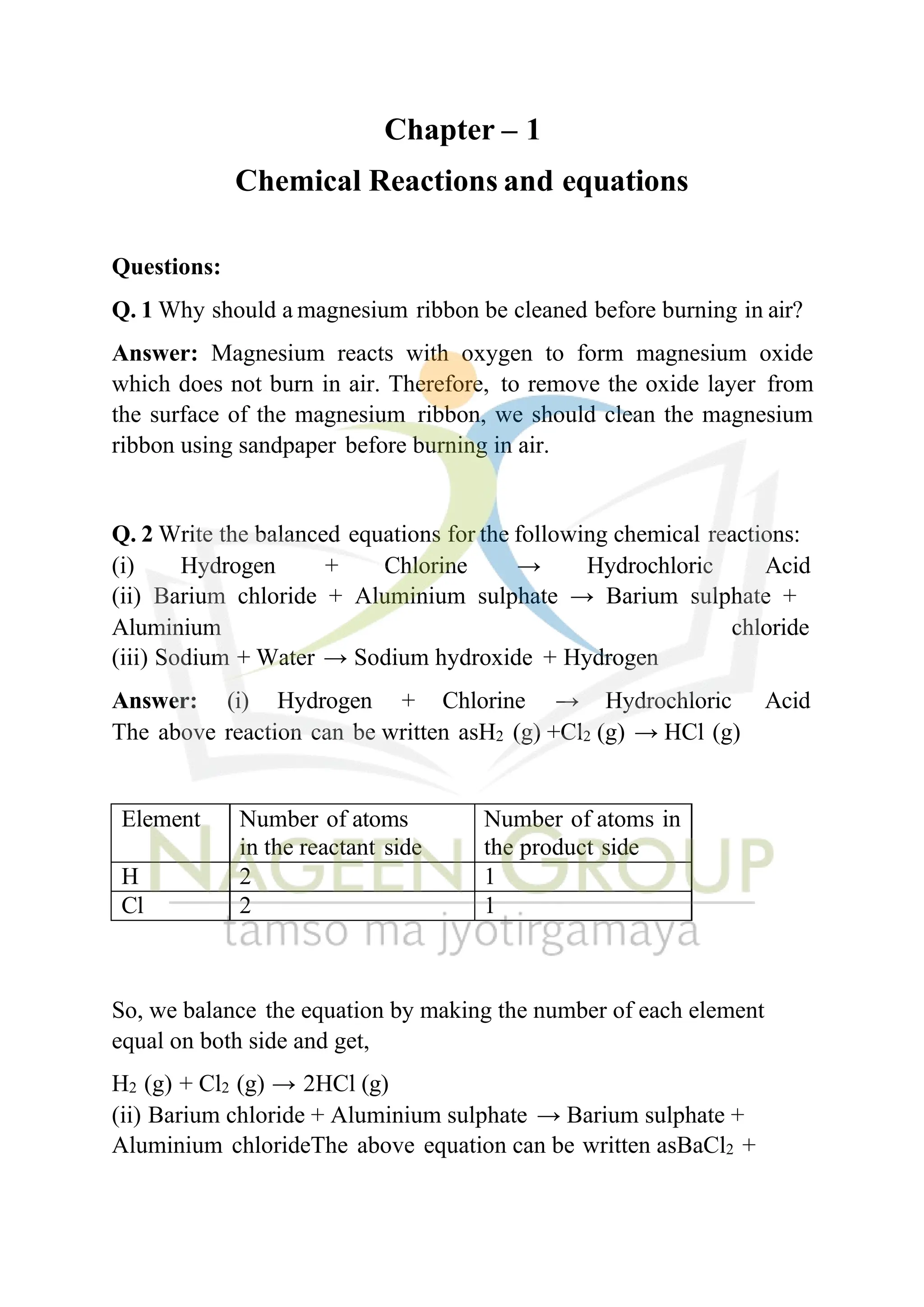
Chapter – 1
Chemical Reactions and equations
Questions:
Q. 1 Why should a magnesium ribbon be cleaned before burning in air?
Answer: Magnesium reacts with oxygen to form magnesium oxide
which does not burn in air. Therefore, to remove the oxide layer from
the surface of the magnesium ribbon, we should clean the magnesium
ribbon using sandpaper before burning in air.
Q. 2 Write the balanced equations for the following chemical reactions:
(i) Hydrogen + Chlorine → Hydrochloric Acid
(ii) Barium chloride + Aluminium sulphate → Barium sulphate +
Aluminium chloride
(iii) Sodium + Water → Sodium hydroxide + Hydrogen
Answer: (i) Hydrogen + Chlorine → Hydrochloric Acid
The above reaction can be written asH2 (g) +Cl2 (g) → HCl (g)
Element Number of atoms
in the reactant side
Number of atoms in
the product side
H 2 1
Cl 2 1
So, we balance the equation by making the number of each element
equal on both side and get,
H2 (g) + Cl2 (g) → 2HCl (g)
(ii) Barium chloride + Aluminium sulphate → Barium sulphate +
Aluminium chlorideThe above equation can be written asBaCl2 +
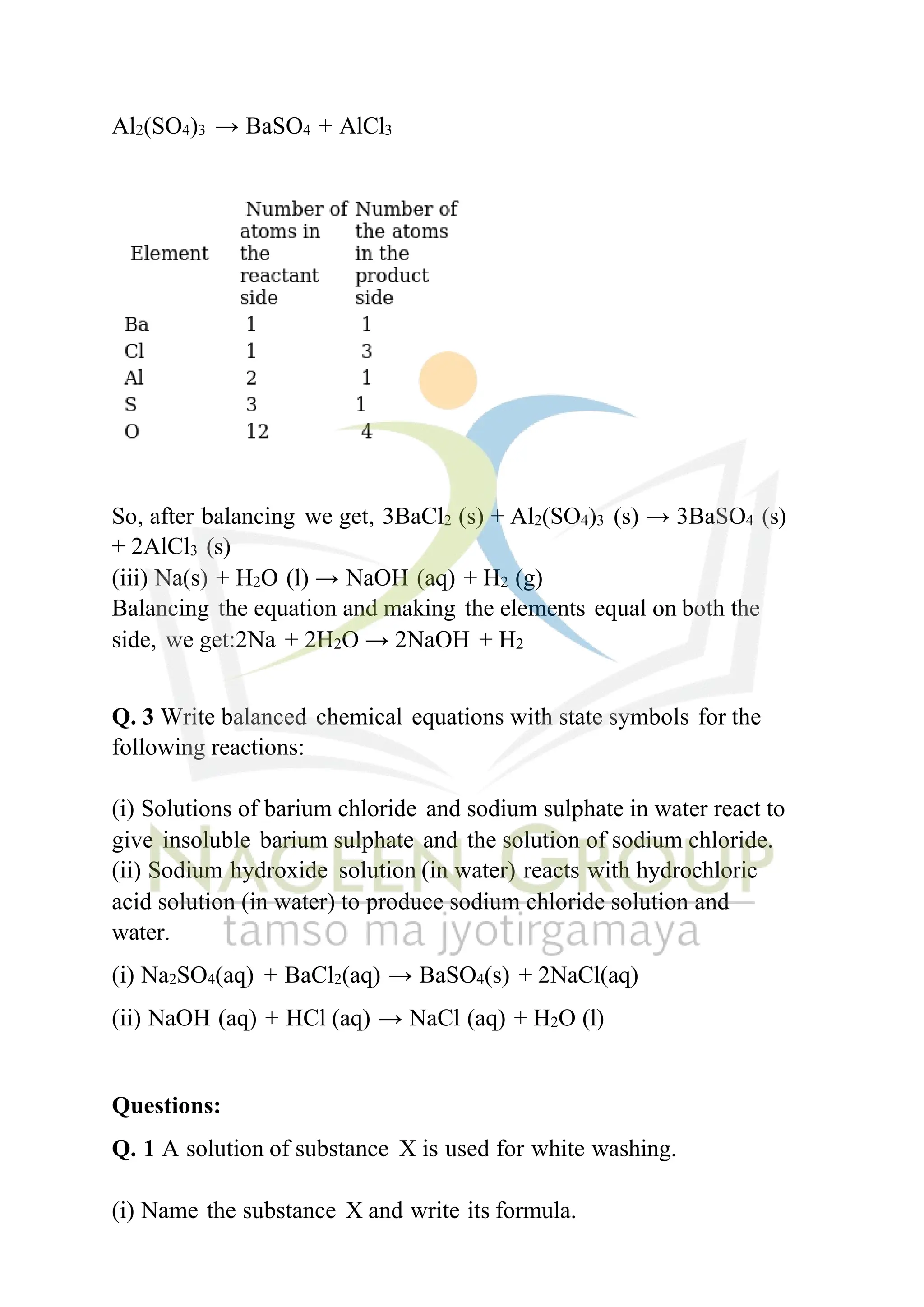
Al2(SO4)3 → BaSO4 + AlCl3
So, after balancing we get, 3BaCl2 (s) + Al2(SO4)3 (s) → 3BaSO4 (s)
+ 2AlCl3 (s)
(iii) Na(s) + H2O (l) → NaOH (aq) + H2 (g)
Balancing the equation and making the elements equal on both the
side, we get:2Na + 2H2O → 2NaOH + H2
Q. 3 Write balanced chemical equations with state symbols for the
following reactions:
(i) Solutions of barium chloride and sodium sulphate in water react to
give insoluble barium sulphate and the solution of sodium chloride.
(ii) Sodium hydroxide solution (in water) reacts with hydrochloric
acid solution (in water) to produce sodium chloride solution and
water.
(i) Na2SO4(aq) + BaCl2(aq) → BaSO4(s) + 2NaCl(aq)
(ii) NaOH (aq) + HCl (aq) → NaCl (aq) + H2O (l)
Questions:
Q. 1 A solution of substance X is used for white washing.
(i) Name the substance X and write its formula.
(ii) Write the reaction of the substance X named in (i) above with
water.
Answer:
(i) Substance X is Calcium Oxide whose solution we use in water
which is used for white washing.
The formula of substance X is CaO.
(ii) Calcium oxide reacts vigorously with water to produce slaked
lime (calcium hydroxide) releasing a large amount of heat.
𝐶𝑎𝑂(𝑠) +𝐻2𝑂(𝑙) → 𝐶𝑎(𝑂𝐻)2(𝑎𝑞)
(𝑄𝑢𝑖𝑐𝑘 𝐿𝑖𝑚𝑒) (𝑊𝑎𝑡𝑒𝑟) (𝑆𝑙𝑎𝑘𝑒𝑑 𝐿𝑖𝑚𝑒)
Q. 2 Why is the amount of gas collected in one of the test tubes in
Activity 1.7 double of the amount collected in the other? Name this
gas.
Answer: Why is the amount of gas collected in one of the test tubes in
the following Activity double of the amount collected in the other?
Name this gas:
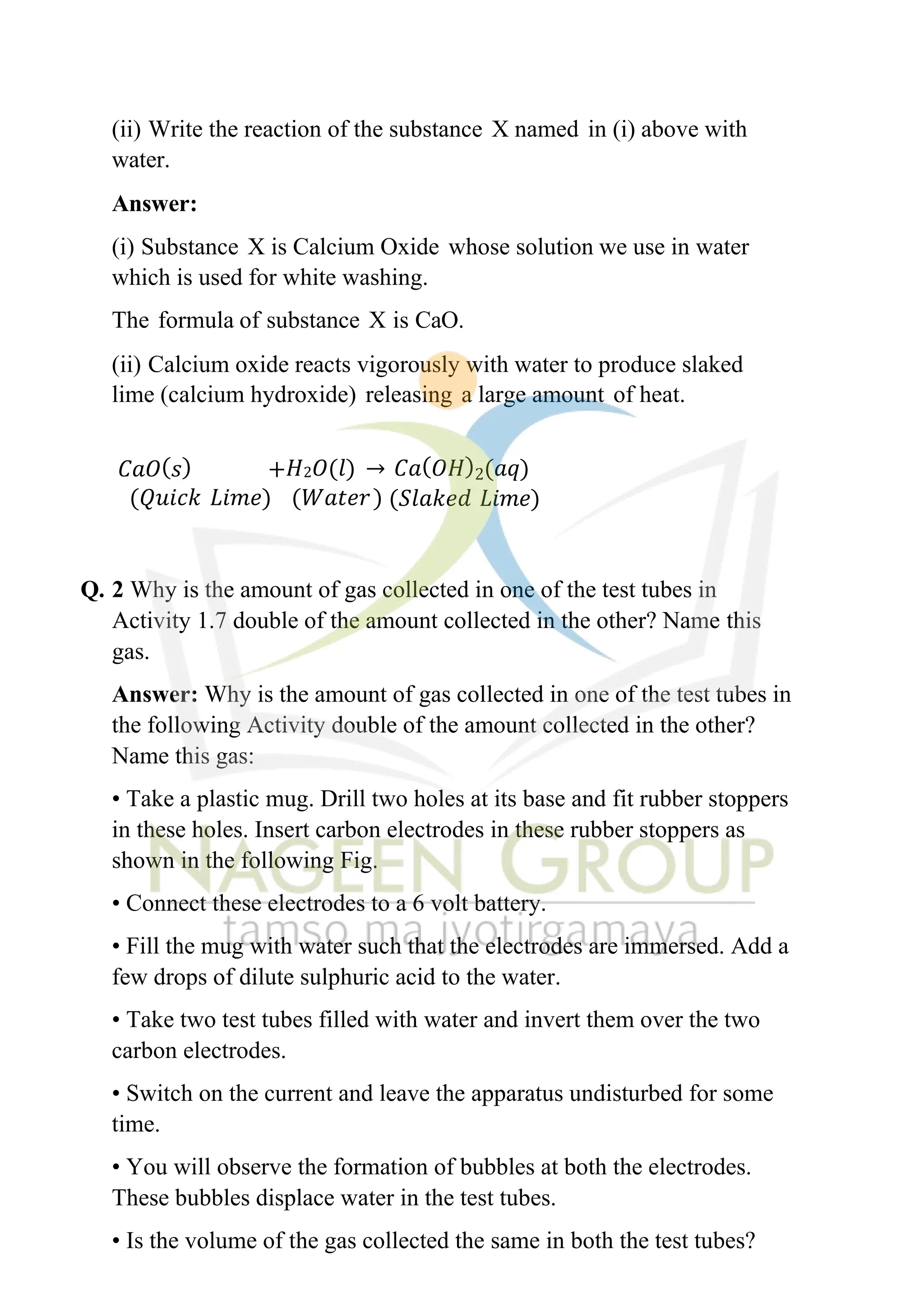
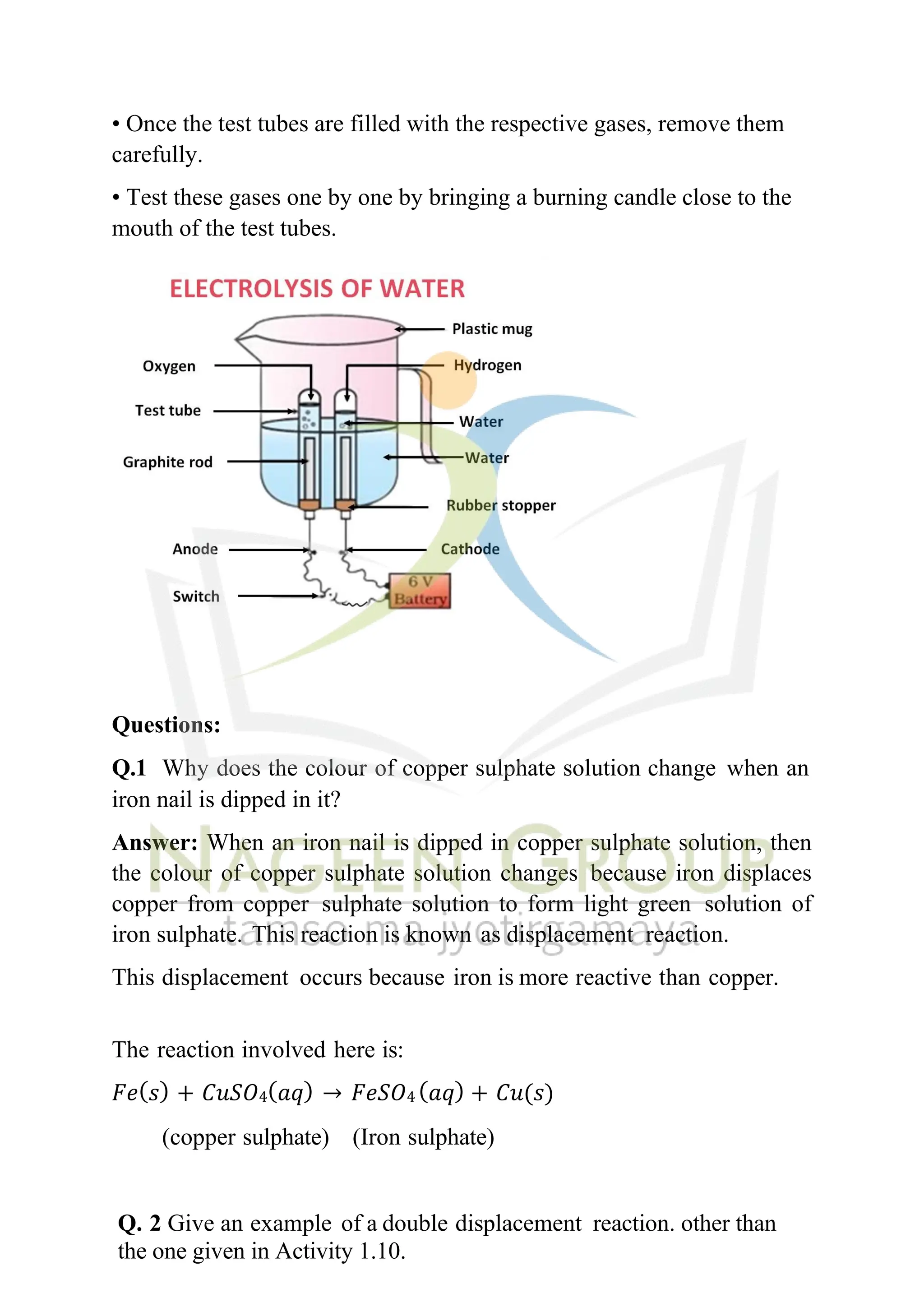
• Take a plastic mug. Drill two holes at its base and fit rubber stoppers
in these holes. Insert carbon electrodes in these rubber stoppers as
shown in the following Fig.
• Connect these electrodes to a 6 volt battery.
• Fill the mug with water such that the electrodes are immersed. Add a
few drops of dilute sulphuric acid to the water.
• Take two test tubes filled with water and invert them over the two
carbon electrodes.
• Switch on the current and leave the apparatus undisturbed for some
time.
• You will observe the formation of bubbles at both the electrodes.
These bubbles displace water in the test tubes.
• Is the volume of the gas collected the same in both the test tubes?
• Once the test tubes are filled with the respective gases, remove them
carefully.
• Test these gases one by one by bringing a burning candle close to the
mouth of the test tubes.
Questions:
Q.1 Why does the colour of copper sulphate solution change when an
iron nail is dipped in it?
Answer: When an iron nail is dipped in copper sulphate solution, then
the colour of copper sulphate solution changes because iron displaces
copper from copper sulphate solution to form light green solution of
iron sulphate. This reaction is known as displacement reaction.
This displacement occurs because iron is more reactive than copper.
The reaction involved here is:
𝐹𝑒(𝑠) + 𝐶𝑢𝑆𝑂4(𝑎𝑞) → 𝐹𝑒𝑆𝑂4 (𝑎𝑞) + 𝐶𝑢(𝑠)
(copper sulphate) (Iron sulphate)
Q. 2 Give an example of a double displacement reaction. other than
the one given in Activity 1.10.
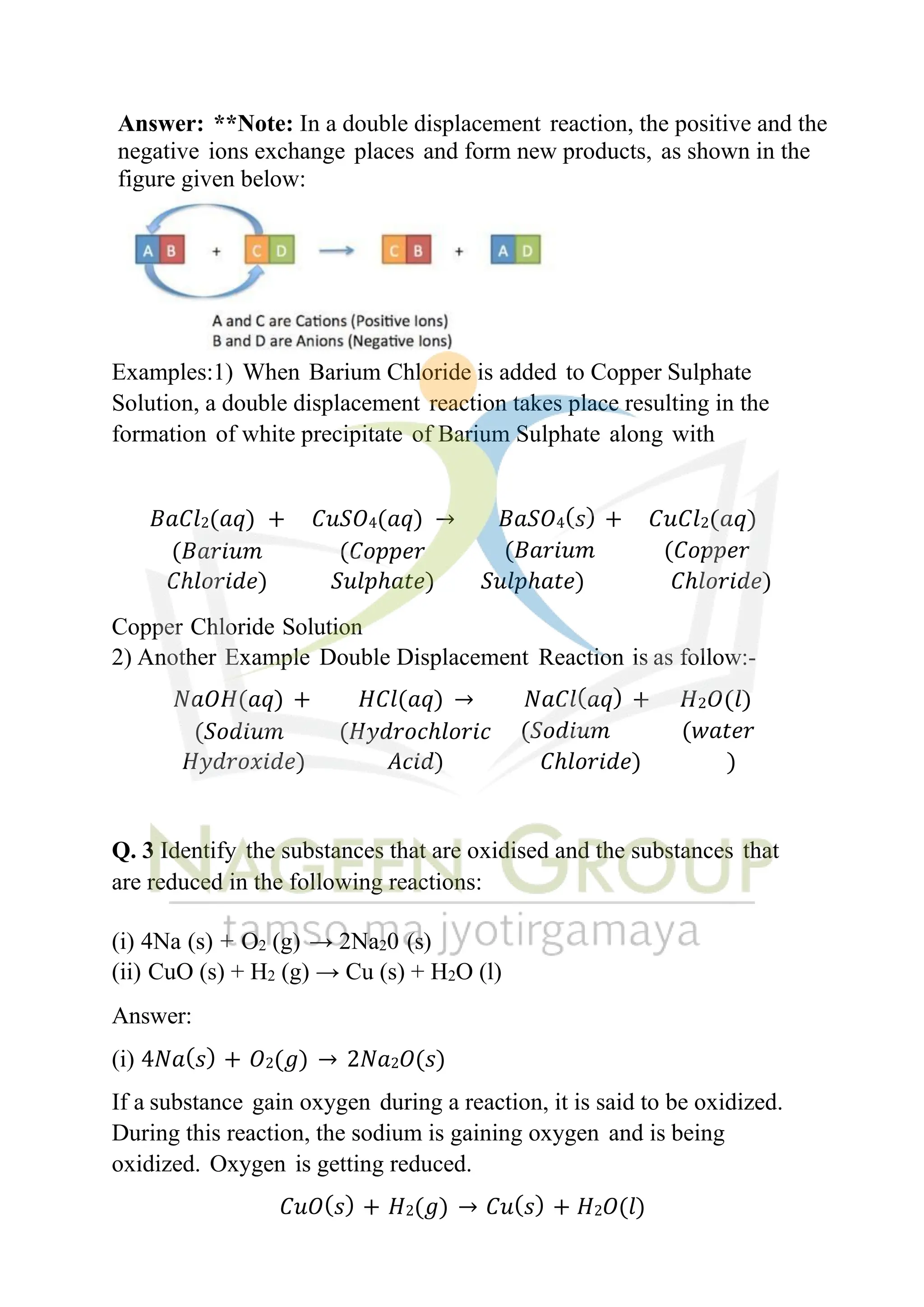
Answer: **Note: In a double displacement reaction, the positive and the
negative ions exchange places and form new products, as shown in the
figure given below:
Examples:1) When Barium Chloride is added to Copper Sulphate
Solution, a double displacement reaction takes place resulting in the
formation of white precipitate of Barium Sulphate along with
𝐵𝑎𝐶𝑙2(𝑎𝑞) + 𝐶𝑢𝑆𝑂4(𝑎𝑞) → 𝐵𝑎𝑆𝑂4(𝑠) + 𝐶𝑢𝐶𝑙2(𝑎𝑞)
(𝐵𝑎𝑟𝑖𝑢𝑚 (𝐶𝑜𝑝𝑝𝑒𝑟 (𝐵𝑎𝑟𝑖𝑢𝑚 (𝐶𝑜𝑝𝑝𝑒𝑟
𝐶ℎ𝑙𝑜𝑟𝑖𝑑𝑒) 𝑆𝑢𝑙𝑝ℎ𝑎𝑡𝑒) 𝑆𝑢𝑙𝑝ℎ𝑎𝑡𝑒) 𝐶ℎ𝑙𝑜𝑟𝑖𝑑𝑒)
Copper Chloride Solution
2) Another Example Double Displacement Reaction is as follow:-
𝑁𝑎𝑂𝐻(𝑎𝑞) + 𝐻𝐶𝑙(𝑎𝑞) → 𝑁𝑎𝐶𝑙(𝑎𝑞) + 𝐻2𝑂(𝑙)
(𝑆𝑜𝑑𝑖𝑢𝑚 (𝐻𝑦𝑑𝑟𝑜𝑐ℎ𝑙𝑜𝑟𝑖𝑐 (𝑆𝑜𝑑𝑖𝑢𝑚 (𝑤𝑎𝑡𝑒𝑟
𝐻𝑦𝑑𝑟𝑜𝑥𝑖𝑑𝑒) 𝐴𝑐𝑖𝑑) 𝐶ℎ𝑙𝑜𝑟𝑖𝑑𝑒) )
Q. 3 Identify the substances that are oxidised and the substances that
are reduced in the following reactions:
(i) 4Na (s) + O2 (g) → 2Na20 (s)
(ii) CuO (s) + H2 (g) → Cu (s) + H2O (l)
Answer:
(i) 4𝑁𝑎(𝑠) + 𝑂2(𝑔) → 2𝑁𝑎2𝑂(𝑠)
If a substance gain oxygen during a reaction, it is said to be oxidized.
During this reaction, the sodium is gaining oxygen and is being
oxidized. Oxygen is getting reduced.
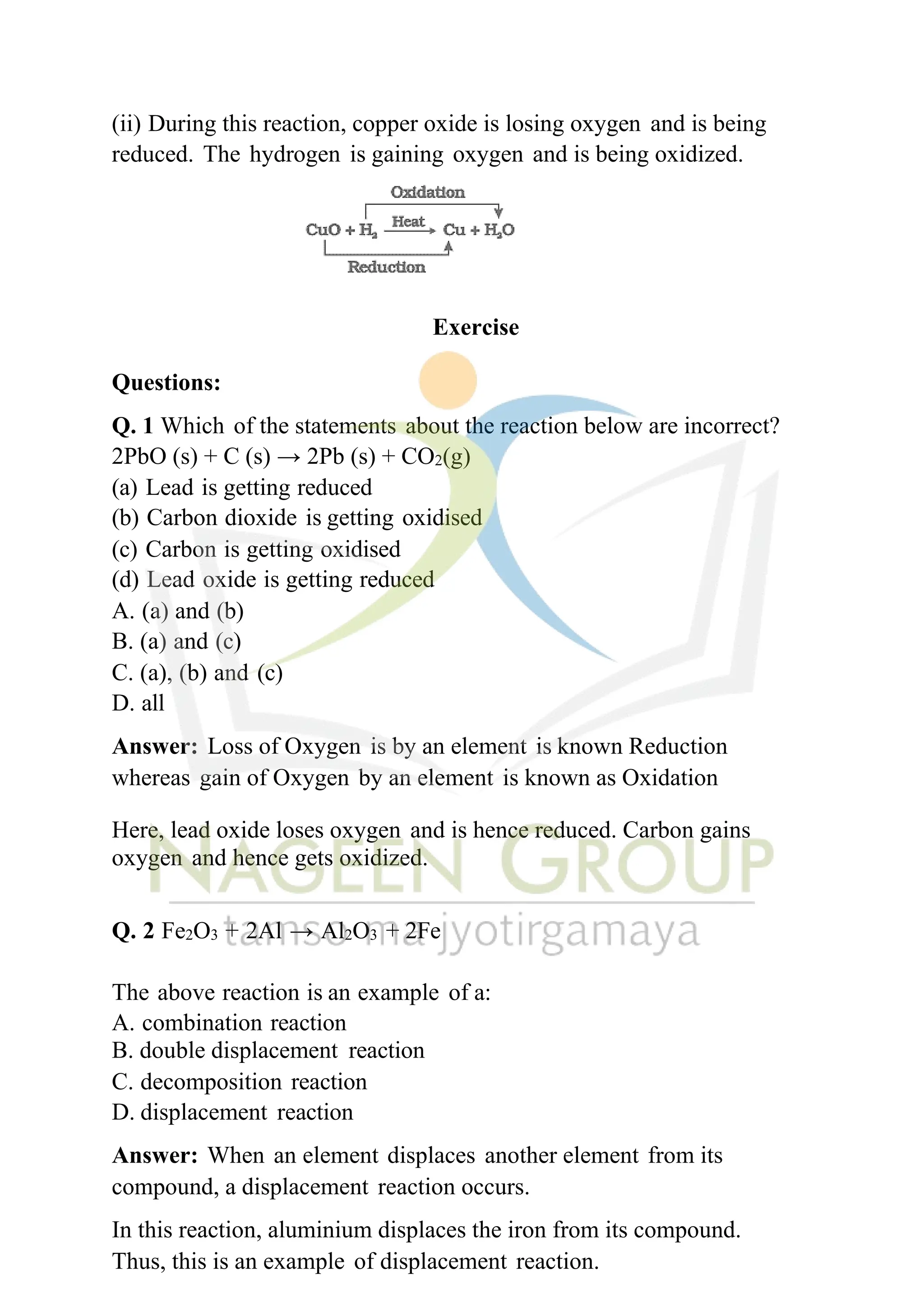
𝐶𝑢𝑂(𝑠) + 𝐻2(𝑔) → 𝐶𝑢(𝑠) + 𝐻2𝑂(𝑙)
(ii) During this reaction, copper oxide is losing oxygen and is being
reduced. The hydrogen is gaining oxygen and is being oxidized.
Exercise
Questions:
Q. 1 Which of the statements about the reaction below are incorrect?
2PbO (s) + C (s) → 2Pb (s) + CO2(g)
(a) Lead is getting reduced
(b) Carbon dioxide is getting oxidised
(c) Carbon is getting oxidised
(d) Lead oxide is getting reduced
A. (a) and (b)
B. (a) and (c)
C. (a), (b) and (c)
D. all
Answer: Loss of Oxygen is by an element is known Reduction
whereas gain of Oxygen by an element is known as Oxidation
Here, lead oxide loses oxygen and is hence reduced. Carbon gains
oxygen and hence gets oxidized.
Q. 2 Fe2O3 + 2Al → Al2O3 + 2Fe
The above reaction is an example of a:
A. combination reaction
B. double displacement reaction
C. decomposition reaction
D. displacement reaction
Answer: When an element displaces another element from its
compound, a displacement reaction occurs.
In this reaction, aluminium displaces the iron from its compound.
Thus, this is an example of displacement reaction.
Q. 3 What happens when dilute hydrochloric acid is added to iron
filings? Tick the correct answer.
A. Hydrogen gas and iron chloride are produced
B. Chlorine gas and iron hydroxide are produced
C. No reaction takes place
D. Iron salt and water are produced
Answer: When dilute hydrochloric acid is added to iron fillings,
hydrogen gas and iron chloride are produced.
𝐹𝑒(𝑠) + 2𝐻𝐶𝑙(𝑎𝑞) − −→ 𝐹𝑒𝐶𝑙2(𝑎𝑞) + 𝐻2(𝑔)
Q. 4 What is a balanced chemical equation? Why should chemical
equations be balanced?
Answer: A chemical reaction which has an equal number of atoms of
the elements in the reactants and product sides is called a balanced
chemical equation.
For example;
𝑍𝑛 + 𝐻2𝑆𝑂4 → 𝑍𝑛𝑆𝑂4 + 𝐻2
In the above reaction; zinc reacts with sulphuric acid to form zinc
sulphate and hydrogen.
Since the number of atoms of each element is the same on both parts
of the equation. Hence, it is a balanced chemical equation.
The chemical equation is said to be balanced if it satisfies the law of
conservation of mass which states that the 'matter (or atoms) can
neither be created nor destroyed in a chemical reaction'.
Thus, the total mass of the elements present in the products of a
chemical reaction should be equal to the total mass of the elements
present in the reactants. In other words, the number of atoms of each
element remains the same, before and after a chemical reaction.
Q. 5 Translate the following statements into chemical equations and
then balance them:
(a) Hydrogen gas combines with nitrogen to form ammonia.
(b) Hydrogen sulphide gas burns in air to give water and sulphur
dioxide.
(c) Barium chloride reacts with aluminium sulphate to give
aluminium chloride solution and a precipitate of barium sulphate.
(d) Potassium metal reacts with water to give potassium hydroxide
and hydrogen gas
Answer:
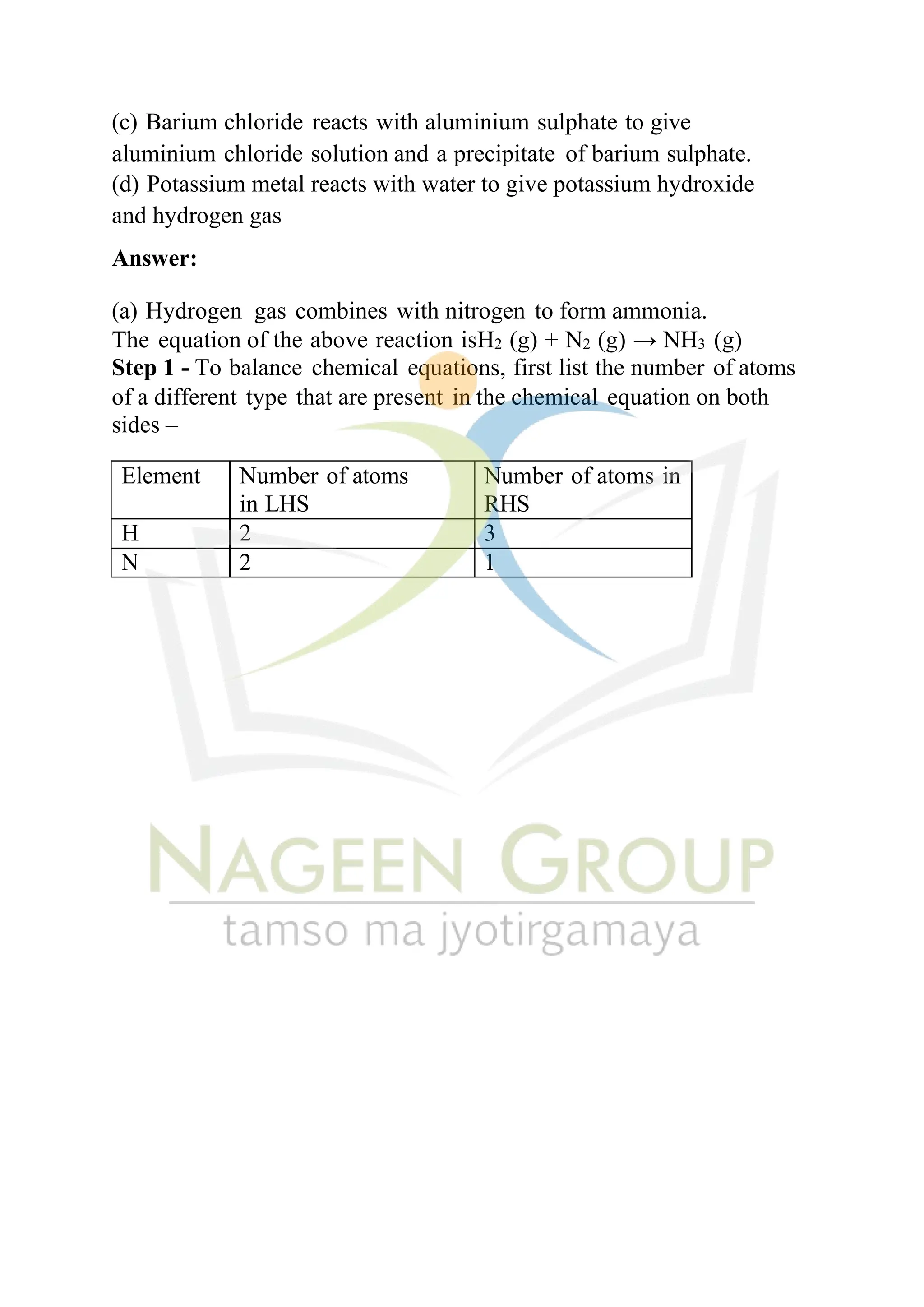
(a) Hydrogen gas combines with nitrogen to form ammonia.
The equation of the above reaction isH2 (g) + N2 (g) → NH3 (g)
Step 1 - To balance chemical equations, first list the number of atoms
of a different type that are present in the chemical equation on both
sides –
Element Number of atoms
in LHS
Number of atoms in
RHS
H 2 3
N 2 1
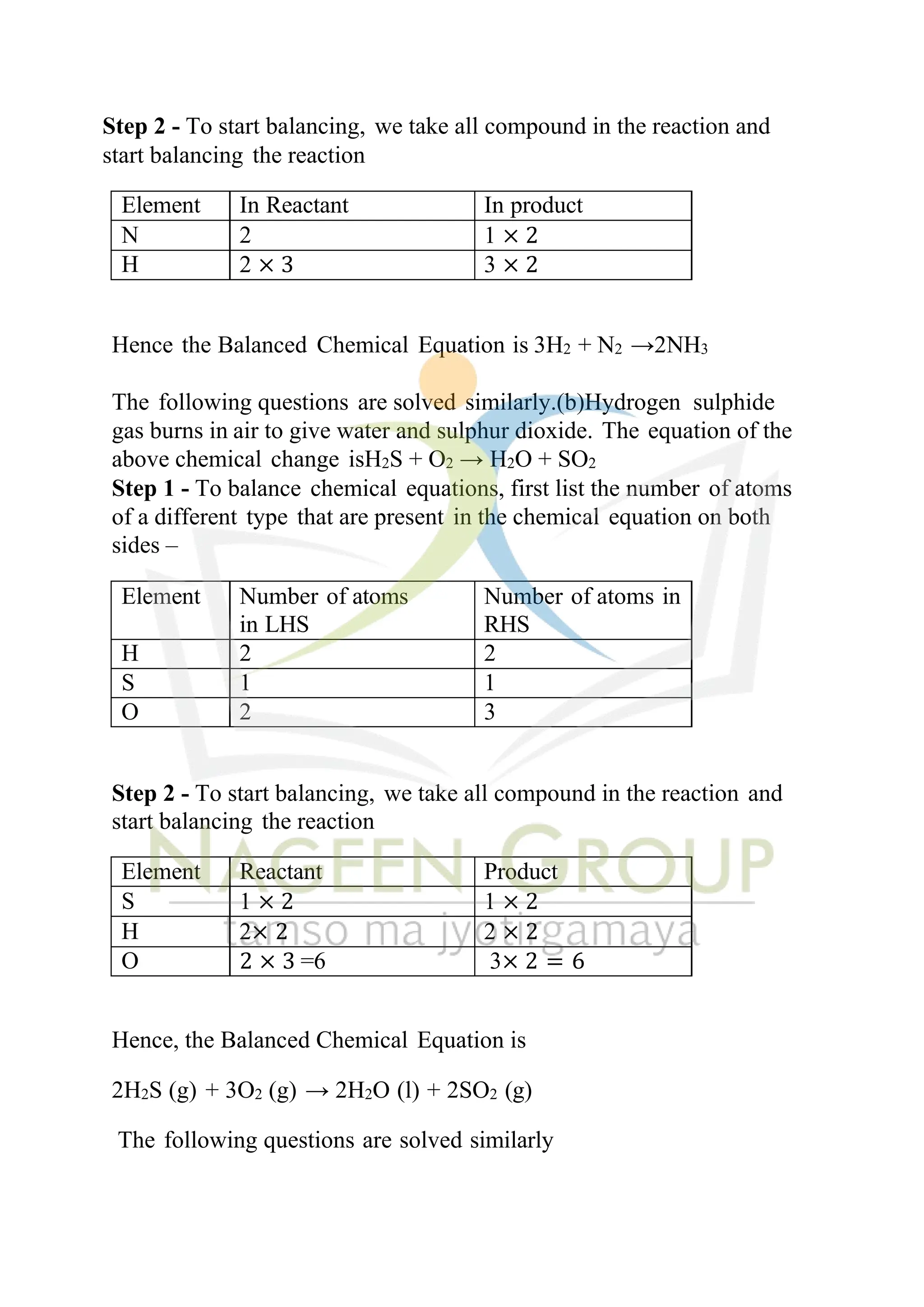
Step 2 - To start balancing, we take all compound in the reaction and
start balancing the reaction
Element In Reactant In product
N 2 1 × 2
H 2 × 3 3 × 2
Hence the Balanced Chemical Equation is 3H2 + N2 →2NH3
The following questions are solved similarly.(b)Hydrogen sulphide
gas burns in air to give water and sulphur dioxide. The equation of the
above chemical change isH2S + O2 → H2O + SO2
Step 1 - To balance chemical equations, first list the number of atoms
of a different type that are present in the chemical equation on both
sides –
Element Number of atoms
in LHS
Number of atoms in
RHS
H 2 2
S 1 1
O 2 3
Step 2 - To start balancing, we take all compound in the reaction and
start balancing the reaction
Element Reactant Product
S 1 × 2 1 × 2
H 2× 2 2 × 2
O 2 × 3 =6 3× 2 = 6
Hence, the Balanced Chemical Equation is
2H2S (g) + 3O2 (g) → 2H2O (l) + 2SO2 (g)
The following questions are solved similarly
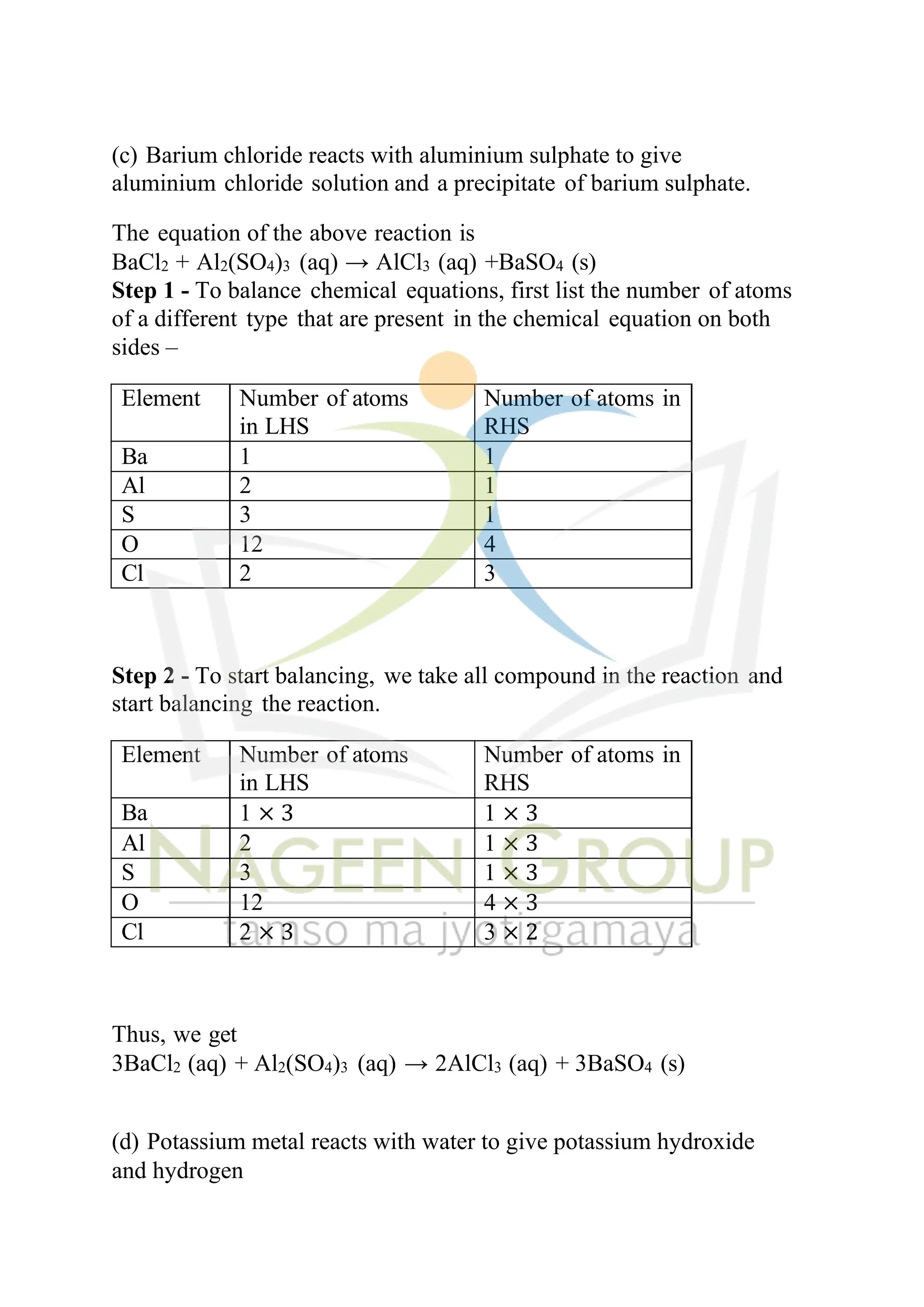
(c) Barium chloride reacts with aluminium sulphate to give
aluminium chloride solution and a precipitate of barium sulphate.
The equation of the above reaction is
BaCl2 + Al2(SO4)3 (aq) → AlCl3 (aq) +BaSO4 (s)
Step 1 - To balance chemical equations, first list the number of atoms
of a different type that are present in the chemical equation on both
sides –
Element Number of atoms
in LHS
Number of atoms in
RHS
Ba 1 1
Al 2 1
S 3 1
O 12 4
Cl 2 3
Step 2 - To start balancing, we take all compound in the reaction and
start balancing the reaction.
Element Number of atoms
in LHS
Number of atoms in
RHS
Ba 1 × 3 1 × 3
Al 2 1 × 3
S 3 1 × 3
O 12 4 × 3
Cl 2 × 3 3 × 2
Thus, we get
3BaCl2 (aq) + Al2(SO4)3 (aq) → 2AlCl3 (aq) + 3BaSO4 (s)
(d) Potassium metal reacts with water to give potassium hydroxide
and hydrogen
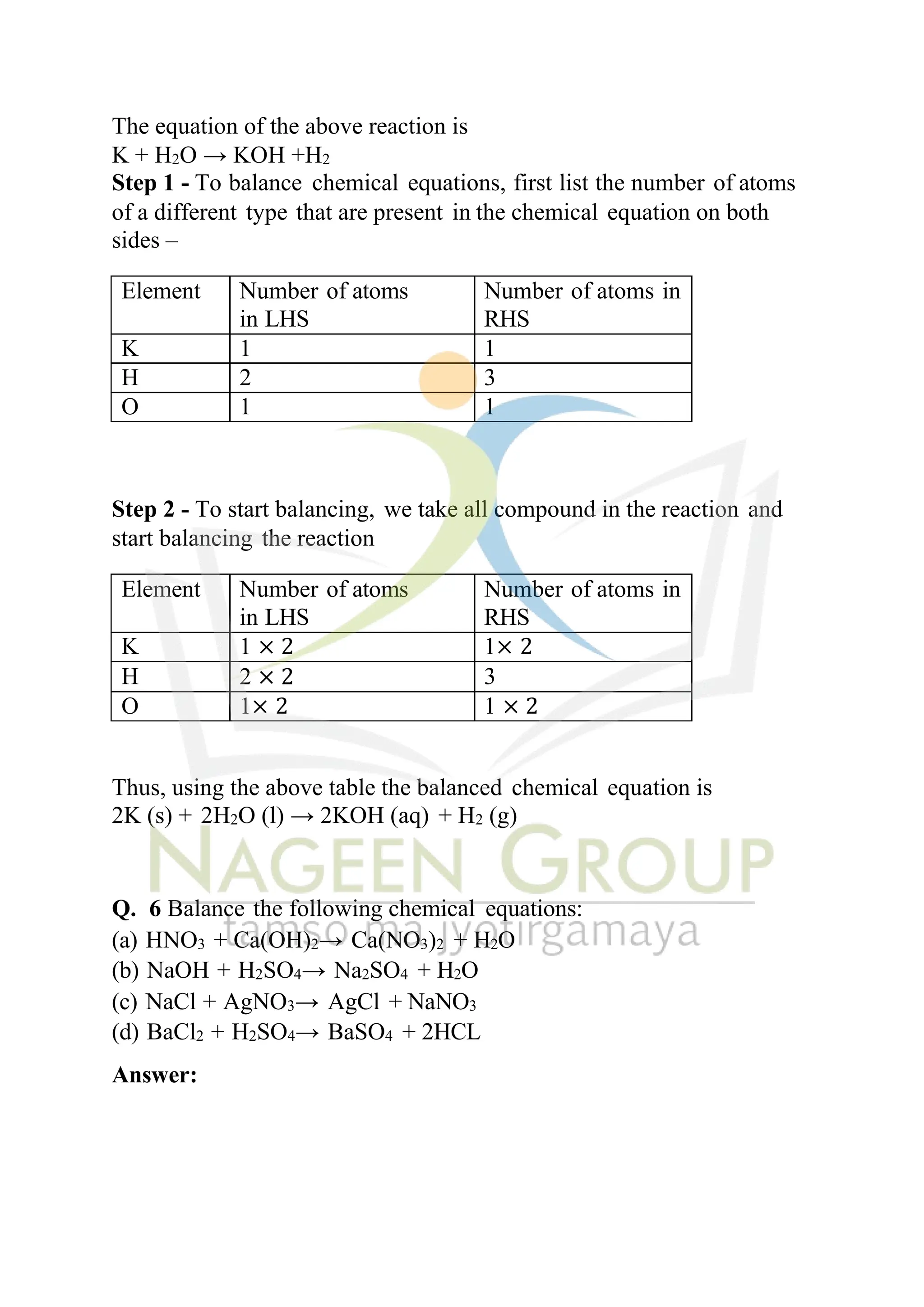
The equation of the above reaction is
K + H2O → KOH +H2
Step 1 - To balance chemical equations, first list the number of atoms
of a different type that are present in the chemical equation on both
sides –
Element Number of atoms
in LHS
Number of atoms in
RHS
K 1 1
H 2 3
O 1 1
Step 2 - To start balancing, we take all compound in the reaction and
start balancing the reaction
Element Number of atoms
in LHS
Number of atoms in
RHS
K 1 × 2 1× 2
H 2 × 2 3
O 1× 2 1 × 2
Thus, using the above table the balanced chemical equation is
2K (s) + 2H2O (l) → 2KOH (aq) + H2 (g)
Q. 6 Balance the following chemical equations:
(a) HNO3 + Ca(OH)2→ Ca(NO3)2 + H2O
(b) NaOH + H2SO4→ Na2SO4 + H2O
(c) NaCl + AgNO3→ AgCl + NaNO3
(d) BaCl2 + H2SO4→ BaSO4 + 2HCL
Answer:
(a) Step 1 - To balance chemical equations, first list the number of
atoms of different type that are present in the chemical equation on
both sides -
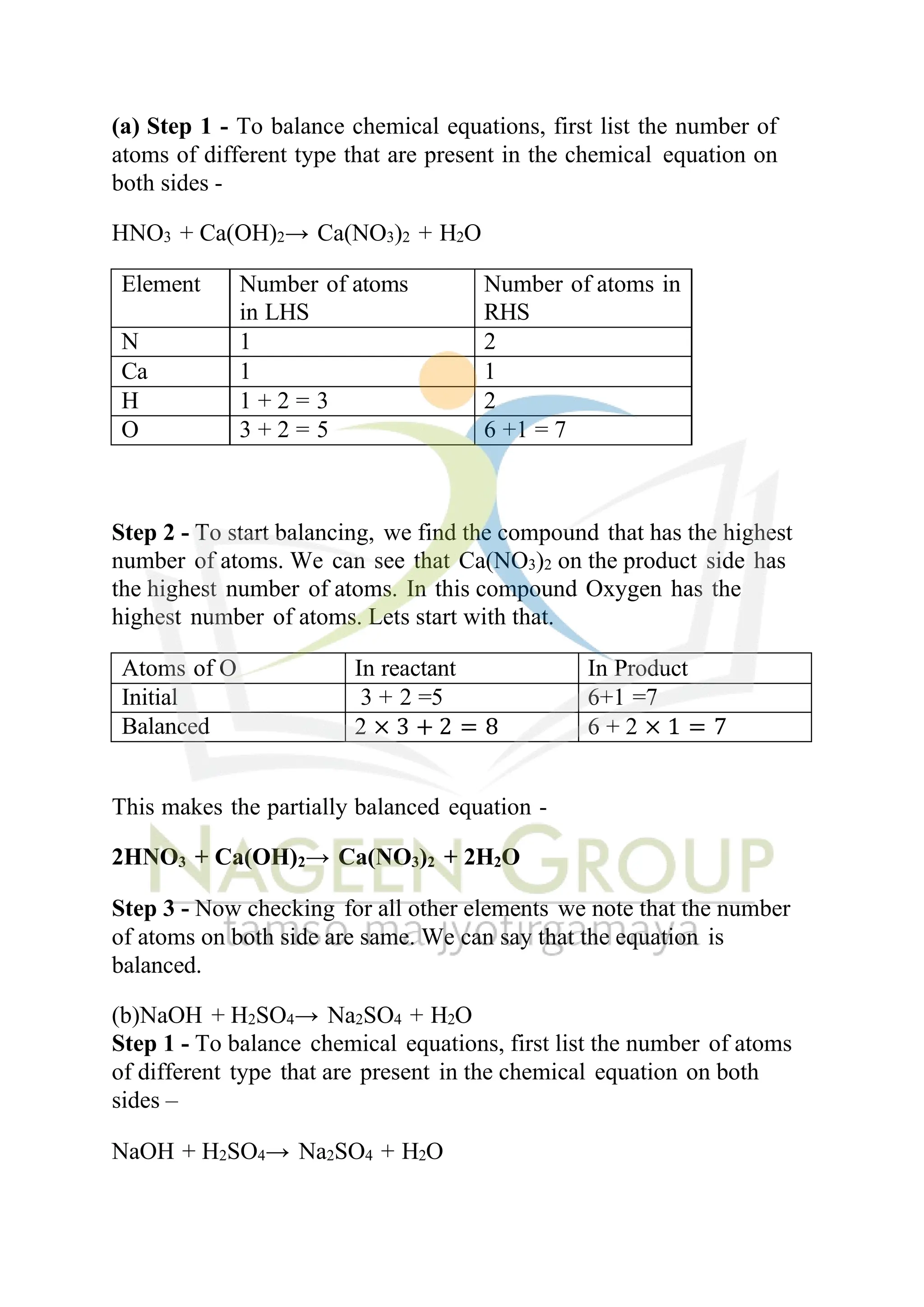
HNO3 + Ca(OH)2→ Ca(NO3)2 + H2O
Element Number of atoms
in LHS
Number of atoms in
RHS
N 1 2
Ca 1 1
H 1 + 2 = 3 2
O 3 + 2 = 5 6 +1 = 7
Step 2 - To start balancing, we find the compound that has the highest
number of atoms. We can see that Ca(NO3)2 on the product side has
the highest number of atoms. In this compound Oxygen has the
highest number of atoms. Lets start with that.
Atoms of O In reactant In Product
Initial 3 + 2 =5 6+1 =7
Balanced 2 × 3 + 2 = 8 6 + 2 × 1 = 7
This makes the partially balanced equation -
2HNO3 + Ca(OH)2→ Ca(NO3)2 + 2H2O
Step 3 - Now checking for all other elements we note that the number
of atoms on both side are same. We can say that the equation is
balanced.
(b)NaOH + H2SO4→ Na2SO4 + H2O
Step 1 - To balance chemical equations, first list the number of atoms
of different type that are present in the chemical equation on both
sides –
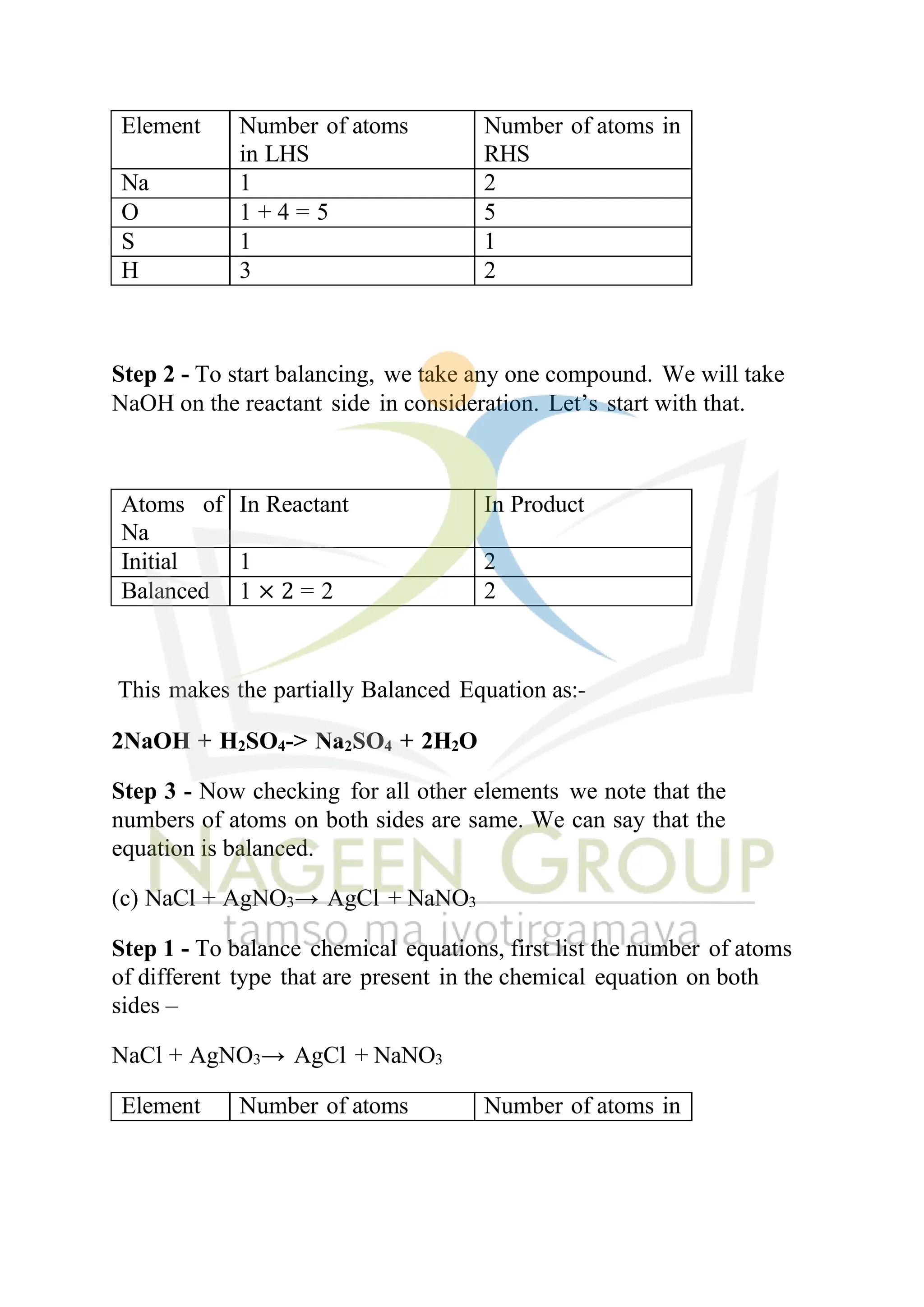
NaOH + H2SO4→ Na2SO4 + H2O
Element Number of atoms
in LHS
Number of atoms in
RHS
Na 1 2
O 1 + 4 = 5 5
S 1 1
H 3 2
Step 2 - To start balancing, we take any one compound. We will take
NaOH on the reactant side in consideration. Let’s start with that.
Atoms of
Na
In Reactant In Product
Initial 1 2
Balanced 1 × 2 = 2 2
This makes the partially Balanced Equation as:-
2NaOH + H2SO4-> Na2SO4 + 2H2O
Step 3 - Now checking for all other elements we note that the
numbers of atoms on both sides are same. We can say that the
equation is balanced.
(c) NaCl + AgNO3→ AgCl + NaNO3
Step 1 - To balance chemical equations, first list the number of atoms
of different type that are present in the chemical equation on both
sides –
NaCl + AgNO3→ AgCl + NaNO3
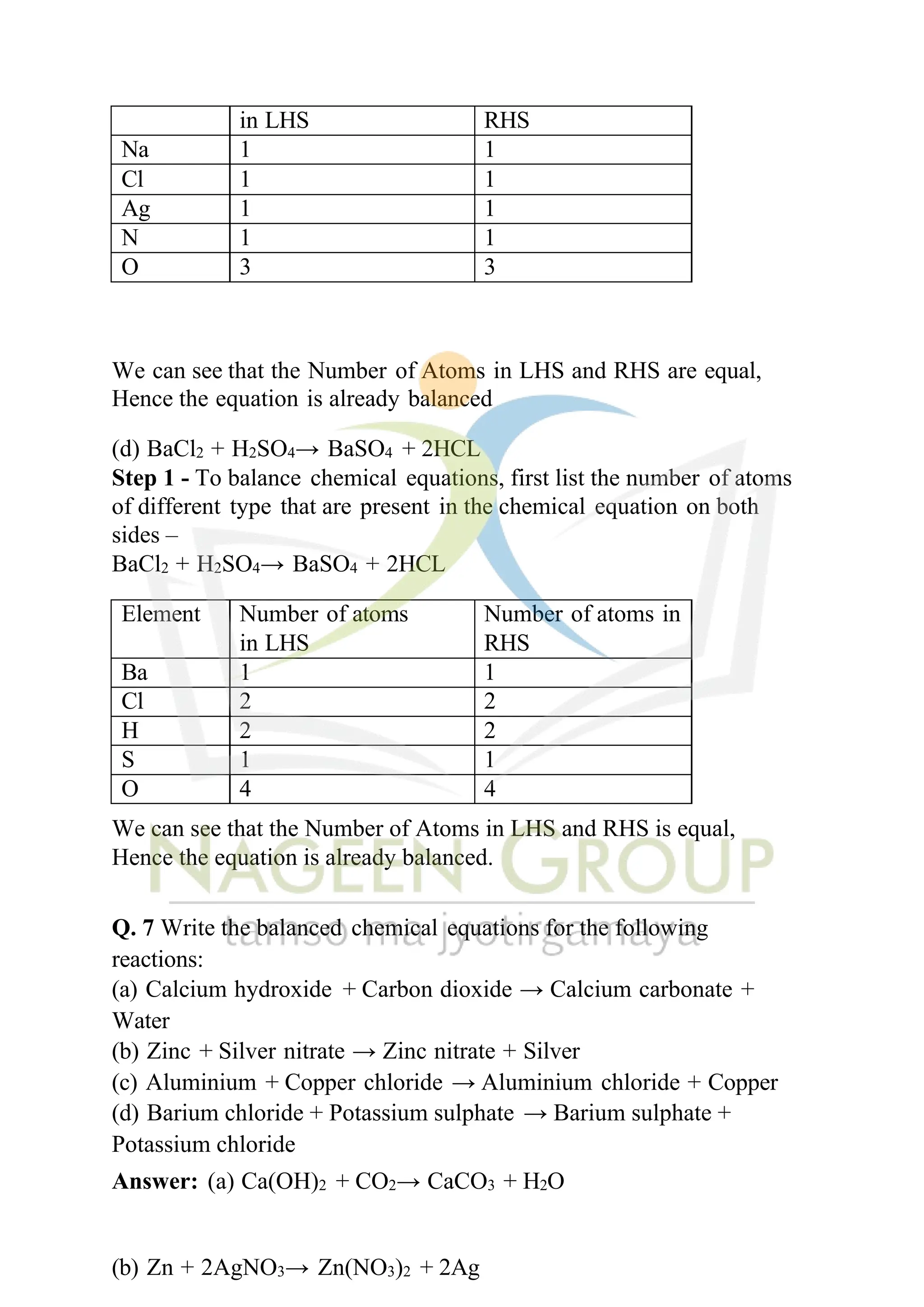
Element Number of atoms Number of atoms in
in LHS RHS
Na 1 1
Cl 1 1
Ag 1 1
N 1 1
O 3 3
We can see that the Number of Atoms in LHS and RHS are equal,
Hence the equation is already balanced
(d) BaCl2 + H2SO4→ BaSO4 + 2HCL
Step 1 - To balance chemical equations, first list the number of atoms
of different type that are present in the chemical equation on both
sides –
BaCl2 + H2SO4→ BaSO4 + 2HCL
Element Number of atoms
in LHS
Number of atoms in
RHS
Ba 1 1
Cl 2 2
H 2 2
S 1 1
O 4 4
We can see that the Number of Atoms in LHS and RHS is equal,
Hence the equation is already balanced.
Q. 7 Write the balanced chemical equations for the following
reactions:
(a) Calcium hydroxide + Carbon dioxide → Calcium carbonate +
Water
(b) Zinc + Silver nitrate → Zinc nitrate + Silver
(c) Aluminium + Copper chloride → Aluminium chloride + Copper
(d) Barium chloride + Potassium sulphate → Barium sulphate +
Potassium chloride
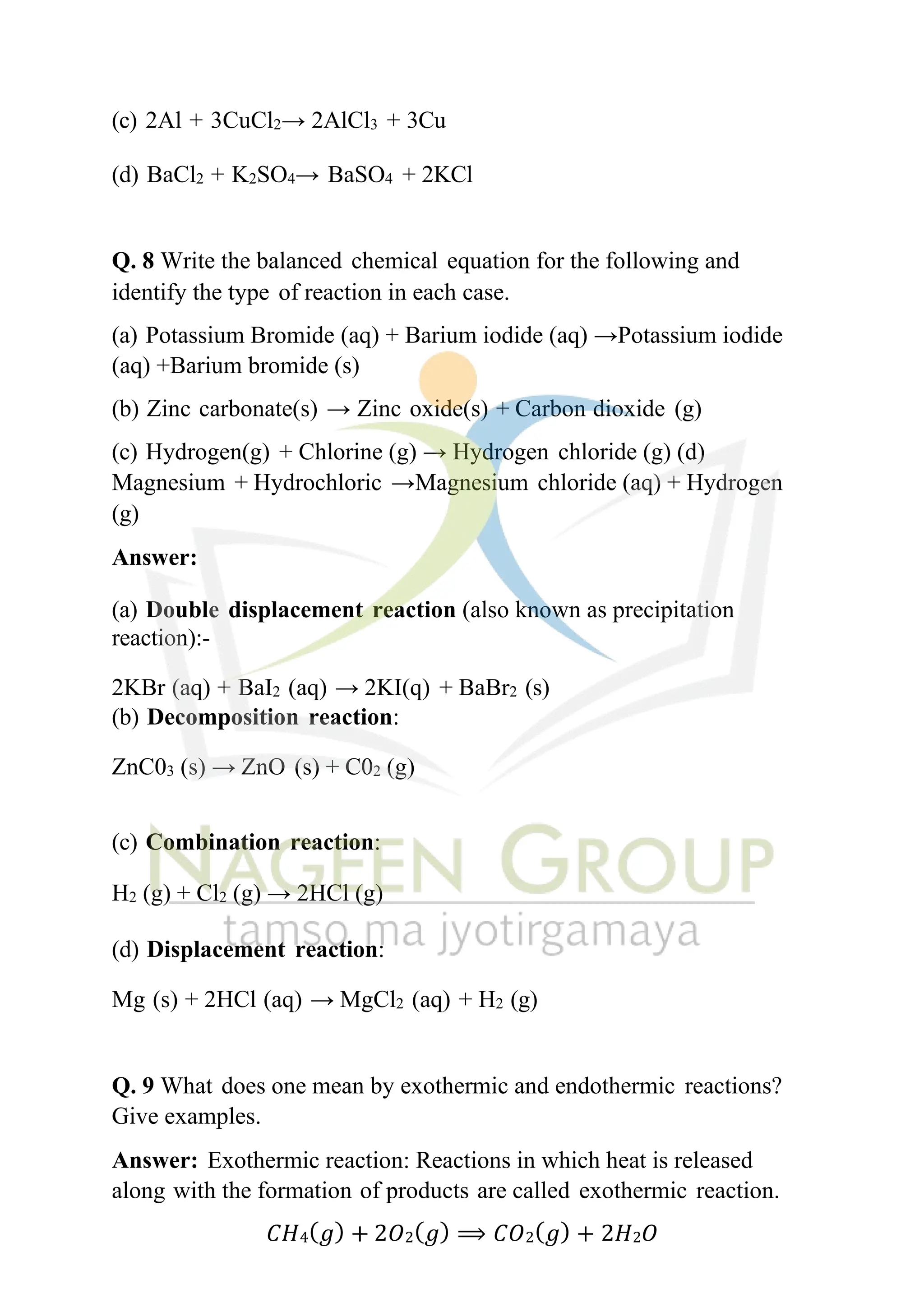
Answer: (a) Ca(OH)2 + CO2→ CaCO3 + H2O
(b) Zn + 2AgNO3→ Zn(NO3)2 + 2Ag
(c) 2Al + 3CuCl2→ 2AlCl3 + 3Cu
(d) BaCl2 + K2SO4→ BaSO4 + 2KCl
Q. 8 Write the balanced chemical equation for the following and
identify the type of reaction in each case.
(a) Potassium Bromide (aq) + Barium iodide (aq) →Potassium iodide
(aq) +Barium bromide (s)
(b) Zinc carbonate(s) → Zinc oxide(s) + Carbon dioxide (g)
(c) Hydrogen(g) + Chlorine (g) → Hydrogen chloride (g) (d)
Magnesium + Hydrochloric →Magnesium chloride (aq) + Hydrogen
(g)
Answer:
(a) Double displacement reaction (also known as precipitation
reaction):-
2KBr (aq) + BaI2 (aq) → 2KI(q) + BaBr2 (s)
(b) Decomposition reaction:
ZnC03 (s) → ZnO (s) + C02 (g)
(c) Combination reaction:
H2 (g) + Cl2 (g) → 2HCl (g)
(d) Displacement reaction:
Mg (s) + 2HCl (aq) → MgCl2 (aq) + H2 (g)
Q. 9 What does one mean by exothermic and endothermic reactions?
Give examples.
Answer: Exothermic reaction: Reactions in which heat is released
along with the formation of products are called exothermic reaction.
𝐶𝐻4(𝑔) + 2𝑂2(𝑔) ⟹ 𝐶𝑂2(𝑔) + 2𝐻2𝑂
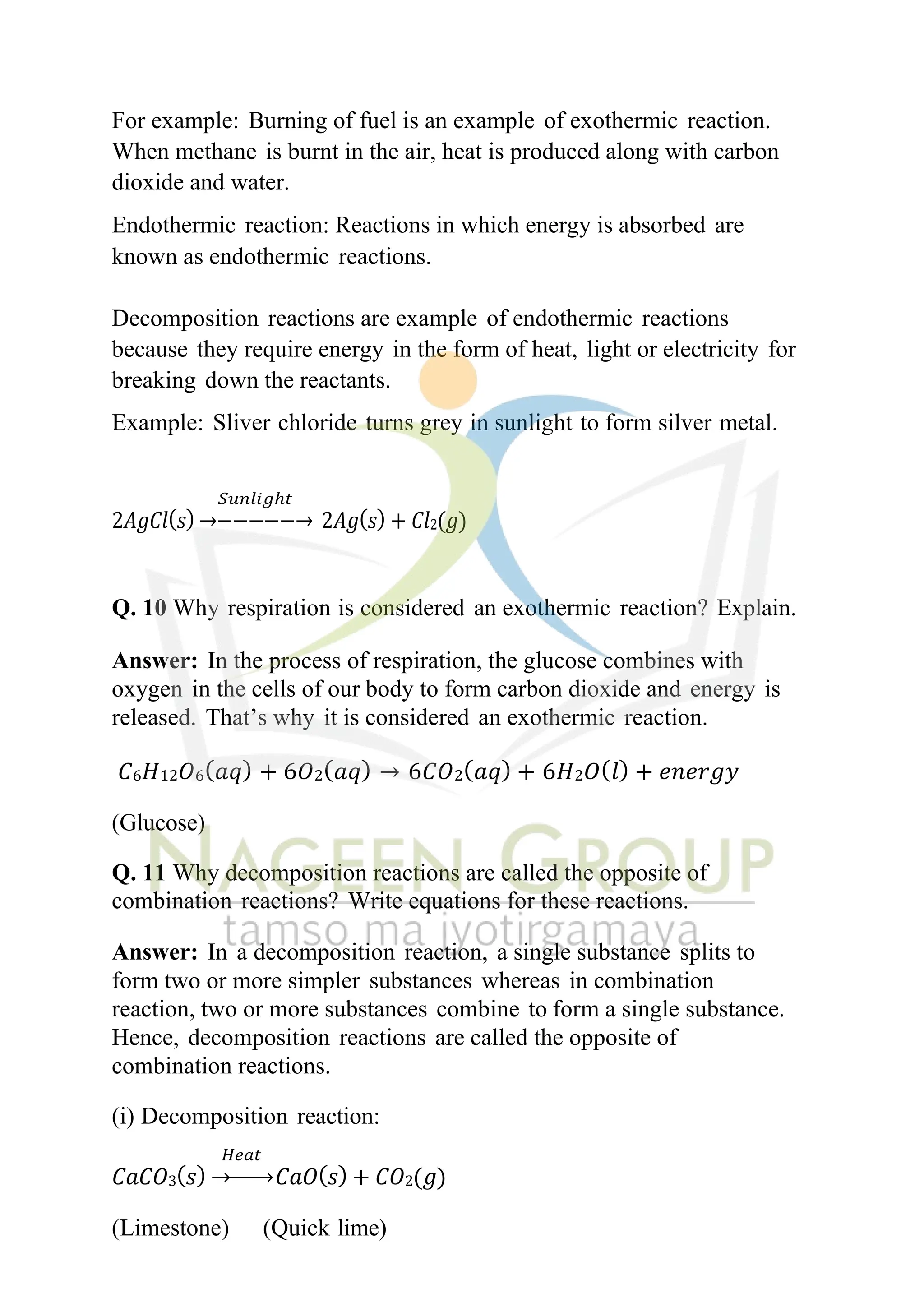
For example: Burning of fuel is an example of exothermic reaction.
When methane is burnt in the air, heat is produced along with carbon
dioxide and water.
Endothermic reaction: Reactions in which energy is absorbed are
known as endothermic reactions.
Decomposition reactions are example of endothermic reactions
because they require energy in the form of heat, light or electricity for
breaking down the reactants.
Example: Sliver chloride turns grey in sunlight to form silver metal.
𝑆𝑢𝑛𝑙𝑖𝑔ℎ𝑡
2𝐴𝑔𝐶𝑙(𝑠) →−−−−−→ 2𝐴𝑔(𝑠) + 𝐶𝑙2(𝑔)
Q. 10 Why respiration is considered an exothermic reaction? Explain.
Answer: In the process of respiration, the glucose combines with
oxygen in the cells of our body to form carbon dioxide and energy is
released. That’s why it is considered an exothermic reaction.
𝐶6𝐻12𝑂6(𝑎𝑞) + 6𝑂2(𝑎𝑞) → 6𝐶𝑂2(𝑎𝑞) + 6𝐻2𝑂(𝑙) + 𝑒𝑛𝑒𝑟𝑔𝑦
(Glucose)
Q. 11 Why decomposition reactions are called the opposite of
combination reactions? Write equations for these reactions.
Answer: In a decomposition reaction, a single substance splits to
form two or more simpler substances whereas in combination
reaction, two or more substances combine to form a single substance.
Hence, decomposition reactions are called the opposite of
combination reactions.
(i) Decomposition reaction:
𝐻𝑒𝑎𝑡
𝐶𝑎𝐶𝑂3(𝑠) →−−→𝐶𝑎𝑂(𝑠) + 𝐶𝑂2(𝑔)
(Limestone) (Quick lime)
In this reaction, calcium carbonate decomposes into calcium oxide
and carbon dioxide on heating. This is an important decomposition
reaction used in various industries.
(ii) Combination reaction: Formation of water
2𝐻2(𝑔) + 𝑂2 (𝑔) → 2𝐻2𝑂(𝑙)
In this reaction, two substances hydrogen and oxygen combine to
form single substance water, so this is a combination reaction.
We can see from the above examples that a decomposition reaction is
opposite of a combination reaction.
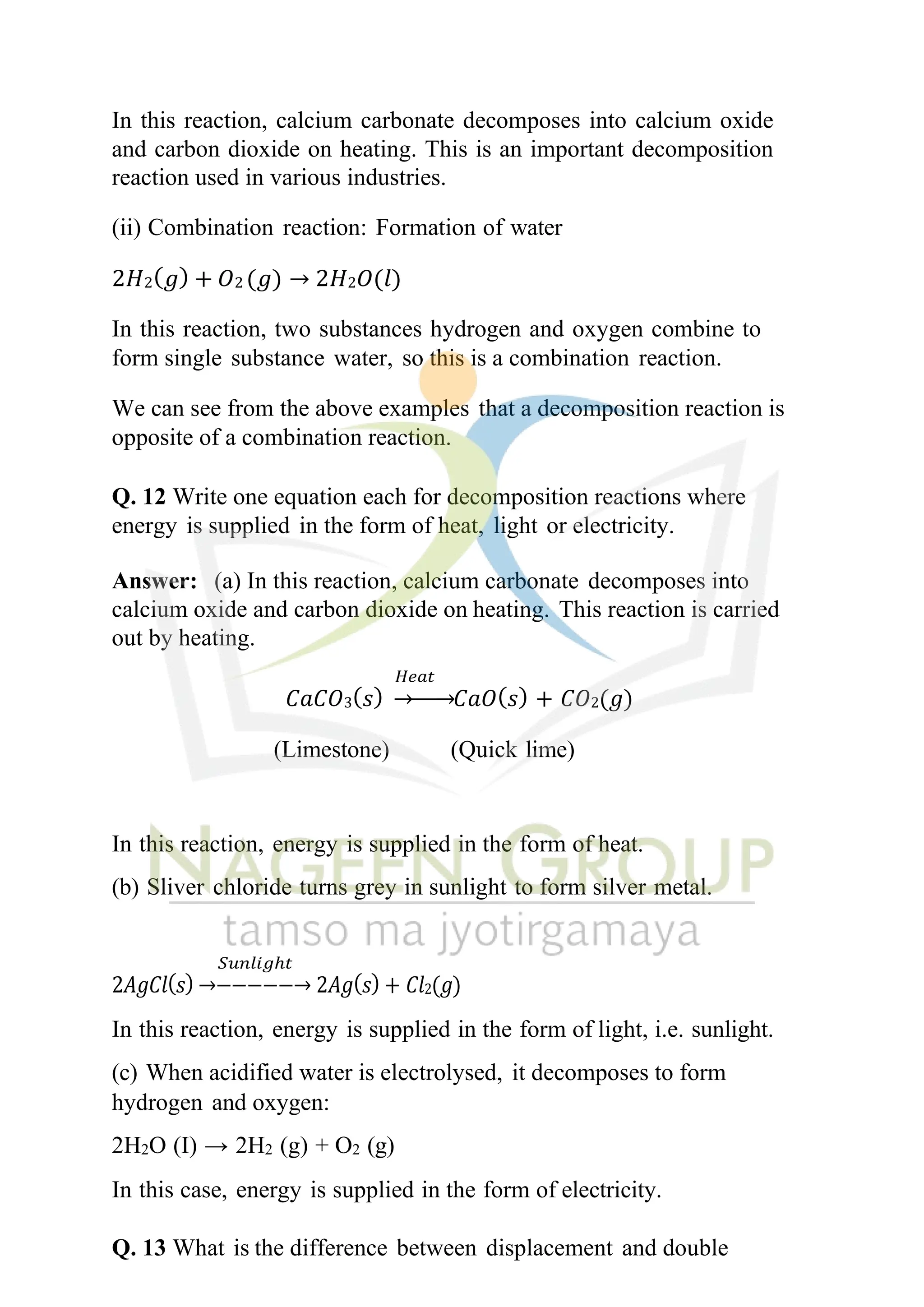
Q. 12 Write one equation each for decomposition reactions where
energy is supplied in the form of heat, light or electricity.
Answer: (a) In this reaction, calcium carbonate decomposes into
calcium oxide and carbon dioxide on heating. This reaction is carried
out by heating.
𝐻𝑒𝑎𝑡
𝐶𝑎𝐶𝑂3(𝑠) →−−→𝐶𝑎𝑂(𝑠) + 𝐶𝑂2(𝑔)
(Limestone) (Quick lime)
In this reaction, energy is supplied in the form of heat.
(b) Sliver chloride turns grey in sunlight to form silver metal.
𝑆𝑢𝑛𝑙𝑖𝑔ℎ𝑡
2𝐴𝑔𝐶𝑙(𝑠) →−−−−−→ 2𝐴𝑔(𝑠) + 𝐶𝑙2(𝑔)
In this reaction, energy is supplied in the form of light, i.e. sunlight.
(c) When acidified water is electrolysed, it decomposes to form
hydrogen and oxygen:
2H2O (I) → 2H2 (g) + O2 (g)
In this case, energy is supplied in the form of electricity.
Q. 13 What is the difference between displacement and double
displacement reactions? Write equations for these reactions.
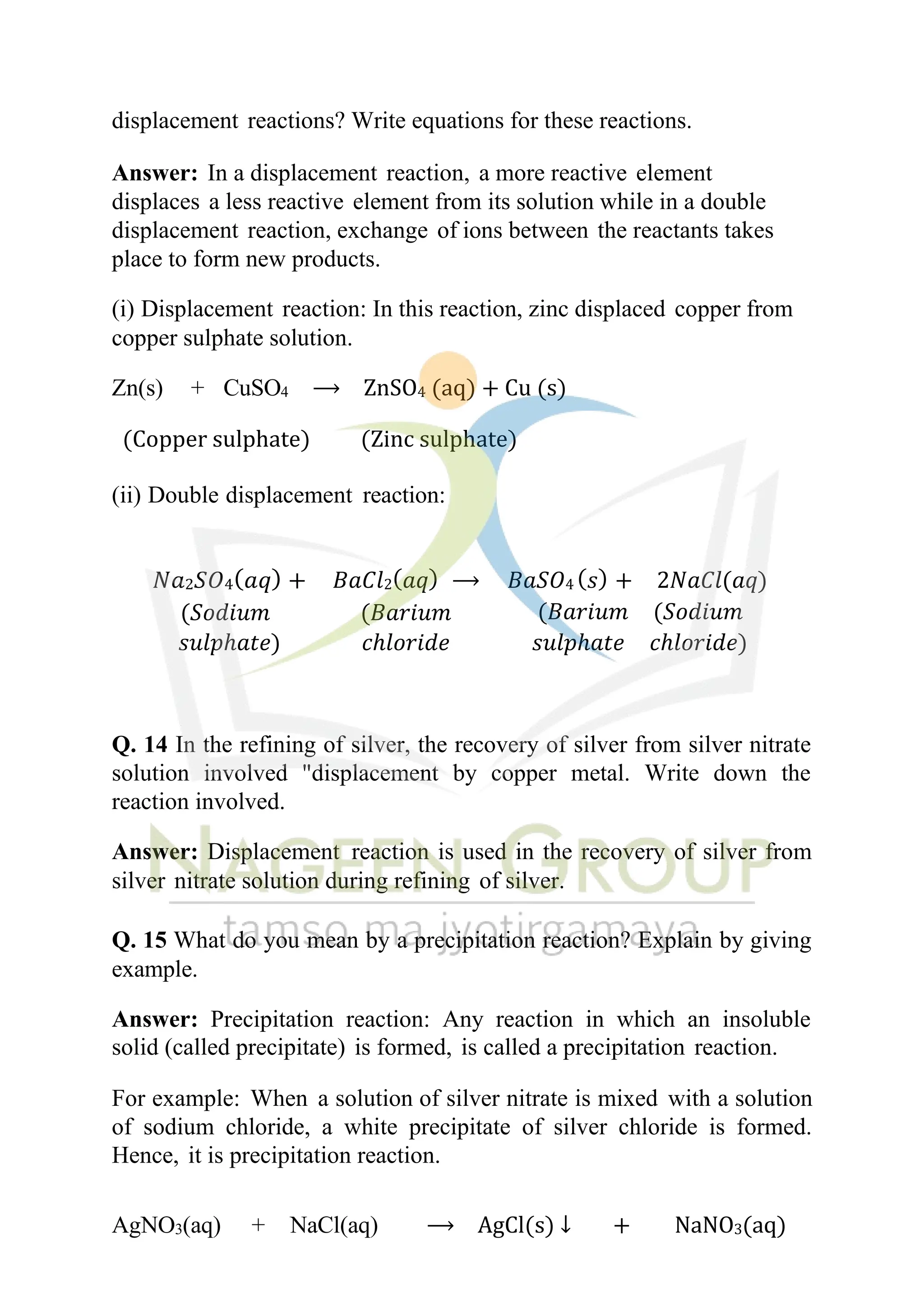
Answer: In a displacement reaction, a more reactive element
displaces a less reactive element from its solution while in a double
displacement reaction, exchange of ions between the reactants takes
place to form new products.
(i) Displacement reaction: In this reaction, zinc displaced copper from
copper sulphate solution.
Zn(s) + CuSO4 ⟶ ZnSO4 (aq) + Cu (s)
(Copper sulphate) (Zinc sulphate)
(ii) Double displacement reaction:
𝑁𝑎2𝑆𝑂4(𝑎𝑞) + 𝐵𝑎𝐶𝑙2(𝑎𝑞) ⟶ 𝐵𝑎𝑆𝑂4 (𝑠) + 2𝑁𝑎𝐶𝑙(𝑎𝑞)
(𝑆𝑜𝑑𝑖𝑢𝑚 (𝐵𝑎𝑟𝑖𝑢𝑚 (𝐵𝑎𝑟𝑖𝑢𝑚 (𝑆𝑜𝑑𝑖𝑢𝑚
𝑠𝑢𝑙𝑝ℎ𝑎𝑡𝑒) 𝑐ℎ𝑙𝑜𝑟𝑖𝑑𝑒 𝑠𝑢𝑙𝑝ℎ𝑎𝑡𝑒 𝑐ℎ𝑙𝑜𝑟𝑖𝑑𝑒)
Q. 14 In the refining of silver, the recovery of silver from silver nitrate
solution involved "displacement by copper metal. Write down the
reaction involved.
Answer: Displacement reaction is used in the recovery of silver from
silver nitrate solution during refining of silver.
Q. 15 What do you mean by a precipitation reaction? Explain by giving
example.
Answer: Precipitation reaction: Any reaction in which an insoluble
solid (called precipitate) is formed, is called a precipitation reaction.
For example: When a solution of silver nitrate is mixed with a solution
of sodium chloride, a white precipitate of silver chloride is formed.
Hence, it is precipitation reaction.
AgNO3(aq) + NaCl(aq) ⟶ AgCl(s) ↓ + NaNO3(aq)
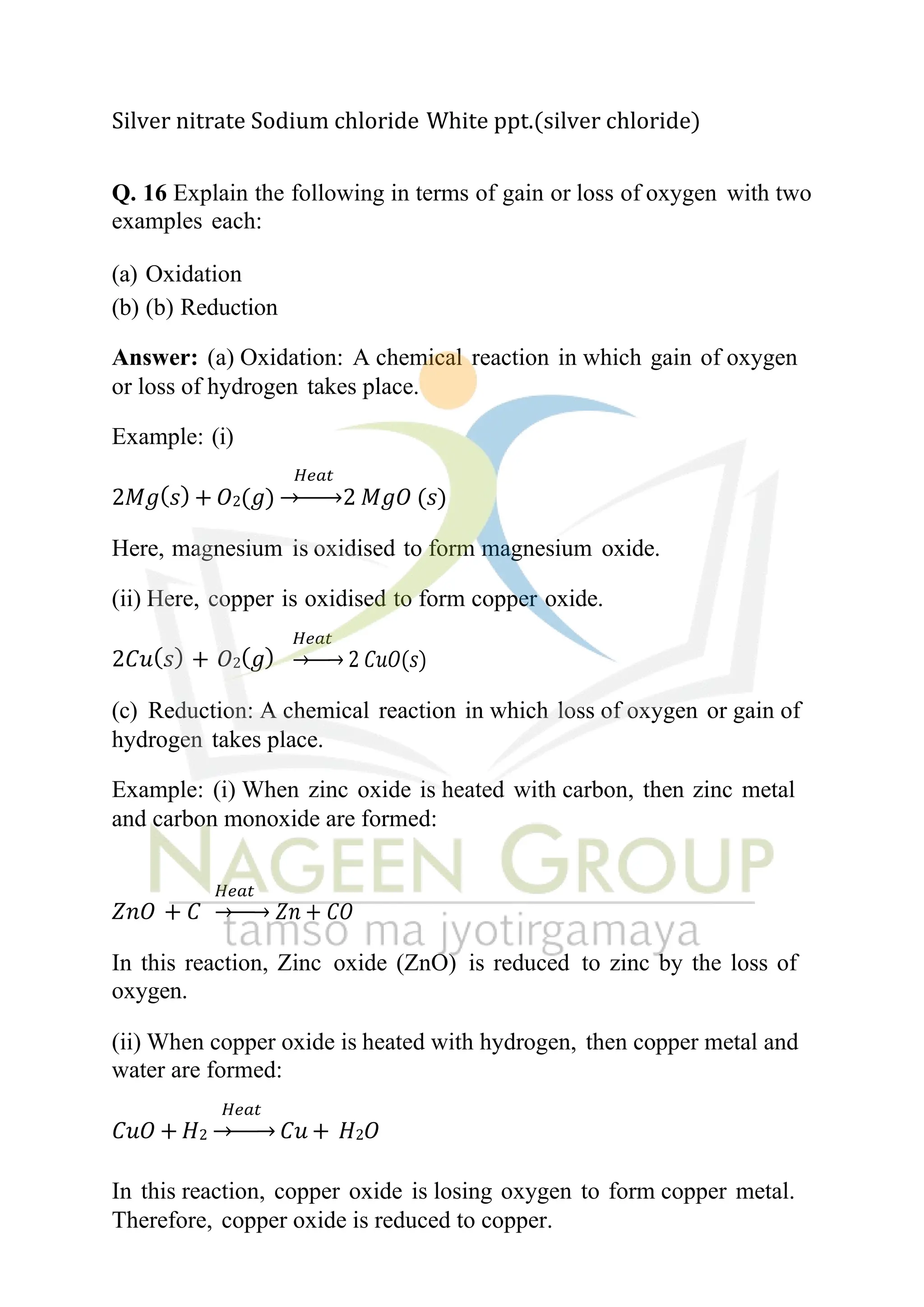
Silver nitrate Sodium chloride White ppt.(silver chloride)
Q. 16 Explain the following in terms of gain or loss of oxygen with two
examples each:
(a) Oxidation
(b) (b) Reduction
Answer: (a) Oxidation: A chemical reaction in which gain of oxygen
or loss of hydrogen takes place.
Example: (i)
𝐻𝑒𝑎𝑡
2𝑀𝑔(𝑠) + 𝑂2(𝑔) →−−→2 𝑀𝑔𝑂 (𝑠)
Here, magnesium is oxidised to form magnesium oxide.
(ii) Here, copper is oxidised to form copper oxide.
2𝐶𝑢(𝑠) + 𝑂2(𝑔)
𝐻𝑒𝑎𝑡
→−−→ 2 𝐶𝑢𝑂(𝑠)
(c) Reduction: A chemical reaction in which loss of oxygen or gain of
hydrogen takes place.
Example: (i) When zinc oxide is heated with carbon, then zinc metal
and carbon monoxide are formed:
𝑍𝑛𝑂 + 𝐶
𝐻𝑒𝑎𝑡
→−−→ 𝑍𝑛 + 𝐶𝑂
In this reaction, Zinc oxide (ZnO) is reduced to zinc by the loss of
oxygen.
(ii) When copper oxide is heated with hydrogen, then copper metal and
water are formed:
𝐻𝑒𝑎𝑡
𝐶𝑢𝑂 + 𝐻2 →−−→ 𝐶𝑢 + 𝐻2𝑂
In this reaction, copper oxide is losing oxygen to form copper metal.
Therefore, copper oxide is reduced to copper.
Q. 17 A shiny brown coloured element X on heating in the air becomes
black in colour. Name the element X and the black coloured compound
formed.
Answer: The unknown element X is copper (Cu). When copper is
heated in air, it forms a black coloured compound called copper oxide
(CuO). The reaction for above chemical change is given below:
𝐻𝑒𝑎𝑡
2𝐶𝑢+ 𝑂2 →−−→ 2𝐶𝑢𝑂
Q. 18 Why do we apply paint on iron articles?
Answer: Iron articles are painted to prevent them from rusting. When
paint is applied on the surface of iron articles, the contact of air and
moisture with iron metals is cut off. Therefore, no rusting takes place.
Q. 19 Oil and fat containing food items are flushed with nitrogen. Why?
Answer: The oil and fat present in food items get oxidized in the
presence of air forming products having unpleasant smell and taste
which turn the food rancid.
Rancidity makes the food unfit for eating.
This is why antioxidants are added to foods containing oil and fat to
prevent oxidation of food.
Nitrogen acts as an antioxidant.
That’s why oil and fat containing food items are flushed with nitrogen
to prevent oxidation.
Thus, the food does not turn rancid and remain good to eat for a longer
time.
Q. 20 Explain the following terms with one example each:
(a) Corrosion
(b) Rancidity
Answer: (a) Corrosion: Gradual Deterioration of metals by the action
of :-
1. Air
2. Moisture
3. Chemical( such as an acid) on their surface.
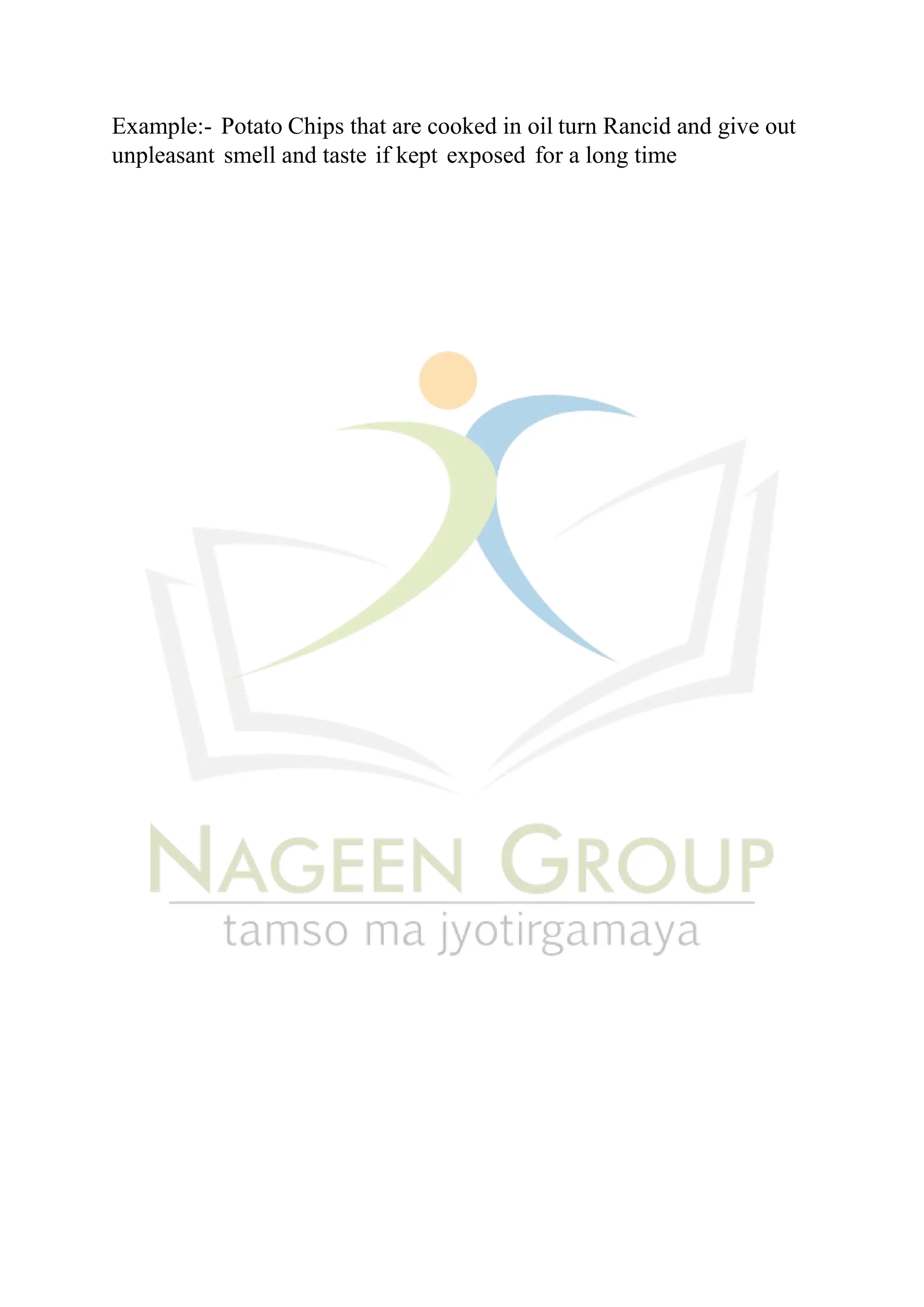
Main Cause of corrosion is the oxidation of metals by the oxygen of
air. Example:- Rusting of Iron - When a piece of Iron is left out in
damp time for a period of time it gets covered with a red-brown
substance called rust. The following reaction takes place resulting in
then formation of rust:-
4𝐹𝑒 + 3𝑂2 + 2𝑥𝐻2𝑂 ⟶ 2𝐹𝑒2𝑂3 . 𝑥𝐻20
𝐼𝑟𝑜𝑛 𝑂𝑥𝑦𝑔𝑒𝑛 𝑤𝑎𝑡𝑒𝑟 𝐻𝑦𝑑𝑟𝑎𝑡𝑒𝑑 𝐼𝑟𝑜𝑛(𝐼 𝐼 𝐼)𝑜𝑥𝑖𝑑𝑒(𝑅𝑢𝑠𝑡)
(b) Rancidity:- Oxidation of Fats and Oils present in food materials by
the oxygen present in air resulting in unpleasant smell and taste is called
Rancidity. This makes the food not fit for eating.
Example:- Potato Chips that are cooked in oil turn Rancid and give out
unpleasant smell and taste if kept exposed for a long time
CLICK TO DOWNLOAD NCERT SOLUTIONS
CLASS 10 (ALL SUBJECTS)
Dear Teachers and Students,
Join School of Educators' exclusive WhatsApp, Telegram, and Signal groups for FREE access
to a vast range of educational resources designed to help you achieve 100/100 in exams!
Separate groups for teachers and students are available, packed with valuable content to
boost your performance.
Additionally, benefit from expert tips, practical advice, and study hacks designed to enhance
performance in both CBSE exams and competitive entrance tests.
Don’t miss out—join today and take the first step toward academic excellence!
Join the Teachers and Students
Group by Clicking the Link Below
JOIN OUR
WHATSAPP
GROUPS
FOR FREE EDUCATIONAL
RESOURCES
JOIN SCHOOL OF EDUCATORS WHATSAPP GROUPS
FOR FREE EDUCATIONAL RESOURCES
BENEFITS OF SOE WHATSAPP GROUPS
We are thrilled to introduce the School of Educators WhatsApp Group, a
platform designed exclusively for educators to enhance your teaching & Learning
experience and learning outcomes. Here are some of the key benefits you can
expect from joining our group:
Abundance of Content: Members gain access to an extensive repository of
educational materials tailored to their class level. This includes various formats such
as PDFs, Word files, PowerPoint presentations, lesson plans, worksheets, practical
tips, viva questions, reference books, smart content, curriculum details, syllabus,
marking schemes, exam patterns, and blueprints. This rich assortment of resources
enhances teaching and learning experiences.
Immediate Doubt Resolution: The group facilitates quick clarification of doubts.
Members can seek assistance by sending messages, and experts promptly respond
to queries. This real-time interaction fosters a supportive learning environment
where educators and students can exchange knowledge and address concerns
effectively.
Access to Previous Years' Question Papers and Topper Answers: The group
provides access to previous years' question papers (PYQ) and exemplary answer
scripts of toppers. This resource is invaluable for exam preparation, allowing
individuals to familiarize themselves with the exam format, gain insights into scoring
techniques, and enhance their performance in assessments.
Free and Unlimited Resources: Members enjoy the benefit of accessing an array of
educational resources without any cost restrictions. Whether its study materials,
teaching aids, or assessment tools, the group offers an abundance of resources
tailored to individual needs. This accessibility ensures that educators and students
have ample support in their academic endeavors without financial constraints.
Instant Access to Educational Content: SOE WhatsApp groups are a platform where
teachers can access a wide range of educational content instantly. This includes study
materials, notes, sample papers, reference materials, and relevant links shared by
group members and moderators.
Timely Updates and Reminders: SOE WhatsApp groups serve as a source of timely
updates and reminders about important dates, exam schedules, syllabus changes, and
academic events. Teachers can stay informed and well-prepared for upcoming
assessments and activities.
Interactive Learning Environment: Teachers can engage in discussions, ask questions,
and seek clarifications within the group, creating an interactive learning environment.
This fosters collaboration, peer learning, and knowledge sharing among group
members, enhancing understanding and retention of concepts.
Access to Expert Guidance: SOE WhatsApp groups are moderated by subject matter
experts, teachers, or experienced educators can benefit from their guidance,
expertise, and insights on various academic topics, exam strategies, and study
techniques.
Join the School of Educators WhatsApp Group today and unlock a world of resources,
support, and collaboration to take your teaching to new heights. To join, simply click
on the group links provided below or send a message to +91-95208-77777 expressing
your interest.
Together, let's empower ourselves & Our Students and
inspire the next generation of learners.
Best Regards,
Team
School of Educators
Join School of Educators WhatsApp Groups
You will get Pre- Board Papers PDF, Word file, PPT, Lesson Plan, Worksheet, practical
tips and Viva questions, reference books, smart content, curriculum, syllabus,
marking scheme, toppers answer scripts, revised exam pattern, revised syllabus,
Blue Print etc. here . Join Your Subject / Class WhatsApp Group.
Kindergarten to Class XII (For Teachers Only)
Class 1 Class 2 Class 3
Class 4 Class 5 Class 6
Class 7 Class 8 Class 9
Class 10 Class 11 (Science) Class 11 (Humanities)
Class 11 (Commerce)
Class 12 (Commerce)
Class 12 (Science) Class 12 (Humanities)
Kindergarten
Subject Wise Secondary and Senior Secondary Groups
(IX & X For Teachers Only)
Secondary Groups (IX & X)
Senior Secondary Groups (XI & XII For Teachers Only)
SST Mathematics Science
English Hindi-A IT Code-402
Physics Chemistry English
Mathematics
Economics
Biology
BST
Accountancy
History
Hindi-B Artificial Intelligence
Hindi Core Home Science Sanskrit
Psychology Political Science Painting
Vocal Music Comp. Science IP
Physical Education APP. Mathematics Legal Studies
Entrepreneurship French
Teachers Jobs
Principal’s Group IIT/NEET
Other Important Groups (For Teachers & Principal’s)
IT
Sociology Hindi Elective
Geography
Artificial Intelligence
Join School of Educators WhatsApp Groups
You will get Pre- Board Papers PDF, Word file, PPT, Lesson Plan, Worksheet, practical
tips and Viva questions, reference books, smart content, curriculum, syllabus,
marking scheme, toppers answer scripts, revised exam pattern, revised syllabus,
Blue Print etc. here . Join Your Subject / Class WhatsApp Group.
Kindergarten to Class XII (For Students Only)
Class 1 Class 2 Class 3
Class 4 Class 5 Class 6
Class 7 Class 8 Class 9
Class 10 Class 11 (Science) Class 11 (Humanities)
Class 11 (Commerce)
Class 12 (Commerce)
Class 12 (Science) Class 12 (Humanities)
Artificial Intelligence
(VI TO VIII)
Subject Wise Secondary and Senior Secondary Groups
(IX & X For Students Only)
Secondary Groups (IX & X)
Senior Secondary Groups (XI & XII For Students Only)
SST Mathematics Science
English Hindi IT Code
Physics Chemistry English
Mathematics
Economics
Biology
BST
Accountancy
History
Artificial Intelligence
Hindi Core Home Science Sanskrit
Psychology Political Science Painting
Music Comp. Science IP
Physical Education APP. Mathematics Legal Studies
Entrepreneurship French IT
Sociology Hindi Elective
Geography
IIT/NEET
AI CUET
To maximize the benefits of these WhatsApp groups, follow these guidelines:
1. Share your valuable resources with the group.
2. Help your fellow educators by answering their queries.
3. Watch and engage with shared videos in the group.
4. Distribute WhatsApp group resources among your students.
5. Encourage your colleagues to join these groups.
Additional notes:
1. Avoid posting messages between 9 PM and 7 AM.
2. After sharing resources with students, consider deleting outdated data if necessary.
3. It's a NO Nuisance groups, single nuisance and you will be removed.
No introductions.
No greetings or wish messages.
No personal chats or messages.
No spam. Or voice calls
Share and seek learning resources only.
Groups Rules & Regulations:
Please only share and request learning resources. For assistance,
contact the helpline via WhatsApp: +91-95208-77777.
Join Premium WhatsApp Groups
Ultimate Educational Resources!!
Join our premium groups and just Rs. 1000 and gain access to all our exclusive
materials for the entire academic year. Whether you're a student in Class IX, X, XI, or
XII, or a teacher for these grades, Artham Resources provides the ultimate tools to
enhance learning. Pay now to delve into a world of premium educational content!
Class 9 Class 10 Class 11
Click here for more details
📣 Don't Miss Out! Elevate your academic journey with top-notch study materials and secure
your path to top scores! Revolutionize your study routine and reach your academic goals with
our comprehensive resources. Join now and set yourself up for success! 📚🌟
Best Wishes,
Team
School of Educators & Artham Resources
Class 12
SKILL MODULES BEING OFFERED IN
MIDDLE SCHOOL
Artificial Intelligence Beauty & Wellness Design Thinking &
Innovation
Financial Literacy
Handicrafts Information Technology Marketing/Commercial
Application
Mass Media - Being Media
Literate
Travel & Tourism Coding Data Science (Class VIII
only)
Augmented Reality /
Virtual Reality
Digital Citizenship Life Cycle of Medicine &
Vaccine
Things you should know
about keeping Medicines
at home
What to do when Doctor
is not around
Humanity & Covid-19 Blue Pottery Pottery Block Printing
Food Food Preservation Baking Herbal Heritage
Khadi Mask Making Mass Media Making of a Graphic
Novel
Kashmiri
Embroidery
Embroidery Rockets Satellites
Application of
Satellites
Photography
SKILL SUBJECTS AT SECONDARY LEVEL (CLASSES IX – X)
Retail Information Technology
Security
Automotive
Introduction To Financial
Markets
Introduction To Tourism Beauty & Wellness Agriculture
Food Production Front Office Operations Banking & Insurance Marketing & Sales
Health Care Apparel Multi Media Multi Skill Foundation
Course
Artificial Intelligence
Physical Activity Trainer
Data Science Electronics & Hardware
(NEW)
Design Thinking & Innovation (NEW)
Foundation Skills For Sciences
(Pharmaceutical & Biotechnology)(NEW)
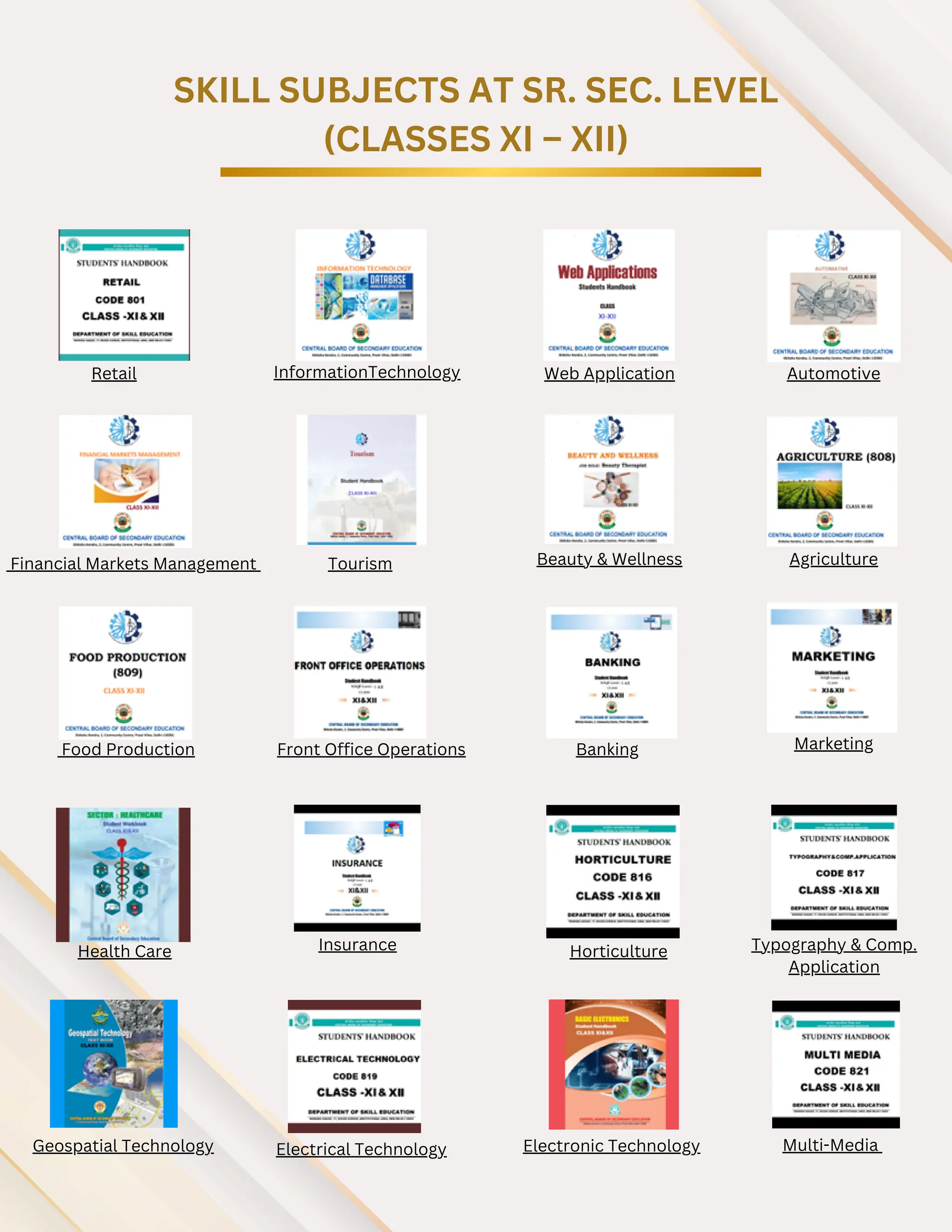
SKILL SUBJECTS AT SR. SEC. LEVEL
(CLASSES XI – XII)
Retail InformationTechnology Web Application Automotive
Financial Markets Management Tourism Beauty & Wellness Agriculture
Food Production Front Office Operations Banking Marketing
Health Care Insurance Horticulture Typography & Comp.
Application
Geospatial Technology Electrical Technology Electronic Technology Multi-Media
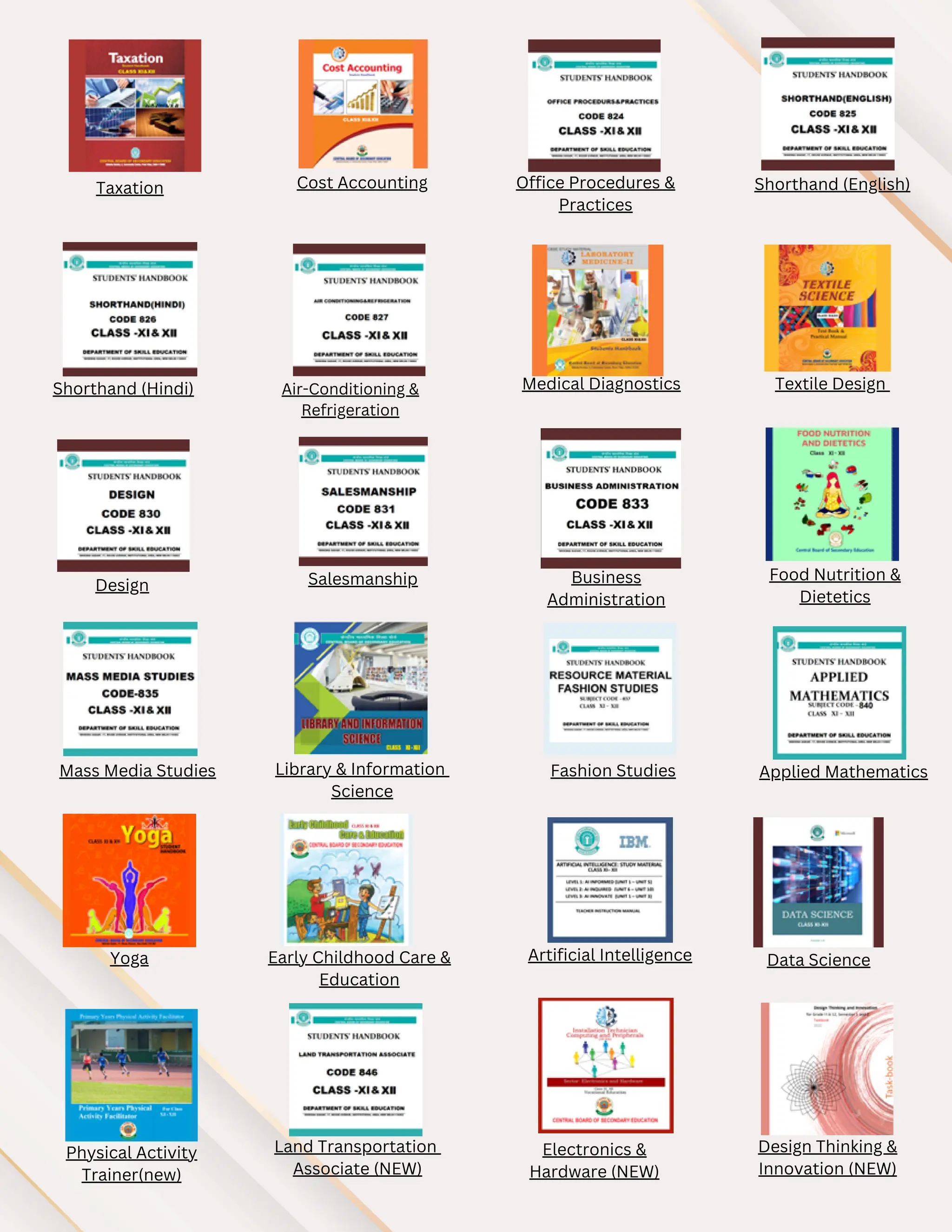
Taxation Cost Accounting Office Procedures &
Practices
Shorthand (English)
Shorthand (Hindi) Air-Conditioning &
Refrigeration
Medical Diagnostics Textile Design
Design Salesmanship Business
Administration
Food Nutrition &
Dietetics
Mass Media Studies Library & Information
Science
Fashion Studies Applied Mathematics
Yoga Early Childhood Care &
Education
Artificial Intelligence Data Science
Physical Activity
Trainer(new)
Land Transportation
Associate (NEW)
Electronics &
Hardware (NEW)
Design Thinking &
Innovation (NEW)
Join School of Educators Signal Groups
You will get Pre- Board Papers PDF, Word file, PPT, Lesson Plan, Worksheet, practical
tips and Viva questions, reference books, smart content, curriculum, syllabus,
marking scheme, toppers answer scripts, revised exam pattern, revised syllabus,
Blue Print etc. here . Join Your Subject / Class signal Group.
Kindergarten to Class XII
Class 2 Class 3
Class 4
Class 5 Class 6
Class 7 Class 8 Class 9
Class 10
Class 1
Class 11 (Humanities)
Class 11 (Science)
Class 11 (Commerce) Class 12 (Science) Class 12 (Humanities)
Class 12 (Commerce) Kindergarten Artifical intelligence
Subject Wise Secondary and Senior Secondary
Groups IX & X
Secondary Groups (IX & X)
SST Mathematics Science
English Hindi-A
IT Code-402
Hindi-B
Senior Secondary Groups XI & XII
Physics Chemistry English
Mathematics Biology Accountancy
Economics
BST History
IT Artifical intelligence
Geography Sociology Hindi Elective
Hindi Core Home Science Sanskrit
Psychology Political Science Painting
Vocal Music Comp. Science
IP
Physical Education APP. Mathematics Legal Studies
Entrepreneurship French
Artifical intelligence CUET
IIT/NEET
Join School of Educators CBSE Telegram Groups
Kindergarten
All classes Class 1 Class 2
Class 3 Class 4 Class 5
Class 6 Class 7 Class 8
Class 9 Class 10 Class 11 (Sci)
Class 11 (Com) Class 11 (Hum) Class 12 (Sci)
Class 12 (Com) Class 12 (Hum) JEE/NEET
CUET NDA, OLYMPIAD, NTSE Principal Professional Group
Teachers Professional Group Project File Group
Join School of Educators ICSE Telegram Groups
Kindergarten Class 1 Class 2
Class 3 Class 4 Class 5
Class 6 Class 7 Class 8
Class 9 Class 10 Class 11 (Sci)
Class 11 (Com) Class 11 (Hum) Class 12 (Sci)
Class 12 (Com) Class 12 (Hum)
Scan QR Code to join
Telegram Groups &
Channels for more free
resources.
Pdf Purchase
Print Purchase
Amazon Print Purchase
Join our
Telegram Group
for more sample
papers
Join our
Join our
Telegram Channel
Telegram Channel
for more books &
for more books &
Notes
Notes
Join our
Telegram Channel
for more books &
Notes

Class 10 Science NCERT Solution Chapter 1 Chemical Reactions and Equations 1

  • 1.
    NCERT Solutions Solutions Solutions Chemistry For Revised SyllabusSession 2024-25 Artham Resource Material 10 Powered by Class
  • 2.
    Chapter – 1 ChemicalReactions and equations Questions: Q. 1 Why should a magnesium ribbon be cleaned before burning in air? Answer: Magnesium reacts with oxygen to form magnesium oxide which does not burn in air. Therefore, to remove the oxide layer from the surface of the magnesium ribbon, we should clean the magnesium ribbon using sandpaper before burning in air. Q. 2 Write the balanced equations for the following chemical reactions: (i) Hydrogen + Chlorine → Hydrochloric Acid (ii) Barium chloride + Aluminium sulphate → Barium sulphate + Aluminium chloride (iii) Sodium + Water → Sodium hydroxide + Hydrogen Answer: (i) Hydrogen + Chlorine → Hydrochloric Acid The above reaction can be written asH2 (g) +Cl2 (g) → HCl (g) Element Number of atoms in the reactant side Number of atoms in the product side H 2 1 Cl 2 1 So, we balance the equation by making the number of each element equal on both side and get, H2 (g) + Cl2 (g) → 2HCl (g) (ii) Barium chloride + Aluminium sulphate → Barium sulphate + Aluminium chlorideThe above equation can be written asBaCl2 +
  • 3.
    Al2(SO4)3 → BaSO4+ AlCl3 So, after balancing we get, 3BaCl2 (s) + Al2(SO4)3 (s) → 3BaSO4 (s) + 2AlCl3 (s) (iii) Na(s) + H2O (l) → NaOH (aq) + H2 (g) Balancing the equation and making the elements equal on both the side, we get:2Na + 2H2O → 2NaOH + H2 Q. 3 Write balanced chemical equations with state symbols for the following reactions: (i) Solutions of barium chloride and sodium sulphate in water react to give insoluble barium sulphate and the solution of sodium chloride. (ii) Sodium hydroxide solution (in water) reacts with hydrochloric acid solution (in water) to produce sodium chloride solution and water. (i) Na2SO4(aq) + BaCl2(aq) → BaSO4(s) + 2NaCl(aq) (ii) NaOH (aq) + HCl (aq) → NaCl (aq) + H2O (l) Questions: Q. 1 A solution of substance X is used for white washing. (i) Name the substance X and write its formula.
  • 4.
    (ii) Write thereaction of the substance X named in (i) above with water. Answer: (i) Substance X is Calcium Oxide whose solution we use in water which is used for white washing. The formula of substance X is CaO. (ii) Calcium oxide reacts vigorously with water to produce slaked lime (calcium hydroxide) releasing a large amount of heat. 𝐶𝑎𝑂(𝑠) +𝐻2𝑂(𝑙) → 𝐶𝑎(𝑂𝐻)2(𝑎𝑞) (𝑄𝑢𝑖𝑐𝑘 𝐿𝑖𝑚𝑒) (𝑊𝑎𝑡𝑒𝑟) (𝑆𝑙𝑎𝑘𝑒𝑑 𝐿𝑖𝑚𝑒) Q. 2 Why is the amount of gas collected in one of the test tubes in Activity 1.7 double of the amount collected in the other? Name this gas. Answer: Why is the amount of gas collected in one of the test tubes in the following Activity double of the amount collected in the other? Name this gas: • Take a plastic mug. Drill two holes at its base and fit rubber stoppers in these holes. Insert carbon electrodes in these rubber stoppers as shown in the following Fig. • Connect these electrodes to a 6 volt battery. • Fill the mug with water such that the electrodes are immersed. Add a few drops of dilute sulphuric acid to the water. • Take two test tubes filled with water and invert them over the two carbon electrodes. • Switch on the current and leave the apparatus undisturbed for some time. • You will observe the formation of bubbles at both the electrodes. These bubbles displace water in the test tubes. • Is the volume of the gas collected the same in both the test tubes?
  • 5.
    • Once thetest tubes are filled with the respective gases, remove them carefully. • Test these gases one by one by bringing a burning candle close to the mouth of the test tubes. Questions: Q.1 Why does the colour of copper sulphate solution change when an iron nail is dipped in it? Answer: When an iron nail is dipped in copper sulphate solution, then the colour of copper sulphate solution changes because iron displaces copper from copper sulphate solution to form light green solution of iron sulphate. This reaction is known as displacement reaction. This displacement occurs because iron is more reactive than copper. The reaction involved here is: 𝐹𝑒(𝑠) + 𝐶𝑢𝑆𝑂4(𝑎𝑞) → 𝐹𝑒𝑆𝑂4 (𝑎𝑞) + 𝐶𝑢(𝑠) (copper sulphate) (Iron sulphate) Q. 2 Give an example of a double displacement reaction. other than the one given in Activity 1.10.
  • 6.
    Answer: **Note: Ina double displacement reaction, the positive and the negative ions exchange places and form new products, as shown in the figure given below: Examples:1) When Barium Chloride is added to Copper Sulphate Solution, a double displacement reaction takes place resulting in the formation of white precipitate of Barium Sulphate along with 𝐵𝑎𝐶𝑙2(𝑎𝑞) + 𝐶𝑢𝑆𝑂4(𝑎𝑞) → 𝐵𝑎𝑆𝑂4(𝑠) + 𝐶𝑢𝐶𝑙2(𝑎𝑞) (𝐵𝑎𝑟𝑖𝑢𝑚 (𝐶𝑜𝑝𝑝𝑒𝑟 (𝐵𝑎𝑟𝑖𝑢𝑚 (𝐶𝑜𝑝𝑝𝑒𝑟 𝐶ℎ𝑙𝑜𝑟𝑖𝑑𝑒) 𝑆𝑢𝑙𝑝ℎ𝑎𝑡𝑒) 𝑆𝑢𝑙𝑝ℎ𝑎𝑡𝑒) 𝐶ℎ𝑙𝑜𝑟𝑖𝑑𝑒) Copper Chloride Solution 2) Another Example Double Displacement Reaction is as follow:- 𝑁𝑎𝑂𝐻(𝑎𝑞) + 𝐻𝐶𝑙(𝑎𝑞) → 𝑁𝑎𝐶𝑙(𝑎𝑞) + 𝐻2𝑂(𝑙) (𝑆𝑜𝑑𝑖𝑢𝑚 (𝐻𝑦𝑑𝑟𝑜𝑐ℎ𝑙𝑜𝑟𝑖𝑐 (𝑆𝑜𝑑𝑖𝑢𝑚 (𝑤𝑎𝑡𝑒𝑟 𝐻𝑦𝑑𝑟𝑜𝑥𝑖𝑑𝑒) 𝐴𝑐𝑖𝑑) 𝐶ℎ𝑙𝑜𝑟𝑖𝑑𝑒) ) Q. 3 Identify the substances that are oxidised and the substances that are reduced in the following reactions: (i) 4Na (s) + O2 (g) → 2Na20 (s) (ii) CuO (s) + H2 (g) → Cu (s) + H2O (l) Answer: (i) 4𝑁𝑎(𝑠) + 𝑂2(𝑔) → 2𝑁𝑎2𝑂(𝑠) If a substance gain oxygen during a reaction, it is said to be oxidized. During this reaction, the sodium is gaining oxygen and is being oxidized. Oxygen is getting reduced. 𝐶𝑢𝑂(𝑠) + 𝐻2(𝑔) → 𝐶𝑢(𝑠) + 𝐻2𝑂(𝑙)
  • 7.
    (ii) During thisreaction, copper oxide is losing oxygen and is being reduced. The hydrogen is gaining oxygen and is being oxidized. Exercise Questions: Q. 1 Which of the statements about the reaction below are incorrect? 2PbO (s) + C (s) → 2Pb (s) + CO2(g) (a) Lead is getting reduced (b) Carbon dioxide is getting oxidised (c) Carbon is getting oxidised (d) Lead oxide is getting reduced A. (a) and (b) B. (a) and (c) C. (a), (b) and (c) D. all Answer: Loss of Oxygen is by an element is known Reduction whereas gain of Oxygen by an element is known as Oxidation Here, lead oxide loses oxygen and is hence reduced. Carbon gains oxygen and hence gets oxidized. Q. 2 Fe2O3 + 2Al → Al2O3 + 2Fe The above reaction is an example of a: A. combination reaction B. double displacement reaction C. decomposition reaction D. displacement reaction Answer: When an element displaces another element from its compound, a displacement reaction occurs. In this reaction, aluminium displaces the iron from its compound. Thus, this is an example of displacement reaction.
  • 8.
    Q. 3 Whathappens when dilute hydrochloric acid is added to iron filings? Tick the correct answer. A. Hydrogen gas and iron chloride are produced B. Chlorine gas and iron hydroxide are produced C. No reaction takes place D. Iron salt and water are produced Answer: When dilute hydrochloric acid is added to iron fillings, hydrogen gas and iron chloride are produced. 𝐹𝑒(𝑠) + 2𝐻𝐶𝑙(𝑎𝑞) − −→ 𝐹𝑒𝐶𝑙2(𝑎𝑞) + 𝐻2(𝑔) Q. 4 What is a balanced chemical equation? Why should chemical equations be balanced? Answer: A chemical reaction which has an equal number of atoms of the elements in the reactants and product sides is called a balanced chemical equation. For example; 𝑍𝑛 + 𝐻2𝑆𝑂4 → 𝑍𝑛𝑆𝑂4 + 𝐻2 In the above reaction; zinc reacts with sulphuric acid to form zinc sulphate and hydrogen. Since the number of atoms of each element is the same on both parts of the equation. Hence, it is a balanced chemical equation. The chemical equation is said to be balanced if it satisfies the law of conservation of mass which states that the 'matter (or atoms) can neither be created nor destroyed in a chemical reaction'. Thus, the total mass of the elements present in the products of a chemical reaction should be equal to the total mass of the elements present in the reactants. In other words, the number of atoms of each element remains the same, before and after a chemical reaction. Q. 5 Translate the following statements into chemical equations and then balance them: (a) Hydrogen gas combines with nitrogen to form ammonia. (b) Hydrogen sulphide gas burns in air to give water and sulphur dioxide.
  • 9.
    (c) Barium chloridereacts with aluminium sulphate to give aluminium chloride solution and a precipitate of barium sulphate. (d) Potassium metal reacts with water to give potassium hydroxide and hydrogen gas Answer: (a) Hydrogen gas combines with nitrogen to form ammonia. The equation of the above reaction isH2 (g) + N2 (g) → NH3 (g) Step 1 - To balance chemical equations, first list the number of atoms of a different type that are present in the chemical equation on both sides – Element Number of atoms in LHS Number of atoms in RHS H 2 3 N 2 1
  • 10.
    Step 2 -To start balancing, we take all compound in the reaction and start balancing the reaction Element In Reactant In product N 2 1 × 2 H 2 × 3 3 × 2 Hence the Balanced Chemical Equation is 3H2 + N2 →2NH3 The following questions are solved similarly.(b)Hydrogen sulphide gas burns in air to give water and sulphur dioxide. The equation of the above chemical change isH2S + O2 → H2O + SO2 Step 1 - To balance chemical equations, first list the number of atoms of a different type that are present in the chemical equation on both sides – Element Number of atoms in LHS Number of atoms in RHS H 2 2 S 1 1 O 2 3 Step 2 - To start balancing, we take all compound in the reaction and start balancing the reaction Element Reactant Product S 1 × 2 1 × 2 H 2× 2 2 × 2 O 2 × 3 =6 3× 2 = 6 Hence, the Balanced Chemical Equation is 2H2S (g) + 3O2 (g) → 2H2O (l) + 2SO2 (g) The following questions are solved similarly
  • 11.
    (c) Barium chloridereacts with aluminium sulphate to give aluminium chloride solution and a precipitate of barium sulphate. The equation of the above reaction is BaCl2 + Al2(SO4)3 (aq) → AlCl3 (aq) +BaSO4 (s) Step 1 - To balance chemical equations, first list the number of atoms of a different type that are present in the chemical equation on both sides – Element Number of atoms in LHS Number of atoms in RHS Ba 1 1 Al 2 1 S 3 1 O 12 4 Cl 2 3 Step 2 - To start balancing, we take all compound in the reaction and start balancing the reaction. Element Number of atoms in LHS Number of atoms in RHS Ba 1 × 3 1 × 3 Al 2 1 × 3 S 3 1 × 3 O 12 4 × 3 Cl 2 × 3 3 × 2 Thus, we get 3BaCl2 (aq) + Al2(SO4)3 (aq) → 2AlCl3 (aq) + 3BaSO4 (s) (d) Potassium metal reacts with water to give potassium hydroxide and hydrogen
  • 12.
    The equation ofthe above reaction is K + H2O → KOH +H2 Step 1 - To balance chemical equations, first list the number of atoms of a different type that are present in the chemical equation on both sides – Element Number of atoms in LHS Number of atoms in RHS K 1 1 H 2 3 O 1 1 Step 2 - To start balancing, we take all compound in the reaction and start balancing the reaction Element Number of atoms in LHS Number of atoms in RHS K 1 × 2 1× 2 H 2 × 2 3 O 1× 2 1 × 2 Thus, using the above table the balanced chemical equation is 2K (s) + 2H2O (l) → 2KOH (aq) + H2 (g) Q. 6 Balance the following chemical equations: (a) HNO3 + Ca(OH)2→ Ca(NO3)2 + H2O (b) NaOH + H2SO4→ Na2SO4 + H2O (c) NaCl + AgNO3→ AgCl + NaNO3 (d) BaCl2 + H2SO4→ BaSO4 + 2HCL Answer:
  • 13.
    (a) Step 1- To balance chemical equations, first list the number of atoms of different type that are present in the chemical equation on both sides - HNO3 + Ca(OH)2→ Ca(NO3)2 + H2O Element Number of atoms in LHS Number of atoms in RHS N 1 2 Ca 1 1 H 1 + 2 = 3 2 O 3 + 2 = 5 6 +1 = 7 Step 2 - To start balancing, we find the compound that has the highest number of atoms. We can see that Ca(NO3)2 on the product side has the highest number of atoms. In this compound Oxygen has the highest number of atoms. Lets start with that. Atoms of O In reactant In Product Initial 3 + 2 =5 6+1 =7 Balanced 2 × 3 + 2 = 8 6 + 2 × 1 = 7 This makes the partially balanced equation - 2HNO3 + Ca(OH)2→ Ca(NO3)2 + 2H2O Step 3 - Now checking for all other elements we note that the number of atoms on both side are same. We can say that the equation is balanced. (b)NaOH + H2SO4→ Na2SO4 + H2O Step 1 - To balance chemical equations, first list the number of atoms of different type that are present in the chemical equation on both sides – NaOH + H2SO4→ Na2SO4 + H2O
  • 14.
    Element Number ofatoms in LHS Number of atoms in RHS Na 1 2 O 1 + 4 = 5 5 S 1 1 H 3 2 Step 2 - To start balancing, we take any one compound. We will take NaOH on the reactant side in consideration. Let’s start with that. Atoms of Na In Reactant In Product Initial 1 2 Balanced 1 × 2 = 2 2 This makes the partially Balanced Equation as:- 2NaOH + H2SO4-> Na2SO4 + 2H2O Step 3 - Now checking for all other elements we note that the numbers of atoms on both sides are same. We can say that the equation is balanced. (c) NaCl + AgNO3→ AgCl + NaNO3 Step 1 - To balance chemical equations, first list the number of atoms of different type that are present in the chemical equation on both sides – NaCl + AgNO3→ AgCl + NaNO3 Element Number of atoms Number of atoms in
  • 15.
    in LHS RHS Na1 1 Cl 1 1 Ag 1 1 N 1 1 O 3 3 We can see that the Number of Atoms in LHS and RHS are equal, Hence the equation is already balanced (d) BaCl2 + H2SO4→ BaSO4 + 2HCL Step 1 - To balance chemical equations, first list the number of atoms of different type that are present in the chemical equation on both sides – BaCl2 + H2SO4→ BaSO4 + 2HCL Element Number of atoms in LHS Number of atoms in RHS Ba 1 1 Cl 2 2 H 2 2 S 1 1 O 4 4 We can see that the Number of Atoms in LHS and RHS is equal, Hence the equation is already balanced. Q. 7 Write the balanced chemical equations for the following reactions: (a) Calcium hydroxide + Carbon dioxide → Calcium carbonate + Water (b) Zinc + Silver nitrate → Zinc nitrate + Silver (c) Aluminium + Copper chloride → Aluminium chloride + Copper (d) Barium chloride + Potassium sulphate → Barium sulphate + Potassium chloride Answer: (a) Ca(OH)2 + CO2→ CaCO3 + H2O (b) Zn + 2AgNO3→ Zn(NO3)2 + 2Ag
  • 16.
    (c) 2Al +3CuCl2→ 2AlCl3 + 3Cu (d) BaCl2 + K2SO4→ BaSO4 + 2KCl Q. 8 Write the balanced chemical equation for the following and identify the type of reaction in each case. (a) Potassium Bromide (aq) + Barium iodide (aq) →Potassium iodide (aq) +Barium bromide (s) (b) Zinc carbonate(s) → Zinc oxide(s) + Carbon dioxide (g) (c) Hydrogen(g) + Chlorine (g) → Hydrogen chloride (g) (d) Magnesium + Hydrochloric →Magnesium chloride (aq) + Hydrogen (g) Answer: (a) Double displacement reaction (also known as precipitation reaction):- 2KBr (aq) + BaI2 (aq) → 2KI(q) + BaBr2 (s) (b) Decomposition reaction: ZnC03 (s) → ZnO (s) + C02 (g) (c) Combination reaction: H2 (g) + Cl2 (g) → 2HCl (g) (d) Displacement reaction: Mg (s) + 2HCl (aq) → MgCl2 (aq) + H2 (g) Q. 9 What does one mean by exothermic and endothermic reactions? Give examples. Answer: Exothermic reaction: Reactions in which heat is released along with the formation of products are called exothermic reaction. 𝐶𝐻4(𝑔) + 2𝑂2(𝑔) ⟹ 𝐶𝑂2(𝑔) + 2𝐻2𝑂
  • 17.
    For example: Burningof fuel is an example of exothermic reaction. When methane is burnt in the air, heat is produced along with carbon dioxide and water. Endothermic reaction: Reactions in which energy is absorbed are known as endothermic reactions. Decomposition reactions are example of endothermic reactions because they require energy in the form of heat, light or electricity for breaking down the reactants. Example: Sliver chloride turns grey in sunlight to form silver metal. 𝑆𝑢𝑛𝑙𝑖𝑔ℎ𝑡 2𝐴𝑔𝐶𝑙(𝑠) →−−−−−→ 2𝐴𝑔(𝑠) + 𝐶𝑙2(𝑔) Q. 10 Why respiration is considered an exothermic reaction? Explain. Answer: In the process of respiration, the glucose combines with oxygen in the cells of our body to form carbon dioxide and energy is released. That’s why it is considered an exothermic reaction. 𝐶6𝐻12𝑂6(𝑎𝑞) + 6𝑂2(𝑎𝑞) → 6𝐶𝑂2(𝑎𝑞) + 6𝐻2𝑂(𝑙) + 𝑒𝑛𝑒𝑟𝑔𝑦 (Glucose) Q. 11 Why decomposition reactions are called the opposite of combination reactions? Write equations for these reactions. Answer: In a decomposition reaction, a single substance splits to form two or more simpler substances whereas in combination reaction, two or more substances combine to form a single substance. Hence, decomposition reactions are called the opposite of combination reactions. (i) Decomposition reaction: 𝐻𝑒𝑎𝑡 𝐶𝑎𝐶𝑂3(𝑠) →−−→𝐶𝑎𝑂(𝑠) + 𝐶𝑂2(𝑔) (Limestone) (Quick lime)
  • 18.
    In this reaction,calcium carbonate decomposes into calcium oxide and carbon dioxide on heating. This is an important decomposition reaction used in various industries. (ii) Combination reaction: Formation of water 2𝐻2(𝑔) + 𝑂2 (𝑔) → 2𝐻2𝑂(𝑙) In this reaction, two substances hydrogen and oxygen combine to form single substance water, so this is a combination reaction. We can see from the above examples that a decomposition reaction is opposite of a combination reaction. Q. 12 Write one equation each for decomposition reactions where energy is supplied in the form of heat, light or electricity. Answer: (a) In this reaction, calcium carbonate decomposes into calcium oxide and carbon dioxide on heating. This reaction is carried out by heating. 𝐻𝑒𝑎𝑡 𝐶𝑎𝐶𝑂3(𝑠) →−−→𝐶𝑎𝑂(𝑠) + 𝐶𝑂2(𝑔) (Limestone) (Quick lime) In this reaction, energy is supplied in the form of heat. (b) Sliver chloride turns grey in sunlight to form silver metal. 𝑆𝑢𝑛𝑙𝑖𝑔ℎ𝑡 2𝐴𝑔𝐶𝑙(𝑠) →−−−−−→ 2𝐴𝑔(𝑠) + 𝐶𝑙2(𝑔) In this reaction, energy is supplied in the form of light, i.e. sunlight. (c) When acidified water is electrolysed, it decomposes to form hydrogen and oxygen: 2H2O (I) → 2H2 (g) + O2 (g) In this case, energy is supplied in the form of electricity. Q. 13 What is the difference between displacement and double
  • 19.
    displacement reactions? Writeequations for these reactions. Answer: In a displacement reaction, a more reactive element displaces a less reactive element from its solution while in a double displacement reaction, exchange of ions between the reactants takes place to form new products. (i) Displacement reaction: In this reaction, zinc displaced copper from copper sulphate solution. Zn(s) + CuSO4 ⟶ ZnSO4 (aq) + Cu (s) (Copper sulphate) (Zinc sulphate) (ii) Double displacement reaction: 𝑁𝑎2𝑆𝑂4(𝑎𝑞) + 𝐵𝑎𝐶𝑙2(𝑎𝑞) ⟶ 𝐵𝑎𝑆𝑂4 (𝑠) + 2𝑁𝑎𝐶𝑙(𝑎𝑞) (𝑆𝑜𝑑𝑖𝑢𝑚 (𝐵𝑎𝑟𝑖𝑢𝑚 (𝐵𝑎𝑟𝑖𝑢𝑚 (𝑆𝑜𝑑𝑖𝑢𝑚 𝑠𝑢𝑙𝑝ℎ𝑎𝑡𝑒) 𝑐ℎ𝑙𝑜𝑟𝑖𝑑𝑒 𝑠𝑢𝑙𝑝ℎ𝑎𝑡𝑒 𝑐ℎ𝑙𝑜𝑟𝑖𝑑𝑒) Q. 14 In the refining of silver, the recovery of silver from silver nitrate solution involved "displacement by copper metal. Write down the reaction involved. Answer: Displacement reaction is used in the recovery of silver from silver nitrate solution during refining of silver. Q. 15 What do you mean by a precipitation reaction? Explain by giving example. Answer: Precipitation reaction: Any reaction in which an insoluble solid (called precipitate) is formed, is called a precipitation reaction. For example: When a solution of silver nitrate is mixed with a solution of sodium chloride, a white precipitate of silver chloride is formed. Hence, it is precipitation reaction. AgNO3(aq) + NaCl(aq) ⟶ AgCl(s) ↓ + NaNO3(aq)
  • 20.
    Silver nitrate Sodiumchloride White ppt.(silver chloride) Q. 16 Explain the following in terms of gain or loss of oxygen with two examples each: (a) Oxidation (b) (b) Reduction Answer: (a) Oxidation: A chemical reaction in which gain of oxygen or loss of hydrogen takes place. Example: (i) 𝐻𝑒𝑎𝑡 2𝑀𝑔(𝑠) + 𝑂2(𝑔) →−−→2 𝑀𝑔𝑂 (𝑠) Here, magnesium is oxidised to form magnesium oxide. (ii) Here, copper is oxidised to form copper oxide. 2𝐶𝑢(𝑠) + 𝑂2(𝑔) 𝐻𝑒𝑎𝑡 →−−→ 2 𝐶𝑢𝑂(𝑠) (c) Reduction: A chemical reaction in which loss of oxygen or gain of hydrogen takes place. Example: (i) When zinc oxide is heated with carbon, then zinc metal and carbon monoxide are formed: 𝑍𝑛𝑂 + 𝐶 𝐻𝑒𝑎𝑡 →−−→ 𝑍𝑛 + 𝐶𝑂 In this reaction, Zinc oxide (ZnO) is reduced to zinc by the loss of oxygen. (ii) When copper oxide is heated with hydrogen, then copper metal and water are formed: 𝐻𝑒𝑎𝑡 𝐶𝑢𝑂 + 𝐻2 →−−→ 𝐶𝑢 + 𝐻2𝑂 In this reaction, copper oxide is losing oxygen to form copper metal. Therefore, copper oxide is reduced to copper.
  • 21.
    Q. 17 Ashiny brown coloured element X on heating in the air becomes black in colour. Name the element X and the black coloured compound formed. Answer: The unknown element X is copper (Cu). When copper is heated in air, it forms a black coloured compound called copper oxide (CuO). The reaction for above chemical change is given below: 𝐻𝑒𝑎𝑡 2𝐶𝑢+ 𝑂2 →−−→ 2𝐶𝑢𝑂 Q. 18 Why do we apply paint on iron articles? Answer: Iron articles are painted to prevent them from rusting. When paint is applied on the surface of iron articles, the contact of air and moisture with iron metals is cut off. Therefore, no rusting takes place. Q. 19 Oil and fat containing food items are flushed with nitrogen. Why? Answer: The oil and fat present in food items get oxidized in the presence of air forming products having unpleasant smell and taste which turn the food rancid. Rancidity makes the food unfit for eating. This is why antioxidants are added to foods containing oil and fat to prevent oxidation of food. Nitrogen acts as an antioxidant. That’s why oil and fat containing food items are flushed with nitrogen to prevent oxidation. Thus, the food does not turn rancid and remain good to eat for a longer time.
  • 22.
    Q. 20 Explainthe following terms with one example each: (a) Corrosion (b) Rancidity Answer: (a) Corrosion: Gradual Deterioration of metals by the action of :- 1. Air 2. Moisture 3. Chemical( such as an acid) on their surface. Main Cause of corrosion is the oxidation of metals by the oxygen of air. Example:- Rusting of Iron - When a piece of Iron is left out in damp time for a period of time it gets covered with a red-brown substance called rust. The following reaction takes place resulting in then formation of rust:- 4𝐹𝑒 + 3𝑂2 + 2𝑥𝐻2𝑂 ⟶ 2𝐹𝑒2𝑂3 . 𝑥𝐻20 𝐼𝑟𝑜𝑛 𝑂𝑥𝑦𝑔𝑒𝑛 𝑤𝑎𝑡𝑒𝑟 𝐻𝑦𝑑𝑟𝑎𝑡𝑒𝑑 𝐼𝑟𝑜𝑛(𝐼 𝐼 𝐼)𝑜𝑥𝑖𝑑𝑒(𝑅𝑢𝑠𝑡) (b) Rancidity:- Oxidation of Fats and Oils present in food materials by the oxygen present in air resulting in unpleasant smell and taste is called Rancidity. This makes the food not fit for eating.
  • 23.
    Example:- Potato Chipsthat are cooked in oil turn Rancid and give out unpleasant smell and taste if kept exposed for a long time
  • 24.
    CLICK TO DOWNLOADNCERT SOLUTIONS CLASS 10 (ALL SUBJECTS)
  • 25.
    Dear Teachers andStudents, Join School of Educators' exclusive WhatsApp, Telegram, and Signal groups for FREE access to a vast range of educational resources designed to help you achieve 100/100 in exams! Separate groups for teachers and students are available, packed with valuable content to boost your performance. Additionally, benefit from expert tips, practical advice, and study hacks designed to enhance performance in both CBSE exams and competitive entrance tests. Don’t miss out—join today and take the first step toward academic excellence! Join the Teachers and Students Group by Clicking the Link Below
  • 26.
    JOIN OUR WHATSAPP GROUPS FOR FREEEDUCATIONAL RESOURCES
  • 27.
    JOIN SCHOOL OFEDUCATORS WHATSAPP GROUPS FOR FREE EDUCATIONAL RESOURCES BENEFITS OF SOE WHATSAPP GROUPS We are thrilled to introduce the School of Educators WhatsApp Group, a platform designed exclusively for educators to enhance your teaching & Learning experience and learning outcomes. Here are some of the key benefits you can expect from joining our group: Abundance of Content: Members gain access to an extensive repository of educational materials tailored to their class level. This includes various formats such as PDFs, Word files, PowerPoint presentations, lesson plans, worksheets, practical tips, viva questions, reference books, smart content, curriculum details, syllabus, marking schemes, exam patterns, and blueprints. This rich assortment of resources enhances teaching and learning experiences. Immediate Doubt Resolution: The group facilitates quick clarification of doubts. Members can seek assistance by sending messages, and experts promptly respond to queries. This real-time interaction fosters a supportive learning environment where educators and students can exchange knowledge and address concerns effectively. Access to Previous Years' Question Papers and Topper Answers: The group provides access to previous years' question papers (PYQ) and exemplary answer scripts of toppers. This resource is invaluable for exam preparation, allowing individuals to familiarize themselves with the exam format, gain insights into scoring techniques, and enhance their performance in assessments.
  • 28.
    Free and UnlimitedResources: Members enjoy the benefit of accessing an array of educational resources without any cost restrictions. Whether its study materials, teaching aids, or assessment tools, the group offers an abundance of resources tailored to individual needs. This accessibility ensures that educators and students have ample support in their academic endeavors without financial constraints. Instant Access to Educational Content: SOE WhatsApp groups are a platform where teachers can access a wide range of educational content instantly. This includes study materials, notes, sample papers, reference materials, and relevant links shared by group members and moderators. Timely Updates and Reminders: SOE WhatsApp groups serve as a source of timely updates and reminders about important dates, exam schedules, syllabus changes, and academic events. Teachers can stay informed and well-prepared for upcoming assessments and activities. Interactive Learning Environment: Teachers can engage in discussions, ask questions, and seek clarifications within the group, creating an interactive learning environment. This fosters collaboration, peer learning, and knowledge sharing among group members, enhancing understanding and retention of concepts. Access to Expert Guidance: SOE WhatsApp groups are moderated by subject matter experts, teachers, or experienced educators can benefit from their guidance, expertise, and insights on various academic topics, exam strategies, and study techniques. Join the School of Educators WhatsApp Group today and unlock a world of resources, support, and collaboration to take your teaching to new heights. To join, simply click on the group links provided below or send a message to +91-95208-77777 expressing your interest. Together, let's empower ourselves & Our Students and inspire the next generation of learners. Best Regards, Team School of Educators
  • 29.
    Join School ofEducators WhatsApp Groups You will get Pre- Board Papers PDF, Word file, PPT, Lesson Plan, Worksheet, practical tips and Viva questions, reference books, smart content, curriculum, syllabus, marking scheme, toppers answer scripts, revised exam pattern, revised syllabus, Blue Print etc. here . Join Your Subject / Class WhatsApp Group. Kindergarten to Class XII (For Teachers Only) Class 1 Class 2 Class 3 Class 4 Class 5 Class 6 Class 7 Class 8 Class 9 Class 10 Class 11 (Science) Class 11 (Humanities) Class 11 (Commerce) Class 12 (Commerce) Class 12 (Science) Class 12 (Humanities) Kindergarten
  • 30.
    Subject Wise Secondaryand Senior Secondary Groups (IX & X For Teachers Only) Secondary Groups (IX & X) Senior Secondary Groups (XI & XII For Teachers Only) SST Mathematics Science English Hindi-A IT Code-402 Physics Chemistry English Mathematics Economics Biology BST Accountancy History Hindi-B Artificial Intelligence
  • 31.
    Hindi Core HomeScience Sanskrit Psychology Political Science Painting Vocal Music Comp. Science IP Physical Education APP. Mathematics Legal Studies Entrepreneurship French Teachers Jobs Principal’s Group IIT/NEET Other Important Groups (For Teachers & Principal’s) IT Sociology Hindi Elective Geography Artificial Intelligence
  • 32.
    Join School ofEducators WhatsApp Groups You will get Pre- Board Papers PDF, Word file, PPT, Lesson Plan, Worksheet, practical tips and Viva questions, reference books, smart content, curriculum, syllabus, marking scheme, toppers answer scripts, revised exam pattern, revised syllabus, Blue Print etc. here . Join Your Subject / Class WhatsApp Group. Kindergarten to Class XII (For Students Only) Class 1 Class 2 Class 3 Class 4 Class 5 Class 6 Class 7 Class 8 Class 9 Class 10 Class 11 (Science) Class 11 (Humanities) Class 11 (Commerce) Class 12 (Commerce) Class 12 (Science) Class 12 (Humanities) Artificial Intelligence (VI TO VIII)
  • 33.
    Subject Wise Secondaryand Senior Secondary Groups (IX & X For Students Only) Secondary Groups (IX & X) Senior Secondary Groups (XI & XII For Students Only) SST Mathematics Science English Hindi IT Code Physics Chemistry English Mathematics Economics Biology BST Accountancy History Artificial Intelligence
  • 34.
    Hindi Core HomeScience Sanskrit Psychology Political Science Painting Music Comp. Science IP Physical Education APP. Mathematics Legal Studies Entrepreneurship French IT Sociology Hindi Elective Geography IIT/NEET AI CUET
  • 35.
    To maximize thebenefits of these WhatsApp groups, follow these guidelines: 1. Share your valuable resources with the group. 2. Help your fellow educators by answering their queries. 3. Watch and engage with shared videos in the group. 4. Distribute WhatsApp group resources among your students. 5. Encourage your colleagues to join these groups. Additional notes: 1. Avoid posting messages between 9 PM and 7 AM. 2. After sharing resources with students, consider deleting outdated data if necessary. 3. It's a NO Nuisance groups, single nuisance and you will be removed. No introductions. No greetings or wish messages. No personal chats or messages. No spam. Or voice calls Share and seek learning resources only. Groups Rules & Regulations: Please only share and request learning resources. For assistance, contact the helpline via WhatsApp: +91-95208-77777.
  • 36.
    Join Premium WhatsAppGroups Ultimate Educational Resources!! Join our premium groups and just Rs. 1000 and gain access to all our exclusive materials for the entire academic year. Whether you're a student in Class IX, X, XI, or XII, or a teacher for these grades, Artham Resources provides the ultimate tools to enhance learning. Pay now to delve into a world of premium educational content! Class 9 Class 10 Class 11 Click here for more details 📣 Don't Miss Out! Elevate your academic journey with top-notch study materials and secure your path to top scores! Revolutionize your study routine and reach your academic goals with our comprehensive resources. Join now and set yourself up for success! 📚🌟 Best Wishes, Team School of Educators & Artham Resources Class 12
  • 37.
    SKILL MODULES BEINGOFFERED IN MIDDLE SCHOOL Artificial Intelligence Beauty & Wellness Design Thinking & Innovation Financial Literacy Handicrafts Information Technology Marketing/Commercial Application Mass Media - Being Media Literate Travel & Tourism Coding Data Science (Class VIII only) Augmented Reality / Virtual Reality Digital Citizenship Life Cycle of Medicine & Vaccine Things you should know about keeping Medicines at home What to do when Doctor is not around Humanity & Covid-19 Blue Pottery Pottery Block Printing
  • 38.
    Food Food PreservationBaking Herbal Heritage Khadi Mask Making Mass Media Making of a Graphic Novel Kashmiri Embroidery Embroidery Rockets Satellites Application of Satellites Photography
  • 39.
    SKILL SUBJECTS ATSECONDARY LEVEL (CLASSES IX – X) Retail Information Technology Security Automotive Introduction To Financial Markets Introduction To Tourism Beauty & Wellness Agriculture Food Production Front Office Operations Banking & Insurance Marketing & Sales Health Care Apparel Multi Media Multi Skill Foundation Course Artificial Intelligence Physical Activity Trainer Data Science Electronics & Hardware (NEW) Design Thinking & Innovation (NEW) Foundation Skills For Sciences (Pharmaceutical & Biotechnology)(NEW)
  • 40.
    SKILL SUBJECTS ATSR. SEC. LEVEL (CLASSES XI – XII) Retail InformationTechnology Web Application Automotive Financial Markets Management Tourism Beauty & Wellness Agriculture Food Production Front Office Operations Banking Marketing Health Care Insurance Horticulture Typography & Comp. Application Geospatial Technology Electrical Technology Electronic Technology Multi-Media
  • 41.
    Taxation Cost AccountingOffice Procedures & Practices Shorthand (English) Shorthand (Hindi) Air-Conditioning & Refrigeration Medical Diagnostics Textile Design Design Salesmanship Business Administration Food Nutrition & Dietetics Mass Media Studies Library & Information Science Fashion Studies Applied Mathematics Yoga Early Childhood Care & Education Artificial Intelligence Data Science Physical Activity Trainer(new) Land Transportation Associate (NEW) Electronics & Hardware (NEW) Design Thinking & Innovation (NEW)
  • 42.
    Join School ofEducators Signal Groups You will get Pre- Board Papers PDF, Word file, PPT, Lesson Plan, Worksheet, practical tips and Viva questions, reference books, smart content, curriculum, syllabus, marking scheme, toppers answer scripts, revised exam pattern, revised syllabus, Blue Print etc. here . Join Your Subject / Class signal Group. Kindergarten to Class XII Class 2 Class 3 Class 4 Class 5 Class 6 Class 7 Class 8 Class 9 Class 10 Class 1 Class 11 (Humanities) Class 11 (Science) Class 11 (Commerce) Class 12 (Science) Class 12 (Humanities) Class 12 (Commerce) Kindergarten Artifical intelligence
  • 43.
    Subject Wise Secondaryand Senior Secondary Groups IX & X Secondary Groups (IX & X) SST Mathematics Science English Hindi-A IT Code-402 Hindi-B Senior Secondary Groups XI & XII Physics Chemistry English Mathematics Biology Accountancy Economics BST History IT Artifical intelligence
  • 44.
    Geography Sociology HindiElective Hindi Core Home Science Sanskrit Psychology Political Science Painting Vocal Music Comp. Science IP Physical Education APP. Mathematics Legal Studies Entrepreneurship French Artifical intelligence CUET IIT/NEET
  • 45.
    Join School ofEducators CBSE Telegram Groups Kindergarten All classes Class 1 Class 2 Class 3 Class 4 Class 5 Class 6 Class 7 Class 8 Class 9 Class 10 Class 11 (Sci) Class 11 (Com) Class 11 (Hum) Class 12 (Sci) Class 12 (Com) Class 12 (Hum) JEE/NEET CUET NDA, OLYMPIAD, NTSE Principal Professional Group Teachers Professional Group Project File Group
  • 46.
    Join School ofEducators ICSE Telegram Groups Kindergarten Class 1 Class 2 Class 3 Class 4 Class 5 Class 6 Class 7 Class 8 Class 9 Class 10 Class 11 (Sci) Class 11 (Com) Class 11 (Hum) Class 12 (Sci) Class 12 (Com) Class 12 (Hum)
  • 47.
    Scan QR Codeto join Telegram Groups & Channels for more free resources. Pdf Purchase Print Purchase Amazon Print Purchase Join our Telegram Group for more sample papers Join our Join our Telegram Channel Telegram Channel for more books & for more books & Notes Notes Join our Telegram Channel for more books & Notes